Admas university
Diversity work force and its Impact on Organizational Performance
Hargeisa Somaliland
{Case study: Somcable and SBI company}
A Thesis Presented to
School OF Post Graduate
Department of Human Resource Management
In partial of fulfillment of the requirements for the award of MBA in human resources
management (Faculty of business administration)
Under the Guidance of Dr. Zarihun Birbirsa
by: Ubah Esse
1
Chapter one: Introduction
1.1 Background of the study
The world’s increasing globalization requires more interaction among people from diverse backgrounds.
People no longer live and work in an insular environment; they are now part of a worldwide economy
competing within a global framework. For this reason, profit and non-profit organizations need to become
more diversified to remain competitive. Maximizing and capitalizing on workplace diversity is an important
issue for management. Supervisors and managers need to recognize the ways in which the workplace is
changing and evolving. Managing diversity is a significant organizational challenge, so managerial skills
must adapt to accommodate a multicultural work environment (Kelly, et al.,2002)
Diversity management is one of the core concepts that emerged within the managerial area.
Nowadays most of the national, international and multinational companies recruiting work force
around the world, because of this reason diversity has become integral part of the organizations.
Diversity management is defined in many ways according to its usage and purpose. Diversity
management is a process of managing multi-cultural people at the work place.
Diversity can generally be defined as recognizing, understanding and accepting individual
differences irrespective of their race, gender, age, class, ethnicity, physical ability, race. spiritual
practice and so on. also, supports this view by adding that each individual is unique but also share
any number of environmental or biological characteristics.
Diversity can be classified into two dimensions. The primary dimension such as age, gender,
and so on, exhibits the main differences between various individuals. These primary differences
also have the most impact on initial encounters and can be easily noticed and serve as filters
through which people view the world. The secondary dimensions such as religion, education,
geographical location, income etc., are those qualities that are not noticeable in the first encounter
and can even change throughout different encounters. These qualities are only noticed after some
interactions occur between individuals. (Wikipedia, 2011)
2
Globalization in this recent time has triggered more interaction amongst people from different
cultures and backgrounds than before. People are now more open-minded in the marketplace
worldwide with competition coming from almost everywhere in the continent. Diversity can be a
problem to an organization but could also be solution, it also comes with its disadvantages but also
benefits and dangerous but also constructive. The challenge then is to extract the very essence of
diversity and tactically manage it for the improvement of the people and the organization. Most
organizations in their own perspective, adopt diversity at their workplace or organization to
become more creative and open to change. Increasing and improving workplace diversity has
become an important issue for management in the recent years due to the recognition of how the
workplace is changing. Since managing diversity still remains a challenge in organizations,
managers tend to learn managerial skills needed in a multicultural working environment and
prepares themselves to teach others within their organizations to value cultural differences and
treat all employees with dignity. For some business leaders and managers point of view, diversity
is a big challenge to them although it knows no organizational boundary and has no limitations.
The business case for diversity advocates that diversity can improve performance, specifically the
bottom line of an organization. Companies need to embrace diversity and look for ways to become
inclusive organizations because diversity has the potential to yield greater work productivity and
competitive advantages (SHRM 1995).
Stephen Butler, co-chair of the Business-Higher Education Forum, believes diversity is an
invaluable competitive asset (Robinson 2002). Managing diversity is a key component of effective
people management in the workplace (Black Enterprise 2001). Demographic changes (women in
the workplace, organizational restructuring, and equal opportunity legislation) will require
organizations to review their management practices and develop new and creative approaches to
managing people. Positive changes will increase work performance and customer service.
Diversity is beneficial to both associates and employers. Although associates are interdependent
in the workplace, respecting individual differences can increase productivity. Diversity in the
workplace can reduce lawsuits and increase marketing opportunities, recruitment, creativity, and
business image (Esty et al. 1995). In an era when flexibility and creativity are keys to
competitiveness, diversity is critical for an organization’s success.
3
Also, the consequences (loss of time and money) should not be overlooked.
Effective managers are aware that certain skills are necessary for creating a successful, diverse
workforce. First, managers must understand discrimination and its consequences. Second,
managers must recognize their own cultural biases and prejudices (Koonce 2001). Diversity is not
about differences among groups, but rather about differences among individuals. Each individual
is unique and does not represent or speak for a particular group. Finally, managers must be willing
to change the organization if necessary (Koonce 2001). Organizations need to learn how to manage
diversity in the workplace to be successful in the future (Flagg 2002).
Unfortunately, there is no single recipe for success. It mainly depends on the manager’s ability to
understand what is best for the organization based on teamwork and the dynamics of the
workplace. According to Roosevelt (2001), managing diversity is a comprehensive process for
creating a work environment that includes everyone. When creating a successful diverse
workforce, an effective manager should focus on personal awareness. Both managers and
associates need to be aware of their personal biases. Therefore, organizations need to develop,
implement, and maintain ongoing training because a one-day session of training will not change
people’s behaviors (Koonce 2001). Managers must also understand that fairness is not necessarily
equality. There are always exceptions to the rule.
Managing diversity is about more than equal employment opportunity and affirmative action
(Losyk 1996). Managers should expect change to be slow, while at the same time encouraging
change (Koonce 2001).
Another vital requirement when dealing with diversity is promoting a safe place for associates to
communicate (Koonce 2001). Social gatherings and business meetings, where every member must
listen and have the chance to speak, are good ways to create dialogues. Managers should
implement policies such as mentoring programs to provide associates access to information and
opportunities. Also, associates should never be denied necessary, constructive, critical feedback
for learning about mistakes and successes). The number of dual-income families and single
working mothers has changed the dynamics of the workplace. (Flagg, A. 2002)
4
Background of the organizations
Somcable Company Profile, always aims to give customers the greatest value for their money
without compromising service quality using network infrastructure to provide a wide range of
communication services for organizations and individuals in Somaliland. Somcable delivers
complete solutions for Internet, Voice, Multimedia and Enterprise Solutions. Corporate Social
Responsibility as responsible corporate citizens, we are and will be committed to community
service and outreach accomplishments. It is an ISP provider that fulfills the connectivity
requirements for Organizations and individuals in Somaliland. Somcable company builds largest
fiber network provider that delivers complete solutions for high Speed Internet, Voice, Multimedia
and Enterprise Solutions. This makes Somcable the most comprehensive provider for all of
Somaliland communication requirements. Our technology and service-delivery strengths comes
from our valued employees who have joined Somcable from all over the world to earn customer
trust and loyalty with a continuing commitment to the deployment of innovative products and
services, reliable, high-quality service and excellent customer care.
Vision: Somcable vision is to rampantly lead Somaliland into the digital revolution & fiber optic
experience of the 21st Century by connecting East Africa to the rest of the word. This will enable
business opportunities and development of the region.
Mission: We are committed to being a customer-oriented and innovative provider of unique
communication services across Somaliland and elsewhere in East Africa. We aim to be the leading
company in this market and aspire to provide affordable communication services that meet and
exceed our customers' requirements.
Somaliland beverage industry profile, this company is a branch of coca cola company located
in Somaliland this invested Somaliland citizens, coca cola company as well as one of the world's
most recognizable brands. Somaliland beverage industry produce four of soft drinks, Coca-Cola,
apple, Fanta, and Sprite. The Somaliland beverage industry produce syrup concentrate, the finished
product in cans and bottles from the concentrate in combination with filtered water and sweeteners.
The bottlers then sell, distribute, and merchandise the resulting Somaliland beverage industry
product to retail stores, vending machines, restaurants, and food service distributors.
5
Mission: with our mission, it declares our purpose as a company and serves as the standard against
which we weigh our actions and decisions.to refresh the east Africa, to inspire moments of
optimism and happiness and to create value and make a difference.
Vision: Our vision is largest provider beverages industry in east Africa, aspect of our business by
describing what we need to accomplish in order to continue achieving sustainable, quality growth.
1.2 Problem Statement
A research conducted by Chartered Institute of Personnel and Development (2005)
found that organizations that do not manage well and follow the right practices concerning
diversity will incur more cost and experience poor performance. Business leaders, academics and
consultants have approved the ‘valuing diversity’ approach to diversity management and point
out that those organizations that manage well a diverse workforce stand to gain competitive
advantage (Cox & Blake, 1991). As per Cox & Blake (1991) organizations that fail to integrate
its workforce increase cost in a form of turnover rates, low job satisfaction leading to productivity
loses and absenteeism which also cost the organization. Resource acquisition has been also found
to be one of the advantages of DMPs. Firms that work hard in terms of diversity initiatives do not
only gain positive image but also gain competitive advantage for getting best personnel though the
labor pool shrinks and changes composition as skilled workers are being attracted by such firms
Cox & Blake (ibid). Another area in which diversity management is seen as a competitive
advantage is marketing. Multi-national organizations benefit from the insight and cultural
sensitivity bring on board by diverse personnel and if well manage, will positively affect market
activities both at the international and domestic levels (Allen et al., 2008)
Mor Barak, 2011). Firms with higher cultural diversity is able to mirror maximize diverse
product markets and will definitely have more complex inimitable social resources, and
employees helping organizations to get better access to international markets (Konrad et al.,
2006).
Creativity and Problem-Solving has been found as competitive advantage from managing
a diverse workforce. Creativity, innovation and problem solving capabilities are enhanced as
critical analysis of issues comes from heterogeneous group (Allen et al., 2008; Gilbert et al., 1999).
Greater organizational flexibility is also an advantage from DM. The system flexibility argues that
6
companies that manage diversity are able to adjust and react to today’s changing environment
faster and at less cost. This is due to two factors – increasing cognitive flexibility and a higher
organizational flexibility such as openness to new ideas, processes and ability to handle change.
Aside these business responsibility goals associated with diversity management, there are other
social advantages. Corporations that are healthy means their society is also healthy and a healthy
society in this modern world is the one which all races, ethnic groups and all people have equal
career opportunities (Konrad et al., 2006). Diversity management has helped many organizations
avoid racial discrimination cost, for example, avoiding payment of financial penalty that may
damage the organization’s image, winning government contracts and attracting customers from
corporate clients who also understand diversity (Mor Barak, 2011; Wrench, 2002). The fact that
there are numerous advantages to diversity management does not mean there are no disadvantages.
Lack of proper management of diverse workforce can lead to increased absenteeism, creates
tension and misunderstanding between employees, communication difficulties and this can lead to
low productivity and higher turnover (Washington, 1993; Mor Barak, 2011). Research shows that
human beings desire or prefer to work in homogeneous group than heterogeneous group and this
makes the implementation of diversity management difficult (Kreitz, 2008). It is therefore
important to find which of the diversity management practices encourage people to work together
in harmony to foster employees’ retention as well as minimizing turnover.
As per preliminary investigation made by the student researcher in some organizations still there
is a gap in diversity work force such as imbalances of employees, un equal of gender and etc.
because of this gap the study will conduct on work place diversity and its impacts in organization
performance. The problem of this study is diversity work force challenges and difficult of
miscommunication and its impacts on the corporate culture. In recent years Diversity in workforce
have been substantial and as such have forced companies to embrace these concepts in their
companies with the aim of increasing productivity and profit. This forced integration has created
divergence and uncertainty in the workforce and so managers are finding it difficult to effectively
practice diversity management. The study explores the sensible means of improving organization
members trying to work together. Cooperation is difficult when organizational members are
following different values and customs. Miss communication among diverse organization
7
members, diverse members may not understand each other. Further, they may use language that
purposely excludes people from certain groups.
1.3 Objectives of the study
The main objective of this study is to investigate the impact of diversity work force on
organizational performance the specific objectives are
- To describe the impact of heterogeneity on the performance of an organization
- Investigate the relationship between diversity and employee performance in an
organization.
- To explain the diversity management practices that enhance the performance of an
organization.
- To reveal out the way organization pave the positive work environment
- To describe factors that affect diversity management in an organization
1.4 Research Questions
The research question of the study is “Has workplace diversity contributed to organizational
success”. In order to answer the research, question the author defined the following
objectives of the study
1. What is the impact heterogeneity on the performance of an organization?
2. What is the relationship between heterogeneity and employee performance?
3. How diversity management practices enhance the performance of an organization.?
4. How does an organization pave the positive work environment?
5. What are the factors that affect the diversity management in an organization?
1.5 The scope of this study
This study is towards the Diversity work force and its Impact on Organizational Performance. The
sample data will be collected from different sources of organizations in Hargeisa specially
SOMCABLE and SBI company, especially managers, administrations, human resources. Through
this research will learn how they manage diversity management and what impact it has on the
organizations.
8
1.6 Significance of the study
This research is very significant to organizations in Hargeisa and this research helps them to
manage the work place diversity to enhance efficiency and performance of employees. This
research also helps the researchers in future want to make like this research as literature review.
The beneficiaries of this study in the future include
- The organizations will get the improvements of employee’s communications
- To improve relation with the surrounding community.
- Everyone who wants to determine anything about diversity.
- To enhance the organization responsiveness to an increasingly diverse world of customers.
Generally speaking, the study will be useful for the companies under discussion to let them
rehears the rationale behind managing diversity, nevertheless it shall also be helpful for people
who want to know more about workplace diversity, and how to manage it. It helps to add to the
body of knowledge and research in the area of diversity management practices and improving
organization performances, furthermore, it also enables policy and decision makers including
human resource managers to take in to considerations policies on diversity management in order
to enhance organizational performances. The study will be useful for the companies under
discussion nevertheless it shall also be helpful for people who want to know more about
workplace diversity, and how to manage it.
1.7 Limitations of the study
In fact to make a research like this is not an easy task, it needs its own effort, time, experience
and financial capacity, the study has a number of limitations. the research focuses on workplace
diversity in gender and ethnicity, focusing on two companies in Hargeisa Somaliland. the study
is limited to exploring the factors that affect employee performance therefore, the major
limitations of this research are as follows, less sufficient references, the findings are based on the
information provided by the respondents, and are subject to the potential bias and prejudice of
the people involved and the extent to which the objectives of the study could be reached were
affected by time limitations.
9
Key words definitions
Diversity is differences of the race, gender, age, class, ethnicity, physical ability and race.
Organization is an organized group of people with a particular purpose.
Performance is defined to include the action or process of performing a task or function seen in
terms of how successfully it is performed.
10
Chapter two: Literature Review
2.1 Introduction
This chapter presents the theoretical framework of the thesis, this chapter consists of reviews of
secondary data that researchers have collected from other journals, books and primary data. It also
outlines the literature and relevant theoretical model reviews regarding to employee performance
and determined and defined deeply about the variables. this chapter explains the impacts of
diversity and organization performance and how they affect each other.
2.2 Definitions and concepts
2.2.1 Definitions of Diversity
In the twentieth century, ecologists and agriculturalists developed an increasingly sophisticated
understanding of the value of biological diversity, specifically the resilience and adaptability it
brings to ecosystems. In the twenty-first century, the ecosystem model has been applied to human
systems, particularly to understanding how organizations are structured and how they operate.
Twenty-first century organizations are challenged by diversity in many arenas. Demographic
changes in workforce composition and customer populations, combined with globalized markets
and international competition are increasing the amount of diversity organizations must manage,
both internally and externally. Many diversity specialists and business leaders argue that
businesses and organizations interested in surviving and thriving in the twenty-first century need
to take competitive advantage of a diverse workplace (Soutar, 2004; Yang, 2005). But to do so
successfully, leaders and human resources (HR) managers must redefine management and
leadership (Jones, 1989).
Today, workforce diversity is no longer just about anti-discrimination legal compliance. The
spotlight of concept of workforce diversity is the impact of inclusion and corporate performance.
Corporations see diversity as a competitive advantage that brings economic benefits when
diversity is realigned to the strategic business goals of the corporations. There is no one definitive
definition of diversity. Diversity is a complex, multidimensional concept as a whole. It is a plural
term with different perceptions in different organizations, societies and national cultures without
any unitary meaning Cox (2001) attempts to define diversity as “the variation of social and cultural
11
identities among people existing together in a defined employment or market setting”. The
"business case for diversity" stem from the progression of the models of diversity within the
workplace since the 1960s. The original model for diversity was situated around affirmative action
drawing strength from the law and a need to comply with equal opportunity
employment objectives. This compliance-based model gave rise to the idea that tokenism was the
reason an individual was hired into a company when they differed from the dominant group.
The social justice model evolved next and extended the idea that individuals outside of the
dominant group should be given opportunities within the workplace, not only because it was the
law, but because it was the right thing to do. This model still revolved around the idea of tokenism,
but it also brought in the notion of hiring based on a "good fit".
In the deficit model, it is believed that organizations that do not have a strong diversity inclusion
culture will invite lower productivity, higher absenteeism, and higher turnover which will result in
higher costs to the company. definition of diversity management as, “The practice of addressing
and supporting multiple lifestyles and personal characteristics within a defined group.
Management activities include educating the group and providing support for the acceptance of
and respect for various racial, cultural, societal, geographic, economic and political backgrounds.”
Of course, diversity also encompasses a wide variety of other differences, including work
experience, parental status, educational background, religion, sexual orientation, physical or
mental disability, pregnancy and age. It should be part of a company’s policy not to engage in
discrimination against or harassment of any person employed on the basis of any of these
dimensions. However, managing diversity means more than simply observing legal and policy
requirements. It also means actively promoting community and comfort with difference.
Companies need to recognize, value and affirm that social diversity contributes richness to the
company community and enhances the quality of office life for all individuals. Companies must
take pride in its employee’s various achievements and celebrate their differences. Workplace
diversity can provide tremendous benefits in terms of improved morale, outside-the-box thinking,
greater teamwork, and an atmosphere of mutual understanding and respect. (Harvey, Carol P.
(2012). Understanding and Managing Diversity)
12
2.2.2 Definition of Organization performance
Organization performance’ can define ‘organization’ as “an organized group of people with a
particular purpose”. ‘Performance’ is defined to include “the action or process of performing a
task or function seen in terms of how successfully it is performed”. When these definitions are
put together, we can say organization performance relates to how successfully an organized group
of people with a particular purpose perform a function. Essentially, this is what we are speaking
about when we refer to organizational performance and achievement of successful outcomes. High
organizational performance is when all the parts of an organization work together to achieve great
results with results being measured in terms of the value we deliver to customers. These parts are:
- Strategic objectives – provide the direction in which everyone within the organization
should head. They provide focus and ensure we are all working towards the same end.
- Organizational structure – this represents the form in which the organization will deliver
its services. The structure must support the strategy just as the strategy must have regard to
the structure. For instance, an on-line delivery strategy will not be successfully executed
unless the organization has on-line capabilities.
- Business performance measures – represent the measures by which each area of the
organization will be assessed. There is no single set of measures that may be applied across
all organizations. In order to be relevant and of use to the organization, the measures must be
determined in light of the organization’s goals and the strategies put in place to achieve those
goals. It is this measurement process that will direct behavior more than any other system
that may be put in place. Further, the information must be easily obtainable - in a timely
manner. This requires the management information systems to be developed to collect the
right data in an efficient way.
- Allocation of resources and processes – relates to the decision-making approach that takes
place within the organization. It is how the organization goes about deciding where to apply
its scarce resources – including money, time and effort - in order to achieve its objectives.
- Values, culture and guiding principles – this part is unique to the organization. If the
organization was human, this would be its DNA. The culture must support the achievement
of the strategic objectives in order to draw out the “best” of people.
13
- The values and guiding principles must support the purpose (remembering from our earlier
definition that an organization is an organized group of people with a particular purpose) for
achievement of desired outcomes.
- Reward structures – must reinforce the culture and direct efforts to support the achievement
of strategic objectives. Reward structures may include various forms – monetary (for
example, bonus on achievement of short term goals), promotion (recognition of having
acquired certain skills), celebration event (recognizing and congratulating team efforts), leave
of absence / day off (recognition and ‘thank you’ for a job well done), and so on. (Robbins.
(2009)
2.3 Theoretical frame work of study
Figure 3.1: source Richardson (2012)
Work place
diversity
Qualification
Diversity
Ethnicity
diversity
Organization
performance
Efficiency
and
effectiveness
14
2.4 Global Diversity Management
While the literatures on workforce diversity cover a wide range of diversity issues in term of
theoretical frameworks and empirical studies and how organization should approach the
management of diverse workforce, the same may not be true about literatures in an international
setting. With increasing impacts of globalization on organizations’ workforce, it is thus imperative
to give an international perspective to managing diversity. It is now common to find multinational
corporations (MNCs) plan, implement or evaluate some forms of diversity initiatives, not only in
the US, but increasingly on an international scale (Wentling and Palma-Rivas 2000). In essence,
global diversity management is defined to relate to the management of workforces (citizens and
immigrants) in different countries (Mor Barak 2005). It is management discipline that concern
how effectively a global workforce can be managed in achieving competitive advantage and
business benefits, while being influenced to a large extent by organizational strategy and pressures
from local labor and product markets (Florkowski ,1996). Mor Barak (2005) recognizes that the
cultural dimension of diversity program has strong sensitivity when corporations faced different
type of customers and markets and it could be used to solve problem related to multicultural teams,
gaining new market shares and product development. This, effectively managing a global
workforce is considered to be critical in achieving benefits for business and in sustaining
international competitive advantage (Florkowski 1996) as well as workforce mobilization (Konrad
2003).
The key challenge is how to leverage the diversity of a global workforce whilst maintaining
consistency throughout the organization (Rosenzweig, 1998). In other words, cross-border
diversity initiatives need to be locally meaningful (Schneider & Barsoux 2003). MNCs ought to
focus on the impact of domestic and overseas legislation, languages, religions, ethnicity and
cultural dimensions that affect working habits, labor composition, industrial relations and cross-
border interaction. (Soltani, E. (2010)
15
2.5 The concepts in diversity management
“Diversity Management can be defined as the process of planning, directing, organizing and
applying all the comprehensive managerial attributes for developing an organizational
environment, in which all diverse employees irrespective of their similarities and differences,
can actively and effectively contribute to the competitive advantage of a company or an
organization. According to Kreitner, (2001:37) diversity “Stands for the various differences in
individuals as well as similarities that exist among them.” Kreitner’s definition emphasizes on
three crucial issues about diversity management: Diversity applies to all employees and do not
only encompass certain range of differences but the entire spectrum of individual differences that
makes people unique. Therefore, diversity cannot be viewed as only racial or religious
differentiation, but it is the combination of all differences. The concept of diversity defines
differences among people and also their similarities. The act of managing diversity requires that
these two aspects be dealt with and managed at the same time. Managers are therefore expected to
integrate the collective mixture of similarities and differences between workers into the
organization. As such, diversity can be described as having four layers (Kreitner, 2001:38):
Personality: This describes the stable set of characteristics that establishes a person’s identity.
There are many different types of personality traits that an individual can portray.
These types of traits could be a person’s action, the behavior they process and their attitude.
2.6 Benefits and challenges of diversity in work place
2.6.1 Benefits of diversity in work place
Diversity will bring substantial potential benefits such as better decision making and improved
problem solving, greater creativity and innovation, which leads to enhanced product development,
and more successful marketing to different types of customers. Diversity provides organizations
with the ability to compete in global markets. Simply recognizing diversity in a corporation helps
link the variety of talents within the organization. The act of recognizing diversity also allows for
those employees with these talents to feel needed and have a sense of belonging, which in turn
increases their commitment to the company and allows each of them to contribute in a unique way.
Standpoint theory suggests that marginalized groups bring a different perspective to an
16
organization that challenges the status quo since their socially constructed world view will differ
from that of the dominant group. Although the standpoint of the dominant group will often carry
more weight, encouraging conflicting standpoints to coexist within an organization which will
create a forum for sanctioned conflict to ensue. Standpoint theory gives a voice to those in a
position to see patterns of behavior that those immersed in the culture have difficulty
acknowledging. From this perspective, these unique and varying standpoints help to
eradicate groupthink which can develop within a homogenous group.
The benefits include the following:
- Increases understanding of different customers (since these are also diverse).
- Boosts creativity and innovation as different viewpoints are brought forward.
- Improves utilization of the competencies of all employees.
- Strengthens commitment towards the employer/organization and decreases employee
turnover.
- Awakes more interest towards the organization among competent applicants.
- Boosts image of the organization among various stakeholders.
- Greater adaptability and flexibility in a rapidly changing marketplace.
- Attract and retain the best talent.
- Reduce costs associated with turnover, absenteeism and low productivity.
- Gain and keep greater/new market share (locally and globally) with an expanded diverse
customer base.
- Increased sales and profits.
2.6.2 Challenges of diversity in work place
There are challenges to managing a diverse work population. Managing diversity is more than
simply acknowledging differences in people. It involves recognizing the value of differences,
combating discrimination, and promoting inclusiveness. Managers may also be challenged with
losses in personnel and work productivity due to prejudice and discrimination, as well as
complaints and legal actions against the organization.
17
One of the greatest challenges organizations has when trying to adopt a more inclusive
environment is assimilation for any member outside of the dominant group. The interplay between
power, ideology, and discursive acts which reinforce the hegemonic structure of organizations is
the subject of much study. Everything from organizational symbols, rituals, and stories serve to
maintain the position of power held by the dominant group. When organizations hire, or promote
individuals that are not part of this dominant group into management positions, a tension develops
between the socially constructed organizational norm and acceptance of cultural diversity. Often
these individuals are mentored and coached to adopt the necessary traits for inclusion into the
privileged group as opposed to being embraced for their differences. According to the journal
article "Cultural Diversity in the Workplace. The challenge faced by organizations striving to
foster a more diverse workforce is the management of a diverse population. Managing diversity is
more than simply acknowledging differences in people. A number of organizational theorists have
suggested that work-teams which are highly diverse can be difficult to motivate and manage for a
variety of reasons. A major challenge is miscommunication within an organization.
Fine reported a study of "work groups that were culturally diverse and found that cross-cultural
differences led to miscommunication." That is, a diverse workforce led to challenges for
management. The meaning of a message can never be completely shared because no two
individuals experience events in exactly the same way. Even when native and non-native speakers
are exposed to the same messages, they may interpret the information differently.
There are competencies, however, which help to develop effective communication in diverse
organizational environments. These skills include self-monitoring, empathy, and strategic
decision-making. Maintaining a culture which supports the idea of employee voice (especially for
marginalized group members) is another challenge for diverse organization. When the
organizational environment is not supportive of dissenting viewpoints, employees may choose to
remain silent for fear of repercussions, or they may seek alternative safe avenues to express their
concerns and frustrations such as on-line forums and affinity group meetings. By finding
opportunities such as these to express dissent, individuals can begin to gather collective support
and generate collective sense-making which creates a voice for the marginalized members so they
can have a collective voice to trigger change. (Loysk, B. 1996. Managing a changing workforce).
18
2.7 Advantages and dis advances of work place diversity in organization performance
With discrimination of any kind prohibited in a corporate setting, the workforce of today is more
diverse than ever. Employees in an organization now comes with different gender, race,
personality, ethnicity, cognitive style, tenure, organizational function, group, age, education,
background, and other differences that set people apart. On top of all these, diversity also involves
how people perceive others and themselves, which can affect how they interact with their
colleagues and peers. This can either cause a bond to form or introduce a gap.
Because it is important for all employees to be on the same page for an organization to function
effectively, the negative aspects of workplace diversity should be avoided or addressed when
issues have already asserted themselves. On the one hand, an organization should recognize the
multicultural advantage of a diverse workforce, and use it to their advantage. An organization can
be successful, even with the variety of difference between its employees, if they are ready and
willing to spend resources to manage an increasingly diverse workforce. Yes, investments have to
be made if success is to be achieved in such a workplace.
2.7.1 Advantages of Diversity in the Workplace
1. Increased creativity: Didn’t they say two heads are better than one? In a diverse workplace,
this saying becomes two different people are better than one. When people in different cultures,
backgrounds and beliefs come together to work for a common goal, increased creativity can be
achieved. What is already artistic can become even better. What already works can evolve into
something else.
2. Increased adaptability: In order to address problems of workplace diversity, an organization
has to develop a variety of solutions, forcing them to adapt to a diverse workforce. It will be a
long process, but totally worth it. Moreover, people from diverse backgrounds can provide ideas
for adapting to ever-changing customer demands and fluctuating markets.
This also means that an organization has to develop a new process for people with different ideas
to collaborate and work together. They must also learn to think cross-culturally and to quickly
adapt to new situations.
19
3. Melting Pot of ideas: No two people think exactly alike, and a company that knows how to
exploit varying viewpoints of each individual can create a large pool of ideas and experiences.
They can then draw from the pool strategies to effectively deal with business concerns and
customer needs.
4. Increased productivity: Globalization and internalization are two of the gifts that workforce
diversity brings to the table, which is why foreign executives are very successful in the corporate
world in America, while citizens from Europe find their place in high-level jobs. Put them
together in one place and what you get is increased productivity.
5. Increased range of services: A diverse collection of people with different experiences, skills,
cultural understanding, languages and other differences enables a company to provide customers
services on a global basis. A hotel, for example, that employs people of different races will have
the confidence to accommodate guests from different races as well. This is because language and
cultural gaps are avoided. If management gets an in-depth understanding of the culture of a
particular race, they can also provide services that would appeal specifically to them.
2.7.2 Disadvantages of Diversity in the Workplace
1. Communication Issues
Effective communication is a driving factor for success. Unfortunately, diversity can be in the
way, and can directly impact productivity because of a lack of cohesiveness. This explains why
some companies catering to international customers hire multilingual or bilingual customer
service reps. It is easier for Spanish-speaking customers, for example, to communicate with
someone who understands their culture and knows their native language. So, unless effective
communication is achieved, workplace diversity can be a problem.
2. Lack of freedom of speech
In a diverse workplace, an employee must be sensitive to others’ race, cultural background,
beliefs, etc. So, you don’t just crack jokes about the Chinese or Indians, because it won’t be as
acceptable as when a stand-up comedian would do it. People can’t freely state their opinions or
tell stories whenever they want for fear of being judged as discriminating. So it’s not only
effective communication that is a disadvantage in a diverse workplace, but also freedom of
speech. Imagine working in an environment where you need to always tread carefully. Not
exactly a fun and attractive workplace.
20
3. Increased cost of training
Apart from the usual training, an organization must invest in seminars, programs and lectures
designed to promote diversity in the workplace. If unity is to be achieved, such training is
essential as they will teach employees how to accept thoughts, ideas and personalities of others
in the workplace. It will also provide information on how to deal with prejudice and conflict in a
civilized and professional manner. As it is possible that you are likely to continue hiring
employees, you will continue to spend on training.
4. Integration issues
Even in a non-diverse workplace exclusive social groups or cliques naturally happens, more so in
a diverse workforce. When such groups form, informal divisions can occur, which will impede
social integration. It will also lead to a situation where culturally diverse employees will avoid
each other. This can hinder the effective sharing of knowledge, experience, skills, resulting in
decreased productivity, team efficacy, and business growth.
5. Increased competition
Competition in the workplace is good as it can drive success and higher productivity. But when
employees do not accept other culture, they are likely to compete against each other, rather than
become collaborative members of a team. These results in divisions where people prefer to work
separately, prolonging the process of task or project completion. This can have a negative impact
on business because progress will be slow moving. There is strength in numbers, after all.
6. Breeds disrespect
The same people who don’t accept other cultures are likely to openly show disrespect and
indifference. This can lead to unnecessary tension and can inhibit communication in the
workplace. The problem with a highly tense or hostile workplace is that everyone is affected,
including those that accept and respect diversity in the workplace.
Diversity in the workplace is generally regarded as a positive for companies that manage it
effectively. However, a workforce that has significant differences in ethnicity, race, religion,
gender and other individual traits can produce negative effects, especially if not well-managed.
These negative effects of diversity are understandable if the work culture does not support
tolerance and acceptance of differences. (Bassett-Jones, N. (2005)
21
2.8 Impacts of diversity in work place
 Communication Barriers: When you build a workforce with employees from different
cultures and countries, you increase the number of communication filters and language barriers
that impact internal and external communication processes. Work cultures that are more
heterogeneous usually find communication easier because employees do not have to work as
hard to overcome language and culture issues. Some larger organizations hire interpreters and
diversity trainers to help employees work through communication challenges of diversity.
 Cultural Resistance: In "Diversity in the Workplace: Benefits, Challenges and Solutions,"
in The Multicultural Advantage, Josh Greenberg, president of employee-survey firm Alpha
Measure in Boulder, Colorado, points out that resistance to change is common in workplaces.
When companies become more diverse, it changes the relationships and nature of the
workplace. These changes can cause stress among employees and contribute to negative
working relationships and poor workplace morale, if not well-planned and managed.
Training employees about diversity is important if it will affect their work roles and
processes.
 Discrimination: Often, companies that intentionally hire a diverse workforce have human
resources processes in place to manage diversity. However, companies that slowly become
diverse without a strategic plan may find more discrimination between managers and
subordinates and between employees. Consider that discrimination is unfair treatment of
someone because of distinguishing traits. Naturally, if you have a diverse workforce there is
more opportunity for discrimination since diversity is based on distinguishing traits among
workers.
 Increased Costs: In his recommended steps to effective diversity management, Greenberg
includes diversity assessment, development and implementation of diversity workplace plans
and various approaches to diversity training. All of these processes have direct and indirect
costs associated. Use of supplies, consultants and outside professionals, and other materials
are direct costs. Indirect costs include the significant time involved by company employees
providing and receiving training and participating in other aspects of analyzing and
implementing diversity management.
22
2.9 Strategic to achieve diversity
Liberal change
The liberal concept recognizes equality of opportunity in practice when all individuals are
enabled freely and equally to compete for social rewards. The aim of the liberal change model is
to have a fair labor market from which the best person is chosen for a job based solely on
performance. To support this concept, a framework of formal rules has been created and
policymakers are responsible for ensuring that these rules are enforced on all so none shall
be discriminated against.
Radical changes
In contrast to the liberal approach, radical change seeks to intervene directly in the workplace
practices in order to achieve balanced workforces, as well as a fair distribution of rewards among
employees. The radical approach is thus more outcome focused than focused on the forming the
rules to ensure equal treatment. One major tool of radical change is quotas which are set by
companies or national institutions with the aim to regulate diversity of the workforce and equal
opportunities.
Transformational change
Transformational change covers an equal opportunity agenda for both the immediate need as well
as long-term solutions. For the short term it implements new measures to minimize bias in
procedures such as recruitment, promotion, and communication. The long term, however, is seen
as a project of transformation for organizations. This approach acknowledges the existence of
power systems and seeks to challenge the existing hegemony through implementation of equality
values. One illustrative case for transformational change is ageing management; Younger
employees are seen as more innovative and flexible, while older employees are associated with
higher costs of salary, benefits, and healthcare needs. Therefore, companies may prefer young
workers to older staff. Through application of the transformational concept an immediate
intervention provides needed relief while a longer-term culture shift occurs.
23
2.10 Seven Steps to Effective Diversity Management
Once upon a time, diversity was regarded as a matter of employment equity or affirmative
action…an idea now as outmoded as cassette tapes. In today’s world, a diverse workforce is widely
regarded as a key business imperative and should be incorporated into every organization’s
strategy. A diverse workforce can deliver better decision-making, better products and services,
happier customers, increased productivity and a better bottom line. Successful diversity
management is about unleashing the rich and diverse potential of an entire workforce. Here are
seven steps to build a better diversity strategy:
1. Define your terms. Everyone has a different idea about what diversity means. Beyond race
and gender, it can also include but is not limited to considerations of age, ethnicity, religion,
sexual orientation, mental and physical capabilities, gender identity, family status, language,
opinions and working style. Define diversity for your organization as there is no one-size-fits-all
solution.
2. Be realistic. When setting goals, involve everyone who has a responsibility for diversity,
from the CEO on down, as buy-in is critical. But also, manage their expectations. Diversity
management is complex and not every company will advance at the same pace.
3. Build in metrics. Diversity management should measure progress toward specific,
quantifiable long- and short-term goals.
4. Assemble your resources. You can’t achieve your goals as a company if you don’t have the
right human or fiscal resources in place. Just by saying you want to become a diverse
organization doesn’t guarantee that you will get there. Successful diversity management is about
unleashing the rich and diverse potential of an entire workforce.”
5. Set up a system. Talent acquisition is about attracting the best talent from a pool of
outstanding individuals of diverse backgrounds. Once you’ve attracted the talent, you must
enable them to become part of the established culture of your organization.
6. Educate. Everyone needs to be trained. Managers must be educated about the benefits of
diversity and the processes necessary to achieve it. Employees must be given the coaching,
mentoring and skills they need. Without training, you risk losing your best talent to your
competitors.
24
7. Demonstrate CEO support. Employees take their cues from the top, so your most senior
executive must be able to articulate the business case for diversity. Diversity is the creation of an
organizational culture where the best people want to work, where everyone is treated with
dignity and respect, where people are promoted on their merits and where opportunities for
success are available to all. Embedding the principles of diversity management in everything
helps in achieving your company’s most ambitious business goals.
(Dass. P & Parker, B. (1999)
2.11 Factors to Consider in adopting a diverse workforce
The concept of workplace diversity might differ from company to company according to
the rules and guidelines that have been stipulated for a particular purpose and also the
meaning a company gives to it and how it is often utilized. “No one wants to pay a company
for services and not get value for money”, a company that would employ a diverse workforce
aims improve its productivity and income. When considering to adopt a diverse workforce, some
important factors and attributes needs to be taken into account, which involves the following:
- Company type
- Organizational culture
- Company Location
Diversity has been an evolving concept. The term is both specific, focused on an individual, and
contextual, defined through societal constructs (Moore, 1999). Many current writers define
diversity as any significant difference that distinguishes one individual from another—a
description that encompasses a broad range of overt and hidden qualities. Generally, researchers
organize diversity characteristics into four areas: personality (e.g., traits, skills and abilities),
internal (e.g., gender, race, ethnicity, I.Q., sexual orientation), external (e.g., culture, nationality,
religion, marital or parental status), and organizational (e.g., position, department, union/non-
union) (Digh, 1998a; How, 2007; Johnson, 2003; Simmons-Welburn, 1999). If organizations and
the people who comprise them worked in foxholes, this approach to surviving—dropping
homogeneity as a criterion for full participation—would be compelling. In life-or-death situations,
many people will suspend beliefs, change behaviors, and embrace new solutions. However, the
current business and organizational climate is not sufficiently dire that most employees would
quickly and completely commit to the broad and deep changes required to sustain genuinely
25
diverse workplaces. Human Resources directors face a serious challenge in developing
organizational diversity. The changes needed are particularly difficult (Porter, 1995; Schein, 1996;
Zane, 2002).
Meeting this challenge takes top management commitment, the skilled training and breadth of
organizational knowledge HR possesses, and a shared understanding that managing diversity is
not a problem to be solved but an ongoing and lengthy process. All three of these pieces are needed
to sustain people’s willingness to work together when they do not share values, experiences,
culture, and ways of interpreting meaning and solving problems (Zane, 2002).
Researchers have documented two reasons why implementing diversity in the workplace is
difficult (Bassett-Jones, 2005; Cox, 2001; Galagan, 1993; Moore, 1999; Thomas, 1992). First,
human beings prefer working in homogeneous groups. Second, human beings, and the
organizations they are a part of, generally avoid and resist change. Successful diversity
management requires HR managers to possess skills in leadership, organizational development,
change management, psychology, communication, measurement, and assessment. Such cross-
cutting skills might seem broadly useful to the success of any business initiative. However, there
is a key difference with diversity management. For organizations to profit from diversity, the
people in those organizations must change how they interact.
Diversity’s focus on changing human processes requires and defines HR’s role in diversity
management. Successful diversity is built out of the often small, everyday actions taken by people
at all levels of an organization. Organizations may start diversity initiatives motivated by
laws and regulations, but, as Paul Freeman argues, “in the end it is not habits of compliance we
seek to change it [is] habits of the heart.” (Makower, 1995, p. 50). Changing how people act must
be reinforced by changing the organizational policies and processes which define how people
operate. “No firm can rely simply on changing the hearts and minds of its employees. It must
develop a broad range of policies and practices to help ensure that today’s workplace works for
everyone” (Aronson, 2002,p.22). The HR manager is uniquely qualified and strategically
positioned to partner with management at all levels within the organization to meet these
challenges (Dass & Parker, 1996; Kossek & Lobel, 1996; McMahon, 2006; Williams, 1999).
26
Company type
The type of a company plays a significant role in the decision-making process of the company
in determining whether or not to employ a diverse workforce. Companies differ in size and
activities, and come with its own rules and company act. Most public companies tends to employ
more workers due to its size as compared to private companies, the same applies to other types
such as limited liability companies, Unlimited companies, Government companies and so on.
Employing diverse employees would mean, being convinced that the company type will do well
or much better with them on board.
Organizational culture
Organizational culture could be defined as a set of values that are share in the organization,
which reflects on the company’s activities. There are five components to organizational
culture that involves its practices, vision, value, people, place, and its history. Each organizational
culture is unique and different from any other companies, therefore any decision made a company
about workplace diversity is based on the company’s beliefs and norms, and must therefore reflect
on that company.
Company location
Company location contributes to the decisions of a company to or not to employ a diverse
workforce. Companies that have their manufacturing plants situate in most parts of the
world does not seem to have much choice but to employ workers from diverse cultures,
since workers are needed in each office they operate. However, some companies have the
ability to decide whether or not to employ a diverse workforce especially when they are
situated only in their country of origin. (Simmons-Welburn J., & Welburn, W.C. 2001)
27
2.12 Required tools for managing a diverse workforce
Managing diversity requires that managers should recognize certain skills that are vital for
creating an effective and successful diverse workforce. Leaders and managers must understand
that understanding discrimination and its consequences will always prevail in the organization.
Managers must recognize their own cultural preferences. They must see diversity as the differences
among individuals and support the fact that each individual is unique in a special way. Moreover,
managers must be ready to change the organizational culture when the need to do so arises and
learn how to effectively manage the diverse workforce in order to be successful in the future. (Kelli
A. G, Mayra L, Allen W, and KarlK 2013). Unfortunately, there is no single formula that a
company could apply to be successful, therefore, it depends on the ability for the manager to figure
out what best suits the company based on teamwork and the dynamics of the workplace. Roosevelt
(2001) explains that diversity management involves a complete process needed for creating a
working environment that involves everyone.
When creating an effective and successful diverse workforce, Managers in the first instance must
focus on personal awareness. Both employers and employees need to outline their personal
prejudices. A one day session of training is not enough to change people’s mind and behaviors;
therefore, organizations need to constantly develop, implement, and maintain ongoing training and
awareness creation. Diversity management entails much more than providing same opportunity
for employment. Managers should realize that change occurs in a slow pace, but yet should
continue to encourage change. Dealing with diversity also requires providing a secure environment
for managers and workers to communicate, such environments include social gatherings and
business meetings where every member feels comfortable to be and creates a friendly atmosphere
to speak freely as well as listen to others. Mentoring programs should be implemented to guide
employees on how to access information (Kelli G., et al., )
28
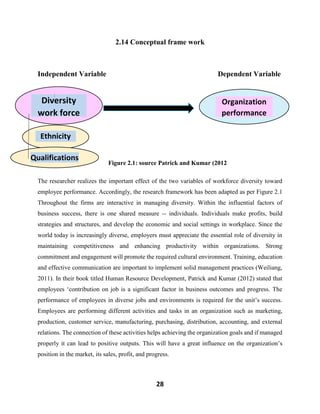
2.14 Conceptual frame work
Independent Variable Dependent Variable
Figure 2.1: source Patrick and Kumar (2012
The researcher realizes the important effect of the two variables of workforce diversity toward
employee performance. Accordingly, the research framework has been adapted as per Figure 2.1
Throughout the firms are interactive in managing diversity. Within the influential factors of
business success, there is one shared measure -- individuals. Individuals make profits, build
strategies and structures, and develop the economic and social settings in workplace. Since the
world today is increasingly diverse, employers must appreciate the essential role of diversity in
maintaining competitiveness and enhancing productivity within organizations. Strong
commitment and engagement will promote the required cultural environment. Training, education
and effective communication are important to implement solid management practices (Weiliang,
2011). In their book titled Human Resource Development, Patrick and Kumar (2012) stated that
employees ‘contribution on job is a significant factor in business outcomes and progress. The
performance of employees in diverse jobs and environments is required for the unit’s success.
Employees are performing different activities and tasks in an organization such as marketing,
production, customer service, manufacturing, purchasing, distribution, accounting, and external
relations. The connection of these activities helps achieving the organization goals and if managed
properly it can lead to positive outputs. This will have a great influence on the organization’s
position in the market, its sales, profit, and progress.
Diversity
work force
Organization
performance
Ethnicity
Qualifications
29
Chapter three: Research Methodology
3.1Introduction
The researcher used a quantitative & qualitative approach with the aim of obtaining an in depth
understanding of diversity and its impacts on organization performance. According to a
quantitative approach the research that involves measuring quantities such as numerical quantities.
The design enables the researcher to statistically analyze the data collected in order to provide
valid solutions to the problems being investigated. The researcher used in this research is primary
and secondary Data. Primary data are when the research is from preliminary that comes from
interviewed the questionnaires and then collected the raw data which can be found the situational
analysis of the topic research how the topic is deeply applicable the organizations.
3.2 A research design
This research used descriptive design to describe and to find deeply information about the
diversity work force and its impacts on organization performance of companies Hargiesa
Somaliland and how they manage work place diversity and the impacts of organization
performance to enhance their efficiency and effectiveness .
3.3 sample population
The population of this research are organizations in Hargeisa, there are many organizations but
the researcher selected two organizations or business SOMCABLE and SPI company to
compare how they manage work place diversity.
3.4 Sampling Method
Sample represents the number of respondents selected from target population. The researcher
selected judgmental sampling, the reason to make use of judgmental sampling is that to get the
relevant information from the concerned personalities in charge, the target population is 100
employees and sample size is 80 individuals of the target population researcher used Slovenes
formula to get the sample size from target population.
30
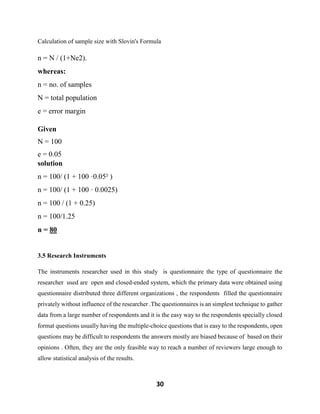
Calculation of sample size with Slovin's Formula
n = N / (1+Ne2).
whereas:
n = no. of samples
N = total population
e = error margin
Given
N = 100
e = 0.05
solution
n = 100/ (1 + 100 ·0.05² )
n = 100/ (1 + 100 · 0.0025)
n = 100 / (1 + 0.25)
n = 100/1.25
n = 80
3.5 Research Instruments
The instruments researcher used in this study is questionnaire the type of questionnaire the
researcher used are open and closed-ended system, which the primary data were obtained using
questionnaire distributed three different organizations , the respondents filled the questionnaire
privately without influence of the researcher .The questionnaires is an simplest technique to gather
data from a large number of respondents and it is the easy way to the respondents specially closed
format questions usually having the multiple-choice questions that is easy to the respondents, open
questions may be difficult to respondents the answers mostly are biased because of based on their
opinions . Often, they are the only feasible way to reach a number of reviewers large enough to
allow statistical analysis of the results.
31
3.6 ETHICAL CONSIDERATIONS
The conducting of research requires not only expertise and diligence, but also honesty and
integrity. This is done to recognize and protect the rights of human subjects. To render the study
ethical, the rights to self-determination, anonymity, confidentiality and informed consent were
observed. anonymity as when subjects cannot be linked, even by the researcher, with his or her
individual responses. In this study anonymity was ensured by not disclosing the respondent name
on the questionnaire and research reports and detaching the written consent from the questionnaire.
When subjects are promised confidentiality, it means that the information they provide will not be
publicly reported in a way which identifies them, in this study, confidentiality was maintained by
keeping the collected data confidential.
The ethical principle of self-determination was also maintained. Scientific honesty is regarded as
a very important ethical responsibility when conducting research. Dishonest conduct includes
manipulation of design and methods, and retention or manipulation of data. The researcher tried
to avoid any form of dishonesty by recording truthfully the answers of respondents.
3.7 Data analysis
After the data was collected it was organized and analyzed. For analysis of closed-ended questions,
a computer program called Statistical Package for Social Sciences (SPSS) was used. Data was
analyzed by using descriptive statistics. Frequency tables were drawn and from these the data was
presented in pie diagrams and bar graphs. The open-ended questions were analyzed through
quantitative content analysis by the researcher with the aim of quantifying emerging characteristics
and concepts. Concept analysis is the process of analyzing verbal or written communications in a
systematic way to measure variables quantitatively.
32
Chapter 4: Data Analysis and Presentation
4.1 Introduction
The fourth chapter presents the focal point of the research report. Previous chapters of the report
have laid the groundwork for the project. Those chapters provided an explanation of the purpose
behind the research, an outline of the research questions, this chapter explains information
gathered from the field through the use of questionnaires. These are analyzed to emphasize
response from respondents using various forms of tables and figures representations.
4.2 Data analysis and presentation
Section A: Demographic information
1. The gender of respondents
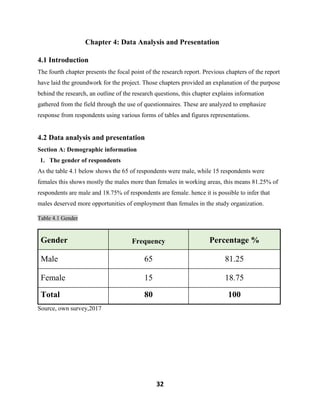
As the table 4.1 below shows the 65 of respondents were male, while 15 respondents were
females this shows mostly the males more than females in working areas, this means 81.25% of
respondents are male and 18.75% of respondents are female. hence it is possible to infer that
males deserved more opportunities of employment than females in the study organization.
Table 4.1 Gender
Gender Frequency Percentage %
Male 65 81.25
Female 15 18.75
Total 80 100
Source, own survey,2017
33
2.The age of respondents
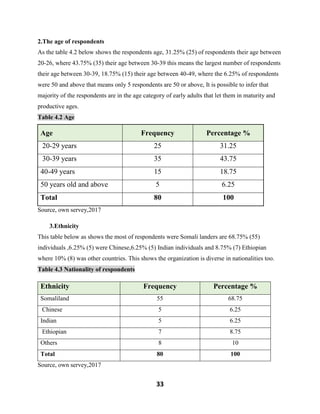
As the table 4.2 below shows the respondents age, 31.25% (25) of respondents their age between
20-26, where 43.75% (35) their age between 30-39 this means the largest number of respondents
their age between 30-39, 18.75% (15) their age between 40-49, where the 6.25% of respondents
were 50 and above that means only 5 respondents are 50 or above, It is possible to infer that
majority of the respondents are in the age category of early adults that let them in maturity and
productive ages.
Table 4.2 Age
Age Frequency Percentage %
20-29 years 25 31.25
30-39 years 35 43.75
40-49 years 15 18.75
50 years old and above 5 6.25
Total 80 100
Source, own servey,2017
3.Ethnicity
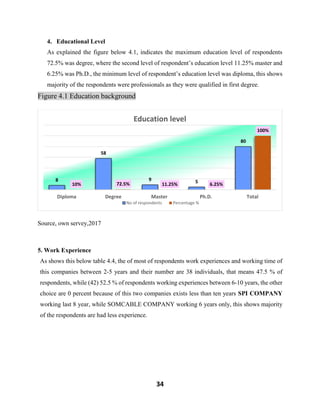
This table below as shows the most of respondents were Somali landers are 68.75% (55)
individuals ,6.25% (5) were Chinese,6.25% (5) Indian individuals and 8.75% (7) Ethiopian
where 10% (8) was other countries. This shows the organization is diverse in nationalities too.
Table 4.3 Nationality of respondents
Ethnicity Frequency Percentage %
Somaliland 55 68.75
Chinese 5 6.25
Indian 5 6.25
Ethiopian 7 8.75
Others 8 10
Total 80 100
Source, own servey,2017
34
4. Educational Level
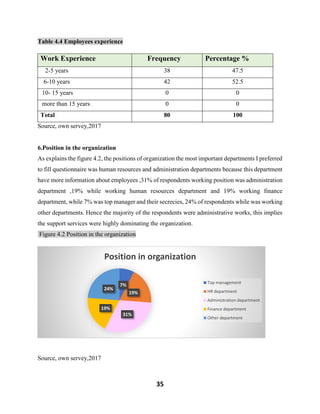
As explained the figure below 4.1, indicates the maximum education level of respondents
72.5% was degree, where the second level of respondent’s education level 11.25% master and
6.25% was Ph.D., the minimum level of respondent’s education level was diploma, this shows
majority of the respondents were professionals as they were qualified in first degree.
Figure 4.1 Education background
Source, own servey,2017
5. Work Experience
As shows this below table 4.4, the of most of respondents work experiences and working time of
this companies between 2-5 years and their number are 38 individuals, that means 47.5 % of
respondents, while (42) 52.5 % of respondents working experiences between 6-10 years, the other
choice are 0 percent because of this two companies exists less than ten years SPI COMPANY
working last 8 year, while SOMCABLE COMPANY working 6 years only, this shows majority
of the respondents are had less experience.
8
58
9 5
80
10% 72.5% 11.25% 6.25%
100%
Diploma Degree Master Ph.D. Total
Education level
No of respondents Percentage %
35
Table 4.4 Employees experience
Work Experience Frequency Percentage %
2-5 years 38 47.5
6-10 years 42 52.5
10- 15 years 0 0
more than 15 years 0 0
Total 80 100
Source, own servey,2017
6.Position in the organization
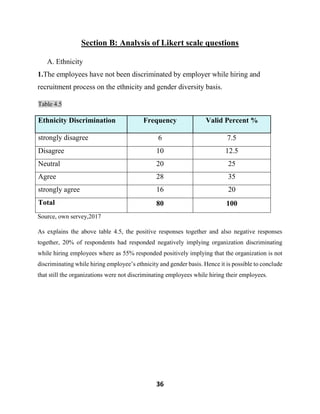
As explains the figure 4.2, the positions of organization the most important departments I preferred
to fill questionnaire was human resources and administration departments because this department
have more information about employees ,31% of respondents working position was administration
department ,19% while working human resources department and 19% working finance
department, while 7% was top manager and their secrecies, 24% of respondents while was working
other departments. Hence the majority of the respondents were administrative works, this implies
the support services were highly dominating the organization.
Figure 4.2 Position in the organization
Source, own servey,2017
7%
19%
31%
19%
24%
Position in organization
Top management
HR department
Administration department
Finance department
Other department
36
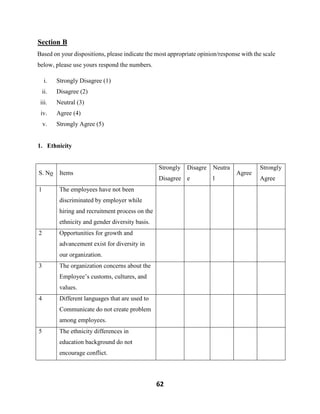
Section B: Analysis of Likert scale questions
A. Ethnicity
1.The employees have not been discriminated by employer while hiring and
recruitment process on the ethnicity and gender diversity basis.
Table 4.5
Ethnicity Discrimination Frequency Valid Percent %
strongly disagree 6 7.5
Disagree 10 12.5
Neutral 20 25
Agree 28 35
strongly agree 16 20
Total 80 100
Source, own servey,2017
As explains the above table 4.5, the positive responses together and also negative responses
together, 20% of respondents had responded negatively implying organization discriminating
while hiring employees where as 55% responded positively implying that the organization is not
discriminating while hiring employee’s ethnicity and gender basis. Hence it is possible to conclude
that still the organizations were not discriminating employees while hiring their employees.
37
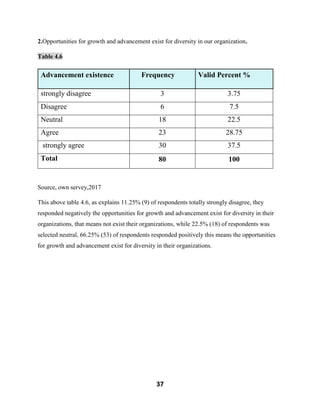
2.Opportunities for growth and advancement exist for diversity in our organization.
Table 4.6
Source, own servey,2017
This above table 4.6, as explains 11.25% (9) of respondents totally strongly disagree, they
responded negatively the opportunities for growth and advancement exist for diversity in their
organizations, that means not exist their organizations, while 22.5% (18) of respondents was
selected neutral, 66.25% (53) of respondents responded positively this means the opportunities
for growth and advancement exist for diversity in their organizations.
Advancement existence Frequency Valid Percent %
strongly disagree 3 3.75
Disagree 6 7.5
Neutral 18 22.5
Agree 23 28.75
strongly agree 30 37.5
Total 80 100
38
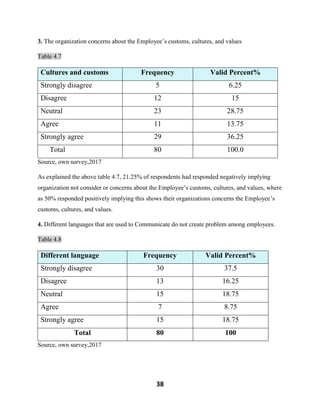
3. The organization concerns about the Employee’s customs, cultures, and values
Table 4.7
Cultures and customs Frequency Valid Percent%
Strongly disagree 5 6.25
Disagree 12 15
Neutral 23 28.75
Agree 11 13.75
Strongly agree 29 36.25
Total 80 100.0
Source, own survey,2017
As explained the above table 4.7, 21.25% of respondents had responded negatively implying
organization not consider or concerns about the Employee’s customs, cultures, and values, where
as 50% responded positively implying this shows their organizations concerns the Employee’s
customs, cultures, and values.
4. Different languages that are used to Communicate do not create problem among employees.
Table 4.8
Different language Frequency Valid Percent%
Strongly disagree 30 37.5
Disagree 13 16.25
Neutral 15 18.75
Agree 7 8.75
Strongly agree 15 18.75
Total 80 100
Source, own survey,2017
39
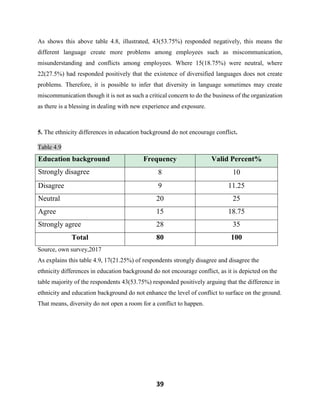
As shows this above table 4.8, illustrated, 43(53.75%) responded negatively, this means the
different language create more problems among employees such as miscommunication,
misunderstanding and conflicts among employees. Where 15(18.75%) were neutral, where
22(27.5%) had responded positively that the existence of diversified languages does not create
problems. Therefore, it is possible to infer that diversity in language sometimes may create
miscommunication though it is not as such a critical concern to do the business of the organization
as there is a blessing in dealing with new experience and exposure.
5. The ethnicity differences in education background do not encourage conflict.
Table 4.9
Education background Frequency Valid Percent%
Strongly disagree 8 10
Disagree 9 11.25
Neutral 20 25
Agree 15 18.75
Strongly agree 28 35
Total 80 100
Source, own survey,2017
As explains this table 4.9, 17(21.25%) of respondents strongly disagree and disagree the
ethnicity differences in education background do not encourage conflict, as it is depicted on the
table majority of the respondents 43(53.75%) responded positively arguing that the difference in
ethnicity and education background do not enhance the level of conflict to surface on the ground.
That means, diversity do not open a room for a conflict to happen.
40
B. Educational Background
1. The recruitment system of the organization is based on the education background and
qualifications of the employees.
Table 4.10
Recruitment system Frequency Valid Percent%
Strongly disagree 3 3.75
Disagree 7 8.75
Neutral 18 22.5
Agree 23 28.75
Strongly Agree 29 36.25
Total 80 100
Source, own survey,2017
As explains this table 4.10, 10(12.5%) of responded negatively the recruitment system of their
organizations is based on the education background and qualifications of the employees and while
18(22.5%) of respondents selected neutral, where 52(65%) of respondents responded positively
that shows their organizations recruitment system based on the education background and
qualification of employees when they are hiring new employees.
41
2.The advancement for employee's communication skills exist our organization
Table 4.11
communication skills Frequency Valid Percent %
Strongly disagree 4 5
Disagree 4 5
Neutral 27 33.75
Agree 17 21.25
Strongly agree 28 35
Total 80 100
Source, own survey,2017
As shows the above table 4.11, 10% strongly disagree and disagree their organizations not exist
advancement for employee's communication skills, 56.25% of respondents responded positively
that shows their organizations exist the advancement for employee's communication skills.
3. At work, learning more skills through courses/training, can improve employees task
performance.
Table 4.12
Training Frequency Valid Percent%
Strongly disagree 2 2.5
Disagree 7 8.75
Neutral 11 13.75
Agree 20 25
Strongly agree 40 50
Total 80 100
Source, own survey,2017
42
As explains the above table 4.12, 2.5 % (2) strongly disagree and 8.75 % (7) disagree the learning
more skills cannot improve their task performance ,13.75 % (11) said neutral, 60 (75%)
respondents responded positively arguing learning more skills through courses/ training can
improve employees task performance that, when the employees have more skills their performance
or output always is effectively and efficiency.
4. The organization gives equal treatment when it comes to the ethnicity and gender diversity for
employee’s.
Table 4.13
Equal treatment existence Frequency Percent Valid Percent %
Strongly disagree 3 5.7 6.2
Disagree 3 5.7 6.2
Neutral 15 28.3 31.2
Agree 17 32.1 35.4
Strongly agree 10 18.9 20.8
Total 48 90.6 100.0
Source, own survey,2017
As show the table 4.13 illustrated, 6(12.4%) of respondents responded negatively totally disagree
Their organizations do not give equal treatment when it comes to the ethnicity and gender
diversity for employee’s, where 15(31.2) of respondents said the treatment is neutral that means
some times their organization do not treat equally ,27(56.2%) responded positively that shows
majority of respondents agree their organizations gives equal treatment to the ethnicity and
gender diversity for employee’s.
43
5.Opportunities for growth and advancement exist for employees who have lower qualification.
Table 4.14
Lower qualification Frequency Percent Valid Percent %
Strongly disagree 3 5.7 6.2
Disagree 2 3.8 4.2
Neutral 14 26.4 29.2
Agree 13 24.5 27.1
Strongly agree 16 30.2 33.3
Total 48 90.6 100.0
Source, own survey,2017
As explains the above table 4.14, 3(6.2%) of respondents strongly disagree and 2(4.2%) of
respondents disagree that means the opportunities for growth and advancement not exist for
employees who have lower qualifications in education their organizations, while 14(29.2%) of
respondents was selected neutral, 13(27.1%) of respondents selected agree and 16(33.3%) of
respondents selected strongly agree this means their organizations exist the opportunities for
growth and advancement for lower qualification employees to build their education and skills to
increase their performances .
44
6.The organization provides paid study leave to employees who further their education.
Table 4.15
Study leave Frequency Percent Valid Percent %
Strongly disagree 4 7.5 8.3
Disagree 5 9.4 10.4
Neutral 11 20.8 22.9
Agree 13 24.5 27.1
strongly agree 15 28.3 31.2
Total 48 90.6 100
Source, own servey,2017
The table 4.15, As explains 8.3% of respondents strongly disagree and 10.4% disagree that
means their organization do not provide paid study leave,22.9% selected neutral, where 27.1%
agree and 31.2% strongly agree their organizations provide paid study leave to employees who
further their education.
C: performance
1. companies that manage diversity more effectively tend to outperform others performances.
Table 4.16
Managing diversity Frequency Percent Valid Percent%
Strongly disagree 4 7.5 8.3
Disagree 4 7.5 8.3
Neutral 12 22.6 25
Agree 10 18.9 20.8
Strongly agree 18 34 37.5
Total 48 90.6 100
Source, own servey,2017
45
As shows the above table 4.16, 8.3% of respondents strongly disagree and 8.3 of respondents
disagree that means the companies that manage diversity are not more effectively tend to
outperform others performances, while 25% of respondents was selected neutral, 20% agree and
137.5% strongly agree the companies that manage diversity are more effectively tend to
outperform others performances.
2. Managing diversity effectively has the potential to increase company performance.
Table 4.17
Company performance. Frequency Percent Valid Percent%
Strongly disagree 1 1.9 2.1
Disagree 5 9.4 10.4
Neutral 14 26.4 29.2
Agree 16 30.2 33.3
Strongly agree 12 22.6 25
Total 48 90.6 100
Source, own servey,2017
As shows this above table 4.17, 2.1 % strongly disagree and 10.4 % disagree the managing
diversity effectively has the potential to increase company performance ,29.2 said neutral, while
33.3% of respondents agree and 25% strongly the managing diversity effectively has the
potential to increase company performance this means managing diversity employees effectively
the organization performance increasing also the organization reaching efficiency and
effectiveness
46
3.Teams with higher relationship of diversity are able to enhance performance.
Table 4.18
Higher relationship Frequency Percent Valid Percent %
Strongly disagree 3 5.7 6.2
Disagree 7 13.2 14.6
Neutral 10 18.9 20.8
Agree 11 20.8 22.9
Strongly agree 17 32.1 35.4
Total 48 90.6 100
Source, own servey,2017
As explains the above table 4.18, illustrates, majority of the respondents, 28(52.9%) responded
that diversified work forces are able to enhance organizational performances, where as 10(18.9%)
responded negatively. Therefore, it is possible to infer that diversity is a room to have better
performance idea and had a means to enhance organizational performances.
4.Diversity training enhances the commitment of employees
Table 4.19
Commitment of employees Frequency Percent % Valid Percent %
Strongly disagree 5 9.4 10.4
Disagree 2 3.8 4.2
Neutral 8 15.1 16.6
Agree 19 35.8 39.6
Strongly agree 14 26.4 29.2
Total 48 90.6 100.0
Source, own servey,2017
47
As it is depicted on the above table 4.19, majority of the respondents, 33(62.2%) responded
positively arguing that training of diversified work force enhances the commitment of employees.
Where 7(13.6%) responded negatively. Hence it is possible to infer that diversity is opens a room
to have a committed employee. That means, when diversified work force get a training opportunity
the possibility of having a committed employee is high.
5.Organizations managing diversity effectively achieve higher creativity
Table 4.20
Effectively achieve Frequency Percent Valid Percent %
Strongly disagree 1 1.9 2.1
Disagree 4 7.5 8.3
Neutral 12 22.6 25.0
Agree 13 24.5 27.1
Strongly agree 18 34.0 37.5
Total 48 90.6 100.0
Source, own servey,2017
As shows this above table 4.20, 2.1 % strongly disagree and 8.3 % disagree the organizations
managing diversity effectively achieve higher creativity, 25% said neutral, while 27.1% of
respondents agree and 37.5% strongly the organizations managing diversity effectively achieve
higher, hence it is possible to infer that diversified work force enhances creativity of employees
as there are more experiences and new ideas in the diversified work force.
48
6.managing diversity effectively result in lower litigation expenses.
Table 4.21
lower litigation expenses Frequency Percent Valid Percent%
Strongly disagree 4 7.5 8.3
Disagree 7 13.2 14.5
Neutral 10 18.9 20.8
Agree 16 30.2 33.3
Strongly agree 11 20.8 22.9
Total 48 90.6 100.0
Source, own servey,2017
As explains the above table 4.21, 8.3 % strongly disagree and 14.5 % disagree the managing
diversity effectively result in lower litigation expenses, 20.8% said neutral, while 33.3% of
respondents agree and 22.9% strongly the organizations managing diversity effectively result in
lower litigation expenses this means managing diversity workforce can participate decreasing the
expenses of organization, Hence it is possible to conclude that managing diversity is a means to
face lower litigation expenses as there is less grievances to surface on the ground.
49
Section C: Analysis of open-ended questions
What do you think the impact of heterogeneity on the performance of an organization?
As per the interview held with sample respondents pertaining to the impact of heterogeneity on
the performances the interviewees justify that heterogeneity have more impacts in organizations
performance, the diversity has both positive and negative impacts in organization performances.
the positive side includes better decision making and improved problem solving, greater creativity
and innovation, which leads to enhanced product development, and more successful marketing to
different types of customers. Diversity provides organizations with the ability to compete in global
markets. Simply recognizing diversity in a corporation helps link the variety of talents within the
organization. the negative side impacts of diversity in organization is the employees comes from
with different ethnicity, and they have different cultures and believes that may Cause
misunderstanding and miscommunication among employees if one employees not understanding
other one its communication barrier the work becomes incomplete or not performed well, also if
the managers not treating equally the employees starting resistances and other problems that may
lead the organization to become failure. But most of them argued that the positive side diversified
work to enhance performances. Even one of the interviewee replied in the following fashion.
“Diversified work force had a pool of experiences, and innovative idea. As they had different
backgrounds. Also, managing diversity is more than simply acknowledging differences in people.
It involves recognizing the value of differences, combating discrimination, and promoting
inclusiveness. Managers may also be challenged with losses in personnel and work productivity.
Managing diversity is a means to have more innovative ideas, experiences. That is Why
organizations’ performances is accelerated more than non-diversified team”.
Hence from the above responses, it is possible to infer that managing diversity is a means to excel
in organizations performances. The diversified work team is a source of new ideas, creativity, high
caliber. Hence, it is simply to infer that diversified work force is a means to undergo less operation
cycle or time, that in turn minimizes overall costs. This finding is consistent with a research
conducted by Chartered Institute of Personnel and Development (2005) found that organizations
that do not manage well and follow the right practices concerning diversity will incur more cost
and experience poor performance. Business leaders, academics and consultants have approved the
50
‘valuing diversity’ approach to diversity management and point out that those organizations that
manage well a diverse workforce stand to gain competitive advantage (Cox & Blake, 1991).
What do you see as the most challenging aspect of a diverse workforce?
In line with challenges of managing diversity the interviewee responded that there might be
biasness ethnicity, gender, and other parameters. sometimes there are language barriers to undergo
smooth communications among employees, one of the respondent argue in the following fashion.
“Sometimes the existence of language barrier, discriminatory in races, ethnicity, and other
biasedness could come in to being while managing diversity. Despite these, still managing
diversity is a means to attain competitive advantages, as it is a means to have new ideas, creativity,
commitment and other cost reductions activities such as lower litigation costs etc.”.
From the above responses, it is possible to infer that whatever minor challenges managing diversity
encounters, still it opens a room of deserving competitive advantages as it is a means to deal with
personalities with innovative ideas. This finding is consistent with Creativity and Problem-Solving
has been found as competitive advantage from managing a diverse workforce. Creativity,
innovation and problem solving capabilities are enhanced as critical analysis of issues comes from
heterogeneous group (Allen et al., 2008; Gilbert et al., 1999). Greater organizational flexibility is
also an advantage from diversity management (DM). The system flexibility argues that companies
that manage diversity are able to adjust and react to today’s changing environment faster and at
less cost. This is due to two factors – increasing cognitive flexibility and a higher organizational
flexibility such as openness to new ideas, processes and ability to handle change.
51
How does the organization undergo the positive work environment?
In line with possible means to undergo positive work environment majorities of interviewees had
responded that though it is difficult to outline the way well managed diversity is maintained but
some of them are described in the following fashion.
“When creating an effective and successful diverse workforce, Managers in the first instance are expected
to focus on personal awareness. Both employers and employees need to outline their personal prejudices
organizations need to constantly develop, implement, and maintain ongoing training and awareness raising,
well establishing the working system, promoting positive attitude, enhancing positive working culture,
adjustment of the majorities to changing elements and respecting the rights of minorities, designing the
organizations in such a way that it enhances cooperation of its members etc”
Therefore, from the above responses it is possible to infer that no single formula exists to maintain
positive work environment but few points that could help organizations to undergo positive work
environment includes, raising the level of awareness of employees, educating, establishing good
organizational culture etc. This finding is consistent with Workplace diversity generally impacts
organizational-level outcomes indirectly through effects that begin at the individual level (Rynes
& Rosen, 1995). Unfortunately, there is no single formula the company could apply to be
successful, therefore, it depends on the ability for the manager to figure out what best suits the
company based on teamwork and the dynamics of the workplace. Roosevelt (2001) explains that
diversity management involves a complete process needed for creating a working environment
that involves everyone.
52
4.3 Discussions
The study depicts the impact of managing diversity on the organizational performances.
Accordingly, as per the findings of the study ethnicity and education background do not enhance
the level of conflict to surface on the ground. That means, diversity do not open a room for a
conflict to happen. The finding of this study is consistent with Tsui and Gutek (1999) summarized
consistent findings that show higher demographic similarity between supervisors and subordinates
on age, race or gender correlates with HR outcomes such as higher ratings on performance,
organizational citizenship, and lower role ambiguity and conflict. As per the study majority of the
respondents, 28(58.3%) responded that diversified work forces are able to enhance organizational
performances, where as 10(20.8%) responded negatively. Therefore, it is possible to infer that
diversity is a room to have better performance idea and had a means to enhance organizational
performances. Hence the findings of this study are consistent with Cox and Blake (1991) argued
that heterogeneous organizations that valued diversity would have higher-quality group decision
making, greater creativity and innovation, more organizational flexibility due to the possession of
divergent thinking, greater ability to attract and retain the best talent, and greater marketing
capability. These objectives can be realized via organizational change strategies and interventions.
Interventions such as altered selection processes (individual focus), conflict management (group
focus) and top management commitment (organizational focus) might all contribute to the effect
that diversity has on firm effectiveness. Interventions target not only formal bottom-line outcomes,
such as turnover and productivity, but also intermediate and informal process-oriented outcomes,
such as the cultural experiences and quality of member interactions, teamwork and cooperation,
and individual commitment and identification with organizational goals.
The study found that 24(50%) responded negatively arguing existence of divergent languages
creates sever problem, this means the different language create more problems among employees
such as miscommunication, misunderstanding and conflicts among employees. Whereas 8(16.7%)
were neutral where as 16(33.4%) had responded positively that the existence of diversified
languages does not create problems. Therefore, it is possible to infer that diversity in language
sometimes may create miscommunication though it is not as such a critical concern to do the
business of the organization as there is a blessing in dealing with new experience and exposure.
The fact that there are numerous advantages to diversity management does not mean there are no
53
disadvantages. Lack of proper management of diverse workforce can lead to increased
absenteeism, creates tension and misunderstanding between employees, communication
difficulties and this can lead to low productivity and higher turnover (Washington, 1993; Mor
Barak, 2011). Research shows that human beings desire or prefer to work in homogeneous group
than heterogeneous group and this makes the implementation of diversity management difficult
(Kreitz, 2008). It is therefore important to find which of the diversity management practices
encourages people to work together in harmony to foster employees’ retention as well as
minimizing turnover. As per majority of the respondents, 33(68.7%) responded positively arguing
that training of diversified work force enhances the commitment of employees. Whereas 7(14.5%)
responded negatively. Hence it is possible to infer that diversity is opens a room to have a
committed employee. That means, when diversified work force get a training opportunity the
possibility of having a committed employee is high.
This finding is consistent with the argument that illustrates diversity training is the most prevalent
individual-level intervention (SHRM Diversity Surveys, 1998, 2000, 2002). Ford and Fisher’s
(1996) review states that training programs aim to change employees’ attitudes (affective and
cognitive) and behaviors to ‘value diversity’ and reduce subtle forms of discrimination and
exclusion that hinder effective working relationships. They note three main types of training
objectives. Programs fostering assimilation provide education about the norms and goals of the
dominant culture and might target minorities. Programs focused on accommodation emphasize
adjustment of the majority to the changing workforce. Programs emphasizing multiculturalism
(where members of two or more cultures are allowed to retain key aspects of their cultures) involve
a bilateral process jointly focused on majority and minorities. When creating an effective and
successful diverse workforce, Managers in the first instance must focus on personal awareness.
Both employers and employees need to outline their personal prejudices. A one day session of
training is not enough to change people’s mind and behaviors; therefore, organizations need to
constantly develop, implement, and maintain ongoing training and awareness creation. Diversity
management entails much more than providing same opportunity for employment.
54
In other words, diversity makes good business sense.” Diversity management can provide
businesses with a competitive advantage. Here the logic is that by managing diversity, companies
have much to gain (Cox, 2001; Kochan et al., 2003), including (a) cost reductions due to lower
absenteeism and turnover, (b) advantages in the competition for talent in the workforce (Thomas,
et al., 2002),8 (c) reduced risk of discrimination lawsuits due to a more just and non-discriminating
environment, (d) more effective marketing to diverse customer pools (Kossek, Lobel, & Brown,
2006; Pradhan, 1989), (e) increased creativity and innovation through diverse work teams (Weiss,
1992; Kossek, Lobel,& Brown, 2006), (f) government contracts for which minority- or gender
balanced businesses are given preference, and (g) improved corporate image, which generates
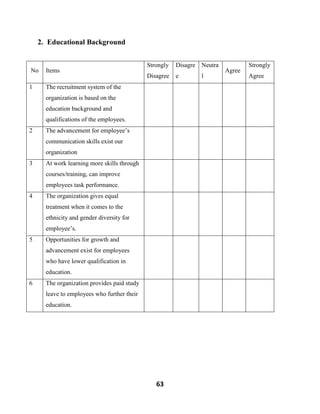
public goodwill.
Generally speaking, it is possible to infer that diversified work force enhances creativity of
employees as there are more experiences and new ideas in the diversified work force. Creativity
and Problem-Solving has been found as competitive advantage from managing a diverse
workforce. Creativity, innovation and problem solving capabilities are enhanced as critical
analysis of issues comes from heterogeneous group (Allen et al., 2008; Gilbert et al., 1999). Greater
organizational flexibility is also an advantage from DM. The system flexibility argues that
companies that manage diversity are able to adjust and react to today’s changing environment
faster and at less cost. This is due to two factors – increasing cognitive flexibility and a higher
organizational flexibility such as openness to new ideas, processes and ability to handle change.
Hence it is possible to conclude that managing diversity is a means to face lower litigation expenses
as there is less grievances to surface on the ground. A research conducted by Chartered Institute
of Personnel and Development (2005) found that organizations that do not manage well and follow
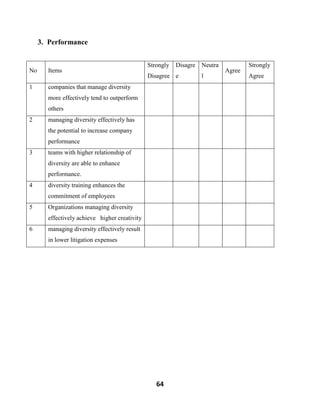
the right practices concerning diversity will incur more cost and experience poor performance.
Business leaders, academics and consultants have approved the ‘valuing diversity’ approach to
diversity management and point out that those organizations that manage well a diverse workforce
stand to gain competitive advantage (Cox & Blake, 1991). Diversity management has helped many
organizations avoid racial discrimination cost, for example, avoiding payment of financial penalty
that may damage the organization’s image, winning government contracts and attracting customers
from corporate clients who also understand diversity (Mor Barak, 2011; Wrench,2002)
55
Chapter five: Conclusion and Recommendation
5.1 Introduction
This chapter is about the ending of the study-linking summary of the main points already made in
the research and presenting them in order way. It starts on with the conclusion, which then will go
after the recommendations, which provides advice on importance of diversity management at work
place. Also, this chapter includes the conclusions, and recommendations of the study.
5.2 Conclusion
After the researcher made this research this investigation found out that, the diversity impacts of
organization performance, the diversity work for have important role in organization market and
products of organizations also diversity in the workplace is important as the globalizing economy
ensures that individuals with different appearances, values, beliefs, heritages, skills, education, and
knowledge will no doubt form work groups to achieve common goals. This study endeavored to
understand the ways in which diversity is related to performance through conflict at the group
level. The objective of this thesis was to investigate influences or impacts of diversity in working
environment whilst considering some practical companies. The main objective of the research is
to examine the different ways of dealing with work place diversity as well as to provide
management with the necessary guidelines for effective diversity management in small and big
International companies in order to show the reader how to build an effective workplace diversity
by applying different diversity management tools. Also, to identify the trends and perception of
diversity management as it is in some demographical segments, the advantages and disadvantages
the research emphasized on the implications management should be mindful of in order to build a
healthy working environment within the circles of workplace diversity. More so, the research
suggested that managers have a more positive and proper perception regarding the implementation
of workplace diversity.
56
5.3 Recommendations
The workforce diversity is becoming one of most popular ways to evaluate employee performance
in an organization in recent year. Therefore, conducting training and raising the awareness level
of employees would make organization to enhance its performances. Managing diversity involves
leveraging and using the cultural differences in people's skills, ideas and creativity to contribute to
a common goal, and doing it in a way that gives the organization a competitive edge. Therefore, it
is advisable to the organization to encourage more of diversified work force if need arise to
enhance organizational performance. Competition-oriented cultures place greater emphasis on
individual accomplishment as opposed to collective accomplishment, and may cause group
members to seek differences amongst themselves. Therefore, it is advisable to organization to
encourage positive working environment if need arise to make use of the experience of diverse
work force. The researcher suggests the organization the following
-The managers it’s to increase the communication between employees and managers.
-The managers it’s to build strongly relationship among diversity employees.
-It is important for organization to have clear cut policies and procedures managing diversity work
force.
-It is essential to be aware of the importance of diversity workforce, because diversity employees
have more impacts on organization success or achievements.
-It is very important to familiarize company employees, through trainings and building capacity.
-Encourage job protection
-Improving the employee’s knowledge and skills.
-Show all employees are equal no discrimination among them.
-Improving the employee’s communication skills
57
5.4 Reverences
- Harvey, Carol P. (2012). Understanding and Managing Diversity. New Jersey: Pearson, Inc.
pp. 51–55.
- Education Jr., Taylor (1991). "The Multicultural Organization". Academy of Management
Executive, 5(2), 34-47.
- Harvey, Carol P. (2012). Understanding and Managing Diversity. New Jersey: Pearson
Education, Inc. pp. 41–47.
- Eisenberg, Eric M.; H.L. Goodall, Jr.; Angela Trethewey (2010). Organizational
Communication (6th ed.). St. Martin's: Bedford. pp. 250–58.
- "Center for Leadership Studies, Inc.".
- Walck, C.L. (1995). Editor's introduction: "Diverse approaches to managing
diversity". Journal of Applied Behavioral Science, 31, 119-23).
- Search engines: Google, Wikipedia Investopedia and www.diversity.com and etc
- Gilbert, J. A., Stead, B. A., & Ivancevich, J. M. (1999). “Diversity management: A new
- organizational paradigm”, Journal of Business Ethics, Vol 21(1): 61–77.
- Konrad, A.M., Prasad, P. & Pringle, J.K., (2006). Handbook of workplace diversity.
- Wrench, J. (2002). Diversity management, discrimination and ethnic minorities in Europe:
- Flagg, A. 2002. “Managing diverse workgroups successfully.” United Behavioral Health.
- Koonce, R. 2001. “Redefining diversity: It’s not just the right thing to do; it also makes good business
sense.” Training and Development (December).
- Loysk, B. 1996. Managing a changing workforce: Achieving outstanding service with today’s
employees. Davie, FL: Workplace Trends Publishing.
- Robinson, K-S. 2002. “U.S. must focus on diversity or face decline in competitiveness.” The Society
for Human Resource Management (SHRM).
- Roosevelt, T.R. Jr. 2001. “Elements of a successful diversity process.” The American Institute for
Managing Diversity.
- Society for Human Resource Management (SHRM). 1998. “SHRM survey explores the best in
diversity practices. Fortune 500 firms outpace the competition with greater commitment to diversity.”
The Society for Human Resource Management (SHRM Retrieved (accessed 13/6/2017)
- Kelli G., Mayra L., Allen W., Karl K., Derek F., and Jennifer L. (2015), Diversity in the Workplace:
Benefits, Challenges, and the Required Managerial Tools http://edis.ifas.ufl.edu
58
- Aronson, D. (2002). Managing the diversity revolution: Best practices for 21st century
business. Civil Rights Journal,
- Bassett-Jones, N. (2005). The paradox of diversity management, creativity and
- innovation. Creativity and Innovation Management, 14, 169-175. Cox, T., Jr. (2001).
- Dass. P., & Parker, B. (1999). Strategies for managing human resource diversity: From
resistance to learning. Academy of Management Executive,
- Digh, P. (1998a). Coming to terms with diversity. HR Magazine, 43(12), 117, 3 pp.
http://www.shrm.org/hrmagazine/articles/1198digh.asp
- Beldona, S., & Namasivayam, K. Gender and demand-based pricing: Differences in perceived (un)
fairness and patronage intentions. Journal of Hospitality & Leisure Marketing, 14(4), 89-107 (2006).
- Pitts, D. (2009). Diversity management, job satisfaction, and performance: Evidence from US federal
agencies. Public Administration Review, 69(2), 328-338.
- Opstal, E., & van der Bokstraat, C. The relationship between the management of ethnic cultural
diversity and organizational performance (2008).
- Johnson, K., Hays, C., Center, H., & Daley, C. Building capacity and sustainable prevention
innovations: A sustainability planning model. Evaluation and Program
- Smith, D. The business case for diversity. Monash Mt Eliza Business Review, 1, 72-
81(1998).
- Patrick, H. A., & Kumar, V. R. Managing Workplace Diversity (2012).
- Richard, O. C., Kochan, T. A., & McMillan-Capehart, A. The impact of visible diversity on
organizational effectiveness Disclosing the contents in Pandora's black box. Journal of
Business and Management, 8(3), 265 (2002).
- Yaping, G., Kenneth, L., Song, C., & Katherine, X. (2012). Human resources management
and firm performance: The differential role of managerial affective and continuance
commitment. Journal of Applied Psychology, 94(1),
- Yavas, U., Luqmani, M., & Quraeshi, Z. (2011). Organizational commitment, job
- satisfaction, work values: Leadership & Organization Development Journal, 11(7), 3-10.
- .
59
- Youndt, M. (2013). Human Resource configurations and value creation: The mediating role
of intellectual capital. Paper presented at the 2011 Academy of Management Conference,
Toronto, Ontario, Canada.
- Younies, H., Barhem, B., & Younis, M. (2010). Ranking of priorities in employees' reward
and recognition schemes 23(4), 357-371.
- Yu, B., & Egri, C. (2012). Human resource management practices and affective
organizational commitment: A comparison of Chinese employees in a state-owned enterprise
and a joint venture. Asia Pacific Journal of Human Resources, 43(3), 332-360.
- Zacharatos, A., Barling, J., & Kelloway, K. (2012). Development and effects of
transformational leadership in adolescents. The Leadership Quarterly, 11(2), 211-226.
- Zeffane, R. (2012). Patterns of organizational commitment and perceived management style:
A comparison of public and private sector employees. Human Relations, 47(8), 977-1010.
- Zeffane, R., & Al Zarooni, H. (2012). The influence of empowerment, commitment, job
satisfaction and trust on perceived managers' performance. International journal of Business
Excellence 1(2), 193 – 209
- Zhang, X., & Zhang, K. (2010). How does globalization affect regional inequality within a
developing? Evidence from China. Journal of Development Studies, 39(4), 47-67.
60
Appendix
Admas University
School OF Post Graduate Department of HRM
Questionnaire form
Company Name: __________________________________ Date: _________________
This Questionnaire is concerning the study of “Diversity and its Impact on Organizational
Performance: Case of SBI and Some Cable company”. It is prepared as a partial fulfillment of MA
in Human Resource Management. Accordingly, the researcher kindly requests your honest
response to the questions which are going to be used only for the research purpose and your identity
will be kept confidential.
61
Section A: Demographic information
1. Gender
a) Male
b) Female
2. Age
a) 20-29 years’ old
b) 30-39 years’ old
c) 40-49 years’ old
d) 50 years old and above
3. Ethnicity
a) Somaliland
b) Chinese
c) Indian
d) Ethiopian
e) Others
4. Educational Level
a) Diploma
b) Degree
c) Master
d) PhD
5. Work Experience
a) 2-5 years
b) 6-10 years
c) 10- 15 years
d) more than 15 years
6. Position in the organization
a) Top management
b) HR department
c) Administration department
d) Finance department
e) Other department
62
Section B
Based on your dispositions, please indicate the most appropriate opinion/response with the scale
below, please use yours respond the numbers.
i. Strongly Disagree (1)
ii. Disagree (2)
iii. Neutral (3)
iv. Agree (4)
v. Strongly Agree (5)
1. Ethnicity
S. No Items
Strongly
Disagree
Disagre
e
Neutra
l
Agree
Strongly
Agree
1 The employees have not been
discriminated by employer while
hiring and recruitment process on the
ethnicity and gender diversity basis.
2 Opportunities for growth and
advancement exist for diversity in
our organization.
3 The organization concerns about the
Employee’s customs, cultures, and
values.
4 Different languages that are used to
Communicate do not create problem
among employees.
5 The ethnicity differences in
education background do not
encourage conflict.
63
2. Educational Background
No Items
Strongly
Disagree
Disagre
e
Neutra
l
Agree
Strongly
Agree
1 The recruitment system of the
organization is based on the
education background and
qualifications of the employees.
2 The advancement for employee’s
communication skills exist our
organization
3 At work learning more skills through
courses/training, can improve
employees task performance.
4 The organization gives equal
treatment when it comes to the
ethnicity and gender diversity for
employee’s.
5 Opportunities for growth and
advancement exist for employees
who have lower qualification in
education.
6 The organization provides paid study
leave to employees who further their
education.
64
3. Performance
No Items
Strongly
Disagree
Disagre
e
Neutra
l
Agree
Strongly
Agree
1 companies that manage diversity
more effectively tend to outperform
others
2 managing diversity effectively has
the potential to increase company
performance
3 teams with higher relationship of
diversity are able to enhance
performance.
4 diversity training enhances the
commitment of employees
5 Organizations managing diversity
effectively achieve higher creativity
6 managing diversity effectively result
in lower litigation expenses
65
Section B: open-ended questions
1. What do you think is the impact of heterogeneity on the performance of an organization?
......................................................................................................................................................
....................................................................................................................................................
......................................................................................................................................................
......................................................................................................................................................
......................................................................................................................................................
2. What do you see as the most challenging aspect of a diverse workforce?
......................................................................................................................................................
......................................................................................................................................................
......................................................................................................................................................
......................................................................................................................................................
......................................................................................................................................................
3. How does the organization undergo the positive work environment?
............................................................................................................................................................
............................................................................................................................................................
............................................................................................................................................................
............................................................................................................................................................
............................................................................................................................................................
------Thank you--------

Diversity work force and its impacts on organizational performance + master thesis

  • 1.
    Admas university Diversity workforce and its Impact on Organizational Performance Hargeisa Somaliland {Case study: Somcable and SBI company} A Thesis Presented to School OF Post Graduate Department of Human Resource Management In partial of fulfillment of the requirements for the award of MBA in human resources management (Faculty of business administration) Under the Guidance of Dr. Zarihun Birbirsa by: Ubah Esse
  • 2.
    1 Chapter one: Introduction 1.1Background of the study The world’s increasing globalization requires more interaction among people from diverse backgrounds. People no longer live and work in an insular environment; they are now part of a worldwide economy competing within a global framework. For this reason, profit and non-profit organizations need to become more diversified to remain competitive. Maximizing and capitalizing on workplace diversity is an important issue for management. Supervisors and managers need to recognize the ways in which the workplace is changing and evolving. Managing diversity is a significant organizational challenge, so managerial skills must adapt to accommodate a multicultural work environment (Kelly, et al.,2002) Diversity management is one of the core concepts that emerged within the managerial area. Nowadays most of the national, international and multinational companies recruiting work force around the world, because of this reason diversity has become integral part of the organizations. Diversity management is defined in many ways according to its usage and purpose. Diversity management is a process of managing multi-cultural people at the work place. Diversity can generally be defined as recognizing, understanding and accepting individual differences irrespective of their race, gender, age, class, ethnicity, physical ability, race. spiritual practice and so on. also, supports this view by adding that each individual is unique but also share any number of environmental or biological characteristics. Diversity can be classified into two dimensions. The primary dimension such as age, gender, and so on, exhibits the main differences between various individuals. These primary differences also have the most impact on initial encounters and can be easily noticed and serve as filters through which people view the world. The secondary dimensions such as religion, education, geographical location, income etc., are those qualities that are not noticeable in the first encounter and can even change throughout different encounters. These qualities are only noticed after some interactions occur between individuals. (Wikipedia, 2011)
  • 3.
    2 Globalization in thisrecent time has triggered more interaction amongst people from different cultures and backgrounds than before. People are now more open-minded in the marketplace worldwide with competition coming from almost everywhere in the continent. Diversity can be a problem to an organization but could also be solution, it also comes with its disadvantages but also benefits and dangerous but also constructive. The challenge then is to extract the very essence of diversity and tactically manage it for the improvement of the people and the organization. Most organizations in their own perspective, adopt diversity at their workplace or organization to become more creative and open to change. Increasing and improving workplace diversity has become an important issue for management in the recent years due to the recognition of how the workplace is changing. Since managing diversity still remains a challenge in organizations, managers tend to learn managerial skills needed in a multicultural working environment and prepares themselves to teach others within their organizations to value cultural differences and treat all employees with dignity. For some business leaders and managers point of view, diversity is a big challenge to them although it knows no organizational boundary and has no limitations. The business case for diversity advocates that diversity can improve performance, specifically the bottom line of an organization. Companies need to embrace diversity and look for ways to become inclusive organizations because diversity has the potential to yield greater work productivity and competitive advantages (SHRM 1995). Stephen Butler, co-chair of the Business-Higher Education Forum, believes diversity is an invaluable competitive asset (Robinson 2002). Managing diversity is a key component of effective people management in the workplace (Black Enterprise 2001). Demographic changes (women in the workplace, organizational restructuring, and equal opportunity legislation) will require organizations to review their management practices and develop new and creative approaches to managing people. Positive changes will increase work performance and customer service. Diversity is beneficial to both associates and employers. Although associates are interdependent in the workplace, respecting individual differences can increase productivity. Diversity in the workplace can reduce lawsuits and increase marketing opportunities, recruitment, creativity, and business image (Esty et al. 1995). In an era when flexibility and creativity are keys to competitiveness, diversity is critical for an organization’s success.
  • 4.
    3 Also, the consequences(loss of time and money) should not be overlooked. Effective managers are aware that certain skills are necessary for creating a successful, diverse workforce. First, managers must understand discrimination and its consequences. Second, managers must recognize their own cultural biases and prejudices (Koonce 2001). Diversity is not about differences among groups, but rather about differences among individuals. Each individual is unique and does not represent or speak for a particular group. Finally, managers must be willing to change the organization if necessary (Koonce 2001). Organizations need to learn how to manage diversity in the workplace to be successful in the future (Flagg 2002). Unfortunately, there is no single recipe for success. It mainly depends on the manager’s ability to understand what is best for the organization based on teamwork and the dynamics of the workplace. According to Roosevelt (2001), managing diversity is a comprehensive process for creating a work environment that includes everyone. When creating a successful diverse workforce, an effective manager should focus on personal awareness. Both managers and associates need to be aware of their personal biases. Therefore, organizations need to develop, implement, and maintain ongoing training because a one-day session of training will not change people’s behaviors (Koonce 2001). Managers must also understand that fairness is not necessarily equality. There are always exceptions to the rule. Managing diversity is about more than equal employment opportunity and affirmative action (Losyk 1996). Managers should expect change to be slow, while at the same time encouraging change (Koonce 2001). Another vital requirement when dealing with diversity is promoting a safe place for associates to communicate (Koonce 2001). Social gatherings and business meetings, where every member must listen and have the chance to speak, are good ways to create dialogues. Managers should implement policies such as mentoring programs to provide associates access to information and opportunities. Also, associates should never be denied necessary, constructive, critical feedback for learning about mistakes and successes). The number of dual-income families and single working mothers has changed the dynamics of the workplace. (Flagg, A. 2002)
  • 5.
    4 Background of theorganizations Somcable Company Profile, always aims to give customers the greatest value for their money without compromising service quality using network infrastructure to provide a wide range of communication services for organizations and individuals in Somaliland. Somcable delivers complete solutions for Internet, Voice, Multimedia and Enterprise Solutions. Corporate Social Responsibility as responsible corporate citizens, we are and will be committed to community service and outreach accomplishments. It is an ISP provider that fulfills the connectivity requirements for Organizations and individuals in Somaliland. Somcable company builds largest fiber network provider that delivers complete solutions for high Speed Internet, Voice, Multimedia and Enterprise Solutions. This makes Somcable the most comprehensive provider for all of Somaliland communication requirements. Our technology and service-delivery strengths comes from our valued employees who have joined Somcable from all over the world to earn customer trust and loyalty with a continuing commitment to the deployment of innovative products and services, reliable, high-quality service and excellent customer care. Vision: Somcable vision is to rampantly lead Somaliland into the digital revolution & fiber optic experience of the 21st Century by connecting East Africa to the rest of the word. This will enable business opportunities and development of the region. Mission: We are committed to being a customer-oriented and innovative provider of unique communication services across Somaliland and elsewhere in East Africa. We aim to be the leading company in this market and aspire to provide affordable communication services that meet and exceed our customers' requirements. Somaliland beverage industry profile, this company is a branch of coca cola company located in Somaliland this invested Somaliland citizens, coca cola company as well as one of the world's most recognizable brands. Somaliland beverage industry produce four of soft drinks, Coca-Cola, apple, Fanta, and Sprite. The Somaliland beverage industry produce syrup concentrate, the finished product in cans and bottles from the concentrate in combination with filtered water and sweeteners. The bottlers then sell, distribute, and merchandise the resulting Somaliland beverage industry product to retail stores, vending machines, restaurants, and food service distributors.
  • 6.
    5 Mission: with ourmission, it declares our purpose as a company and serves as the standard against which we weigh our actions and decisions.to refresh the east Africa, to inspire moments of optimism and happiness and to create value and make a difference. Vision: Our vision is largest provider beverages industry in east Africa, aspect of our business by describing what we need to accomplish in order to continue achieving sustainable, quality growth. 1.2 Problem Statement A research conducted by Chartered Institute of Personnel and Development (2005) found that organizations that do not manage well and follow the right practices concerning diversity will incur more cost and experience poor performance. Business leaders, academics and consultants have approved the ‘valuing diversity’ approach to diversity management and point out that those organizations that manage well a diverse workforce stand to gain competitive advantage (Cox & Blake, 1991). As per Cox & Blake (1991) organizations that fail to integrate its workforce increase cost in a form of turnover rates, low job satisfaction leading to productivity loses and absenteeism which also cost the organization. Resource acquisition has been also found to be one of the advantages of DMPs. Firms that work hard in terms of diversity initiatives do not only gain positive image but also gain competitive advantage for getting best personnel though the labor pool shrinks and changes composition as skilled workers are being attracted by such firms Cox & Blake (ibid). Another area in which diversity management is seen as a competitive advantage is marketing. Multi-national organizations benefit from the insight and cultural sensitivity bring on board by diverse personnel and if well manage, will positively affect market activities both at the international and domestic levels (Allen et al., 2008) Mor Barak, 2011). Firms with higher cultural diversity is able to mirror maximize diverse product markets and will definitely have more complex inimitable social resources, and employees helping organizations to get better access to international markets (Konrad et al., 2006). Creativity and Problem-Solving has been found as competitive advantage from managing a diverse workforce. Creativity, innovation and problem solving capabilities are enhanced as critical analysis of issues comes from heterogeneous group (Allen et al., 2008; Gilbert et al., 1999). Greater organizational flexibility is also an advantage from DM. The system flexibility argues that
  • 7.
    6 companies that managediversity are able to adjust and react to today’s changing environment faster and at less cost. This is due to two factors – increasing cognitive flexibility and a higher organizational flexibility such as openness to new ideas, processes and ability to handle change. Aside these business responsibility goals associated with diversity management, there are other social advantages. Corporations that are healthy means their society is also healthy and a healthy society in this modern world is the one which all races, ethnic groups and all people have equal career opportunities (Konrad et al., 2006). Diversity management has helped many organizations avoid racial discrimination cost, for example, avoiding payment of financial penalty that may damage the organization’s image, winning government contracts and attracting customers from corporate clients who also understand diversity (Mor Barak, 2011; Wrench, 2002). The fact that there are numerous advantages to diversity management does not mean there are no disadvantages. Lack of proper management of diverse workforce can lead to increased absenteeism, creates tension and misunderstanding between employees, communication difficulties and this can lead to low productivity and higher turnover (Washington, 1993; Mor Barak, 2011). Research shows that human beings desire or prefer to work in homogeneous group than heterogeneous group and this makes the implementation of diversity management difficult (Kreitz, 2008). It is therefore important to find which of the diversity management practices encourage people to work together in harmony to foster employees’ retention as well as minimizing turnover. As per preliminary investigation made by the student researcher in some organizations still there is a gap in diversity work force such as imbalances of employees, un equal of gender and etc. because of this gap the study will conduct on work place diversity and its impacts in organization performance. The problem of this study is diversity work force challenges and difficult of miscommunication and its impacts on the corporate culture. In recent years Diversity in workforce have been substantial and as such have forced companies to embrace these concepts in their companies with the aim of increasing productivity and profit. This forced integration has created divergence and uncertainty in the workforce and so managers are finding it difficult to effectively practice diversity management. The study explores the sensible means of improving organization members trying to work together. Cooperation is difficult when organizational members are following different values and customs. Miss communication among diverse organization
  • 8.
    7 members, diverse membersmay not understand each other. Further, they may use language that purposely excludes people from certain groups. 1.3 Objectives of the study The main objective of this study is to investigate the impact of diversity work force on organizational performance the specific objectives are - To describe the impact of heterogeneity on the performance of an organization - Investigate the relationship between diversity and employee performance in an organization. - To explain the diversity management practices that enhance the performance of an organization. - To reveal out the way organization pave the positive work environment - To describe factors that affect diversity management in an organization 1.4 Research Questions The research question of the study is “Has workplace diversity contributed to organizational success”. In order to answer the research, question the author defined the following objectives of the study 1. What is the impact heterogeneity on the performance of an organization? 2. What is the relationship between heterogeneity and employee performance? 3. How diversity management practices enhance the performance of an organization.? 4. How does an organization pave the positive work environment? 5. What are the factors that affect the diversity management in an organization? 1.5 The scope of this study This study is towards the Diversity work force and its Impact on Organizational Performance. The sample data will be collected from different sources of organizations in Hargeisa specially SOMCABLE and SBI company, especially managers, administrations, human resources. Through this research will learn how they manage diversity management and what impact it has on the organizations.
  • 9.
    8 1.6 Significance ofthe study This research is very significant to organizations in Hargeisa and this research helps them to manage the work place diversity to enhance efficiency and performance of employees. This research also helps the researchers in future want to make like this research as literature review. The beneficiaries of this study in the future include - The organizations will get the improvements of employee’s communications - To improve relation with the surrounding community. - Everyone who wants to determine anything about diversity. - To enhance the organization responsiveness to an increasingly diverse world of customers. Generally speaking, the study will be useful for the companies under discussion to let them rehears the rationale behind managing diversity, nevertheless it shall also be helpful for people who want to know more about workplace diversity, and how to manage it. It helps to add to the body of knowledge and research in the area of diversity management practices and improving organization performances, furthermore, it also enables policy and decision makers including human resource managers to take in to considerations policies on diversity management in order to enhance organizational performances. The study will be useful for the companies under discussion nevertheless it shall also be helpful for people who want to know more about workplace diversity, and how to manage it. 1.7 Limitations of the study In fact to make a research like this is not an easy task, it needs its own effort, time, experience and financial capacity, the study has a number of limitations. the research focuses on workplace diversity in gender and ethnicity, focusing on two companies in Hargeisa Somaliland. the study is limited to exploring the factors that affect employee performance therefore, the major limitations of this research are as follows, less sufficient references, the findings are based on the information provided by the respondents, and are subject to the potential bias and prejudice of the people involved and the extent to which the objectives of the study could be reached were affected by time limitations.
  • 10.
    9 Key words definitions Diversityis differences of the race, gender, age, class, ethnicity, physical ability and race. Organization is an organized group of people with a particular purpose. Performance is defined to include the action or process of performing a task or function seen in terms of how successfully it is performed.
  • 11.
    10 Chapter two: LiteratureReview 2.1 Introduction This chapter presents the theoretical framework of the thesis, this chapter consists of reviews of secondary data that researchers have collected from other journals, books and primary data. It also outlines the literature and relevant theoretical model reviews regarding to employee performance and determined and defined deeply about the variables. this chapter explains the impacts of diversity and organization performance and how they affect each other. 2.2 Definitions and concepts 2.2.1 Definitions of Diversity In the twentieth century, ecologists and agriculturalists developed an increasingly sophisticated understanding of the value of biological diversity, specifically the resilience and adaptability it brings to ecosystems. In the twenty-first century, the ecosystem model has been applied to human systems, particularly to understanding how organizations are structured and how they operate. Twenty-first century organizations are challenged by diversity in many arenas. Demographic changes in workforce composition and customer populations, combined with globalized markets and international competition are increasing the amount of diversity organizations must manage, both internally and externally. Many diversity specialists and business leaders argue that businesses and organizations interested in surviving and thriving in the twenty-first century need to take competitive advantage of a diverse workplace (Soutar, 2004; Yang, 2005). But to do so successfully, leaders and human resources (HR) managers must redefine management and leadership (Jones, 1989). Today, workforce diversity is no longer just about anti-discrimination legal compliance. The spotlight of concept of workforce diversity is the impact of inclusion and corporate performance. Corporations see diversity as a competitive advantage that brings economic benefits when diversity is realigned to the strategic business goals of the corporations. There is no one definitive definition of diversity. Diversity is a complex, multidimensional concept as a whole. It is a plural term with different perceptions in different organizations, societies and national cultures without any unitary meaning Cox (2001) attempts to define diversity as “the variation of social and cultural
  • 12.
    11 identities among peopleexisting together in a defined employment or market setting”. The "business case for diversity" stem from the progression of the models of diversity within the workplace since the 1960s. The original model for diversity was situated around affirmative action drawing strength from the law and a need to comply with equal opportunity employment objectives. This compliance-based model gave rise to the idea that tokenism was the reason an individual was hired into a company when they differed from the dominant group. The social justice model evolved next and extended the idea that individuals outside of the dominant group should be given opportunities within the workplace, not only because it was the law, but because it was the right thing to do. This model still revolved around the idea of tokenism, but it also brought in the notion of hiring based on a "good fit". In the deficit model, it is believed that organizations that do not have a strong diversity inclusion culture will invite lower productivity, higher absenteeism, and higher turnover which will result in higher costs to the company. definition of diversity management as, “The practice of addressing and supporting multiple lifestyles and personal characteristics within a defined group. Management activities include educating the group and providing support for the acceptance of and respect for various racial, cultural, societal, geographic, economic and political backgrounds.” Of course, diversity also encompasses a wide variety of other differences, including work experience, parental status, educational background, religion, sexual orientation, physical or mental disability, pregnancy and age. It should be part of a company’s policy not to engage in discrimination against or harassment of any person employed on the basis of any of these dimensions. However, managing diversity means more than simply observing legal and policy requirements. It also means actively promoting community and comfort with difference. Companies need to recognize, value and affirm that social diversity contributes richness to the company community and enhances the quality of office life for all individuals. Companies must take pride in its employee’s various achievements and celebrate their differences. Workplace diversity can provide tremendous benefits in terms of improved morale, outside-the-box thinking, greater teamwork, and an atmosphere of mutual understanding and respect. (Harvey, Carol P. (2012). Understanding and Managing Diversity)
  • 13.
    12 2.2.2 Definition ofOrganization performance Organization performance’ can define ‘organization’ as “an organized group of people with a particular purpose”. ‘Performance’ is defined to include “the action or process of performing a task or function seen in terms of how successfully it is performed”. When these definitions are put together, we can say organization performance relates to how successfully an organized group of people with a particular purpose perform a function. Essentially, this is what we are speaking about when we refer to organizational performance and achievement of successful outcomes. High organizational performance is when all the parts of an organization work together to achieve great results with results being measured in terms of the value we deliver to customers. These parts are: - Strategic objectives – provide the direction in which everyone within the organization should head. They provide focus and ensure we are all working towards the same end. - Organizational structure – this represents the form in which the organization will deliver its services. The structure must support the strategy just as the strategy must have regard to the structure. For instance, an on-line delivery strategy will not be successfully executed unless the organization has on-line capabilities. - Business performance measures – represent the measures by which each area of the organization will be assessed. There is no single set of measures that may be applied across all organizations. In order to be relevant and of use to the organization, the measures must be determined in light of the organization’s goals and the strategies put in place to achieve those goals. It is this measurement process that will direct behavior more than any other system that may be put in place. Further, the information must be easily obtainable - in a timely manner. This requires the management information systems to be developed to collect the right data in an efficient way. - Allocation of resources and processes – relates to the decision-making approach that takes place within the organization. It is how the organization goes about deciding where to apply its scarce resources – including money, time and effort - in order to achieve its objectives. - Values, culture and guiding principles – this part is unique to the organization. If the organization was human, this would be its DNA. The culture must support the achievement of the strategic objectives in order to draw out the “best” of people.
  • 14.
    13 - The valuesand guiding principles must support the purpose (remembering from our earlier definition that an organization is an organized group of people with a particular purpose) for achievement of desired outcomes. - Reward structures – must reinforce the culture and direct efforts to support the achievement of strategic objectives. Reward structures may include various forms – monetary (for example, bonus on achievement of short term goals), promotion (recognition of having acquired certain skills), celebration event (recognizing and congratulating team efforts), leave of absence / day off (recognition and ‘thank you’ for a job well done), and so on. (Robbins. (2009) 2.3 Theoretical frame work of study Figure 3.1: source Richardson (2012) Work place diversity Qualification Diversity Ethnicity diversity Organization performance Efficiency and effectiveness
  • 15.
    14 2.4 Global DiversityManagement While the literatures on workforce diversity cover a wide range of diversity issues in term of theoretical frameworks and empirical studies and how organization should approach the management of diverse workforce, the same may not be true about literatures in an international setting. With increasing impacts of globalization on organizations’ workforce, it is thus imperative to give an international perspective to managing diversity. It is now common to find multinational corporations (MNCs) plan, implement or evaluate some forms of diversity initiatives, not only in the US, but increasingly on an international scale (Wentling and Palma-Rivas 2000). In essence, global diversity management is defined to relate to the management of workforces (citizens and immigrants) in different countries (Mor Barak 2005). It is management discipline that concern how effectively a global workforce can be managed in achieving competitive advantage and business benefits, while being influenced to a large extent by organizational strategy and pressures from local labor and product markets (Florkowski ,1996). Mor Barak (2005) recognizes that the cultural dimension of diversity program has strong sensitivity when corporations faced different type of customers and markets and it could be used to solve problem related to multicultural teams, gaining new market shares and product development. This, effectively managing a global workforce is considered to be critical in achieving benefits for business and in sustaining international competitive advantage (Florkowski 1996) as well as workforce mobilization (Konrad 2003). The key challenge is how to leverage the diversity of a global workforce whilst maintaining consistency throughout the organization (Rosenzweig, 1998). In other words, cross-border diversity initiatives need to be locally meaningful (Schneider & Barsoux 2003). MNCs ought to focus on the impact of domestic and overseas legislation, languages, religions, ethnicity and cultural dimensions that affect working habits, labor composition, industrial relations and cross- border interaction. (Soltani, E. (2010)
  • 16.
    15 2.5 The conceptsin diversity management “Diversity Management can be defined as the process of planning, directing, organizing and applying all the comprehensive managerial attributes for developing an organizational environment, in which all diverse employees irrespective of their similarities and differences, can actively and effectively contribute to the competitive advantage of a company or an organization. According to Kreitner, (2001:37) diversity “Stands for the various differences in individuals as well as similarities that exist among them.” Kreitner’s definition emphasizes on three crucial issues about diversity management: Diversity applies to all employees and do not only encompass certain range of differences but the entire spectrum of individual differences that makes people unique. Therefore, diversity cannot be viewed as only racial or religious differentiation, but it is the combination of all differences. The concept of diversity defines differences among people and also their similarities. The act of managing diversity requires that these two aspects be dealt with and managed at the same time. Managers are therefore expected to integrate the collective mixture of similarities and differences between workers into the organization. As such, diversity can be described as having four layers (Kreitner, 2001:38): Personality: This describes the stable set of characteristics that establishes a person’s identity. There are many different types of personality traits that an individual can portray. These types of traits could be a person’s action, the behavior they process and their attitude. 2.6 Benefits and challenges of diversity in work place 2.6.1 Benefits of diversity in work place Diversity will bring substantial potential benefits such as better decision making and improved problem solving, greater creativity and innovation, which leads to enhanced product development, and more successful marketing to different types of customers. Diversity provides organizations with the ability to compete in global markets. Simply recognizing diversity in a corporation helps link the variety of talents within the organization. The act of recognizing diversity also allows for those employees with these talents to feel needed and have a sense of belonging, which in turn increases their commitment to the company and allows each of them to contribute in a unique way. Standpoint theory suggests that marginalized groups bring a different perspective to an
  • 17.
    16 organization that challengesthe status quo since their socially constructed world view will differ from that of the dominant group. Although the standpoint of the dominant group will often carry more weight, encouraging conflicting standpoints to coexist within an organization which will create a forum for sanctioned conflict to ensue. Standpoint theory gives a voice to those in a position to see patterns of behavior that those immersed in the culture have difficulty acknowledging. From this perspective, these unique and varying standpoints help to eradicate groupthink which can develop within a homogenous group. The benefits include the following: - Increases understanding of different customers (since these are also diverse). - Boosts creativity and innovation as different viewpoints are brought forward. - Improves utilization of the competencies of all employees. - Strengthens commitment towards the employer/organization and decreases employee turnover. - Awakes more interest towards the organization among competent applicants. - Boosts image of the organization among various stakeholders. - Greater adaptability and flexibility in a rapidly changing marketplace. - Attract and retain the best talent. - Reduce costs associated with turnover, absenteeism and low productivity. - Gain and keep greater/new market share (locally and globally) with an expanded diverse customer base. - Increased sales and profits. 2.6.2 Challenges of diversity in work place There are challenges to managing a diverse work population. Managing diversity is more than simply acknowledging differences in people. It involves recognizing the value of differences, combating discrimination, and promoting inclusiveness. Managers may also be challenged with losses in personnel and work productivity due to prejudice and discrimination, as well as complaints and legal actions against the organization.
  • 18.
    17 One of thegreatest challenges organizations has when trying to adopt a more inclusive environment is assimilation for any member outside of the dominant group. The interplay between power, ideology, and discursive acts which reinforce the hegemonic structure of organizations is the subject of much study. Everything from organizational symbols, rituals, and stories serve to maintain the position of power held by the dominant group. When organizations hire, or promote individuals that are not part of this dominant group into management positions, a tension develops between the socially constructed organizational norm and acceptance of cultural diversity. Often these individuals are mentored and coached to adopt the necessary traits for inclusion into the privileged group as opposed to being embraced for their differences. According to the journal article "Cultural Diversity in the Workplace. The challenge faced by organizations striving to foster a more diverse workforce is the management of a diverse population. Managing diversity is more than simply acknowledging differences in people. A number of organizational theorists have suggested that work-teams which are highly diverse can be difficult to motivate and manage for a variety of reasons. A major challenge is miscommunication within an organization. Fine reported a study of "work groups that were culturally diverse and found that cross-cultural differences led to miscommunication." That is, a diverse workforce led to challenges for management. The meaning of a message can never be completely shared because no two individuals experience events in exactly the same way. Even when native and non-native speakers are exposed to the same messages, they may interpret the information differently. There are competencies, however, which help to develop effective communication in diverse organizational environments. These skills include self-monitoring, empathy, and strategic decision-making. Maintaining a culture which supports the idea of employee voice (especially for marginalized group members) is another challenge for diverse organization. When the organizational environment is not supportive of dissenting viewpoints, employees may choose to remain silent for fear of repercussions, or they may seek alternative safe avenues to express their concerns and frustrations such as on-line forums and affinity group meetings. By finding opportunities such as these to express dissent, individuals can begin to gather collective support and generate collective sense-making which creates a voice for the marginalized members so they can have a collective voice to trigger change. (Loysk, B. 1996. Managing a changing workforce).
  • 19.
    18 2.7 Advantages anddis advances of work place diversity in organization performance With discrimination of any kind prohibited in a corporate setting, the workforce of today is more diverse than ever. Employees in an organization now comes with different gender, race, personality, ethnicity, cognitive style, tenure, organizational function, group, age, education, background, and other differences that set people apart. On top of all these, diversity also involves how people perceive others and themselves, which can affect how they interact with their colleagues and peers. This can either cause a bond to form or introduce a gap. Because it is important for all employees to be on the same page for an organization to function effectively, the negative aspects of workplace diversity should be avoided or addressed when issues have already asserted themselves. On the one hand, an organization should recognize the multicultural advantage of a diverse workforce, and use it to their advantage. An organization can be successful, even with the variety of difference between its employees, if they are ready and willing to spend resources to manage an increasingly diverse workforce. Yes, investments have to be made if success is to be achieved in such a workplace. 2.7.1 Advantages of Diversity in the Workplace 1. Increased creativity: Didn’t they say two heads are better than one? In a diverse workplace, this saying becomes two different people are better than one. When people in different cultures, backgrounds and beliefs come together to work for a common goal, increased creativity can be achieved. What is already artistic can become even better. What already works can evolve into something else. 2. Increased adaptability: In order to address problems of workplace diversity, an organization has to develop a variety of solutions, forcing them to adapt to a diverse workforce. It will be a long process, but totally worth it. Moreover, people from diverse backgrounds can provide ideas for adapting to ever-changing customer demands and fluctuating markets. This also means that an organization has to develop a new process for people with different ideas to collaborate and work together. They must also learn to think cross-culturally and to quickly adapt to new situations.
  • 20.
    19 3. Melting Potof ideas: No two people think exactly alike, and a company that knows how to exploit varying viewpoints of each individual can create a large pool of ideas and experiences. They can then draw from the pool strategies to effectively deal with business concerns and customer needs. 4. Increased productivity: Globalization and internalization are two of the gifts that workforce diversity brings to the table, which is why foreign executives are very successful in the corporate world in America, while citizens from Europe find their place in high-level jobs. Put them together in one place and what you get is increased productivity. 5. Increased range of services: A diverse collection of people with different experiences, skills, cultural understanding, languages and other differences enables a company to provide customers services on a global basis. A hotel, for example, that employs people of different races will have the confidence to accommodate guests from different races as well. This is because language and cultural gaps are avoided. If management gets an in-depth understanding of the culture of a particular race, they can also provide services that would appeal specifically to them. 2.7.2 Disadvantages of Diversity in the Workplace 1. Communication Issues Effective communication is a driving factor for success. Unfortunately, diversity can be in the way, and can directly impact productivity because of a lack of cohesiveness. This explains why some companies catering to international customers hire multilingual or bilingual customer service reps. It is easier for Spanish-speaking customers, for example, to communicate with someone who understands their culture and knows their native language. So, unless effective communication is achieved, workplace diversity can be a problem. 2. Lack of freedom of speech In a diverse workplace, an employee must be sensitive to others’ race, cultural background, beliefs, etc. So, you don’t just crack jokes about the Chinese or Indians, because it won’t be as acceptable as when a stand-up comedian would do it. People can’t freely state their opinions or tell stories whenever they want for fear of being judged as discriminating. So it’s not only effective communication that is a disadvantage in a diverse workplace, but also freedom of speech. Imagine working in an environment where you need to always tread carefully. Not exactly a fun and attractive workplace.
  • 21.
    20 3. Increased costof training Apart from the usual training, an organization must invest in seminars, programs and lectures designed to promote diversity in the workplace. If unity is to be achieved, such training is essential as they will teach employees how to accept thoughts, ideas and personalities of others in the workplace. It will also provide information on how to deal with prejudice and conflict in a civilized and professional manner. As it is possible that you are likely to continue hiring employees, you will continue to spend on training. 4. Integration issues Even in a non-diverse workplace exclusive social groups or cliques naturally happens, more so in a diverse workforce. When such groups form, informal divisions can occur, which will impede social integration. It will also lead to a situation where culturally diverse employees will avoid each other. This can hinder the effective sharing of knowledge, experience, skills, resulting in decreased productivity, team efficacy, and business growth. 5. Increased competition Competition in the workplace is good as it can drive success and higher productivity. But when employees do not accept other culture, they are likely to compete against each other, rather than become collaborative members of a team. These results in divisions where people prefer to work separately, prolonging the process of task or project completion. This can have a negative impact on business because progress will be slow moving. There is strength in numbers, after all. 6. Breeds disrespect The same people who don’t accept other cultures are likely to openly show disrespect and indifference. This can lead to unnecessary tension and can inhibit communication in the workplace. The problem with a highly tense or hostile workplace is that everyone is affected, including those that accept and respect diversity in the workplace. Diversity in the workplace is generally regarded as a positive for companies that manage it effectively. However, a workforce that has significant differences in ethnicity, race, religion, gender and other individual traits can produce negative effects, especially if not well-managed. These negative effects of diversity are understandable if the work culture does not support tolerance and acceptance of differences. (Bassett-Jones, N. (2005)
  • 22.
    21 2.8 Impacts ofdiversity in work place  Communication Barriers: When you build a workforce with employees from different cultures and countries, you increase the number of communication filters and language barriers that impact internal and external communication processes. Work cultures that are more heterogeneous usually find communication easier because employees do not have to work as hard to overcome language and culture issues. Some larger organizations hire interpreters and diversity trainers to help employees work through communication challenges of diversity.  Cultural Resistance: In "Diversity in the Workplace: Benefits, Challenges and Solutions," in The Multicultural Advantage, Josh Greenberg, president of employee-survey firm Alpha Measure in Boulder, Colorado, points out that resistance to change is common in workplaces. When companies become more diverse, it changes the relationships and nature of the workplace. These changes can cause stress among employees and contribute to negative working relationships and poor workplace morale, if not well-planned and managed. Training employees about diversity is important if it will affect their work roles and processes.  Discrimination: Often, companies that intentionally hire a diverse workforce have human resources processes in place to manage diversity. However, companies that slowly become diverse without a strategic plan may find more discrimination between managers and subordinates and between employees. Consider that discrimination is unfair treatment of someone because of distinguishing traits. Naturally, if you have a diverse workforce there is more opportunity for discrimination since diversity is based on distinguishing traits among workers.  Increased Costs: In his recommended steps to effective diversity management, Greenberg includes diversity assessment, development and implementation of diversity workplace plans and various approaches to diversity training. All of these processes have direct and indirect costs associated. Use of supplies, consultants and outside professionals, and other materials are direct costs. Indirect costs include the significant time involved by company employees providing and receiving training and participating in other aspects of analyzing and implementing diversity management.
  • 23.
    22 2.9 Strategic toachieve diversity Liberal change The liberal concept recognizes equality of opportunity in practice when all individuals are enabled freely and equally to compete for social rewards. The aim of the liberal change model is to have a fair labor market from which the best person is chosen for a job based solely on performance. To support this concept, a framework of formal rules has been created and policymakers are responsible for ensuring that these rules are enforced on all so none shall be discriminated against. Radical changes In contrast to the liberal approach, radical change seeks to intervene directly in the workplace practices in order to achieve balanced workforces, as well as a fair distribution of rewards among employees. The radical approach is thus more outcome focused than focused on the forming the rules to ensure equal treatment. One major tool of radical change is quotas which are set by companies or national institutions with the aim to regulate diversity of the workforce and equal opportunities. Transformational change Transformational change covers an equal opportunity agenda for both the immediate need as well as long-term solutions. For the short term it implements new measures to minimize bias in procedures such as recruitment, promotion, and communication. The long term, however, is seen as a project of transformation for organizations. This approach acknowledges the existence of power systems and seeks to challenge the existing hegemony through implementation of equality values. One illustrative case for transformational change is ageing management; Younger employees are seen as more innovative and flexible, while older employees are associated with higher costs of salary, benefits, and healthcare needs. Therefore, companies may prefer young workers to older staff. Through application of the transformational concept an immediate intervention provides needed relief while a longer-term culture shift occurs.
  • 24.
    23 2.10 Seven Stepsto Effective Diversity Management Once upon a time, diversity was regarded as a matter of employment equity or affirmative action…an idea now as outmoded as cassette tapes. In today’s world, a diverse workforce is widely regarded as a key business imperative and should be incorporated into every organization’s strategy. A diverse workforce can deliver better decision-making, better products and services, happier customers, increased productivity and a better bottom line. Successful diversity management is about unleashing the rich and diverse potential of an entire workforce. Here are seven steps to build a better diversity strategy: 1. Define your terms. Everyone has a different idea about what diversity means. Beyond race and gender, it can also include but is not limited to considerations of age, ethnicity, religion, sexual orientation, mental and physical capabilities, gender identity, family status, language, opinions and working style. Define diversity for your organization as there is no one-size-fits-all solution. 2. Be realistic. When setting goals, involve everyone who has a responsibility for diversity, from the CEO on down, as buy-in is critical. But also, manage their expectations. Diversity management is complex and not every company will advance at the same pace. 3. Build in metrics. Diversity management should measure progress toward specific, quantifiable long- and short-term goals. 4. Assemble your resources. You can’t achieve your goals as a company if you don’t have the right human or fiscal resources in place. Just by saying you want to become a diverse organization doesn’t guarantee that you will get there. Successful diversity management is about unleashing the rich and diverse potential of an entire workforce.” 5. Set up a system. Talent acquisition is about attracting the best talent from a pool of outstanding individuals of diverse backgrounds. Once you’ve attracted the talent, you must enable them to become part of the established culture of your organization. 6. Educate. Everyone needs to be trained. Managers must be educated about the benefits of diversity and the processes necessary to achieve it. Employees must be given the coaching, mentoring and skills they need. Without training, you risk losing your best talent to your competitors.
  • 25.
    24 7. Demonstrate CEOsupport. Employees take their cues from the top, so your most senior executive must be able to articulate the business case for diversity. Diversity is the creation of an organizational culture where the best people want to work, where everyone is treated with dignity and respect, where people are promoted on their merits and where opportunities for success are available to all. Embedding the principles of diversity management in everything helps in achieving your company’s most ambitious business goals. (Dass. P & Parker, B. (1999) 2.11 Factors to Consider in adopting a diverse workforce The concept of workplace diversity might differ from company to company according to the rules and guidelines that have been stipulated for a particular purpose and also the meaning a company gives to it and how it is often utilized. “No one wants to pay a company for services and not get value for money”, a company that would employ a diverse workforce aims improve its productivity and income. When considering to adopt a diverse workforce, some important factors and attributes needs to be taken into account, which involves the following: - Company type - Organizational culture - Company Location Diversity has been an evolving concept. The term is both specific, focused on an individual, and contextual, defined through societal constructs (Moore, 1999). Many current writers define diversity as any significant difference that distinguishes one individual from another—a description that encompasses a broad range of overt and hidden qualities. Generally, researchers organize diversity characteristics into four areas: personality (e.g., traits, skills and abilities), internal (e.g., gender, race, ethnicity, I.Q., sexual orientation), external (e.g., culture, nationality, religion, marital or parental status), and organizational (e.g., position, department, union/non- union) (Digh, 1998a; How, 2007; Johnson, 2003; Simmons-Welburn, 1999). If organizations and the people who comprise them worked in foxholes, this approach to surviving—dropping homogeneity as a criterion for full participation—would be compelling. In life-or-death situations, many people will suspend beliefs, change behaviors, and embrace new solutions. However, the current business and organizational climate is not sufficiently dire that most employees would quickly and completely commit to the broad and deep changes required to sustain genuinely
  • 26.
    25 diverse workplaces. HumanResources directors face a serious challenge in developing organizational diversity. The changes needed are particularly difficult (Porter, 1995; Schein, 1996; Zane, 2002). Meeting this challenge takes top management commitment, the skilled training and breadth of organizational knowledge HR possesses, and a shared understanding that managing diversity is not a problem to be solved but an ongoing and lengthy process. All three of these pieces are needed to sustain people’s willingness to work together when they do not share values, experiences, culture, and ways of interpreting meaning and solving problems (Zane, 2002). Researchers have documented two reasons why implementing diversity in the workplace is difficult (Bassett-Jones, 2005; Cox, 2001; Galagan, 1993; Moore, 1999; Thomas, 1992). First, human beings prefer working in homogeneous groups. Second, human beings, and the organizations they are a part of, generally avoid and resist change. Successful diversity management requires HR managers to possess skills in leadership, organizational development, change management, psychology, communication, measurement, and assessment. Such cross- cutting skills might seem broadly useful to the success of any business initiative. However, there is a key difference with diversity management. For organizations to profit from diversity, the people in those organizations must change how they interact. Diversity’s focus on changing human processes requires and defines HR’s role in diversity management. Successful diversity is built out of the often small, everyday actions taken by people at all levels of an organization. Organizations may start diversity initiatives motivated by laws and regulations, but, as Paul Freeman argues, “in the end it is not habits of compliance we seek to change it [is] habits of the heart.” (Makower, 1995, p. 50). Changing how people act must be reinforced by changing the organizational policies and processes which define how people operate. “No firm can rely simply on changing the hearts and minds of its employees. It must develop a broad range of policies and practices to help ensure that today’s workplace works for everyone” (Aronson, 2002,p.22). The HR manager is uniquely qualified and strategically positioned to partner with management at all levels within the organization to meet these challenges (Dass & Parker, 1996; Kossek & Lobel, 1996; McMahon, 2006; Williams, 1999).
  • 27.
    26 Company type The typeof a company plays a significant role in the decision-making process of the company in determining whether or not to employ a diverse workforce. Companies differ in size and activities, and come with its own rules and company act. Most public companies tends to employ more workers due to its size as compared to private companies, the same applies to other types such as limited liability companies, Unlimited companies, Government companies and so on. Employing diverse employees would mean, being convinced that the company type will do well or much better with them on board. Organizational culture Organizational culture could be defined as a set of values that are share in the organization, which reflects on the company’s activities. There are five components to organizational culture that involves its practices, vision, value, people, place, and its history. Each organizational culture is unique and different from any other companies, therefore any decision made a company about workplace diversity is based on the company’s beliefs and norms, and must therefore reflect on that company. Company location Company location contributes to the decisions of a company to or not to employ a diverse workforce. Companies that have their manufacturing plants situate in most parts of the world does not seem to have much choice but to employ workers from diverse cultures, since workers are needed in each office they operate. However, some companies have the ability to decide whether or not to employ a diverse workforce especially when they are situated only in their country of origin. (Simmons-Welburn J., & Welburn, W.C. 2001)
  • 28.
    27 2.12 Required toolsfor managing a diverse workforce Managing diversity requires that managers should recognize certain skills that are vital for creating an effective and successful diverse workforce. Leaders and managers must understand that understanding discrimination and its consequences will always prevail in the organization. Managers must recognize their own cultural preferences. They must see diversity as the differences among individuals and support the fact that each individual is unique in a special way. Moreover, managers must be ready to change the organizational culture when the need to do so arises and learn how to effectively manage the diverse workforce in order to be successful in the future. (Kelli A. G, Mayra L, Allen W, and KarlK 2013). Unfortunately, there is no single formula that a company could apply to be successful, therefore, it depends on the ability for the manager to figure out what best suits the company based on teamwork and the dynamics of the workplace. Roosevelt (2001) explains that diversity management involves a complete process needed for creating a working environment that involves everyone. When creating an effective and successful diverse workforce, Managers in the first instance must focus on personal awareness. Both employers and employees need to outline their personal prejudices. A one day session of training is not enough to change people’s mind and behaviors; therefore, organizations need to constantly develop, implement, and maintain ongoing training and awareness creation. Diversity management entails much more than providing same opportunity for employment. Managers should realize that change occurs in a slow pace, but yet should continue to encourage change. Dealing with diversity also requires providing a secure environment for managers and workers to communicate, such environments include social gatherings and business meetings where every member feels comfortable to be and creates a friendly atmosphere to speak freely as well as listen to others. Mentoring programs should be implemented to guide employees on how to access information (Kelli G., et al., )
  • 29.
    28 2.14 Conceptual framework Independent Variable Dependent Variable Figure 2.1: source Patrick and Kumar (2012 The researcher realizes the important effect of the two variables of workforce diversity toward employee performance. Accordingly, the research framework has been adapted as per Figure 2.1 Throughout the firms are interactive in managing diversity. Within the influential factors of business success, there is one shared measure -- individuals. Individuals make profits, build strategies and structures, and develop the economic and social settings in workplace. Since the world today is increasingly diverse, employers must appreciate the essential role of diversity in maintaining competitiveness and enhancing productivity within organizations. Strong commitment and engagement will promote the required cultural environment. Training, education and effective communication are important to implement solid management practices (Weiliang, 2011). In their book titled Human Resource Development, Patrick and Kumar (2012) stated that employees ‘contribution on job is a significant factor in business outcomes and progress. The performance of employees in diverse jobs and environments is required for the unit’s success. Employees are performing different activities and tasks in an organization such as marketing, production, customer service, manufacturing, purchasing, distribution, accounting, and external relations. The connection of these activities helps achieving the organization goals and if managed properly it can lead to positive outputs. This will have a great influence on the organization’s position in the market, its sales, profit, and progress. Diversity work force Organization performance Ethnicity Qualifications
  • 30.
    29 Chapter three: ResearchMethodology 3.1Introduction The researcher used a quantitative & qualitative approach with the aim of obtaining an in depth understanding of diversity and its impacts on organization performance. According to a quantitative approach the research that involves measuring quantities such as numerical quantities. The design enables the researcher to statistically analyze the data collected in order to provide valid solutions to the problems being investigated. The researcher used in this research is primary and secondary Data. Primary data are when the research is from preliminary that comes from interviewed the questionnaires and then collected the raw data which can be found the situational analysis of the topic research how the topic is deeply applicable the organizations. 3.2 A research design This research used descriptive design to describe and to find deeply information about the diversity work force and its impacts on organization performance of companies Hargiesa Somaliland and how they manage work place diversity and the impacts of organization performance to enhance their efficiency and effectiveness . 3.3 sample population The population of this research are organizations in Hargeisa, there are many organizations but the researcher selected two organizations or business SOMCABLE and SPI company to compare how they manage work place diversity. 3.4 Sampling Method Sample represents the number of respondents selected from target population. The researcher selected judgmental sampling, the reason to make use of judgmental sampling is that to get the relevant information from the concerned personalities in charge, the target population is 100 employees and sample size is 80 individuals of the target population researcher used Slovenes formula to get the sample size from target population.
  • 31.
    30 Calculation of samplesize with Slovin's Formula n = N / (1+Ne2). whereas: n = no. of samples N = total population e = error margin Given N = 100 e = 0.05 solution n = 100/ (1 + 100 ·0.05² ) n = 100/ (1 + 100 · 0.0025) n = 100 / (1 + 0.25) n = 100/1.25 n = 80 3.5 Research Instruments The instruments researcher used in this study is questionnaire the type of questionnaire the researcher used are open and closed-ended system, which the primary data were obtained using questionnaire distributed three different organizations , the respondents filled the questionnaire privately without influence of the researcher .The questionnaires is an simplest technique to gather data from a large number of respondents and it is the easy way to the respondents specially closed format questions usually having the multiple-choice questions that is easy to the respondents, open questions may be difficult to respondents the answers mostly are biased because of based on their opinions . Often, they are the only feasible way to reach a number of reviewers large enough to allow statistical analysis of the results.
  • 32.
    31 3.6 ETHICAL CONSIDERATIONS Theconducting of research requires not only expertise and diligence, but also honesty and integrity. This is done to recognize and protect the rights of human subjects. To render the study ethical, the rights to self-determination, anonymity, confidentiality and informed consent were observed. anonymity as when subjects cannot be linked, even by the researcher, with his or her individual responses. In this study anonymity was ensured by not disclosing the respondent name on the questionnaire and research reports and detaching the written consent from the questionnaire. When subjects are promised confidentiality, it means that the information they provide will not be publicly reported in a way which identifies them, in this study, confidentiality was maintained by keeping the collected data confidential. The ethical principle of self-determination was also maintained. Scientific honesty is regarded as a very important ethical responsibility when conducting research. Dishonest conduct includes manipulation of design and methods, and retention or manipulation of data. The researcher tried to avoid any form of dishonesty by recording truthfully the answers of respondents. 3.7 Data analysis After the data was collected it was organized and analyzed. For analysis of closed-ended questions, a computer program called Statistical Package for Social Sciences (SPSS) was used. Data was analyzed by using descriptive statistics. Frequency tables were drawn and from these the data was presented in pie diagrams and bar graphs. The open-ended questions were analyzed through quantitative content analysis by the researcher with the aim of quantifying emerging characteristics and concepts. Concept analysis is the process of analyzing verbal or written communications in a systematic way to measure variables quantitatively.
  • 33.
    32 Chapter 4: DataAnalysis and Presentation 4.1 Introduction The fourth chapter presents the focal point of the research report. Previous chapters of the report have laid the groundwork for the project. Those chapters provided an explanation of the purpose behind the research, an outline of the research questions, this chapter explains information gathered from the field through the use of questionnaires. These are analyzed to emphasize response from respondents using various forms of tables and figures representations. 4.2 Data analysis and presentation Section A: Demographic information 1. The gender of respondents As the table 4.1 below shows the 65 of respondents were male, while 15 respondents were females this shows mostly the males more than females in working areas, this means 81.25% of respondents are male and 18.75% of respondents are female. hence it is possible to infer that males deserved more opportunities of employment than females in the study organization. Table 4.1 Gender Gender Frequency Percentage % Male 65 81.25 Female 15 18.75 Total 80 100 Source, own survey,2017
  • 34.
    33 2.The age ofrespondents As the table 4.2 below shows the respondents age, 31.25% (25) of respondents their age between 20-26, where 43.75% (35) their age between 30-39 this means the largest number of respondents their age between 30-39, 18.75% (15) their age between 40-49, where the 6.25% of respondents were 50 and above that means only 5 respondents are 50 or above, It is possible to infer that majority of the respondents are in the age category of early adults that let them in maturity and productive ages. Table 4.2 Age Age Frequency Percentage % 20-29 years 25 31.25 30-39 years 35 43.75 40-49 years 15 18.75 50 years old and above 5 6.25 Total 80 100 Source, own servey,2017 3.Ethnicity This table below as shows the most of respondents were Somali landers are 68.75% (55) individuals ,6.25% (5) were Chinese,6.25% (5) Indian individuals and 8.75% (7) Ethiopian where 10% (8) was other countries. This shows the organization is diverse in nationalities too. Table 4.3 Nationality of respondents Ethnicity Frequency Percentage % Somaliland 55 68.75 Chinese 5 6.25 Indian 5 6.25 Ethiopian 7 8.75 Others 8 10 Total 80 100 Source, own servey,2017
  • 35.
    34 4. Educational Level Asexplained the figure below 4.1, indicates the maximum education level of respondents 72.5% was degree, where the second level of respondent’s education level 11.25% master and 6.25% was Ph.D., the minimum level of respondent’s education level was diploma, this shows majority of the respondents were professionals as they were qualified in first degree. Figure 4.1 Education background Source, own servey,2017 5. Work Experience As shows this below table 4.4, the of most of respondents work experiences and working time of this companies between 2-5 years and their number are 38 individuals, that means 47.5 % of respondents, while (42) 52.5 % of respondents working experiences between 6-10 years, the other choice are 0 percent because of this two companies exists less than ten years SPI COMPANY working last 8 year, while SOMCABLE COMPANY working 6 years only, this shows majority of the respondents are had less experience. 8 58 9 5 80 10% 72.5% 11.25% 6.25% 100% Diploma Degree Master Ph.D. Total Education level No of respondents Percentage %
  • 36.
    35 Table 4.4 Employeesexperience Work Experience Frequency Percentage % 2-5 years 38 47.5 6-10 years 42 52.5 10- 15 years 0 0 more than 15 years 0 0 Total 80 100 Source, own servey,2017 6.Position in the organization As explains the figure 4.2, the positions of organization the most important departments I preferred to fill questionnaire was human resources and administration departments because this department have more information about employees ,31% of respondents working position was administration department ,19% while working human resources department and 19% working finance department, while 7% was top manager and their secrecies, 24% of respondents while was working other departments. Hence the majority of the respondents were administrative works, this implies the support services were highly dominating the organization. Figure 4.2 Position in the organization Source, own servey,2017 7% 19% 31% 19% 24% Position in organization Top management HR department Administration department Finance department Other department
  • 37.
    36 Section B: Analysisof Likert scale questions A. Ethnicity 1.The employees have not been discriminated by employer while hiring and recruitment process on the ethnicity and gender diversity basis. Table 4.5 Ethnicity Discrimination Frequency Valid Percent % strongly disagree 6 7.5 Disagree 10 12.5 Neutral 20 25 Agree 28 35 strongly agree 16 20 Total 80 100 Source, own servey,2017 As explains the above table 4.5, the positive responses together and also negative responses together, 20% of respondents had responded negatively implying organization discriminating while hiring employees where as 55% responded positively implying that the organization is not discriminating while hiring employee’s ethnicity and gender basis. Hence it is possible to conclude that still the organizations were not discriminating employees while hiring their employees.
  • 38.
    37 2.Opportunities for growthand advancement exist for diversity in our organization. Table 4.6 Source, own servey,2017 This above table 4.6, as explains 11.25% (9) of respondents totally strongly disagree, they responded negatively the opportunities for growth and advancement exist for diversity in their organizations, that means not exist their organizations, while 22.5% (18) of respondents was selected neutral, 66.25% (53) of respondents responded positively this means the opportunities for growth and advancement exist for diversity in their organizations. Advancement existence Frequency Valid Percent % strongly disagree 3 3.75 Disagree 6 7.5 Neutral 18 22.5 Agree 23 28.75 strongly agree 30 37.5 Total 80 100
  • 39.
    38 3. The organizationconcerns about the Employee’s customs, cultures, and values Table 4.7 Cultures and customs Frequency Valid Percent% Strongly disagree 5 6.25 Disagree 12 15 Neutral 23 28.75 Agree 11 13.75 Strongly agree 29 36.25 Total 80 100.0 Source, own survey,2017 As explained the above table 4.7, 21.25% of respondents had responded negatively implying organization not consider or concerns about the Employee’s customs, cultures, and values, where as 50% responded positively implying this shows their organizations concerns the Employee’s customs, cultures, and values. 4. Different languages that are used to Communicate do not create problem among employees. Table 4.8 Different language Frequency Valid Percent% Strongly disagree 30 37.5 Disagree 13 16.25 Neutral 15 18.75 Agree 7 8.75 Strongly agree 15 18.75 Total 80 100 Source, own survey,2017
  • 40.
    39 As shows thisabove table 4.8, illustrated, 43(53.75%) responded negatively, this means the different language create more problems among employees such as miscommunication, misunderstanding and conflicts among employees. Where 15(18.75%) were neutral, where 22(27.5%) had responded positively that the existence of diversified languages does not create problems. Therefore, it is possible to infer that diversity in language sometimes may create miscommunication though it is not as such a critical concern to do the business of the organization as there is a blessing in dealing with new experience and exposure. 5. The ethnicity differences in education background do not encourage conflict. Table 4.9 Education background Frequency Valid Percent% Strongly disagree 8 10 Disagree 9 11.25 Neutral 20 25 Agree 15 18.75 Strongly agree 28 35 Total 80 100 Source, own survey,2017 As explains this table 4.9, 17(21.25%) of respondents strongly disagree and disagree the ethnicity differences in education background do not encourage conflict, as it is depicted on the table majority of the respondents 43(53.75%) responded positively arguing that the difference in ethnicity and education background do not enhance the level of conflict to surface on the ground. That means, diversity do not open a room for a conflict to happen.
  • 41.
    40 B. Educational Background 1.The recruitment system of the organization is based on the education background and qualifications of the employees. Table 4.10 Recruitment system Frequency Valid Percent% Strongly disagree 3 3.75 Disagree 7 8.75 Neutral 18 22.5 Agree 23 28.75 Strongly Agree 29 36.25 Total 80 100 Source, own survey,2017 As explains this table 4.10, 10(12.5%) of responded negatively the recruitment system of their organizations is based on the education background and qualifications of the employees and while 18(22.5%) of respondents selected neutral, where 52(65%) of respondents responded positively that shows their organizations recruitment system based on the education background and qualification of employees when they are hiring new employees.
  • 42.
    41 2.The advancement foremployee's communication skills exist our organization Table 4.11 communication skills Frequency Valid Percent % Strongly disagree 4 5 Disagree 4 5 Neutral 27 33.75 Agree 17 21.25 Strongly agree 28 35 Total 80 100 Source, own survey,2017 As shows the above table 4.11, 10% strongly disagree and disagree their organizations not exist advancement for employee's communication skills, 56.25% of respondents responded positively that shows their organizations exist the advancement for employee's communication skills. 3. At work, learning more skills through courses/training, can improve employees task performance. Table 4.12 Training Frequency Valid Percent% Strongly disagree 2 2.5 Disagree 7 8.75 Neutral 11 13.75 Agree 20 25 Strongly agree 40 50 Total 80 100 Source, own survey,2017
  • 43.
    42 As explains theabove table 4.12, 2.5 % (2) strongly disagree and 8.75 % (7) disagree the learning more skills cannot improve their task performance ,13.75 % (11) said neutral, 60 (75%) respondents responded positively arguing learning more skills through courses/ training can improve employees task performance that, when the employees have more skills their performance or output always is effectively and efficiency. 4. The organization gives equal treatment when it comes to the ethnicity and gender diversity for employee’s. Table 4.13 Equal treatment existence Frequency Percent Valid Percent % Strongly disagree 3 5.7 6.2 Disagree 3 5.7 6.2 Neutral 15 28.3 31.2 Agree 17 32.1 35.4 Strongly agree 10 18.9 20.8 Total 48 90.6 100.0 Source, own survey,2017 As show the table 4.13 illustrated, 6(12.4%) of respondents responded negatively totally disagree Their organizations do not give equal treatment when it comes to the ethnicity and gender diversity for employee’s, where 15(31.2) of respondents said the treatment is neutral that means some times their organization do not treat equally ,27(56.2%) responded positively that shows majority of respondents agree their organizations gives equal treatment to the ethnicity and gender diversity for employee’s.
  • 44.
    43 5.Opportunities for growthand advancement exist for employees who have lower qualification. Table 4.14 Lower qualification Frequency Percent Valid Percent % Strongly disagree 3 5.7 6.2 Disagree 2 3.8 4.2 Neutral 14 26.4 29.2 Agree 13 24.5 27.1 Strongly agree 16 30.2 33.3 Total 48 90.6 100.0 Source, own survey,2017 As explains the above table 4.14, 3(6.2%) of respondents strongly disagree and 2(4.2%) of respondents disagree that means the opportunities for growth and advancement not exist for employees who have lower qualifications in education their organizations, while 14(29.2%) of respondents was selected neutral, 13(27.1%) of respondents selected agree and 16(33.3%) of respondents selected strongly agree this means their organizations exist the opportunities for growth and advancement for lower qualification employees to build their education and skills to increase their performances .
  • 45.
    44 6.The organization providespaid study leave to employees who further their education. Table 4.15 Study leave Frequency Percent Valid Percent % Strongly disagree 4 7.5 8.3 Disagree 5 9.4 10.4 Neutral 11 20.8 22.9 Agree 13 24.5 27.1 strongly agree 15 28.3 31.2 Total 48 90.6 100 Source, own servey,2017 The table 4.15, As explains 8.3% of respondents strongly disagree and 10.4% disagree that means their organization do not provide paid study leave,22.9% selected neutral, where 27.1% agree and 31.2% strongly agree their organizations provide paid study leave to employees who further their education. C: performance 1. companies that manage diversity more effectively tend to outperform others performances. Table 4.16 Managing diversity Frequency Percent Valid Percent% Strongly disagree 4 7.5 8.3 Disagree 4 7.5 8.3 Neutral 12 22.6 25 Agree 10 18.9 20.8 Strongly agree 18 34 37.5 Total 48 90.6 100 Source, own servey,2017
  • 46.
    45 As shows theabove table 4.16, 8.3% of respondents strongly disagree and 8.3 of respondents disagree that means the companies that manage diversity are not more effectively tend to outperform others performances, while 25% of respondents was selected neutral, 20% agree and 137.5% strongly agree the companies that manage diversity are more effectively tend to outperform others performances. 2. Managing diversity effectively has the potential to increase company performance. Table 4.17 Company performance. Frequency Percent Valid Percent% Strongly disagree 1 1.9 2.1 Disagree 5 9.4 10.4 Neutral 14 26.4 29.2 Agree 16 30.2 33.3 Strongly agree 12 22.6 25 Total 48 90.6 100 Source, own servey,2017 As shows this above table 4.17, 2.1 % strongly disagree and 10.4 % disagree the managing diversity effectively has the potential to increase company performance ,29.2 said neutral, while 33.3% of respondents agree and 25% strongly the managing diversity effectively has the potential to increase company performance this means managing diversity employees effectively the organization performance increasing also the organization reaching efficiency and effectiveness
  • 47.
    46 3.Teams with higherrelationship of diversity are able to enhance performance. Table 4.18 Higher relationship Frequency Percent Valid Percent % Strongly disagree 3 5.7 6.2 Disagree 7 13.2 14.6 Neutral 10 18.9 20.8 Agree 11 20.8 22.9 Strongly agree 17 32.1 35.4 Total 48 90.6 100 Source, own servey,2017 As explains the above table 4.18, illustrates, majority of the respondents, 28(52.9%) responded that diversified work forces are able to enhance organizational performances, where as 10(18.9%) responded negatively. Therefore, it is possible to infer that diversity is a room to have better performance idea and had a means to enhance organizational performances. 4.Diversity training enhances the commitment of employees Table 4.19 Commitment of employees Frequency Percent % Valid Percent % Strongly disagree 5 9.4 10.4 Disagree 2 3.8 4.2 Neutral 8 15.1 16.6 Agree 19 35.8 39.6 Strongly agree 14 26.4 29.2 Total 48 90.6 100.0 Source, own servey,2017
  • 48.
    47 As it isdepicted on the above table 4.19, majority of the respondents, 33(62.2%) responded positively arguing that training of diversified work force enhances the commitment of employees. Where 7(13.6%) responded negatively. Hence it is possible to infer that diversity is opens a room to have a committed employee. That means, when diversified work force get a training opportunity the possibility of having a committed employee is high. 5.Organizations managing diversity effectively achieve higher creativity Table 4.20 Effectively achieve Frequency Percent Valid Percent % Strongly disagree 1 1.9 2.1 Disagree 4 7.5 8.3 Neutral 12 22.6 25.0 Agree 13 24.5 27.1 Strongly agree 18 34.0 37.5 Total 48 90.6 100.0 Source, own servey,2017 As shows this above table 4.20, 2.1 % strongly disagree and 8.3 % disagree the organizations managing diversity effectively achieve higher creativity, 25% said neutral, while 27.1% of respondents agree and 37.5% strongly the organizations managing diversity effectively achieve higher, hence it is possible to infer that diversified work force enhances creativity of employees as there are more experiences and new ideas in the diversified work force.
  • 49.
    48 6.managing diversity effectivelyresult in lower litigation expenses. Table 4.21 lower litigation expenses Frequency Percent Valid Percent% Strongly disagree 4 7.5 8.3 Disagree 7 13.2 14.5 Neutral 10 18.9 20.8 Agree 16 30.2 33.3 Strongly agree 11 20.8 22.9 Total 48 90.6 100.0 Source, own servey,2017 As explains the above table 4.21, 8.3 % strongly disagree and 14.5 % disagree the managing diversity effectively result in lower litigation expenses, 20.8% said neutral, while 33.3% of respondents agree and 22.9% strongly the organizations managing diversity effectively result in lower litigation expenses this means managing diversity workforce can participate decreasing the expenses of organization, Hence it is possible to conclude that managing diversity is a means to face lower litigation expenses as there is less grievances to surface on the ground.
  • 50.
    49 Section C: Analysisof open-ended questions What do you think the impact of heterogeneity on the performance of an organization? As per the interview held with sample respondents pertaining to the impact of heterogeneity on the performances the interviewees justify that heterogeneity have more impacts in organizations performance, the diversity has both positive and negative impacts in organization performances. the positive side includes better decision making and improved problem solving, greater creativity and innovation, which leads to enhanced product development, and more successful marketing to different types of customers. Diversity provides organizations with the ability to compete in global markets. Simply recognizing diversity in a corporation helps link the variety of talents within the organization. the negative side impacts of diversity in organization is the employees comes from with different ethnicity, and they have different cultures and believes that may Cause misunderstanding and miscommunication among employees if one employees not understanding other one its communication barrier the work becomes incomplete or not performed well, also if the managers not treating equally the employees starting resistances and other problems that may lead the organization to become failure. But most of them argued that the positive side diversified work to enhance performances. Even one of the interviewee replied in the following fashion. “Diversified work force had a pool of experiences, and innovative idea. As they had different backgrounds. Also, managing diversity is more than simply acknowledging differences in people. It involves recognizing the value of differences, combating discrimination, and promoting inclusiveness. Managers may also be challenged with losses in personnel and work productivity. Managing diversity is a means to have more innovative ideas, experiences. That is Why organizations’ performances is accelerated more than non-diversified team”. Hence from the above responses, it is possible to infer that managing diversity is a means to excel in organizations performances. The diversified work team is a source of new ideas, creativity, high caliber. Hence, it is simply to infer that diversified work force is a means to undergo less operation cycle or time, that in turn minimizes overall costs. This finding is consistent with a research conducted by Chartered Institute of Personnel and Development (2005) found that organizations that do not manage well and follow the right practices concerning diversity will incur more cost and experience poor performance. Business leaders, academics and consultants have approved the
  • 51.
    50 ‘valuing diversity’ approachto diversity management and point out that those organizations that manage well a diverse workforce stand to gain competitive advantage (Cox & Blake, 1991). What do you see as the most challenging aspect of a diverse workforce? In line with challenges of managing diversity the interviewee responded that there might be biasness ethnicity, gender, and other parameters. sometimes there are language barriers to undergo smooth communications among employees, one of the respondent argue in the following fashion. “Sometimes the existence of language barrier, discriminatory in races, ethnicity, and other biasedness could come in to being while managing diversity. Despite these, still managing diversity is a means to attain competitive advantages, as it is a means to have new ideas, creativity, commitment and other cost reductions activities such as lower litigation costs etc.”. From the above responses, it is possible to infer that whatever minor challenges managing diversity encounters, still it opens a room of deserving competitive advantages as it is a means to deal with personalities with innovative ideas. This finding is consistent with Creativity and Problem-Solving has been found as competitive advantage from managing a diverse workforce. Creativity, innovation and problem solving capabilities are enhanced as critical analysis of issues comes from heterogeneous group (Allen et al., 2008; Gilbert et al., 1999). Greater organizational flexibility is also an advantage from diversity management (DM). The system flexibility argues that companies that manage diversity are able to adjust and react to today’s changing environment faster and at less cost. This is due to two factors – increasing cognitive flexibility and a higher organizational flexibility such as openness to new ideas, processes and ability to handle change.
  • 52.
    51 How does theorganization undergo the positive work environment? In line with possible means to undergo positive work environment majorities of interviewees had responded that though it is difficult to outline the way well managed diversity is maintained but some of them are described in the following fashion. “When creating an effective and successful diverse workforce, Managers in the first instance are expected to focus on personal awareness. Both employers and employees need to outline their personal prejudices organizations need to constantly develop, implement, and maintain ongoing training and awareness raising, well establishing the working system, promoting positive attitude, enhancing positive working culture, adjustment of the majorities to changing elements and respecting the rights of minorities, designing the organizations in such a way that it enhances cooperation of its members etc” Therefore, from the above responses it is possible to infer that no single formula exists to maintain positive work environment but few points that could help organizations to undergo positive work environment includes, raising the level of awareness of employees, educating, establishing good organizational culture etc. This finding is consistent with Workplace diversity generally impacts organizational-level outcomes indirectly through effects that begin at the individual level (Rynes & Rosen, 1995). Unfortunately, there is no single formula the company could apply to be successful, therefore, it depends on the ability for the manager to figure out what best suits the company based on teamwork and the dynamics of the workplace. Roosevelt (2001) explains that diversity management involves a complete process needed for creating a working environment that involves everyone.
  • 53.
    52 4.3 Discussions The studydepicts the impact of managing diversity on the organizational performances. Accordingly, as per the findings of the study ethnicity and education background do not enhance the level of conflict to surface on the ground. That means, diversity do not open a room for a conflict to happen. The finding of this study is consistent with Tsui and Gutek (1999) summarized consistent findings that show higher demographic similarity between supervisors and subordinates on age, race or gender correlates with HR outcomes such as higher ratings on performance, organizational citizenship, and lower role ambiguity and conflict. As per the study majority of the respondents, 28(58.3%) responded that diversified work forces are able to enhance organizational performances, where as 10(20.8%) responded negatively. Therefore, it is possible to infer that diversity is a room to have better performance idea and had a means to enhance organizational performances. Hence the findings of this study are consistent with Cox and Blake (1991) argued that heterogeneous organizations that valued diversity would have higher-quality group decision making, greater creativity and innovation, more organizational flexibility due to the possession of divergent thinking, greater ability to attract and retain the best talent, and greater marketing capability. These objectives can be realized via organizational change strategies and interventions. Interventions such as altered selection processes (individual focus), conflict management (group focus) and top management commitment (organizational focus) might all contribute to the effect that diversity has on firm effectiveness. Interventions target not only formal bottom-line outcomes, such as turnover and productivity, but also intermediate and informal process-oriented outcomes, such as the cultural experiences and quality of member interactions, teamwork and cooperation, and individual commitment and identification with organizational goals. The study found that 24(50%) responded negatively arguing existence of divergent languages creates sever problem, this means the different language create more problems among employees such as miscommunication, misunderstanding and conflicts among employees. Whereas 8(16.7%) were neutral where as 16(33.4%) had responded positively that the existence of diversified languages does not create problems. Therefore, it is possible to infer that diversity in language sometimes may create miscommunication though it is not as such a critical concern to do the business of the organization as there is a blessing in dealing with new experience and exposure. The fact that there are numerous advantages to diversity management does not mean there are no
  • 54.
    53 disadvantages. Lack ofproper management of diverse workforce can lead to increased absenteeism, creates tension and misunderstanding between employees, communication difficulties and this can lead to low productivity and higher turnover (Washington, 1993; Mor Barak, 2011). Research shows that human beings desire or prefer to work in homogeneous group than heterogeneous group and this makes the implementation of diversity management difficult (Kreitz, 2008). It is therefore important to find which of the diversity management practices encourages people to work together in harmony to foster employees’ retention as well as minimizing turnover. As per majority of the respondents, 33(68.7%) responded positively arguing that training of diversified work force enhances the commitment of employees. Whereas 7(14.5%) responded negatively. Hence it is possible to infer that diversity is opens a room to have a committed employee. That means, when diversified work force get a training opportunity the possibility of having a committed employee is high. This finding is consistent with the argument that illustrates diversity training is the most prevalent individual-level intervention (SHRM Diversity Surveys, 1998, 2000, 2002). Ford and Fisher’s (1996) review states that training programs aim to change employees’ attitudes (affective and cognitive) and behaviors to ‘value diversity’ and reduce subtle forms of discrimination and exclusion that hinder effective working relationships. They note three main types of training objectives. Programs fostering assimilation provide education about the norms and goals of the dominant culture and might target minorities. Programs focused on accommodation emphasize adjustment of the majority to the changing workforce. Programs emphasizing multiculturalism (where members of two or more cultures are allowed to retain key aspects of their cultures) involve a bilateral process jointly focused on majority and minorities. When creating an effective and successful diverse workforce, Managers in the first instance must focus on personal awareness. Both employers and employees need to outline their personal prejudices. A one day session of training is not enough to change people’s mind and behaviors; therefore, organizations need to constantly develop, implement, and maintain ongoing training and awareness creation. Diversity management entails much more than providing same opportunity for employment.
  • 55.
    54 In other words,diversity makes good business sense.” Diversity management can provide businesses with a competitive advantage. Here the logic is that by managing diversity, companies have much to gain (Cox, 2001; Kochan et al., 2003), including (a) cost reductions due to lower absenteeism and turnover, (b) advantages in the competition for talent in the workforce (Thomas, et al., 2002),8 (c) reduced risk of discrimination lawsuits due to a more just and non-discriminating environment, (d) more effective marketing to diverse customer pools (Kossek, Lobel, & Brown, 2006; Pradhan, 1989), (e) increased creativity and innovation through diverse work teams (Weiss, 1992; Kossek, Lobel,& Brown, 2006), (f) government contracts for which minority- or gender balanced businesses are given preference, and (g) improved corporate image, which generates public goodwill. Generally speaking, it is possible to infer that diversified work force enhances creativity of employees as there are more experiences and new ideas in the diversified work force. Creativity and Problem-Solving has been found as competitive advantage from managing a diverse workforce. Creativity, innovation and problem solving capabilities are enhanced as critical analysis of issues comes from heterogeneous group (Allen et al., 2008; Gilbert et al., 1999). Greater organizational flexibility is also an advantage from DM. The system flexibility argues that companies that manage diversity are able to adjust and react to today’s changing environment faster and at less cost. This is due to two factors – increasing cognitive flexibility and a higher organizational flexibility such as openness to new ideas, processes and ability to handle change. Hence it is possible to conclude that managing diversity is a means to face lower litigation expenses as there is less grievances to surface on the ground. A research conducted by Chartered Institute of Personnel and Development (2005) found that organizations that do not manage well and follow the right practices concerning diversity will incur more cost and experience poor performance. Business leaders, academics and consultants have approved the ‘valuing diversity’ approach to diversity management and point out that those organizations that manage well a diverse workforce stand to gain competitive advantage (Cox & Blake, 1991). Diversity management has helped many organizations avoid racial discrimination cost, for example, avoiding payment of financial penalty that may damage the organization’s image, winning government contracts and attracting customers from corporate clients who also understand diversity (Mor Barak, 2011; Wrench,2002)
  • 56.
    55 Chapter five: Conclusionand Recommendation 5.1 Introduction This chapter is about the ending of the study-linking summary of the main points already made in the research and presenting them in order way. It starts on with the conclusion, which then will go after the recommendations, which provides advice on importance of diversity management at work place. Also, this chapter includes the conclusions, and recommendations of the study. 5.2 Conclusion After the researcher made this research this investigation found out that, the diversity impacts of organization performance, the diversity work for have important role in organization market and products of organizations also diversity in the workplace is important as the globalizing economy ensures that individuals with different appearances, values, beliefs, heritages, skills, education, and knowledge will no doubt form work groups to achieve common goals. This study endeavored to understand the ways in which diversity is related to performance through conflict at the group level. The objective of this thesis was to investigate influences or impacts of diversity in working environment whilst considering some practical companies. The main objective of the research is to examine the different ways of dealing with work place diversity as well as to provide management with the necessary guidelines for effective diversity management in small and big International companies in order to show the reader how to build an effective workplace diversity by applying different diversity management tools. Also, to identify the trends and perception of diversity management as it is in some demographical segments, the advantages and disadvantages the research emphasized on the implications management should be mindful of in order to build a healthy working environment within the circles of workplace diversity. More so, the research suggested that managers have a more positive and proper perception regarding the implementation of workplace diversity.
  • 57.
    56 5.3 Recommendations The workforcediversity is becoming one of most popular ways to evaluate employee performance in an organization in recent year. Therefore, conducting training and raising the awareness level of employees would make organization to enhance its performances. Managing diversity involves leveraging and using the cultural differences in people's skills, ideas and creativity to contribute to a common goal, and doing it in a way that gives the organization a competitive edge. Therefore, it is advisable to the organization to encourage more of diversified work force if need arise to enhance organizational performance. Competition-oriented cultures place greater emphasis on individual accomplishment as opposed to collective accomplishment, and may cause group members to seek differences amongst themselves. Therefore, it is advisable to organization to encourage positive working environment if need arise to make use of the experience of diverse work force. The researcher suggests the organization the following -The managers it’s to increase the communication between employees and managers. -The managers it’s to build strongly relationship among diversity employees. -It is important for organization to have clear cut policies and procedures managing diversity work force. -It is essential to be aware of the importance of diversity workforce, because diversity employees have more impacts on organization success or achievements. -It is very important to familiarize company employees, through trainings and building capacity. -Encourage job protection -Improving the employee’s knowledge and skills. -Show all employees are equal no discrimination among them. -Improving the employee’s communication skills
  • 58.
    57 5.4 Reverences - Harvey,Carol P. (2012). Understanding and Managing Diversity. New Jersey: Pearson, Inc. pp. 51–55. - Education Jr., Taylor (1991). "The Multicultural Organization". Academy of Management Executive, 5(2), 34-47. - Harvey, Carol P. (2012). Understanding and Managing Diversity. New Jersey: Pearson Education, Inc. pp. 41–47. - Eisenberg, Eric M.; H.L. Goodall, Jr.; Angela Trethewey (2010). Organizational Communication (6th ed.). St. Martin's: Bedford. pp. 250–58. - "Center for Leadership Studies, Inc.". - Walck, C.L. (1995). Editor's introduction: "Diverse approaches to managing diversity". Journal of Applied Behavioral Science, 31, 119-23). - Search engines: Google, Wikipedia Investopedia and www.diversity.com and etc - Gilbert, J. A., Stead, B. A., & Ivancevich, J. M. (1999). “Diversity management: A new - organizational paradigm”, Journal of Business Ethics, Vol 21(1): 61–77. - Konrad, A.M., Prasad, P. & Pringle, J.K., (2006). Handbook of workplace diversity. - Wrench, J. (2002). Diversity management, discrimination and ethnic minorities in Europe: - Flagg, A. 2002. “Managing diverse workgroups successfully.” United Behavioral Health. - Koonce, R. 2001. “Redefining diversity: It’s not just the right thing to do; it also makes good business sense.” Training and Development (December). - Loysk, B. 1996. Managing a changing workforce: Achieving outstanding service with today’s employees. Davie, FL: Workplace Trends Publishing. - Robinson, K-S. 2002. “U.S. must focus on diversity or face decline in competitiveness.” The Society for Human Resource Management (SHRM). - Roosevelt, T.R. Jr. 2001. “Elements of a successful diversity process.” The American Institute for Managing Diversity. - Society for Human Resource Management (SHRM). 1998. “SHRM survey explores the best in diversity practices. Fortune 500 firms outpace the competition with greater commitment to diversity.” The Society for Human Resource Management (SHRM Retrieved (accessed 13/6/2017) - Kelli G., Mayra L., Allen W., Karl K., Derek F., and Jennifer L. (2015), Diversity in the Workplace: Benefits, Challenges, and the Required Managerial Tools http://edis.ifas.ufl.edu
  • 59.
    58 - Aronson, D.(2002). Managing the diversity revolution: Best practices for 21st century business. Civil Rights Journal, - Bassett-Jones, N. (2005). The paradox of diversity management, creativity and - innovation. Creativity and Innovation Management, 14, 169-175. Cox, T., Jr. (2001). - Dass. P., & Parker, B. (1999). Strategies for managing human resource diversity: From resistance to learning. Academy of Management Executive, - Digh, P. (1998a). Coming to terms with diversity. HR Magazine, 43(12), 117, 3 pp. http://www.shrm.org/hrmagazine/articles/1198digh.asp - Beldona, S., & Namasivayam, K. Gender and demand-based pricing: Differences in perceived (un) fairness and patronage intentions. Journal of Hospitality & Leisure Marketing, 14(4), 89-107 (2006). - Pitts, D. (2009). Diversity management, job satisfaction, and performance: Evidence from US federal agencies. Public Administration Review, 69(2), 328-338. - Opstal, E., & van der Bokstraat, C. The relationship between the management of ethnic cultural diversity and organizational performance (2008). - Johnson, K., Hays, C., Center, H., & Daley, C. Building capacity and sustainable prevention innovations: A sustainability planning model. Evaluation and Program - Smith, D. The business case for diversity. Monash Mt Eliza Business Review, 1, 72- 81(1998). - Patrick, H. A., & Kumar, V. R. Managing Workplace Diversity (2012). - Richard, O. C., Kochan, T. A., & McMillan-Capehart, A. The impact of visible diversity on organizational effectiveness Disclosing the contents in Pandora's black box. Journal of Business and Management, 8(3), 265 (2002). - Yaping, G., Kenneth, L., Song, C., & Katherine, X. (2012). Human resources management and firm performance: The differential role of managerial affective and continuance commitment. Journal of Applied Psychology, 94(1), - Yavas, U., Luqmani, M., & Quraeshi, Z. (2011). Organizational commitment, job - satisfaction, work values: Leadership & Organization Development Journal, 11(7), 3-10. - .
  • 60.
    59 - Youndt, M.(2013). Human Resource configurations and value creation: The mediating role of intellectual capital. Paper presented at the 2011 Academy of Management Conference, Toronto, Ontario, Canada. - Younies, H., Barhem, B., & Younis, M. (2010). Ranking of priorities in employees' reward and recognition schemes 23(4), 357-371. - Yu, B., & Egri, C. (2012). Human resource management practices and affective organizational commitment: A comparison of Chinese employees in a state-owned enterprise and a joint venture. Asia Pacific Journal of Human Resources, 43(3), 332-360. - Zacharatos, A., Barling, J., & Kelloway, K. (2012). Development and effects of transformational leadership in adolescents. The Leadership Quarterly, 11(2), 211-226. - Zeffane, R. (2012). Patterns of organizational commitment and perceived management style: A comparison of public and private sector employees. Human Relations, 47(8), 977-1010. - Zeffane, R., & Al Zarooni, H. (2012). The influence of empowerment, commitment, job satisfaction and trust on perceived managers' performance. International journal of Business Excellence 1(2), 193 – 209 - Zhang, X., & Zhang, K. (2010). How does globalization affect regional inequality within a developing? Evidence from China. Journal of Development Studies, 39(4), 47-67.
  • 61.
    60 Appendix Admas University School OFPost Graduate Department of HRM Questionnaire form Company Name: __________________________________ Date: _________________ This Questionnaire is concerning the study of “Diversity and its Impact on Organizational Performance: Case of SBI and Some Cable company”. It is prepared as a partial fulfillment of MA in Human Resource Management. Accordingly, the researcher kindly requests your honest response to the questions which are going to be used only for the research purpose and your identity will be kept confidential.
  • 62.
    61 Section A: Demographicinformation 1. Gender a) Male b) Female 2. Age a) 20-29 years’ old b) 30-39 years’ old c) 40-49 years’ old d) 50 years old and above 3. Ethnicity a) Somaliland b) Chinese c) Indian d) Ethiopian e) Others 4. Educational Level a) Diploma b) Degree c) Master d) PhD 5. Work Experience a) 2-5 years b) 6-10 years c) 10- 15 years d) more than 15 years 6. Position in the organization a) Top management b) HR department c) Administration department d) Finance department e) Other department
  • 63.
    62 Section B Based onyour dispositions, please indicate the most appropriate opinion/response with the scale below, please use yours respond the numbers. i. Strongly Disagree (1) ii. Disagree (2) iii. Neutral (3) iv. Agree (4) v. Strongly Agree (5) 1. Ethnicity S. No Items Strongly Disagree Disagre e Neutra l Agree Strongly Agree 1 The employees have not been discriminated by employer while hiring and recruitment process on the ethnicity and gender diversity basis. 2 Opportunities for growth and advancement exist for diversity in our organization. 3 The organization concerns about the Employee’s customs, cultures, and values. 4 Different languages that are used to Communicate do not create problem among employees. 5 The ethnicity differences in education background do not encourage conflict.
  • 64.
    63 2. Educational Background NoItems Strongly Disagree Disagre e Neutra l Agree Strongly Agree 1 The recruitment system of the organization is based on the education background and qualifications of the employees. 2 The advancement for employee’s communication skills exist our organization 3 At work learning more skills through courses/training, can improve employees task performance. 4 The organization gives equal treatment when it comes to the ethnicity and gender diversity for employee’s. 5 Opportunities for growth and advancement exist for employees who have lower qualification in education. 6 The organization provides paid study leave to employees who further their education.
  • 65.
    64 3. Performance No Items Strongly Disagree Disagre e Neutra l Agree Strongly Agree 1companies that manage diversity more effectively tend to outperform others 2 managing diversity effectively has the potential to increase company performance 3 teams with higher relationship of diversity are able to enhance performance. 4 diversity training enhances the commitment of employees 5 Organizations managing diversity effectively achieve higher creativity 6 managing diversity effectively result in lower litigation expenses
  • 66.
    65 Section B: open-endedquestions 1. What do you think is the impact of heterogeneity on the performance of an organization? ...................................................................................................................................................... .................................................................................................................................................... ...................................................................................................................................................... ...................................................................................................................................................... ...................................................................................................................................................... 2. What do you see as the most challenging aspect of a diverse workforce? ...................................................................................................................................................... ...................................................................................................................................................... ...................................................................................................................................................... ...................................................................................................................................................... ...................................................................................................................................................... 3. How does the organization undergo the positive work environment? ............................................................................................................................................................ ............................................................................................................................................................ ............................................................................................................................................................ ............................................................................................................................................................ ............................................................................................................................................................ ------Thank you--------