McGraw-Hill/Irwin Copyright © 2009 by The McGraw-Hill Companies, Inc. All rights reserved.
8-3 
Learning Objectives 
 L01: Describe how changes in the U.S. 
workforce make diversity a critical 
organizational and managerial issue. 
 L02: Distinguish between affirmative action 
and managing diversity. 
 L03: Explain how diversity, if well managed, 
can give organizations a competitive edge. 
 L04: Identify challenges associated with 
managing a diverse workforce.
8-4 
Learning Objectives 
 L05: Define monolithic, pluralistic, and 
multicultural organizations. 
 L06: List steps managers and their 
organizations can take to cultivate diversity. 
 L07: Summarize the skills and knowledge 
managers need to manage globally. 
 L08: Identify ways in which cultural 
differences across countries influence 
management.
8-5 
Managing Diversity 
 Involves recruiting, training, promoting, 
and utilizing to full advantage individuals 
with different backgrounds, beliefs, 
capabilities, and cultures. 
 Understanding and deeply valuing 
employee differences to build a more 
effective and profitable organization. 
 Valuing the connections that arise and 
develop between diverse employees.
8-6 
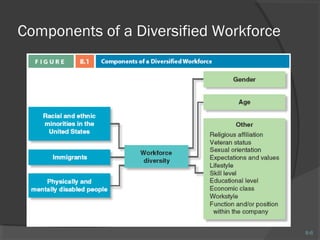
Components of a Diversified Workforce
8-7 
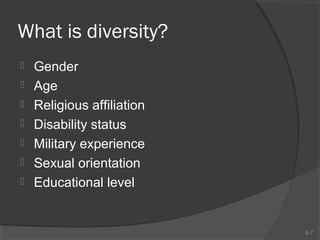
What is diversity? 
 Gender 
 Age 
 Religious affiliation 
 Disability status 
 Military experience 
 Sexual orientation 
 Educational level
8-8 
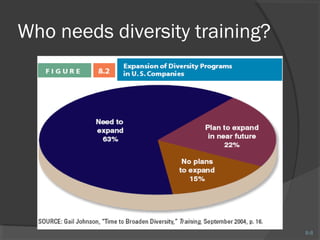
Who needs diversity training?
8-9 
Gender Demographics 
 Women make up about 465 of the workforce 
 Women in the workforce climbed from 1970s 
and 1990s and is now holding steady as rate 
of men declines 
 About 60% of all marriages are dual-earner 
marriages 
 One of every four married women in two-income 
households earns more than her 
husband does
8-10 
Gender Issues 
 Women still carry the bulk of family 
responsibility 
 Some companies expect employees to put in 
long hours and sacrifice personal lives 
 Organizations are becoming more flexible in 
balancing organizational and employee needs 
 Pay disparities still exist between men and 
women 
 “Glass ceiling” barrier is a reality for many 
women 
 Sexual harassment in the workplace has 
increased
8-11 
Glass Ceiling 
 Invisible barrier that makes it difficult for 
women and minorities to rise above a certain 
level in the organization 
 Currently 12 women are chief executives of 
Fortune 500 companies 
 Some companies are offering activities to 
help female employees break through the 
glass ceiling
8-12 
Sexual Harassment 
 Conduct of a sexual nature that has negative 
consequences for employment 
 Two categories 
Quid pro quo: submission to or rejection of sexual 
conduct is used as a basis for employment 
decision. 
Hostile environment: when unwelcome sexual 
conduct “has the purpose or effect of 
unreasonably interfering with job performance or 
creating an intimidating, hostile, or offensive 
working environment.”
8-13 
Components of a Sexual Harassment 
Policy 
1. Develop a comprehensive organization-wide 
policy on sexual harassment and 
present it to all current and new employees. 
2. Hold training sessions with supervisors to 
explain Title VII requirements, their role in 
providing an environment free of sexual 
harassment, and proper investigative 
procedures when charges occur.
8-14 
Components of a Sexual Harassment 
Policy 
3. Establish a formal complaint procedure in 
which employees can discuss problems 
without fear of retaliation. 
4. Act immediately when employees complain 
of sexual harassment. 
5. When an investigation supports employee 
charges, discipline the offender at once. 
6. Follow up on all cases to ensure a 
satisfactory resolution of the problem.
8-15 
Minorities and Immigrants 
 Black, Asian, and Hispanic workers hold more than one 
of every four U.S. jobs 
 Asian and Hispanic workforces are growing the fastest 
in the U.S., followed by African American workforce 
 Three in ten college enrollees are people of color. 
 Foreign-born workers make up more than 15% of the 
U.S. civilian labor force. About half of these workers are 
Hispanic, and 22% are Asian. 
 The younger Americans are, the more likely they are to 
be persons of color. 
 One in 66 people in the U.S. identifies himself or herself 
as multiracial, and the number could soar to 1 in 5 by 
2050.
8-16 
What’s going on with minorities? 
 White males are no longer dominating the 
workforce in urban areas 
 Managing diversity is becoming more than 
eliminating discrimination 
 Capitalizing on the wide variety of skills 
available in the labor market 
 There are still disparities in employment and 
earnings 
 Unemployment rates are higher for Hispanics 
and African Americans 
 Median earnings for white workers is higher 
than those for Hispanics and African Americans
8-17 
Overcoming disparities 
 Organizations have policies and programs to 
increase minority representation, including 
compensation systems that reward managers 
for increasing the diversity of their operations. 
 Companies are focusing on developing, hiring 
and retaining minority executives based on their 
ability to manage an ever-more-diverse 
workforce and to serve an increasing number of 
clients and customers with varied backgrounds
8-18 
Mentally and Physically Disabled 
People 
 Largest unemployed minority population 
in the U.S. is people with disabilities. 
 New assistive technologies are making it 
easier for companies to comply with 
ADA and for people with disabilities to 
be productive on the job. 
 People with disabilities are an 
unexplored but fruitful labor force.
8-19 
Tomorrow’s workers 
 The number of women, Asian Americans, 
African Americans, and Hispanic workers are 
growing faster than the number of white male 
workers 
 Lower birth rates in the U.S. will result in a 
smaller labor force leading to outsourcing to 
firms in developing nations 
 Median age of America’s workforce is 
increasing 
 70% of workers between the ages of 45 and 74 
intend to work in retirement
8-20 
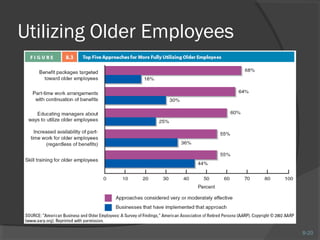
Utilizing Older Employees
8-21 
Walgreens Employs the 
“Unemployable” 
 Read the story on page 180 
 What competitive advantage might 
Walgreens gain with its proactive stance 
toward hiring workers with disabilities? 
 What challenges might Walgreens face 
in managing this workforce?
8-22 
Managing Diversity vs. Affirmative 
Action 
 Managing Diversity: moving beyond 
legislated mandates to embrace a 
proactive business philosophy that sees 
differences as positive 
 Affirmative Action: Special efforts to 
recruit and hire qualified members of 
groups that have been discriminated 
against in the past
8-23 
Diversity as a competitive advantage 
 Ability to attract and retain motivated 
employees 
 Better perspective on a differentiated 
market 
 Ability to leverage creativity and 
innovation in problem solving 
 Enhancement of organizational flexibility
8-24 
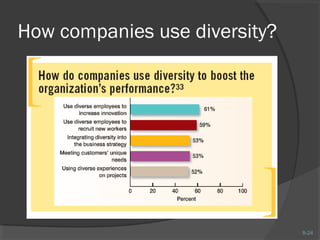
How companies use diversity?
8-25 
The challenges of managing a diverse 
workforce 
 Seeing the world from another’s perspective can 
be difficult 
 Diversity can create a lack of cohesiveness 
 Communication problems such as 
misunderstandings, inaccuracies, inefficiencies, 
and slowness 
 People prefer to associate with others who are 
like themselves 
 We learn to interpret the world in a certain way 
based on our backgrounds and experiences
8-26 
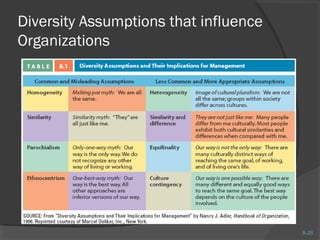
Diversity Assumptions that influence 
Organizations
8-27 
Multicultural Organizations 
 Monolithic Organization – one that has a low 
degree of structural integration-employing few 
women, minorities, or other groups that differ 
from the majority-and thus has a highly 
homogeneous employee population 
 Pluralistic Organization – An organization that 
has a relatively diverse employee population 
and makes an effort to involve employees from 
different gender, racial or cultural backgrounds
8-28 
Multicultural Organizations (cont’d) 
 Multicultural Organization – one that 
values cultural diversity and seeks to 
utilize and encourage it.
8-29 
Five Components of Cultivating a 
Diverse Workforce 
1. Securing top management’s leadership 
and commitment 
2. Assessing the organization’s progress 
toward goals 
3. Attracting employees 
4. Training employees in diversity 
5. Retaining employees
8-30 
Attract Qualified Diverse Employees 
 Recruitment 
 Accommodating work and family needs 
 Alternative work arrangements
8-31 
Train employees to understand and 
work with diversity 
 Awareness building: designed to 
increase recognition of the meaning and 
importance of valuing diversity 
 Skill building: aims to develop the skills 
that employees and managers need to 
deal effectively with one another and 
with customers in a diverse environment
8-32 
Retain talented employees 
 Support groups – provide emotional and 
career support for those excluded from 
the majority’s informal groups 
 Mentoring – when higher-level 
employees help ensure that high-potential 
people are introduced to top 
management and socialized into the 
norms and values of the organization.
8-33 
Retain Talented Employees 
 Career development and promotions 
 Systems accommodation 
 Accountability
8-34 
Managing Across Borders 
 Expatriates 
 Host-country nationals 
 Third-country nationals
8-35 
Successful Global Managers 
have… 
 Sensitivity to cultural 
differences 
 Business knowledge 
 Courage to take a 
stand 
 Ability to bring out 
the best in people 
 Integrity 
 Insightfulness 
 Commitment to 
success 
 Risk taking 
 Use of feedback 
 Cultural 
adventurousness 
 Desire for 
opportunities to learn 
 Openness to criticism 
 Desire for feedback 
 Flexibility
8-36 
Successful global assignments 
 Structure assignments clearly 
 Create clear job objectives 
 Develop performance measurements 
based on objectives 
 Use effective, validated selection and 
screening criteria 
 Prepare expatriates and families for 
assignments
8-37 
Successful Global Assignments 
(cont’d) 
 Create a vehicle for ongoing 
communication with expatriates 
 Anticipate repatriation to facilitate 
reentry when they come back home 
 Consider developing a mentor program 
that will help monitor and intervene in 
case of trouble
8-38 
Cultural Differences 
 Power distance – the extent to which a society 
accepts the fact that power in organizations is 
distributed unequally 
 Individualism/collectivism – the extent to which 
people act on their own or as a part of a group 
 Uncertainty avoidance – the extent to which people 
in a society feel threatened by uncertain and 
ambiguous situations 
 Masculinity/Femininity – the extent to which a 
society values quantity of life over quality of life
8-39 
Five core values 
1. Compassion 
2. Fairness 
3. Honesty 
4. Responsibility 
5. Respect for other

Managing the Diverse Workforce

  • 2.
    McGraw-Hill/Irwin Copyright ©2009 by The McGraw-Hill Companies, Inc. All rights reserved.
  • 3.
    8-3 Learning Objectives  L01: Describe how changes in the U.S. workforce make diversity a critical organizational and managerial issue.  L02: Distinguish between affirmative action and managing diversity.  L03: Explain how diversity, if well managed, can give organizations a competitive edge.  L04: Identify challenges associated with managing a diverse workforce.
  • 4.
    8-4 Learning Objectives  L05: Define monolithic, pluralistic, and multicultural organizations.  L06: List steps managers and their organizations can take to cultivate diversity.  L07: Summarize the skills and knowledge managers need to manage globally.  L08: Identify ways in which cultural differences across countries influence management.
  • 5.
    8-5 Managing Diversity  Involves recruiting, training, promoting, and utilizing to full advantage individuals with different backgrounds, beliefs, capabilities, and cultures.  Understanding and deeply valuing employee differences to build a more effective and profitable organization.  Valuing the connections that arise and develop between diverse employees.
  • 6.
    8-6 Components ofa Diversified Workforce
  • 7.
    8-7 What isdiversity?  Gender  Age  Religious affiliation  Disability status  Military experience  Sexual orientation  Educational level
  • 8.
    8-8 Who needsdiversity training?
  • 9.
    8-9 Gender Demographics  Women make up about 465 of the workforce  Women in the workforce climbed from 1970s and 1990s and is now holding steady as rate of men declines  About 60% of all marriages are dual-earner marriages  One of every four married women in two-income households earns more than her husband does
  • 10.
    8-10 Gender Issues  Women still carry the bulk of family responsibility  Some companies expect employees to put in long hours and sacrifice personal lives  Organizations are becoming more flexible in balancing organizational and employee needs  Pay disparities still exist between men and women  “Glass ceiling” barrier is a reality for many women  Sexual harassment in the workplace has increased
  • 11.
    8-11 Glass Ceiling  Invisible barrier that makes it difficult for women and minorities to rise above a certain level in the organization  Currently 12 women are chief executives of Fortune 500 companies  Some companies are offering activities to help female employees break through the glass ceiling
  • 12.
    8-12 Sexual Harassment  Conduct of a sexual nature that has negative consequences for employment  Two categories Quid pro quo: submission to or rejection of sexual conduct is used as a basis for employment decision. Hostile environment: when unwelcome sexual conduct “has the purpose or effect of unreasonably interfering with job performance or creating an intimidating, hostile, or offensive working environment.”
  • 13.
    8-13 Components ofa Sexual Harassment Policy 1. Develop a comprehensive organization-wide policy on sexual harassment and present it to all current and new employees. 2. Hold training sessions with supervisors to explain Title VII requirements, their role in providing an environment free of sexual harassment, and proper investigative procedures when charges occur.
  • 14.
    8-14 Components ofa Sexual Harassment Policy 3. Establish a formal complaint procedure in which employees can discuss problems without fear of retaliation. 4. Act immediately when employees complain of sexual harassment. 5. When an investigation supports employee charges, discipline the offender at once. 6. Follow up on all cases to ensure a satisfactory resolution of the problem.
  • 15.
    8-15 Minorities andImmigrants  Black, Asian, and Hispanic workers hold more than one of every four U.S. jobs  Asian and Hispanic workforces are growing the fastest in the U.S., followed by African American workforce  Three in ten college enrollees are people of color.  Foreign-born workers make up more than 15% of the U.S. civilian labor force. About half of these workers are Hispanic, and 22% are Asian.  The younger Americans are, the more likely they are to be persons of color.  One in 66 people in the U.S. identifies himself or herself as multiracial, and the number could soar to 1 in 5 by 2050.
  • 16.
    8-16 What’s goingon with minorities?  White males are no longer dominating the workforce in urban areas  Managing diversity is becoming more than eliminating discrimination  Capitalizing on the wide variety of skills available in the labor market  There are still disparities in employment and earnings  Unemployment rates are higher for Hispanics and African Americans  Median earnings for white workers is higher than those for Hispanics and African Americans
  • 17.
    8-17 Overcoming disparities  Organizations have policies and programs to increase minority representation, including compensation systems that reward managers for increasing the diversity of their operations.  Companies are focusing on developing, hiring and retaining minority executives based on their ability to manage an ever-more-diverse workforce and to serve an increasing number of clients and customers with varied backgrounds
  • 18.
    8-18 Mentally andPhysically Disabled People  Largest unemployed minority population in the U.S. is people with disabilities.  New assistive technologies are making it easier for companies to comply with ADA and for people with disabilities to be productive on the job.  People with disabilities are an unexplored but fruitful labor force.
  • 19.
    8-19 Tomorrow’s workers  The number of women, Asian Americans, African Americans, and Hispanic workers are growing faster than the number of white male workers  Lower birth rates in the U.S. will result in a smaller labor force leading to outsourcing to firms in developing nations  Median age of America’s workforce is increasing  70% of workers between the ages of 45 and 74 intend to work in retirement
  • 20.
  • 21.
    8-21 Walgreens Employsthe “Unemployable”  Read the story on page 180  What competitive advantage might Walgreens gain with its proactive stance toward hiring workers with disabilities?  What challenges might Walgreens face in managing this workforce?
  • 22.
    8-22 Managing Diversityvs. Affirmative Action  Managing Diversity: moving beyond legislated mandates to embrace a proactive business philosophy that sees differences as positive  Affirmative Action: Special efforts to recruit and hire qualified members of groups that have been discriminated against in the past
  • 23.
    8-23 Diversity asa competitive advantage  Ability to attract and retain motivated employees  Better perspective on a differentiated market  Ability to leverage creativity and innovation in problem solving  Enhancement of organizational flexibility
  • 24.
    8-24 How companiesuse diversity?
  • 25.
    8-25 The challengesof managing a diverse workforce  Seeing the world from another’s perspective can be difficult  Diversity can create a lack of cohesiveness  Communication problems such as misunderstandings, inaccuracies, inefficiencies, and slowness  People prefer to associate with others who are like themselves  We learn to interpret the world in a certain way based on our backgrounds and experiences
  • 26.
    8-26 Diversity Assumptionsthat influence Organizations
  • 27.
    8-27 Multicultural Organizations  Monolithic Organization – one that has a low degree of structural integration-employing few women, minorities, or other groups that differ from the majority-and thus has a highly homogeneous employee population  Pluralistic Organization – An organization that has a relatively diverse employee population and makes an effort to involve employees from different gender, racial or cultural backgrounds
  • 28.
    8-28 Multicultural Organizations(cont’d)  Multicultural Organization – one that values cultural diversity and seeks to utilize and encourage it.
  • 29.
    8-29 Five Componentsof Cultivating a Diverse Workforce 1. Securing top management’s leadership and commitment 2. Assessing the organization’s progress toward goals 3. Attracting employees 4. Training employees in diversity 5. Retaining employees
  • 30.
    8-30 Attract QualifiedDiverse Employees  Recruitment  Accommodating work and family needs  Alternative work arrangements
  • 31.
    8-31 Train employeesto understand and work with diversity  Awareness building: designed to increase recognition of the meaning and importance of valuing diversity  Skill building: aims to develop the skills that employees and managers need to deal effectively with one another and with customers in a diverse environment
  • 32.
    8-32 Retain talentedemployees  Support groups – provide emotional and career support for those excluded from the majority’s informal groups  Mentoring – when higher-level employees help ensure that high-potential people are introduced to top management and socialized into the norms and values of the organization.
  • 33.
    8-33 Retain TalentedEmployees  Career development and promotions  Systems accommodation  Accountability
  • 34.
    8-34 Managing AcrossBorders  Expatriates  Host-country nationals  Third-country nationals
  • 35.
    8-35 Successful GlobalManagers have…  Sensitivity to cultural differences  Business knowledge  Courage to take a stand  Ability to bring out the best in people  Integrity  Insightfulness  Commitment to success  Risk taking  Use of feedback  Cultural adventurousness  Desire for opportunities to learn  Openness to criticism  Desire for feedback  Flexibility
  • 36.
    8-36 Successful globalassignments  Structure assignments clearly  Create clear job objectives  Develop performance measurements based on objectives  Use effective, validated selection and screening criteria  Prepare expatriates and families for assignments
  • 37.
    8-37 Successful GlobalAssignments (cont’d)  Create a vehicle for ongoing communication with expatriates  Anticipate repatriation to facilitate reentry when they come back home  Consider developing a mentor program that will help monitor and intervene in case of trouble
  • 38.
    8-38 Cultural Differences  Power distance – the extent to which a society accepts the fact that power in organizations is distributed unequally  Individualism/collectivism – the extent to which people act on their own or as a part of a group  Uncertainty avoidance – the extent to which people in a society feel threatened by uncertain and ambiguous situations  Masculinity/Femininity – the extent to which a society values quantity of life over quality of life
  • 39.
    8-39 Five corevalues 1. Compassion 2. Fairness 3. Honesty 4. Responsibility 5. Respect for other