
DESIGN OF MATRIX CONVERTER BASED
DYNAMIC
VOLTAGE RESTORER FOR POWER QUALITY
ENHANCEMENT
ABSTRACT
 A new series power conditioning system using a matrix
converter is proposed. The proposed solution has utilized
a single AC/AC power converter for interface as an
conventional AC/DC/AC converter. The dynamic model is
used to design a vector control system that seamlessly
integrates functional of compensating load voltage and
managing energy storage during voltage sag and idling
modes. The purpose of matrix converter used in dynamic
voltage restorer (DVR) for power quality enhancement,
which is connected in between the feeder to secure the
electric power from sags. The DVR is based on dqo
algorithm which is discussed with matrix converter to inject
external supply into the feeder by means of a series
transformer. Harmonics are produced due to non-linear loads,
and it is filtered out by a filter which is connected at terminal
end of the system. The simulation results are carried out
by MATLAB and the performance of proposed method is
verified.
INTRODUCTION TO POWER QUALITY
 Power quality determines the fitness of
electric power to consumer devices.
Synchronization of the voltage frequency and
phase allows electrical systems to function in their
intended manner without significant loss of
performance or life.
 The power quality is main area should be deal in
power system in modern technology for using
equipment without any problems.
 The power quality enhancement must be needed
to protect the sensitive equipment from the fault
which occurs at generating station and
transmission lines.
POWER QUALITY PROBLEMS
 The power supply contains lot of power quality
issues like flickers, sags, swells, harmonics,
transients, and notching.
 In this voltage sag is main phenomena that causes
vulnerable to the power system. Due to sag,
the losses in machines get increases, sensitive
equipment gets fail, voltage regulation will be
affected, the circuit breaker trips without being
overloaded, speed of motor gets vary, and
makes the power system into imbalance condition.
DEFINITION AND CAUSES OF SAG
 The sag is nothing but reduction in
magnitude of sinusoidal wave.
 The sag causes due to lightning stroke,
switching of lines, non linear loads like
arc furnace, welding machines, weather
condition, falling of trees, animal
contacts, and insulation failures and short
circuit fault at the distribution feeder.
PROPOSED CONCEPT
A new series power conditioning
system(DVR) using matrix converter
is proposed in this project.
The purpose of matrix converter
used in dynamic voltage restorer
(DVR) for power quality
enhancement, which is connected in
between the feeder to secure the
electric power from sags.
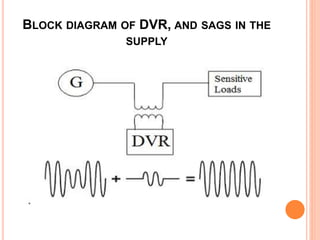
BLOCK DIAGRAM OF DVR, AND SAGS IN THE
SUPPLY
OBJECTIVE
 The main objective of this project is to reduce the sag
and make the power supply into sag free.
 The device well known for reduction of voltage sag
is dynamic voltage restorer (DVR) had been
implemented as an advantage of series
compensation over the shunt compensation for
voltage stiff system.
 The mitigation of sags in sensitive equipment with
high power factor is quit enhanced. The energy storage
device normally required for eliminating the sag with
high power factor.
 The series compensator, dynamic voltage restorer
restore the supply voltage without sag by injecting
the external source into the feeder.
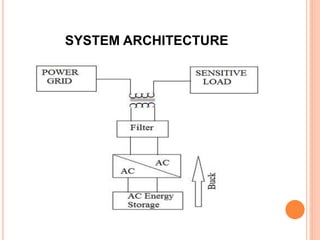
SYSTEM ARCHITECTURE
SYSTEM DESCRIPTION
 The system architecture based on the operational
conditions: which three requirements have been proposed in
the above figure
 1) To mitigate the voltage sag and recover storage
energy, bidirectional power flow is requiring.
 2) According to the nature of the load the system should
operate properly, so it must contain wide range of power
factor at converter end.
 3) The converter must have capability to operate in buck
mode, when the grid injection voltage is very low during fully
charged flywheel
MODELING OF MATRIX CONVERTER
 The matrix converter is necessary to operate as
bidirectional converter or switch. The proposed
matrix converter is indirect matrix converter (IMC) in
which it maintained DC link voltage positive and
allowing the current to be either in positive or
negative.
 The current source inverter is connected to the source
and voltage source inverter is connected to the grid.
 The matrix converter should operate according to
the flywheel supply from rotation. To maintain the
DC link voltage positive, displacement angle must
be limited to (-л/6, л/6),it is normally done by an
algorithm.
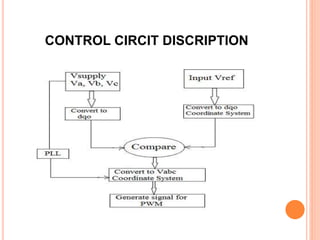
CONTROL CIRCIT DISCRIPTION
CONTROL ALGORITHM FOR MATRIX
CONVERTER
 The phase lock loop is implemented to
compare two non idling signals and gives mean
signal for protection of pulse with modulation
(PWM)
 The simulation is based on dqo algorithm in which
system is compare with reference voltage and error
voltage is produced, by converting into abc to
dqo algorithm as shown in above figure
 According to the error value, pulses are
generated to control the matrix converter to
inject the external source into the system. The
overall simulation diagram is shown in below
figure.
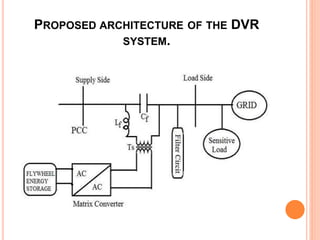
PROPOSED ARCHITECTURE OF THE DVR
SYSTEM.
CONCLUSIONS
 The method of DVR proposed in this project introduces matrix
converter , which neglects DC link based topology as used in back to
back converter.
 The implementation of phase lock loop which maintains the pulse
width modulation for control the matrix converter is proposed.
 The closed loop method proposed, to improve the dynamic
performance of the system. The modeling and control circuit is based
on dqo algorithm, in which sags are effectively reduced by the DVR.
 It will provides quickly excellent voltage regulation in power supply.
 The balance and unbalance voltage level gets regulated by appropriate
voltage is injecting and compensate the power supply.
 By this method, grid supply is maintained constant for all time . The
advantages of DVR are low cost, simple control circuit and it can mitigate
long duration voltage sags efficiently. The simulation of DVR using
MATLAB/SIMULINK has been presented and verified
REFERENCES
 [1] M. F. Mc Granaghan, D. R. Mueller, and M. J.
Samotyi,” V Voltage Sags in Industerial Systems,”
IEEE trans ind. A ppl., vol. 29, no. 2, pp. 397-403,
Mar/Apr. 1996.
 [2] A. kara, P . Dabler, D. Amhof , and H.
Gruning” Power Supply Quality Improvement
with A Dynamic Restorer (DVR)”, in proc .13
Annu .APEC (cat no 98CH36154), An aheim, ca,
1998, PP. 986-993
 [3] L. Gyugyi, C. D. Schauder, C. W . Edwards
and M.Sarkozii, ”Apparatus and Method for
Dynamic Voltage Restoration of Utility Distribution
Network ,”US. pattent 5 329 222, Jul. 1994

DESIGN OF MATRIX CONVERTER BASED DYNAMIC VOLTAGE RESTORER FOR POWER QUALITY ENHANCEMENT

  • 1.
    DESIGN OF MATRIXCONVERTER BASED DYNAMIC VOLTAGE RESTORER FOR POWER QUALITY ENHANCEMENT
  • 2.
    ABSTRACT  A newseries power conditioning system using a matrix converter is proposed. The proposed solution has utilized a single AC/AC power converter for interface as an conventional AC/DC/AC converter. The dynamic model is used to design a vector control system that seamlessly integrates functional of compensating load voltage and managing energy storage during voltage sag and idling modes. The purpose of matrix converter used in dynamic voltage restorer (DVR) for power quality enhancement, which is connected in between the feeder to secure the electric power from sags. The DVR is based on dqo algorithm which is discussed with matrix converter to inject external supply into the feeder by means of a series transformer. Harmonics are produced due to non-linear loads, and it is filtered out by a filter which is connected at terminal end of the system. The simulation results are carried out by MATLAB and the performance of proposed method is verified.
  • 3.
    INTRODUCTION TO POWERQUALITY  Power quality determines the fitness of electric power to consumer devices. Synchronization of the voltage frequency and phase allows electrical systems to function in their intended manner without significant loss of performance or life.  The power quality is main area should be deal in power system in modern technology for using equipment without any problems.  The power quality enhancement must be needed to protect the sensitive equipment from the fault which occurs at generating station and transmission lines.
  • 4.
    POWER QUALITY PROBLEMS The power supply contains lot of power quality issues like flickers, sags, swells, harmonics, transients, and notching.  In this voltage sag is main phenomena that causes vulnerable to the power system. Due to sag, the losses in machines get increases, sensitive equipment gets fail, voltage regulation will be affected, the circuit breaker trips without being overloaded, speed of motor gets vary, and makes the power system into imbalance condition.
  • 5.
    DEFINITION AND CAUSESOF SAG  The sag is nothing but reduction in magnitude of sinusoidal wave.  The sag causes due to lightning stroke, switching of lines, non linear loads like arc furnace, welding machines, weather condition, falling of trees, animal contacts, and insulation failures and short circuit fault at the distribution feeder.
  • 6.
    PROPOSED CONCEPT A newseries power conditioning system(DVR) using matrix converter is proposed in this project. The purpose of matrix converter used in dynamic voltage restorer (DVR) for power quality enhancement, which is connected in between the feeder to secure the electric power from sags.
  • 7.
    BLOCK DIAGRAM OFDVR, AND SAGS IN THE SUPPLY
  • 8.
    OBJECTIVE  The mainobjective of this project is to reduce the sag and make the power supply into sag free.  The device well known for reduction of voltage sag is dynamic voltage restorer (DVR) had been implemented as an advantage of series compensation over the shunt compensation for voltage stiff system.  The mitigation of sags in sensitive equipment with high power factor is quit enhanced. The energy storage device normally required for eliminating the sag with high power factor.  The series compensator, dynamic voltage restorer restore the supply voltage without sag by injecting the external source into the feeder.
  • 9.
  • 10.
    SYSTEM DESCRIPTION  Thesystem architecture based on the operational conditions: which three requirements have been proposed in the above figure  1) To mitigate the voltage sag and recover storage energy, bidirectional power flow is requiring.  2) According to the nature of the load the system should operate properly, so it must contain wide range of power factor at converter end.  3) The converter must have capability to operate in buck mode, when the grid injection voltage is very low during fully charged flywheel
  • 11.
    MODELING OF MATRIXCONVERTER  The matrix converter is necessary to operate as bidirectional converter or switch. The proposed matrix converter is indirect matrix converter (IMC) in which it maintained DC link voltage positive and allowing the current to be either in positive or negative.  The current source inverter is connected to the source and voltage source inverter is connected to the grid.  The matrix converter should operate according to the flywheel supply from rotation. To maintain the DC link voltage positive, displacement angle must be limited to (-л/6, л/6),it is normally done by an algorithm.
  • 12.
  • 13.
    CONTROL ALGORITHM FORMATRIX CONVERTER  The phase lock loop is implemented to compare two non idling signals and gives mean signal for protection of pulse with modulation (PWM)  The simulation is based on dqo algorithm in which system is compare with reference voltage and error voltage is produced, by converting into abc to dqo algorithm as shown in above figure  According to the error value, pulses are generated to control the matrix converter to inject the external source into the system. The overall simulation diagram is shown in below figure.
  • 14.
    PROPOSED ARCHITECTURE OFTHE DVR SYSTEM.
  • 15.
    CONCLUSIONS  The methodof DVR proposed in this project introduces matrix converter , which neglects DC link based topology as used in back to back converter.  The implementation of phase lock loop which maintains the pulse width modulation for control the matrix converter is proposed.  The closed loop method proposed, to improve the dynamic performance of the system. The modeling and control circuit is based on dqo algorithm, in which sags are effectively reduced by the DVR.  It will provides quickly excellent voltage regulation in power supply.  The balance and unbalance voltage level gets regulated by appropriate voltage is injecting and compensate the power supply.  By this method, grid supply is maintained constant for all time . The advantages of DVR are low cost, simple control circuit and it can mitigate long duration voltage sags efficiently. The simulation of DVR using MATLAB/SIMULINK has been presented and verified
  • 16.
    REFERENCES  [1] M.F. Mc Granaghan, D. R. Mueller, and M. J. Samotyi,” V Voltage Sags in Industerial Systems,” IEEE trans ind. A ppl., vol. 29, no. 2, pp. 397-403, Mar/Apr. 1996.  [2] A. kara, P . Dabler, D. Amhof , and H. Gruning” Power Supply Quality Improvement with A Dynamic Restorer (DVR)”, in proc .13 Annu .APEC (cat no 98CH36154), An aheim, ca, 1998, PP. 986-993  [3] L. Gyugyi, C. D. Schauder, C. W . Edwards and M.Sarkozii, ”Apparatus and Method for Dynamic Voltage Restoration of Utility Distribution Network ,”US. pattent 5 329 222, Jul. 1994