International Journal of Engineering Research and Development
e-ISSN: 2278-067X, p-ISSN: 2278-800X, www.ijerd.com
Volume 2, Issue 11 (August 2012), PP. 07-13


A Comprehensive Transmission Expansion Planning Strategy for
                   Developing Countries
                               Mr G.Srinivasulu1, Dr B Subramanyam2
1
 Associate Professor, Dept of Electrical & Electronics Engineering, Narayana Engineering College, Nellore-524004(India)
           2
             Professor, Dept of Electrical & Electronics Engineering, KL University, Vijayawada-520002(India)


Abstract––In the recent past, developing countries are moving into Electricity Deregulation. As Electric load demand
raise, Transmission Expansion Planning must be developed in a suitable and appropriate way to provide reliable and
quality power to the consumers. The objective of the paper is to present a Comprehensive Transmission Expansion
Planning (CTEP) by considering physical and operational constraints like power balance, power flow limit on
transmission lines, power generation limit, right-off-way and bus voltage phase angle limit. CTEP is proposed for Garver
6-bus system in view of contingencies like generator outage, line outage, combined generator and line outage, rise in load
demand and rise in both generation and load demand. CTEP is proposed to achieve optimal planning cost, increased
reliability and reduced transmission losses. AC load flow using Newton Raphson Method is considered for making CTEP
in this paper.

Keywords––CTEP, right –off-way, optimal planning cost, reliability, Transmission losses and AC load flow

                                               I.       INTRODUCTION
           Electrical energy is acceptable form of energy since it can be transported simply at high efficiency and sensible
cost. Currently the Electrical Power Systems are large-scale and highly composite interconnected transmission systems. An
electric power system can be subdivided into three major parts like generation, transmission and distribution. The principle
of a transmission system is to transmit electrical energy from generating stations located at various places to the distribution
systems and to ultimately provide supply to the load centers. Transmission system interconnects the adjacent utilities to
allow economic dispatch of power across different areas during normal and emergency conditions.
           In the recent past, the quantity of electrical power to be transferred from generating stations to major load centers
has been rising significantly. Owing to mounting costs and the essential need for reliable electrical power systems,
appropriate and best possible design methods for different parts of the power system are necessary. Transmission system
occupies a major part of any power system, thus they have to be perfectly and efficiently planned [7]. Due to augmentation
of power system, grid connected transmission lines have emerged, providing different paths for power flows from various
generators to loads improving the reliability of continuous supply. Interconnection of transmission system removes the
imbalance of generation and load by transmitting surplus power to the regions which are having deficiency of power.
Supplementary transmission capability is necessary, whenever there is a need to transmit cheaper power to meet mounting
load demand or improve system reliability or both.

                                           II.        OBJECTIVE OF TEP
           The aim of Transmission Expansion Planning (TEP) is to specify addition of transmission lines that give sufficient
power and at the same time maintain reliability of transmission system [3]. To congregate demand escalation, generation
addition and augmented power flow, Transmission Expansion Planning must identify efficient plan, precise site, capacity,
timing and type of novel transmission apparatus [3]. One of the major challenge in power system optimization is that TEP
should be cost-effective in spite of the problem being complex, large-scale and nonlinear [5]. Planning horizon, instance
topology of the base year, candidate circuits, load forecast, generation expansion and investment constraints are to be
considered for TEP, increasing the complexity of the problem [3].
           Comprehensive Transmission Expansion Planning (CTEP) shall be made based on analysis of AC load flow or DC
load flow. Real and Reactive Power flows can be obtained from AC load flow or DC load flow [1]. In this paper AC load
flow is considered in view of including transmission losses, but in DC load flow transmission losses are zero. CTEP can be
computed by analyzing the line flows between whether they are exceeded or not and detailed analysis is as described in
section 5.

                                        III.        PROBLEM STATEMENT
           The TEP presents the problem of finding the finest number of transmission lines that must be added to an existing
network to supply the forecasted load demand as economically as possible by considering operating constraints [5]. The
physical and economical constraints are to be considered in the TEP to minimize the capital and operating costs of the
electrical transmission network [3]. The constraints are very vital while attempting to develop a power system at a lowest
cost considering fiscal and load restrictions that placed upon the system [7]. The TEP problem can be defined in the
following manner [3]:

                                                               7
A Comprehensive Transmission Expansion Planning Strategy for Developing Countries
          𝑁𝐵   𝑁𝐵                     𝑁𝐿

min 𝜈 =              𝐶 𝑖𝑗 𝑛 𝑖𝑗 + 𝐾         𝐼2 𝑅 𝑖
                                            𝑖              (1)
          𝑖=1 𝑗 =1                   𝑖=1
Cij- Cost of the new transmission line added to line i-j
nij- Number of transmission lines added to the line i-j
NB- Total number of buses
K- Loss coefficient, K=8760*NYE*CkWh
NYE- Anticipated life span of the Transmission Expansion Network in years
CkWh- Cost of one kWh in $/kWh
Ri- Resistance of the ith line
Ii- Current through ith line
NL- Number of present transmission lines

          The loss coefficient (K) relies on the number of years of operation and the cost of kWh i.e. cost of kWh increases
with number of years of operation that leads to rise in loss coefficient [4].
          The TEP problem (1) represents the capital cost of the recently installed transmission lines, it has some restrictions
to solve it. To find optimal solution of TEP, physical and operational constraints must be included into the mathematical
model. The constraints are explained as follows [7]:

3.1 Power Flow Node Balance
       The non linear equality constraint represents the conservation of power at each node, i.e.
 𝑃 𝐺𝑖 = 𝑃 𝐷𝑖 + 𝑃𝑖                                 (2) for i=1, 2 ….NB
Where PGi, PDi and Pi is real power generation, real load demand and real power injection at bus i, respectively.

3.2 Power Flow Limit On Transmission Lines
      The inequality constraint of power flow limit on transmission line for each path is
  𝑃𝑖𝑗 ≤ 𝑛0 + 𝑛 𝑖𝑗 𝑃𝑖𝑗𝑚𝑎𝑥
            𝑖𝑗                               3
Where P ij, Pijmax, nij and nij0 gives total power flow through transmission line i-j, maximum power flow through transmission
line i-j, number of lines added to transmission line i-j and number of transmission lines in original base system, respectively.

3.3 Power Generation Limit
        In TEP, power generation limit should be incorporated as one of the constraints. Mathematically, it can be represented
as follows:
  𝑃 𝑔𝑖𝑚𝑖𝑛 ≤ 𝑃 𝑔𝑖 ≤ 𝑃 𝑔𝑖𝑚𝑎𝑥              (4)
Where Pgi, Pgimin and Pgimax is real power generation at bus I, the lower and upper real power generation bounds at bus i,
respectively.

3.4 Right Of Way
      The planners need to know the exact location and capacity of the newly required transmission lines for a precise TEP.
Hence this constraint should be incorporated into the deliberation of planning problem. The new transmission line location
and the maximum number of lines that can be installed in a specified location shall be obtained from this constraint, it can be
represented mathematically as follows:
0 ≤ 𝑛 𝑖𝑗 ≤ 𝑛 𝑖𝑗𝑚𝑎𝑥                         (5)
Where nij and nijmax is the total number of lines added to the transmission line i-j and the maximum number of added lines in
the transmission line i-j, respectively.

3.5 Bus Voltage Phase Angle Limit
        The bus voltage phase angle is incorporated as a TEP constraint and the calculated voltage phase angle (θ ical) must be
less than the specified maximum voltage phase angle (θ imax), it can be defined mathematically as:
  𝜃 𝑖𝑐𝑎𝑙 ≤ 𝜃 𝑖 𝑚𝑎𝑥                           (6)

To check the reliability of the transmission system, the TEP problem should not only consider the usual operation but also
incorporate contingencies due to changes in the system, e.g., generator outage, line outage, load uncertainties, etc.

3.6 Generator Outage
     Generating capacity may be reduced by declaring a “forced outage” to make repairs, or by extending a planned outage
for maintenance. Reducing generating capacity may be lead to an artificial shortage of electricity supply and create reliability
problems. Due to internal or external faults of generators, generator outage may be happened, hence this constraint should be
included in TEP problem.

3.7 Transmission Line Outage
     The main reasons of transmission line outages are adverse weather (i.e. due to lighting, wind and icing), faulty
equipment, foreign intervention, bad environment, and human element, it leads to interruption of power supply, hence this
constraint must be incorporated in TEP problem.


                                                                 8
A Comprehensive Transmission Expansion Planning Strategy for Developing Countries

3.8 Load Uncertainties
          The reasons for uncertainty in load are, that the load is always variable, future load is a random variable, random
results may be produced by load forecasting methods, errors in forecasted result and the majority of methods suffer from
missing data and input data accuracy. Hence, this constraint must be integrated in TEP problem.

                                                             IV.   AC LOAD FLOW
           Load flow analysis gives steady state information about bus voltages, current injections at all buses, real and
reactive power flows through transmission lines for given power system. The representation of AC load flow can be
illustrated by the equations given below:
        𝑛

𝑃𝑖 =             𝑉𝑖    𝑉𝑘    𝑌𝑖𝑘 cos 𝜃 𝑖𝑘 + 𝛿 𝑘 − 𝛿 𝑖        (7)
       𝑘=1
             𝑛

𝑄𝑖 = −                𝑉𝑖    𝑉𝑘   𝑌𝑖𝑘 sin 𝜃 𝑖𝑘 + 𝛿 𝑘 − 𝛿 𝑖    (8)
            𝑘=1
For i=1, 2…NB and k=1, 2 …NB
Where Pi, Qi, 𝑉𝑖 , 𝜃 𝑖𝑘 , 𝛿 𝑖 and 𝛿 𝑘 is real power injection, reactive power injection, voltage magnitude at bus i, admittance
angle of line i-k, voltage phase angle at bus i and voltage phase angle at bus k, respectively.
In this paper, to solve AC load flow, Newton-Raphson (NR) method [1] is considered. The following steps are involved in
solving AC load flow using NR method [1]:
     i.    Reading the bus data, line data, initial guess and convergence criteria.
    ii.    Forming the bus admittance matrix.
  iii.     Setting the bus count i=2 and iteration count r=0.
   iv.     Testing the type of bus, If bus is PQ bus, find Pir and Qir using equation (7) and (8) respectively and also find
           ∆𝑃𝑖 𝑟 = 𝑃𝑖 𝑠𝑝𝑒𝑐𝑖𝑓𝑖𝑒𝑑 − 𝑃𝑖 𝑟 and ∆𝑄 𝑖𝑟 = 𝑄 𝑖 𝑠𝑝𝑒𝑐𝑖𝑓𝑖𝑒𝑑 − 𝑄 𝑖𝑟 . If bus is PV bus, calculate Pir and Qir using equation (7)
           and (8) respectively and also determine ∆𝑃𝑖 𝑟 = 𝑃𝑖 𝑠𝑝𝑒𝑐𝑖𝑓𝑖𝑒𝑑 − 𝑃𝑖 𝑟 .
    v.     Advancing the bus count 𝑖 → 𝑖 + 1 and if 𝑖 < 𝑛, go to step iv and otherwise go to step vi.
   vi.     Checking the change in power i.e. to verify whether ∆𝑃𝑖 𝑟 ≤ 𝜖 and ∆𝑄 𝑖𝑟 ≤ 𝜖 are satisfied or not. If this condition is
           satisfied, go to step xi and otherwise go to step vii to find Jacobian Matrix.
  vii.     Computing the elements of Jacobian Matrix „J‟.
 viii.     Calculating the change in voltage magnitudes and phase angles using P ir, Qir and J.
   ix.     Updating the voltage magnitudes and phase angles and then go to step x.
    x.     Advancing the iteration count 𝑟 → 𝑟 + 1 and then go to step iv.
   xi.     Computing the slack bus powers and line flows.
  xii.     Printing the results and stop the iteration.

                                                  V.         CTEP USING AC LOAD FLOW
          CTEP can be made using AC load flow analysis, since it gives real and reactive power flows and line flows. The
steps involved in CTEP using AC load flow by considering constraints as explained in section 3, are explained as follows:
     i.   Reading the bus data, line data, initial guess, convergence criteria and constraints involved in CTEP.
    ii.   Executing the AC load flow using NR Method.
   iii.   Checking the power balance equation is satisfied or not. If it is satisfied, go to step v, otherwise transmit power
          from other areas to balance the load or go for load shedding to balance the load.
   iv.    Testing the generating power is within the specified limits or not. If it exceeds the maximum limit, reduce load on
          that generator and if it exceeds the minimum limit stop the generator.
    v.    Verifying the line flows are within the limits or not. If line flows exceeded the specified line flow limit, find which
          line has highest exceeded line flow then add a line across it and go to step ii to run AC load flow, otherwise go to
          step vi.
   vi.    Checking the number of lines between any two buses exceeded right off way limit or not. If it is exceeded, remove
          the line and go to step ii, otherwise go to step vii.
  vii.    If there is generator outage, go to step ii, otherwise go to step viii.
 viii.    If there is line outage, go to step ii, otherwise go to step ix.
   ix.    If there is load uncertainty, go to step ii, otherwise go to step x.
    x.    Printing the results and find the cost required for adding new transmission lines.

                                                       VI.     RESULTS & DISCUSSION
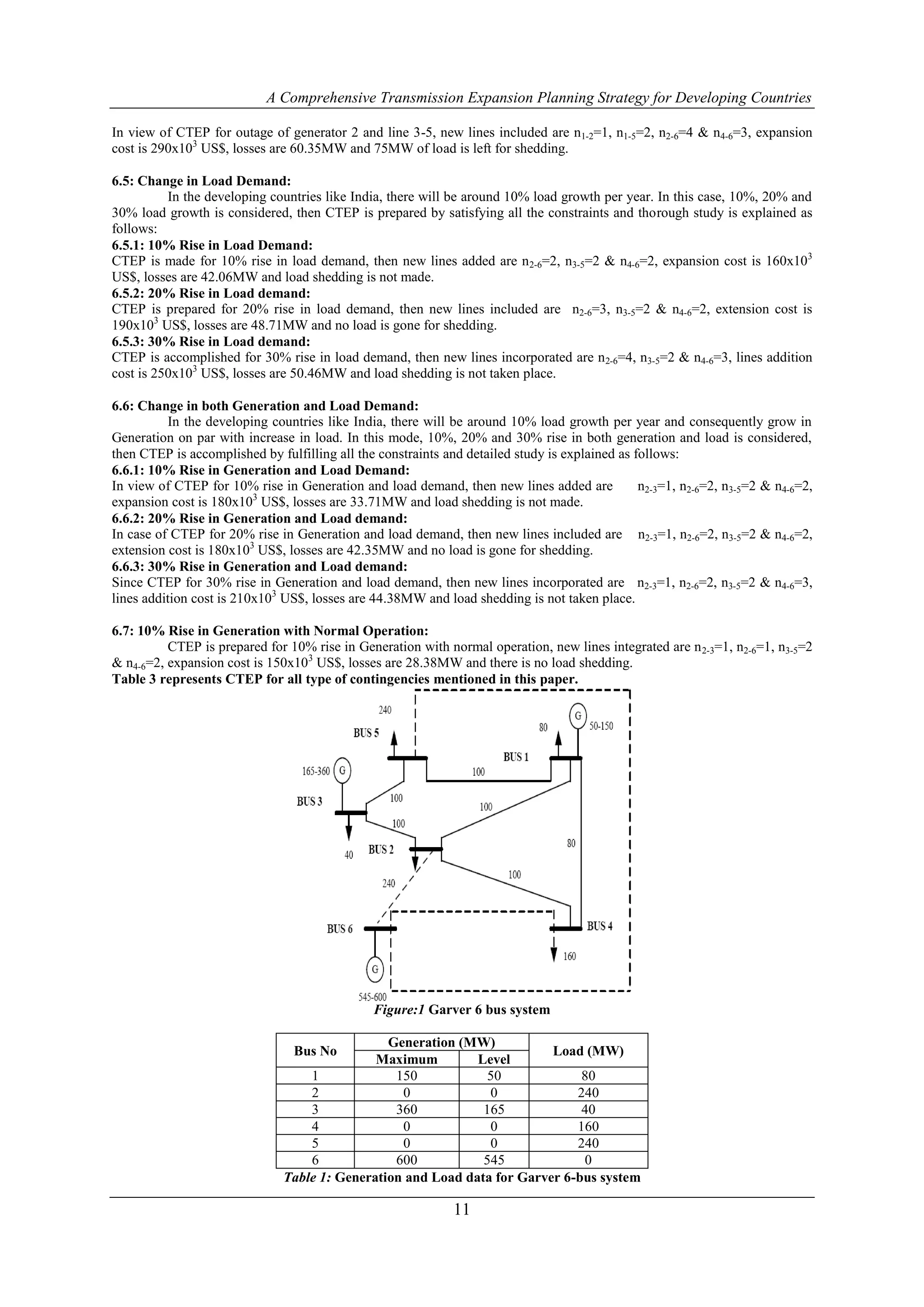
          In this paper Garver 6-bus system is taken as case study. Single line diagram of Garver 6-bus system is shown in
figure 1. Comprehensive Transmission Expansion Planning (CTEP) is done based on optimum expansion cost, reliable
operation and reducing transmission losses by satisfying the physical and operational constraints from 3.1 to 3.5 as explained
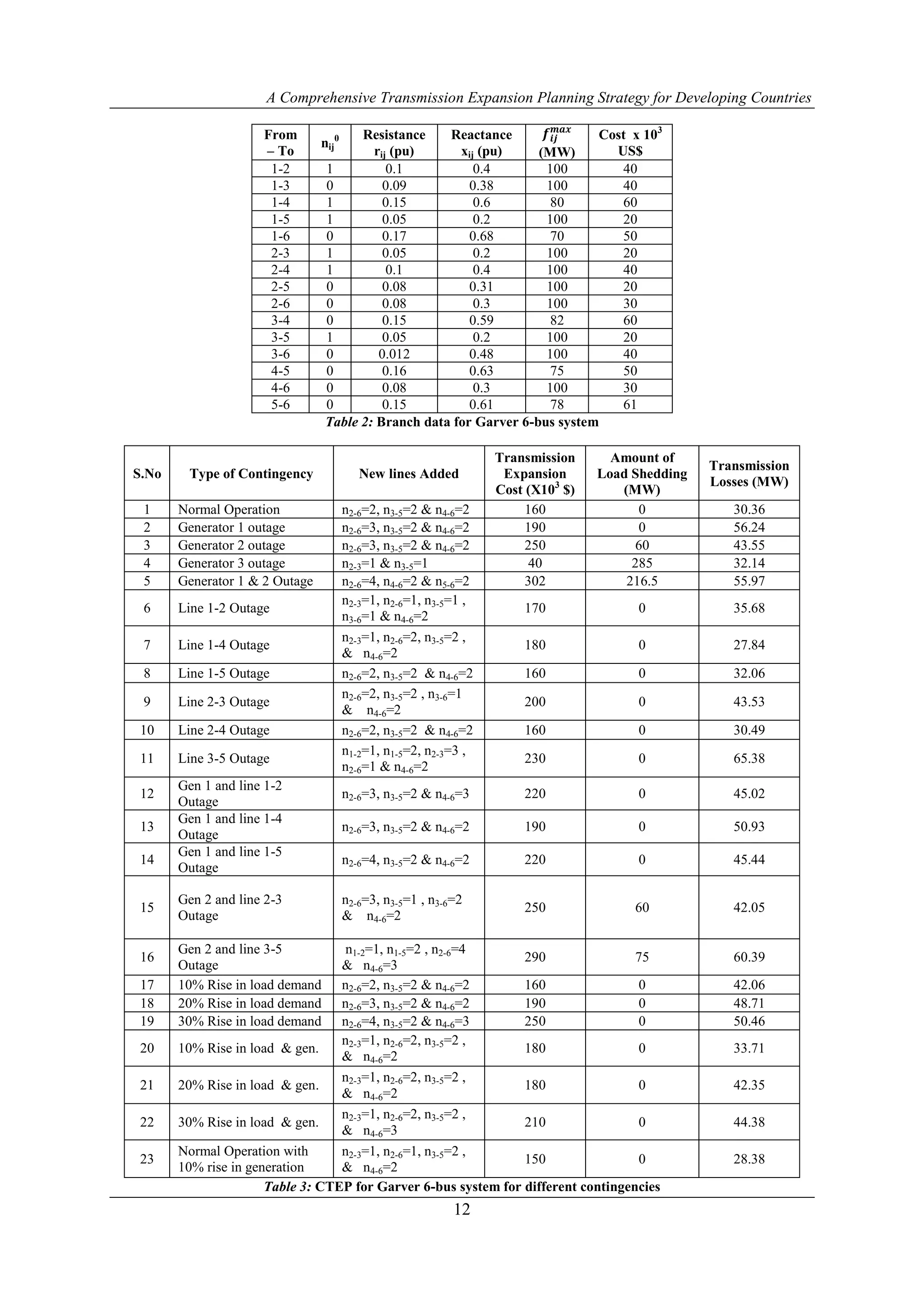
in section 3. Generation and load data and Branch data represented in table 1 and table 2 respectively. CTEP using AC Load
Flow is explained in section 5. CTEP is made for the following contingencies in this paper.
     i.   Normal Operation
    ii.   Generator Outage
   iii.   Line Outage
   iv.    Both Generator and Line Outage

                                                                      9
A Comprehensive Transmission Expansion Planning Strategy for Developing Countries

   v.     Change in Load Demand
  vi.     Change in both Generation and Load Demand
Detailed analysis of CTEP for above mentioned contingencies is explained as follows:

6.1: Normal Operation:
          In this case total load on the system is 760MW, maximum available generation is 1110MW and lines 1-2, 1-4, 1-5,
2-3, 2-4 and 3-5 are connected to the system. Before CTEP, under normal operating mode, some of the physical constraints
are not satisfied. All the constraints are satisfied after completion of CTEP. In this case new lines added are n 2-6=2, n3-5=2 &
n4-6=2, Transmission Expansion cost is 160x103 US$, losses are 30.36MW and load shedding is not taken place.

6.2: Generator Outage:
           There are three generators in the system. Here CTEP is studied for single generator outage and double generator
outage. Detailed analysis of CTEP for generator outage is explained below:
6.2.1: Outage of Generator 1:
When generator 1 is in outage, CTEP is done by satisfying all the constraints. For this mode, new lines added are n 2-6=3, n3-
                                         3
5=2 & n4-6=2, expansion cost is 190x10 US$, losses are 56.24MW and load shedding is not made.
6.2.2: Outage of Generator 2:
In case of outage of generator 2, CTEP is accomplished in fulfilling all the constraints. In this mode, new lines included are
n2-6=3, n3-5=2 & n4-6=2, extension cost is 250x103 US$, losses are 43.55MW and 60MW of load is gone for shedding.
6.2.3: Outage of Generator 3:
While generator 3 is outage state, CTEP is prepared by satisfying all the constraints. In this case, new lines incorporated are
n2-3=1 & n3-5=1, lines addition cost is 40x103 US$, losses are 32.14MW and 285MW of load is left for shedding.
6.2.4: Outage of Generator 1 and Generator 2:
If both the generator 1 and 2 are in outage, CTEP is completed via gratifying all the constraints. For this approach, new lines
integrated are n2-6=4, n4-6=2 & n5-6=2, expansion cost is 302x103 US$, losses are 55.97MW and 216.5MW of load is gone for
shedding.

6.3: Line Outage:
           Presently Garver 6-bus system has 6 lines. In this case CTEP is discussed for single line outages. Thorough
analysis of CTEP for line outage is enlightened as follows:
6.3.1: Outage of Line 1-2:
CTEP is made by satisfying all the constraints for outage of line 1-2. For this mode, new lines added are n2-3=1, n2-6=1, n3-
                                                3
5=1, n3-6=1 & n4-6=2, expansion cost is 170x10 US$, losses are 35.68MW and load shedding is not made.
6.3.2: Outage of Line 1-4:
CTEP is accomplished in fulfilling all the constraints for outage of line 1-4. In this mode, new lines included are n 2-3=1, n2-
                                                3
6=2, n3-5=2, & n4-6=2, extension cost is 180x10 US$, losses are 27.84MW and no load is gone for shedding.
6.3.3: Outage of Line 1-5:
CTEP is prepared by satisfying all the constraints for outage of line 1-5. In this case, new lines incorporated are n2-6=2, n3-
                                            3
5=2 & n4-6=2, lines addition cost is 160x10 US$, losses are 32.06MW and load shedding is not taken place.
6.3.4: Outage of Line 2-3:
CTEP is completed via gratifying all the constraints when line 2-3 is gone for outage. For this approach, new lines integrated
are n2-6=2, n3-5=2, n3-6=1 & n4-6=2, expansion cost is 200x103 US$, losses are 43.53MW and 216.5MW of load is gone for
shedding.
6.3.5: Outage of Line 2-4:
CTEP is finished through satisfying all the constraints while line 2-4 is left for outage. For this mode, new lines included are
n2-6=2, n3-5=2, n3-6=1 & n4-6=2, expansion cost is 160x103 US$, losses are 30.49MW and load shedding is 0.
6.3.6: Outage of Line 3-5:
CTEP is done by satisfying all the constraints while line 2-4 is left for outage. For this case, new lines incorporated are n2-
                                                       3
6=2, n3-5=2, n3-6=1 & n4-6=2, expansion cost is 230x10 US$, losses are 65.38MW and load shedding is mot made.


6.4: Both Generator and Line Outage:
          Combination of generator and line outages are considered in this approach. CTEP is made for both generator and
line outages by fulfilling all the constraints and scrupulous study is explained as follows:
6.4.1: Outage of Generator 1 and Line 1-2:
In case of CTEP for outage of generator 1 and line 1-2, new lines added are n2-6=3, n3-5=2 & n4-6=3, expansion cost is
220x103 US$, losses are 45.02MW and load shedding is not made.
6.4.2: Outage of Generator 1 and Line 1-4:
In view of CTEP for outage of generator 1 and line 1-4, new lines included are n2-6=3, n3-5=2 & n4-6=2, extension cost is
190x103 US$, losses are 50.93MW and no load is gone for shedding.
6.4.3: Outage of Generator 1 and Line 1-5:
Since CTEP for outage of generator 1 and line 1-5, new lines incorporated are n2-6=4, n3-5=2 & n4-6=2, lines addition cost is
220x103 US$, losses are 45.44MW and load shedding is not taken place.
6.4.4: Outage of Generator 2 and Line 2-3:
While CTEP for outage of generator 2 and line 2-3, new lines integrated are n2-6=3, n3-5=1, n3-6=2 & n4-6=2, expansion cost
is 250x103 US$, losses are 42.05MW and 60MW of load is gone for shedding.
6.4.5: Outage of Generator 2 and Line 3-5:

                                                              10
A Comprehensive Transmission Expansion Planning Strategy for Developing Countries

In view of CTEP for outage of generator 2 and line 3-5, new lines included are n1-2=1, n1-5=2, n2-6=4 & n4-6=3, expansion
cost is 290x103 US$, losses are 60.35MW and 75MW of load is left for shedding.

6.5: Change in Load Demand:
          In the developing countries like India, there will be around 10% load growth per year. In this case, 10%, 20% and
30% load growth is considered, then CTEP is prepared by satisfying all the constraints and thorough study is explained as
follows:
6.5.1: 10% Rise in Load Demand:
CTEP is made for 10% rise in load demand, then new lines added are n 2-6=2, n3-5=2 & n4-6=2, expansion cost is 160x103
US$, losses are 42.06MW and load shedding is not made.
6.5.2: 20% Rise in Load demand:
CTEP is prepared for 20% rise in load demand, then new lines included are n2-6=3, n3-5=2 & n4-6=2, extension cost is
190x103 US$, losses are 48.71MW and no load is gone for shedding.
6.5.3: 30% Rise in Load demand:
CTEP is accomplished for 30% rise in load demand, then new lines incorporated are n 2-6=4, n3-5=2 & n4-6=3, lines addition
cost is 250x103 US$, losses are 50.46MW and load shedding is not taken place.

6.6: Change in both Generation and Load Demand:
          In the developing countries like India, there will be around 10% load growth per year and consequently grow in
Generation on par with increase in load. In this mode, 10%, 20% and 30% rise in both generation and load is considered,
then CTEP is accomplished by fulfilling all the constraints and detailed study is explained as follows:
6.6.1: 10% Rise in Generation and Load Demand:
In view of CTEP for 10% rise in Generation and load demand, then new lines added are            n2-3=1, n2-6=2, n3-5=2 & n4-6=2,
expansion cost is 180x103 US$, losses are 33.71MW and load shedding is not made.
6.6.2: 20% Rise in Generation and Load demand:
In case of CTEP for 20% rise in Generation and load demand, then new lines included are n2-3=1, n2-6=2, n3-5=2 & n4-6=2,
extension cost is 180x103 US$, losses are 42.35MW and no load is gone for shedding.
6.6.3: 30% Rise in Generation and Load demand:
Since CTEP for 30% rise in Generation and load demand, then new lines incorporated are n2-3=1, n2-6=2, n3-5=2 & n4-6=3,
lines addition cost is 210x103 US$, losses are 44.38MW and load shedding is not taken place.

6.7: 10% Rise in Generation with Normal Operation:
          CTEP is prepared for 10% rise in Generation with normal operation, new lines integrated are n 2-3=1, n2-6=1, n3-5=2
& n4-6=2, expansion cost is 150x103 US$, losses are 28.38MW and there is no load shedding.
Table 3 represents CTEP for all type of contingencies mentioned in this paper.


                                               Figure:1 Garver 6 bus system

                                                Generation (MW)
                                 Bus No                                   Load (MW)
                                              Maximum         Level
                                   1             150            50             80
                                   2              0             0             240
                                   3             360           165             40
                                   4              0             0             160
                                   5              0             0             240
                                   6             600           545             0
                               Table 1: Generation and Load data for Garver 6-bus system

                                                              11
A Comprehensive Transmission Expansion Planning Strategy for Developing Countries
                                                                        𝒎𝒂𝒙
                     From              Resistance    Reactance       𝒇 𝒊𝒋    Cost x 103
                                nij0
                     – To                rij (pu)      xij (pu)     (MW)       US$
                      1-2        1          0.1           0.4        100        40
                      1-3        0         0.09          0.38        100        40
                      1-4        1         0.15           0.6         80        60
                      1-5        1         0.05           0.2        100        20
                      1-6        0         0.17          0.68         70        50
                      2-3        1         0.05           0.2        100        20
                      2-4        1          0.1           0.4        100        40
                      2-5        0         0.08          0.31        100        20
                      2-6        0         0.08           0.3        100        30
                      3-4        0         0.15          0.59         82        60
                      3-5        1         0.05           0.2        100        20
                      3-6        0        0.012          0.48        100        40
                      4-5        0         0.16          0.63         75        50
                      4-6        0         0.08           0.3        100        30
                      5-6        0         0.15          0.61         78        61
                                 Table 2: Branch data for Garver 6-bus system

                                                                  Transmission      Amount of
                                                                                                  Transmission
S.No    Type of Contingency               New lines Added          Expansion      Load Shedding
                                                                                                  Losses (MW)
                                                                  Cost (X103 $)      (MW)
 1     Normal Operation                n2-6=2, n3-5=2 & n4-6=2         160              0            30.36
 2     Generator 1 outage              n2-6=3, n3-5=2 & n4-6=2         190              0            56.24
 3     Generator 2 outage              n2-6=3, n3-5=2 & n4-6=2         250              60           43.55
 4     Generator 3 outage              n2-3=1 & n3-5=1                  40             285           32.14
 5     Generator 1 & 2 Outage          n2-6=4, n4-6=2 & n5-6=2         302            216.5          55.97
                                       n2-3=1, n2-6=1, n3-5=1 ,
 6     Line 1-2 Outage                                                170              0             35.68
                                       n3-6=1 & n4-6=2
                                       n2-3=1, n2-6=2, n3-5=2 ,
 7     Line 1-4 Outage                                                180              0             27.84
                                       & n4-6=2
 8     Line 1-5 Outage                 n2-6=2, n3-5=2 & n4-6=2        160              0             32.06
                                       n2-6=2, n3-5=2 , n3-6=1
 9     Line 2-3 Outage                                                200              0             43.53
                                       & n4-6=2
10     Line 2-4 Outage                 n2-6=2, n3-5=2 & n4-6=2        160              0             30.49
                                       n1-2=1, n1-5=2, n2-3=3 ,
11     Line 3-5 Outage                                                230              0             65.38
                                       n2-6=1 & n4-6=2
       Gen 1 and line 1-2
12                                     n2-6=3, n3-5=2 & n4-6=3        220              0             45.02
       Outage
       Gen 1 and line 1-4
13                                     n2-6=3, n3-5=2 & n4-6=2        190              0             50.93
       Outage
       Gen 1 and line 1-5
14                                     n2-6=4, n3-5=2 & n4-6=2        220              0             45.44
       Outage

       Gen 2 and line 2-3              n2-6=3, n3-5=1 , n3-6=2
15                                                                    250              60            42.05
       Outage                          & n4-6=2

       Gen 2 and line 3-5          n1-2=1, n1-5=2 , n2-6=4
16                                                              290                75                60.39
       Outage                     & n4-6=3
17     10% Rise in load demand    n2-6=2, n3-5=2 & n4-6=2       160                0                 42.06
18     20% Rise in load demand    n2-6=3, n3-5=2 & n4-6=2       190                0                 48.71
19     30% Rise in load demand    n2-6=4, n3-5=2 & n4-6=3       250                0                 50.46
                                  n2-3=1, n2-6=2, n3-5=2 ,
20     10% Rise in load & gen.                                  180                0                 33.71
                                  & n4-6=2
                                  n2-3=1, n2-6=2, n3-5=2 ,
21     20% Rise in load & gen.                                  180                0                 42.35
                                  & n4-6=2
                                  n2-3=1, n2-6=2, n3-5=2 ,
22     30% Rise in load & gen.                                  210                0                 44.38
                                  & n4-6=3
       Normal Operation with      n2-3=1, n2-6=1, n3-5=2 ,
23                                                              150                0                 28.38
       10% rise in generation     & n4-6=2
                      Table 3: CTEP for Garver 6-bus system for different contingencies
                                                            12
A Comprehensive Transmission Expansion Planning Strategy for Developing Countries

                                              VII.      CONCLUSION
           Comprehensive Transmission Expansion Planning (CTEP) is proposed for Garver 6-bus system. CTEP is
completed by considering physical and operational constraints to achieve optimal transmission planning cost, reliability and
reduced transmission losses. CTEP is developed for contingencies like generator outage, line outage, combined generator
and line outage, rise in load demand and rise in both generation and load demand. CTEP for Garver 6-bus system for
different contingencies is shown in Table 3. In this paper, optimal transmission cost, reliability and reduced transmission
losses are achieved using CTEP for a Garver 6-bus system.

                                                   REFERENCES
  [1].    Power System Engineering by DP Kothari and IJ Nagrath, second edition, Tata McGraw-Hill publishing company
          limited, 2008.
  [2].    CW Lee, KK Nag, J Zhong and Felix F Wu, “Transmission Expansion Planning from Past to future”, Power
          Systems Conference and Exposition, 2006. PSCE '06. 2006 IEEE PES.
  [3].    G.Latorre, R.D.Cruz, and J.M.Arezia, “Classification of publications and models on Transmission Expansion
          Planning” presented at IEEE PES transmission and Distribution Conf., Brazil, Mar. 2002.
  [4].    R. Villasana, Troy, L.L. Garver, S.J. Salon, “Transmission network planning using linear programming”, IEEE
          Transactions on Power Apparatus and Systems, Vol. PAS-104, No. 2, February 1985.
  [5].    Silvio Binato, Mário Veiga F. Pereira, and Sérgio Granville, “A New Benders Decomposition Approach to Solve
          Power Transmission Network Design Problems”, IEEE Transactions on Power Systems, Vol. 16, No. 2, May
          2001.
  [6].    Dariush Shirmohammadi and Xisto Vieira Fib and Boris Gorenstin, “Some fundamental technical concepts about
          Cost based transmission pricing”, IEEE Transactions on Power Systems, Vol. 11, No. 2, May 1996.
  [7].    Lee, C.W.; Ng, S.K.K.; Zhong, J.; Wu, F.F, “Transmission Expansion Planning From Past to Future”, Power
          Systems Conference and Exposition, 2006. PSCE '06, IEEE PES, pages: 257 – 265
  [8].    Nadira, R. Austria, R.R. Dortolina, C.A. Lecaros, F, “Transmission planning in the presence of uncertainties”,
          Power Engineering Society General Meeting, 2003, IEEE Vol: 1, pages: 289-294.
  [9].    Al-Hamouz, Z.M.; Al-Faraj, A.S. “Transmission expansion planning using nonlinear programming”,
          Transmission and Distribution Conference and Exhibition 2002: Asia Pacific. IEEE/PES, pages: 50 – 55, vol.1.
  [10].   T. Tachikawa et al., “A study of transmission planning under a deregulated environment in power system,” in
          Proc. IEEE Int. Conf. Electric Utility Deregulation and Restructuring, 2000, pp. 649–654.
  [11].   M. Oloomi Buygi, H. Modir Shanechi, and M. Shahidehpour, “Transmission planning in deregulated
          environments”, International Journal of Engineering, Vol. 15, No. 3, pp. 249-256, Oct. 2002.


                                                            13

IJERD (www.ijerd.com) International Journal of Engineering Research and Development

  • 1.
    International Journal ofEngineering Research and Development e-ISSN: 2278-067X, p-ISSN: 2278-800X, www.ijerd.com Volume 2, Issue 11 (August 2012), PP. 07-13 A Comprehensive Transmission Expansion Planning Strategy for Developing Countries Mr G.Srinivasulu1, Dr B Subramanyam2 1 Associate Professor, Dept of Electrical & Electronics Engineering, Narayana Engineering College, Nellore-524004(India) 2 Professor, Dept of Electrical & Electronics Engineering, KL University, Vijayawada-520002(India) Abstract––In the recent past, developing countries are moving into Electricity Deregulation. As Electric load demand raise, Transmission Expansion Planning must be developed in a suitable and appropriate way to provide reliable and quality power to the consumers. The objective of the paper is to present a Comprehensive Transmission Expansion Planning (CTEP) by considering physical and operational constraints like power balance, power flow limit on transmission lines, power generation limit, right-off-way and bus voltage phase angle limit. CTEP is proposed for Garver 6-bus system in view of contingencies like generator outage, line outage, combined generator and line outage, rise in load demand and rise in both generation and load demand. CTEP is proposed to achieve optimal planning cost, increased reliability and reduced transmission losses. AC load flow using Newton Raphson Method is considered for making CTEP in this paper. Keywords––CTEP, right –off-way, optimal planning cost, reliability, Transmission losses and AC load flow I. INTRODUCTION Electrical energy is acceptable form of energy since it can be transported simply at high efficiency and sensible cost. Currently the Electrical Power Systems are large-scale and highly composite interconnected transmission systems. An electric power system can be subdivided into three major parts like generation, transmission and distribution. The principle of a transmission system is to transmit electrical energy from generating stations located at various places to the distribution systems and to ultimately provide supply to the load centers. Transmission system interconnects the adjacent utilities to allow economic dispatch of power across different areas during normal and emergency conditions. In the recent past, the quantity of electrical power to be transferred from generating stations to major load centers has been rising significantly. Owing to mounting costs and the essential need for reliable electrical power systems, appropriate and best possible design methods for different parts of the power system are necessary. Transmission system occupies a major part of any power system, thus they have to be perfectly and efficiently planned [7]. Due to augmentation of power system, grid connected transmission lines have emerged, providing different paths for power flows from various generators to loads improving the reliability of continuous supply. Interconnection of transmission system removes the imbalance of generation and load by transmitting surplus power to the regions which are having deficiency of power. Supplementary transmission capability is necessary, whenever there is a need to transmit cheaper power to meet mounting load demand or improve system reliability or both. II. OBJECTIVE OF TEP The aim of Transmission Expansion Planning (TEP) is to specify addition of transmission lines that give sufficient power and at the same time maintain reliability of transmission system [3]. To congregate demand escalation, generation addition and augmented power flow, Transmission Expansion Planning must identify efficient plan, precise site, capacity, timing and type of novel transmission apparatus [3]. One of the major challenge in power system optimization is that TEP should be cost-effective in spite of the problem being complex, large-scale and nonlinear [5]. Planning horizon, instance topology of the base year, candidate circuits, load forecast, generation expansion and investment constraints are to be considered for TEP, increasing the complexity of the problem [3]. Comprehensive Transmission Expansion Planning (CTEP) shall be made based on analysis of AC load flow or DC load flow. Real and Reactive Power flows can be obtained from AC load flow or DC load flow [1]. In this paper AC load flow is considered in view of including transmission losses, but in DC load flow transmission losses are zero. CTEP can be computed by analyzing the line flows between whether they are exceeded or not and detailed analysis is as described in section 5. III. PROBLEM STATEMENT The TEP presents the problem of finding the finest number of transmission lines that must be added to an existing network to supply the forecasted load demand as economically as possible by considering operating constraints [5]. The physical and economical constraints are to be considered in the TEP to minimize the capital and operating costs of the electrical transmission network [3]. The constraints are very vital while attempting to develop a power system at a lowest cost considering fiscal and load restrictions that placed upon the system [7]. The TEP problem can be defined in the following manner [3]: 7
  • 2.
    A Comprehensive TransmissionExpansion Planning Strategy for Developing Countries 𝑁𝐵 𝑁𝐵 𝑁𝐿 min 𝜈 = 𝐶 𝑖𝑗 𝑛 𝑖𝑗 + 𝐾 𝐼2 𝑅 𝑖 𝑖 (1) 𝑖=1 𝑗 =1 𝑖=1 Cij- Cost of the new transmission line added to line i-j nij- Number of transmission lines added to the line i-j NB- Total number of buses K- Loss coefficient, K=8760*NYE*CkWh NYE- Anticipated life span of the Transmission Expansion Network in years CkWh- Cost of one kWh in $/kWh Ri- Resistance of the ith line Ii- Current through ith line NL- Number of present transmission lines The loss coefficient (K) relies on the number of years of operation and the cost of kWh i.e. cost of kWh increases with number of years of operation that leads to rise in loss coefficient [4]. The TEP problem (1) represents the capital cost of the recently installed transmission lines, it has some restrictions to solve it. To find optimal solution of TEP, physical and operational constraints must be included into the mathematical model. The constraints are explained as follows [7]: 3.1 Power Flow Node Balance The non linear equality constraint represents the conservation of power at each node, i.e. 𝑃 𝐺𝑖 = 𝑃 𝐷𝑖 + 𝑃𝑖 (2) for i=1, 2 ….NB Where PGi, PDi and Pi is real power generation, real load demand and real power injection at bus i, respectively. 3.2 Power Flow Limit On Transmission Lines The inequality constraint of power flow limit on transmission line for each path is 𝑃𝑖𝑗 ≤ 𝑛0 + 𝑛 𝑖𝑗 𝑃𝑖𝑗𝑚𝑎𝑥 𝑖𝑗 3 Where P ij, Pijmax, nij and nij0 gives total power flow through transmission line i-j, maximum power flow through transmission line i-j, number of lines added to transmission line i-j and number of transmission lines in original base system, respectively. 3.3 Power Generation Limit In TEP, power generation limit should be incorporated as one of the constraints. Mathematically, it can be represented as follows: 𝑃 𝑔𝑖𝑚𝑖𝑛 ≤ 𝑃 𝑔𝑖 ≤ 𝑃 𝑔𝑖𝑚𝑎𝑥 (4) Where Pgi, Pgimin and Pgimax is real power generation at bus I, the lower and upper real power generation bounds at bus i, respectively. 3.4 Right Of Way The planners need to know the exact location and capacity of the newly required transmission lines for a precise TEP. Hence this constraint should be incorporated into the deliberation of planning problem. The new transmission line location and the maximum number of lines that can be installed in a specified location shall be obtained from this constraint, it can be represented mathematically as follows: 0 ≤ 𝑛 𝑖𝑗 ≤ 𝑛 𝑖𝑗𝑚𝑎𝑥 (5) Where nij and nijmax is the total number of lines added to the transmission line i-j and the maximum number of added lines in the transmission line i-j, respectively. 3.5 Bus Voltage Phase Angle Limit The bus voltage phase angle is incorporated as a TEP constraint and the calculated voltage phase angle (θ ical) must be less than the specified maximum voltage phase angle (θ imax), it can be defined mathematically as: 𝜃 𝑖𝑐𝑎𝑙 ≤ 𝜃 𝑖 𝑚𝑎𝑥 (6) To check the reliability of the transmission system, the TEP problem should not only consider the usual operation but also incorporate contingencies due to changes in the system, e.g., generator outage, line outage, load uncertainties, etc. 3.6 Generator Outage Generating capacity may be reduced by declaring a “forced outage” to make repairs, or by extending a planned outage for maintenance. Reducing generating capacity may be lead to an artificial shortage of electricity supply and create reliability problems. Due to internal or external faults of generators, generator outage may be happened, hence this constraint should be included in TEP problem. 3.7 Transmission Line Outage The main reasons of transmission line outages are adverse weather (i.e. due to lighting, wind and icing), faulty equipment, foreign intervention, bad environment, and human element, it leads to interruption of power supply, hence this constraint must be incorporated in TEP problem. 8
  • 3.
    A Comprehensive TransmissionExpansion Planning Strategy for Developing Countries 3.8 Load Uncertainties The reasons for uncertainty in load are, that the load is always variable, future load is a random variable, random results may be produced by load forecasting methods, errors in forecasted result and the majority of methods suffer from missing data and input data accuracy. Hence, this constraint must be integrated in TEP problem. IV. AC LOAD FLOW Load flow analysis gives steady state information about bus voltages, current injections at all buses, real and reactive power flows through transmission lines for given power system. The representation of AC load flow can be illustrated by the equations given below: 𝑛 𝑃𝑖 = 𝑉𝑖 𝑉𝑘 𝑌𝑖𝑘 cos 𝜃 𝑖𝑘 + 𝛿 𝑘 − 𝛿 𝑖 (7) 𝑘=1 𝑛 𝑄𝑖 = − 𝑉𝑖 𝑉𝑘 𝑌𝑖𝑘 sin 𝜃 𝑖𝑘 + 𝛿 𝑘 − 𝛿 𝑖 (8) 𝑘=1 For i=1, 2…NB and k=1, 2 …NB Where Pi, Qi, 𝑉𝑖 , 𝜃 𝑖𝑘 , 𝛿 𝑖 and 𝛿 𝑘 is real power injection, reactive power injection, voltage magnitude at bus i, admittance angle of line i-k, voltage phase angle at bus i and voltage phase angle at bus k, respectively. In this paper, to solve AC load flow, Newton-Raphson (NR) method [1] is considered. The following steps are involved in solving AC load flow using NR method [1]: i. Reading the bus data, line data, initial guess and convergence criteria. ii. Forming the bus admittance matrix. iii. Setting the bus count i=2 and iteration count r=0. iv. Testing the type of bus, If bus is PQ bus, find Pir and Qir using equation (7) and (8) respectively and also find ∆𝑃𝑖 𝑟 = 𝑃𝑖 𝑠𝑝𝑒𝑐𝑖𝑓𝑖𝑒𝑑 − 𝑃𝑖 𝑟 and ∆𝑄 𝑖𝑟 = 𝑄 𝑖 𝑠𝑝𝑒𝑐𝑖𝑓𝑖𝑒𝑑 − 𝑄 𝑖𝑟 . If bus is PV bus, calculate Pir and Qir using equation (7) and (8) respectively and also determine ∆𝑃𝑖 𝑟 = 𝑃𝑖 𝑠𝑝𝑒𝑐𝑖𝑓𝑖𝑒𝑑 − 𝑃𝑖 𝑟 . v. Advancing the bus count 𝑖 → 𝑖 + 1 and if 𝑖 < 𝑛, go to step iv and otherwise go to step vi. vi. Checking the change in power i.e. to verify whether ∆𝑃𝑖 𝑟 ≤ 𝜖 and ∆𝑄 𝑖𝑟 ≤ 𝜖 are satisfied or not. If this condition is satisfied, go to step xi and otherwise go to step vii to find Jacobian Matrix. vii. Computing the elements of Jacobian Matrix „J‟. viii. Calculating the change in voltage magnitudes and phase angles using P ir, Qir and J. ix. Updating the voltage magnitudes and phase angles and then go to step x. x. Advancing the iteration count 𝑟 → 𝑟 + 1 and then go to step iv. xi. Computing the slack bus powers and line flows. xii. Printing the results and stop the iteration. V. CTEP USING AC LOAD FLOW CTEP can be made using AC load flow analysis, since it gives real and reactive power flows and line flows. The steps involved in CTEP using AC load flow by considering constraints as explained in section 3, are explained as follows: i. Reading the bus data, line data, initial guess, convergence criteria and constraints involved in CTEP. ii. Executing the AC load flow using NR Method. iii. Checking the power balance equation is satisfied or not. If it is satisfied, go to step v, otherwise transmit power from other areas to balance the load or go for load shedding to balance the load. iv. Testing the generating power is within the specified limits or not. If it exceeds the maximum limit, reduce load on that generator and if it exceeds the minimum limit stop the generator. v. Verifying the line flows are within the limits or not. If line flows exceeded the specified line flow limit, find which line has highest exceeded line flow then add a line across it and go to step ii to run AC load flow, otherwise go to step vi. vi. Checking the number of lines between any two buses exceeded right off way limit or not. If it is exceeded, remove the line and go to step ii, otherwise go to step vii. vii. If there is generator outage, go to step ii, otherwise go to step viii. viii. If there is line outage, go to step ii, otherwise go to step ix. ix. If there is load uncertainty, go to step ii, otherwise go to step x. x. Printing the results and find the cost required for adding new transmission lines. VI. RESULTS & DISCUSSION In this paper Garver 6-bus system is taken as case study. Single line diagram of Garver 6-bus system is shown in figure 1. Comprehensive Transmission Expansion Planning (CTEP) is done based on optimum expansion cost, reliable operation and reducing transmission losses by satisfying the physical and operational constraints from 3.1 to 3.5 as explained in section 3. Generation and load data and Branch data represented in table 1 and table 2 respectively. CTEP using AC Load Flow is explained in section 5. CTEP is made for the following contingencies in this paper. i. Normal Operation ii. Generator Outage iii. Line Outage iv. Both Generator and Line Outage 9
  • 4.
    A Comprehensive TransmissionExpansion Planning Strategy for Developing Countries v. Change in Load Demand vi. Change in both Generation and Load Demand Detailed analysis of CTEP for above mentioned contingencies is explained as follows: 6.1: Normal Operation: In this case total load on the system is 760MW, maximum available generation is 1110MW and lines 1-2, 1-4, 1-5, 2-3, 2-4 and 3-5 are connected to the system. Before CTEP, under normal operating mode, some of the physical constraints are not satisfied. All the constraints are satisfied after completion of CTEP. In this case new lines added are n 2-6=2, n3-5=2 & n4-6=2, Transmission Expansion cost is 160x103 US$, losses are 30.36MW and load shedding is not taken place. 6.2: Generator Outage: There are three generators in the system. Here CTEP is studied for single generator outage and double generator outage. Detailed analysis of CTEP for generator outage is explained below: 6.2.1: Outage of Generator 1: When generator 1 is in outage, CTEP is done by satisfying all the constraints. For this mode, new lines added are n 2-6=3, n3- 3 5=2 & n4-6=2, expansion cost is 190x10 US$, losses are 56.24MW and load shedding is not made. 6.2.2: Outage of Generator 2: In case of outage of generator 2, CTEP is accomplished in fulfilling all the constraints. In this mode, new lines included are n2-6=3, n3-5=2 & n4-6=2, extension cost is 250x103 US$, losses are 43.55MW and 60MW of load is gone for shedding. 6.2.3: Outage of Generator 3: While generator 3 is outage state, CTEP is prepared by satisfying all the constraints. In this case, new lines incorporated are n2-3=1 & n3-5=1, lines addition cost is 40x103 US$, losses are 32.14MW and 285MW of load is left for shedding. 6.2.4: Outage of Generator 1 and Generator 2: If both the generator 1 and 2 are in outage, CTEP is completed via gratifying all the constraints. For this approach, new lines integrated are n2-6=4, n4-6=2 & n5-6=2, expansion cost is 302x103 US$, losses are 55.97MW and 216.5MW of load is gone for shedding. 6.3: Line Outage: Presently Garver 6-bus system has 6 lines. In this case CTEP is discussed for single line outages. Thorough analysis of CTEP for line outage is enlightened as follows: 6.3.1: Outage of Line 1-2: CTEP is made by satisfying all the constraints for outage of line 1-2. For this mode, new lines added are n2-3=1, n2-6=1, n3- 3 5=1, n3-6=1 & n4-6=2, expansion cost is 170x10 US$, losses are 35.68MW and load shedding is not made. 6.3.2: Outage of Line 1-4: CTEP is accomplished in fulfilling all the constraints for outage of line 1-4. In this mode, new lines included are n 2-3=1, n2- 3 6=2, n3-5=2, & n4-6=2, extension cost is 180x10 US$, losses are 27.84MW and no load is gone for shedding. 6.3.3: Outage of Line 1-5: CTEP is prepared by satisfying all the constraints for outage of line 1-5. In this case, new lines incorporated are n2-6=2, n3- 3 5=2 & n4-6=2, lines addition cost is 160x10 US$, losses are 32.06MW and load shedding is not taken place. 6.3.4: Outage of Line 2-3: CTEP is completed via gratifying all the constraints when line 2-3 is gone for outage. For this approach, new lines integrated are n2-6=2, n3-5=2, n3-6=1 & n4-6=2, expansion cost is 200x103 US$, losses are 43.53MW and 216.5MW of load is gone for shedding. 6.3.5: Outage of Line 2-4: CTEP is finished through satisfying all the constraints while line 2-4 is left for outage. For this mode, new lines included are n2-6=2, n3-5=2, n3-6=1 & n4-6=2, expansion cost is 160x103 US$, losses are 30.49MW and load shedding is 0. 6.3.6: Outage of Line 3-5: CTEP is done by satisfying all the constraints while line 2-4 is left for outage. For this case, new lines incorporated are n2- 3 6=2, n3-5=2, n3-6=1 & n4-6=2, expansion cost is 230x10 US$, losses are 65.38MW and load shedding is mot made. 6.4: Both Generator and Line Outage: Combination of generator and line outages are considered in this approach. CTEP is made for both generator and line outages by fulfilling all the constraints and scrupulous study is explained as follows: 6.4.1: Outage of Generator 1 and Line 1-2: In case of CTEP for outage of generator 1 and line 1-2, new lines added are n2-6=3, n3-5=2 & n4-6=3, expansion cost is 220x103 US$, losses are 45.02MW and load shedding is not made. 6.4.2: Outage of Generator 1 and Line 1-4: In view of CTEP for outage of generator 1 and line 1-4, new lines included are n2-6=3, n3-5=2 & n4-6=2, extension cost is 190x103 US$, losses are 50.93MW and no load is gone for shedding. 6.4.3: Outage of Generator 1 and Line 1-5: Since CTEP for outage of generator 1 and line 1-5, new lines incorporated are n2-6=4, n3-5=2 & n4-6=2, lines addition cost is 220x103 US$, losses are 45.44MW and load shedding is not taken place. 6.4.4: Outage of Generator 2 and Line 2-3: While CTEP for outage of generator 2 and line 2-3, new lines integrated are n2-6=3, n3-5=1, n3-6=2 & n4-6=2, expansion cost is 250x103 US$, losses are 42.05MW and 60MW of load is gone for shedding. 6.4.5: Outage of Generator 2 and Line 3-5: 10
  • 5.
    A Comprehensive TransmissionExpansion Planning Strategy for Developing Countries In view of CTEP for outage of generator 2 and line 3-5, new lines included are n1-2=1, n1-5=2, n2-6=4 & n4-6=3, expansion cost is 290x103 US$, losses are 60.35MW and 75MW of load is left for shedding. 6.5: Change in Load Demand: In the developing countries like India, there will be around 10% load growth per year. In this case, 10%, 20% and 30% load growth is considered, then CTEP is prepared by satisfying all the constraints and thorough study is explained as follows: 6.5.1: 10% Rise in Load Demand: CTEP is made for 10% rise in load demand, then new lines added are n 2-6=2, n3-5=2 & n4-6=2, expansion cost is 160x103 US$, losses are 42.06MW and load shedding is not made. 6.5.2: 20% Rise in Load demand: CTEP is prepared for 20% rise in load demand, then new lines included are n2-6=3, n3-5=2 & n4-6=2, extension cost is 190x103 US$, losses are 48.71MW and no load is gone for shedding. 6.5.3: 30% Rise in Load demand: CTEP is accomplished for 30% rise in load demand, then new lines incorporated are n 2-6=4, n3-5=2 & n4-6=3, lines addition cost is 250x103 US$, losses are 50.46MW and load shedding is not taken place. 6.6: Change in both Generation and Load Demand: In the developing countries like India, there will be around 10% load growth per year and consequently grow in Generation on par with increase in load. In this mode, 10%, 20% and 30% rise in both generation and load is considered, then CTEP is accomplished by fulfilling all the constraints and detailed study is explained as follows: 6.6.1: 10% Rise in Generation and Load Demand: In view of CTEP for 10% rise in Generation and load demand, then new lines added are n2-3=1, n2-6=2, n3-5=2 & n4-6=2, expansion cost is 180x103 US$, losses are 33.71MW and load shedding is not made. 6.6.2: 20% Rise in Generation and Load demand: In case of CTEP for 20% rise in Generation and load demand, then new lines included are n2-3=1, n2-6=2, n3-5=2 & n4-6=2, extension cost is 180x103 US$, losses are 42.35MW and no load is gone for shedding. 6.6.3: 30% Rise in Generation and Load demand: Since CTEP for 30% rise in Generation and load demand, then new lines incorporated are n2-3=1, n2-6=2, n3-5=2 & n4-6=3, lines addition cost is 210x103 US$, losses are 44.38MW and load shedding is not taken place. 6.7: 10% Rise in Generation with Normal Operation: CTEP is prepared for 10% rise in Generation with normal operation, new lines integrated are n 2-3=1, n2-6=1, n3-5=2 & n4-6=2, expansion cost is 150x103 US$, losses are 28.38MW and there is no load shedding. Table 3 represents CTEP for all type of contingencies mentioned in this paper. Figure:1 Garver 6 bus system Generation (MW) Bus No Load (MW) Maximum Level 1 150 50 80 2 0 0 240 3 360 165 40 4 0 0 160 5 0 0 240 6 600 545 0 Table 1: Generation and Load data for Garver 6-bus system 11
  • 6.
    A Comprehensive TransmissionExpansion Planning Strategy for Developing Countries 𝒎𝒂𝒙 From Resistance Reactance 𝒇 𝒊𝒋 Cost x 103 nij0 – To rij (pu) xij (pu) (MW) US$ 1-2 1 0.1 0.4 100 40 1-3 0 0.09 0.38 100 40 1-4 1 0.15 0.6 80 60 1-5 1 0.05 0.2 100 20 1-6 0 0.17 0.68 70 50 2-3 1 0.05 0.2 100 20 2-4 1 0.1 0.4 100 40 2-5 0 0.08 0.31 100 20 2-6 0 0.08 0.3 100 30 3-4 0 0.15 0.59 82 60 3-5 1 0.05 0.2 100 20 3-6 0 0.012 0.48 100 40 4-5 0 0.16 0.63 75 50 4-6 0 0.08 0.3 100 30 5-6 0 0.15 0.61 78 61 Table 2: Branch data for Garver 6-bus system Transmission Amount of Transmission S.No Type of Contingency New lines Added Expansion Load Shedding Losses (MW) Cost (X103 $) (MW) 1 Normal Operation n2-6=2, n3-5=2 & n4-6=2 160 0 30.36 2 Generator 1 outage n2-6=3, n3-5=2 & n4-6=2 190 0 56.24 3 Generator 2 outage n2-6=3, n3-5=2 & n4-6=2 250 60 43.55 4 Generator 3 outage n2-3=1 & n3-5=1 40 285 32.14 5 Generator 1 & 2 Outage n2-6=4, n4-6=2 & n5-6=2 302 216.5 55.97 n2-3=1, n2-6=1, n3-5=1 , 6 Line 1-2 Outage 170 0 35.68 n3-6=1 & n4-6=2 n2-3=1, n2-6=2, n3-5=2 , 7 Line 1-4 Outage 180 0 27.84 & n4-6=2 8 Line 1-5 Outage n2-6=2, n3-5=2 & n4-6=2 160 0 32.06 n2-6=2, n3-5=2 , n3-6=1 9 Line 2-3 Outage 200 0 43.53 & n4-6=2 10 Line 2-4 Outage n2-6=2, n3-5=2 & n4-6=2 160 0 30.49 n1-2=1, n1-5=2, n2-3=3 , 11 Line 3-5 Outage 230 0 65.38 n2-6=1 & n4-6=2 Gen 1 and line 1-2 12 n2-6=3, n3-5=2 & n4-6=3 220 0 45.02 Outage Gen 1 and line 1-4 13 n2-6=3, n3-5=2 & n4-6=2 190 0 50.93 Outage Gen 1 and line 1-5 14 n2-6=4, n3-5=2 & n4-6=2 220 0 45.44 Outage Gen 2 and line 2-3 n2-6=3, n3-5=1 , n3-6=2 15 250 60 42.05 Outage & n4-6=2 Gen 2 and line 3-5 n1-2=1, n1-5=2 , n2-6=4 16 290 75 60.39 Outage & n4-6=3 17 10% Rise in load demand n2-6=2, n3-5=2 & n4-6=2 160 0 42.06 18 20% Rise in load demand n2-6=3, n3-5=2 & n4-6=2 190 0 48.71 19 30% Rise in load demand n2-6=4, n3-5=2 & n4-6=3 250 0 50.46 n2-3=1, n2-6=2, n3-5=2 , 20 10% Rise in load & gen. 180 0 33.71 & n4-6=2 n2-3=1, n2-6=2, n3-5=2 , 21 20% Rise in load & gen. 180 0 42.35 & n4-6=2 n2-3=1, n2-6=2, n3-5=2 , 22 30% Rise in load & gen. 210 0 44.38 & n4-6=3 Normal Operation with n2-3=1, n2-6=1, n3-5=2 , 23 150 0 28.38 10% rise in generation & n4-6=2 Table 3: CTEP for Garver 6-bus system for different contingencies 12
  • 7.
    A Comprehensive TransmissionExpansion Planning Strategy for Developing Countries VII. CONCLUSION Comprehensive Transmission Expansion Planning (CTEP) is proposed for Garver 6-bus system. CTEP is completed by considering physical and operational constraints to achieve optimal transmission planning cost, reliability and reduced transmission losses. CTEP is developed for contingencies like generator outage, line outage, combined generator and line outage, rise in load demand and rise in both generation and load demand. CTEP for Garver 6-bus system for different contingencies is shown in Table 3. In this paper, optimal transmission cost, reliability and reduced transmission losses are achieved using CTEP for a Garver 6-bus system. REFERENCES [1]. Power System Engineering by DP Kothari and IJ Nagrath, second edition, Tata McGraw-Hill publishing company limited, 2008. [2]. CW Lee, KK Nag, J Zhong and Felix F Wu, “Transmission Expansion Planning from Past to future”, Power Systems Conference and Exposition, 2006. PSCE '06. 2006 IEEE PES. [3]. G.Latorre, R.D.Cruz, and J.M.Arezia, “Classification of publications and models on Transmission Expansion Planning” presented at IEEE PES transmission and Distribution Conf., Brazil, Mar. 2002. [4]. R. Villasana, Troy, L.L. Garver, S.J. Salon, “Transmission network planning using linear programming”, IEEE Transactions on Power Apparatus and Systems, Vol. PAS-104, No. 2, February 1985. [5]. Silvio Binato, Mário Veiga F. Pereira, and Sérgio Granville, “A New Benders Decomposition Approach to Solve Power Transmission Network Design Problems”, IEEE Transactions on Power Systems, Vol. 16, No. 2, May 2001. [6]. Dariush Shirmohammadi and Xisto Vieira Fib and Boris Gorenstin, “Some fundamental technical concepts about Cost based transmission pricing”, IEEE Transactions on Power Systems, Vol. 11, No. 2, May 1996. [7]. Lee, C.W.; Ng, S.K.K.; Zhong, J.; Wu, F.F, “Transmission Expansion Planning From Past to Future”, Power Systems Conference and Exposition, 2006. PSCE '06, IEEE PES, pages: 257 – 265 [8]. Nadira, R. Austria, R.R. Dortolina, C.A. Lecaros, F, “Transmission planning in the presence of uncertainties”, Power Engineering Society General Meeting, 2003, IEEE Vol: 1, pages: 289-294. [9]. Al-Hamouz, Z.M.; Al-Faraj, A.S. “Transmission expansion planning using nonlinear programming”, Transmission and Distribution Conference and Exhibition 2002: Asia Pacific. IEEE/PES, pages: 50 – 55, vol.1. [10]. T. Tachikawa et al., “A study of transmission planning under a deregulated environment in power system,” in Proc. IEEE Int. Conf. Electric Utility Deregulation and Restructuring, 2000, pp. 649–654. [11]. M. Oloomi Buygi, H. Modir Shanechi, and M. Shahidehpour, “Transmission planning in deregulated environments”, International Journal of Engineering, Vol. 15, No. 3, pp. 249-256, Oct. 2002. 13