This paper discusses the optimal sizing and placement of offshore wind farms and D-STATCOM devices within a coastal distribution power system, specifically modeled on an IEEE 33-bus system. A multi-objective optimization framework is employed, utilizing a teaching-learning algorithm to enhance reactive power compensation and minimize costs while ensuring voltage stability and network security. The results from MATLAB simulations indicate that the proposed methods yield efficient placements and improve overall system performance.
![International Journal of Electrical and Computer Engineering (IJECE)
Vol. 11, No. 6, December 2021, pp. 4641~4648
ISSN: 2088-8708, DOI: 10.11591/ijece.v11i6.pp4641-4648 4641
Journal homepage: http://ijece.iaescore.com
Resource aware wind farm and D-STATCOM optimal sizing
and placement in a distribution power system
Anzum Ansari1
, Shankarlingappa C. Byalihal2
1
Department of Electrical and Electronics Engineering (EEE), Acharya Institute of Technology, Bengaluru, India
1,2
Department of Electrical and Electronics Engineering (EEE), Dr. Ambedkar Institute of Technology, Bengaluru, India
Article Info ABSTRACT
Article history:
Received Oct 14, 2020
Revised May 20, 2021
Accepted Jun 8, 2021
Doubly fed induction generators (DFIG) based wind farms are capable of
providing reactive power compensation. Compensation capability
enhancement using reactors such as distributed static synchronous
compensator (D-STATCOM) while connecting distribution generation (DG)
systems to grid is imperative. This paper presents an optimal placement and
sizing of offshore wind farms in a coastal distribution system that is emulated
on an IEEE 33 bus system. A multi-objective formulation for optimal
placement and sizing of the offshore wind farms with both the location and
size constraints is developed. Teaching learning algorithm is used to optimize
the multi-objective function constraining on the capacity and location of the
offshore wind farms. The proposed formulation is a multi-objective problem
for placement of the wind generator in the power system with dynamic wind
supply to the power system. The random wind speed is generated as the input
and the wind farm output generated to perform the optimal sizing and
placement in the distributed system. MATLAB based simulation developed
is found to be efficient and robust.
Keywords:
Distribution generator
D-STATCOM
Optimal placement
Optimal sizing
Wind farm
This is an open access article under the CC BY-SA license.
Corresponding Author:
Anzum Ansari
Department of Electrical and Electronics Engineering
Acharya Institute of Technology
Bengaluru, India
Email: anzumansari@gmail.com
1. INTRODUCTION
With 7200 kilometers of the coastal region, India has the capability of installing offshore wind farms
ranging to around 70 GW and above. Optimal placement and sizing of DGs for minimized loss and higher
reliability using discrete particle swarm optimization (DPSO) is developed on a semi-urban 37 bus
distribution system [1]. Multi distributed generation (DG) placement and sizing adopting particle swarm
optimization (PSO) based multi-objective optimization considering loading in the line, active and reactive
power loss, voltage profile, and MVA intake by the grid as the parameters [2]. Distributed network operators
(DNO) and the distributed generation owners (DGO) invest in the equipment in a different way. Optimal
sizing and placement of DG that acts as the tradeoff between both their investments for a planning period are
developed [3]. A two-stage heuristic method is applied to obtain the benefit-sharing between both DNO and
DGO. Voltage stability margin improvement by introducing renewable energy to voltage sensitive buses is
formulated using mixed-integer nonlinear programming [4]. Improved multi-objective harmonized system
(IMOHS) and non-dominated sorting genetic algorithm II (NSGA-II) algorithms are compared for the
optimal placement and sizing of DG. Power loss and voltage profile are considered as the multiobjective
function for convergence [5]. Kalman filter-based algorithm that chooses the optimal size of the DG in steps](https://image.slidesharecdn.com/0523982emr20may2114oct20ry-211116054710/75/Resource-aware-wind-farm-and-D-STATCOM-optimal-sizing-and-placement-in-a-distribution-power-system-1-2048.jpg)
![ ISSN: 2088-8708
Int J Elec & Comp Eng, Vol. 11, No. 6, December 2021 : 4641 - 4648
4642
of 10 KW is applied on a 60 mega volt ampere (MVA) scale distribution network. Optimal locator index is
introduced to determine the power loss sensitivities and to adopt the best location of the DG [6]. A
multiobjective formulation that includes minimizing the number of DGs and maximizing voltage stability is
applied for DG placement and sizing problem. Nonlinear programming is applied to the multiobjective
problem and shown better efficiency [7]. A multiobjective approach for DG sizing and placement is
developed for an IEEE 33 bus system that benefits both the DG owners and distribution companies. It uses
PSO algorithm to optimize both operational and generation-based parameters [8]. A non-iterative method for
DG sizing and placing that gives the output directly is developed [9]. According to the sensitivity factors, a
priority list is developed and executed to give a quick solution for the sizing and placement problem. An
improved nondominated sorting genetic algorithm-II (INSGA-II) is developed for the sizing and placement
of DGs [10]. Recently the popularity of the offshore wind farm is evident with the research findings on
uniform wind speed and large sea area in the offshore environment. Both medium voltage alternating current
(MVAC) and medium voltage direct current (MVDC) distribution system’s performance is evaluated for the
offshore wind farms [11]. Direct load flow solution with the kirchoff voltage law (KVL) and kirchoff current
law (KCL) is implemented with offshore wind farms in the distribution system and the performance
evaluation is carried out. Anticipating the inherent voltage instability due to the squirrel cage induction
generator (SCIG) a DG configuration that combines both the SCIG and DFIG is used to solve the voltage
instability issue. The IEEE 1547 standard that standardizes the connection of distributed energy resources
(DERs) to the main grid describes that the unity power factor needs to be maintained. This literature has a
setup that would allow the DFIG to absorb the reactive power that is fed by the SCIG to the grid thus paving
the way to follow IEEE 1547 standards [12]. Optimal sizing and placement of flexible air conditioning
transmission system (FACTS) devices and renewable distributed generators with varying and stable
renewable energy input is discussed in literatures [13]-[18]. New contribution from the conventional
approaches is proposed in [19], which is the scenario reduction algorithm unlike the cost reduction algorithm
due to voltage unstability. Instead of the cost reduction algorithm that reduces the cost of power production
due to voltage unstability, this implementation concentrates on voltage unstability reduction which is called
the scenario reduction algorithm. The constraints of availability of the wind generation in the bus need to be
constrained for an in situ scenario. Previous publications dealing with the placement of the wind generation
system has allowed the constant wind generation system as the DG in the placement problem. Dynamics of
the wind speed variation need to be adopted in the placement of the wind generator.
This paper provides the placement of the wind generation system by formulating the wind
placement system by calculating the probabilistically variable wind generation in only a few selected buses.
A multiobjective sizing and placement of DG and D-STATCOM are combined in the solution that is
implemented on an IEEE 33 bus distributed system. This paper proposes the multiobjective objective
function with benefit to cost ratio obtained from 𝑟𝑎𝑡𝑖𝑜𝑛 , 𝑚𝑎𝑖𝑛𝑡𝑒𝑛𝑎𝑛𝑐𝑒 𝑐𝑜𝑠𝑡 , and 𝑛𝑣𝑒𝑠𝑡𝑚𝑒𝑛𝑡 𝑐𝑜𝑠𝑡 . The
multiobjective formulation also includes network security index and the voltage safety factor. The paper is
organized in the following manner. Section 2 discusses the multiobjective formulation that includes the
voltage stability as well as the cost-based constraint. Section 3 discusses the results and discussion of the
optimization framework, followed by a conclusion and references.
2. PROBLEM FORMULATION
The primary contriution of this paper is obtaining the placement of the wind generation system with
multiobjective function that include, cost security, and safety of the network. Dynamic wind veariation is
considered as the DG in this formulation. The problem is formulated to minimize the total cost of wind
power generation and maintenance. In the total cost, there are three parts. Investment cost (IC), operation,
and maintenance cost (OMC) of DG including the interest rate and inflation rate are considered. The benefits
of cost due to the placement of DG are considered along with the benefit to cost ratio (BCR). This has to be
maximum so that the benefits are more while maintaining the voltage stability factor (VSF) and network
security index within the limit. Formulation of the multiobjective problem is is being as, the size of the wind
turbine generator is calculated by using (1) with wind velocity as the input. For determining the output power
of the wind turbines, the annual average speed is considered as 6.02 m/s.
𝑃𝑟𝑎𝑡𝑒𝑑 = 0.5𝜌𝐴𝑣𝑤
3
𝐶𝑝 (1)
𝑃𝐷𝐺 𝑟𝑒𝑛 = {
0 𝑉 < 𝑉𝑐𝑖𝑛 𝑜𝑟 𝑉
𝑤 > 𝑉𝑜𝑢𝑡
𝑃𝑟𝑎𝑡𝑒𝑑 (𝑉
𝑤 − 𝑉𝑐𝑖𝑛)/ (𝑉𝑁 − 𝑉𝑐𝑖𝑛) 𝑉_𝑐𝑖𝑛 ≤ 𝑉_𝑤 ≤ 𝑉_𝑁
𝑃𝑟𝑎𝑡𝑒𝑑 𝑉𝑁 ≤ 𝑉
𝑤 ≤ 𝑉𝑐𝑜𝑢𝑡
(2)](https://image.slidesharecdn.com/0523982emr20may2114oct20ry-211116054710/75/Resource-aware-wind-farm-and-D-STATCOM-optimal-sizing-and-placement-in-a-distribution-power-system-2-2048.jpg)
![ ISSN: 2088-8708
Int J Elec & Comp Eng, Vol. 11, No. 6, December 2021 : 4641 - 4648
4644
𝑉𝑆𝐹𝑖+1 = (2𝑉𝑖+1 − 𝑉𝑖) (9)
Where, 𝑉𝑖 −voltage magnitude at bus 𝑖 , 𝑉𝑖+1 −voltage magnitude at bus 𝑖+1 and VSF for the entire network
is given by.
𝑉𝑆𝐹 =
∑ 𝑉𝑆𝐹𝑖+1
𝑁−1
𝑖=1
(𝑁−1)
(10)
Network security index
Security of the network also should be considered on the placement of DG.
𝐿𝐿𝑖 =
𝐿𝑀𝑉𝐴,𝑖
𝐿𝑀𝑉𝐴𝑚𝑎𝑥,𝑖
(11)
Network security index can be formulated as given in (12).
𝑁𝑆𝐼 =
∑ 𝐿𝐿𝑖
𝑁−1
𝑖=1
(𝑁−1)
(12)
Certain buses can’t use wind energy as it has the complexity in connecting the wind turbine in that
location neglecting few buses using the following equation.
𝐵𝑓𝑒𝑎𝑠𝑖𝑏𝑖𝑙𝑒,𝑖 ≤ 𝑂𝑝𝑡𝑖𝑚𝑎𝑙 𝑙𝑜𝑐𝑎𝑡𝑖𝑜𝑛 < 𝐵𝑖𝑛𝑓𝑒𝑎𝑠𝑖𝑏𝑙𝑒,𝑖
ℎ𝑒𝑟𝑒 𝑖 − 𝑖𝑛𝑑𝑒𝑥 𝑜𝑓 𝑡ℎ𝑒 𝐵𝑓𝑒𝑎𝑠𝑖𝑏𝑙𝑒 & 𝐵𝑖𝑛𝑓𝑒𝑎𝑠𝑖𝑏𝑙𝑒
Similarly,
𝑡𝑜𝑡𝑎𝑙 𝑑𝑒𝑚𝑎𝑛𝑑 𝑖𝑛 𝑀𝑉𝐴 = ∑ √(𝑃𝐷𝑖
2
+ 𝑄𝐷𝑖
2
)
𝑛
𝑖=1 (13)
0 ≤ 𝑂𝑝𝑡𝑖𝑚𝑎𝑙 𝑠𝑖𝑧𝑒 < 𝑡𝑜𝑡𝑎𝑙 𝑑𝑒𝑚𝑎𝑛𝑑 𝑖𝑛 𝑀𝑉𝐴
A low value is better. So, the objective function is represented as.
𝑚𝑖𝑛𝑖𝑚𝑖𝑧𝑒 𝑓(𝑃𝐷𝐺 𝑟𝑒𝑛 𝑖𝑗, 𝑛𝑖, 𝑙𝑖) = (1 + (
1
𝐵𝐶𝑅
)) + (1 +
1
𝑉𝑆𝐹
) + 𝑁𝑆𝐼 +
𝑃𝑙𝑜𝑠𝑠𝑤𝑖𝑡ℎ𝑜𝑢𝑡
𝑃𝑙𝑜𝑠𝑠𝑤𝑖𝑡ℎ
(14)
In the formulation, the wind generation cost is taken from [20]. The (14) defines the objective
function that needs to be minimized using the metaheuristic methods. The convergence of both the PSO and
teaching-learning-based optimization (TLBO) algorithm will follow this objective function which includes
both the voltage stability and cost parameters in it. The IEEE 33 bus distributed system is used to validate the
problem formulation and the results and discussion obtained are as explained in the next section.
3. TEACHER AND LEARNER ALGORITHM
This algorithm is made of the teacher-learning ability of the teacher and student in a classroom. The
TLBO algorithm is divided into two parts. Teacher phase and Learner phase. The population (control
variable/the parameters need to be identified) X is randomly initialized. The search space is of 𝑁 × 𝐷. The N
is the number of learners and D is the course offered. This is the problem dimension. The iteration count
(𝐼𝑇max) is the total number of iteration carried out and this is the stopping criteria. By defining the size of the
DG (in Wattage), STATCOM location (line number) and number of DG as the independent variables and
considering the equation (14) as the objective function TLBO algorithm is applied to obtain the best of the
DG size, STATCOM location and number of DGs. Optimization algorithm that runs for few number of
iterations is executed and results are obtained using the algorithm similar with modified objective function
and condition of wind energy resources availability. The multiple objectives like the benefit to cost ratio
(BCR), voltage stability factor (VSF), network security index, and loss minimization are considered. The
BCR and VSF are maximized with minimization of losses and network service integration (NSI) is carried
out.](https://image.slidesharecdn.com/0523982emr20may2114oct20ry-211116054710/75/Resource-aware-wind-farm-and-D-STATCOM-optimal-sizing-and-placement-in-a-distribution-power-system-4-2048.jpg)
![Int J Elec & Comp Eng ISSN: 2088-8708
Resource aware wind farm and D-STATCOM optimal sizing and placement in … (Anzum Ansari)
4645
4. RESULTS AND DISCUSSION
Wind DGs are placed in the IEEE 33-bus radial distribution system with 33 buses in the
implementation using MATLAB. Total load size of 3.715 MW and 2.3 MVar with 12.66 kV. As the grid
standards the lower and upper limit 0.95 p.u and 1.05 p.u respectively. Here the DG is considered as the wind
turbine connected with the DFIG generatorThe multi-objective function is tested with PSO and TLBO
algorithm. The wind data used in the solution is as given in Table 1. The wind data is selected with a random
generation of wind as the nature of wind daily cannot be predicted exactly. According to [20], [21] average of
6.06 is assumed for calculations. The algorithm is run many times and tested for robustness.
Table 1. Wind data considered [21], [22]
Parameters Values
Wind available buses 2 to 16
wind not available buses 17 to 33
Cut-in speed in m/s 6
Cutout speed in m/s 13
Wind velocity considered in m/s 6.06 [21], [22]
Air density in kg/m2
1.225
CF 0.59
Length of the wing (m) 52 m
The problem thus formulated in the previous section stipulates the placement of the wind buses in
the buses mentioned as “wind available buses” in the above table. The constraint also extends to the amount
of power generated in each bus in the wind buses. The formulation is optimized using both the PSO and
TLBO algorithms [23]-[25]. The (14) is defined as the objective function and is minimized for better
placement and sizing of the DG.
The curve of convergence for both the PSO and the TLBO based optimal sizing and placement is as
shown in Figure 1. The convergence of the TLBO exhibits earlier convergence and with lesser cost than the
PSO algorithm. Since the STATCOM placement also is combined for the DG placement in the
implementation the voltage stability is assured in the buses. TLBO algorithm is giving better fitness by
minimizing the cost objective function. Observing the convergence graph in Figure 2 indicates that the TLBO
converged at the 13th
iteration and PSO at the 50th
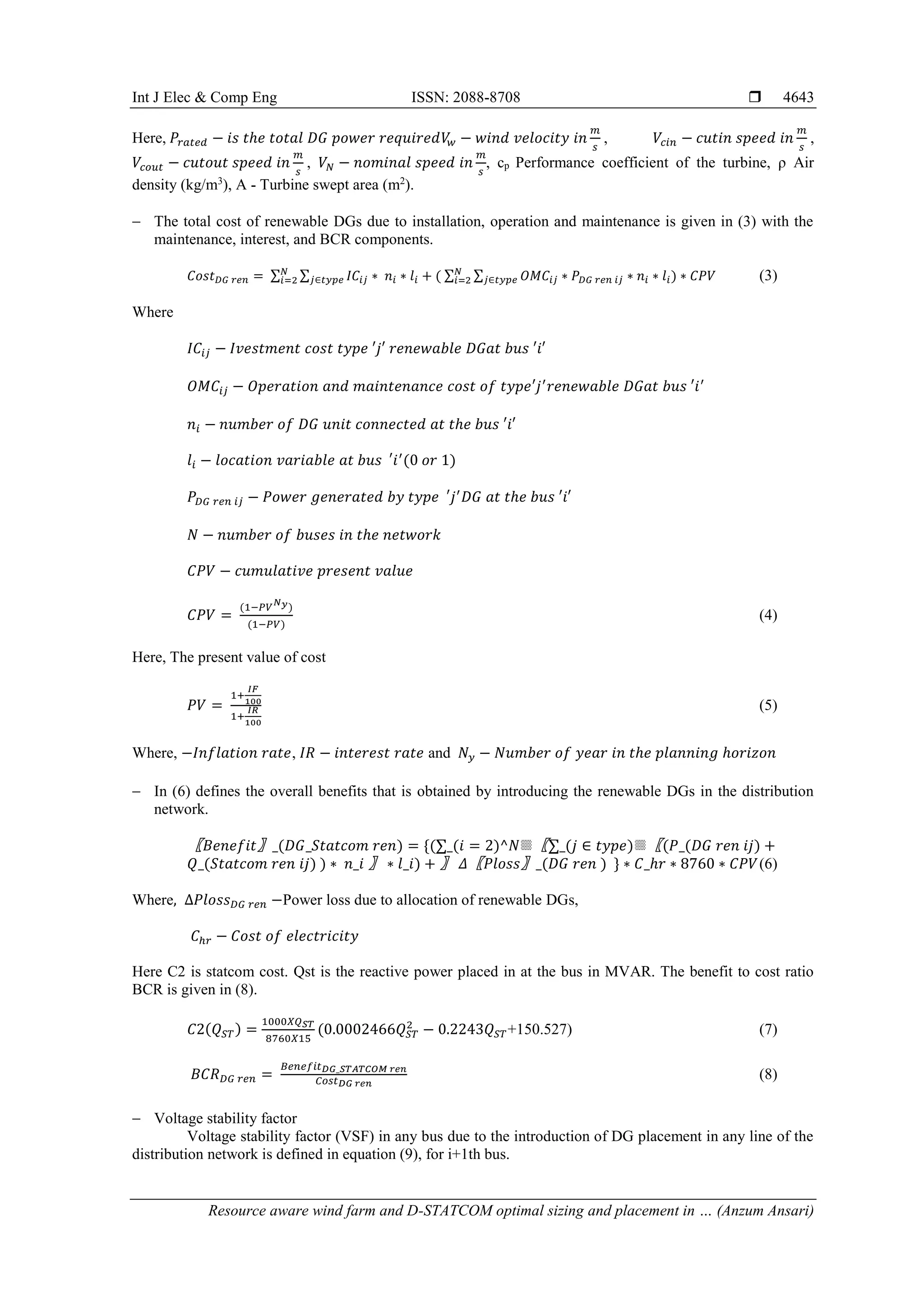
iteration. A slightly better voltage profile is observed in the
TLBO algorithm compared to the PSO algorithm as is shown in Figure 1.
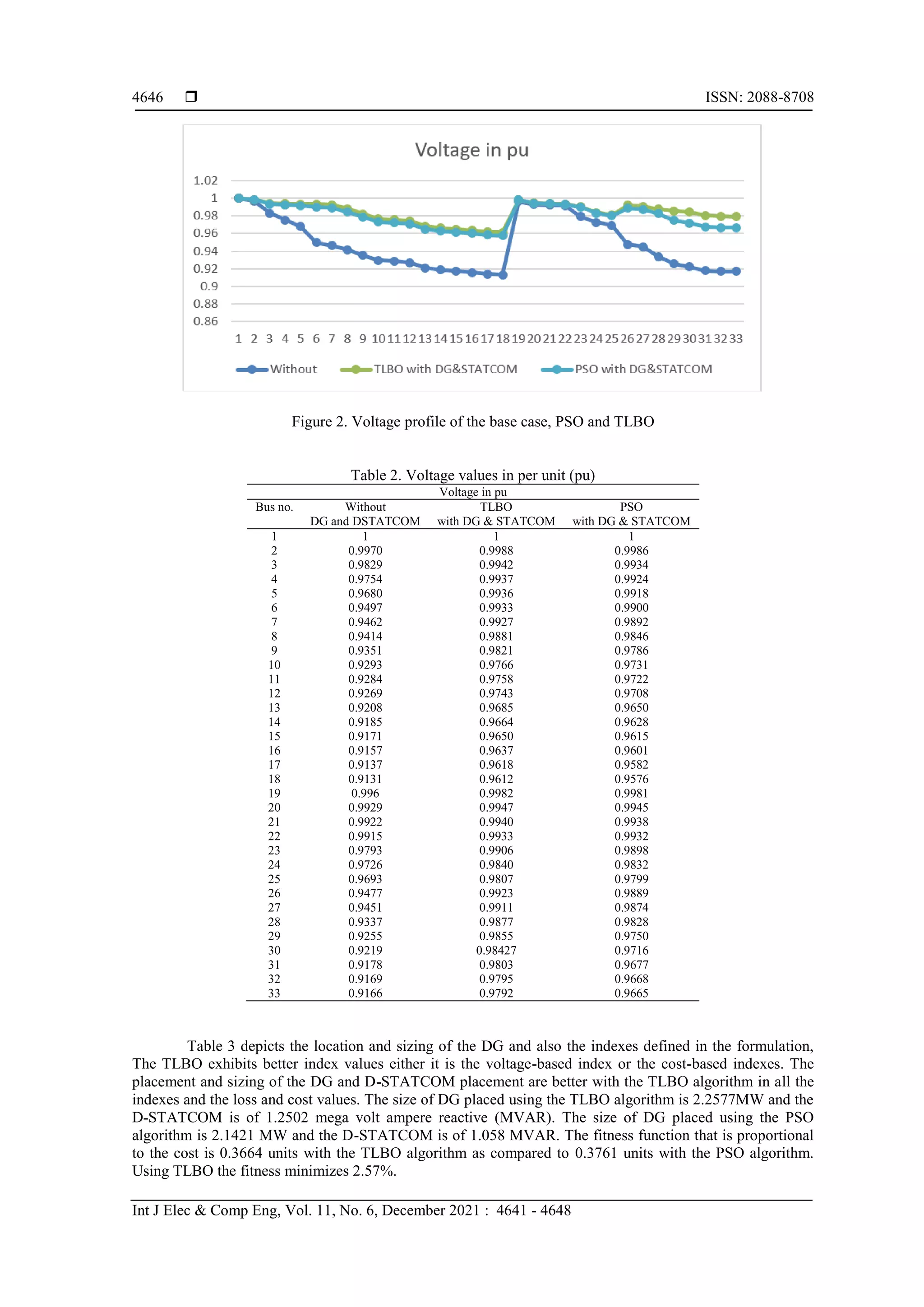
Table 2 exhibits voltage stability in all the buses with DG and the STATCOM placement is
optimized using both PSO and the TLBO algorithm. It is also evident from Table 2 that the voltage stability
improvement is better with TLBO algorithm when compared to the PSO algorithm. The cost of the wind
generation for calculation is obtained from [22]. Although the PSO and TLBO algorithms are applied for the
placement and sizing in different peaces of literature literatures [23]-[25].
Figure 1. Convergence waveform of TLBO and PSO](https://image.slidesharecdn.com/0523982emr20may2114oct20ry-211116054710/75/Resource-aware-wind-farm-and-D-STATCOM-optimal-sizing-and-placement-in-a-distribution-power-system-5-2048.jpg)
![Int J Elec & Comp Eng ISSN: 2088-8708
Resource aware wind farm and D-STATCOM optimal sizing and placement in … (Anzum Ansari)
4647
The cost objective is lesser with the TLBO algorithm compared to the PSO algorithm. This
improves the VSF by 0.44%, NSI by 0.43%, and the total loss minimized by 13.35 %. These all happen when
the BCR of the nearly the same value. So, without compromizing the cost of the STATCOM the
improvements are done in the test system considered. The proposed multi-objective formulation with
dynamic wind speed input clearly improves the fitness while the TLBO algorithm is implemented. From
table it is evident that the TLBO algorithm dominates in every aspect of the multi-objective formulation
proposed. Thus, the multi-objective formulation with dynamic wind generation input is found to be working
effectively with good voltage stability and network security.
Table 3. Convergence results of TLBO and PSO
Parameters
TLBO PSO
with DG & STATCOM with DG & STATCOM
Fit 0.3664 0.3761
BCR 2.7700 2.7846
VSF 0.9826 0.9783
NSI 0.4345 0.4330
Loss in KW 52.8162 60.9530
Location 7,30 7,28
Size in MW 2.2577,1.2502 2.1421,1.058
5. CONCLUSION
Multi-objective placement and sizing of DG and D-STATCOM problem formulated based on the
availability of the wind resources is solved using both PSO and TLBO algorithm. The stable voltage stability
and cost reduction are evident in the implementation of both the metaheuristics methods. Although voltage
stability is evident in both the algorithms the TLBO algorithm exhibited better convergence both in terms of
improved performance indexes and also the cost minimization. Thus, the proposed multi-objective
formulation has shown good performance while introducing the dynamic wind generation input. Cost,
network security and the voltage safety is found optimized to obtain the optimized placement of the wind
generator.
REFERENCES
[1] I. Ziari, G. Ledwich, A. Ghosh, D. Cornforth, and M. Wishart, "Optimal allocation and sizing of DGs in
distribution networks," IEEE PES General Meeting, 2010, pp. 1-8, doi: 10.1109/PES.2010.5588114.
[2] A. M. El-Zonkey, "Optimal placement of multi-distributed generation units including different load models using
particle swarm optimization," in IET Generation, Transmission & Distribution, vol. 5, no. 7, pp. 760-771, July
2011, doi: 10.1049/iet-gtd.2010.0676.
[3] A. Soroudi, M. Ehsan, R. Caire, and N. Hadjsaid, "Hybrid immune-genetic algorithm method for benefit
maximization of distribution network operators and distributed generation owners in a deregulated environment," in
IET Generation, Transmission & Distribution, vol. 5, no. 9, pp. 961-972, September 2011.
[4] R. S. Al Abri, E. F. El-Saadany, and Y. M. Atwa, "Optimal Placement and Sizing Method to Improve the Voltage
Stability Margin in a Distribution System Using Distributed Generation," in IEEE Transactions on Power Systems,
vol. 28, no. 1, pp. 326-334, Feb. 2013, doi: 10.1109/TPWRS.2012.2200049.
[5] K. Nekooei, M. M. Farsangi, H. Nezamabadi-Pour, and K. Y. Lee, "An Improved Multi-Objective Harmony Search
for Optimal Placement of DGs in Distribution Systems," in IEEE Transactions on Smart Grid, vol. 4, no. 1,
pp. 557-567, March 2013, doi: 10.1109/TSG.2012.2237420.
[6] S. H. Lee and J. Park, "Optimal Placement and Sizing of Multiple DGs in a Practical Distribution System by
Considering Power Loss," in IEEE Transactions on Industry Applications, vol. 49, no. 5, pp. 2262-2270, Sept.-Oct.
2013, doi: 10.1109/TIA.2013.2260117.
[7] M. Esmaili, "Placement of minimum distributed generation units observing power losses and voltage stability with
network constraints," in IET Generation, Transmission & Distribution, vol. 7, no. 8, pp. 813-821, Aug. 2013,
doi: 10.1049/iet-gtd.2013.0140.
[8] A. Ameli, S. Bahrami, F. Khazaeli, and M. Haghifam, "A Multiobjective Particle Swarm Optimization for Sizing
and Placement of DGs from DG Owner's and Distribution Company's Viewpoints," in IEEE Transactions on
Power Delivery, vol. 29, no. 4, pp. 1831-1840, Aug. 2014, doi: 10.1109/TPWRD.2014.2300845.
[9] S. Elsaiah, M. Benidris, and J. Mitra, "Analytical approach for placement and sizing of distributed generation on
distribution systems," in IET Generation, Transmission & Distribution, vol. 8, no. 6, pp. 1039-1049, June 2014,
doi: 10.1049/iet-gtd.2013.0803.
[10] W. Sheng, K. Liu, Y. Liu, X. Meng, and Y. Li, "Optimal Placement and Sizing of Distributed Generation via an
Improved Nondominated Sorting Genetic Algorithm II," in IEEE Transactions on Power Delivery, vol. 30, no. 2,
pp. 569-578, April 2015, doi: 10.1109/TPWRD.2014.2325938.](https://image.slidesharecdn.com/0523982emr20may2114oct20ry-211116054710/75/Resource-aware-wind-farm-and-D-STATCOM-optimal-sizing-and-placement-in-a-distribution-power-system-7-2048.jpg)
![ ISSN: 2088-8708
Int J Elec & Comp Eng, Vol. 11, No. 6, December 2021 : 4641 - 4648
4648
[11] S. C. Raval, R. Botta, and H. N. Raval, "Comparison of energy production cost for MVAC and MVDC offshore
wind farm distribution system," 2017 Asian Conference on Energy, Power and Transportation Electrification
(ACEPT), 2017, pp. 1-6, doi: 10.1109/ACEPT.2017.8168543.
[12] T. M. Masaud, G. Nannapaneni, and R. Challoo, "Optimal placement and sizing of distributed generation-based
wind energy considering optimal self VAR control," in IET Renewable Power Generation, vol. 11, no. 3, pp. 281-
288, 2017, doi: 10.1049/iet-rpg.2015.0391.
[13] S. M. Hakimi, A. Hasankhani, M. Shafie-khah, and J. P. S. Catalão, "Optimal sizing and siting of smart microgrid
components under high renewables penetration considering demand response," in IET Renewable Power
Generation, vol. 13, no. 10, pp. 1809-1822, July 2019, doi: 10.1049/iet-rpg.2018.6015.
[14] Z. Li, Y. Xu, S. Fang, and S. Mazzoni, "Optimal placement of heterogeneous distributed generators in a grid-
connected multi-energy microgrid under uncertainties," in IET Renewable Power Generation, vol. 13, no. 14,
pp. 2623-2633, October 2019, doi: 10.1049/iet-rpg.2019.0036.
[15] J. Radosavljević, N. Arsić, M. Milovanović, and A. Ktena, "Optimal Placement and Sizing of Renewable
Distributed Generation Using Hybrid Metaheuristic Algorithm," in Journal of Modern Power Systems and Clean
Energy, vol. 8, no. 3, pp. 499-510, May 2020, doi: 10.35833/MPCE.2019.000259.
[16] Y. Chi and Y. Xu, "Multi-stage coordinated dynamic VAR source placement for voltage stability enhancement of
wind-energy power system," in IET Generation, Transmission & Distribution, vol. 14, no. 6, pp. 1104-1113, March
2020, doi: 10.1049/iet-gtd.2019.0126.
[17] A. A. Yahaya, M. AlMuhaini, and G. T. Heydt, "Optimal design of hybrid DG systems for microgrid reliability
enhancement," in IET Generation, Transmission & Distribution, vol. 14, no. 5, pp. 816-823, January 2020,
doi: 10.1049/iet-gtd.2019.0277.
[18] X. Xiong, W. Wu, N. Li, L. Yang, J. Zhang, and Z. Wei, "Risk-Based Multi-Objective Optimization of Distributed
Generation Based on GPSO-BFA Algorithm," in IEEE Access, vol. 7, pp. 30563-30572, 2019,
doi: 10.1109/ACCESS.2019.2902886.
[19] J. Liu, Y. Xu, J. Qiu, Z. Y. Dong, and K. P. Wong, "Non-Network Solution Coordinated Voltage Stability
Enhancement with STATCOM and UVLS for Wind-Penetrated Power System," in IEEE Transactions on
Sustainable Energy, vol. 11, no. 3, pp. 1559-1568, July 2020, doi: 10.1109/TSTE.2019.2931455.
[20] Saidah and M. Masrufun, "Optimization of DG Placement and Size Using PSO Based on GUI," 2020 International
Conference on Smart Technology and Applications (ICoSTA), 2020, pp. 1-6,
doi: 10.1109/ICoSTA48221.2020.1570615982.
[21] Windpower Engineering and Development, "How to calculate-wind-power output," 2020. [Online]. Available:
https://www.windpowerengineering.com/.
[22] The Royal Academy of Engineering, "Wind Turbine Power Calculation." [Online]. Available:
https://www.raeng.org.uk/publications/other/23-wind-turbine.
[23] I. Irena, "Renewable Power Generation Costs in 2017," International Renewable Energy Agency, Abu Dhabi, 2018.
[24] B. Hussain, A. Amin, A. Mahmood, and M. Usman, "An Optimal Site Selection for Distributed Generation in the
Distribution Network by QPSO Algorithm," 2020 International Conference on Engineering and Emerging
Technologies (ICEET), 2020, pp. 1-6, doi: 10.1109/ICEET48479.2020.9048230.
[25] G. Trivedi, A. Markana, P. Bhatt, and V. Patel, "Optimal Sizing and Placement of Multiple Distributed Generators
using Teaching Learning Based Optimization Algorithm in Radial Distributed Network," 2019 6th International
Conference on Control, Decision and Information Technologies (CoDIT), 2019, pp. 958-963,
doi: 10.1109/CoDIT.2019.8820681.
BIOGRAPHIES OF AUTHORS
Anzum Ansari had received her B.E (Electrical) degree as a Gold Medalist from HNGU, Gujarat,
India in 2010 and M. Tech (Power Systems Engineering) degree as a Gold Medalist from
Visveswaraya Technological University, Belgaum, Karnataka, India in 2013. She is a research
scholar of Dr. Ambedkar Institute of Technology, Bangalore and presently working as an Assistant
Professor in the Department of EEE at Acharya Institute of Technology. Bangalore. Her current
research area includes renewable energy, FACTs controllers, and power systems. She is a Life
Member of the Indian Society for Technical Education (ISTE).
Shankaralingappa C. B. was born in Raichur, Karnataka, India on June 01, 1969. He received his
B.E (Electrical) and M.E (Energy systems) degrees from Karnatak University Dharwar, India in
1993 and 94, respectively, and Ph.D. (Power Systems) from Visveswaraya Technological
University, Belgaum Karnataka, India in 2011. Currently, he is working as a professor in the
Department of Electrical & Electronics Engineering at Dr. Ambedkar Institute of Technology,
Bangalore. His current research interests renewable integration, electric vehicle, and metaheuristic
algorithms. He is a Life Member of the Indian Society for Technical Education (ISTE).](https://image.slidesharecdn.com/0523982emr20may2114oct20ry-211116054710/75/Resource-aware-wind-farm-and-D-STATCOM-optimal-sizing-and-placement-in-a-distribution-power-system-8-2048.jpg)


