Building Science II (BLD 61303)
Project 1
A Case Study in Acoustic Design
(MBSA Auditorium)
Group Members
Chow Su Ling 0325020
Lim Peidi 0324272
Ng Lek Yuen 0324010
Ng Pui Yan 0324785
Sarah Esa 0324805
Tan Yang 0328025
Introduction
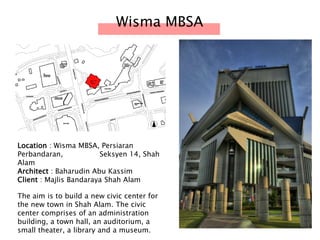
Wisma MBSA
The aim is to build a new civic center for
the new town in Shah Alam. The civic
center comprises of an administration
building, a town hall, an auditorium, a
small theater, a library and a museum.
Location : Wisma MBSA, Persiaran
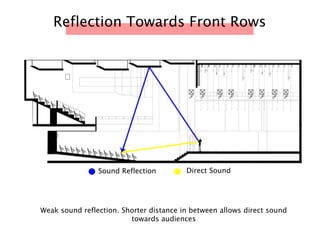
Perbandaran, Seksyen 14, Shah
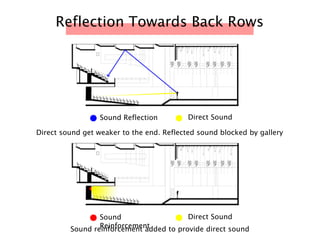
Alam
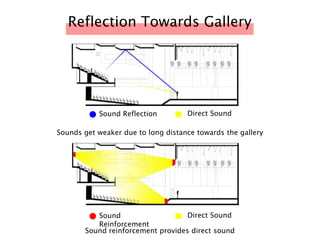
Architect : Baharudin Abu Kassim
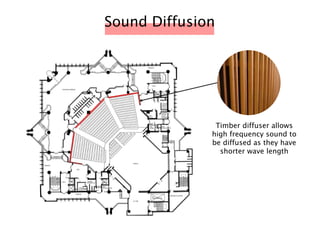
Client : Majlis Bandaraya Shah Alam
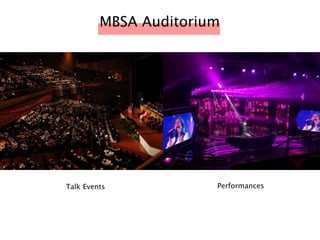
MBSA Auditorium
Talk Events Performances
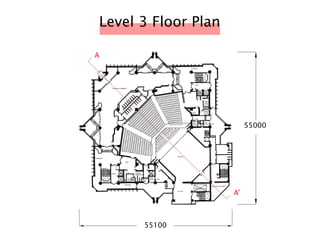
Level 3 Floor Plan
55000
55100
A
A’
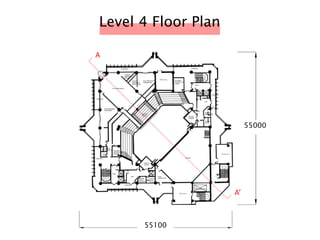
Level 4 Floor Plan
55000
55100
A
A’
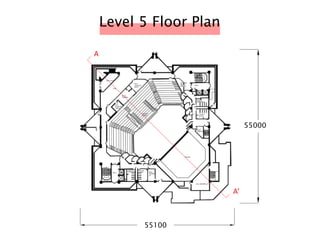
Level 5 Floor Plan
55000
55100
A
A’
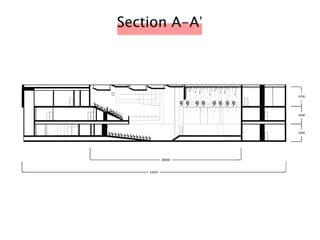
Section A-A’
Auditorium Design Analysis
Shape & Massing . Seating Arrangement
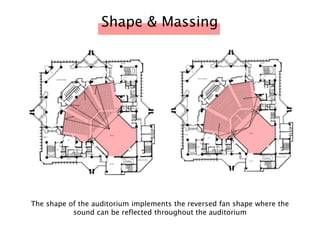
Shape & Massing
The shape of the auditorium implements the reversed fan shape where the
sound can be reflected throughout the auditorium
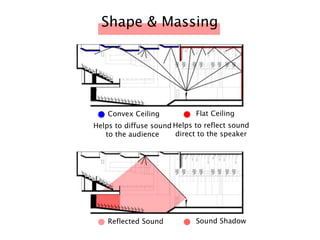
Shape & Massing
Helps to diffuse sound
to the audience
Convex Ceiling Flat Ceiling
Helps to reflect sound
direct to the speaker
Reflected Sound Sound Shadow
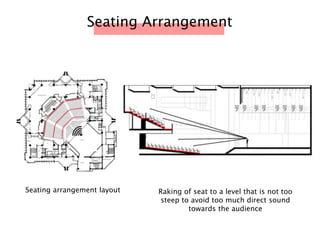
Seating Arrangement
Raking of seat to a level that is not too
steep to avoid too much direct sound
towards the audience
Seating arrangement layout
Acoustics Design Analysis
Materiality . Propagation & Concentration . Sound Shadow . Reflection . Sound Delay . Noise Source . Sound Lock .
Sound Reinforcement
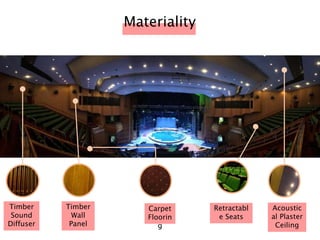
Materiality
Timber
Sound
Diffuser
Timber
Wall
Panel
Carpet
Floorin
g
Acoustic
al Plaster
Ceiling
Retractabl
e Seats
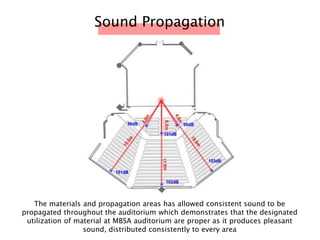
Sound Propagation
The materials and propagation areas has allowed consistent sound to be
propagated throughout the auditorium which demonstrates that the designated
utilization of material at MBSA auditorium are proper as it produces pleasant
sound, distributed consistently to every area
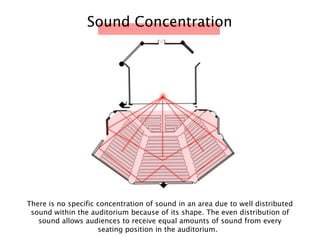
Sound Concentration
There is no specific concentration of sound in an area due to well distributed
sound within the auditorium because of its shape. The even distribution of
sound allows audiences to receive equal amounts of sound from every
seating position in the auditorium.
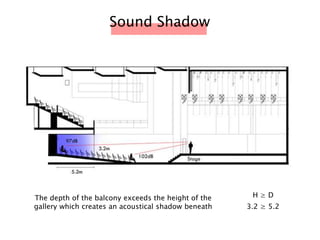
Sound Shadow
The depth of the balcony exceeds the height of the
gallery which creates an acoustical shadow beneath
H ≥ D
3.2 ≥ 5.2
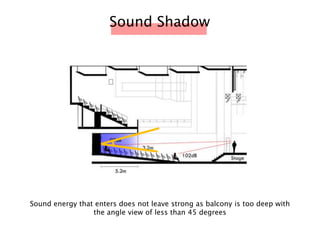
Sound Shadow
Sound energy that enters does not leave strong as balcony is too deep with
the angle view of less than 45 degrees
Reflection Towards Front Rows
Sound Reflection Direct Sound
Weak sound reflection. Shorter distance in between allows direct sound
towards audiences
Reflection Towards Back Rows
Sound Reflection Direct Sound
Direct sound get weaker to the end. Reflected sound blocked by gallery
Sound
Reinforcement
Direct Sound
Sound reinforcement added to provide direct sound
Reflection Towards Gallery
Sound Reflection Direct Sound
Sounds get weaker due to long distance towards the gallery
Sound
Reinforcement
Direct Sound
Sound reinforcement provides direct sound
Sound Diffusion
Timber diffuser allows
high frequency sound to
be diffused as they have
shorter wave length
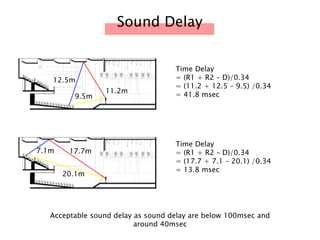
Sound Delay
12.5m
9.5m
11.2m
17.7m7.1m
20.1m
Time Delay
= (R1 + R2 – D)/0.34
= (11.2 + 12.5 – 9.5) /0.34
= 41.8 msec
Time Delay
= (R1 + R2 – D)/0.34
= (17.7 + 7.1 – 20.1) /0.34
= 13.8 msec
Acceptable sound delay as sound delay are below 100msec and
around 40msec
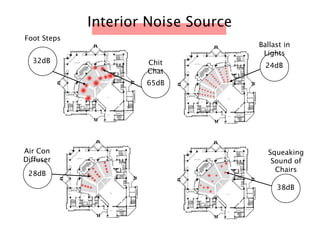
Interior Noise Source
Foot Steps
Ballast in
Lights
Squeaking
Sound of
Chairs
Air Con
Diffuser
Chit
Chat
65dB
32dB
24dB
28dB
38dB
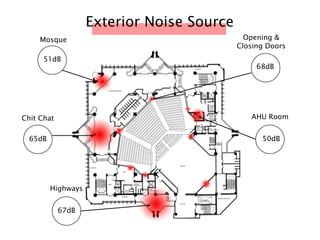
Exterior Noise Source
Mosque
51dB
65dB
67dB
50dB
68dB
Chit Chat
Highways
AHU Room
Opening &
Closing Doors
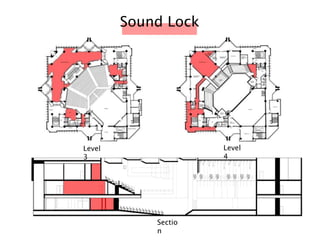
Sound Lock
Level
3
Level
4
Sectio
n
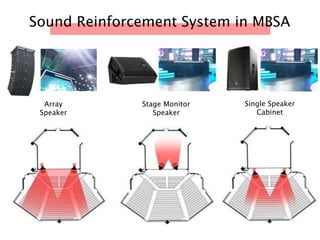
Sound Reinforcement System in MBSA
Array
Speaker
Stage Monitor
Speaker
Single Speaker
Cabinet
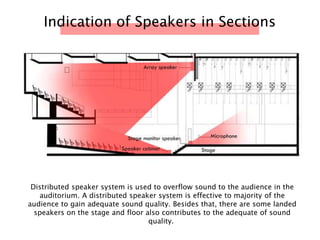
Indication of Speakers in Sections
Distributed speaker system is used to overflow sound to the audience in the
auditorium. A distributed speaker system is effective to majority of the
audience to gain adequate sound quality. Besides that, there are some landed
speakers on the stage and floor also contributes to the adequate of sound
quality.
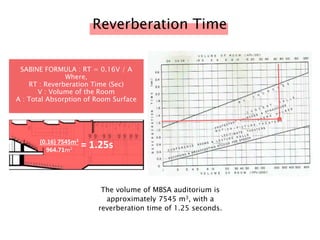
SABINE FORMULA : RT = 0.16V / A
Where,
RT : Reverberation Time (Sec)
V : Volume of the Room
A : Total Absorption of Room Surface
= 1.25s
= 1.25s(0.16) 7545m3
964.71m2
The volume of MBSA auditorium is
approximately 7545 m3, with a
reverberation time of 1.25 seconds.
Reverberation Time
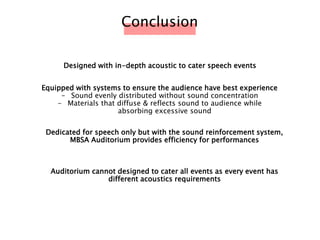
Designed with in-depth acoustic to cater speech events
Conclusion
Dedicated for speech only but with the sound reinforcement system,
MBSA Auditorium provides efficiency for performances
Equipped with systems to ensure the audience have best experience
- Sound evenly distributed without sound concentration
- Materials that diffuse & reflects sound to audience while
absorbing excessive sound
Auditorium cannot designed to cater all events as every event has
different acoustics requirements
A Guide to Sound Isolation and Noise Control. (2005, March 26). Retrieved from
https://www.audioholics.com/room-acoustics/a-guide-to-sound-isolation-and-
noise-control
Berg, R. E. (2018, June 14). Acoustics. Retrieved from
https://www.britannica.com/science/acoustics/Acoustic-problems#ref527632
Edwin, C. (n.d.). Lecture 2 : Room Acoustics. Lecture.
Egan, M. D. (2007). Architectural acoustics. Place of publication unknown: J.Ross
Publishing.
SOUND. (n.d.). Retrieved from
http://artsites.ucsc.edu/EMS/music/tech_background/te-01/teces_01.html
Soundproofing floors and noise absorption. (n.d.). Retrieved from
https://www.carpetyourlife.com/en/about-carpet/advantages/soundproofing-floors
Sound Reinforcement Systems. (2017, March 07). Retrieved from
https://audioacademy.in/821/
Shaik, A. (n.d.). Sound. Retrieved from http://www.physics-and-radio-
electronics.com/physics/sound.html
What is Acoustics? (n.d.). Retrieved from https://acoustics.byu.edu/content/what-
acoustics
X. (n.d.). Stadium seating. Retrieved from
http://www.daplast.com/english/products/stadium-seating/AB
(n.d.). Retrieved from http://hyperphysics.phy-
astr.gsu.edu/hbase/Sound/intens.html
References

b science acoustic

  • 1.
    Building Science II(BLD 61303) Project 1 A Case Study in Acoustic Design (MBSA Auditorium) Group Members Chow Su Ling 0325020 Lim Peidi 0324272 Ng Lek Yuen 0324010 Ng Pui Yan 0324785 Sarah Esa 0324805 Tan Yang 0328025
  • 2.
  • 3.
    Wisma MBSA The aimis to build a new civic center for the new town in Shah Alam. The civic center comprises of an administration building, a town hall, an auditorium, a small theater, a library and a museum. Location : Wisma MBSA, Persiaran Perbandaran, Seksyen 14, Shah Alam Architect : Baharudin Abu Kassim Client : Majlis Bandaraya Shah Alam
  • 4.
  • 5.
    Level 3 FloorPlan 55000 55100 A A’
  • 6.
    Level 4 FloorPlan 55000 55100 A A’
  • 7.
    Level 5 FloorPlan 55000 55100 A A’
  • 8.
  • 9.
    Auditorium Design Analysis Shape& Massing . Seating Arrangement
  • 10.
    Shape & Massing Theshape of the auditorium implements the reversed fan shape where the sound can be reflected throughout the auditorium
  • 11.
    Shape & Massing Helpsto diffuse sound to the audience Convex Ceiling Flat Ceiling Helps to reflect sound direct to the speaker Reflected Sound Sound Shadow
  • 12.
    Seating Arrangement Raking ofseat to a level that is not too steep to avoid too much direct sound towards the audience Seating arrangement layout
  • 13.
    Acoustics Design Analysis Materiality. Propagation & Concentration . Sound Shadow . Reflection . Sound Delay . Noise Source . Sound Lock . Sound Reinforcement
  • 14.
  • 15.
    Sound Propagation The materialsand propagation areas has allowed consistent sound to be propagated throughout the auditorium which demonstrates that the designated utilization of material at MBSA auditorium are proper as it produces pleasant sound, distributed consistently to every area
  • 16.
    Sound Concentration There isno specific concentration of sound in an area due to well distributed sound within the auditorium because of its shape. The even distribution of sound allows audiences to receive equal amounts of sound from every seating position in the auditorium.
  • 17.
    Sound Shadow The depthof the balcony exceeds the height of the gallery which creates an acoustical shadow beneath H ≥ D 3.2 ≥ 5.2
  • 18.
    Sound Shadow Sound energythat enters does not leave strong as balcony is too deep with the angle view of less than 45 degrees
  • 19.
    Reflection Towards FrontRows Sound Reflection Direct Sound Weak sound reflection. Shorter distance in between allows direct sound towards audiences
  • 20.
    Reflection Towards BackRows Sound Reflection Direct Sound Direct sound get weaker to the end. Reflected sound blocked by gallery Sound Reinforcement Direct Sound Sound reinforcement added to provide direct sound
  • 21.
    Reflection Towards Gallery SoundReflection Direct Sound Sounds get weaker due to long distance towards the gallery Sound Reinforcement Direct Sound Sound reinforcement provides direct sound
  • 22.
    Sound Diffusion Timber diffuserallows high frequency sound to be diffused as they have shorter wave length
  • 23.
    Sound Delay 12.5m 9.5m 11.2m 17.7m7.1m 20.1m Time Delay =(R1 + R2 – D)/0.34 = (11.2 + 12.5 – 9.5) /0.34 = 41.8 msec Time Delay = (R1 + R2 – D)/0.34 = (17.7 + 7.1 – 20.1) /0.34 = 13.8 msec Acceptable sound delay as sound delay are below 100msec and around 40msec
  • 24.
    Interior Noise Source FootSteps Ballast in Lights Squeaking Sound of Chairs Air Con Diffuser Chit Chat 65dB 32dB 24dB 28dB 38dB
  • 25.
    Exterior Noise Source Mosque 51dB 65dB 67dB 50dB 68dB ChitChat Highways AHU Room Opening & Closing Doors
  • 26.
  • 27.
    Sound Reinforcement Systemin MBSA Array Speaker Stage Monitor Speaker Single Speaker Cabinet
  • 28.
    Indication of Speakersin Sections Distributed speaker system is used to overflow sound to the audience in the auditorium. A distributed speaker system is effective to majority of the audience to gain adequate sound quality. Besides that, there are some landed speakers on the stage and floor also contributes to the adequate of sound quality.
  • 29.
    SABINE FORMULA :RT = 0.16V / A Where, RT : Reverberation Time (Sec) V : Volume of the Room A : Total Absorption of Room Surface = 1.25s = 1.25s(0.16) 7545m3 964.71m2 The volume of MBSA auditorium is approximately 7545 m3, with a reverberation time of 1.25 seconds. Reverberation Time
  • 30.
    Designed with in-depthacoustic to cater speech events Conclusion Dedicated for speech only but with the sound reinforcement system, MBSA Auditorium provides efficiency for performances Equipped with systems to ensure the audience have best experience - Sound evenly distributed without sound concentration - Materials that diffuse & reflects sound to audience while absorbing excessive sound Auditorium cannot designed to cater all events as every event has different acoustics requirements
  • 31.
    A Guide toSound Isolation and Noise Control. (2005, March 26). Retrieved from https://www.audioholics.com/room-acoustics/a-guide-to-sound-isolation-and- noise-control Berg, R. E. (2018, June 14). Acoustics. Retrieved from https://www.britannica.com/science/acoustics/Acoustic-problems#ref527632 Edwin, C. (n.d.). Lecture 2 : Room Acoustics. Lecture. Egan, M. D. (2007). Architectural acoustics. Place of publication unknown: J.Ross Publishing. SOUND. (n.d.). Retrieved from http://artsites.ucsc.edu/EMS/music/tech_background/te-01/teces_01.html Soundproofing floors and noise absorption. (n.d.). Retrieved from https://www.carpetyourlife.com/en/about-carpet/advantages/soundproofing-floors Sound Reinforcement Systems. (2017, March 07). Retrieved from https://audioacademy.in/821/ Shaik, A. (n.d.). Sound. Retrieved from http://www.physics-and-radio- electronics.com/physics/sound.html What is Acoustics? (n.d.). Retrieved from https://acoustics.byu.edu/content/what- acoustics X. (n.d.). Stadium seating. Retrieved from http://www.daplast.com/english/products/stadium-seating/AB (n.d.). Retrieved from http://hyperphysics.phy- astr.gsu.edu/hbase/Sound/intens.html References