Acoustic study by
Khoo Zer Kai
Lai Tzexiuan
Lim Jey Shen
Lim Zanyu
Nicole Foo Shuli
Teh Sin Ying
Teo Chong Yih
Teo Vi Vien
0320500
0318056
0319796
0325034
0325517
0320509
0314660
0321645
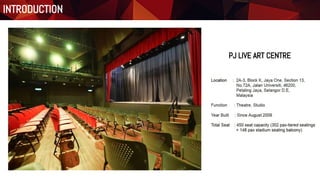
INTRODUCTION
PJ LIVE ART CENTRE
PURPOSE
PERFORMANCE
Interior Space
PJ Live Art Centre
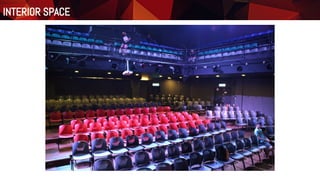
INTERIOR SPACE
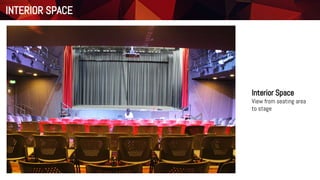
Interior Space
View from seating area
to stage
INTERIOR SPACE
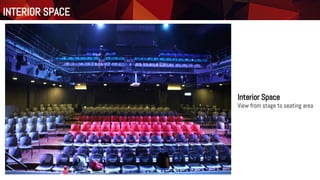
Interior Space
View from stage to seating area
INTERIOR SPACE
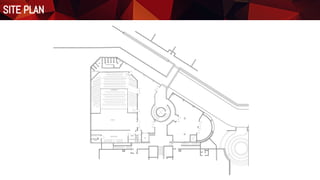
SITE PLAN
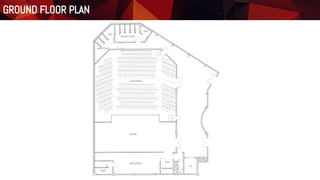
Ground Floor Plan
PJ Live Art Centre
GROUND FLOOR PLAN
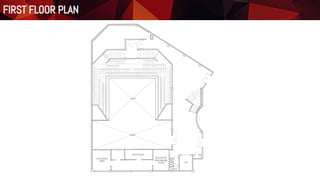
First Floor Plan
PJ Live Art Centre
FIRST FLOOR PLAN
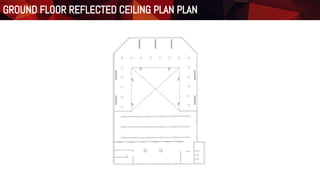
Ground Floor Reflected Ceiling Plan
PJ Live Art Centre
GROUND FLOOR REFLECTED CEILING PLAN PLAN
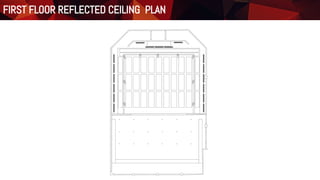
First Floor Reflected Ceiling Plan
PJ Live Art Centre
FIRST FLOOR REFLECTED CEILING PLAN
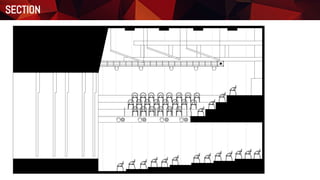
Section
PJ Live Art Centre
SECTION
ACOUSTIC ANALYSIS
Acoustic Analysis
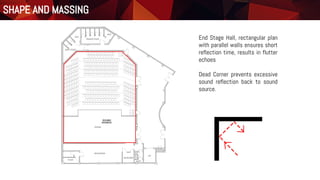
Shape and Massing
End Stage Hall, rectangular plan
with parallel walls ensures short
reflection time, results in flutter
echoes
Dead Corner prevents excessive
sound reflection back to sound
source.
SHAPE AND MASSING
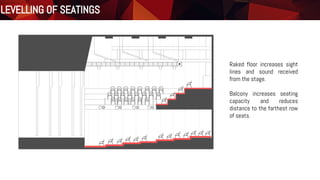
Raked floor increases sight
lines and sound received
from the stage.
Balcony increases seating
capacity and reduces
distance to the farthest row
of seats.
LEVELLING OF SEATINGS
Acoustic Analysis
Shape and Massing
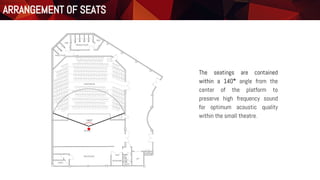
The seatings are contained
within a 140° angle from the
center of the platform to
preserve high frequency sound
for optimum acoustic quality
within the small theatre.
ARRANGEMENT OF SEATS
Acoustic Analysis
Shape and Massing
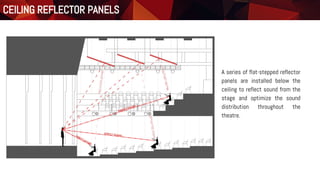
A series of flat-stepped reflector
panels are installed below the
ceiling to reflect sound from the
stage and optimize the sound
distribution throughout the
theatre.
CEILING REFLECTOR PANELS
MATERIALS AND COMPONENTS
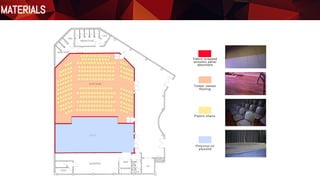
MATERIALS
Materials
Floor Plan
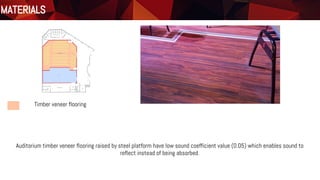
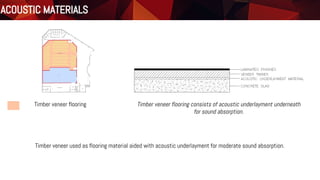
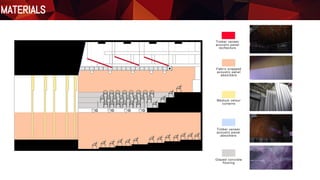
Timber veneer flooring
MATERIALS
Auditorium timber veneer flooring raised by steel platform have low sound coefficient value (0.05) which enables sound to
reflect instead of being absorbed.
Materials
Floor Plan
Timber veneer flooring
ACOUSTIC MATERIALS
Timber veneer flooring consists of acoustic underlayment underneath
for sound absorption.
Timber veneer used as flooring material aided with acoustic underlayment for moderate sound absorption.
Materials
Floor Plan
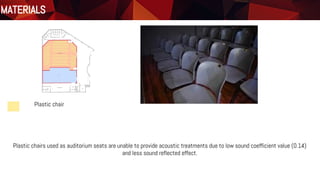
Plastic chair
MATERIALS
Plastic chairs used as auditorium seats are unable to provide acoustic treatments due to low sound coefficient value (0.14)
and less sound reflected effect.
Materials
Floor Plan
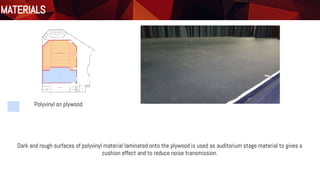
Polyvinyl on plywood
MATERIALS
Dark and rough surfaces of polyvinyl material laminated onto the plywood is used as auditorium stage material to gives a
cushion effect and to reduce noise transmission.
Materials
Floor Plan
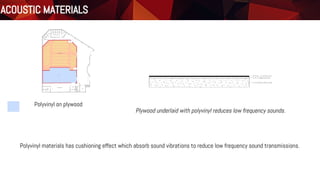
Polyvinyl on plywood
ACOUSTIC MATERIALS
Plywood underlaid with polyvinyl reduces low frequency sounds.
Polyvinyl materials has cushioning effect which absorb sound vibrations to reduce low frequency sound transmissions.
Materials
Floor Plan
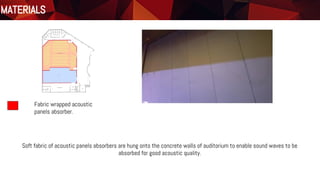
Fabric wrapped acoustic
panels absorber.
MATERIALS
Soft fabric of acoustic panels absorbers are hung onto the concrete walls of auditorium to enable sound waves to be
absorbed for good acoustic quality.
Materials
Floor Plan
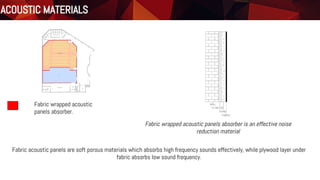
Fabric wrapped acoustic
panels absorber.
ACOUSTIC MATERIALS
Fabric wrapped acoustic panels absorber is an effective noise
reduction material
Fabric acoustic panels are soft porous materials which absorbs high frequency sounds effectively, while plywood layer under
fabric absorbs low sound frequency.
MATERIALS
Materials
Floor Plan
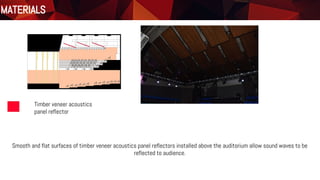
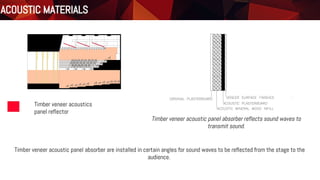
Timber veneer acoustics
panel reflector
MATERIALS
Smooth and flat surfaces of timber veneer acoustics panel reflectors installed above the auditorium allow sound waves to be
reflected to audience.
Materials
Floor Plan
ACOUSTIC MATERIALS
Timber veneer acoustic panel absorber reflects sound waves to
transmit sound.
Timber veneer acoustic panel absorber are installed in certain angles for sound waves to be reflected from the stage to the
audience.
Timber veneer acoustics
panel reflector
Materials
Floor Plan
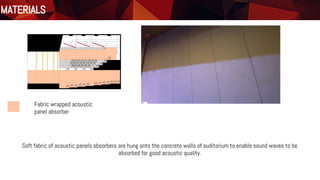
Fabric wrapped acoustic
panel absorber
MATERIALS
Soft fabric of acoustic panels absorbers are hung onto the concrete walls of auditorium to enable sound waves to be
absorbed for good acoustic quality.
Materials
Floor Plan
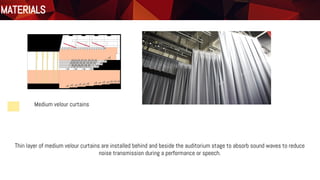
Medium velour curtains
MATERIALS
Thin layer of medium velour curtains are installed behind and beside the auditorium stage to absorb sound waves to reduce
noise transmission during a performance or speech.
Materials
Floor Plan
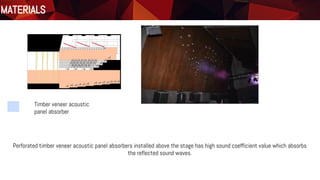
Timber veneer acoustic
panel absorber
MATERIALS
Perforated timber veneer acoustic panel absorbers installed above the stage has high sound coefficient value which absorbs
the reflected sound waves.
Materials
Floor Plan
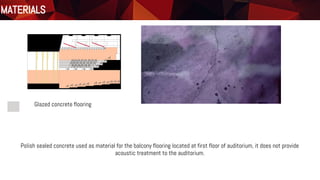
Glazed concrete flooring
MATERIALS
Polish sealed concrete used as material for the balcony flooring located at first floor of auditorium, it does not provide
acoustic treatment to the auditorium.
Materials
Floor Plan
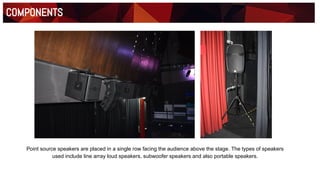
COMPONENTS
Point source speakers are placed in a single row facing the audience above the stage. The types of speakers
used include line array loud speakers, subwoofer speakers and also portable speakers.
Materials
Floor Plan
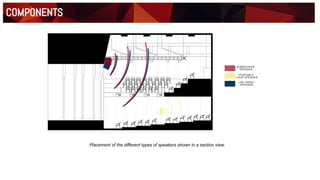
COMPONENTS
Placement of the different types of speakers shown in a section view.
SOUND AND NOISE SOURCE
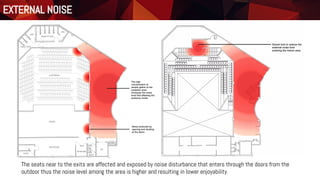
The seats near to the exits are affected and exposed by noise disturbance that enters through the doors from the
outdoor thus the noise level among the area is higher and resulting in lower enjoyability.
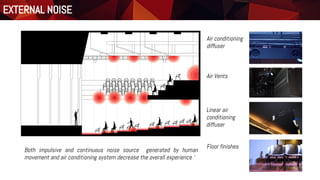
EXTERNAL NOISE
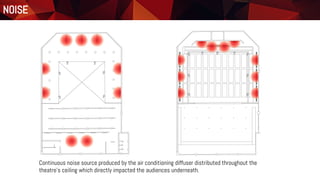
NOISE
Continuous noise source produced by the air conditioning diffuser distributed throughout the
theatre’s ceiling which directly impacted the audiences underneath.
Both impulsive and continuous noise source generated by human
movement and air conditioning system decrease the overall experience ‘
Air conditioning
diffuser
EXTERNAL NOISE
Air Vents
Linear air
conditioning
diffuser
Floor finishes
SOUND PROPAGATION
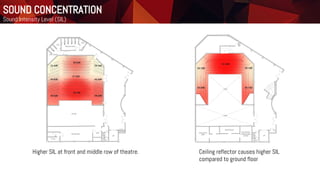
Sound Intensity Level (SIL)
Higher SIL at front and middle row of theatre. Ceiling reflector causes higher SIL
compared to ground floor
SOUND CONCENTRATION
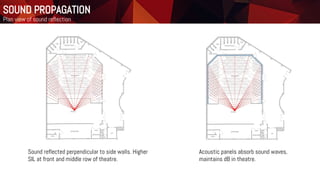
Sound reflected perpendicular to side walls. Higher
SIL at front and middle row of theatre.
Acoustic panels absorb sound waves,
maintains dB in theatre.
Plan view of sound reflection
SOUND PROPAGATION
direct
reflect
direct
direct reflect
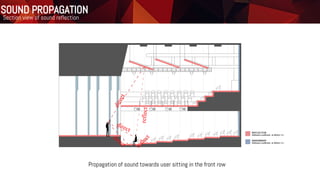
Propagation of sound towards user sitting in the front row
Section view of sound reflection
SOUND PROPAGATION
direct
direct
reflect
reflect
direct
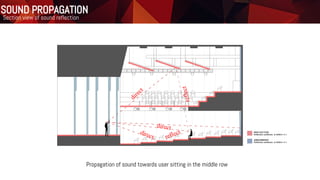
Propagation of sound towards user sitting in the middle row
Sound Propagation
Section view of sound reflectionSection view of sound reflection
SOUND PROPAGATION
direct
reflect
reflect
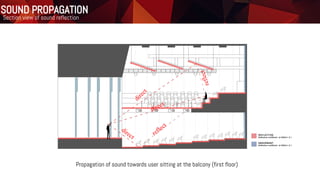
Propagation of sound towards user sitting at the balcony (first floor)
direct
direct
direct
reflect
reflect
Sound Propagation
Section view of sound reflectionSection view of sound reflection
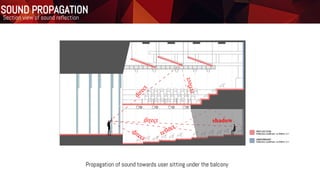
SOUND PROPAGATION
Sound Propagation
Section view of sound reflection
Propagation of sound towards user sitting under the balcony
direct
direct
direct
reflect
reflect
shadow
Section view of sound reflection
SOUND PROPAGATION
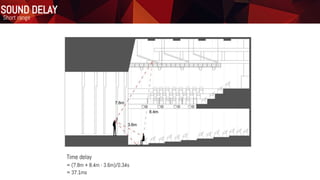
Sound Delay
Short range
Time delay
= (7.8m + 8.4m - 3.6m)/0.34s
= 37.1ms
direct
reflect
Short range
SOUND DELAY
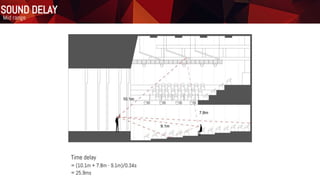
Time delay
= (10.1m + 7.8m - 9.1m)/0.34s
= 25.9ms
Mid range
SOUND DELAY
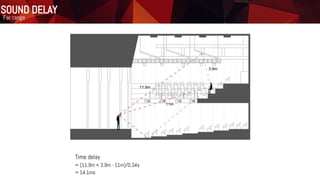
Time delay
= (11.9m + 3.9m - 11m)/0.34s
= 14.1ms
Far range
SOUND DELAY
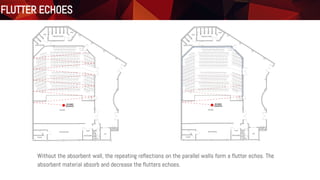
Flutter Echoes
Without the absorbent wall, the repeating reflections on the parallel walls form a flutter echos. The
absorbent material absorb and decrease the flutters echoes.
FLUTTER ECHOES
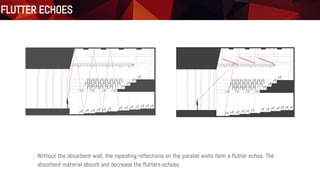
Flutter Echoes
Without the absorbent wall, the repeating reflections on the parallel walls form a flutter echos. The
absorbent material absorb and decrease the flutters echoes.
FLUTTER ECHOES
As (chair)
= [(0.37m x 0.26m) + (0.3m x 0.41m)] x 0.14
= [0.10m² + 0.12m²] x 0.14
= 0.04 m² sabins
No. of chairs = 412 chairs
As (chair)
= 0.04 x 412
= 16.48 m² sabins
As (acoustic panel - wall)
= (200.05m² + 573.58m²) x 0.75
= 580.22 m² sabins
As (curtain)
= 200.05m² x 0.15
= 30.01 m² sabins
As (timber veneer flooring)
= (250.22m² + 79.69m²) x 0.05
= 16.5 m² sabins
As (sealed concrete flooring)
= 11.82m² x 0.01
= 0.12m² sabins
As (rough concrete ceiling)
= 250.22m² x 0.03
= 7.51 m² sabins
As (plaster ceiling)
= 91.51m² x 0.03
= 2.75 m² sabins
As (ceiling timber panels)
= 85.65m² x 0.25
= 21.41 m² sabins
Total As
= (16.48 + 16.5 + 0.12 + 7.51 + 2.75 + 21.41 +
580.22 + 30.01) m² sabins
= 675 m² sabins
Volume of theatre
= (101.25m² x 7.05m) + (226.52m² x 11.9m)
= 713.81m³ + 2695.59m³
= 3373.4m³
Reverberation Time
= 0.16V/A
= 0.16 x 3373.4/675
= 0.8 seconds
Reverberation Time CalculationREVERBERATION TIME CALCULATION
Conclusion
PJ Live Art Centre
CONCLUSION
For a general use of a theatre catering for speech and performance purposes, a reverberation time of 1.5-2s is
optimum. While in PJ Live Arts, the reverberation time is considered as low, as only suitable for a recording studio, or
even as a classroom (< 1s). Design considerations should be taken care of to increase the reverberation time within
the theatre, such as to replace some of the absorbance material with reflective materials. This helps sound waves to
linger within the spaces for a longer period of time to provide a better quality of experience. Extra care should be
taken care of so as reverberation time will not become echoes.
THANK Y0U

Building Science 2 Project 1 Presentation slides

  • 1.
    Acoustic study by KhooZer Kai Lai Tzexiuan Lim Jey Shen Lim Zanyu Nicole Foo Shuli Teh Sin Ying Teo Chong Yih Teo Vi Vien 0320500 0318056 0319796 0325034 0325517 0320509 0314660 0321645
  • 2.
  • 3.
  • 4.
    Interior Space PJ LiveArt Centre INTERIOR SPACE
  • 5.
    Interior Space View fromseating area to stage INTERIOR SPACE
  • 6.
    Interior Space View fromstage to seating area INTERIOR SPACE
  • 7.
  • 8.
    Ground Floor Plan PJLive Art Centre GROUND FLOOR PLAN
  • 9.
    First Floor Plan PJLive Art Centre FIRST FLOOR PLAN
  • 10.
    Ground Floor ReflectedCeiling Plan PJ Live Art Centre GROUND FLOOR REFLECTED CEILING PLAN PLAN
  • 11.
    First Floor ReflectedCeiling Plan PJ Live Art Centre FIRST FLOOR REFLECTED CEILING PLAN
  • 12.
    Section PJ Live ArtCentre SECTION
  • 13.
  • 14.
    Acoustic Analysis Shape andMassing End Stage Hall, rectangular plan with parallel walls ensures short reflection time, results in flutter echoes Dead Corner prevents excessive sound reflection back to sound source. SHAPE AND MASSING
  • 15.
    Raked floor increasessight lines and sound received from the stage. Balcony increases seating capacity and reduces distance to the farthest row of seats. LEVELLING OF SEATINGS
  • 16.
    Acoustic Analysis Shape andMassing The seatings are contained within a 140° angle from the center of the platform to preserve high frequency sound for optimum acoustic quality within the small theatre. ARRANGEMENT OF SEATS
  • 17.
    Acoustic Analysis Shape andMassing A series of flat-stepped reflector panels are installed below the ceiling to reflect sound from the stage and optimize the sound distribution throughout the theatre. CEILING REFLECTOR PANELS
  • 18.
  • 19.
  • 20.
    Materials Floor Plan Timber veneerflooring MATERIALS Auditorium timber veneer flooring raised by steel platform have low sound coefficient value (0.05) which enables sound to reflect instead of being absorbed.
  • 21.
    Materials Floor Plan Timber veneerflooring ACOUSTIC MATERIALS Timber veneer flooring consists of acoustic underlayment underneath for sound absorption. Timber veneer used as flooring material aided with acoustic underlayment for moderate sound absorption.
  • 22.
    Materials Floor Plan Plastic chair MATERIALS Plasticchairs used as auditorium seats are unable to provide acoustic treatments due to low sound coefficient value (0.14) and less sound reflected effect.
  • 23.
    Materials Floor Plan Polyvinyl onplywood MATERIALS Dark and rough surfaces of polyvinyl material laminated onto the plywood is used as auditorium stage material to gives a cushion effect and to reduce noise transmission.
  • 24.
    Materials Floor Plan Polyvinyl onplywood ACOUSTIC MATERIALS Plywood underlaid with polyvinyl reduces low frequency sounds. Polyvinyl materials has cushioning effect which absorb sound vibrations to reduce low frequency sound transmissions.
  • 25.
    Materials Floor Plan Fabric wrappedacoustic panels absorber. MATERIALS Soft fabric of acoustic panels absorbers are hung onto the concrete walls of auditorium to enable sound waves to be absorbed for good acoustic quality.
  • 26.
    Materials Floor Plan Fabric wrappedacoustic panels absorber. ACOUSTIC MATERIALS Fabric wrapped acoustic panels absorber is an effective noise reduction material Fabric acoustic panels are soft porous materials which absorbs high frequency sounds effectively, while plywood layer under fabric absorbs low sound frequency.
  • 27.
  • 28.
    Materials Floor Plan Timber veneeracoustics panel reflector MATERIALS Smooth and flat surfaces of timber veneer acoustics panel reflectors installed above the auditorium allow sound waves to be reflected to audience.
  • 29.
    Materials Floor Plan ACOUSTIC MATERIALS Timberveneer acoustic panel absorber reflects sound waves to transmit sound. Timber veneer acoustic panel absorber are installed in certain angles for sound waves to be reflected from the stage to the audience. Timber veneer acoustics panel reflector
  • 30.
    Materials Floor Plan Fabric wrappedacoustic panel absorber MATERIALS Soft fabric of acoustic panels absorbers are hung onto the concrete walls of auditorium to enable sound waves to be absorbed for good acoustic quality.
  • 31.
    Materials Floor Plan Medium velourcurtains MATERIALS Thin layer of medium velour curtains are installed behind and beside the auditorium stage to absorb sound waves to reduce noise transmission during a performance or speech.
  • 32.
    Materials Floor Plan Timber veneeracoustic panel absorber MATERIALS Perforated timber veneer acoustic panel absorbers installed above the stage has high sound coefficient value which absorbs the reflected sound waves.
  • 33.
    Materials Floor Plan Glazed concreteflooring MATERIALS Polish sealed concrete used as material for the balcony flooring located at first floor of auditorium, it does not provide acoustic treatment to the auditorium.
  • 34.
    Materials Floor Plan COMPONENTS Point sourcespeakers are placed in a single row facing the audience above the stage. The types of speakers used include line array loud speakers, subwoofer speakers and also portable speakers.
  • 35.
    Materials Floor Plan COMPONENTS Placement ofthe different types of speakers shown in a section view.
  • 36.
  • 37.
    The seats nearto the exits are affected and exposed by noise disturbance that enters through the doors from the outdoor thus the noise level among the area is higher and resulting in lower enjoyability. EXTERNAL NOISE
  • 38.
    NOISE Continuous noise sourceproduced by the air conditioning diffuser distributed throughout the theatre’s ceiling which directly impacted the audiences underneath.
  • 39.
    Both impulsive andcontinuous noise source generated by human movement and air conditioning system decrease the overall experience ‘ Air conditioning diffuser EXTERNAL NOISE Air Vents Linear air conditioning diffuser Floor finishes
  • 40.
  • 41.
    Sound Intensity Level(SIL) Higher SIL at front and middle row of theatre. Ceiling reflector causes higher SIL compared to ground floor SOUND CONCENTRATION
  • 42.
    Sound reflected perpendicularto side walls. Higher SIL at front and middle row of theatre. Acoustic panels absorb sound waves, maintains dB in theatre. Plan view of sound reflection SOUND PROPAGATION
  • 43.
    direct reflect direct direct reflect Propagation ofsound towards user sitting in the front row Section view of sound reflection SOUND PROPAGATION
  • 44.
    direct direct reflect reflect direct Propagation of soundtowards user sitting in the middle row Sound Propagation Section view of sound reflectionSection view of sound reflection SOUND PROPAGATION
  • 45.
    direct reflect reflect Propagation of soundtowards user sitting at the balcony (first floor) direct direct direct reflect reflect Sound Propagation Section view of sound reflectionSection view of sound reflection SOUND PROPAGATION
  • 46.
    Sound Propagation Section viewof sound reflection Propagation of sound towards user sitting under the balcony direct direct direct reflect reflect shadow Section view of sound reflection SOUND PROPAGATION
  • 47.
    Sound Delay Short range Timedelay = (7.8m + 8.4m - 3.6m)/0.34s = 37.1ms direct reflect Short range SOUND DELAY
  • 48.
    Time delay = (10.1m+ 7.8m - 9.1m)/0.34s = 25.9ms Mid range SOUND DELAY
  • 49.
    Time delay = (11.9m+ 3.9m - 11m)/0.34s = 14.1ms Far range SOUND DELAY
  • 50.
    Flutter Echoes Without theabsorbent wall, the repeating reflections on the parallel walls form a flutter echos. The absorbent material absorb and decrease the flutters echoes. FLUTTER ECHOES
  • 51.
    Flutter Echoes Without theabsorbent wall, the repeating reflections on the parallel walls form a flutter echos. The absorbent material absorb and decrease the flutters echoes. FLUTTER ECHOES
  • 52.
    As (chair) = [(0.37mx 0.26m) + (0.3m x 0.41m)] x 0.14 = [0.10m² + 0.12m²] x 0.14 = 0.04 m² sabins No. of chairs = 412 chairs As (chair) = 0.04 x 412 = 16.48 m² sabins As (acoustic panel - wall) = (200.05m² + 573.58m²) x 0.75 = 580.22 m² sabins As (curtain) = 200.05m² x 0.15 = 30.01 m² sabins As (timber veneer flooring) = (250.22m² + 79.69m²) x 0.05 = 16.5 m² sabins As (sealed concrete flooring) = 11.82m² x 0.01 = 0.12m² sabins As (rough concrete ceiling) = 250.22m² x 0.03 = 7.51 m² sabins As (plaster ceiling) = 91.51m² x 0.03 = 2.75 m² sabins As (ceiling timber panels) = 85.65m² x 0.25 = 21.41 m² sabins Total As = (16.48 + 16.5 + 0.12 + 7.51 + 2.75 + 21.41 + 580.22 + 30.01) m² sabins = 675 m² sabins Volume of theatre = (101.25m² x 7.05m) + (226.52m² x 11.9m) = 713.81m³ + 2695.59m³ = 3373.4m³ Reverberation Time = 0.16V/A = 0.16 x 3373.4/675 = 0.8 seconds Reverberation Time CalculationREVERBERATION TIME CALCULATION
  • 53.
    Conclusion PJ Live ArtCentre CONCLUSION For a general use of a theatre catering for speech and performance purposes, a reverberation time of 1.5-2s is optimum. While in PJ Live Arts, the reverberation time is considered as low, as only suitable for a recording studio, or even as a classroom (< 1s). Design considerations should be taken care of to increase the reverberation time within the theatre, such as to replace some of the absorbance material with reflective materials. This helps sound waves to linger within the spaces for a longer period of time to provide a better quality of experience. Extra care should be taken care of so as reverberation time will not become echoes.
  • 54.