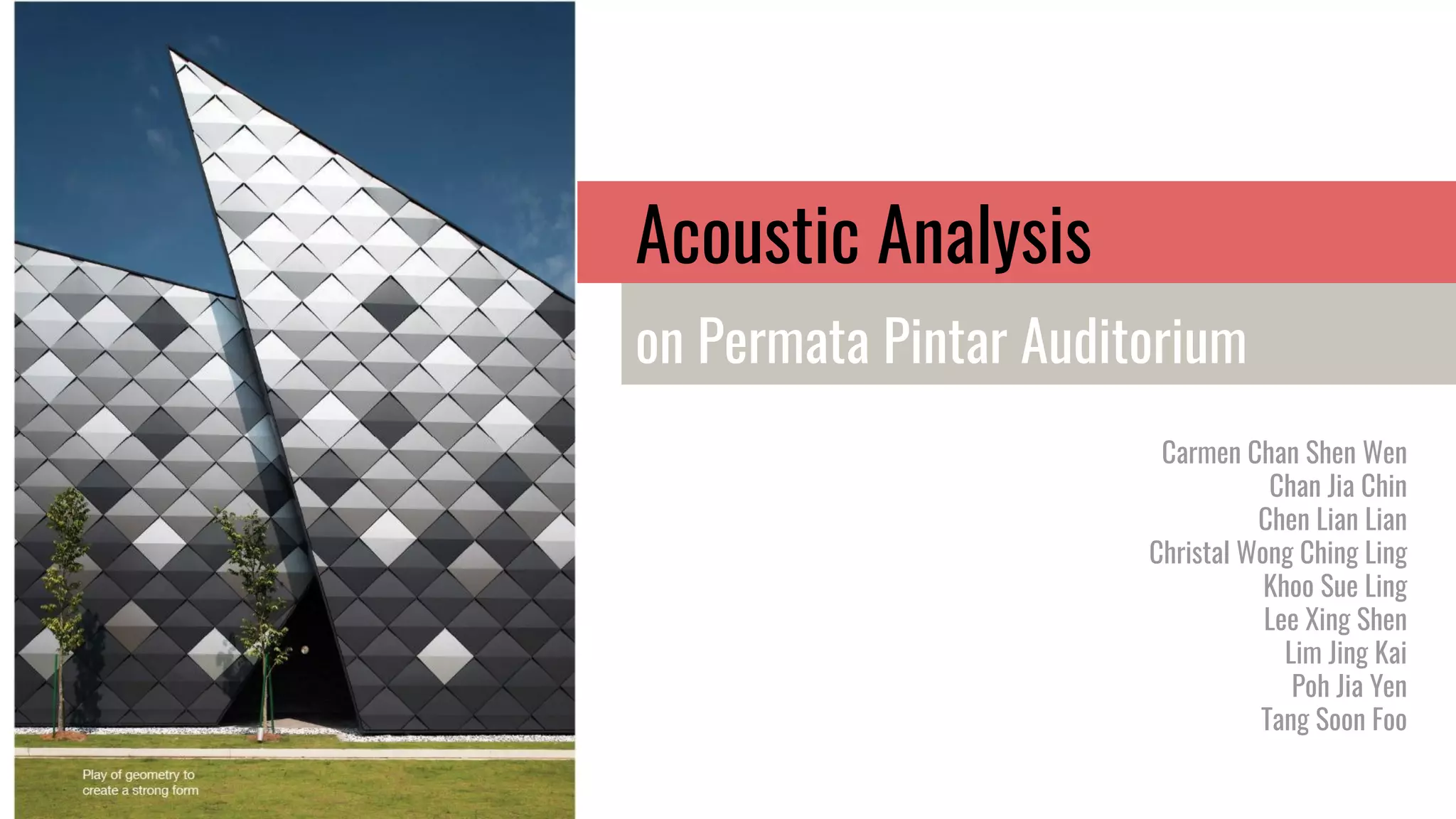
Acoustic Analysis
on Permata Pintar Auditorium
Carmen Chan Shen Wen
Chan Jia Chin
Chen Lian Lian
Christal Wong Ching Ling
Khoo Sue Ling
Lee Xing Shen
Lim Jing Kai
Poh Jia Yen
Tang Soon Foo
About the Auditorium
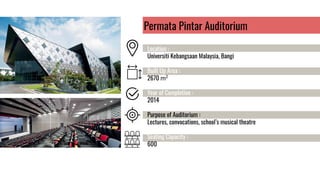
Permata Pintar Auditorium
Location :
Universiti Kebangsaan Malaysia, Bangi
Built Up Area :
2670 m2
Year of Completion :
2014
Purpose of Auditorium :
Lectures, convocations, school’s musical theatre
Seating Capacity :
600
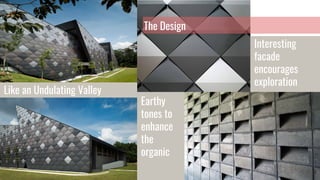
The Design
Like an Undulating Valley
Interesting
facade
encourages
exploration
Earthy
tones to
enhance
the
organic
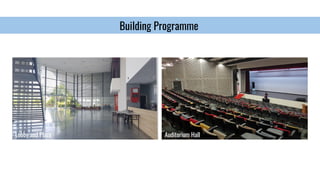
Building Programme
Lobby and Plaza Auditorium Hall
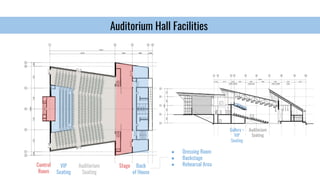
Auditorium Hall Facilities
Back
of House
StageAuditorium
Seating
VIP
Seating
Control
Room
● Dressing Room
● Backstage
● Rehearsal Area
Auditorium
Seating
Gallery =
VIP
Seating
Acoustical Analysis
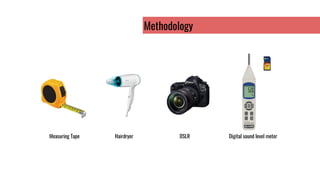
Methodology
Measuring Tape Hairdryer DSLR Digital sound level meter
Auditorium Design
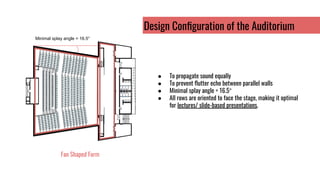
Design Configuration of the Auditorium
Fan Shaped Form
● To propagate sound equally
● To prevent flutter echo between parallel walls
● Minimal splay angle = 16.5°
● All rows are oriented to face the stage, making it optimal
for lectures/ slide-based presentations.
Minimal splay angle = 16.5°
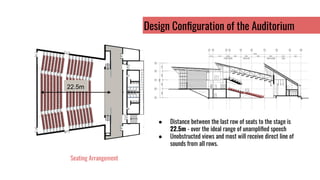
22.5m
Seating Arrangement
Design Configuration of the Auditorium
● Distance between the last row of seats to the stage is
22.5m - over the ideal range of unamplified speech
● Unobstructed views and most will receive direct line of
sounds from all rows.
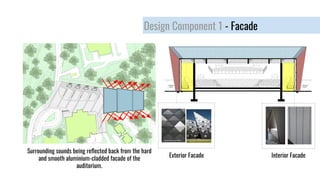
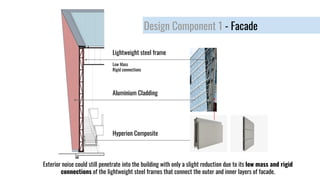
Design Component 1 - Facade
Surrounding sounds being reflected back from the hard
and smooth aluminium-cladded facade of the
auditorium.
Interior FacadeExterior Facade
Design Component 1 - Facade
Lightweight steel frame
Aluminium Cladding
Hyperion Composite
Low Mass
Rigid connections
Exterior noise could still penetrate into the building with only a slight reduction due to its low mass and rigid
connections of the lightweight steel frames that connect the outer and inner layers of facade.
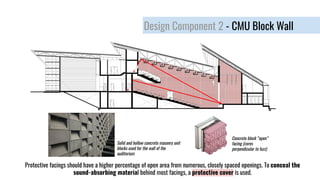
Design Component 2 - CMU Block Wall
Concrete block “open”
facing (cores
perpendicular to fuzz)
Protective facings should have a higher percentage of open area from numerous, closely spaced openings. To conceal the
sound-absorbing material behind most facings, a protective cover is used.
Solid and hollow concrete masonry unit
blocks used for the wall of the
auditorium
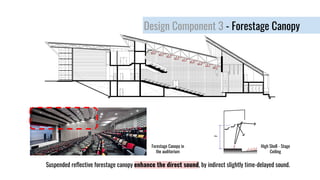
Design Component 3 - Forestage Canopy
Forestage Canopy in
the auditorium
High Shell - Stage
Ceiling
Suspended reflective forestage canopy enhance the direct sound, by indirect slightly time-delayed sound.
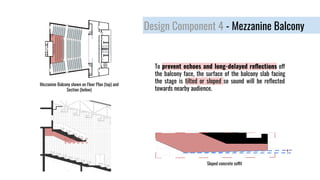
Design Component 4 - Mezzanine Balcony
To prevent echoes and long-delayed reflections off
the balcony face, the surface of the balcony slab facing
the stage is tilted or sloped so sound will be reflected
towards nearby audience.
Sloped concrete soffit
Mezzanine Balcony shown on Floor Plan (top) and
Section (below)
Acoustical Components
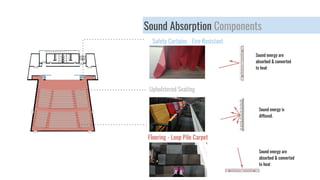
Sound Absorption Components
Safety Curtains - Fire Resistant
Upholstered Seating
Flooring - Loop Pile Carpet
Sound energy are
absorbed & converted
to heat
Sound energy are
absorbed & converted
to heat
Sound energy is
diffused.
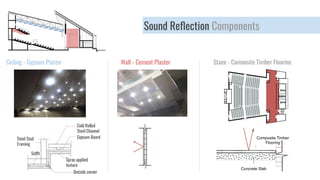
Sound Reflection Components
Ceiling - Gypsum Plaster Wall - Cement Plaster Stage - Composite Timber Flooring
Steel Stud
Framing
Soffit
Cold Rolled
Steel Channel
Gypsum Board
Spray applied
texture
Outside corner
Composite Timber
Flooring
Concrete Slab
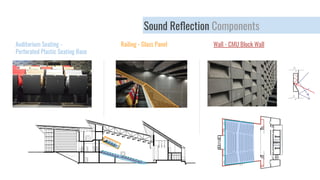
Sound Reflection Components
Auditorium Seating -
Perforated Plastic Seating Base
Railing - Glass Panel Wall - CMU Block Wall
Sound Diffusion
Sound Diffusion
Diffusivity of a sound field was measured by:
1. Taking reverberation time measurements at different points
2. Taking the standard deviation on the decay times.
3. Spatial distribution of the sound is then examined.
Sound diffusion is a method to:
1. Distribute sound energy evenly with a diffusion
2. Treat sound abbreviations (such as echos) in the space
- to prevent the occurrence of undesirable acoustical defects.
3. An excellent alternative or complement to sound absorption.
- do not remove sound energy, but effectively reduce distinct
echoes and reflections while still leaving a live sounding space.
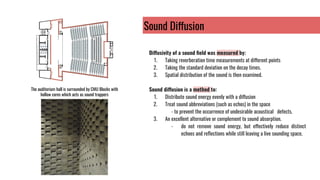
The auditorium hall is surrounded by CMU Blocks with
hollow cores which acts as sound trappers
Sound Diffusion
● Reflection occurs when sound strikes onto the wall’s hard
surface.
● Bouncing of sound waves causing it to lose its energy.
● Reflection of sound leads to echo and reverberation (Cavanaugh,
Tocci & Wilkes, 2010).
● The rough surface of unfinished concrete walls diffuse and reflect
sound energy.
● Due to the nature of concrete, it is mildly absorptive.
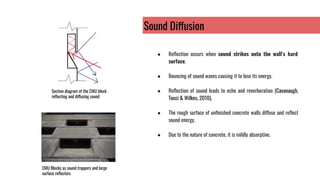
Section diagram of the CMU block
reflecting and diffusing sound
CMU Blocks as sound trappers and large
surface reflectors
Diffusive Space Non-Diffusive Spaces
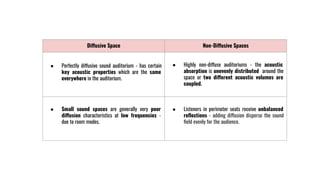
● Perfectly diffusive sound auditorium - has certain
key acoustic properties which are the same
everywhere in the auditorium.
● Highly non-diffuse auditoriums - the acoustic
absorption is unevenly distributed around the
space or two different acoustic volumes are
coupled.
● Small sound spaces are generally very poor
diffusion characteristics at low frequencies -
due to room modes.
● Listeners in perimeter seats receive unbalanced
reflections - adding diffusion disperse the sound
field evenly for the audience.
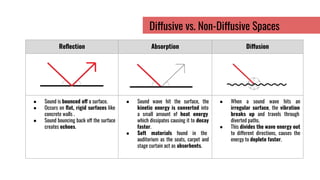
Reflection Absorption Diffusion
● Sound is bounced off a surface.
● Occurs on flat, rigid surfaces like
concrete walls .
● Sound bouncing back off the surface
creates echoes.
● Sound wave hit the surface, the
kinetic energy is converted into
a small amount of heat energy
which dissipates causing it to decay
faster.
● Soft materials found in the
auditorium as the seats, carpet and
stage curtain act as absorbents.
● When a sound wave hits an
irregular surface, the vibration
breaks up and travels through
diverted paths.
● This divides the wave energy out
to different directions, causes the
energy to deplete faster.
Diffusive vs. Non-Diffusive Spaces
Sound Diffusion
Suggestions
- To optimize sound diffusion in a hall or room, the wall and ceiling
could be designed in a zig-zag profile or uneven irregular-shaped
units.
- Sharp-uneven hard surfaces enable to diffuse sounds better.
- Reflectors should be installed at the front ⅓ portion to the stage
in order to maximize sound from the stage to the audience
- The remaining ⅔ should be diffusers to control the sound spread
and intensity.
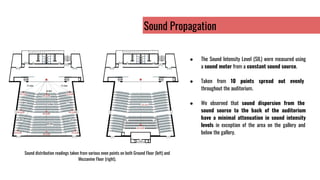
Sound Propagation
● The Sound Intensity Level (SIL) were measured using
a sound meter from a constant sound source.
● Taken from 10 points spread out evenly
throughout the auditorium.
● We observed that sound dispersion from the
sound source to the back of the auditorium
have a minimal attenuation in sound intensity
levels in exception of the area on the gallery and
below the gallery.
Sound distribution readings taken from various even points on both Ground Floor (left) and
Mezzanine Floor (right).
Sound Reflection
Sound Reflection
Sound Reflection
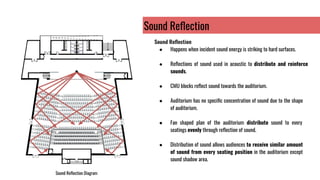
● Happens when incident sound energy is striking to hard surfaces.
● Reflections of sound used in acoustic to distribute and reinforce
sounds.
● CMU blocks reflect sound towards the auditorium.
● Auditorium has no specific concentration of sound due to the shape
of auditorium.
● Fan shaped plan of the auditorium distribute sound to every
seatings evenly through reflection of sound.
● Distribution of sound allows audiences to receive similar amount
of sound from every seating position in the auditorium except
sound shadow area.
Sound Reflection Diagram
Sound Reflection
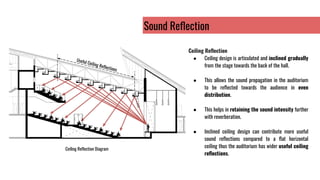
Useful Ceiling Reflections
Ceiling Reflection
● Ceiling design is articulated and inclined gradually
from the stage towards the back of the hall.
● This allows the sound propagation in the auditorium
to be reflected towards the audience in even
distribution.
● This helps in retaining the sound intensity further
with reverberation.
● Inclined ceiling design can contribute more useful
sound reflections compared to a flat horizontal
ceiling thus the auditorium has wider useful ceiling
reflections.
Ceiling Reflection Diagram
Sound Delay
Sound Delay
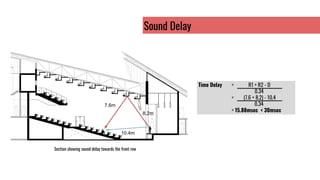
● Reflected sound beneficially reinforces the direct sound if
the time delay between them is relatively short, with maximum of
30msec.
● However, echo occurs when the time delay exceed 40msec for
speech and 100msec for music.
● Echos are probably the most serious of room acoustical defects
thus most of the auditorium designs were to avoid echos.
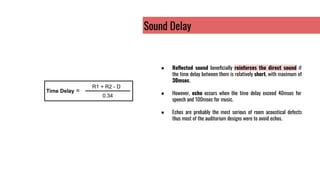
Time Delay =
R1 + R2 - D
0.34
Sound Delay
Section showing sound delay towards the front row
10.4m
8.2m
7.6m
Time Delay = R1 + R2 - D
0.34
= (7.6 + 8.2) - 10.4
0.34
= 15.88msec < 30msec
Sound Delay
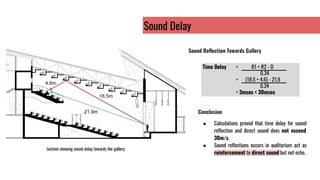
Section showing sound delay towards the gallery
Sound Reflection Towards Gallery
21.9m
18.5m
4.6m
Time Delay = R1 + R2 - D
0.34
= (18.5 + 4.6) - 21.9
0.34
= 3msec < 30msec
● Calculations proved that time delay for sound
reflection and direct sound does not exceed
30m/s.
● Sound reflections occurs in auditorium act as
reinforcement to direct sound but not echo.
Conclusion
Sound Shadow
Sound Shadow
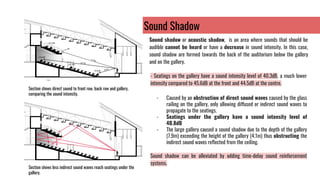
- Seatings on the gallery have a sound intensity level of 40.3dB, a much lower
intensity compared to 45.6dB at the front and 44.5dB at the centre.
- Caused by an obstruction of direct sound waves caused by the glass
railing on the gallery, only allowing diffused or indirect sound waves to
propagate to the seatings.
- Seatings under the gallery have a sound intensity level of
40.8dB
- The large gallery caused a sound shadow due to the depth of the gallery
(7.9m) exceeding the height of the gallery (4.1m) thus obstructing the
indirect sound waves reflected from the ceiling.
Sound shadow can be alleviated by adding time-delay sound reinforcement
systems.
Section shows direct sound to front row, back row and gallery,
comparing the sound intensity.
Section shows less indirect sound waves reach seatings under the
gallery.
Sound shadow or acoustic shadow, is an area where sounds that should be
audible cannot be heard or have a decrease in sound intensity. In this case,
sound shadow are formed towards the back of the auditorium below the gallery
and on the gallery.
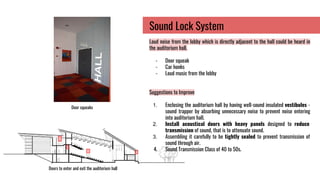
Sound Lock System
Noise Intrusion
Door squeaks
Sound Lock System
Loud noise from the lobby which is directly adjacent to the hall could be heard in
the auditorium hall.
- Door squeak
- Car honks
- Loud music from the lobby
Suggestions to Improve
1. Enclosing the auditorium hall by having well-sound insulated vestibules -
sound trapper by absorbing unnecessary noise to prevent noise entering
into auditorium hall.
2. Install acoustical doors with heavy panels designed to reduce
transmission of sound, that is to attenuate sound.
3. Assembling it carefully to be tightly sealed to prevent transmission of
sound through air.
4. Sound Transmission Class of 40 to 50s.
Doors to enter and exit the auditorium hall
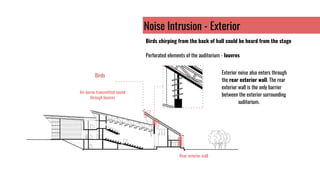
Noise Intrusion - Exterior
Birds chirping from the back of hall could be heard from the stage
Perforated elements of the auditorium - louvres
Exterior noise also enters through
the rear exterior wall. The rear
exterior wall is the only barrier
between the exterior surrounding
and the auditorium.
Birds
Air-borne transmitted sound
through louvres
Rear exterior wall
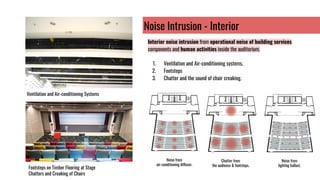
Noise Intrusion - Interior
Interior noise intrusion from operational noise of building services
components and human activities inside the auditorium.
1. Ventilation and Air-conditioning systems,
2. Footsteps
3. Chatter and the sound of chair creaking.
Chatter from
the audience & footsteps.
Noise from
lighting ballast.
Noise from
air-conditioning diffuser.
Footsteps on Timber Flooring at Stage
Chatters and Creaking of Chairs
Ventilation and Air-conditioning Systems
Sound Reinforcement System
The role of a sound system is to amplify and adjust the sound quality of an audio
signal, and then provide corresponding output from the speaker system that the
listeners will hear.
1. The process begins with a sound source (such as a human voice), which
creates waves of sound (acoustical energy).
2. These waves are detected by a transducer (microphone), which converts
them to electrical energy.
3. The electrical signal from the microphone is very weak, and must be fed to
an amplifier before anything serious can be done with it.
4. The loudspeaker converts the electrical signal back into sound waves,
which are heard by human ears.
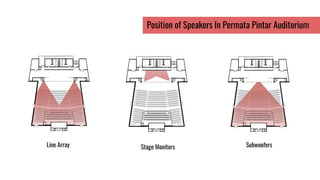
In the auditorium, the speaker system in
operation is classified into 3 types:
1. Line array
2. Subwoofer
3. Stage monitor.
Line Array
Position of Speakers In Permata Pintar Auditorium
SubwoofersStage Monitors
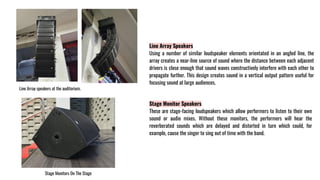
Line Array Speakers
Using a number of similar loudspeaker elements orientated in an angled line, the
array creates a near-line source of sound where the distance between each adjacent
drivers is close enough that sound waves constructively interfere with each other to
propagate further. This design creates sound in a vertical output pattern useful for
focusing sound at large audiences.
Line Array speakers at the auditorium.
Stage Monitor Speakers
These are stage-facing loudspeakers which allow performers to listen to their own
sound or audio mixes. Without these monitors, the performers will hear the
reverberated sounds which are delayed and distorted in turn which could, for
example, cause the singer to sing out of time with the band.
Stage Monitors On The Stage
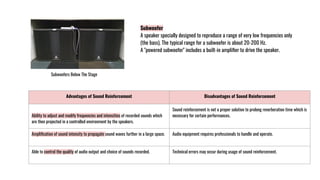
Subwoofer
A speaker specially designed to reproduce a range of very low frequencies only
(the bass). The typical range for a subwoofer is about 20-200 Hz.
A "powered subwoofer" includes a built-in amplifier to drive the speaker.
Subwoofers Below The Stage
Advantages of Sound Reinforcement Disadvantages of Sound Reinforcement
Ability to adjust and modify frequencies and intensities of recorded sounds which
are then projected in a controlled environment by the speakers.
Sound reinforcement is not a proper solution to prolong reverberation time which is
necessary for certain performances.
Amplification of sound intensity to propagate sound waves further in a large space. Audio equipment requires professionals to handle and operate.
Able to control the quality of audio output and choice of sounds recorded. Technical errors may occur during usage of sound reinforcement.
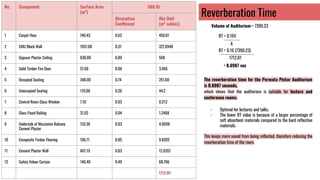
Reverberation Time
The reverberation time for the Permata Pintar Auditorium
is 0.6907 seconds,
which shows that the auditorium is suitable for lecture and
conference rooms.
- Optimal for lectures and talks.
- The lower RT value is because of a larger percentage of
soft absorbent materials compared to the hard reflective
materials.
This keeps more sound from being reflected, therefore reducing the
reverberation time of the room.
No. Component Surface Area
(m2
)
500 Hz
Absorption
Coefficient
Abs Unit
(m2
sabins)
1 Carpet Floor 740.43 0.62 459.07
2 CMU Block Wall 1057.08 0.31 327.6948
3 Gypsum Plaster Ceiling 630.00 0.80 508
4 Solid Timber Fire Door 57.60 0.06 3.456
5 Occupied Seating 340.00 0.74 251.60
6 Unoccupied Seating 170.00 0.26 44.2
7 Control Room Glass Window 7.10 0.03 0.213
8 Glass Panel Railing 31.02 0.04 1.2408
9 Underside of Mezzanine Balcony
Cement Plaster
133.36 0.03 4.0008
10 Composite Timber Flooring 196.71 0.05 9.8355
11 Cement Plaster Wall 401.19 0.03 12.0357
12 Safety Velour Curtain 140.40 0.49 68.796
1712.01
Reverberation Time
RT = 0.16V
A
RT = 0.16 (7390.23)
1712.01
= 0.6907 sec
Volume of Auditorium = 7390.23
Conclusion
Conclusion
Through our case study, the RT of Permata Pintar Auditorium is 0.69s
which is optimum for speeches and under the lecture hall category, in
line with their main programs.
The design and form is also legible in distributing the sound evenly with
only a slight decrease in SIL towards the back row seatings.
However, there are several major issues highlighted in the auditorium:
- Sound shadow at below and above the gallery.
- Significant exterior noise intrusion
- Noise created by M&E appliances.
These issues could be fixed by repairing M&E appliances, installing
sound insulating materials and acoustical doors with high STC and to
enclose the auditorium hall with a vestibule.
THANK YOU

Acoustic Analysis on Permata Pintar Auditorium (presentation)

  • 1.
    Acoustic Analysis on PermataPintar Auditorium Carmen Chan Shen Wen Chan Jia Chin Chen Lian Lian Christal Wong Ching Ling Khoo Sue Ling Lee Xing Shen Lim Jing Kai Poh Jia Yen Tang Soon Foo
  • 2.
  • 3.
    Permata Pintar Auditorium Location: Universiti Kebangsaan Malaysia, Bangi Built Up Area : 2670 m2 Year of Completion : 2014 Purpose of Auditorium : Lectures, convocations, school’s musical theatre Seating Capacity : 600
  • 4.
    The Design Like anUndulating Valley Interesting facade encourages exploration Earthy tones to enhance the organic
  • 5.
    Building Programme Lobby andPlaza Auditorium Hall
  • 6.
    Auditorium Hall Facilities Back ofHouse StageAuditorium Seating VIP Seating Control Room ● Dressing Room ● Backstage ● Rehearsal Area Auditorium Seating Gallery = VIP Seating
  • 7.
  • 8.
    Methodology Measuring Tape HairdryerDSLR Digital sound level meter
  • 9.
  • 10.
    Design Configuration ofthe Auditorium Fan Shaped Form ● To propagate sound equally ● To prevent flutter echo between parallel walls ● Minimal splay angle = 16.5° ● All rows are oriented to face the stage, making it optimal for lectures/ slide-based presentations. Minimal splay angle = 16.5°
  • 11.
    22.5m Seating Arrangement Design Configurationof the Auditorium ● Distance between the last row of seats to the stage is 22.5m - over the ideal range of unamplified speech ● Unobstructed views and most will receive direct line of sounds from all rows.
  • 12.
    Design Component 1- Facade Surrounding sounds being reflected back from the hard and smooth aluminium-cladded facade of the auditorium. Interior FacadeExterior Facade
  • 13.
    Design Component 1- Facade Lightweight steel frame Aluminium Cladding Hyperion Composite Low Mass Rigid connections Exterior noise could still penetrate into the building with only a slight reduction due to its low mass and rigid connections of the lightweight steel frames that connect the outer and inner layers of facade.
  • 14.
    Design Component 2- CMU Block Wall Concrete block “open” facing (cores perpendicular to fuzz) Protective facings should have a higher percentage of open area from numerous, closely spaced openings. To conceal the sound-absorbing material behind most facings, a protective cover is used. Solid and hollow concrete masonry unit blocks used for the wall of the auditorium
  • 15.
    Design Component 3- Forestage Canopy Forestage Canopy in the auditorium High Shell - Stage Ceiling Suspended reflective forestage canopy enhance the direct sound, by indirect slightly time-delayed sound.
  • 16.
    Design Component 4- Mezzanine Balcony To prevent echoes and long-delayed reflections off the balcony face, the surface of the balcony slab facing the stage is tilted or sloped so sound will be reflected towards nearby audience. Sloped concrete soffit Mezzanine Balcony shown on Floor Plan (top) and Section (below)
  • 17.
  • 18.
    Sound Absorption Components SafetyCurtains - Fire Resistant Upholstered Seating Flooring - Loop Pile Carpet Sound energy are absorbed & converted to heat Sound energy are absorbed & converted to heat Sound energy is diffused.
  • 19.
    Sound Reflection Components Ceiling- Gypsum Plaster Wall - Cement Plaster Stage - Composite Timber Flooring Steel Stud Framing Soffit Cold Rolled Steel Channel Gypsum Board Spray applied texture Outside corner Composite Timber Flooring Concrete Slab
  • 20.
    Sound Reflection Components AuditoriumSeating - Perforated Plastic Seating Base Railing - Glass Panel Wall - CMU Block Wall
  • 21.
  • 22.
    Sound Diffusion Diffusivity ofa sound field was measured by: 1. Taking reverberation time measurements at different points 2. Taking the standard deviation on the decay times. 3. Spatial distribution of the sound is then examined. Sound diffusion is a method to: 1. Distribute sound energy evenly with a diffusion 2. Treat sound abbreviations (such as echos) in the space - to prevent the occurrence of undesirable acoustical defects. 3. An excellent alternative or complement to sound absorption. - do not remove sound energy, but effectively reduce distinct echoes and reflections while still leaving a live sounding space. The auditorium hall is surrounded by CMU Blocks with hollow cores which acts as sound trappers
  • 23.
    Sound Diffusion ● Reflectionoccurs when sound strikes onto the wall’s hard surface. ● Bouncing of sound waves causing it to lose its energy. ● Reflection of sound leads to echo and reverberation (Cavanaugh, Tocci & Wilkes, 2010). ● The rough surface of unfinished concrete walls diffuse and reflect sound energy. ● Due to the nature of concrete, it is mildly absorptive. Section diagram of the CMU block reflecting and diffusing sound CMU Blocks as sound trappers and large surface reflectors
  • 24.
    Diffusive Space Non-DiffusiveSpaces ● Perfectly diffusive sound auditorium - has certain key acoustic properties which are the same everywhere in the auditorium. ● Highly non-diffuse auditoriums - the acoustic absorption is unevenly distributed around the space or two different acoustic volumes are coupled. ● Small sound spaces are generally very poor diffusion characteristics at low frequencies - due to room modes. ● Listeners in perimeter seats receive unbalanced reflections - adding diffusion disperse the sound field evenly for the audience.
  • 25.
    Reflection Absorption Diffusion ●Sound is bounced off a surface. ● Occurs on flat, rigid surfaces like concrete walls . ● Sound bouncing back off the surface creates echoes. ● Sound wave hit the surface, the kinetic energy is converted into a small amount of heat energy which dissipates causing it to decay faster. ● Soft materials found in the auditorium as the seats, carpet and stage curtain act as absorbents. ● When a sound wave hits an irregular surface, the vibration breaks up and travels through diverted paths. ● This divides the wave energy out to different directions, causes the energy to deplete faster. Diffusive vs. Non-Diffusive Spaces
  • 26.
    Sound Diffusion Suggestions - Tooptimize sound diffusion in a hall or room, the wall and ceiling could be designed in a zig-zag profile or uneven irregular-shaped units. - Sharp-uneven hard surfaces enable to diffuse sounds better. - Reflectors should be installed at the front ⅓ portion to the stage in order to maximize sound from the stage to the audience - The remaining ⅔ should be diffusers to control the sound spread and intensity.
  • 27.
    Sound Propagation ● TheSound Intensity Level (SIL) were measured using a sound meter from a constant sound source. ● Taken from 10 points spread out evenly throughout the auditorium. ● We observed that sound dispersion from the sound source to the back of the auditorium have a minimal attenuation in sound intensity levels in exception of the area on the gallery and below the gallery. Sound distribution readings taken from various even points on both Ground Floor (left) and Mezzanine Floor (right).
  • 28.
  • 29.
    Sound Reflection Sound Reflection ●Happens when incident sound energy is striking to hard surfaces. ● Reflections of sound used in acoustic to distribute and reinforce sounds. ● CMU blocks reflect sound towards the auditorium. ● Auditorium has no specific concentration of sound due to the shape of auditorium. ● Fan shaped plan of the auditorium distribute sound to every seatings evenly through reflection of sound. ● Distribution of sound allows audiences to receive similar amount of sound from every seating position in the auditorium except sound shadow area. Sound Reflection Diagram
  • 30.
    Sound Reflection Useful CeilingReflections Ceiling Reflection ● Ceiling design is articulated and inclined gradually from the stage towards the back of the hall. ● This allows the sound propagation in the auditorium to be reflected towards the audience in even distribution. ● This helps in retaining the sound intensity further with reverberation. ● Inclined ceiling design can contribute more useful sound reflections compared to a flat horizontal ceiling thus the auditorium has wider useful ceiling reflections. Ceiling Reflection Diagram
  • 31.
  • 32.
    Sound Delay ● Reflectedsound beneficially reinforces the direct sound if the time delay between them is relatively short, with maximum of 30msec. ● However, echo occurs when the time delay exceed 40msec for speech and 100msec for music. ● Echos are probably the most serious of room acoustical defects thus most of the auditorium designs were to avoid echos. Time Delay = R1 + R2 - D 0.34
  • 33.
    Sound Delay Section showingsound delay towards the front row 10.4m 8.2m 7.6m Time Delay = R1 + R2 - D 0.34 = (7.6 + 8.2) - 10.4 0.34 = 15.88msec < 30msec
  • 34.
    Sound Delay Section showingsound delay towards the gallery Sound Reflection Towards Gallery 21.9m 18.5m 4.6m Time Delay = R1 + R2 - D 0.34 = (18.5 + 4.6) - 21.9 0.34 = 3msec < 30msec ● Calculations proved that time delay for sound reflection and direct sound does not exceed 30m/s. ● Sound reflections occurs in auditorium act as reinforcement to direct sound but not echo. Conclusion
  • 35.
  • 36.
    Sound Shadow - Seatingson the gallery have a sound intensity level of 40.3dB, a much lower intensity compared to 45.6dB at the front and 44.5dB at the centre. - Caused by an obstruction of direct sound waves caused by the glass railing on the gallery, only allowing diffused or indirect sound waves to propagate to the seatings. - Seatings under the gallery have a sound intensity level of 40.8dB - The large gallery caused a sound shadow due to the depth of the gallery (7.9m) exceeding the height of the gallery (4.1m) thus obstructing the indirect sound waves reflected from the ceiling. Sound shadow can be alleviated by adding time-delay sound reinforcement systems. Section shows direct sound to front row, back row and gallery, comparing the sound intensity. Section shows less indirect sound waves reach seatings under the gallery. Sound shadow or acoustic shadow, is an area where sounds that should be audible cannot be heard or have a decrease in sound intensity. In this case, sound shadow are formed towards the back of the auditorium below the gallery and on the gallery.
  • 37.
  • 38.
    Door squeaks Sound LockSystem Loud noise from the lobby which is directly adjacent to the hall could be heard in the auditorium hall. - Door squeak - Car honks - Loud music from the lobby Suggestions to Improve 1. Enclosing the auditorium hall by having well-sound insulated vestibules - sound trapper by absorbing unnecessary noise to prevent noise entering into auditorium hall. 2. Install acoustical doors with heavy panels designed to reduce transmission of sound, that is to attenuate sound. 3. Assembling it carefully to be tightly sealed to prevent transmission of sound through air. 4. Sound Transmission Class of 40 to 50s. Doors to enter and exit the auditorium hall
  • 39.
    Noise Intrusion -Exterior Birds chirping from the back of hall could be heard from the stage Perforated elements of the auditorium - louvres Exterior noise also enters through the rear exterior wall. The rear exterior wall is the only barrier between the exterior surrounding and the auditorium. Birds Air-borne transmitted sound through louvres Rear exterior wall
  • 40.
    Noise Intrusion -Interior Interior noise intrusion from operational noise of building services components and human activities inside the auditorium. 1. Ventilation and Air-conditioning systems, 2. Footsteps 3. Chatter and the sound of chair creaking. Chatter from the audience & footsteps. Noise from lighting ballast. Noise from air-conditioning diffuser. Footsteps on Timber Flooring at Stage Chatters and Creaking of Chairs Ventilation and Air-conditioning Systems
  • 41.
  • 42.
    Sound Reinforcement System Therole of a sound system is to amplify and adjust the sound quality of an audio signal, and then provide corresponding output from the speaker system that the listeners will hear. 1. The process begins with a sound source (such as a human voice), which creates waves of sound (acoustical energy). 2. These waves are detected by a transducer (microphone), which converts them to electrical energy. 3. The electrical signal from the microphone is very weak, and must be fed to an amplifier before anything serious can be done with it. 4. The loudspeaker converts the electrical signal back into sound waves, which are heard by human ears. In the auditorium, the speaker system in operation is classified into 3 types: 1. Line array 2. Subwoofer 3. Stage monitor.
  • 43.
    Line Array Position ofSpeakers In Permata Pintar Auditorium SubwoofersStage Monitors
  • 44.
    Line Array Speakers Usinga number of similar loudspeaker elements orientated in an angled line, the array creates a near-line source of sound where the distance between each adjacent drivers is close enough that sound waves constructively interfere with each other to propagate further. This design creates sound in a vertical output pattern useful for focusing sound at large audiences. Line Array speakers at the auditorium. Stage Monitor Speakers These are stage-facing loudspeakers which allow performers to listen to their own sound or audio mixes. Without these monitors, the performers will hear the reverberated sounds which are delayed and distorted in turn which could, for example, cause the singer to sing out of time with the band. Stage Monitors On The Stage
  • 45.
    Subwoofer A speaker speciallydesigned to reproduce a range of very low frequencies only (the bass). The typical range for a subwoofer is about 20-200 Hz. A "powered subwoofer" includes a built-in amplifier to drive the speaker. Subwoofers Below The Stage Advantages of Sound Reinforcement Disadvantages of Sound Reinforcement Ability to adjust and modify frequencies and intensities of recorded sounds which are then projected in a controlled environment by the speakers. Sound reinforcement is not a proper solution to prolong reverberation time which is necessary for certain performances. Amplification of sound intensity to propagate sound waves further in a large space. Audio equipment requires professionals to handle and operate. Able to control the quality of audio output and choice of sounds recorded. Technical errors may occur during usage of sound reinforcement.
  • 46.
  • 47.
    The reverberation timefor the Permata Pintar Auditorium is 0.6907 seconds, which shows that the auditorium is suitable for lecture and conference rooms. - Optimal for lectures and talks. - The lower RT value is because of a larger percentage of soft absorbent materials compared to the hard reflective materials. This keeps more sound from being reflected, therefore reducing the reverberation time of the room. No. Component Surface Area (m2 ) 500 Hz Absorption Coefficient Abs Unit (m2 sabins) 1 Carpet Floor 740.43 0.62 459.07 2 CMU Block Wall 1057.08 0.31 327.6948 3 Gypsum Plaster Ceiling 630.00 0.80 508 4 Solid Timber Fire Door 57.60 0.06 3.456 5 Occupied Seating 340.00 0.74 251.60 6 Unoccupied Seating 170.00 0.26 44.2 7 Control Room Glass Window 7.10 0.03 0.213 8 Glass Panel Railing 31.02 0.04 1.2408 9 Underside of Mezzanine Balcony Cement Plaster 133.36 0.03 4.0008 10 Composite Timber Flooring 196.71 0.05 9.8355 11 Cement Plaster Wall 401.19 0.03 12.0357 12 Safety Velour Curtain 140.40 0.49 68.796 1712.01 Reverberation Time RT = 0.16V A RT = 0.16 (7390.23) 1712.01 = 0.6907 sec Volume of Auditorium = 7390.23
  • 48.
  • 49.
    Conclusion Through our casestudy, the RT of Permata Pintar Auditorium is 0.69s which is optimum for speeches and under the lecture hall category, in line with their main programs. The design and form is also legible in distributing the sound evenly with only a slight decrease in SIL towards the back row seatings. However, there are several major issues highlighted in the auditorium: - Sound shadow at below and above the gallery. - Significant exterior noise intrusion - Noise created by M&E appliances. These issues could be fixed by repairing M&E appliances, installing sound insulating materials and acoustical doors with high STC and to enclose the auditorium hall with a vestibule.
  • 50.