1
1 INTRODUCTION
1.1 AIM AND OBJECTIVES
In a group of six people, we are to conduct a case study on auditorium locally. The chosen
auditorium is the Wisma MBSA Auditorium Hall located in Shah Alam. Upon visitation, we
are then to produce an analysis report based on our understanding of the acoustic qualities
of a room.
The objectives are as follow:
1. To understand how an auditorium design layout can influence the effectiveness of the
sound quality in a particular hall.
2. To develop deeper understanding in terms of the choice of materials used to enhance the
acoustic quality of an auditorium.
3. To produce a well-documented analysis report based on the observation and data
collected upon site visitation.
2
1.2 SITE LOCATION
Figure 1.2 (a) MBSA Site Plan
Figure 1.2 (b) Photos of Wisma MBSA
Wisma MBSA is located in Shah Alam and is surrounded by mainly government buildings and
office buildings. There are also a few of old shopping centers located opposite Wisma MBSA.
The back of the building is a park with huge pond and a museum.
Overall, the building itself is located at a tranquil place with less traffic congestion on a daily
basis. Therefore, the auditorium is not disturbed by the noise coming from the outside.
3
1.3 SITE BACKGROUND
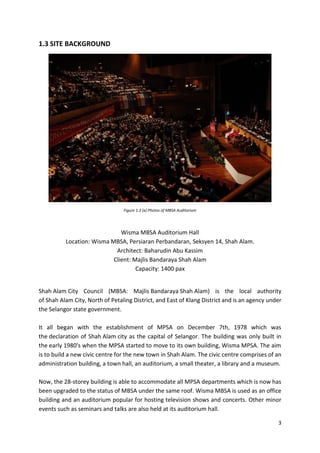
Figure 1.3 (a) Photos of MBSA Auditorium
Wisma MBSA Auditorium Hall
Location: Wisma MBSA, Persiaran Perbandaran, Seksyen 14, Shah Alam.
Architect: Baharudin Abu Kassim
Client: Majlis Bandaraya Shah Alam
Capacity: 1400 pax
Shah Alam City Council (MBSA: Majlis Bandaraya Shah Alam) is the local authority
of Shah Alam City, North of Petaling District, and East of Klang District and is an agency under
the Selangor state government.
It all began with the establishment of MPSA on December 7th, 1978 which was
the declaration of Shah Alam city as the capital of Selangor. The building was only built in
the early 1980's when the MPSA started to move to its own building, Wisma MPSA. The aim
is to build a new civic centre for the new town in Shah Alam. The civic centre comprises of an
administration building, a town hall, an auditorium, a small theater, a library and a museum.
Now, the 28-storey building is able to accommodate all MPSA departments which is now has
been upgraded to the status of MBSA under the same roof. Wisma MBSA is used as an office
building and an auditorium popular for hosting television shows and concerts. Other minor
events such as seminars and talks are also held at its auditorium hall.
4
1.4 ARCHITECTURAL DRAWINGS
1.4.1 THRID FLOOR PLAN
Figure 1.4.1 (a) MBSA Third Floor Plan
55000
55100
5
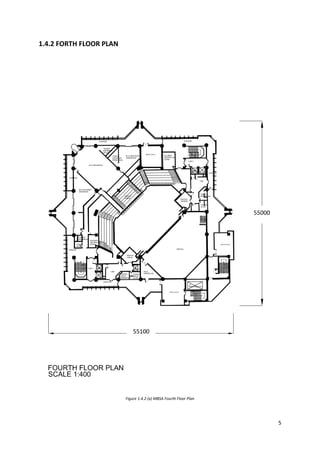
1.4.2 FORTH FLOOR PLAN
Figure 1.4.2 (a) MBSA Fourth Floor Plan
55000
55100
6
1.4.3 FIFTH FLOOR PLAN
Figure 1.4.3(a) MBSA Fifth Floor Plan
55000
55100
7
1.4.4 SECTION A – A’
Figure 1.4.4 (a) Auditorium Section
8
1.5 SITE PHOTOS
Figure 1.5 (a) Auditorium stage Figure 1.5 (b) View on top of the stage
Figure 1.5 (c) The front seating area Figure 1.5 (d)The gallery seating area
Figure 1.5 (e) The balcony seating area
9
1.6 AUDITORIUM DESIGN ANALYSIS
1.6.1 AUDITORIUM SHAPE AND MASSING
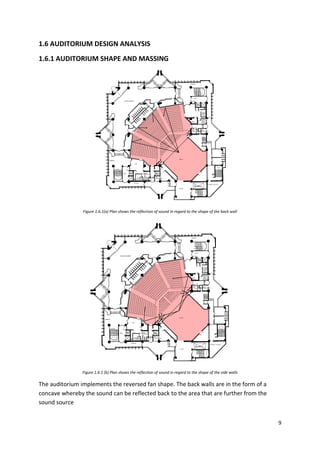
Figure 1.6.1(a) Plan shows the reflection of sound in regard to the shape of the back wall
Figure 1.6.1 (b) Plan shows the reflection of sound in regard to the shape of the side walls
The auditorium implements the reversed fan shape. The back walls are in the form of a
concave whereby the sound can be reflected back to the area that are further from the
sound source
10
Convex ceiling Flat ceiling
Figure 1.6.1 (c) Section shows the types of how the sound is reflected in regards of the surfaces of the ceilings
In terms of the sectional view, the auditorium implements the rectangular shaped ceiling at
the stage and the convex ceilings at the seating area. The flat ceiling at the stage helps to
reduce the reverberation time so that the musician can hear one another clearly. Whereas,
the convex ceiling at the seating area helps to reflect the sound to the audience.
Reflected sound Sound shadow
Figure 1.6.1 (d) Section shows the sound shadow occur underneath the balcony
Because of the balcony, sound shadow occurs at the back seating area where the sound
quality decreases. Therefore, sound reinforcements are attached to the walls at the gallery
area. More on this will be further discussed in the later part of the report.
11
1.6.2 SEATING ARRANGEMENTS
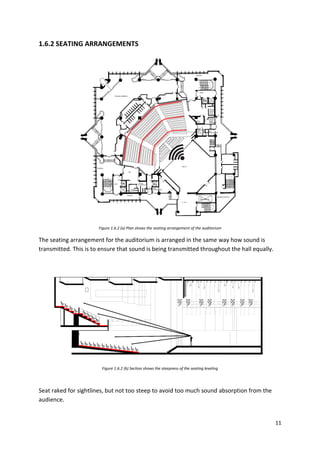
Figure 1.6.2 (a) Plan shows the seating arrangement of the auditorium
The seating arrangement for the auditorium is arranged in the same way how sound is
transmitted. This is to ensure that sound is being transmitted throughout the hall equally.
Figure 1.6.2 (b) Section shows the steepness of the seating leveling
Seat raked for sightlines, but not too steep to avoid too much sound absorption from the
audience.
12
2 ACOUSTICS & ARCHITECTURE
2.1 LITREATURE REVIEW
Acoustics is the science concerned with the production, control, transmission, reception,
and effects of sound (as defined by Merriam-Webster).
Sound is a vibrational energy transmitted through an elastic medium such as gas, liquid or
solid, which travels in waves, spreading outwards from the source of the sound.
Studies of acoustics includes the study of musical instruments and architectural spaces,
covering a vast range of topics, including noise control, navigation, ultrasound for imaging,
electroacoustic communication etc.
Acoustics is usually evaluated on reverberation time (RT) and noise curve in the built
environment. The desired RT can be achieved by employing the sound absorption materials
such as wall and ceiling cladding. The sound absorption materials are rated with sound
absorption coefficient where the absorption and transmission loss of sound are depended
on the fiber or material size, volume of fiber, porosity, airflow resistance, thickness, density,
compression and placement or position of materials. The main factors that affect sound
absorption within an interior space is the fiber or material size, porosity, thickness and
density. Sound absorption is inversely proportional to the diameter or width of fiber.
2.2 SOUND INTENSITY LEVEL (SIL)
Sound intensity is defined as the sound power per unit area. The usual context is the
measurement of sound intensity in the air at a listener's location. The basic units are
watts/m2 or watts/cm2. Many sound intensity measurements are made relative to a
standard threshold of hearing intensity I0 = 10-12 W/m2.
Sound intensity level (SIL) measurement is commonly done in decibel (dB) scale. "I" is the
intensity of sound expressed in watts per meter and the "I0" is the reference intensity
defined to be 10-12W/m2. This value of "I0" is the threshold (minimum sound intensity) of
hearing at 1kHz, for a person under the best circumstances.
SIL = 10 log10 [I/I0]
13
2.3 REVERBERATION, ATTENUATION, ECHOS & SOUND SHADOWS
Reverberation is the collection of reflected sounds from the surfaces in an enclosure like an
auditorium. It is a desirable property of auditoriums to the extent that it helps to overcome
the inverse square law drop off of sound intensity in the enclosure. Reverberation is an
important parameter for describing speech intelligibility and the perception of music and is
used to correct or normalize sound insulation and sound power measurements, for
example, to enhance the room's acoustical performance, a specifically high reflective ceiling
panels is installed directly above the stage area to help directing the sound towards specific
seating area. However, if it is excessive, it makes the sounds run together with loss of
articulation - the sound becomes muddy, garbled, resulting in a distracting echo effect. To
quantitatively characterize the reverberation, the parameter called the reverberation time is
used.
Sound attenuation is a measure of the energy loss of sound propagation in media, in other
words, loss in intensity. Most media have viscosity, whereby when sound travels through a
medium, its intensity diminishes proportionally with the distance traveled. In idealized
media, sound pressure (signal amplitude) is only reduced by the spreading of the wave.
Scattering is the reflection of sound in directions other than its original direction of
propagation and absorption is the conversion of the sound energy to other forms of energy,
together these creates attenuation.
An acoustic shadow or sound shadow is an area through which sound waves fail to
propagate. A short-distance acoustic shadow occurs behind a building or a sound barrier.
The sound from a source is shielded by the obstruction. Due to diffraction around the
object, it will not be completely silent in the sound shadow. The amplitude of the sound can
be reduced considerably, however, depending on the additional distance the sound has to
travel between source and receiver. Sound reflection occur when sound wave bounce off
from a surface. At corners, sound wave are reflected and returned, where at concave
surface sound wave tend to be concentrated and focused to an area while dispersed at a
convex surface.
14
2.4 METHODOLOGY
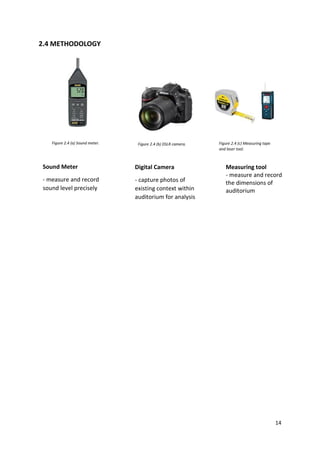
Sound Meter
- measure and record
sound level precisely
Digital Camera
- capture photos of
existing context within
auditorium for analysis
Measuring tool
- measure and record
the dimensions of
auditorium
Figure 2.4 (a) Sound meter. Figure 2.4 (b) DSLR camera. Figure 2.4 (c) Measuring tape
and laser tool.
15
3 ACOUSTIC DESIGN ANALYSIS
3.1 SOUND REINFORCEMENT SYSTEMS
The types of speakers used in the auditorium can be classified into 3 different categories:
1. Sensory controlled subwoofer
2. Compact 3-way symmetrical line array module speakers
3. 2-way compact versatile full range system speaker
Figure 3.1(a) Sensory controlled subwoofer
Sensory controlled subwoofer is designed to produce low frequency sounds, typically
from 40Hz up to 500 Hz. It helps to achieve a better sound quality for low frequency.
Figure 3.1 (b) Compact 3-way symmetrical line array module speakers
It functions provide additional sound pressure and further dispersion option. It also provides
a point source with a flexible coverage of sound.
Figure 3.1 (c) 2-way compact versatile full range system speaker
Usually located on the central part of the theatre or auditorium. It helps to achieve the
balance and quality of sound throughout the space of the theatre.
16
3.1.1 SOUND REINFORCEMENT USED IN MBSA
3.1.1.1 ARRAY SPEAKERS
Figure 3.1.1.1 (a) Array speaker
Figure 3.1.1.1 (b) Figure 3.1.1.1(c)
Figure 3.1.1.1 (b) & (c) Placement of suspended array speakers
Line array is a loudspeaker system that is consists of several identical loudspeaker elements
mounted in a line and fed in phase, to create a near-line source of sound. The distance
between adjacent drivers are close in between that they constructively interfere with each
other to transmit sound waves farther than traditional horn-loaded loudspeakers, and with
a more evenly distributed sound output pattern.
2 array speakers are suspended from the ceiling directly in front of the stage directed to the
center, slightly slanted angle down to provide extra coverage to the nearest front of the stage
while the top half will be angled upward facing the mezzanine floor of the auditorium. It is
placed at left and right sides of the hall to ensure a balanced transmission of sound to the
entire hall.
17
3.1.1.2 STAGE MONITOR SPEAKERS
Figure 3.1.1.2 (a) Stage monitor speaker
Figure 3.1.1.2 (b) Figure 3.1.1.2 (c)
Figure 3.1.1.2 (b) & (c) Placement of stage monitor speaker located on the stage facing the performers
Stage monitor speakers function to provide feedback to the performers on stage which are
situated in the blind spot area of the speakers. It Is essential for the performers as it helps to
amplify sound when acoustics instruments or vocals are utilized.
The speakers are placed on the stage floor facing the performers to ensure that they can
hear the sound they project to help with synchronization between different instruments
during performance.
18
3.1.1.3 SINGLE CABINET SPEAKERS
Figure 3.1.1.3(a)Single speaker cabinet
Figure 3.1.1.3(b) Figure 3.1.1.3(c)
Figure 3.1.1.3(b) & (c) Placement of single speaker cabinet below stage
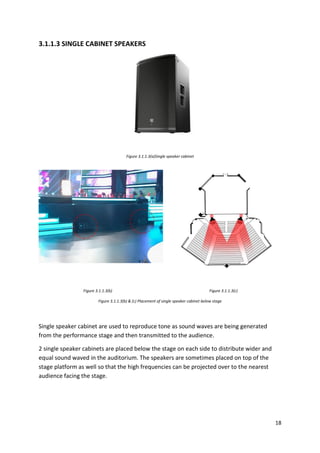
Single speaker cabinet are used to reproduce tone as sound waves are being generated
from the performance stage and then transmitted to the audience.
2 single speaker cabinets are placed below the stage on each side to distribute wider and
equal sound waved in the auditorium. The speakers are sometimes placed on top of the
stage platform as well so that the high frequencies can be projected over to the nearest
audience facing the stage.
19
3.1.1.4 CONVENTIONAL SOUND REINFORCEMENT SYSTEM
Figure 3.1.1.4 (a) Microphone Figure 3.1.1.4(b) Signal Processor Amplifiers Figure 3.1.1.4(c)Portable Loud Speaker
Figure 3.1.1.4 (a), (b) & (c) The conventional equipment used in the auditorium which consists of the microphone, signal processor
amplifiers and portable loudspeaker.
Commonly used sound reinforcement systems may include the combination of
microphones, signal processor amplifiers and portable loudspeaker. In many situations, a
sound reinforcement system is also used to enhance or alter the sound of the sources on
the stage, typically by using electronic effects, such as reverb, as opposed to simply
amplifying the sources unaltered.
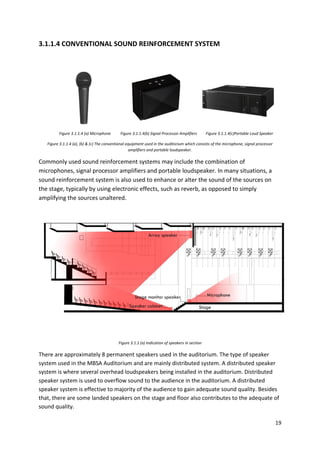
Figure 3.1.1 (a) Indication of speakers in section
There are approximately 8 permanent speakers used in the auditorium. The type of speaker
system used in the MBSA Auditorium and are mainly distributed system. A distributed speaker
system is where several overhead loudspeakers being installed in the auditorium. Distributed
speaker system is used to overflow sound to the audience in the auditorium. A distributed
speaker system is effective to majority of the audience to gain adequate sound quality. Besides
that, there are some landed speakers on the stage and floor also contributes to the adequate of
sound quality.
20
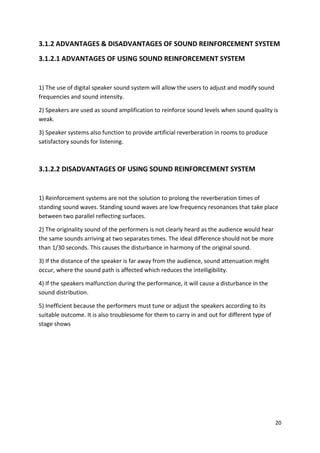
3.1.2 ADVANTAGES & DISADVANTAGES OF SOUND REINFORCEMENT SYSTEM
3.1.2.1 ADVANTAGES OF USING SOUND REINFORCEMENT SYSTEM
1) The use of digital speaker sound system will allow the users to adjust and modify sound
frequencies and sound intensity.
2) Speakers are used as sound amplification to reinforce sound levels when sound quality is
weak.
3) Speaker systems also function to provide artificial reverberation in rooms to produce
satisfactory sounds for listening.
3.1.2.2 DISADVANTAGES OF USING SOUND REINFORCEMENT SYSTEM
1) Reinforcement systems are not the solution to prolong the reverberation times of
standing sound waves. Standing sound waves are low frequency resonances that take place
between two parallel reflecting surfaces.
2) The originality sound of the performers is not clearly heard as the audience would hear
the same sounds arriving at two separates times. The ideal difference should not be more
than 1/30 seconds. This causes the disturbance in harmony of the original sound.
3) If the distance of the speaker is far away from the audience, sound attenuation might
occur, where the sound path is affected which reduces the intelligibility.
4) If the speakers malfunction during the performance, it will cause a disturbance in the
sound distribution.
5) Inefficient because the performers must tune or adjust the speakers according to its
suitable outcome. It is also troublesome for them to carry in and out for different type of
stage shows
21
3.2 SOUND PROPAGATION & CONCENTRATION
3.2.1 SOUND PROPAGATION
Figure 3.2.1 (a) Plan shows sounds distribution readings taken from sound source around the auditorium
Sound intensity level were measured based on our sound level during the performance
amid their practice. Sound dispersion is plotted out in the enclosed auditorium and
discovered that energy loss of sound is low due to its narrow shallow arrangement. The
distance from the stage to the end is 17.9m long.
The materials and propagation areas has allowed consistent sound to be propagated
throughout the auditorium which demonstrates that the designated of utilization of
material in the auditorium is proper as it produces pleasant sound that is distributed
consistently at every area
22
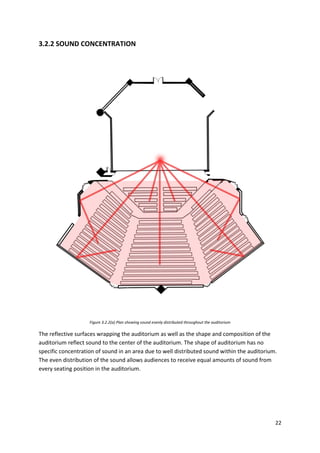
3.2.2 SOUND CONCENTRATION
Figure 3.2.2(a) Plan showing sound evenly distributed throughout the auditorium
The reflective surfaces wrapping the auditorium as well as the shape and composition of the
auditorium reflect sound to the center of the auditorium. The shape of auditorium has no
specific concentration of sound in an area due to well distributed sound within the auditorium.
The even distribution of the sound allows audiences to receive equal amounts of sound from
every seating position in the auditorium.
23
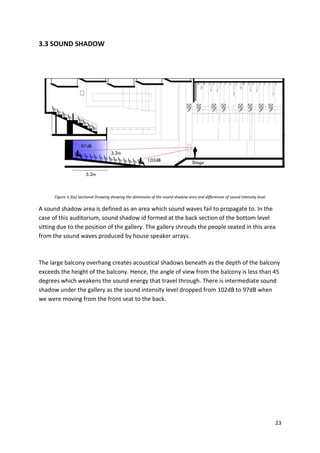
3.3 SOUND SHADOW
Figure 3.3(a) Sectional Drawing showing the dimension of the sound shadow area and differences of sound intensity level
A sound shadow area is defined as an area which sound waves fail to propagate to. In the
case of this auditorium, sound shadow id formed at the back section of the bottom level
sitting due to the position of the gallery. The gallery shrouds the people seated in this area
from the sound waves produced by house speaker arrays.
The large balcony overhang creates acoustical shadows beneath as the depth of the balcony
exceeds the height of the balcony. Hence, the angle of view from the balcony is less than 45
degrees which weakens the sound energy that travel through. There is intermediate sound
shadow under the gallery as the sound intensity level dropped from 102dB to 97dB when
we were moving from the front seat to the back.
24
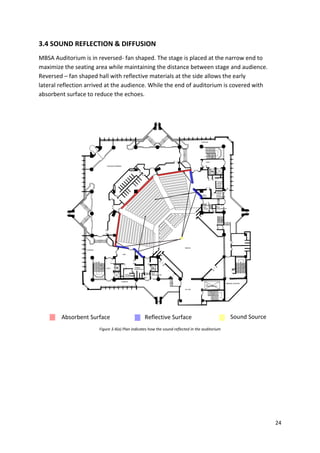
Absorbent Surface Reflective Surface Sound Source
3.4 SOUND REFLECTION & DIFFUSION
MBSA Auditorium is in reversed- fan shaped. The stage is placed at the narrow end to
maximize the seating area while maintaining the distance between stage and audience.
Reversed – fan shaped hall with reflective materials at the side allows the early
lateral reflection arrived at the audience. While the end of auditorium is covered with
absorbent surface to reduce the echoes.
Figure 3.4(a) Plan indicates how the sound reflected in the auditorium
25
Sound Dispersion Sound Reflection Direct Sound
MBSA is designed to fulfill the acoustic requirements. One of the acoustic elements is the
surface and height of the ceilings. The ceiling is arranged in concave shape (refer to Figure
3.4b) to reflect the sound to the audiences. There are 3 types of ceiling surface can be found
in MBSA auditorium which are Flat Ceiling Surface, Tilted Ceiling Surface & Convex Ceiling
Surface. Each ceiling surface has its own characteristics which helps to enhance the room
acoustic.
Flat Ceiling Surface
- Allows sound to be reflected uniformly towards the audience
Tilted Surface Ceiling
- Allows sound from stage to be reflected towards the audience
Convex Surface Ceiling
- Allows sound to be dispersed to the gallery above
Figure 3.4 (b) Section drawings showing the sound travels directly and reflected or dispersed
through different surface of ceiling
26
Sound Reflection Direct Sound
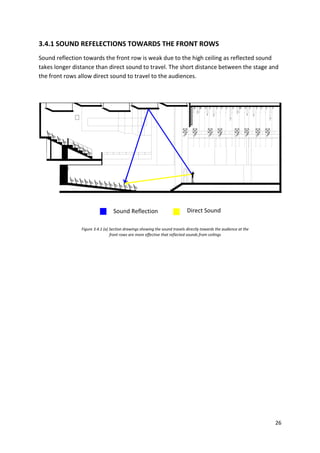
3.4.1 SOUND REFELECTIONS TOWARDS THE FRONT ROWS
Sound reflection towards the front row is weak due to the high ceiling as reflected sound
takes longer distance than direct sound to travel. The short distance between the stage and
the front rows allow direct sound to travel to the audiences.
Figure 3.4.1 (a) Section drawings showing the sound travels directly towards the audience at the
front rows are more effective that reflected sounds from ceilings
27
Sound Reflection Direct Sound
Direct Sound Sound Reinforcement System
3.4.2 SOUND REFELCTIONS TOWARDS THE BACK ROWS
Direct sound is weakening as it travels to the end of the rows. Sound reflected from the
ceiling unable to reach the back rows on level 3 as the sound is blocked by the gallery.
Hence, to reinforce the sound at the back rows on level 3, sound reinforcements in the form
of single speaker cabinets are placed under the gallery to allow direct sound travel to the
end of the auditorium.
Figure 3.4.2 (a) Section drawings showing the sound travels directly towards the audience at the
back rows is weakening and sound reflected from ceiling unable to reach
Figure 3.4.2 (b) Section drawings showing the sound reinforcement system added at the back to
provide direct sound under the gallery
28
Direct Sound Reflected Sound
Direct Sound Sound Reinforcement System
3.4.3 SOUND REFLECTIONS TOWARDS THE GALLERY
Direct sound is unable to reach the gallery. Sound is reflected and dispersed by the tilted
and convex surfaced ceiling. Sound faded as it travels from the performers to the ceiling and
reflected to the audience on the gallery.
Sound reinforcement in the form of array speakers are hung closer to the ceiling to allow
direct sounds towards the balcony. Sub-woofers are placed in front of stage at level 3 as
lower frequency sounds are less likely to diffract. Hence, the convex surface of ceiling will
not scatter the low frequency sounds produced by the sub-woofers, negating unnecessary
sound reflections.
Figure 3.4.3 (a) Section drawings showing the sound travels to the gallery faded while travelling to
the gallery
Figure 3.4.3 (b) Section drawings showing the sound reinforcement system provides direct sound to
the gallery
29
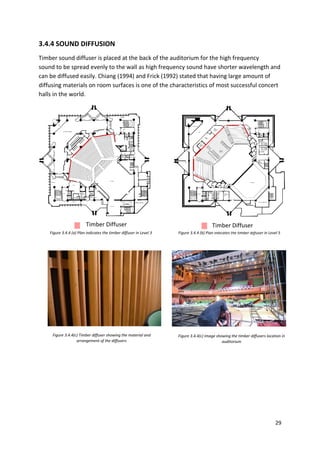
Timber Diffuser
Figure 3.4.4(c) Timber diffuser showing the material and
arrangement of the diffusers
Figure 3.4.4 (a) Plan indicates the timber diffuser in Level 3 Figure 3.4.4 (b) Plan indicates the timber diffuser in Level 5
Timber Diffuser
Figure 3.4.4(c) Image showing the timber diffusers location in
auditorium
3.4.4 SOUND DIFFUSION
Timber sound diffuser is placed at the back of the auditorium for the high frequency
sound to be spread evenly to the wall as high frequency sound have shorter wavelength and
can be diffused easily. Chiang (1994) and Frick (1992) stated that having large amount of
diffusing materials on room surfaces is one of the characteristics of most successful concert
halls in the world.
30
R1
R2
Sound
Source D
Sound
Recipient
R1 R2 D
3.5 SOUND DELAY
Sound echoes also defined as time delay. It is one of the more serious acoustical defects
that need to take note of. Different usage purpose of auditorium will consider different
values for sound echoes. A time delay of 40msec for speech and 100msec for music will be
considered as a sound echo.
Time delay can be calculated in the formula
Time Delay = (R1 + R2 – D) / 0.34
MBSA does not have flutter echoes due to the absence of parallel wall.
14.1m
13.8m
14.7m
Time Delay
= (R1 + R2 – D)/0.34
= (13.8 + 14.7 – 14.1) /0.34
= 42.4 msec
Figure 3.5 (a) Figure showing time delay formula
Figure 3.5 (b) Figure showing time delay in plan
31
R1 R2 D
R1 R2 D
MBSA Auditorium has acceptable sound delay for performance purposes as the sound delay
are below 100msec.
Time Delay
= (R1 + R2 – D)/0.34
= (11.2 + 12.5 – 9.5) /0.34
= 41.8 msec
Figure 3.5 (c) Figure showing time delay for the first row in section
Time Delay
= (R1 + R2 – D)/0.34
= (17.7 + 7.1 – 20.1) /0.34
= 13.8 msec
Figure 3.5 (d) Figure showing time delay for the gallery in section
12.5m 11.2m
9.5m
7.1m
17.7m
20.1m
32
Figure 3.6.1 (a) Exterior corridor is exposed with glass Figure 3.6.1 (b) Corridor in between auditorium and other spaces
creates a sound lock
Figure 3.6.1 (c) Buffer zone at the entrance covered with carpet to
reduce noise
Figure 3.6.1 (d) Auditorium’s backstage connected to the exterior
which cause possible noise source from highways
3.6 NOISE SOURCES
“Sound” and “Noise” are often interpreted to be the same. However, noise can be
interpreted from receiver’s point of view. Noise are undesired sound by occupants.
Continuous noise is noise that remains constant and stable over given period. Different
continuous noise source may lead to the change of sound. Although MBSA Auditorium is
designed to the acoustical requirements but there are still some internal and external noises
that cause disturbance within the auditorium
3.6.1 EXTERNAL NOISE SOURCE
There are some external noise sources occurred in MBSA auditorium. For example, the
opening and closing of doors. Conversation at the lobby allows sound to travel into the
auditorium at certain levels. Buffer zone at the entrance helped to reduce the sound travels
into the auditorium. Exhibition area outside the hall is exposed by glass panels which brings
in environmental and neighboring noises such as wind noise and noises from the mosque.
Corridors in between the auditorium and other spaces equipped with carpets on the floor
helps to absorb the exterior noise but the opening and closing of doors contributes to the
noise source due to its excessive weight.
33
Exterior noise from
mosque
51dB
Act of Opening &
Closing Doors
68dB
AHU Room allows
noise travels through
walls
50dB
People chit-chatting at
corridor
65dB
Highways located
behind the stage
67dB
Figure 3.6.1 (e) Plan showing the exterior noise source
Figure 3.6.1 (f) Section showing sound lock
Sound lock is applied to the auditorium to reduce the noise travels into the auditorium.
34
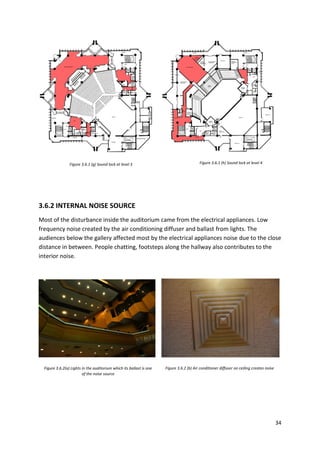
Figure 3.6.1 (g) Sound lock at level 3 Figure 3.6.1 (h) Sound lock at level 4
Figure 3.6.2(a) Lights in the auditorium which its ballast is one
of the noise source
Figure 3.6.2 (b) Air conditioner diffuser on ceiling creates noise
3.6.2 INTERNAL NOISE SOURCE
Most of the disturbance inside the auditorium came from the electrical appliances. Low
frequency noise created by the air conditioning diffuser and ballast from lights. The
audiences below the gallery affected most by the electrical appliances noise due to the close
distance in between. People chatting, footsteps along the hallway also contributes to the
interior noise.
35
Figure 3.6.2 (c) Human activities – walking and chit chatting in
the auditorium is one of the noise source
Figure 3.6.2 (d) The squeaking sound produced while putting
down the chairs
Footsteps
32dB
38dB
Figure 3.6.2 (e) Noise from the aircon diffuser Figure 3.6.2 (f) Ballast in lights is one of the interior noise
source
Chit-
Chatting
65dB
Footsteps
32dB
38dB
28dB 24dB
36
3.7 ACOUSTIC TREATMENTS & COMPONENTS
Acoustic treatments and components are important in the auditorium as the acoustic
quality of the auditorium is affected by it.
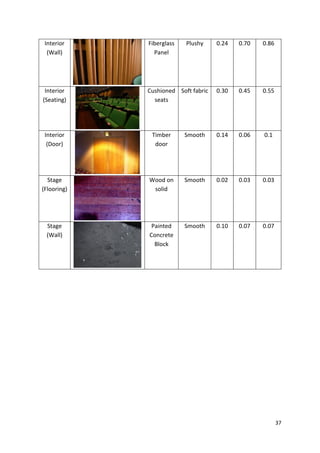
3.7.1 TABLES OF MATERIALITY & SOUND ABSORPTION COEFFICIENT
Area Material Surface
Finishes
Coefficient
Photo Material 125Hz 500Hz 1000Hz
Interior
(Flooring)
Heavy
carpet on
concrete
Plushy 0.02 0.14 0.37
Interior
(Ceiling)
Acoustic
plaster
ceiling
Smooth 0.06 0.11 0.13
Interior
(Curtains)
Medium
curtains
Plushy 0.14 0.52 0.7
Interior
(Railings)
Steel
Railing
Reflective 0.13 0.08 0.09
Interior
(Wall)
Timber
Wall
Smooth 0.18 0.42 0.83
Interior
(Wall)
Timber Smooth 0.43 0.11 0.07
37
Interior
(Wall)
Fiberglass
Panel
Plushy 0.24 0.70 0.86
Interior
(Seating)
Cushioned
seats
Soft fabric 0.30 0.45 0.55
Interior
(Door)
Timber
door
Smooth 0.14 0.06 0.1
Stage
(Flooring)
Wood on
solid
Smooth 0.02 0.03 0.03
Stage
(Wall)
Painted
Concrete
Block
Smooth 0.10 0.07 0.07
38
3.7.2 ACOUSTICS COMPONENTS
3.7.2.1 WALLS
The wall panels are arranged in a reversed-fan shape which allows equal transmission of
sound wave to the audience.
Most of the walls at the back of the auditorium is finished with timber sound diffuser with
acoustic panels at the back. This will help to diffuse sound and dissipate sound wave that
passes through it.
Figure 3.7.2.1(a) Type of wall finish on level 3. Figure 3.7.2.1(b) Type of wall finish on level 4.
Figure 3.7.2.1(c) Timber sound diffuser.
Figure 3.7.2.1(e) Timber wall panels.
Timber sound diffuser Timber wall panel Timber sound diffuser Timber wall panel
Timber frame
25mm acoustic screen
insulation
Acoustic impact
resistance membrane
Fixing
Wall
Figure 3.7.2.1(f) Construction details of timber wall
panels
Figure 3.7.2.1(d) Construction details of timber sound
diffuser
Timber sound diffuser
Pro acoustic panels
Clip
Keel
Batten
Fiberglass
39
3.7.2.2 SEATINGS
There is 1500 of seats in the auditorium. Each of them composed of a block of polyurethane
foam attached to ABS plastic or plywood which automatically tips up when not in use as it
uses counterweight mechanism that allows smooth operation. The seat, back rest and side
panel are joined together by a central bridge support attached to two aluminum side legs
that are connected with a steel plate as base. The seats are then fixed to the floor by
connecting the base with steel expansion bolts.
3.7.2.3 CEILING
The ceiling is in segments and angled to redirect sound to the audience. The ceiling is made
out of acoustical plaster system that reflects sound to the audience while minimizing
occurrence of echoes.
Figure 3.7.2.2(a) Seats in auditorium. Figure 3.7.2.2(b) Legs of seat fixed to ground.
Figure 3.7.2.3(a) Segments and angled ceiling. Figure 3.7.2.3(b) Construction details of ceiling.
150mm cold rolled steel channel
with 250mm metal furring channel
150mm gypsum board
150mm sound absorptive spray
Finished wall
40
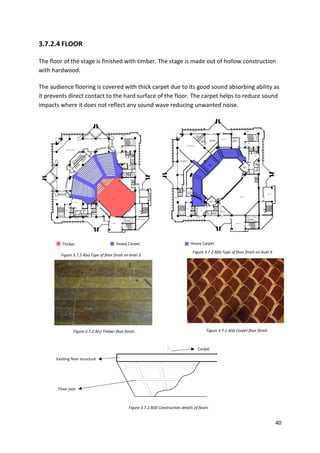
3.7.2.4 FLOOR
The floor of the stage is finished with timber. The stage is made out of hollow construction
with hardwood.
The audience flooring is covered with thick carpet due to its good sound absorbing ability as
it prevents direct contact to the hard surface of the floor. The carpet helps to reduce sound
impacts where it does not reflect any sound wave reducing unwanted noise.
Timber Heavy Carpet Heavy Carpet
Figure 3.7.2.4(a) Type of floor finish on level 3.
Figure 3.7.2.4(b) Type of floor finish on level 4.
Figure 3.7.2.4(c) Timber floor finish. Figure 3.7.2.4(d) Carpet floor finish.
Figure 3.7.2.4(d) Construction details of floors
Carpet
Existing floor structure
Floor joist
41
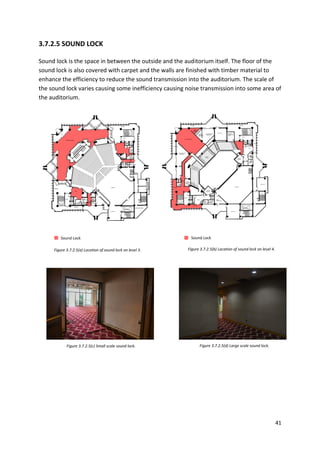
3.7.2.5 SOUND LOCK
Sound lock is the space in between the outside and the auditorium itself. The floor of the
sound lock is also covered with carpet and the walls are finished with timber material to
enhance the efficiency to reduce the sound transmission into the auditorium. The scale of
the sound lock varies causing some inefficiency causing noise transmission into some area of
the auditorium.
Sound Lock
Figure 3.7.2.5(a) Location of sound lock on level 3. Figure 3.7.2.5(b) Location of sound lock on level 4.
Sound Lock
Figure 3.7.2.5(c) Small scale sound lock. Figure 3.7.2.5(d) Large scale sound lock.
42
4 CALCULATIONS
4.1 Area of Floor Materials
Surface Area (m2) 500Hz
Absorption
coefficient (a)
Abs.Unit (m2sabins)
F1 772.43 0.14 108.14
F2 207.88 0.06 12.47
TOTAL 120.61
F1
F1
F2
Figure 4.1 (a) Heavy carpet on concrete
Figure 4.1 (b) Wood flooring
43
4.2 Area of Wall Materials
Surface Area (m2) 500Hz
Absorption
coefficient (a)
Abs.Unit(m2sabins)
W1 265.54 0.86 228.37
W2 437.76 0.06 26.27
W3 424.23 0.07 29.7
TOTAL 284.34
W1
W2
Figure 4.2 (a) Fiber Glass Panel Figure 4.2 (b) Timber Wall Panel
W3
Figure 4.2 (c) Painted Concrete Wall
44
4.3 Area of Other Materials
M1
M2
M3 M4 M5
Figure 4.3 (a) Plaster ceiling
Figure 4.3 (b) Cushion seating Figure 4.3 (c) Curtain Figure 4.3 (d) Timber door Figure 4.3 (e) Steel Railing
45
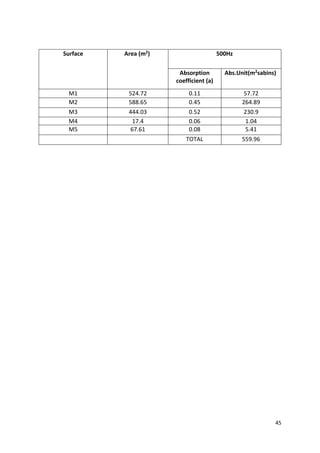
Surface Area (m2) 500Hz
Absorption
coefficient (a)
Abs.Unit(m2sabins)
M1 524.72 0.11 57.72
M2 588.65 0.45 264.89
M3 444.03 0.52 230.9
M4 17.4 0.06 1.04
M5 67.61 0.08 5.41
TOTAL 559.96
46
4.4 CALCULATIONS OF RT
V1 = 5179.58m3
A= ΣFAα + WAα + MAα
=108.14 + 254.64 + 551.06
=913.84 m2
SABINE FORMULA: RT = 0.16V / A
Where,
RT=0.16(5179.58)/(913.84)
=0.91s
V2 = 7545.65m3
A= ΣFAα + WAα + MAα
=120.61+284.34+559.96
=964.91 m2
SABINE FORMULA: RT = 0.16V / A
Where,
RT=0.16(7545.65)/(964.71)
=1.25s
Figure 4.4 (a) Section showing the RT calculation for audience area
Figure 4.4 (b) Section showing the RT calculation for audience & stage area
47
The volume of MBSA is approximately 7545.65 m3, with a reverberation time of 1.25
seconds.
From the figure above, we can conclude that the reverberation time of MBSA Auditorium is
slightly off the ideal RT for speech purpose. Sound absorbent material can be added into
auditorium to reduce the reverberation time.
The reverberation time of MBSA Auditorium is in between ideal RT of conference room &
concert hall which allows the MBSA Auditorium to serve these two purposes and become a
multi-purpose hall.
Figure 4.4 (c) “Ideal” average reverberation time versus room volume for several basic types of rooms
48
5 CONCLUSIONS
Through our analysis and case study at the auditorium of MBSA, this auditorium is dedicated
for speech only but with additional sound reinforcement system, such as microphone and
speakers the auditorium can provide efficiency for performances.
The auditorium is equipped with system that ensure the audience has the best experience
as sound is evenly distributed to the floor without any sound concentration. The auditorium
is also finished with materials that reflect and diffuse sound to the audience while absorbing
excessive sound to prevent echoes.
The auditorium designed with in-depth acoustics consideration to cater speech events. We
learnt that an auditorium cannot be designed to cater all events perfectly as every event
requires different acoustics quality to ensure that the audience has the best experience with
the system provided in the auditorium.
49
6 LIST OF FIGURES
Figure 1.2 (a) MBSA Site Plan
Figure 1.2 (b) Photos of Wisma MBSA
Figure 1.3 (a) Photos of MBSA Auditorium
Figure 1.4.1 (a) MBSA Third Floor Plan
Figure 1.4.2 (a) MBSA Fourth Floor Plan
Figure 1.4.3(a) MBSA Fifth Floor Plan
Figure 1.4.4 (a) MBSA Section A-A’
Figure 1.5 (a) Auditorium stage
Figure 1.5 (b) View on top of the stage
Figure 1.5 (c) The front seating area
Figure 1.5 (d)The gallery seating area
Figure 1.5 (e) The balcony seating area
Figure 1.6.1(a) Plan shows the reflection of sound in regard to the shape of the back wall
Figure 1.6.1 (b) Plan shows the reflection of sound in regard to the shape of the side walls
Figure 1.6.1 (c) Section shows the types of how the sound is reflected in regards of the
surfaces of the ceilings
Figure 1.6.1 (d) Section shows the sound shadow occur underneath the balcony
Figure 1.6.2 (a) Plan shows the seating arrangement of the auditorium
Figure 1.6.2 (b) Section shows the steepness of the seating leveling
Figure 2.4 (a) Sound meter
Figure 2.4 (b) DSLR camera
Figure 2.4 (c) Measuring tape and laser tool
Figure 3.1 (a) Sensory controlled subwoofer
Figure 3.1 (b) Compact 3-way symmetrical line array module speakers
Figure 3.1 (c) 2-way compact versatile full range system speaker
Figure 3.1.1.1 (a) Array speaker
Figure 3.1.1.1 (b) Array speaker
Figure 3.1.1.1 (c) Array speaker
Figure 3.1.1.2 (a) Stage monitor speaker
Figure 3.1.1.2 (b) Placement of stage monitor speaker located on the stage facing the
performers
Figure 3.1.1.2 (c) Placement of stage monitor speaker located on the stage facing the
performers
Figure 3.1.1.3 (a) Single speaker cabinet
Figure 3.1.1.3 (b) Placement of single speaker cabinet below stage
Figure 3.1.1.3 (c) Placement of single speaker cabinet below stage
Figure 3.1.1.4 (a) Microphone
Figure 3.1.1.4 (b) Signal Processor Amplifiers
Figure 3.1.1.4 (c) Portable Loud Speaker
50
Figure 3.1.1 (a) Indication of speakers in section
Figure 3.2.1 (a) Plan shows sounds distribution readings taken from sound source around
the auditorium
Figure 3.2.2 (a) Plan showing sound evenly distributed throughout the auditorium Figure
Figure 3.3 (a) Sectional Drawing showing the dimension of the sound shadow area and
differences of sound intensity level
Figure 3.4 (a) Plan indicates how the sound reflected in the auditorium
Figure 3.4 (b) Section drawings showing the sound travels directly and reflected or
dispersed through different surface of ceiling
Figure 3.4.1 (a) Section drawings showing the sound travels directly towards the audience at
the front rows are more effective that reflected sounds from ceilings
Figure 3.4.2 (a) Section drawings showing the sound travels directly towards the audience at
the back rows is weakening and sound reflected from ceiling unable to reach
Figure 3.4.2 (b) Section drawings showing the sound reinforcement system added at the
back to provide direct sound under the gallery
Figure 3.4.3 (a) Section drawings showing the sound travels to the gallery faded while
travelling to the gallery
Figure 3.4.3 (b) Section drawings showing the sound reinforcement system provides direct
sound to the gallery
Figure 3.4.4 (a) Plan indicates the timber diffuser in
Figure 3.4.4 (b) Plan indicates the timber diffuser in
Figure 3.4.4 (c) Timber diffuser showing the material and arrangement of the diffusers
Figure 3.4.4 (d) Image showing the timber diffusers location in auditorium
Figure 3.5 (a) Figure showing time delay formula
Figure 3.5 (b) Figure showing time delay in plan
Figure 3.5 (c) Figure showing time delay for the first row in section
Figure 3.5 (d) Figure showing time delay for the gallery in section
Figure 3.6.1 (a) Exterior corridor is exposed with glass
Figure 3.6.1 (b) Corridor in between auditorium and other spaces creates a sound lock
Figure 3.6.1 (c) Buffer zone at the entrance covered with carpet to reduce noise
Figure 3.6.1 (d) Auditorium’s backstage connected to the exterior which cause possible
noise source from highways
Figure 3.6.1 (e) Plan showing the exterior noise source
Figure 3.6.1 (f) Section showing sound lock
Figure 3.6.1 (g) Sound lock at level 3
Figure 3.6.1 (h) Sound lock at level 4
Figure 3.6.2 (a) Lights in the auditorium which its ballast is one of the noise source
Figure 3.6.2 (b) Air conditioner diffuser on ceiling creates noise
Figure 3.6.2 (c) Human activities – walking and chit chatting in the auditorium is one of the
noise source
Figure 3.6.2 (d) The squeaking sound produced while putting down the chairs
51
Figure 3.6.2 (e) Noise from the aircond diffuser
Figure 3.6.2 (f) Ballast in lights is one of the interior noise source
Figure 3.7.2.1 (a) Type of wall finish on level 3.
Figure 3.7.2.1 (b) Type of wall finish on level 4.
Figure 3.7.2.1 (c) Timber sound diffuser.
Figure 3.7.2.1 (d) Construction details of timber sound diffuser
Figure 3.7.2.1 (e) Timber wall panels.
Figure 3.7.2.1 (f) Construction details of timber wall panels
Figure 3.7.2.2 (a) Seats in auditorium.
Figure 3.7.2.2 (b) Legs of seat fixed to ground.
Figure 3.7.2.3 (a) Segments and angled ceiling.
Figure 3.7.2.3 (b) Construction details of ceiling.
Figure 3.7.2.4 (a) Type of floor finish on level 3.
Figure 3.7.2.4 (b) Type of floor finish on level 4.
Figure 3.7.2.4 (c) Timber floor finish.
Figure 3.7.2.4 (d) Carpet floor finish.
Figure 3.7.2.4 (d) Construction details of floors
Figure 3.7.2.5 (a) Location of sound lock on level 3.
Figure 3.7.2.5 (b) Location of sound lock on level 4.
Figure 3.7.2.5 (c) Small scale sound lock.
Figure 3.7.2.5 (d) Large scale sound lock.
Figure 4.1 (a) Heavy carpet on concrete
Figure 4.1 (b) Wood flooring
Figure 4.2 (a) Fiberglass Panel
Figure 4.2 (b) Timber Wall Panel
Figure 4.2 (c) Painted concrete wall
Figure 4.3 (a) Plaster Ceiling
Figure 4.3 (b) Cushion seating
Figure 4.3 (c) Curtain
Figure 4.3 (d) Timber door
Figure 4.3 (e) Steel railing
Figure 4.4 (a) Section showing the RT calculatiob for audience area
Figure 4.4 (b) Section showing the RT calculation for audience & stage area
Figure 4.4 (c) "Ideal" average reverberation time versus room volume for several basic types
of rooms
52
7 REFERENCES
1. INTRODUCTION
(n.d.). Retrieved from
http://www.mbsa.gov.my/en-my/mbsa/kenalimbsa/Pages/penubuhan_mbsa.aspx
(n.d.). Retrieved from http://www.mbsa.gov.my/ms-
my/mbsa/perkhidmatan/kemudahanawamtempahan/Halaman/tempahan_auditorium.aspx
2. ACOUSTICS & ARCHITECTURE
Shaik, A. (n.d.). Sound. Retrieved from http://www.physics-and-radio-
electronics.com/physics/sound.html
What is Acoustics? (n.d.). Retrieved from https://acoustics.byu.edu/content/what-acoustics
(n.d.). Retrieved from http://hyperphysics.phy-astr.gsu.edu/hbase/Sound/intens.html
(n.d.). Retrieved from http://hyperphysics.phy-astr.gsu.edu/hbase/Acoustic/reverb.html
3. ACOUSTICS DESIGN ANALYSIS
A Guide to Sound Isolation and Noise Control. (2005, March 26). Retrieved from
https://www.audioholics.com/room-acoustics/a-guide-to-sound-isolation-and-noise-control
Berg, R. E. (2018, June 14). Acoustics. Retrieved from
https://www.britannica.com/science/acoustics/Acoustic-problems#ref527632
Edwin, C. (n.d.). Lecture 2 : Room Acoustics. Lecture.
Egan, M. D. (2007). Architectural acoustics. Place of publication unknown: J.Ross Publishing.
SOUND. (n.d.). Retrieved from http://artsites.ucsc.edu/EMS/music/tech_background/te-
01/teces_01.html
Soundproofing floors and noise absorption. (n.d.). Retrieved from
https://www.carpetyourlife.com/en/about-carpet/advantages/soundproofing-floors
Sound Reinforcement Systems. (2017, March 07). Retrieved from
https://audioacademy.in/821/
X. (n.d.). Stadium seating. Retrieved from
http://www.daplast.com/english/products/stadium-seating/AB

BSCIENCE ACOUSTIC

  • 1.
    1 1 INTRODUCTION 1.1 AIMAND OBJECTIVES In a group of six people, we are to conduct a case study on auditorium locally. The chosen auditorium is the Wisma MBSA Auditorium Hall located in Shah Alam. Upon visitation, we are then to produce an analysis report based on our understanding of the acoustic qualities of a room. The objectives are as follow: 1. To understand how an auditorium design layout can influence the effectiveness of the sound quality in a particular hall. 2. To develop deeper understanding in terms of the choice of materials used to enhance the acoustic quality of an auditorium. 3. To produce a well-documented analysis report based on the observation and data collected upon site visitation.
  • 2.
    2 1.2 SITE LOCATION Figure1.2 (a) MBSA Site Plan Figure 1.2 (b) Photos of Wisma MBSA Wisma MBSA is located in Shah Alam and is surrounded by mainly government buildings and office buildings. There are also a few of old shopping centers located opposite Wisma MBSA. The back of the building is a park with huge pond and a museum. Overall, the building itself is located at a tranquil place with less traffic congestion on a daily basis. Therefore, the auditorium is not disturbed by the noise coming from the outside.
  • 3.
    3 1.3 SITE BACKGROUND Figure1.3 (a) Photos of MBSA Auditorium Wisma MBSA Auditorium Hall Location: Wisma MBSA, Persiaran Perbandaran, Seksyen 14, Shah Alam. Architect: Baharudin Abu Kassim Client: Majlis Bandaraya Shah Alam Capacity: 1400 pax Shah Alam City Council (MBSA: Majlis Bandaraya Shah Alam) is the local authority of Shah Alam City, North of Petaling District, and East of Klang District and is an agency under the Selangor state government. It all began with the establishment of MPSA on December 7th, 1978 which was the declaration of Shah Alam city as the capital of Selangor. The building was only built in the early 1980's when the MPSA started to move to its own building, Wisma MPSA. The aim is to build a new civic centre for the new town in Shah Alam. The civic centre comprises of an administration building, a town hall, an auditorium, a small theater, a library and a museum. Now, the 28-storey building is able to accommodate all MPSA departments which is now has been upgraded to the status of MBSA under the same roof. Wisma MBSA is used as an office building and an auditorium popular for hosting television shows and concerts. Other minor events such as seminars and talks are also held at its auditorium hall.
  • 4.
    4 1.4 ARCHITECTURAL DRAWINGS 1.4.1THRID FLOOR PLAN Figure 1.4.1 (a) MBSA Third Floor Plan 55000 55100
  • 5.
    5 1.4.2 FORTH FLOORPLAN Figure 1.4.2 (a) MBSA Fourth Floor Plan 55000 55100
  • 6.
    6 1.4.3 FIFTH FLOORPLAN Figure 1.4.3(a) MBSA Fifth Floor Plan 55000 55100
  • 7.
    7 1.4.4 SECTION A– A’ Figure 1.4.4 (a) Auditorium Section
  • 8.
    8 1.5 SITE PHOTOS Figure1.5 (a) Auditorium stage Figure 1.5 (b) View on top of the stage Figure 1.5 (c) The front seating area Figure 1.5 (d)The gallery seating area Figure 1.5 (e) The balcony seating area
  • 9.
    9 1.6 AUDITORIUM DESIGNANALYSIS 1.6.1 AUDITORIUM SHAPE AND MASSING Figure 1.6.1(a) Plan shows the reflection of sound in regard to the shape of the back wall Figure 1.6.1 (b) Plan shows the reflection of sound in regard to the shape of the side walls The auditorium implements the reversed fan shape. The back walls are in the form of a concave whereby the sound can be reflected back to the area that are further from the sound source
  • 10.
    10 Convex ceiling Flatceiling Figure 1.6.1 (c) Section shows the types of how the sound is reflected in regards of the surfaces of the ceilings In terms of the sectional view, the auditorium implements the rectangular shaped ceiling at the stage and the convex ceilings at the seating area. The flat ceiling at the stage helps to reduce the reverberation time so that the musician can hear one another clearly. Whereas, the convex ceiling at the seating area helps to reflect the sound to the audience. Reflected sound Sound shadow Figure 1.6.1 (d) Section shows the sound shadow occur underneath the balcony Because of the balcony, sound shadow occurs at the back seating area where the sound quality decreases. Therefore, sound reinforcements are attached to the walls at the gallery area. More on this will be further discussed in the later part of the report.
  • 11.
    11 1.6.2 SEATING ARRANGEMENTS Figure1.6.2 (a) Plan shows the seating arrangement of the auditorium The seating arrangement for the auditorium is arranged in the same way how sound is transmitted. This is to ensure that sound is being transmitted throughout the hall equally. Figure 1.6.2 (b) Section shows the steepness of the seating leveling Seat raked for sightlines, but not too steep to avoid too much sound absorption from the audience.
  • 12.
    12 2 ACOUSTICS &ARCHITECTURE 2.1 LITREATURE REVIEW Acoustics is the science concerned with the production, control, transmission, reception, and effects of sound (as defined by Merriam-Webster). Sound is a vibrational energy transmitted through an elastic medium such as gas, liquid or solid, which travels in waves, spreading outwards from the source of the sound. Studies of acoustics includes the study of musical instruments and architectural spaces, covering a vast range of topics, including noise control, navigation, ultrasound for imaging, electroacoustic communication etc. Acoustics is usually evaluated on reverberation time (RT) and noise curve in the built environment. The desired RT can be achieved by employing the sound absorption materials such as wall and ceiling cladding. The sound absorption materials are rated with sound absorption coefficient where the absorption and transmission loss of sound are depended on the fiber or material size, volume of fiber, porosity, airflow resistance, thickness, density, compression and placement or position of materials. The main factors that affect sound absorption within an interior space is the fiber or material size, porosity, thickness and density. Sound absorption is inversely proportional to the diameter or width of fiber. 2.2 SOUND INTENSITY LEVEL (SIL) Sound intensity is defined as the sound power per unit area. The usual context is the measurement of sound intensity in the air at a listener's location. The basic units are watts/m2 or watts/cm2. Many sound intensity measurements are made relative to a standard threshold of hearing intensity I0 = 10-12 W/m2. Sound intensity level (SIL) measurement is commonly done in decibel (dB) scale. "I" is the intensity of sound expressed in watts per meter and the "I0" is the reference intensity defined to be 10-12W/m2. This value of "I0" is the threshold (minimum sound intensity) of hearing at 1kHz, for a person under the best circumstances. SIL = 10 log10 [I/I0]
  • 13.
    13 2.3 REVERBERATION, ATTENUATION,ECHOS & SOUND SHADOWS Reverberation is the collection of reflected sounds from the surfaces in an enclosure like an auditorium. It is a desirable property of auditoriums to the extent that it helps to overcome the inverse square law drop off of sound intensity in the enclosure. Reverberation is an important parameter for describing speech intelligibility and the perception of music and is used to correct or normalize sound insulation and sound power measurements, for example, to enhance the room's acoustical performance, a specifically high reflective ceiling panels is installed directly above the stage area to help directing the sound towards specific seating area. However, if it is excessive, it makes the sounds run together with loss of articulation - the sound becomes muddy, garbled, resulting in a distracting echo effect. To quantitatively characterize the reverberation, the parameter called the reverberation time is used. Sound attenuation is a measure of the energy loss of sound propagation in media, in other words, loss in intensity. Most media have viscosity, whereby when sound travels through a medium, its intensity diminishes proportionally with the distance traveled. In idealized media, sound pressure (signal amplitude) is only reduced by the spreading of the wave. Scattering is the reflection of sound in directions other than its original direction of propagation and absorption is the conversion of the sound energy to other forms of energy, together these creates attenuation. An acoustic shadow or sound shadow is an area through which sound waves fail to propagate. A short-distance acoustic shadow occurs behind a building or a sound barrier. The sound from a source is shielded by the obstruction. Due to diffraction around the object, it will not be completely silent in the sound shadow. The amplitude of the sound can be reduced considerably, however, depending on the additional distance the sound has to travel between source and receiver. Sound reflection occur when sound wave bounce off from a surface. At corners, sound wave are reflected and returned, where at concave surface sound wave tend to be concentrated and focused to an area while dispersed at a convex surface.
  • 14.
    14 2.4 METHODOLOGY Sound Meter -measure and record sound level precisely Digital Camera - capture photos of existing context within auditorium for analysis Measuring tool - measure and record the dimensions of auditorium Figure 2.4 (a) Sound meter. Figure 2.4 (b) DSLR camera. Figure 2.4 (c) Measuring tape and laser tool.
  • 15.
    15 3 ACOUSTIC DESIGNANALYSIS 3.1 SOUND REINFORCEMENT SYSTEMS The types of speakers used in the auditorium can be classified into 3 different categories: 1. Sensory controlled subwoofer 2. Compact 3-way symmetrical line array module speakers 3. 2-way compact versatile full range system speaker Figure 3.1(a) Sensory controlled subwoofer Sensory controlled subwoofer is designed to produce low frequency sounds, typically from 40Hz up to 500 Hz. It helps to achieve a better sound quality for low frequency. Figure 3.1 (b) Compact 3-way symmetrical line array module speakers It functions provide additional sound pressure and further dispersion option. It also provides a point source with a flexible coverage of sound. Figure 3.1 (c) 2-way compact versatile full range system speaker Usually located on the central part of the theatre or auditorium. It helps to achieve the balance and quality of sound throughout the space of the theatre.
  • 16.
    16 3.1.1 SOUND REINFORCEMENTUSED IN MBSA 3.1.1.1 ARRAY SPEAKERS Figure 3.1.1.1 (a) Array speaker Figure 3.1.1.1 (b) Figure 3.1.1.1(c) Figure 3.1.1.1 (b) & (c) Placement of suspended array speakers Line array is a loudspeaker system that is consists of several identical loudspeaker elements mounted in a line and fed in phase, to create a near-line source of sound. The distance between adjacent drivers are close in between that they constructively interfere with each other to transmit sound waves farther than traditional horn-loaded loudspeakers, and with a more evenly distributed sound output pattern. 2 array speakers are suspended from the ceiling directly in front of the stage directed to the center, slightly slanted angle down to provide extra coverage to the nearest front of the stage while the top half will be angled upward facing the mezzanine floor of the auditorium. It is placed at left and right sides of the hall to ensure a balanced transmission of sound to the entire hall.
  • 17.
    17 3.1.1.2 STAGE MONITORSPEAKERS Figure 3.1.1.2 (a) Stage monitor speaker Figure 3.1.1.2 (b) Figure 3.1.1.2 (c) Figure 3.1.1.2 (b) & (c) Placement of stage monitor speaker located on the stage facing the performers Stage monitor speakers function to provide feedback to the performers on stage which are situated in the blind spot area of the speakers. It Is essential for the performers as it helps to amplify sound when acoustics instruments or vocals are utilized. The speakers are placed on the stage floor facing the performers to ensure that they can hear the sound they project to help with synchronization between different instruments during performance.
  • 18.
    18 3.1.1.3 SINGLE CABINETSPEAKERS Figure 3.1.1.3(a)Single speaker cabinet Figure 3.1.1.3(b) Figure 3.1.1.3(c) Figure 3.1.1.3(b) & (c) Placement of single speaker cabinet below stage Single speaker cabinet are used to reproduce tone as sound waves are being generated from the performance stage and then transmitted to the audience. 2 single speaker cabinets are placed below the stage on each side to distribute wider and equal sound waved in the auditorium. The speakers are sometimes placed on top of the stage platform as well so that the high frequencies can be projected over to the nearest audience facing the stage.
  • 19.
    19 3.1.1.4 CONVENTIONAL SOUNDREINFORCEMENT SYSTEM Figure 3.1.1.4 (a) Microphone Figure 3.1.1.4(b) Signal Processor Amplifiers Figure 3.1.1.4(c)Portable Loud Speaker Figure 3.1.1.4 (a), (b) & (c) The conventional equipment used in the auditorium which consists of the microphone, signal processor amplifiers and portable loudspeaker. Commonly used sound reinforcement systems may include the combination of microphones, signal processor amplifiers and portable loudspeaker. In many situations, a sound reinforcement system is also used to enhance or alter the sound of the sources on the stage, typically by using electronic effects, such as reverb, as opposed to simply amplifying the sources unaltered. Figure 3.1.1 (a) Indication of speakers in section There are approximately 8 permanent speakers used in the auditorium. The type of speaker system used in the MBSA Auditorium and are mainly distributed system. A distributed speaker system is where several overhead loudspeakers being installed in the auditorium. Distributed speaker system is used to overflow sound to the audience in the auditorium. A distributed speaker system is effective to majority of the audience to gain adequate sound quality. Besides that, there are some landed speakers on the stage and floor also contributes to the adequate of sound quality.
  • 20.
    20 3.1.2 ADVANTAGES &DISADVANTAGES OF SOUND REINFORCEMENT SYSTEM 3.1.2.1 ADVANTAGES OF USING SOUND REINFORCEMENT SYSTEM 1) The use of digital speaker sound system will allow the users to adjust and modify sound frequencies and sound intensity. 2) Speakers are used as sound amplification to reinforce sound levels when sound quality is weak. 3) Speaker systems also function to provide artificial reverberation in rooms to produce satisfactory sounds for listening. 3.1.2.2 DISADVANTAGES OF USING SOUND REINFORCEMENT SYSTEM 1) Reinforcement systems are not the solution to prolong the reverberation times of standing sound waves. Standing sound waves are low frequency resonances that take place between two parallel reflecting surfaces. 2) The originality sound of the performers is not clearly heard as the audience would hear the same sounds arriving at two separates times. The ideal difference should not be more than 1/30 seconds. This causes the disturbance in harmony of the original sound. 3) If the distance of the speaker is far away from the audience, sound attenuation might occur, where the sound path is affected which reduces the intelligibility. 4) If the speakers malfunction during the performance, it will cause a disturbance in the sound distribution. 5) Inefficient because the performers must tune or adjust the speakers according to its suitable outcome. It is also troublesome for them to carry in and out for different type of stage shows
  • 21.
    21 3.2 SOUND PROPAGATION& CONCENTRATION 3.2.1 SOUND PROPAGATION Figure 3.2.1 (a) Plan shows sounds distribution readings taken from sound source around the auditorium Sound intensity level were measured based on our sound level during the performance amid their practice. Sound dispersion is plotted out in the enclosed auditorium and discovered that energy loss of sound is low due to its narrow shallow arrangement. The distance from the stage to the end is 17.9m long. The materials and propagation areas has allowed consistent sound to be propagated throughout the auditorium which demonstrates that the designated of utilization of material in the auditorium is proper as it produces pleasant sound that is distributed consistently at every area
  • 22.
    22 3.2.2 SOUND CONCENTRATION Figure3.2.2(a) Plan showing sound evenly distributed throughout the auditorium The reflective surfaces wrapping the auditorium as well as the shape and composition of the auditorium reflect sound to the center of the auditorium. The shape of auditorium has no specific concentration of sound in an area due to well distributed sound within the auditorium. The even distribution of the sound allows audiences to receive equal amounts of sound from every seating position in the auditorium.
  • 23.
    23 3.3 SOUND SHADOW Figure3.3(a) Sectional Drawing showing the dimension of the sound shadow area and differences of sound intensity level A sound shadow area is defined as an area which sound waves fail to propagate to. In the case of this auditorium, sound shadow id formed at the back section of the bottom level sitting due to the position of the gallery. The gallery shrouds the people seated in this area from the sound waves produced by house speaker arrays. The large balcony overhang creates acoustical shadows beneath as the depth of the balcony exceeds the height of the balcony. Hence, the angle of view from the balcony is less than 45 degrees which weakens the sound energy that travel through. There is intermediate sound shadow under the gallery as the sound intensity level dropped from 102dB to 97dB when we were moving from the front seat to the back.
  • 24.
    24 Absorbent Surface ReflectiveSurface Sound Source 3.4 SOUND REFLECTION & DIFFUSION MBSA Auditorium is in reversed- fan shaped. The stage is placed at the narrow end to maximize the seating area while maintaining the distance between stage and audience. Reversed – fan shaped hall with reflective materials at the side allows the early lateral reflection arrived at the audience. While the end of auditorium is covered with absorbent surface to reduce the echoes. Figure 3.4(a) Plan indicates how the sound reflected in the auditorium
  • 25.
    25 Sound Dispersion SoundReflection Direct Sound MBSA is designed to fulfill the acoustic requirements. One of the acoustic elements is the surface and height of the ceilings. The ceiling is arranged in concave shape (refer to Figure 3.4b) to reflect the sound to the audiences. There are 3 types of ceiling surface can be found in MBSA auditorium which are Flat Ceiling Surface, Tilted Ceiling Surface & Convex Ceiling Surface. Each ceiling surface has its own characteristics which helps to enhance the room acoustic. Flat Ceiling Surface - Allows sound to be reflected uniformly towards the audience Tilted Surface Ceiling - Allows sound from stage to be reflected towards the audience Convex Surface Ceiling - Allows sound to be dispersed to the gallery above Figure 3.4 (b) Section drawings showing the sound travels directly and reflected or dispersed through different surface of ceiling
  • 26.
    26 Sound Reflection DirectSound 3.4.1 SOUND REFELECTIONS TOWARDS THE FRONT ROWS Sound reflection towards the front row is weak due to the high ceiling as reflected sound takes longer distance than direct sound to travel. The short distance between the stage and the front rows allow direct sound to travel to the audiences. Figure 3.4.1 (a) Section drawings showing the sound travels directly towards the audience at the front rows are more effective that reflected sounds from ceilings
  • 27.
    27 Sound Reflection DirectSound Direct Sound Sound Reinforcement System 3.4.2 SOUND REFELCTIONS TOWARDS THE BACK ROWS Direct sound is weakening as it travels to the end of the rows. Sound reflected from the ceiling unable to reach the back rows on level 3 as the sound is blocked by the gallery. Hence, to reinforce the sound at the back rows on level 3, sound reinforcements in the form of single speaker cabinets are placed under the gallery to allow direct sound travel to the end of the auditorium. Figure 3.4.2 (a) Section drawings showing the sound travels directly towards the audience at the back rows is weakening and sound reflected from ceiling unable to reach Figure 3.4.2 (b) Section drawings showing the sound reinforcement system added at the back to provide direct sound under the gallery
  • 28.
    28 Direct Sound ReflectedSound Direct Sound Sound Reinforcement System 3.4.3 SOUND REFLECTIONS TOWARDS THE GALLERY Direct sound is unable to reach the gallery. Sound is reflected and dispersed by the tilted and convex surfaced ceiling. Sound faded as it travels from the performers to the ceiling and reflected to the audience on the gallery. Sound reinforcement in the form of array speakers are hung closer to the ceiling to allow direct sounds towards the balcony. Sub-woofers are placed in front of stage at level 3 as lower frequency sounds are less likely to diffract. Hence, the convex surface of ceiling will not scatter the low frequency sounds produced by the sub-woofers, negating unnecessary sound reflections. Figure 3.4.3 (a) Section drawings showing the sound travels to the gallery faded while travelling to the gallery Figure 3.4.3 (b) Section drawings showing the sound reinforcement system provides direct sound to the gallery
  • 29.
    29 Timber Diffuser Figure 3.4.4(c)Timber diffuser showing the material and arrangement of the diffusers Figure 3.4.4 (a) Plan indicates the timber diffuser in Level 3 Figure 3.4.4 (b) Plan indicates the timber diffuser in Level 5 Timber Diffuser Figure 3.4.4(c) Image showing the timber diffusers location in auditorium 3.4.4 SOUND DIFFUSION Timber sound diffuser is placed at the back of the auditorium for the high frequency sound to be spread evenly to the wall as high frequency sound have shorter wavelength and can be diffused easily. Chiang (1994) and Frick (1992) stated that having large amount of diffusing materials on room surfaces is one of the characteristics of most successful concert halls in the world.
  • 30.
    30 R1 R2 Sound Source D Sound Recipient R1 R2D 3.5 SOUND DELAY Sound echoes also defined as time delay. It is one of the more serious acoustical defects that need to take note of. Different usage purpose of auditorium will consider different values for sound echoes. A time delay of 40msec for speech and 100msec for music will be considered as a sound echo. Time delay can be calculated in the formula Time Delay = (R1 + R2 – D) / 0.34 MBSA does not have flutter echoes due to the absence of parallel wall. 14.1m 13.8m 14.7m Time Delay = (R1 + R2 – D)/0.34 = (13.8 + 14.7 – 14.1) /0.34 = 42.4 msec Figure 3.5 (a) Figure showing time delay formula Figure 3.5 (b) Figure showing time delay in plan
  • 31.
    31 R1 R2 D R1R2 D MBSA Auditorium has acceptable sound delay for performance purposes as the sound delay are below 100msec. Time Delay = (R1 + R2 – D)/0.34 = (11.2 + 12.5 – 9.5) /0.34 = 41.8 msec Figure 3.5 (c) Figure showing time delay for the first row in section Time Delay = (R1 + R2 – D)/0.34 = (17.7 + 7.1 – 20.1) /0.34 = 13.8 msec Figure 3.5 (d) Figure showing time delay for the gallery in section 12.5m 11.2m 9.5m 7.1m 17.7m 20.1m
  • 32.
    32 Figure 3.6.1 (a)Exterior corridor is exposed with glass Figure 3.6.1 (b) Corridor in between auditorium and other spaces creates a sound lock Figure 3.6.1 (c) Buffer zone at the entrance covered with carpet to reduce noise Figure 3.6.1 (d) Auditorium’s backstage connected to the exterior which cause possible noise source from highways 3.6 NOISE SOURCES “Sound” and “Noise” are often interpreted to be the same. However, noise can be interpreted from receiver’s point of view. Noise are undesired sound by occupants. Continuous noise is noise that remains constant and stable over given period. Different continuous noise source may lead to the change of sound. Although MBSA Auditorium is designed to the acoustical requirements but there are still some internal and external noises that cause disturbance within the auditorium 3.6.1 EXTERNAL NOISE SOURCE There are some external noise sources occurred in MBSA auditorium. For example, the opening and closing of doors. Conversation at the lobby allows sound to travel into the auditorium at certain levels. Buffer zone at the entrance helped to reduce the sound travels into the auditorium. Exhibition area outside the hall is exposed by glass panels which brings in environmental and neighboring noises such as wind noise and noises from the mosque. Corridors in between the auditorium and other spaces equipped with carpets on the floor helps to absorb the exterior noise but the opening and closing of doors contributes to the noise source due to its excessive weight.
  • 33.
    33 Exterior noise from mosque 51dB Actof Opening & Closing Doors 68dB AHU Room allows noise travels through walls 50dB People chit-chatting at corridor 65dB Highways located behind the stage 67dB Figure 3.6.1 (e) Plan showing the exterior noise source Figure 3.6.1 (f) Section showing sound lock Sound lock is applied to the auditorium to reduce the noise travels into the auditorium.
  • 34.
    34 Figure 3.6.1 (g)Sound lock at level 3 Figure 3.6.1 (h) Sound lock at level 4 Figure 3.6.2(a) Lights in the auditorium which its ballast is one of the noise source Figure 3.6.2 (b) Air conditioner diffuser on ceiling creates noise 3.6.2 INTERNAL NOISE SOURCE Most of the disturbance inside the auditorium came from the electrical appliances. Low frequency noise created by the air conditioning diffuser and ballast from lights. The audiences below the gallery affected most by the electrical appliances noise due to the close distance in between. People chatting, footsteps along the hallway also contributes to the interior noise.
  • 35.
    35 Figure 3.6.2 (c)Human activities – walking and chit chatting in the auditorium is one of the noise source Figure 3.6.2 (d) The squeaking sound produced while putting down the chairs Footsteps 32dB 38dB Figure 3.6.2 (e) Noise from the aircon diffuser Figure 3.6.2 (f) Ballast in lights is one of the interior noise source Chit- Chatting 65dB Footsteps 32dB 38dB 28dB 24dB
  • 36.
    36 3.7 ACOUSTIC TREATMENTS& COMPONENTS Acoustic treatments and components are important in the auditorium as the acoustic quality of the auditorium is affected by it. 3.7.1 TABLES OF MATERIALITY & SOUND ABSORPTION COEFFICIENT Area Material Surface Finishes Coefficient Photo Material 125Hz 500Hz 1000Hz Interior (Flooring) Heavy carpet on concrete Plushy 0.02 0.14 0.37 Interior (Ceiling) Acoustic plaster ceiling Smooth 0.06 0.11 0.13 Interior (Curtains) Medium curtains Plushy 0.14 0.52 0.7 Interior (Railings) Steel Railing Reflective 0.13 0.08 0.09 Interior (Wall) Timber Wall Smooth 0.18 0.42 0.83 Interior (Wall) Timber Smooth 0.43 0.11 0.07
  • 37.
    37 Interior (Wall) Fiberglass Panel Plushy 0.24 0.700.86 Interior (Seating) Cushioned seats Soft fabric 0.30 0.45 0.55 Interior (Door) Timber door Smooth 0.14 0.06 0.1 Stage (Flooring) Wood on solid Smooth 0.02 0.03 0.03 Stage (Wall) Painted Concrete Block Smooth 0.10 0.07 0.07
  • 38.
    38 3.7.2 ACOUSTICS COMPONENTS 3.7.2.1WALLS The wall panels are arranged in a reversed-fan shape which allows equal transmission of sound wave to the audience. Most of the walls at the back of the auditorium is finished with timber sound diffuser with acoustic panels at the back. This will help to diffuse sound and dissipate sound wave that passes through it. Figure 3.7.2.1(a) Type of wall finish on level 3. Figure 3.7.2.1(b) Type of wall finish on level 4. Figure 3.7.2.1(c) Timber sound diffuser. Figure 3.7.2.1(e) Timber wall panels. Timber sound diffuser Timber wall panel Timber sound diffuser Timber wall panel Timber frame 25mm acoustic screen insulation Acoustic impact resistance membrane Fixing Wall Figure 3.7.2.1(f) Construction details of timber wall panels Figure 3.7.2.1(d) Construction details of timber sound diffuser Timber sound diffuser Pro acoustic panels Clip Keel Batten Fiberglass
  • 39.
    39 3.7.2.2 SEATINGS There is1500 of seats in the auditorium. Each of them composed of a block of polyurethane foam attached to ABS plastic or plywood which automatically tips up when not in use as it uses counterweight mechanism that allows smooth operation. The seat, back rest and side panel are joined together by a central bridge support attached to two aluminum side legs that are connected with a steel plate as base. The seats are then fixed to the floor by connecting the base with steel expansion bolts. 3.7.2.3 CEILING The ceiling is in segments and angled to redirect sound to the audience. The ceiling is made out of acoustical plaster system that reflects sound to the audience while minimizing occurrence of echoes. Figure 3.7.2.2(a) Seats in auditorium. Figure 3.7.2.2(b) Legs of seat fixed to ground. Figure 3.7.2.3(a) Segments and angled ceiling. Figure 3.7.2.3(b) Construction details of ceiling. 150mm cold rolled steel channel with 250mm metal furring channel 150mm gypsum board 150mm sound absorptive spray Finished wall
  • 40.
    40 3.7.2.4 FLOOR The floorof the stage is finished with timber. The stage is made out of hollow construction with hardwood. The audience flooring is covered with thick carpet due to its good sound absorbing ability as it prevents direct contact to the hard surface of the floor. The carpet helps to reduce sound impacts where it does not reflect any sound wave reducing unwanted noise. Timber Heavy Carpet Heavy Carpet Figure 3.7.2.4(a) Type of floor finish on level 3. Figure 3.7.2.4(b) Type of floor finish on level 4. Figure 3.7.2.4(c) Timber floor finish. Figure 3.7.2.4(d) Carpet floor finish. Figure 3.7.2.4(d) Construction details of floors Carpet Existing floor structure Floor joist
  • 41.
    41 3.7.2.5 SOUND LOCK Soundlock is the space in between the outside and the auditorium itself. The floor of the sound lock is also covered with carpet and the walls are finished with timber material to enhance the efficiency to reduce the sound transmission into the auditorium. The scale of the sound lock varies causing some inefficiency causing noise transmission into some area of the auditorium. Sound Lock Figure 3.7.2.5(a) Location of sound lock on level 3. Figure 3.7.2.5(b) Location of sound lock on level 4. Sound Lock Figure 3.7.2.5(c) Small scale sound lock. Figure 3.7.2.5(d) Large scale sound lock.
  • 42.
    42 4 CALCULATIONS 4.1 Areaof Floor Materials Surface Area (m2) 500Hz Absorption coefficient (a) Abs.Unit (m2sabins) F1 772.43 0.14 108.14 F2 207.88 0.06 12.47 TOTAL 120.61 F1 F1 F2 Figure 4.1 (a) Heavy carpet on concrete Figure 4.1 (b) Wood flooring
  • 43.
    43 4.2 Area ofWall Materials Surface Area (m2) 500Hz Absorption coefficient (a) Abs.Unit(m2sabins) W1 265.54 0.86 228.37 W2 437.76 0.06 26.27 W3 424.23 0.07 29.7 TOTAL 284.34 W1 W2 Figure 4.2 (a) Fiber Glass Panel Figure 4.2 (b) Timber Wall Panel W3 Figure 4.2 (c) Painted Concrete Wall
  • 44.
    44 4.3 Area ofOther Materials M1 M2 M3 M4 M5 Figure 4.3 (a) Plaster ceiling Figure 4.3 (b) Cushion seating Figure 4.3 (c) Curtain Figure 4.3 (d) Timber door Figure 4.3 (e) Steel Railing
  • 45.
    45 Surface Area (m2)500Hz Absorption coefficient (a) Abs.Unit(m2sabins) M1 524.72 0.11 57.72 M2 588.65 0.45 264.89 M3 444.03 0.52 230.9 M4 17.4 0.06 1.04 M5 67.61 0.08 5.41 TOTAL 559.96
  • 46.
    46 4.4 CALCULATIONS OFRT V1 = 5179.58m3 A= ΣFAα + WAα + MAα =108.14 + 254.64 + 551.06 =913.84 m2 SABINE FORMULA: RT = 0.16V / A Where, RT=0.16(5179.58)/(913.84) =0.91s V2 = 7545.65m3 A= ΣFAα + WAα + MAα =120.61+284.34+559.96 =964.91 m2 SABINE FORMULA: RT = 0.16V / A Where, RT=0.16(7545.65)/(964.71) =1.25s Figure 4.4 (a) Section showing the RT calculation for audience area Figure 4.4 (b) Section showing the RT calculation for audience & stage area
  • 47.
    47 The volume ofMBSA is approximately 7545.65 m3, with a reverberation time of 1.25 seconds. From the figure above, we can conclude that the reverberation time of MBSA Auditorium is slightly off the ideal RT for speech purpose. Sound absorbent material can be added into auditorium to reduce the reverberation time. The reverberation time of MBSA Auditorium is in between ideal RT of conference room & concert hall which allows the MBSA Auditorium to serve these two purposes and become a multi-purpose hall. Figure 4.4 (c) “Ideal” average reverberation time versus room volume for several basic types of rooms
  • 48.
    48 5 CONCLUSIONS Through ouranalysis and case study at the auditorium of MBSA, this auditorium is dedicated for speech only but with additional sound reinforcement system, such as microphone and speakers the auditorium can provide efficiency for performances. The auditorium is equipped with system that ensure the audience has the best experience as sound is evenly distributed to the floor without any sound concentration. The auditorium is also finished with materials that reflect and diffuse sound to the audience while absorbing excessive sound to prevent echoes. The auditorium designed with in-depth acoustics consideration to cater speech events. We learnt that an auditorium cannot be designed to cater all events perfectly as every event requires different acoustics quality to ensure that the audience has the best experience with the system provided in the auditorium.
  • 49.
    49 6 LIST OFFIGURES Figure 1.2 (a) MBSA Site Plan Figure 1.2 (b) Photos of Wisma MBSA Figure 1.3 (a) Photos of MBSA Auditorium Figure 1.4.1 (a) MBSA Third Floor Plan Figure 1.4.2 (a) MBSA Fourth Floor Plan Figure 1.4.3(a) MBSA Fifth Floor Plan Figure 1.4.4 (a) MBSA Section A-A’ Figure 1.5 (a) Auditorium stage Figure 1.5 (b) View on top of the stage Figure 1.5 (c) The front seating area Figure 1.5 (d)The gallery seating area Figure 1.5 (e) The balcony seating area Figure 1.6.1(a) Plan shows the reflection of sound in regard to the shape of the back wall Figure 1.6.1 (b) Plan shows the reflection of sound in regard to the shape of the side walls Figure 1.6.1 (c) Section shows the types of how the sound is reflected in regards of the surfaces of the ceilings Figure 1.6.1 (d) Section shows the sound shadow occur underneath the balcony Figure 1.6.2 (a) Plan shows the seating arrangement of the auditorium Figure 1.6.2 (b) Section shows the steepness of the seating leveling Figure 2.4 (a) Sound meter Figure 2.4 (b) DSLR camera Figure 2.4 (c) Measuring tape and laser tool Figure 3.1 (a) Sensory controlled subwoofer Figure 3.1 (b) Compact 3-way symmetrical line array module speakers Figure 3.1 (c) 2-way compact versatile full range system speaker Figure 3.1.1.1 (a) Array speaker Figure 3.1.1.1 (b) Array speaker Figure 3.1.1.1 (c) Array speaker Figure 3.1.1.2 (a) Stage monitor speaker Figure 3.1.1.2 (b) Placement of stage monitor speaker located on the stage facing the performers Figure 3.1.1.2 (c) Placement of stage monitor speaker located on the stage facing the performers Figure 3.1.1.3 (a) Single speaker cabinet Figure 3.1.1.3 (b) Placement of single speaker cabinet below stage Figure 3.1.1.3 (c) Placement of single speaker cabinet below stage Figure 3.1.1.4 (a) Microphone Figure 3.1.1.4 (b) Signal Processor Amplifiers Figure 3.1.1.4 (c) Portable Loud Speaker
  • 50.
    50 Figure 3.1.1 (a)Indication of speakers in section Figure 3.2.1 (a) Plan shows sounds distribution readings taken from sound source around the auditorium Figure 3.2.2 (a) Plan showing sound evenly distributed throughout the auditorium Figure Figure 3.3 (a) Sectional Drawing showing the dimension of the sound shadow area and differences of sound intensity level Figure 3.4 (a) Plan indicates how the sound reflected in the auditorium Figure 3.4 (b) Section drawings showing the sound travels directly and reflected or dispersed through different surface of ceiling Figure 3.4.1 (a) Section drawings showing the sound travels directly towards the audience at the front rows are more effective that reflected sounds from ceilings Figure 3.4.2 (a) Section drawings showing the sound travels directly towards the audience at the back rows is weakening and sound reflected from ceiling unable to reach Figure 3.4.2 (b) Section drawings showing the sound reinforcement system added at the back to provide direct sound under the gallery Figure 3.4.3 (a) Section drawings showing the sound travels to the gallery faded while travelling to the gallery Figure 3.4.3 (b) Section drawings showing the sound reinforcement system provides direct sound to the gallery Figure 3.4.4 (a) Plan indicates the timber diffuser in Figure 3.4.4 (b) Plan indicates the timber diffuser in Figure 3.4.4 (c) Timber diffuser showing the material and arrangement of the diffusers Figure 3.4.4 (d) Image showing the timber diffusers location in auditorium Figure 3.5 (a) Figure showing time delay formula Figure 3.5 (b) Figure showing time delay in plan Figure 3.5 (c) Figure showing time delay for the first row in section Figure 3.5 (d) Figure showing time delay for the gallery in section Figure 3.6.1 (a) Exterior corridor is exposed with glass Figure 3.6.1 (b) Corridor in between auditorium and other spaces creates a sound lock Figure 3.6.1 (c) Buffer zone at the entrance covered with carpet to reduce noise Figure 3.6.1 (d) Auditorium’s backstage connected to the exterior which cause possible noise source from highways Figure 3.6.1 (e) Plan showing the exterior noise source Figure 3.6.1 (f) Section showing sound lock Figure 3.6.1 (g) Sound lock at level 3 Figure 3.6.1 (h) Sound lock at level 4 Figure 3.6.2 (a) Lights in the auditorium which its ballast is one of the noise source Figure 3.6.2 (b) Air conditioner diffuser on ceiling creates noise Figure 3.6.2 (c) Human activities – walking and chit chatting in the auditorium is one of the noise source Figure 3.6.2 (d) The squeaking sound produced while putting down the chairs
  • 51.
    51 Figure 3.6.2 (e)Noise from the aircond diffuser Figure 3.6.2 (f) Ballast in lights is one of the interior noise source Figure 3.7.2.1 (a) Type of wall finish on level 3. Figure 3.7.2.1 (b) Type of wall finish on level 4. Figure 3.7.2.1 (c) Timber sound diffuser. Figure 3.7.2.1 (d) Construction details of timber sound diffuser Figure 3.7.2.1 (e) Timber wall panels. Figure 3.7.2.1 (f) Construction details of timber wall panels Figure 3.7.2.2 (a) Seats in auditorium. Figure 3.7.2.2 (b) Legs of seat fixed to ground. Figure 3.7.2.3 (a) Segments and angled ceiling. Figure 3.7.2.3 (b) Construction details of ceiling. Figure 3.7.2.4 (a) Type of floor finish on level 3. Figure 3.7.2.4 (b) Type of floor finish on level 4. Figure 3.7.2.4 (c) Timber floor finish. Figure 3.7.2.4 (d) Carpet floor finish. Figure 3.7.2.4 (d) Construction details of floors Figure 3.7.2.5 (a) Location of sound lock on level 3. Figure 3.7.2.5 (b) Location of sound lock on level 4. Figure 3.7.2.5 (c) Small scale sound lock. Figure 3.7.2.5 (d) Large scale sound lock. Figure 4.1 (a) Heavy carpet on concrete Figure 4.1 (b) Wood flooring Figure 4.2 (a) Fiberglass Panel Figure 4.2 (b) Timber Wall Panel Figure 4.2 (c) Painted concrete wall Figure 4.3 (a) Plaster Ceiling Figure 4.3 (b) Cushion seating Figure 4.3 (c) Curtain Figure 4.3 (d) Timber door Figure 4.3 (e) Steel railing Figure 4.4 (a) Section showing the RT calculatiob for audience area Figure 4.4 (b) Section showing the RT calculation for audience & stage area Figure 4.4 (c) "Ideal" average reverberation time versus room volume for several basic types of rooms
  • 52.
    52 7 REFERENCES 1. INTRODUCTION (n.d.).Retrieved from http://www.mbsa.gov.my/en-my/mbsa/kenalimbsa/Pages/penubuhan_mbsa.aspx (n.d.). Retrieved from http://www.mbsa.gov.my/ms- my/mbsa/perkhidmatan/kemudahanawamtempahan/Halaman/tempahan_auditorium.aspx 2. ACOUSTICS & ARCHITECTURE Shaik, A. (n.d.). Sound. Retrieved from http://www.physics-and-radio- electronics.com/physics/sound.html What is Acoustics? (n.d.). Retrieved from https://acoustics.byu.edu/content/what-acoustics (n.d.). Retrieved from http://hyperphysics.phy-astr.gsu.edu/hbase/Sound/intens.html (n.d.). Retrieved from http://hyperphysics.phy-astr.gsu.edu/hbase/Acoustic/reverb.html 3. ACOUSTICS DESIGN ANALYSIS A Guide to Sound Isolation and Noise Control. (2005, March 26). Retrieved from https://www.audioholics.com/room-acoustics/a-guide-to-sound-isolation-and-noise-control Berg, R. E. (2018, June 14). Acoustics. Retrieved from https://www.britannica.com/science/acoustics/Acoustic-problems#ref527632 Edwin, C. (n.d.). Lecture 2 : Room Acoustics. Lecture. Egan, M. D. (2007). Architectural acoustics. Place of publication unknown: J.Ross Publishing. SOUND. (n.d.). Retrieved from http://artsites.ucsc.edu/EMS/music/tech_background/te- 01/teces_01.html Soundproofing floors and noise absorption. (n.d.). Retrieved from https://www.carpetyourlife.com/en/about-carpet/advantages/soundproofing-floors Sound Reinforcement Systems. (2017, March 07). Retrieved from https://audioacademy.in/821/ X. (n.d.). Stadium seating. Retrieved from http://www.daplast.com/english/products/stadium-seating/AB