the
calvary
convention
centre .
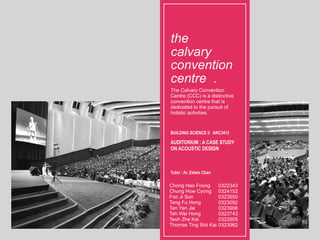
The Calvary Convention
Centre (CCC) is a distinctive
convention centre that is
dedicated to the pursuit of
holistic activities.
Chong Hao Foong
Chung How Cyong
Foo Ji Sun
Tang Fu Hong
Tan Yan Jie
Teh Wei Hong
Teoh Zhe Kai
Thomas Ting Shii Kai
0322343
0324152
0323550
0323092
0323906
0323743
0322905
0323962
BUILDING SCIENCE II ARC3413
AUDITORIUM : A CASE STUDY
ON ACOUSTIC DESIGN
Tutor : Ar. Edwin Chan
Name of Auditorium: Calvary Convention Centre
Location: Jalan Jalil Perkasa 1, Taman Teknologi Malaysia,
57000 Kuala Lumpur, Wilayah Persekutuan Kuala Lumpur.
Type of Auditorium: Speech-based Auditorium, Holistic-
driven events
Total Built Up Area: 600,000 square feet
Year of Completed: 2013
Total Seats: 5,000 seat auditorium, with upholstered tip-up
theatre seat covered of 2,965 square metre and timber
padded retractable tip-up seat of 420 square metre.
introduction
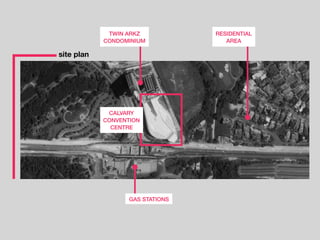
CALVARY
CONVENTION
CENTRE
GAS STATIONS
RESIDENTIAL
AREA
TWIN ARKZ
CONDOMINIUM
site plan
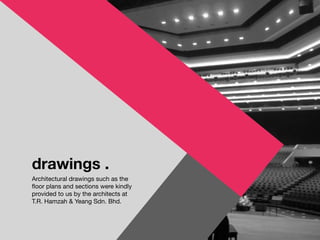
drawings .
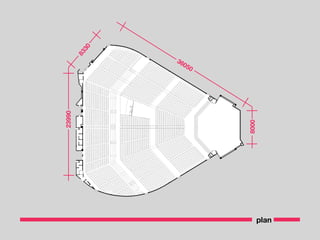
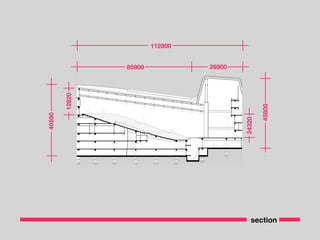
Architectural drawings such as the
floor plans and sections were kindly
provided to us by the architects at
T.R. Hamzah & Yeang Sdn. Bhd.
plan
23990
8000
8330
36050
section
40590
12820
45800
24320
85900 26900
112800
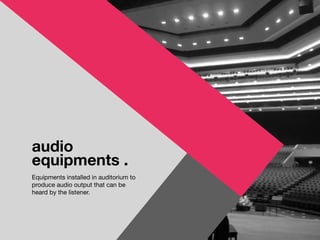
audio
equipments .
Equipments installed in auditorium to
produce audio output that can be
heard by the listener.
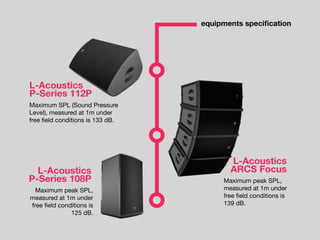
equipments specification
L-Acoustics
P-Series 112P
Maximum SPL (Sound Pressure
Level), measured at 1m under
free field conditions is 133 dB.
L-Acoustics
ARCS Focus
Maximum peak SPL,
measured at 1m under
free field conditions is
139 dB.
L-Acoustics
P-Series 108P
Maximum peak SPL,
measured at 1m under
free field conditions is
125 dB.
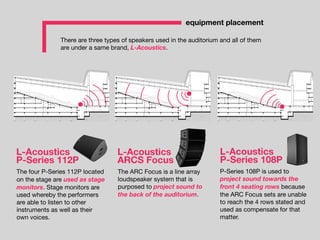
There are three types of speakers used in the auditorium and all of them
are under a same brand, L-Acoustics.
equipment placement
The four P-Series 112P located
on the stage are used as stage
monitors. Stage monitors are
used whereby the performers
are able to listen to other
instruments as well as their
own voices.
L-Acoustics
P-Series 112P
The ARC Focus is a line array
loudspeaker system that is
purposed to project sound to
the back of the auditorium.
L-Acoustics
ARCS Focus
P-Series 108P is used to
project sound towards the
front 4 seating rows because
the ARC Focus sets are unable
to reach the 4 rows stated and
used as compensate for that
matter.
L-Acoustics
P-Series 108P
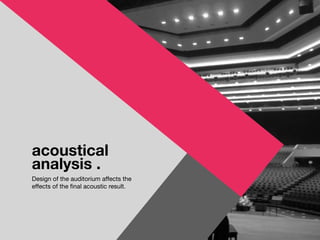
acoustical
analysis .
Design of the auditorium affects the
effects of the final acoustic result.
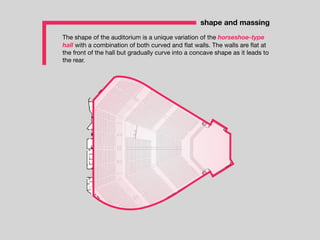
The shape of the auditorium is a unique variation of the horseshoe-type
hall with a combination of both curved and flat walls. The walls are flat at
the front of the hall but gradually curve into a concave shape as it leads to
the rear.
shape and massing
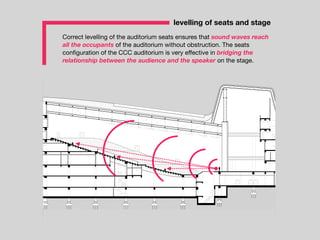
Correct levelling of the auditorium seats ensures that sound waves reach
all the occupants of the auditorium without obstruction. The seats
configuration of the CCC auditorium is very effective in bridging the
relationship between the audience and the speaker on the stage.
levelling of seats and stage
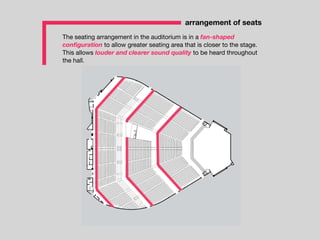
The seating arrangement in the auditorium is in a fan-shaped
configuration to allow greater seating area that is closer to the stage.
This allows louder and clearer sound quality to be heard throughout
the hall.
arrangement of seats
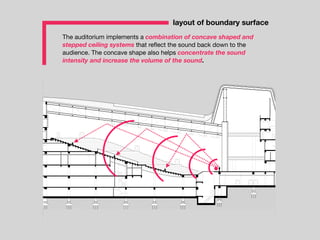
The auditorium implements a combination of concave shaped and
stepped ceiling systems that reflect the sound back down to the
audience. The concave shape also helps concentrate the sound
intensity and increase the volume of the sound.
layout of boundary surface
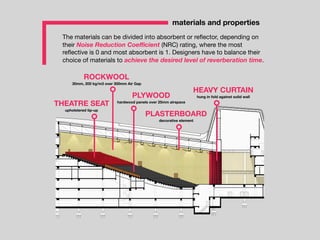
The materials can be divided into absorbent or reflector, depending on
their Noise Reduction Coefficient (NRC) rating, where the most
reflective is 0 and most absorbent is 1. Designers have to balance their
choice of materials to achieve the desired level of reverberation time.
materials and properties
THEATRE SEAT
upholstered tip-up
HEAVY CURTAIN
hung in fold against solid wallPLYWOOD
hardwood panels over 25mm airspace
PLASTERBOARD
decorative element
ROCKWOOL
30mm, 200 kg/m3 over 300mm Air Gap
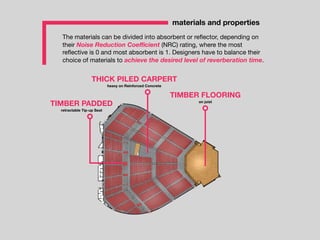
The materials can be divided into absorbent or reflector, depending on
their Noise Reduction Coefficient (NRC) rating, where the most
reflective is 0 and most absorbent is 1. Designers have to balance their
choice of materials to achieve the desired level of reverberation time.
materials and properties
TIMBER PADDED
retractable Tip-up Seat
TIMBER FLOORING
on joist
THICK PILED CARPERT
heavy on Reinforced Concrete
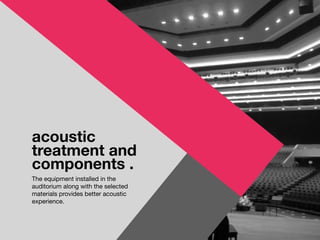
acoustic
treatment and
components .
The equipment installed in the
auditorium along with the selected
materials provides better acoustic
experience.
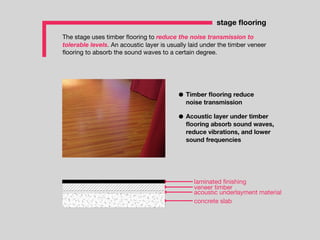
The stage uses timber flooring to reduce the noise transmission to
tolerable levels. An acoustic layer is usually laid under the timber veneer
flooring to absorb the sound waves to a certain degree.
acoustic underlayment material
stage flooring
veneer timber
laminated finishing
concrete slab
Timber flooring reduce
noise transmission
Acoustic layer under timber
flooring absorb sound waves,
reduce vibrations, and lower
sound frequencies
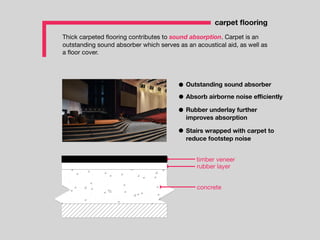
Thick carpeted flooring contributes to sound absorption. Carpet is an
outstanding sound absorber which serves as an acoustical aid, as well as
a floor cover.
carpet flooring
timber veneer
rubber layer
concrete
Outstanding sound absorber
Absorb airborne noise efficiently
Rubber underlay further
improves absorption
Stairs wrapped with carpet to
reduce footstep noise
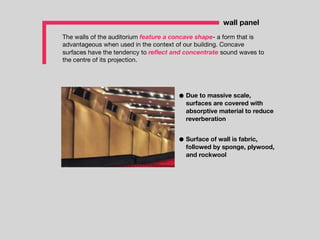
The walls of the auditorium feature a concave shape- a form that is
advantageous when used in the context of our building. Concave
surfaces have the tendency to reflect and concentrate sound waves to
the centre of its projection.
wall panel
Due to massive scale,
surfaces are covered with
absorptive material to reduce
reverberation
Surface of wall is fabric,
followed by sponge, plywood,
and rockwool
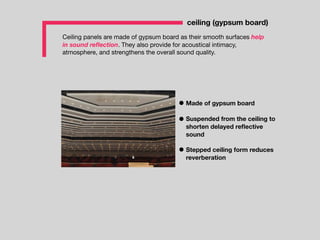
Ceiling panels are made of gypsum board as their smooth surfaces help
in sound reflection. They also provide for acoustical intimacy,
atmosphere, and strengthens the overall sound quality.
ceiling (gypsum board)
Suspended from the ceiling to
shorten delayed reflective
sound
Stepped ceiling form reduces
reverberation
Made of gypsum board
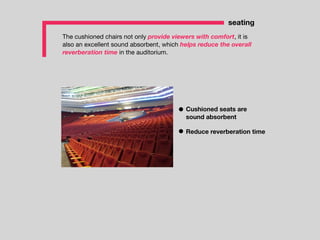
The cushioned chairs not only provide viewers with comfort, it is
also an excellent sound absorbent, which helps reduce the overall
reverberation time in the auditorium.
seating
Cushioned seats are
sound absorbent
Reduce reverberation time
sound
propagations
and related
phenomena .
Architectural acoustics refers to the
relationship between sound produced
in a space and its listeners, of
particular concern in the design of
concert halls and auditoriums.
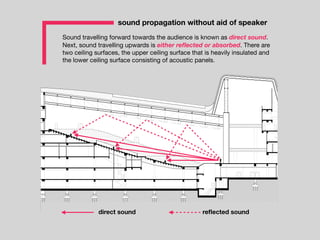
Sound travelling forward towards the audience is known as direct sound.
Next, sound travelling upwards is either reflected or absorbed. There are
two ceiling surfaces, the upper ceiling surface that is heavily insulated and
the lower ceiling surface consisting of acoustic panels.
sound propagation without aid of speaker
direct sound reflected sound
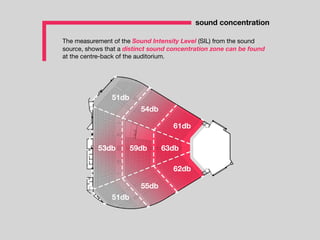
The measurement of the Sound Intensity Level (SIL) from the sound
source, shows that a distinct sound concentration zone can be found
at the centre-back of the auditorium.
sound concentration
51db
53db 59db
62db
63db
61db
54db
51db
55db
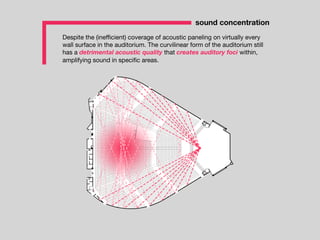
Despite the (inefficient) coverage of acoustic paneling on virtually every
wall surface in the auditorium. The curvilinear form of the auditorium still
has a detrimental acoustic quality that creates auditory foci within,
amplifying sound in specific areas.
sound concentration
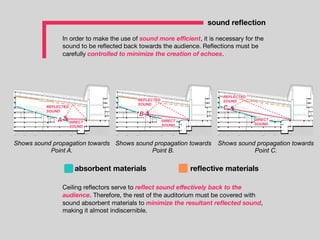
In order to make the use of sound more efficient, it is necessary for the
sound to be reflected back towards the audience. Reflections must be
carefully controlled to minimize the creation of echoes.
sound reflection
A
B
C
Ceiling reflectors serve to reflect sound effectively back to the
audience. Therefore, the rest of the auditorium must be covered with
sound absorbent materials to minimize the resultant reflected sound,
making it almost indiscernible.
Shows sound propagation towards
Point A.
Shows sound propagation towards
Point B.
Shows sound propagation towards
Point C.
DIRECT
SOUND
DIRECT
SOUND
DIRECT
SOUND
REFLECTED
SOUND
REFLECTED
SOUND
REFLECTED
SOUND
absorbent materials reflective materials
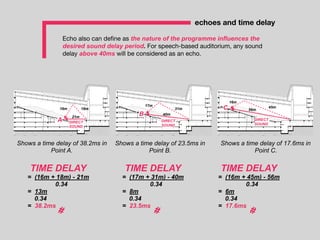
Echo also can define as the nature of the programme influences the
desired sound delay period. For speech-based auditorium, any sound
delay above 40ms will be considered as an echo.
echoes and time delay
TIME DELAY
= (16m + 18m) - 21m
0.34
= 13m
0.34
= 38.2ms
#
TIME DELAY
= (17m + 31m) - 40m
0.34
= 8m
0.34
= 23.5ms
#
TIME DELAY
= (16m + 45m) - 56m
0.34
= 6m
0.34
= 17.6ms
#
Shows a time delay of 38.2ms in
Point A.
Shows a time delay of 23.5ms in
Point B.
Shows a time delay of 17.6ms in
Point C.
DIRECT
SOUND
16m 18m
21m
DIRECT
SOUND
DIRECT
SOUND
A
B
C17m
31m
40m
16m
45m
56m
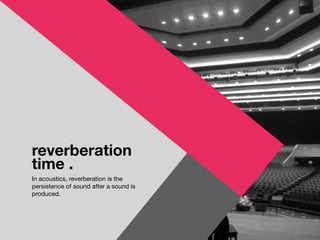
reverberation
time .
In acoustics, reverberation is the
persistence of sound after a sound is
produced.
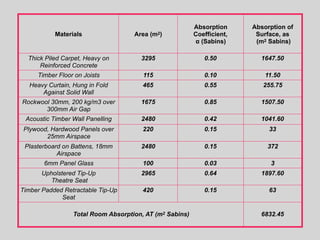
Based on the materials identified on site and the
measurements obtained from the drawings, we were
able to calculate the absorption of each surface and
determine the total room absorption of the auditorium.
reverberation time
Materials Area (m2)
Absorption
Coefficient,
α (Sabins)
Absorption of
Surface, as
(m2 Sabins)
Thick Piled Carpet, Heavy on
Reinforced Concrete
3295 0.50 1647.50
Timber Floor on Joists 115 0.10 11.50
Heavy Curtain, Hung in Fold
Against Solid Wall
465 0.55 255.75
Rockwool 30mm, 200 kg/m3 over
300mm Air Gap
1675 0.85 1507.50
Acoustic Timber Wall Panelling 2480 0.42 1041.60
Plywood, Hardwood Panels over
25mm Airspace
220 0.15 33
Plasterboard on Battens, 18mm
Airspace
2480 0.15 372
6mm Panel Glass 100 0.03 3
Upholstered Tip-Up
Theatre Seat
2965 0.64 1897.60
Timber Padded Retractable Tip-Up
Seat
420 0.15 63
Total Room Absorption, AT (m2 Sabins) 6832.45
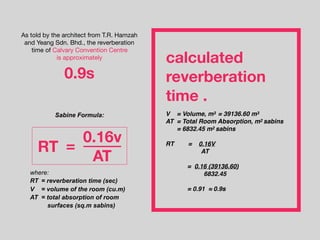
As told by the architect from T.R. Hamzah
and Yeang Sdn. Bhd., the reverberation
time of Calvary Convention Centre 

is approximately
Sabine Formula:
where:
RT = reverberation time (sec)
V = volume of the room (cu.m)
AT = total absorption of room
surfaces (sq.m sabins)
0.9s
RT
0.16v
AT
=
V = Volume, m3 = 39136.60 m3
AT = Total Room Absorption, m2 sabins
= 6832.45 m2 sabins
RT = 0.16V
AT
= 0.16 (39136.60)
6832.45
= 0.91 ≈ 0.9s
calculated
reverberation
time .
conclusion .
Based on analysis and calculation.
To sum up a conclusion from our accumulated findings and
subsequent analysis, Calvary Convention Centre has the
flexibility to cater both demands for speeches and music
performances. A multipurpose auditorium with the capacity of
having 5,000 occupants, situated on a disproportionate land
area with a well-considered tropical climate design strategies.
Isolation by air gaps and restructuring of systems is
employed to overcome noise emanating from outside and the
inside. Smart choice of materials aids the noise control and
creates conducive environment for event hosting.
Nevertheless, consideration of the type and position of
loudspeakers used is vital for acoustical control. Calvary
Convention Centre has successfully achieved an optimum
reverberation time of 0.9s for a speech-based auditorium.
Last but not least, we were able to truly understand and
appreciate a full scope on acoustics for our case study,
Calvary Convention Centre. In a short period of time, enabled
us to understand how different types of designs and their
acoustical treatments influence the sound efficiency and the
overall user experiences.
conclusion
THANK
YOU
!

Auditorium: A Case Study on Acoustic Design Presentation

  • 1.
    the calvary convention centre . The CalvaryConvention Centre (CCC) is a distinctive convention centre that is dedicated to the pursuit of holistic activities. Chong Hao Foong Chung How Cyong Foo Ji Sun Tang Fu Hong Tan Yan Jie Teh Wei Hong Teoh Zhe Kai Thomas Ting Shii Kai 0322343 0324152 0323550 0323092 0323906 0323743 0322905 0323962 BUILDING SCIENCE II ARC3413 AUDITORIUM : A CASE STUDY ON ACOUSTIC DESIGN Tutor : Ar. Edwin Chan
  • 2.
    Name of Auditorium:Calvary Convention Centre Location: Jalan Jalil Perkasa 1, Taman Teknologi Malaysia, 57000 Kuala Lumpur, Wilayah Persekutuan Kuala Lumpur. Type of Auditorium: Speech-based Auditorium, Holistic- driven events Total Built Up Area: 600,000 square feet Year of Completed: 2013 Total Seats: 5,000 seat auditorium, with upholstered tip-up theatre seat covered of 2,965 square metre and timber padded retractable tip-up seat of 420 square metre. introduction
  • 3.
  • 4.
    drawings . Architectural drawingssuch as the floor plans and sections were kindly provided to us by the architects at T.R. Hamzah & Yeang Sdn. Bhd.
  • 5.
  • 6.
  • 7.
    audio equipments . Equipments installedin auditorium to produce audio output that can be heard by the listener.
  • 8.
    equipments specification L-Acoustics P-Series 112P MaximumSPL (Sound Pressure Level), measured at 1m under free field conditions is 133 dB. L-Acoustics ARCS Focus Maximum peak SPL, measured at 1m under free field conditions is 139 dB. L-Acoustics P-Series 108P Maximum peak SPL, measured at 1m under free field conditions is 125 dB.
  • 9.
    There are threetypes of speakers used in the auditorium and all of them are under a same brand, L-Acoustics. equipment placement The four P-Series 112P located on the stage are used as stage monitors. Stage monitors are used whereby the performers are able to listen to other instruments as well as their own voices. L-Acoustics P-Series 112P The ARC Focus is a line array loudspeaker system that is purposed to project sound to the back of the auditorium. L-Acoustics ARCS Focus P-Series 108P is used to project sound towards the front 4 seating rows because the ARC Focus sets are unable to reach the 4 rows stated and used as compensate for that matter. L-Acoustics P-Series 108P
  • 10.
    acoustical analysis . Design ofthe auditorium affects the effects of the final acoustic result.
  • 11.
    The shape ofthe auditorium is a unique variation of the horseshoe-type hall with a combination of both curved and flat walls. The walls are flat at the front of the hall but gradually curve into a concave shape as it leads to the rear. shape and massing
  • 12.
    Correct levelling ofthe auditorium seats ensures that sound waves reach all the occupants of the auditorium without obstruction. The seats configuration of the CCC auditorium is very effective in bridging the relationship between the audience and the speaker on the stage. levelling of seats and stage
  • 13.
    The seating arrangementin the auditorium is in a fan-shaped configuration to allow greater seating area that is closer to the stage. This allows louder and clearer sound quality to be heard throughout the hall. arrangement of seats
  • 14.
    The auditorium implementsa combination of concave shaped and stepped ceiling systems that reflect the sound back down to the audience. The concave shape also helps concentrate the sound intensity and increase the volume of the sound. layout of boundary surface
  • 15.
    The materials canbe divided into absorbent or reflector, depending on their Noise Reduction Coefficient (NRC) rating, where the most reflective is 0 and most absorbent is 1. Designers have to balance their choice of materials to achieve the desired level of reverberation time. materials and properties THEATRE SEAT upholstered tip-up HEAVY CURTAIN hung in fold against solid wallPLYWOOD hardwood panels over 25mm airspace PLASTERBOARD decorative element ROCKWOOL 30mm, 200 kg/m3 over 300mm Air Gap
  • 16.
    The materials canbe divided into absorbent or reflector, depending on their Noise Reduction Coefficient (NRC) rating, where the most reflective is 0 and most absorbent is 1. Designers have to balance their choice of materials to achieve the desired level of reverberation time. materials and properties TIMBER PADDED retractable Tip-up Seat TIMBER FLOORING on joist THICK PILED CARPERT heavy on Reinforced Concrete
  • 17.
    acoustic treatment and components . Theequipment installed in the auditorium along with the selected materials provides better acoustic experience.
  • 18.
    The stage usestimber flooring to reduce the noise transmission to tolerable levels. An acoustic layer is usually laid under the timber veneer flooring to absorb the sound waves to a certain degree. acoustic underlayment material stage flooring veneer timber laminated finishing concrete slab Timber flooring reduce noise transmission Acoustic layer under timber flooring absorb sound waves, reduce vibrations, and lower sound frequencies
  • 19.
    Thick carpeted flooringcontributes to sound absorption. Carpet is an outstanding sound absorber which serves as an acoustical aid, as well as a floor cover. carpet flooring timber veneer rubber layer concrete Outstanding sound absorber Absorb airborne noise efficiently Rubber underlay further improves absorption Stairs wrapped with carpet to reduce footstep noise
  • 20.
    The walls ofthe auditorium feature a concave shape- a form that is advantageous when used in the context of our building. Concave surfaces have the tendency to reflect and concentrate sound waves to the centre of its projection. wall panel Due to massive scale, surfaces are covered with absorptive material to reduce reverberation Surface of wall is fabric, followed by sponge, plywood, and rockwool
  • 21.
    Ceiling panels aremade of gypsum board as their smooth surfaces help in sound reflection. They also provide for acoustical intimacy, atmosphere, and strengthens the overall sound quality. ceiling (gypsum board) Suspended from the ceiling to shorten delayed reflective sound Stepped ceiling form reduces reverberation Made of gypsum board
  • 22.
    The cushioned chairsnot only provide viewers with comfort, it is also an excellent sound absorbent, which helps reduce the overall reverberation time in the auditorium. seating Cushioned seats are sound absorbent Reduce reverberation time
  • 23.
    sound propagations and related phenomena . Architecturalacoustics refers to the relationship between sound produced in a space and its listeners, of particular concern in the design of concert halls and auditoriums.
  • 24.
    Sound travelling forwardtowards the audience is known as direct sound. Next, sound travelling upwards is either reflected or absorbed. There are two ceiling surfaces, the upper ceiling surface that is heavily insulated and the lower ceiling surface consisting of acoustic panels. sound propagation without aid of speaker direct sound reflected sound
  • 25.
    The measurement ofthe Sound Intensity Level (SIL) from the sound source, shows that a distinct sound concentration zone can be found at the centre-back of the auditorium. sound concentration 51db 53db 59db 62db 63db 61db 54db 51db 55db
  • 26.
    Despite the (inefficient)coverage of acoustic paneling on virtually every wall surface in the auditorium. The curvilinear form of the auditorium still has a detrimental acoustic quality that creates auditory foci within, amplifying sound in specific areas. sound concentration
  • 27.
    In order tomake the use of sound more efficient, it is necessary for the sound to be reflected back towards the audience. Reflections must be carefully controlled to minimize the creation of echoes. sound reflection A B C Ceiling reflectors serve to reflect sound effectively back to the audience. Therefore, the rest of the auditorium must be covered with sound absorbent materials to minimize the resultant reflected sound, making it almost indiscernible. Shows sound propagation towards Point A. Shows sound propagation towards Point B. Shows sound propagation towards Point C. DIRECT SOUND DIRECT SOUND DIRECT SOUND REFLECTED SOUND REFLECTED SOUND REFLECTED SOUND absorbent materials reflective materials
  • 28.
    Echo also candefine as the nature of the programme influences the desired sound delay period. For speech-based auditorium, any sound delay above 40ms will be considered as an echo. echoes and time delay TIME DELAY = (16m + 18m) - 21m 0.34 = 13m 0.34 = 38.2ms # TIME DELAY = (17m + 31m) - 40m 0.34 = 8m 0.34 = 23.5ms # TIME DELAY = (16m + 45m) - 56m 0.34 = 6m 0.34 = 17.6ms # Shows a time delay of 38.2ms in Point A. Shows a time delay of 23.5ms in Point B. Shows a time delay of 17.6ms in Point C. DIRECT SOUND 16m 18m 21m DIRECT SOUND DIRECT SOUND A B C17m 31m 40m 16m 45m 56m
  • 29.
    reverberation time . In acoustics,reverberation is the persistence of sound after a sound is produced.
  • 30.
    Based on thematerials identified on site and the measurements obtained from the drawings, we were able to calculate the absorption of each surface and determine the total room absorption of the auditorium. reverberation time
  • 31.
    Materials Area (m2) Absorption Coefficient, α(Sabins) Absorption of Surface, as (m2 Sabins) Thick Piled Carpet, Heavy on Reinforced Concrete 3295 0.50 1647.50 Timber Floor on Joists 115 0.10 11.50 Heavy Curtain, Hung in Fold Against Solid Wall 465 0.55 255.75 Rockwool 30mm, 200 kg/m3 over 300mm Air Gap 1675 0.85 1507.50 Acoustic Timber Wall Panelling 2480 0.42 1041.60 Plywood, Hardwood Panels over 25mm Airspace 220 0.15 33 Plasterboard on Battens, 18mm Airspace 2480 0.15 372 6mm Panel Glass 100 0.03 3 Upholstered Tip-Up Theatre Seat 2965 0.64 1897.60 Timber Padded Retractable Tip-Up Seat 420 0.15 63 Total Room Absorption, AT (m2 Sabins) 6832.45
  • 32.
    As told bythe architect from T.R. Hamzah and Yeang Sdn. Bhd., the reverberation time of Calvary Convention Centre is approximately Sabine Formula: where: RT = reverberation time (sec) V = volume of the room (cu.m) AT = total absorption of room surfaces (sq.m sabins) 0.9s RT 0.16v AT = V = Volume, m3 = 39136.60 m3 AT = Total Room Absorption, m2 sabins = 6832.45 m2 sabins RT = 0.16V AT = 0.16 (39136.60) 6832.45 = 0.91 ≈ 0.9s calculated reverberation time .
  • 33.
    conclusion . Based onanalysis and calculation.
  • 34.
    To sum upa conclusion from our accumulated findings and subsequent analysis, Calvary Convention Centre has the flexibility to cater both demands for speeches and music performances. A multipurpose auditorium with the capacity of having 5,000 occupants, situated on a disproportionate land area with a well-considered tropical climate design strategies. Isolation by air gaps and restructuring of systems is employed to overcome noise emanating from outside and the inside. Smart choice of materials aids the noise control and creates conducive environment for event hosting. Nevertheless, consideration of the type and position of loudspeakers used is vital for acoustical control. Calvary Convention Centre has successfully achieved an optimum reverberation time of 0.9s for a speech-based auditorium. Last but not least, we were able to truly understand and appreciate a full scope on acoustics for our case study, Calvary Convention Centre. In a short period of time, enabled us to understand how different types of designs and their acoustical treatments influence the sound efficiency and the overall user experiences. conclusion
  • 35.