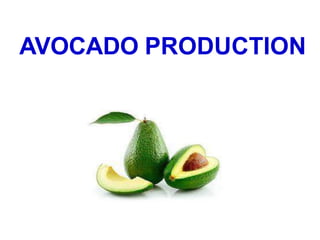
AVOCADO PRODUCTION
Avocado
2
Introduction
Photo: © Victor Omari, 2019 HCD
3
Introduction:
• Avocado is a member of the Lauraceae family
• It is eaten raw (ripe) and also flavors soups, ice
cream and milkshakes
• It has high protein, several minerals (Zinc &
Selenium) and Vitamins (A, C & E) and high in Fat.
• Avocado oil is easily digestible, largely
unsaturated and has low sugar content
Common Varieties
4
‘Fuerte’
Photo: SHEP PLUS
5
“Fuerte”
• Fuerte is one of the major varieties in export
markets
• The tree is broad, very productive and
susceptible to both Anthracnose and Scab
• Pear-shaped fruit with medium seed
• Weight: 140 – 395 g per fruit
• Smooth thin green skin
• Skin remains green when fruits are mature
• Creamy, pale green flesh
‘Hass’
6
7
‘Hass’
• The tree grows tall and requires cutting back
• Distinctive for its skin that turns from green to
purplish-black when fruits are mature
• Oval-shaped fruit with small to medium seed
• Easy peeling
• Great taste
• Outstanding shelf-life and shipping
characteristics
Other varieties being cultivated
are
‘Pinkerton’
• Long, pear-shaped fruit with
small seed
• Large fruit that weighs 225 –
510 g per fruit
• Medium thick green skin with
slight pebbling
• Green skin deepens in color as it
ripens
• Excellent peeling
• Creamy, pale green flesh “Pinkerton”
1-4
9
‘Reed’
• Round fruit with medium
seed
• Medium to large fruits with
the weight of 225 – 510 g per
fruit
• Thick green skin with slight
pebbling
• Skin remains green when
fruits are mature
• Easy peeling
• Creamy flesh with good taste “Reed”
10
11
‘Puebla’
• Small compact fruits
• Skin of ripe fruit is black, thin and smooth
• Fruit has a velvety flesh with nutty aroma and
a rich butter taste
Other varieties:
Linda, Ettinger, Nabal, Simmonds, Lyon,
Tonnage, Zutano, Hardy, Teague etc.
Note: Cultivars used as rootstocks are “Puebla”
or “Local varieties”
Puebla
Botany of Avocado
 Avocado trees can be tall or spreading, and they have elliptic to
egg-shaped leaves that are 10–30 cm (4–12 inches) in length.
 The small greenish flowers are bornein dense inflorescences and
lack true petals. The flowers have nine stamens, arranged in
three series, and a one-celled ovary.
 Interestingly, there are two types of avocado flowers, A and B,
depending on the cultivar.
 These flowers are dichogamous (male and female parts mature
separately).
 Type A flowers are functionally female in the morning, close at
midday, and then reopen as functionally male in the afternoon of
the following day.
 Type B flowers are functionally female in the afternoon, close in
the evening, and then reopen the following morning as
functionally male.
 "A" cultivars: Hass, Gwen, Pinkerton, Reed.
"B" cultivars: Fuerte, Sharwil, Zutano, Bacon, Ettinger.
 The fruit is exceedingly variable in size. The form varies from
round to pear-shaped with a long slender neck.
 Botanically, the fruit is a berry and features a single large
round seed with two cotyledons.
 The fruit’s outer skin is sometimes no thicker than that of
an apple and sometimes is coarse and woody in texture.
Propagation
 Avocados can be propagated by planting seeds,
cuttings, grafting and layering.
 Usually, grafted seedlings are the more common
propagation material used for commercial cultivation.
 The most common method of grafting avocados is the cleft
graft.
11
Optimal Ecological Requirements
Altitude 1,200 – 2,200 metres above sea
level
Rainfall 1,000 – 1,200 mm of rainfall
annually
Growing
Temperature
25 – 30 0C
Soils • Fertile and well aerated,
particularly sandy or alluvial loams
• pH range 5 – 7.
Land Preparation
3-1
Size of Planting Hole
60 cm
60 cm
subsoil
topsoil
Picture: SHEP PLUS
18
19
Ploughing
• Soils should be ploughed sufficiently to eliminate
debris and clods.
• Plough to a fine tilth
• Avoid field operations when it is wet to avoid soil
compaction and hard pans which affect proper root
development.
• It is recommended to have the land ploughed at least
2 – 3 months before transplanting.
20
Recommended Spacing
Spacing: The usual spacing is 6-9m x 7-10m depending
on growth characteristic of the individual variety and
the type of soil, fertility status, agro-ecological
conditions and agronomic practices
• Basal Fertilizer Application
During the preparation of planting holes, manure/compost
and basal fertilizer are applied to allow the soils to settle
and establish.
21
Water Requirement
 Avocadoes have large soft leaves and evaporate a
lot of water in warm weather, so they need regular
watering.
 Irrigation is required incase of insufficient rainfall,
especially during flowering and fruit setting.
Crop Management: Pruning & Training
Prune off suckers & terminal shoots
Shoots
22
Shoots
Suckers
23
• Formative pruning is important to encourage lateral
growth and multiple framework branching.
• In order to reinforce this shaping of the tree, remove all
sucker growth originating from below the graft union
• Cut back shoots or pinch out the terminal buds of
shoots growing straight up
• Training involves creating a strong central shoot from
which extend spaced side branches at the desired
height and the creation of a bare main trunk about
70 cm in height.
24
Pests & Diseases Control:
Major Insect Pests
The following are the major pests of Avocado
A. False codling moth
B. Thrips
C. Scales
D. Fruit flies
A: False Codling Moth
25
Caterpillar (left) & adult (right) of the
False Coding Moth
3-5 3-6
Photo: Tertia Grové, Institute for Tropical and
Subtropical Crops, Bugwood.org (CC BY 3.0 US) Photo: Pest and Diseases Image Library, Bugwood.org (CC BY 3.0 US)
26
Control:
• Proper orchard sanitation
• Infested fruits (both on the tree and fallen)
should be removed regularly (at least twice a
week) and buried at least 50 cm or dump in a
drum filled with water mixed with a little used oil
for 1 week
• Use of pheromone traps
B: Thrips
Avocado thrips
27
Damage of Thrips
on a fruit
3-8
3-7
Photo: Jack Clark, University of California - Davis,
Bugwood.org (CC BY 3.0 US)
Photo: Mark S. Hoddle, University of California - Riverside, Bugwood.org (CC BY
3.0 US)
28
Control:
• Conserve natural enemies: Thrips are attacked
by predatory Thrips, Lacewings and
Predatory Bugs
• If chemical control is considered, use products
such as Lambda Cyhalothrin ( eg.Karate 2.5
WG® PHI 3days)
B: Thrips Cont’
C: Scales
29
Armoured Scales on a leaf (left) and
fruit (right)
3-9 3-10
Source: http://www.infonet-biovision.org/PlantHealth/Crops/Avocados
(accessed on 29 Sep 2016) © A. M. Varela, icipe
Source: http://www.infonet-biovision.org/PlantHealth/Crops/Avocados
(accessed on 29 Sep 2016) © A. M. Varela, icipe
30
Control:
• Chemical control: Use of insecticide such as
Malathion ((Dera Malathion DC®)PHI 14days)
• Conserve natural enemies such as parasitic
wasps, ladybird beetles and lacewings, provided no
broad- spectrum pesticides are used and no ants
are present
D: Fruit Flies
31
A fruit fly adult
32
Control:
• Practice orchard sanitation.
• Practise monitoring.
• Trap flies using commercial pheromone traps -
Methyl Euginol (Bactrolure liquid) at 20 traps per acre.
• Remove infested fruits (e.g. those with dimples and
oozing sap) twice a week and destroy by burying about
60cm deep
33
• The following are the major diseases of
Avocado
a. Root Rot (Die Back)
b. Anthracnose
c. Cercospora Fruit Spot
d. Scab
Major Diseases
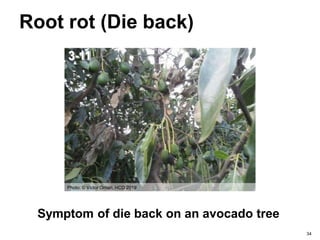
Root rot (Die back)
3-11
Symptom of die back on an avocado tree
Photo: © Victor Omari, HCD 2019
34
35
Control:
• Uprooting of affected trees
• Grafting on Phytophthora-tolerant rootstocks
Anthracnose
36
3-12
Anthracnose on Avocado fruit
Photo: © A.A. Seif, icipe
http://www.infonet-biovision.org/PlantHealth/Crops/Avocados
37
Control:
 Orchard sanitation
 Fungicides are normally used to control the disease
besides other chemicals such as: Mancozeb
(Dithane M-45 WP®) and Propineb (MILRAZ WP 76®)
among others
Cercospora Fruit Spot
38
Avocado fruit showing a lesion caused
by Cercospora
3-13
Photo: © A.A. Seif, icipe
http://www.infonet-biovision.org/PlantHealth/Crops/Avocados
39
Control:
• Orchard sanitation
• Fungicides are normally used to control the
disease besides other chemicals such as:
Propineb (MILRAZ WP 76®)
Scab
40
Scab on a Avocado fruit
3-14
Source: http://www.infonet-biovision.org/PlantHealth/MinorPests/Scab-1
© A.A. Seif, icipe
41
Control:
• Orchard sanitation: remove dead branches and
twigs since they harbour the fungus.
• Also remove fallen rotten fruits from the field
• Fungicides are normally used to control the
disease besides other chemicals such as
Mancozeb (DITHANE M-45®)at pre-flowering,
fruit formation, and after harvest
42
Harvesting Indices
Maturity Period: 3 – 4 years after transplanting into
the field (grafted plants)
Maturity:
• Since Avocados do not soften on the trees, it is
not easy to identify the right harvesting period.
Some indicators of maturity include:
- Dark varieties: a change in colour from
green to black or purple
- Green varieties: the fruit stems turn yellow,
the skin may appear less shiny, or the end
develops rust-like spots
- Some varieties develop a whitish
appearance
Harvest
43
Methods of Determining Fruits Maturity:
• Floating Test:
- Fruits that float on the surface when
immersed into water are usually mature
- Immature Avocados sink or float below the
surface.
• Another Method:
- Pick a few fruits when they are apparently
mature
- Leave them to ripen in a warm place
- If these soften without shriveling within a
week at room temperature (about 20 0C), then
the crop is ready for picking
Post-Harvest Handling
44
5-1
Avocados in a packhouse
Source: © Victor Omari, HCD 2019
45
Containers & Packaging Materials
• The plastic or wooden containers must be padded
to prevent damaging the skin of fruits as this can
result into infections
• Store the field boxes in the shade in order to
minimize sunburn, loss of moisture and dust
accumulation
Value Addition Techniques: Sorting, Cleaning &
Grading
• Sorting: Remove all the field debris including
misshaped, diseased and bruised fruit
• Cleaning: Use cold, clean water to remove any
dirt found on the fruits
46
• Pre-cooling: Fruits must be cooled as quickly as
possible.
• Grading: Fruits are graded according to size and
stage of ripening. For the export market, the size
grades are coded as shown in the next slide.
47
Photo: https://pxhere.com/en/photo/840225 (CC0 1.0)
Avocados packed into a box for the
export market
48
Storage
• Avocado fruits can be stored at temperatures of 5 0C
– 7 0C and a relative humidity of 85 % – 95 % for
three to four weeks
Packaging
• Fresh Avocado fruits are packed in cartons
made of solid or corrugated fiberboard
• The boxes must have adequate ventilation, holes,
for effective cooling and air circulation
49
Transportation
• Avocado fruits must be packed firmly in place
and should not roll around or rub against one
another in transport vehicle
• Boxes must not be shaken during loading and
offloading and must be securely stacked in the
container, preferably on pallets, throughout
transportation
• Covered vehicles should used: insulated or
refrigerated trucks are recommended
72
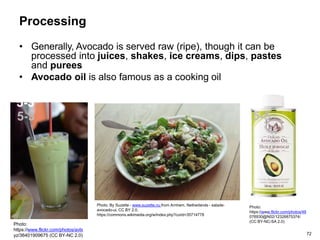
Processing
• Generally, Avocado is served raw (ripe), though it can be
processed into juices, shakes, ice creams, dips, pastes
and purees
• Avocado oil is also famous as a cooking oil
5-3
Photo:
https://www.flickr.com/photos/avlx
yz/36401909675 (CC BY-NC 2.0)
Photo: By Suzette - www.suzette.nu from Arnhem, Netherlands - salade-
avocado-ui, CC BY 2.0,
https://commons.wikimedia.org/w/index.php?curid=35714778
Photo:
https://www.flickr.com/photos/48
076930@N02/12326875374/
(CC BY-NC-SA 2.0)
Avocado PPT.pptx

Avocado PPT.pptx

  • 1.
  • 2.
  • 3.
    3 Introduction: • Avocado isa member of the Lauraceae family • It is eaten raw (ripe) and also flavors soups, ice cream and milkshakes • It has high protein, several minerals (Zinc & Selenium) and Vitamins (A, C & E) and high in Fat. • Avocado oil is easily digestible, largely unsaturated and has low sugar content
  • 4.
  • 5.
    5 “Fuerte” • Fuerte isone of the major varieties in export markets • The tree is broad, very productive and susceptible to both Anthracnose and Scab • Pear-shaped fruit with medium seed • Weight: 140 – 395 g per fruit • Smooth thin green skin • Skin remains green when fruits are mature • Creamy, pale green flesh
  • 6.
  • 7.
    7 ‘Hass’ • The treegrows tall and requires cutting back • Distinctive for its skin that turns from green to purplish-black when fruits are mature • Oval-shaped fruit with small to medium seed • Easy peeling • Great taste • Outstanding shelf-life and shipping characteristics
  • 9.
    Other varieties beingcultivated are ‘Pinkerton’ • Long, pear-shaped fruit with small seed • Large fruit that weighs 225 – 510 g per fruit • Medium thick green skin with slight pebbling • Green skin deepens in color as it ripens • Excellent peeling • Creamy, pale green flesh “Pinkerton” 1-4 9
  • 10.
    ‘Reed’ • Round fruitwith medium seed • Medium to large fruits with the weight of 225 – 510 g per fruit • Thick green skin with slight pebbling • Skin remains green when fruits are mature • Easy peeling • Creamy flesh with good taste “Reed” 10
  • 11.
    11 ‘Puebla’ • Small compactfruits • Skin of ripe fruit is black, thin and smooth • Fruit has a velvety flesh with nutty aroma and a rich butter taste Other varieties: Linda, Ettinger, Nabal, Simmonds, Lyon, Tonnage, Zutano, Hardy, Teague etc. Note: Cultivars used as rootstocks are “Puebla” or “Local varieties”
  • 12.
  • 13.
    Botany of Avocado Avocado trees can be tall or spreading, and they have elliptic to egg-shaped leaves that are 10–30 cm (4–12 inches) in length.  The small greenish flowers are bornein dense inflorescences and lack true petals. The flowers have nine stamens, arranged in three series, and a one-celled ovary.  Interestingly, there are two types of avocado flowers, A and B, depending on the cultivar.  These flowers are dichogamous (male and female parts mature separately).  Type A flowers are functionally female in the morning, close at midday, and then reopen as functionally male in the afternoon of the following day.
  • 14.
     Type Bflowers are functionally female in the afternoon, close in the evening, and then reopen the following morning as functionally male.  "A" cultivars: Hass, Gwen, Pinkerton, Reed. "B" cultivars: Fuerte, Sharwil, Zutano, Bacon, Ettinger.
  • 15.
     The fruitis exceedingly variable in size. The form varies from round to pear-shaped with a long slender neck.  Botanically, the fruit is a berry and features a single large round seed with two cotyledons.  The fruit’s outer skin is sometimes no thicker than that of an apple and sometimes is coarse and woody in texture.
  • 16.
    Propagation  Avocados canbe propagated by planting seeds, cuttings, grafting and layering.  Usually, grafted seedlings are the more common propagation material used for commercial cultivation.  The most common method of grafting avocados is the cleft graft.
  • 17.
    11 Optimal Ecological Requirements Altitude1,200 – 2,200 metres above sea level Rainfall 1,000 – 1,200 mm of rainfall annually Growing Temperature 25 – 30 0C Soils • Fertile and well aerated, particularly sandy or alluvial loams • pH range 5 – 7.
  • 18.
    Land Preparation 3-1 Size ofPlanting Hole 60 cm 60 cm subsoil topsoil Picture: SHEP PLUS 18
  • 19.
    19 Ploughing • Soils shouldbe ploughed sufficiently to eliminate debris and clods. • Plough to a fine tilth • Avoid field operations when it is wet to avoid soil compaction and hard pans which affect proper root development. • It is recommended to have the land ploughed at least 2 – 3 months before transplanting.
  • 20.
    20 Recommended Spacing Spacing: Theusual spacing is 6-9m x 7-10m depending on growth characteristic of the individual variety and the type of soil, fertility status, agro-ecological conditions and agronomic practices • Basal Fertilizer Application During the preparation of planting holes, manure/compost and basal fertilizer are applied to allow the soils to settle and establish.
  • 21.
    21 Water Requirement  Avocadoeshave large soft leaves and evaporate a lot of water in warm weather, so they need regular watering.  Irrigation is required incase of insufficient rainfall, especially during flowering and fruit setting.
  • 22.
    Crop Management: Pruning& Training Prune off suckers & terminal shoots Shoots 22 Shoots Suckers
  • 23.
    23 • Formative pruningis important to encourage lateral growth and multiple framework branching. • In order to reinforce this shaping of the tree, remove all sucker growth originating from below the graft union • Cut back shoots or pinch out the terminal buds of shoots growing straight up • Training involves creating a strong central shoot from which extend spaced side branches at the desired height and the creation of a bare main trunk about 70 cm in height.
  • 24.
    24 Pests & DiseasesControl: Major Insect Pests The following are the major pests of Avocado A. False codling moth B. Thrips C. Scales D. Fruit flies
  • 25.
    A: False CodlingMoth 25 Caterpillar (left) & adult (right) of the False Coding Moth 3-5 3-6 Photo: Tertia Grové, Institute for Tropical and Subtropical Crops, Bugwood.org (CC BY 3.0 US) Photo: Pest and Diseases Image Library, Bugwood.org (CC BY 3.0 US)
  • 26.
    26 Control: • Proper orchardsanitation • Infested fruits (both on the tree and fallen) should be removed regularly (at least twice a week) and buried at least 50 cm or dump in a drum filled with water mixed with a little used oil for 1 week • Use of pheromone traps
  • 27.
    B: Thrips Avocado thrips 27 Damageof Thrips on a fruit 3-8 3-7 Photo: Jack Clark, University of California - Davis, Bugwood.org (CC BY 3.0 US) Photo: Mark S. Hoddle, University of California - Riverside, Bugwood.org (CC BY 3.0 US)
  • 28.
    28 Control: • Conserve naturalenemies: Thrips are attacked by predatory Thrips, Lacewings and Predatory Bugs • If chemical control is considered, use products such as Lambda Cyhalothrin ( eg.Karate 2.5 WG® PHI 3days) B: Thrips Cont’
  • 29.
    C: Scales 29 Armoured Scaleson a leaf (left) and fruit (right) 3-9 3-10 Source: http://www.infonet-biovision.org/PlantHealth/Crops/Avocados (accessed on 29 Sep 2016) © A. M. Varela, icipe Source: http://www.infonet-biovision.org/PlantHealth/Crops/Avocados (accessed on 29 Sep 2016) © A. M. Varela, icipe
  • 30.
    30 Control: • Chemical control:Use of insecticide such as Malathion ((Dera Malathion DC®)PHI 14days) • Conserve natural enemies such as parasitic wasps, ladybird beetles and lacewings, provided no broad- spectrum pesticides are used and no ants are present
  • 31.
    D: Fruit Flies 31 Afruit fly adult
  • 32.
    32 Control: • Practice orchardsanitation. • Practise monitoring. • Trap flies using commercial pheromone traps - Methyl Euginol (Bactrolure liquid) at 20 traps per acre. • Remove infested fruits (e.g. those with dimples and oozing sap) twice a week and destroy by burying about 60cm deep
  • 33.
    33 • The followingare the major diseases of Avocado a. Root Rot (Die Back) b. Anthracnose c. Cercospora Fruit Spot d. Scab Major Diseases
  • 34.
    Root rot (Dieback) 3-11 Symptom of die back on an avocado tree Photo: © Victor Omari, HCD 2019 34
  • 35.
    35 Control: • Uprooting ofaffected trees • Grafting on Phytophthora-tolerant rootstocks
  • 36.
    Anthracnose 36 3-12 Anthracnose on Avocadofruit Photo: © A.A. Seif, icipe http://www.infonet-biovision.org/PlantHealth/Crops/Avocados
  • 37.
    37 Control:  Orchard sanitation Fungicides are normally used to control the disease besides other chemicals such as: Mancozeb (Dithane M-45 WP®) and Propineb (MILRAZ WP 76®) among others
  • 38.
    Cercospora Fruit Spot 38 Avocadofruit showing a lesion caused by Cercospora 3-13 Photo: © A.A. Seif, icipe http://www.infonet-biovision.org/PlantHealth/Crops/Avocados
  • 39.
    39 Control: • Orchard sanitation •Fungicides are normally used to control the disease besides other chemicals such as: Propineb (MILRAZ WP 76®)
  • 40.
    Scab 40 Scab on aAvocado fruit 3-14 Source: http://www.infonet-biovision.org/PlantHealth/MinorPests/Scab-1 © A.A. Seif, icipe
  • 41.
    41 Control: • Orchard sanitation:remove dead branches and twigs since they harbour the fungus. • Also remove fallen rotten fruits from the field • Fungicides are normally used to control the disease besides other chemicals such as Mancozeb (DITHANE M-45®)at pre-flowering, fruit formation, and after harvest
  • 42.
    42 Harvesting Indices Maturity Period:3 – 4 years after transplanting into the field (grafted plants) Maturity: • Since Avocados do not soften on the trees, it is not easy to identify the right harvesting period. Some indicators of maturity include: - Dark varieties: a change in colour from green to black or purple - Green varieties: the fruit stems turn yellow, the skin may appear less shiny, or the end develops rust-like spots - Some varieties develop a whitish appearance Harvest
  • 43.
    43 Methods of DeterminingFruits Maturity: • Floating Test: - Fruits that float on the surface when immersed into water are usually mature - Immature Avocados sink or float below the surface. • Another Method: - Pick a few fruits when they are apparently mature - Leave them to ripen in a warm place - If these soften without shriveling within a week at room temperature (about 20 0C), then the crop is ready for picking
  • 44.
    Post-Harvest Handling 44 5-1 Avocados ina packhouse Source: © Victor Omari, HCD 2019
  • 45.
    45 Containers & PackagingMaterials • The plastic or wooden containers must be padded to prevent damaging the skin of fruits as this can result into infections • Store the field boxes in the shade in order to minimize sunburn, loss of moisture and dust accumulation Value Addition Techniques: Sorting, Cleaning & Grading • Sorting: Remove all the field debris including misshaped, diseased and bruised fruit • Cleaning: Use cold, clean water to remove any dirt found on the fruits
  • 46.
    46 • Pre-cooling: Fruitsmust be cooled as quickly as possible. • Grading: Fruits are graded according to size and stage of ripening. For the export market, the size grades are coded as shown in the next slide.
  • 47.
    47 Photo: https://pxhere.com/en/photo/840225 (CC01.0) Avocados packed into a box for the export market
  • 48.
    48 Storage • Avocado fruitscan be stored at temperatures of 5 0C – 7 0C and a relative humidity of 85 % – 95 % for three to four weeks Packaging • Fresh Avocado fruits are packed in cartons made of solid or corrugated fiberboard • The boxes must have adequate ventilation, holes, for effective cooling and air circulation
  • 49.
    49 Transportation • Avocado fruitsmust be packed firmly in place and should not roll around or rub against one another in transport vehicle • Boxes must not be shaken during loading and offloading and must be securely stacked in the container, preferably on pallets, throughout transportation • Covered vehicles should used: insulated or refrigerated trucks are recommended
  • 50.
    72 Processing • Generally, Avocadois served raw (ripe), though it can be processed into juices, shakes, ice creams, dips, pastes and purees • Avocado oil is also famous as a cooking oil 5-3 Photo: https://www.flickr.com/photos/avlx yz/36401909675 (CC BY-NC 2.0) Photo: By Suzette - www.suzette.nu from Arnhem, Netherlands - salade- avocado-ui, CC BY 2.0, https://commons.wikimedia.org/w/index.php?curid=35714778 Photo: https://www.flickr.com/photos/48 076930@N02/12326875374/ (CC BY-NC-SA 2.0)