Welcome
to
Our
Presentation
3/14/2018 1
About Ourselves
3/14/2018 2
Ripon Kumar Mondal 15109049
Sumaya Shemu 15109014
Abdul Hadi 15109005
Denesh Tanchangaya 15109033
Sazib Akan 15109040
3/14/2018 3
Production Technology of Guava
3/14/2018 4
Outline..
 Introduction
 Growing areas in Bangladesh
 Economic Importance
 Varieties
 Climate Requirement
 Land preparation
Planting method
Manuring and Fertilization
Intercultural operations
Harvesting & Yield
Post Harvest Management
Common Pests & Diseases
Management
Uses
 Conclusion
3/14/2018
5
Introduction
 Common name:
Guava
 Scientific name:
Psidium guajava L.
 Family: Myrtaceae
3/14/2018
6
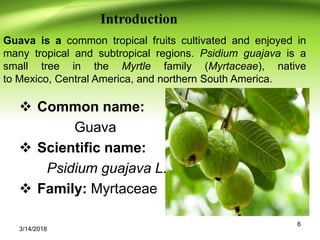
Guava is a common tropical fruits cultivated and enjoyed in
many tropical and subtropical regions. Psidium guajava is a
small tree in the Myrtle family (Myrtaceae), native
to Mexico, Central America, and northern South America.
Growing areas in Bangladesh
• In Bangladesh, it is grown in all the
areas but specially ,
 Themajor guava growing areas are-
• Barisal,Pabna,Dhaka,Rajshahi,Chittagong,
& Khulna.
3/14/2018 7
Economic Importance
• The fruit is a good source of vitamin C, pectin, calcium and
phosphorus.
• The fruit is used for the preparation of processed products like
jams, jellies and nectar.
• Guava jelly puree is very popular for its attractive purplish-red
colour, pleasant taste and aroma.
• Good quality salad can be prepared from the shell (with or without
seed core )of ripe fruits.
• Leaves of guava are used for curing diarrhea and also for dyeing
and tanning.
3/14/2018 8
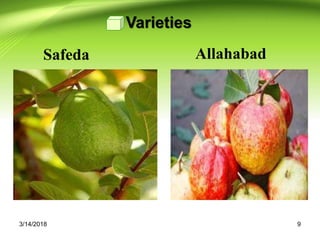
Allahabad
3/14/2018 9
Safeda
Varieties
3/14/2018 10
3/14/2018
11
Commercial Varieties
 Mainly three types of guava are cultivated
commercially.
 Kazi Peara (guava)
 Bari Peara (BARI, 2003)
 Thai peara
3/14/2018 12
Kazi Peara
Thai peara
3/14/2018 13
Cont…….
Bari Peara
3/14/2018 14
Climate Requirement
• Guava grown under tropical and subtropical climatic
zones.
• young plants are susceptible to drought and cold
conditions.
• In areas with distinct winter season, the yield tends
to increase and quality improves.
• High temperature at the time of fruit development
can cause fruit drop.
3/14/2018 15
Soil Requirements
Well drained, deep loamy ,friable soils are best
for guava cultivation.
It can be grown in wide range of soils from
heavy clay to very sandy in nature.
River basins are very well suited for growing
Guava fruits
Ideal Soil pH-4.5 to 7.0
Avoid water logging conditions as it can cause
the root rot.
3/14/2018 16
3/14/2018 17
Propagation
Soaking of seeds in water for 12 hours gives about
90 per cent germination. Time of guava propagation
is Feb-March and July-August. Guava can also be
successfully propagated generally through –
 Cuttings
Air layering
Grafting
Budding
Land preparation
• Land should be deeply ploughed, harrowed &
leveled before planting.
• Make sure to bring the soil to fine tilth stage.
• Remove any weeds from previous crops & land
should be prepared in such a way that any
excess water should be drained out.
3/14/2018 18
Planting method
• Season of planting from June - December.
• Spacing 5 - 6m in either way is generally followed.
• Plant the layers with the ball of earth in the centre of
pit of 45 cm x 45 cm x 45 cm size filled with FYM
10 Kg, neem cake 1 Kg and top soil.
3/14/2018 19
Cont…
Guavatrees are planted at adistance of 5-6
meters.
Treesgrow rapidly and fruit in 2-4years.
Theylive 30-40 yearsbut productivitydeclines after
the 15thyear.
Guavasome time suffers from deficiency ofzinc and
iron.
Spraying the trees with 7.0 gm per litter of ZnSo4
and 46.5 gm of FeSo4improves yieldand quality.
3/14/2018 20
FYM Fertilizer requirement (g / tree)
Age of tree
(Year)
(Kg/tree) Urea
Diammonium
Phosphate
Muriate of
potash
1 5 55 35 15
2 10 115 70 35
3 15 170 105 50
4 20 225 140 65
5 25 345 170 85
6 30 415 205 100
7 35 565 240 115
8 & onwards 40 700 275 135
3/14/2018 21
Manuring and Fertilization
Note:- The fertilizer should be applied in two split doses i.e. 1st week of May for
rainy season crop and 1st week of July for winter season crop.
Although guava is grown without application of any manure and
fertilizer, it responds well in their application by giving higher yield and
better quality fruit.
Pruning Blossoming
Light annual pruning is necessaryafter every harvest.
 Guavaflowers twice ayear:
•1st in March to April for summercrop. 2nd in
August to September for winter.
. Blooming period varies from 25-45days.
Winter crop is usually preferred as it yields higher with
fruit of better quality.
Guavafruit takesabout 125 daysto reach maturity after
setting.
3/14/2018 22
Intercultural operations
• Irrigation: Guava is mostly grown under rainfed
conditions and irrigation is generally not practiced
but wherever the irrigation is available, it should be
given in summer and October/Novermber as it
enhances the yield of guava tree by increasing fruit
set.
• Intercropping of Guava: Guava orchards may be
intercropped with short growing leguminous crops
like mash, moong, guar and vegetables.
3/14/2018 23
Cont..
• Aftercare of Guava
• Pre-harvest spray of calcium nitrate (2%) two weeks
before harvest improve quality at the time of harvest of
guava, whereas, the spray of 150 ppm silver nitrate at 5
weeks before harvest and another spray at three weeks
after first spray increases the shelf life of guava
satisfactorily upto 6 days at room temperature.
• GA, 90 ppm, sprayed 30 days before harvest improves the
fruit quality at harvest and also increases the shelf life of
guava.
3/14/2018 24
Harvesting & Yield
At maturity fruit turns from greento oil green andat
ripening creamyincolour.
Hand picking of ripened fruits two to three times a week is
suggested.
 Theharvestingseasonmanylast 8-10weeks.
• Grafted plants come into bearing at the age of 3 years and
peak harvesting periods are August-September for rainy
season crop and Jan-Feb. for winter season crop.
• Guava develops best flavour and aroma only when they ripe
on tree. A ten year old guava tree gives a yield, up to 100 kg
of fruit.
• Fruit is highly perishable, it should be immediately marketer after
harvest. 3/14/2018
25
Post Harvest Management
Grading-Fruits are graded on the basis of their weight, size and colour.
Storage-The fresh fruit has a short shelf life and distant marketing can
be done only if it is properly stored.
Packing-The fruits are packed in baskets made from locally available
plant material.
Marketing-Majority of the cultivation sell their produce either through
trade agents at village level or commission agents at the market.
Transportation-Road transport by trucks / lorries is the most
convenient mode of transport due to easy approach from orchards to
the market.
3/14/2018 26
Common Pests & Diseases
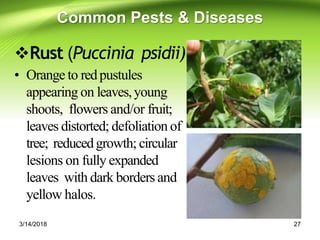
Rust (Puccinia psidii)
• Orange to redpustules
appearing on leaves,young
shoots, flowers and/or fruit;
leaves distorted; defoliation of
tree; reducedgrowth; circular
lesions on fully expanded
leaves with dark borders and
yellow halos.
3/14/2018 27
Primary method of controlling diseaseis usually
the applicationof appropriate fungicides.
Cultural practices that mayreduce the incidence
of thedisease.
3/14/2018 28
Management
Cont..
Anthracnose ( Colletotrichumgloeosporoides)
Sunken,dark colored lesions on maturefruit which
maybecomecovered in pinkspores.
lesions coalesceto form large necroticpatches on
surfaceof fruit.
3/14/2018 29
Management
The primary method of controlling the diseaseisto
plant resistantguava cultivars.
Both systemicandnon-systemic fungicidesareeffective
atcontrolling the disease.
3/14/2018 30
Algal leaf spot (Cephaleuros virescens)
• Orange,rust-colored,dense,silky tufts on both upper
& lower surfaces of leaves which turn reddish-
purple in color as they mature.
• If tufts are scraped away, a thin gray-white or
dark-colored necrotic spot remains on the leaf.
3/14/2018 31
Management
Ensuretrees receive adequatefertilization, irrigation
and and are properly pruned to avoid stresson the
plants and promote air circulation through the
canopy.
Periodic applications of acopper based fungicide is
usually enough to controlthe disease
3/14/2018 32
Fruit Rot (Phyotophthora nicotianae)
Symptoms Management
The disease starts at the styler end.
Whitish cottony mass develops very fast
as the fruit starts ripening and covers the
entire fruit surface in few days. Humid
weather favours the disease. The diseased
fruit drops from the tree.
Spray the tree with
combination of fungicides
metalaxyl + mancozeb (250
g/100 L water) or metalaxyl
(100 g/100 L water) or
fosetyl-al (300g/100 L water)
as soon as the disease is
observed, repeat sprays at 15
days interval.
3/14/2018 33
Cont..
3/14/2018 34
Fruit Fly (Bactrocera dorsalis)
Guava Pests Management
Fruit flies deposit eggs in
soft skin of ripening guava
fruits. After hatching the
maggots feed on the soft
pulp as a result fruits start
rotting and fall on the
ground.
i) Harvest fruits when they
are still hard.
ii) Collect and destroy all
fallen fruits.
iii) Apply bait sprays in
July-August at 10-15 days
intervals (malathion50 EC
200 ml and gur 1 kg in 100
L water).
3/14/2018 35
Cont..
3/14/2018 36
Fruit Borers (Virachola Isocrates)
Pest Management
Larvae bore into the fruit
and feed on the pulp of the
fruit.
Spray dimethoate 30 EC
(0.03%) at marble stage of
the fruit followed by
2ndspray at 4 weeks
interval.
3/14/2018 37
Uses
Guava fruits may be eaten fresh or processed to
produce paste ,jellies or preserves.
• Dehydrate fruit is used to make guava
powder
3/14/2018 38
Conclusion
• Guava is useful in food and many other
commercial and industrial applications. Guava
fruit is not only a rich source of vitamins but
also a good source of minerals. The
preservation of fruits especially guava is the
pre requisite for the economical and efficient
utilization of this perishable commodity in
Bangladesh.
3/13/2018 39
3/13/2018 40
3/13/2018 41

Production Technology of Guava

  • 1.
  • 2.
    About Ourselves 3/14/2018 2 RiponKumar Mondal 15109049 Sumaya Shemu 15109014 Abdul Hadi 15109005 Denesh Tanchangaya 15109033 Sazib Akan 15109040
  • 3.
  • 4.
  • 5.
    Outline..  Introduction  Growingareas in Bangladesh  Economic Importance  Varieties  Climate Requirement  Land preparation Planting method Manuring and Fertilization Intercultural operations Harvesting & Yield Post Harvest Management Common Pests & Diseases Management Uses  Conclusion 3/14/2018 5
  • 6.
    Introduction  Common name: Guava Scientific name: Psidium guajava L.  Family: Myrtaceae 3/14/2018 6 Guava is a common tropical fruits cultivated and enjoyed in many tropical and subtropical regions. Psidium guajava is a small tree in the Myrtle family (Myrtaceae), native to Mexico, Central America, and northern South America.
  • 7.
    Growing areas inBangladesh • In Bangladesh, it is grown in all the areas but specially ,  Themajor guava growing areas are- • Barisal,Pabna,Dhaka,Rajshahi,Chittagong, & Khulna. 3/14/2018 7
  • 8.
    Economic Importance • Thefruit is a good source of vitamin C, pectin, calcium and phosphorus. • The fruit is used for the preparation of processed products like jams, jellies and nectar. • Guava jelly puree is very popular for its attractive purplish-red colour, pleasant taste and aroma. • Good quality salad can be prepared from the shell (with or without seed core )of ripe fruits. • Leaves of guava are used for curing diarrhea and also for dyeing and tanning. 3/14/2018 8
  • 9.
  • 10.
  • 11.
  • 12.
    Commercial Varieties  Mainlythree types of guava are cultivated commercially.  Kazi Peara (guava)  Bari Peara (BARI, 2003)  Thai peara 3/14/2018 12 Kazi Peara
  • 13.
  • 14.
  • 15.
    Climate Requirement • Guavagrown under tropical and subtropical climatic zones. • young plants are susceptible to drought and cold conditions. • In areas with distinct winter season, the yield tends to increase and quality improves. • High temperature at the time of fruit development can cause fruit drop. 3/14/2018 15
  • 16.
    Soil Requirements Well drained,deep loamy ,friable soils are best for guava cultivation. It can be grown in wide range of soils from heavy clay to very sandy in nature. River basins are very well suited for growing Guava fruits Ideal Soil pH-4.5 to 7.0 Avoid water logging conditions as it can cause the root rot. 3/14/2018 16
  • 17.
    3/14/2018 17 Propagation Soaking ofseeds in water for 12 hours gives about 90 per cent germination. Time of guava propagation is Feb-March and July-August. Guava can also be successfully propagated generally through –  Cuttings Air layering Grafting Budding
  • 18.
    Land preparation • Landshould be deeply ploughed, harrowed & leveled before planting. • Make sure to bring the soil to fine tilth stage. • Remove any weeds from previous crops & land should be prepared in such a way that any excess water should be drained out. 3/14/2018 18
  • 19.
    Planting method • Seasonof planting from June - December. • Spacing 5 - 6m in either way is generally followed. • Plant the layers with the ball of earth in the centre of pit of 45 cm x 45 cm x 45 cm size filled with FYM 10 Kg, neem cake 1 Kg and top soil. 3/14/2018 19
  • 20.
    Cont… Guavatrees are plantedat adistance of 5-6 meters. Treesgrow rapidly and fruit in 2-4years. Theylive 30-40 yearsbut productivitydeclines after the 15thyear. Guavasome time suffers from deficiency ofzinc and iron. Spraying the trees with 7.0 gm per litter of ZnSo4 and 46.5 gm of FeSo4improves yieldand quality. 3/14/2018 20
  • 21.
    FYM Fertilizer requirement(g / tree) Age of tree (Year) (Kg/tree) Urea Diammonium Phosphate Muriate of potash 1 5 55 35 15 2 10 115 70 35 3 15 170 105 50 4 20 225 140 65 5 25 345 170 85 6 30 415 205 100 7 35 565 240 115 8 & onwards 40 700 275 135 3/14/2018 21 Manuring and Fertilization Note:- The fertilizer should be applied in two split doses i.e. 1st week of May for rainy season crop and 1st week of July for winter season crop. Although guava is grown without application of any manure and fertilizer, it responds well in their application by giving higher yield and better quality fruit.
  • 22.
    Pruning Blossoming Light annualpruning is necessaryafter every harvest.  Guavaflowers twice ayear: •1st in March to April for summercrop. 2nd in August to September for winter. . Blooming period varies from 25-45days. Winter crop is usually preferred as it yields higher with fruit of better quality. Guavafruit takesabout 125 daysto reach maturity after setting. 3/14/2018 22
  • 23.
    Intercultural operations • Irrigation:Guava is mostly grown under rainfed conditions and irrigation is generally not practiced but wherever the irrigation is available, it should be given in summer and October/Novermber as it enhances the yield of guava tree by increasing fruit set. • Intercropping of Guava: Guava orchards may be intercropped with short growing leguminous crops like mash, moong, guar and vegetables. 3/14/2018 23
  • 24.
    Cont.. • Aftercare ofGuava • Pre-harvest spray of calcium nitrate (2%) two weeks before harvest improve quality at the time of harvest of guava, whereas, the spray of 150 ppm silver nitrate at 5 weeks before harvest and another spray at three weeks after first spray increases the shelf life of guava satisfactorily upto 6 days at room temperature. • GA, 90 ppm, sprayed 30 days before harvest improves the fruit quality at harvest and also increases the shelf life of guava. 3/14/2018 24
  • 25.
    Harvesting & Yield Atmaturity fruit turns from greento oil green andat ripening creamyincolour. Hand picking of ripened fruits two to three times a week is suggested.  Theharvestingseasonmanylast 8-10weeks. • Grafted plants come into bearing at the age of 3 years and peak harvesting periods are August-September for rainy season crop and Jan-Feb. for winter season crop. • Guava develops best flavour and aroma only when they ripe on tree. A ten year old guava tree gives a yield, up to 100 kg of fruit. • Fruit is highly perishable, it should be immediately marketer after harvest. 3/14/2018 25
  • 26.
    Post Harvest Management Grading-Fruitsare graded on the basis of their weight, size and colour. Storage-The fresh fruit has a short shelf life and distant marketing can be done only if it is properly stored. Packing-The fruits are packed in baskets made from locally available plant material. Marketing-Majority of the cultivation sell their produce either through trade agents at village level or commission agents at the market. Transportation-Road transport by trucks / lorries is the most convenient mode of transport due to easy approach from orchards to the market. 3/14/2018 26
  • 27.
    Common Pests &Diseases Rust (Puccinia psidii) • Orange to redpustules appearing on leaves,young shoots, flowers and/or fruit; leaves distorted; defoliation of tree; reducedgrowth; circular lesions on fully expanded leaves with dark borders and yellow halos. 3/14/2018 27
  • 28.
    Primary method ofcontrolling diseaseis usually the applicationof appropriate fungicides. Cultural practices that mayreduce the incidence of thedisease. 3/14/2018 28 Management
  • 29.
    Cont.. Anthracnose ( Colletotrichumgloeosporoides) Sunken,darkcolored lesions on maturefruit which maybecomecovered in pinkspores. lesions coalesceto form large necroticpatches on surfaceof fruit. 3/14/2018 29
  • 30.
    Management The primary methodof controlling the diseaseisto plant resistantguava cultivars. Both systemicandnon-systemic fungicidesareeffective atcontrolling the disease. 3/14/2018 30
  • 31.
    Algal leaf spot(Cephaleuros virescens) • Orange,rust-colored,dense,silky tufts on both upper & lower surfaces of leaves which turn reddish- purple in color as they mature. • If tufts are scraped away, a thin gray-white or dark-colored necrotic spot remains on the leaf. 3/14/2018 31
  • 32.
    Management Ensuretrees receive adequatefertilization,irrigation and and are properly pruned to avoid stresson the plants and promote air circulation through the canopy. Periodic applications of acopper based fungicide is usually enough to controlthe disease 3/14/2018 32
  • 33.
    Fruit Rot (Phyotophthoranicotianae) Symptoms Management The disease starts at the styler end. Whitish cottony mass develops very fast as the fruit starts ripening and covers the entire fruit surface in few days. Humid weather favours the disease. The diseased fruit drops from the tree. Spray the tree with combination of fungicides metalaxyl + mancozeb (250 g/100 L water) or metalaxyl (100 g/100 L water) or fosetyl-al (300g/100 L water) as soon as the disease is observed, repeat sprays at 15 days interval. 3/14/2018 33
  • 34.
  • 35.
    Fruit Fly (Bactroceradorsalis) Guava Pests Management Fruit flies deposit eggs in soft skin of ripening guava fruits. After hatching the maggots feed on the soft pulp as a result fruits start rotting and fall on the ground. i) Harvest fruits when they are still hard. ii) Collect and destroy all fallen fruits. iii) Apply bait sprays in July-August at 10-15 days intervals (malathion50 EC 200 ml and gur 1 kg in 100 L water). 3/14/2018 35
  • 36.
  • 37.
    Fruit Borers (ViracholaIsocrates) Pest Management Larvae bore into the fruit and feed on the pulp of the fruit. Spray dimethoate 30 EC (0.03%) at marble stage of the fruit followed by 2ndspray at 4 weeks interval. 3/14/2018 37
  • 38.
    Uses Guava fruits maybe eaten fresh or processed to produce paste ,jellies or preserves. • Dehydrate fruit is used to make guava powder 3/14/2018 38
  • 39.
    Conclusion • Guava isuseful in food and many other commercial and industrial applications. Guava fruit is not only a rich source of vitamins but also a good source of minerals. The preservation of fruits especially guava is the pre requisite for the economical and efficient utilization of this perishable commodity in Bangladesh. 3/13/2018 39
  • 40.
  • 41.