Intoduction
 Family: Passifloraceae
 Origin : Brazil
 Distribution in india: Parts of Western
Ghat such as Nilgiris, Wayanad,
Kodaikanal, Shevroys, Coorg and Malabar
Himachal Pradesh
North Eastern States like Manipur,
Nagaland and Mizoram
PURPLE PASSION FRUIT
 Passiflora edulis
 Vines are productive at
higher elevations.
 Fruits are 4-5 cm in
diameter, deep purple
when ripe each weighing
35-45 g.
 The juice content varies
from 31-35 per cent.
 The variety is known for its quality in terms of
flavour and nutrient content.
 Seeds are black in colour.
 The varieties are susceptible to leaf spot, collar
rot, attack by thrips and nematodes.
YELLOW PASSION FRUIT
 Passiflora edulis f. flavicarpa
 This variety is suitable for lower
elevations
 Highly vigorous than purple one
 The fruit is weighing about 60 g
round in shape with yellow
mottled spots, turns golden
yellow when ripe
 Juice is more acidic, its recovery being comparatively less
than the purple.
 Seeds are brown
 Tolerant to leaf spot and wilt, escapes the damage by thrips
and tolerant to nematodes.
Passiflora quadrangularis
-Giant granadilla
Oblong-ovoid fruit of
very large size (20-30
cm long and 12-15 cm
diameter)
Thick skin Greenish-
white to pale yellow
color
Whitish to yellowish
sweet acid arils having
mild flavor.
Passiflora ligularis
-Sweet granadilla
Passiflora mollissima
-Bananapassionfruit
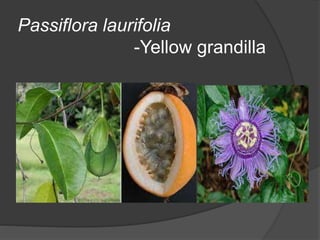
Passiflora laurifolia
-Yellow grandilla
Passiflora maliformis
-Sweet
calabash
Passiflora caerulea
-Blue passion fruit
Resistant to fusarium wilt and phytophthora stem
rot
Botany
 The passion fruit vine is shallow rooted,
woody, perennial, climbing by means of
tendrils
 A single fragrant pentamerous flower, 5 cm to
7.5 cm wide is borne at each node on the new
growth
 The fruits are nearly round to oval and has a
tough rind which is smooth and waxy
 The fruit has an aromatic mass of double
walled, membranous sacs filled with orange
coloured, pulpy juice and as many as 250
small, hard, dark brown or black seeds
Importance
 Fruit can be used as fresh fruit as it is delicious
and nutritious
 It is a rich source of Vitamin A and contains fair
amounts of Sodium, Magnesium, Sulphur and
Chlorides
 The fruit is used for producing a high quality
squash and flavouring several other products.
 To enhance the flavour of the final produce,
passion fruit juice is often mixed with juices of
pineapple, mango, ginger etc.
 The juice is extensively used in confectionery
and preparation of cakes, pies and ice cream
 The leaf of passion fruit is used as a vegetable
in the hills of North Eastern India
Cont….
 Boiled extract of fresh tender leaves is prescribed as a
remedy for diabetes, hypertension, diarrhoea, dysentry,
gastritis, abdominal flatulence and as a liver tonic
 The rinds of passion fruit have 2.4% pectin content
 The rind residue contains about 5-6 % protein and could
be used as a filler in poultry and stock feed
 The seeds yield 23 % oil which has edible as well as
industrial uses
 A glycoside, passiflorine, especially from P. incarnata
used as a sedative or tranquilizer
 Juice of Passion fruit is prescribed as a digestive
stimulant and treatment for gastric cancer
Climate
 Tropical to subtropical humid climate
 Grows well up to 2000 m altitude with an
annual rainfall of 1000 to 2500 mm
Yellow-lower altitude
purple-1000 to 2000 m
 The crop requires an optimum
temperature of 20° to 30°C
 Temperatures below 15°C restricts
vegetative growth and flowering
Soil
 It grows best in light sandy loam soils
with good drainage
 pH 6.0 -7.0 (5.5-7.5)
 Soil having sufficient quantity of
moisture, rich in organic matter
 Salt content should be low
 Cannot tolerate salinity and heavy or
shallow textured soil
 Varieties
 Purple gold, E-23, Black Beauty, Lacey,
 Hybrids
 Kaveri (purple x yellow) –High yielding
-Tolerant to wilt nematodes and collar rot
- by Central Horticulture Experimental Station,
Indian Institute of Horticulture Research, Chettalli,
Karnataka
 Tai Non NO.1 –From Japan
Propagation
Seed Propagation
 Seed extraction-Fermentation of pulp(72 hr) ,
washing, drying, storage at low temperature
for three months
 The seeds are sown in well prepared seed
beds during March-April
 The seedlings after attaining 4-6 leaves
stage are transplanted in 10 cm x 22 cm
polybags filled with a mixture of soil,
compost and sand (2:1:1)
 The seedlings will be ready for transplanting
in the main field in about three months
Cutting
 Semi-hardwood cuttings of about 20-30 cm
long with 2-3 nodes
 Thecuttingsare to befirst placedin sandbeds/pots
for root initiation andthen transferred to polybags
for better root development
 Therooted cuttingsare readyfor plantingin about
three months
Grafting
 Hedge or cleft grafting
 Rootstocks for P. edulis f. flavicarpa are
P. caerulea
P. cincinnata
Micrografting
 Commonly used for mass multiplication
of hybrids
 In vitro shoot tip grafting in modified MS
medium is successful in passion fruit
 Meristems from green house grown
plant were micrografted on in vitro
germinated seedlings
 After formation of two or more leaves
hardening is done
Micropropagation
 Leaf culture and internodal culture in MS
media
 Shoot regeneration from leaf derived
explant using BA and rhizogenesis with
NAA
 Shoot tip culture is successful in yellow
passion fruit
Planting
 Planting sites experiencing high winds should
be avoided
 Planting done in a pit of 45x45x45 cm
 The pits are filled with a mixture of three parts of
top soil and one part of compost
 Planting is done during May-June after onset of
monsoon
 Spacing – 2 to 4 X 2.5 to 5
 Kniffin system -2m x 3m, -1666 plants/ha
 In bower system - 3m x 3m -1110 plants/ha
 Turmeric and ginger could be grown as
intercrops
Manures and fertilizers
 Index leaves- Sixth leaf from apex and
leaf against the first open flower
 Leaf nutrient standards
N :4.25-5.25%
P :0.25-0.35%
K :2.0-2.5%
Ca :0.5-1.5%
Mg :0.25-0.35%
S :0.2-0.4%
Mn :50-200 ppm
Fe :100-200 ppm
Zn :45-80 ppm
 Nutrient recommendation
- N:P2O5 :K2O-1000:100:500 kg/ha/year
 Increased level of N promote only
vegetative growth
 Potassium enhance fruit yield
For organic crops
 FYM-1st year -10 kg/vine
2nd year onwards -15 kg/vine
 FYM + vermicompost - 3-4:1 in Feb-March
Training
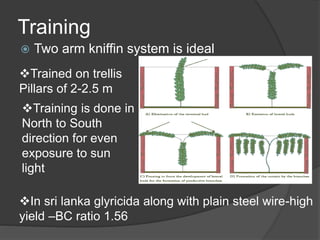
 Two arm kniffin system is ideal
Trained on trellis
Pillars of 2-2.5 m
Training is done in
North to South
direction for even
exposure to sun
light
In sri lanka glyricida along with plain steel wire-high
yield –BC ratio 1.56
Pruning
 Pruning done in late winter when plant is
dormant
 Dead ,weak and diseased branches are
removed
 Shorten the strong cane by 1/3rd to
encourage new growth of shoots
 In some areas after the harvest of the
crop, the laterals are cut back to 4-5
buds
Irrigation
 Water requirement -1300 to 1470 mm
for 40 t/ha productivity
 Irrigation done when rainfall is less and
poorly distributed
 Water requirement is high during fruit
development and maturity
 Drip irrigation system is widely adopted
by farmers
Weeding
 Hand weeding
 Weedicides- diuron 2-4 kg ai/ha
-oxyfluorfen 0.5-1.0 kg ai/ha
Growth and development
 Four stages of growth and development
1. Embryonic -10 to15 days
2. Juvanile -80±10 days(2 phyllotaxic turns)
3. Transition-3rd to 7th phyllotaxic turns
4. Adult phase –After 8th phyllotaxic turn
 Vegitative and reproductive phase are
continuous and simultaneous
Flowering
 Flowers form above 24th node
 Formed on leaf axils of new shoots
 protandrous
 Purple passion fruit- self pollinated
 Yellow passion fruit-self in compatible
 Pollinators -Carpenter Bee (Xylocopa sonorina)
and the honeybee (Apis millifera)
Fruiting
 Fruit set - 20-45%
 Single sigmoid growth pattern
 Maximum fruit size- 25-30 days
 Maturity -60-90 days(70-75 days peak)
(1-2 years from planting)
 Economic life span of 3-5 years
Harvesting and yield
 There are two major seasons of production,
June to August and November to January
 Immature fruits do not ripen properly after
harvest
 The fully mature fruit have the best flavour,
but a short shelf-life.
 Harvested when they are about three-quarters
yellow or purple
 Yield
Purple variety - 8-10 t/ha
Yellow variety – 7-10 t/ha
Hybrid Kaveri -16-20 t/ ha.
Post harvest management
 Grading –based on colour and size
 Packing- 8-10 kg cartons and in
polythene bag
Storage
 4-5 days at room temperature
 4-5 weeks at 5°C and 80-90% relative
humidity
Pests
 Mealy bug (Planococcus pacificus)
 Mites (Brevipus phoenicis)
 Fruit fly (Dacus tryoni)
 California Red Scale (Aonidiella aurantii)
 Barnacle scale (Ceroplastes cistudiformis)
 Snails
 Helicornia caterpillers
Diseases
 Brown spot - Alternaria macrospora
 Root Rot -Phytophthora nicotianae var.
parasitica
 Wilt - Fusarium oxysporum/ F.passiflorae
 Septoria spot-Septoria passiflorae
 Collor rot –Rhizoctonia solani
Viruses
 Chrysanthemum B carlavirus,
 Passiflora latent carlavirus
 Passiflora ringspot potyvirus
 Passionfruit woodiness potyvirus
 Purple granadilla mosaic virus
Physiological disorders
 Shrivel and fruit drop- moisture stress
 Pulp fermentation
 Chilling injury- Exposure of fruit to low
temperature(<5°C)
References
Passion fruit

Passion fruit

  • 2.
    Intoduction  Family: Passifloraceae Origin : Brazil  Distribution in india: Parts of Western Ghat such as Nilgiris, Wayanad, Kodaikanal, Shevroys, Coorg and Malabar Himachal Pradesh North Eastern States like Manipur, Nagaland and Mizoram
  • 3.
    PURPLE PASSION FRUIT Passiflora edulis  Vines are productive at higher elevations.  Fruits are 4-5 cm in diameter, deep purple when ripe each weighing 35-45 g.  The juice content varies from 31-35 per cent.  The variety is known for its quality in terms of flavour and nutrient content.  Seeds are black in colour.  The varieties are susceptible to leaf spot, collar rot, attack by thrips and nematodes.
  • 4.
    YELLOW PASSION FRUIT Passiflora edulis f. flavicarpa  This variety is suitable for lower elevations  Highly vigorous than purple one  The fruit is weighing about 60 g round in shape with yellow mottled spots, turns golden yellow when ripe  Juice is more acidic, its recovery being comparatively less than the purple.  Seeds are brown  Tolerant to leaf spot and wilt, escapes the damage by thrips and tolerant to nematodes.
  • 5.
    Passiflora quadrangularis -Giant granadilla Oblong-ovoidfruit of very large size (20-30 cm long and 12-15 cm diameter) Thick skin Greenish- white to pale yellow color Whitish to yellowish sweet acid arils having mild flavor.
  • 6.
  • 7.
  • 8.
  • 9.
  • 10.
    Passiflora caerulea -Blue passionfruit Resistant to fusarium wilt and phytophthora stem rot
  • 11.
    Botany  The passionfruit vine is shallow rooted, woody, perennial, climbing by means of tendrils  A single fragrant pentamerous flower, 5 cm to 7.5 cm wide is borne at each node on the new growth  The fruits are nearly round to oval and has a tough rind which is smooth and waxy  The fruit has an aromatic mass of double walled, membranous sacs filled with orange coloured, pulpy juice and as many as 250 small, hard, dark brown or black seeds
  • 12.
    Importance  Fruit canbe used as fresh fruit as it is delicious and nutritious  It is a rich source of Vitamin A and contains fair amounts of Sodium, Magnesium, Sulphur and Chlorides  The fruit is used for producing a high quality squash and flavouring several other products.  To enhance the flavour of the final produce, passion fruit juice is often mixed with juices of pineapple, mango, ginger etc.  The juice is extensively used in confectionery and preparation of cakes, pies and ice cream  The leaf of passion fruit is used as a vegetable in the hills of North Eastern India
  • 13.
    Cont….  Boiled extractof fresh tender leaves is prescribed as a remedy for diabetes, hypertension, diarrhoea, dysentry, gastritis, abdominal flatulence and as a liver tonic  The rinds of passion fruit have 2.4% pectin content  The rind residue contains about 5-6 % protein and could be used as a filler in poultry and stock feed  The seeds yield 23 % oil which has edible as well as industrial uses  A glycoside, passiflorine, especially from P. incarnata used as a sedative or tranquilizer  Juice of Passion fruit is prescribed as a digestive stimulant and treatment for gastric cancer
  • 15.
    Climate  Tropical tosubtropical humid climate  Grows well up to 2000 m altitude with an annual rainfall of 1000 to 2500 mm Yellow-lower altitude purple-1000 to 2000 m  The crop requires an optimum temperature of 20° to 30°C  Temperatures below 15°C restricts vegetative growth and flowering
  • 16.
    Soil  It growsbest in light sandy loam soils with good drainage  pH 6.0 -7.0 (5.5-7.5)  Soil having sufficient quantity of moisture, rich in organic matter  Salt content should be low  Cannot tolerate salinity and heavy or shallow textured soil
  • 17.
     Varieties  Purplegold, E-23, Black Beauty, Lacey,  Hybrids  Kaveri (purple x yellow) –High yielding -Tolerant to wilt nematodes and collar rot - by Central Horticulture Experimental Station, Indian Institute of Horticulture Research, Chettalli, Karnataka  Tai Non NO.1 –From Japan
  • 18.
    Propagation Seed Propagation  Seedextraction-Fermentation of pulp(72 hr) , washing, drying, storage at low temperature for three months  The seeds are sown in well prepared seed beds during March-April  The seedlings after attaining 4-6 leaves stage are transplanted in 10 cm x 22 cm polybags filled with a mixture of soil, compost and sand (2:1:1)  The seedlings will be ready for transplanting in the main field in about three months
  • 19.
    Cutting  Semi-hardwood cuttingsof about 20-30 cm long with 2-3 nodes  Thecuttingsare to befirst placedin sandbeds/pots for root initiation andthen transferred to polybags for better root development  Therooted cuttingsare readyfor plantingin about three months
  • 20.
    Grafting  Hedge orcleft grafting  Rootstocks for P. edulis f. flavicarpa are P. caerulea P. cincinnata
  • 21.
    Micrografting  Commonly usedfor mass multiplication of hybrids  In vitro shoot tip grafting in modified MS medium is successful in passion fruit  Meristems from green house grown plant were micrografted on in vitro germinated seedlings  After formation of two or more leaves hardening is done
  • 22.
    Micropropagation  Leaf cultureand internodal culture in MS media  Shoot regeneration from leaf derived explant using BA and rhizogenesis with NAA  Shoot tip culture is successful in yellow passion fruit
  • 23.
    Planting  Planting sitesexperiencing high winds should be avoided  Planting done in a pit of 45x45x45 cm  The pits are filled with a mixture of three parts of top soil and one part of compost  Planting is done during May-June after onset of monsoon  Spacing – 2 to 4 X 2.5 to 5  Kniffin system -2m x 3m, -1666 plants/ha  In bower system - 3m x 3m -1110 plants/ha  Turmeric and ginger could be grown as intercrops
  • 24.
    Manures and fertilizers Index leaves- Sixth leaf from apex and leaf against the first open flower  Leaf nutrient standards N :4.25-5.25% P :0.25-0.35% K :2.0-2.5% Ca :0.5-1.5% Mg :0.25-0.35% S :0.2-0.4% Mn :50-200 ppm Fe :100-200 ppm Zn :45-80 ppm
  • 25.
     Nutrient recommendation -N:P2O5 :K2O-1000:100:500 kg/ha/year  Increased level of N promote only vegetative growth  Potassium enhance fruit yield For organic crops  FYM-1st year -10 kg/vine 2nd year onwards -15 kg/vine  FYM + vermicompost - 3-4:1 in Feb-March
  • 26.
    Training  Two armkniffin system is ideal Trained on trellis Pillars of 2-2.5 m Training is done in North to South direction for even exposure to sun light In sri lanka glyricida along with plain steel wire-high yield –BC ratio 1.56
  • 27.
    Pruning  Pruning donein late winter when plant is dormant  Dead ,weak and diseased branches are removed  Shorten the strong cane by 1/3rd to encourage new growth of shoots  In some areas after the harvest of the crop, the laterals are cut back to 4-5 buds
  • 28.
    Irrigation  Water requirement-1300 to 1470 mm for 40 t/ha productivity  Irrigation done when rainfall is less and poorly distributed  Water requirement is high during fruit development and maturity  Drip irrigation system is widely adopted by farmers
  • 29.
    Weeding  Hand weeding Weedicides- diuron 2-4 kg ai/ha -oxyfluorfen 0.5-1.0 kg ai/ha
  • 30.
    Growth and development Four stages of growth and development 1. Embryonic -10 to15 days 2. Juvanile -80±10 days(2 phyllotaxic turns) 3. Transition-3rd to 7th phyllotaxic turns 4. Adult phase –After 8th phyllotaxic turn  Vegitative and reproductive phase are continuous and simultaneous
  • 31.
    Flowering  Flowers formabove 24th node  Formed on leaf axils of new shoots  protandrous  Purple passion fruit- self pollinated  Yellow passion fruit-self in compatible  Pollinators -Carpenter Bee (Xylocopa sonorina) and the honeybee (Apis millifera)
  • 32.
    Fruiting  Fruit set- 20-45%  Single sigmoid growth pattern  Maximum fruit size- 25-30 days  Maturity -60-90 days(70-75 days peak) (1-2 years from planting)  Economic life span of 3-5 years
  • 33.
    Harvesting and yield There are two major seasons of production, June to August and November to January  Immature fruits do not ripen properly after harvest  The fully mature fruit have the best flavour, but a short shelf-life.  Harvested when they are about three-quarters yellow or purple  Yield Purple variety - 8-10 t/ha Yellow variety – 7-10 t/ha Hybrid Kaveri -16-20 t/ ha.
  • 34.
    Post harvest management Grading –based on colour and size  Packing- 8-10 kg cartons and in polythene bag Storage  4-5 days at room temperature  4-5 weeks at 5°C and 80-90% relative humidity
  • 35.
    Pests  Mealy bug(Planococcus pacificus)  Mites (Brevipus phoenicis)  Fruit fly (Dacus tryoni)  California Red Scale (Aonidiella aurantii)  Barnacle scale (Ceroplastes cistudiformis)  Snails  Helicornia caterpillers
  • 36.
    Diseases  Brown spot- Alternaria macrospora  Root Rot -Phytophthora nicotianae var. parasitica  Wilt - Fusarium oxysporum/ F.passiflorae  Septoria spot-Septoria passiflorae  Collor rot –Rhizoctonia solani
  • 37.
    Viruses  Chrysanthemum Bcarlavirus,  Passiflora latent carlavirus  Passiflora ringspot potyvirus  Passionfruit woodiness potyvirus  Purple granadilla mosaic virus
  • 38.
    Physiological disorders  Shriveland fruit drop- moisture stress  Pulp fermentation  Chilling injury- Exposure of fruit to low temperature(<5°C)
  • 39.

Editor's Notes

  • #3 Family passifloraceae includes 12 genera and about 550 species Genus passiflora contains 400 species
  • #13 The fruit is valued for its pronounced flavour and aroma which helps not only in producing a high quality squash but also in flavouring several other products.
  • #14 . Italian chemists extracted passiflorine from the air-dried leaves.
  • #25 Nutrient requirement of crop can be determined by soil analyses and leaf analyses
  • #31 One phyllo taxic turns nearly includes 5 leaves
  • #34 . Immature fruits do not ripen properly after harvest.  The fully mature fruit have the best flavour, but a short shelf-life.