Cloud
Computing
Presented by –
Ritul Chaudhary
Contents
Overview
History
IBM SmartCloud (or IBM Cloud)
Public, private and hybrid cloud models
Competitors
IBM cloud computing is a set of cloud computing
services for business offered by the information
technology company IBM. IBM cloud includes
infrastructure as a service (IaaS), software as a
service (SaaS) and platform as a service (PaaS) offered
through public, private and hybrid cloud delivery
models, in addition to the components that make up those
clouds.
Overview
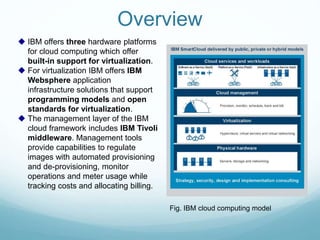
Fig. IBM cloud computing model
 IBM offers three hardware platforms
for cloud computing which offer
built-in support for virtualization.
 For virtualization IBM offers IBM
Websphere application
infrastructure solutions that support
programming models and open
standards for virtualization.
 The management layer of the IBM
cloud framework includes IBM Tivoli
middleware. Management tools
provide capabilities to regulate
images with automated provisioning
and de-provisioning, monitor
operations and meter usage while
tracking costs and allocating billing.
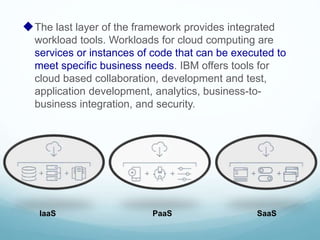
The last layer of the framework provides integrated
workload tools. Workloads for cloud computing are
services or instances of code that can be executed to
meet specific business needs. IBM offers tools for
cloud based collaboration, development and test,
application development, analytics, business-to-
business integration, and security.
IaaS PaaS SaaS
History
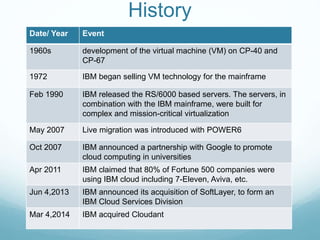
Date/ Year Event
1960s development of the virtual machine (VM) on CP-40 and
CP-67
1972 IBM began selling VM technology for the mainframe
Feb 1990 IBM released the RS/6000 based servers. The servers, in
combination with the IBM mainframe, were built for
complex and mission-critical virtualization
May 2007 Live migration was introduced with POWER6
Oct 2007 IBM announced a partnership with Google to promote
cloud computing in universities
Apr 2011 IBM claimed that 80% of Fortune 500 companies were
using IBM cloud including 7-Eleven, Aviva, etc.
Jun 4,2013 IBM announced its acquisition of SoftLayer, to form an
IBM Cloud Services Division
Mar 4,2014 IBM acquired Cloudant
IBM SmartCloud
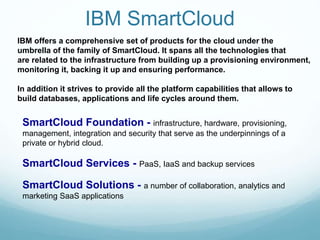
SmartCloud Foundation - infrastructure, hardware, provisioning,
management, integration and security that serve as the underpinnings of a
private or hybrid cloud.
SmartCloud Services - PaaS, IaaS and backup services
SmartCloud Solutions - a number of collaboration, analytics and
marketing SaaS applications
IBM offers a comprehensive set of products for the cloud under the
umbrella of the family of SmartCloud. It spans all the technologies that
are related to the infrastructure from building up a provisioning environment,
monitoring it, backing it up and ensuring performance.
In addition it strives to provide all the platform capabilities that allows to
build databases, applications and life cycles around them.
IBM also builds cloud environments for clients that are not
necessarily on the SmartCloud Platform.
 For eg., features of Tivoli management software can be
integrated separately as part of a non-IBM cloud platform
IBM SmartCloud Enterprise and SmartCloud Enterprise+
compete with products like those of Rackspace and
Amazon Web Services (AWS).
In 2011, IBM SmartCloud integrated Hadoop-based
InfoSphere BigInsights for big data, Green Hat for
software testing and Nirvanix for cloud storage.
By 2014, the name SmartCloud was replaced with products
that have a prefix of IBM Cloud. For eg. a product called
IBM Cloud Manager with OpenStack was IBM's integration
of OpenStack
IBM’s Cloud provision models
Private cloud, owned and operated by the customer
Private cloud, owned by the customer, but operated by
IBM (or another provider)
Private cloud, owned and operated by IBM (or another
provider)
Virtual private cloud services (based on multi-tenanted
support for individual enterprises)
Public cloud services (based on the provision of
functions to individuals)
The majority of cloud users choose a hybrid cloud model,
with some workloads being served by internal systems,
some from commercial cloud providers and some from
public cloud service providers.
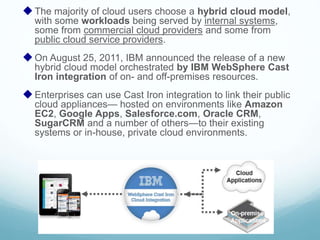
On August 25, 2011, IBM announced the release of a new
hybrid cloud model orchestrated by IBM WebSphere Cast
Iron integration of on- and off-premises resources.
Enterprises can use Cast Iron integration to link their public
cloud appliances— hosted on environments like Amazon
EC2, Google Apps, Salesforce.com, Oracle CRM,
SugarCRM and a number of others—to their existing
systems or in-house, private cloud environments.
The IBM public cloud offering, SmartCloud
Enterprise, was launched on April 7, 2011.
SCE is hosted IaaS with service level
agreements (SLA)s, and can be offered in a
private, public or hybrid model. The environment is
hosted on IBM servers (System p or System x),
with a standard set of software images to choose
from.
For building strictly private clouds, IBM offers IBM
Workload Deployer and Cloudburst as ready-to-
deploy, “cloud in a box” style solutions.
Workload Deployer connects an enterprise’s existing
servers to virtualization components and
middleware in order to help deploy standardized
virtual machines designed by IBM.
Cloudburst provides blade servers, middleware and
virtualization for an enterprise to build its own cloud-
ready virtual machines.
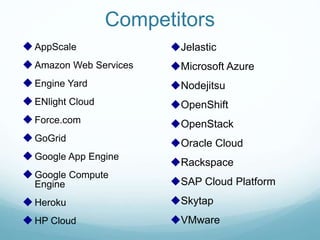
Competitors
AppScale
Amazon Web Services
Engine Yard
ENlight Cloud
Force.com
GoGrid
Google App Engine
Google Compute
Engine
Heroku
HP Cloud
Jelastic
Microsoft Azure
Nodejitsu
OpenShift
OpenStack
Oracle Cloud
Rackspace
SAP Cloud Platform
Skytap
VMware
References
https://en.wikipedia.org/wiki/IBM_cloud_computing
IBM Cloud Computing

IBM Cloud Computing

  • 1.
  • 2.
    Contents Overview History IBM SmartCloud (orIBM Cloud) Public, private and hybrid cloud models Competitors
  • 3.
    IBM cloud computingis a set of cloud computing services for business offered by the information technology company IBM. IBM cloud includes infrastructure as a service (IaaS), software as a service (SaaS) and platform as a service (PaaS) offered through public, private and hybrid cloud delivery models, in addition to the components that make up those clouds.
  • 4.
    Overview Fig. IBM cloudcomputing model  IBM offers three hardware platforms for cloud computing which offer built-in support for virtualization.  For virtualization IBM offers IBM Websphere application infrastructure solutions that support programming models and open standards for virtualization.  The management layer of the IBM cloud framework includes IBM Tivoli middleware. Management tools provide capabilities to regulate images with automated provisioning and de-provisioning, monitor operations and meter usage while tracking costs and allocating billing.
  • 5.
    The last layerof the framework provides integrated workload tools. Workloads for cloud computing are services or instances of code that can be executed to meet specific business needs. IBM offers tools for cloud based collaboration, development and test, application development, analytics, business-to- business integration, and security. IaaS PaaS SaaS
  • 6.
    History Date/ Year Event 1960sdevelopment of the virtual machine (VM) on CP-40 and CP-67 1972 IBM began selling VM technology for the mainframe Feb 1990 IBM released the RS/6000 based servers. The servers, in combination with the IBM mainframe, were built for complex and mission-critical virtualization May 2007 Live migration was introduced with POWER6 Oct 2007 IBM announced a partnership with Google to promote cloud computing in universities Apr 2011 IBM claimed that 80% of Fortune 500 companies were using IBM cloud including 7-Eleven, Aviva, etc. Jun 4,2013 IBM announced its acquisition of SoftLayer, to form an IBM Cloud Services Division Mar 4,2014 IBM acquired Cloudant
  • 7.
    IBM SmartCloud SmartCloud Foundation- infrastructure, hardware, provisioning, management, integration and security that serve as the underpinnings of a private or hybrid cloud. SmartCloud Services - PaaS, IaaS and backup services SmartCloud Solutions - a number of collaboration, analytics and marketing SaaS applications IBM offers a comprehensive set of products for the cloud under the umbrella of the family of SmartCloud. It spans all the technologies that are related to the infrastructure from building up a provisioning environment, monitoring it, backing it up and ensuring performance. In addition it strives to provide all the platform capabilities that allows to build databases, applications and life cycles around them.
  • 8.
    IBM also buildscloud environments for clients that are not necessarily on the SmartCloud Platform.  For eg., features of Tivoli management software can be integrated separately as part of a non-IBM cloud platform IBM SmartCloud Enterprise and SmartCloud Enterprise+ compete with products like those of Rackspace and Amazon Web Services (AWS). In 2011, IBM SmartCloud integrated Hadoop-based InfoSphere BigInsights for big data, Green Hat for software testing and Nirvanix for cloud storage. By 2014, the name SmartCloud was replaced with products that have a prefix of IBM Cloud. For eg. a product called IBM Cloud Manager with OpenStack was IBM's integration of OpenStack
  • 9.
    IBM’s Cloud provisionmodels Private cloud, owned and operated by the customer Private cloud, owned by the customer, but operated by IBM (or another provider) Private cloud, owned and operated by IBM (or another provider) Virtual private cloud services (based on multi-tenanted support for individual enterprises) Public cloud services (based on the provision of functions to individuals)
  • 10.
    The majority ofcloud users choose a hybrid cloud model, with some workloads being served by internal systems, some from commercial cloud providers and some from public cloud service providers. On August 25, 2011, IBM announced the release of a new hybrid cloud model orchestrated by IBM WebSphere Cast Iron integration of on- and off-premises resources. Enterprises can use Cast Iron integration to link their public cloud appliances— hosted on environments like Amazon EC2, Google Apps, Salesforce.com, Oracle CRM, SugarCRM and a number of others—to their existing systems or in-house, private cloud environments.
  • 11.
    The IBM publiccloud offering, SmartCloud Enterprise, was launched on April 7, 2011. SCE is hosted IaaS with service level agreements (SLA)s, and can be offered in a private, public or hybrid model. The environment is hosted on IBM servers (System p or System x), with a standard set of software images to choose from.
  • 12.
    For building strictlyprivate clouds, IBM offers IBM Workload Deployer and Cloudburst as ready-to- deploy, “cloud in a box” style solutions. Workload Deployer connects an enterprise’s existing servers to virtualization components and middleware in order to help deploy standardized virtual machines designed by IBM. Cloudburst provides blade servers, middleware and virtualization for an enterprise to build its own cloud- ready virtual machines.
  • 13.
    Competitors AppScale Amazon Web Services EngineYard ENlight Cloud Force.com GoGrid Google App Engine Google Compute Engine Heroku HP Cloud Jelastic Microsoft Azure Nodejitsu OpenShift OpenStack Oracle Cloud Rackspace SAP Cloud Platform Skytap VMware
  • 14.