Autonomous Vehicles
Introduction
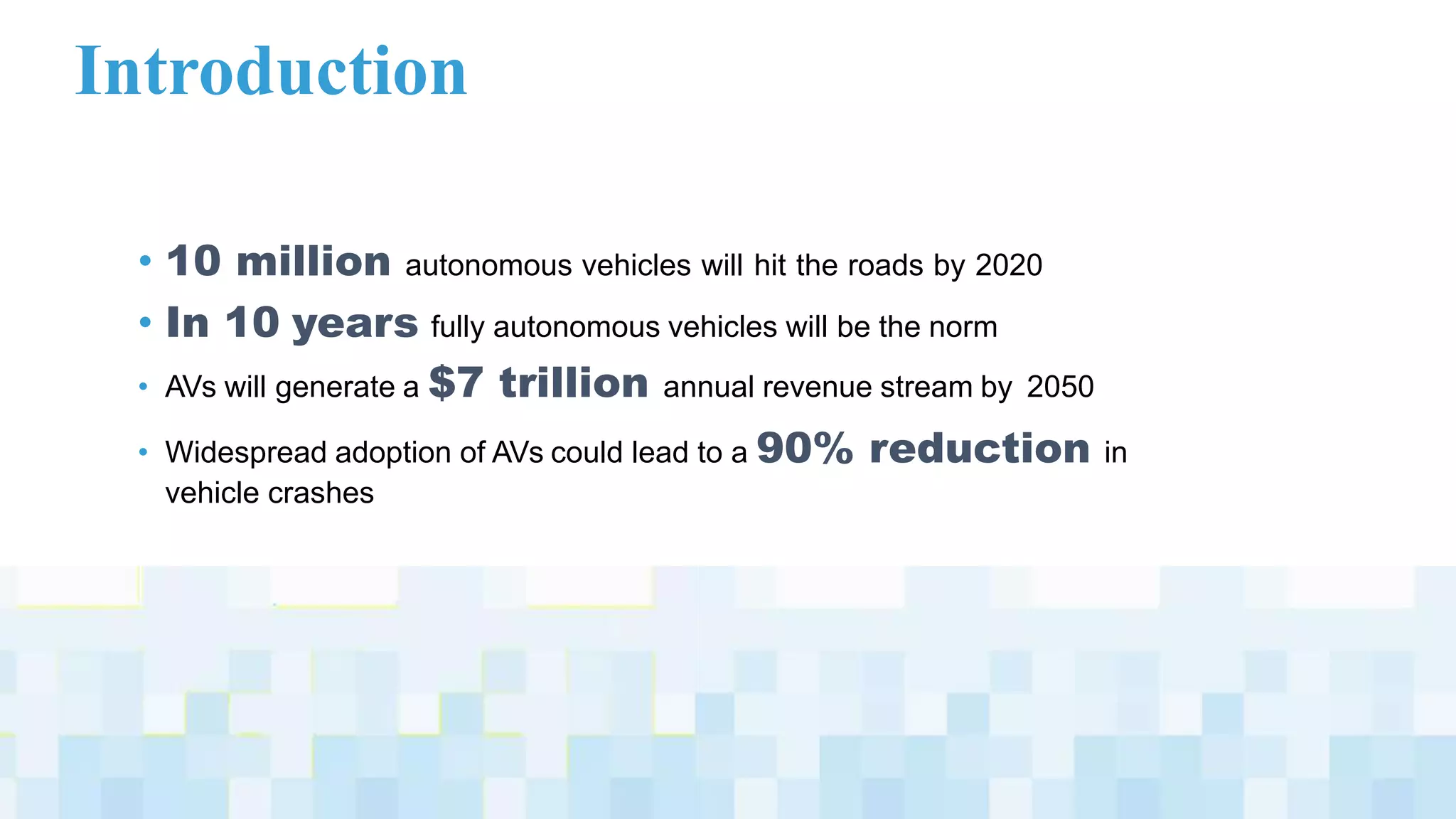
• 10 million autonomous vehicles will hit the roads by 2020
• In 10 years fully autonomous vehicles will be the norm
• AVs will generate a $7 trillion annual revenue stream by 2050
• Widespread adoption of AVs could lead to a 90% reduction in
vehicle crashes
Introduction
SAE Levels of Automation
History of Autonomous Vehicles
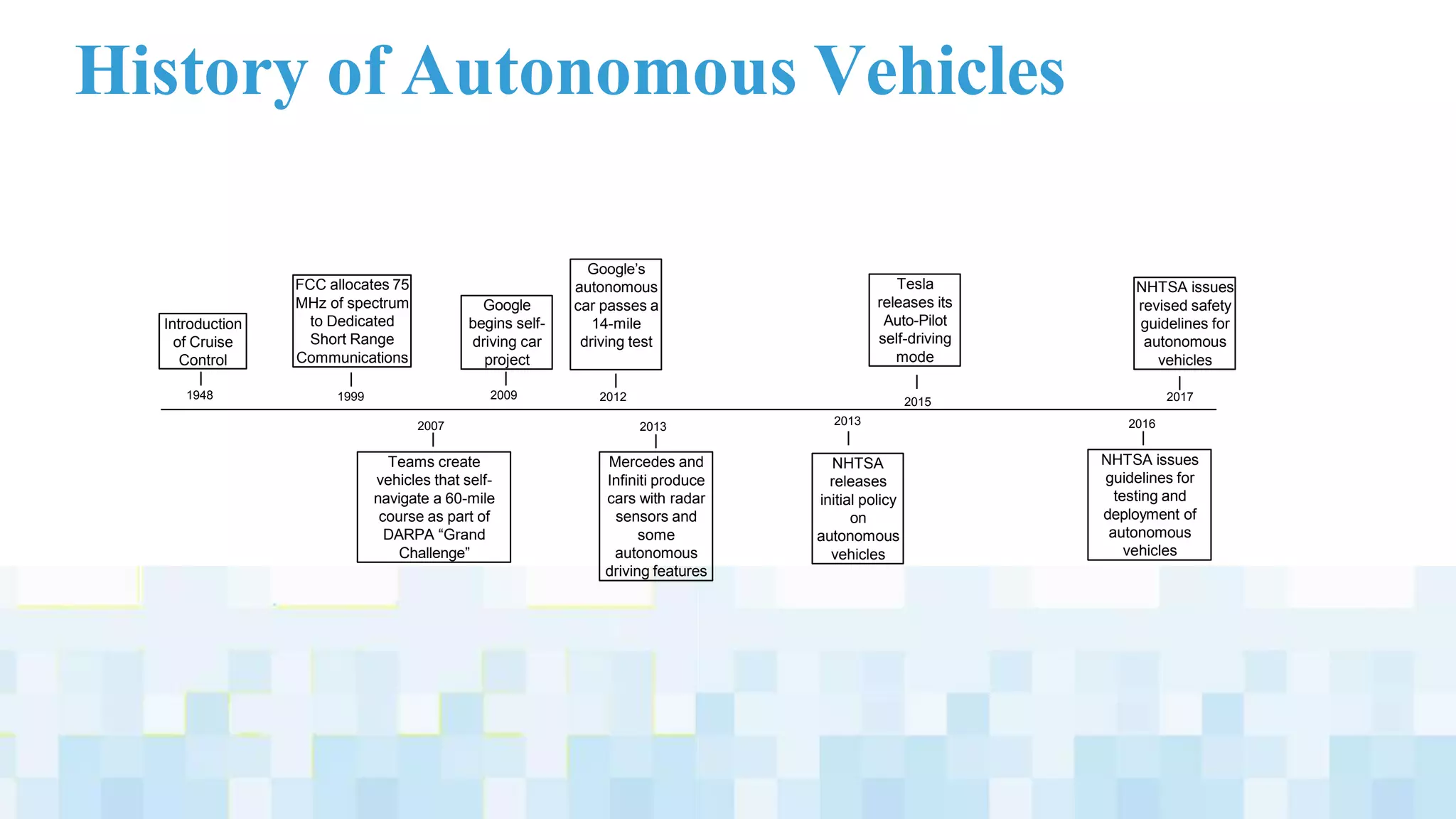
1999
FCC allocates 75
MHz of spectrum
to Dedicated
Short Range
Communications
Introduction
of Cruise
Control
1948
2007
Teams create
vehicles that self-
navigate a 60-mile
course as part of
DARPA “Grand
Challenge”
2009
Google
begins self-
driving car
project
2012
Google’s
autonomous
car passes a
14-mile
driving test
2013
Mercedes and
Infiniti produce
cars with radar
sensors and
some
autonomous
driving features
2013
NHTSA
releases
initial policy
on
autonomous
vehicles
2015
Tesla
releases its
Auto-Pilot
self-driving
mode
2017
NHTSA issues
revised safety
guidelines for
autonomous
vehicles
NHTSA issues
guidelines for
testing and
deployment of
autonomous
vehicles
2016
Basic Physical Ecosystem of an Autonomous Vehicle
• Global Positioning System (GPS)
• Light Detection and Ranging
(LIDAR)
• Cameras (Video)
• Ultrasonic Sensors
• Central Computer
• Radar Sensors
• Dedicated Short-Range
Communications-Based Receiver
(not pictured)
Source: The Economist, “How does a self-driving car work?”
Companies Investing in Autonomous Vehicles
44+
Vehicles operating in SAE levels of automation 1-3 are already in commercial use and
many companies are investing further in developing highly and fully automated vehicles
Strategic Partnerships
Legal Issues Around Autonomous Vehicles
• Regulations
• Liability
• Personal Injury
• Cybersecurity and data breaches
• Intellectual property ownership
Cybersecurity
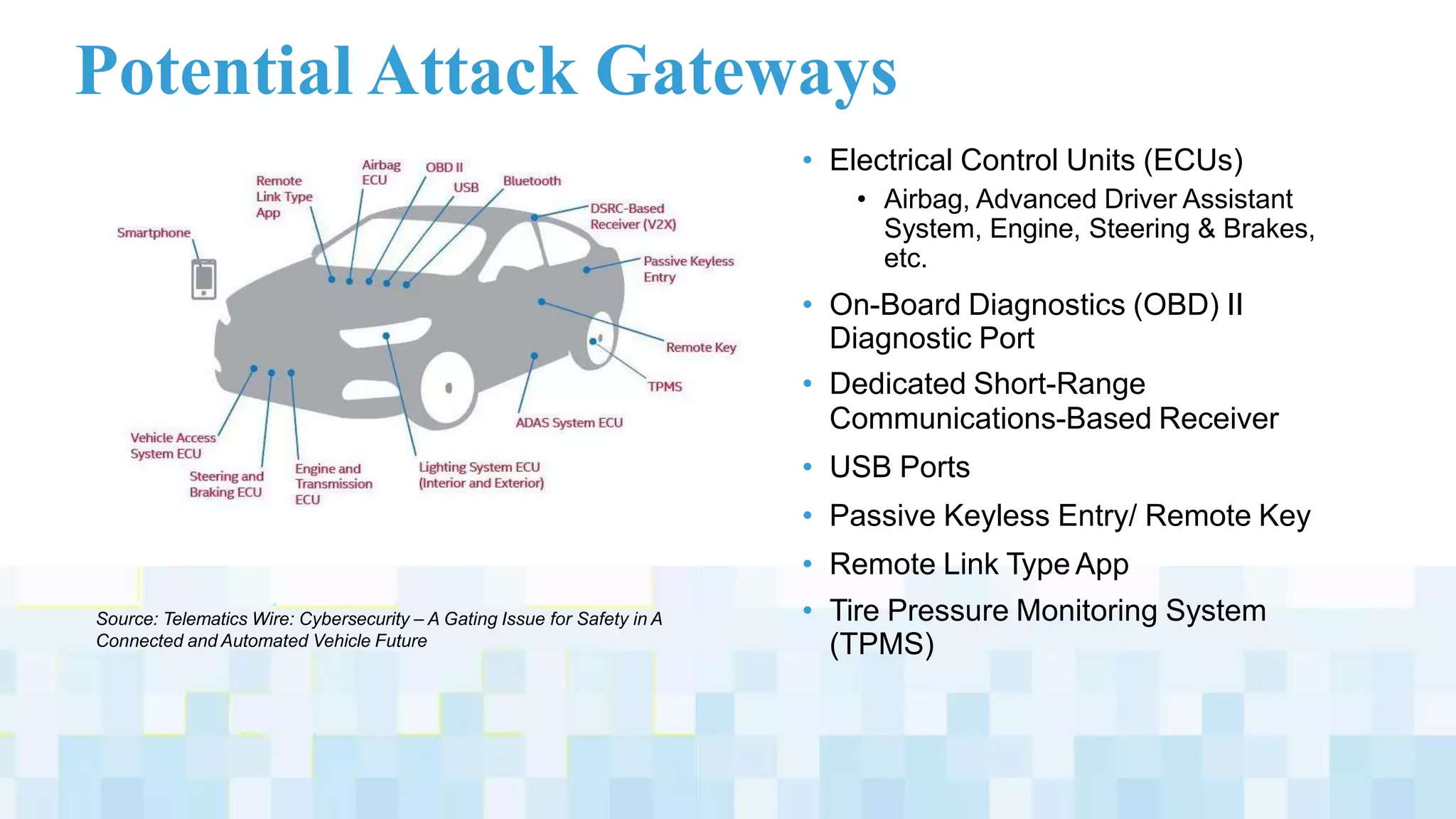
Potential Attack Gateways
• Electrical Control Units (ECUs)
• Airbag, Advanced Driver Assistant
System, Engine, Steering & Brakes,
etc.
• On-Board Diagnostics (OBD) II
Diagnostic Port
• Dedicated Short-Range
Communications-Based Receiver
• USB Ports
• Passive Keyless Entry/ Remote Key
• Remote Link Type App
• Tire Pressure Monitoring System
(TPMS)
Source: Telematics Wire: Cybersecurity – A Gating Issue for Safety in A
Connected and Automated Vehicle Future
Common Security Vulnerabilities
• Software Glitches – Connected vehicles today contain more than 100 million lines of
code. More code means more opportunity for bugs and mistakes.
• No Single Source of Knowledge of or Control Over Source Code – Software for
different components of connected vehicles is being written by different developers,
installed by different supplies, and no one source has knowledge of or control over the
source code.
• Increase Use of Apps Leave Vulnerabilities – Consumers are using an increasing
number of smartphone apps to interface with their connected cars and help run certain
functions. Researchers have already demonstrated weaknesses in some of these apps.
Likely to see spread in use of malware.
• Need for Constant Updates May be Overlooked – With the increased use of connected
features comes an increased need for continuous updates to fix glitches and help protect
vehicles. There is a risk these updates could be overlooked or that malicious actors could
infect routine updates.
Data Privacy
Multiple Players are Collecting Data from Multiple
Points Within Connected and Autonomous Vehicles
Protecting Intellectual
Property
Who Filed the Most Patents?
Automakers are the leaders in autonomous vehicle related patents
Who Owns the Most Patents?
• Toyota is the global leader in the number of autonomous vehicle patents with
more than 1,400 patents
• Google is the tech company with the most autonomous vehicle patents, but ranks
26th when compared to all companies with autonomous vehicle patents
Source: https://www.reuters.com/article/us-tech-ces-autos/automakers-not-silicon-valley-lead-in-
driverless-car-patents-study-idUSKBN0UJ1UD20160105; The 2016 State of Self-Driving Innovation,
Thomson Reuters.
Areas of Innovation
Source: Thomson Reuters 2016 State of Self-Driving Automotive Innovation
Areas of Innovation
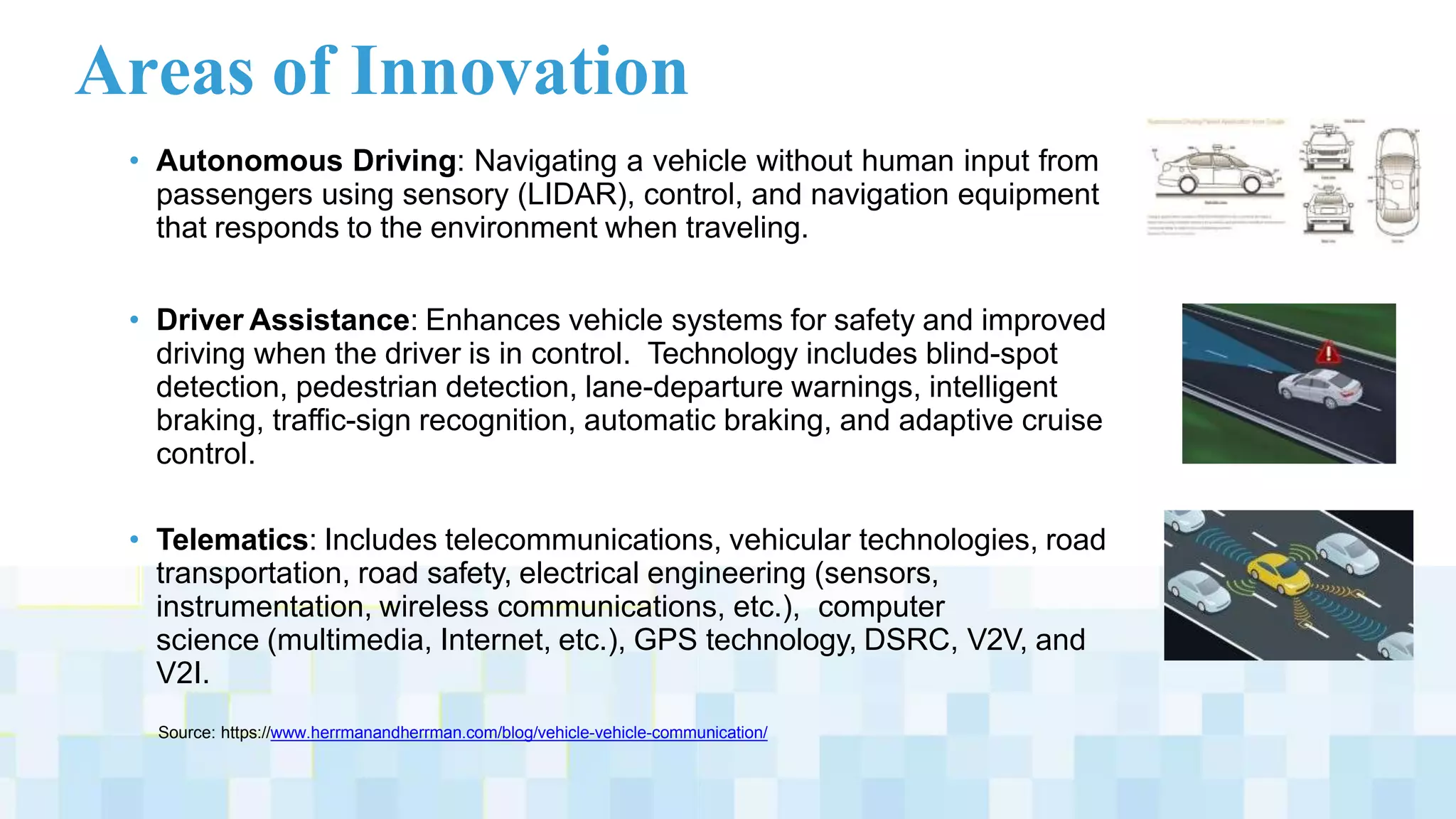
• Autonomous Driving: Navigating a vehicle without human input from
passengers using sensory (LIDAR), control, and navigation equipment
that responds to the environment when traveling.
• Driver Assistance: Enhances vehicle systems for safety and improved
driving when the driver is in control. Technology includes blind-spot
detection, pedestrian detection, lane-departure warnings, intelligent
braking, traffic-sign recognition, automatic braking, and adaptive cruise
control.
• Telematics: Includes telecommunications, vehicular technologies, road
transportation, road safety, electrical engineering (sensors,
instrumentation, wireless communications, etc.), computer
science (multimedia, Internet, etc.), GPS technology, DSRC, V2V, and
V2I.
Source: https://www.herrmanandherrman.com/blog/vehicle-vehicle-communication/
Key Technology Areas
• Artificial Intelligence (AI) – In order for theAV to operate in a full range of
environments with millions of changing aspects that will need to be
accounted for, it will require AI, which will allow the base level software to
be developed and tested with a self-learning capability.
• GPS – These global positioning systems will be a critical link forAV to
determine their location as they move.
• Dedicated short range communications (DSRC) – The ability for
vehicles to communicate with each other (“vehicle-to-vehicle” or “V2V”).
• LIDAR – LIDAR is a radar system that emits a laser in a pattern similar to a
rotating radar, only in more discrete and densely-spaced increments. The
reflected laser light is used to provide theAV information on the distance for
each discrete laser emission.
Insurance
Considerations
Case Study
Autonomous Vehicles in Public Transportation
Public transportation agencies are showing interest in incorporating autonomous vehicles
into their service, and looking at pilot programs usingAVs
• Use of AVs for “micro-transit” or “last mile” service could reduce costs and expand
accessibility
• Reduction in costs – maintenance is less expensive and operators may be unnecessary
• Safety benefits
• Driver/operator jobs will be impacted; operators will need to be retrained to become
“computer technicians
• Infrastructure maintenance and interactivity with vehicles
• Traffic lights and vehicles must talk to each other and roads must be pothole free
First Fully Autonomous Public
Transportation vehicle
Thank You!

autonomous vehicles org ppt.pptx

  • 1.
  • 2.
  • 3.
    • 10 millionautonomous vehicles will hit the roads by 2020 • In 10 years fully autonomous vehicles will be the norm • AVs will generate a $7 trillion annual revenue stream by 2050 • Widespread adoption of AVs could lead to a 90% reduction in vehicle crashes Introduction
  • 4.
    SAE Levels ofAutomation
  • 5.
    History of AutonomousVehicles 1999 FCC allocates 75 MHz of spectrum to Dedicated Short Range Communications Introduction of Cruise Control 1948 2007 Teams create vehicles that self- navigate a 60-mile course as part of DARPA “Grand Challenge” 2009 Google begins self- driving car project 2012 Google’s autonomous car passes a 14-mile driving test 2013 Mercedes and Infiniti produce cars with radar sensors and some autonomous driving features 2013 NHTSA releases initial policy on autonomous vehicles 2015 Tesla releases its Auto-Pilot self-driving mode 2017 NHTSA issues revised safety guidelines for autonomous vehicles NHTSA issues guidelines for testing and deployment of autonomous vehicles 2016
  • 6.
    Basic Physical Ecosystemof an Autonomous Vehicle • Global Positioning System (GPS) • Light Detection and Ranging (LIDAR) • Cameras (Video) • Ultrasonic Sensors • Central Computer • Radar Sensors • Dedicated Short-Range Communications-Based Receiver (not pictured) Source: The Economist, “How does a self-driving car work?”
  • 7.
    Companies Investing inAutonomous Vehicles 44+ Vehicles operating in SAE levels of automation 1-3 are already in commercial use and many companies are investing further in developing highly and fully automated vehicles
  • 8.
  • 9.
    Legal Issues AroundAutonomous Vehicles • Regulations • Liability • Personal Injury • Cybersecurity and data breaches • Intellectual property ownership
  • 10.
  • 11.
    Potential Attack Gateways •Electrical Control Units (ECUs) • Airbag, Advanced Driver Assistant System, Engine, Steering & Brakes, etc. • On-Board Diagnostics (OBD) II Diagnostic Port • Dedicated Short-Range Communications-Based Receiver • USB Ports • Passive Keyless Entry/ Remote Key • Remote Link Type App • Tire Pressure Monitoring System (TPMS) Source: Telematics Wire: Cybersecurity – A Gating Issue for Safety in A Connected and Automated Vehicle Future
  • 12.
    Common Security Vulnerabilities •Software Glitches – Connected vehicles today contain more than 100 million lines of code. More code means more opportunity for bugs and mistakes. • No Single Source of Knowledge of or Control Over Source Code – Software for different components of connected vehicles is being written by different developers, installed by different supplies, and no one source has knowledge of or control over the source code. • Increase Use of Apps Leave Vulnerabilities – Consumers are using an increasing number of smartphone apps to interface with their connected cars and help run certain functions. Researchers have already demonstrated weaknesses in some of these apps. Likely to see spread in use of malware. • Need for Constant Updates May be Overlooked – With the increased use of connected features comes an increased need for continuous updates to fix glitches and help protect vehicles. There is a risk these updates could be overlooked or that malicious actors could infect routine updates.
  • 13.
  • 14.
    Multiple Players areCollecting Data from Multiple Points Within Connected and Autonomous Vehicles
  • 15.
  • 16.
    Who Filed theMost Patents? Automakers are the leaders in autonomous vehicle related patents
  • 17.
    Who Owns theMost Patents? • Toyota is the global leader in the number of autonomous vehicle patents with more than 1,400 patents • Google is the tech company with the most autonomous vehicle patents, but ranks 26th when compared to all companies with autonomous vehicle patents Source: https://www.reuters.com/article/us-tech-ces-autos/automakers-not-silicon-valley-lead-in- driverless-car-patents-study-idUSKBN0UJ1UD20160105; The 2016 State of Self-Driving Innovation, Thomson Reuters.
  • 18.
    Areas of Innovation Source:Thomson Reuters 2016 State of Self-Driving Automotive Innovation
  • 19.
    Areas of Innovation •Autonomous Driving: Navigating a vehicle without human input from passengers using sensory (LIDAR), control, and navigation equipment that responds to the environment when traveling. • Driver Assistance: Enhances vehicle systems for safety and improved driving when the driver is in control. Technology includes blind-spot detection, pedestrian detection, lane-departure warnings, intelligent braking, traffic-sign recognition, automatic braking, and adaptive cruise control. • Telematics: Includes telecommunications, vehicular technologies, road transportation, road safety, electrical engineering (sensors, instrumentation, wireless communications, etc.), computer science (multimedia, Internet, etc.), GPS technology, DSRC, V2V, and V2I. Source: https://www.herrmanandherrman.com/blog/vehicle-vehicle-communication/
  • 20.
    Key Technology Areas •Artificial Intelligence (AI) – In order for theAV to operate in a full range of environments with millions of changing aspects that will need to be accounted for, it will require AI, which will allow the base level software to be developed and tested with a self-learning capability. • GPS – These global positioning systems will be a critical link forAV to determine their location as they move. • Dedicated short range communications (DSRC) – The ability for vehicles to communicate with each other (“vehicle-to-vehicle” or “V2V”). • LIDAR – LIDAR is a radar system that emits a laser in a pattern similar to a rotating radar, only in more discrete and densely-spaced increments. The reflected laser light is used to provide theAV information on the distance for each discrete laser emission.
  • 21.
  • 24.
  • 25.
    Autonomous Vehicles inPublic Transportation Public transportation agencies are showing interest in incorporating autonomous vehicles into their service, and looking at pilot programs usingAVs • Use of AVs for “micro-transit” or “last mile” service could reduce costs and expand accessibility • Reduction in costs – maintenance is less expensive and operators may be unnecessary • Safety benefits • Driver/operator jobs will be impacted; operators will need to be retrained to become “computer technicians • Infrastructure maintenance and interactivity with vehicles • Traffic lights and vehicles must talk to each other and roads must be pothole free
  • 26.
    First Fully AutonomousPublic Transportation vehicle
  • 27.