AUTONOMICS Ma. Janetth B. Serrano, MD, DPBA
NERVOUS  SYSTEM CENTRAL NERVOUS SYSTEM PERIPHERAL NERVOUS SYSTEM BRAIN SPINAL CORD EFFERENT Division AFFERENT Division AUTONOMIC N.S. SOMATIC  N.S. Sympathetic N.S. Parasympathetic N.S. Enteric N.S.
NERVOUS  SYSTEM SOMATIC  N.S. Skeletal, motor, voluntary  No ganglias or plexuses Motor n. to skeletal muscles myelinated Interruption of impulses    paralysis & atrophy AUTONOMIC  N.S. Visceral, vegetative, involuntary Efferent n. supply all except skeletal m. Peripheral ganglias & plexuses Postganglionic fibers unmyelinated Interruption of transmission    spontaneous activity
NEUROTRANSMITTERS: Sympathetic: ADRENERGIC Central: EPINEPHRINE Peripheral: NOREPINEPHRINE Parasympathetic: CHOLINERGIC Acetylcholine
RECEPTORS: Sympathetic:  ADRENOCEPTORS Alpha     α 1  ,  α 2  Beta      1  ,   2  ,   3 Parasympathetic:  CHOLINOCEPTORS Muscarinic Nicotinic Dopaminergic:  D 1 , D 2
Stimulation of adenyl cyclase ↑  cAMP Postsynaptic effector cells esp. lipocytes Beta 3 Stimulation of adenyl cyclase ↑  cAMP Posynaptic effector cells esp. sm. m. & cardiac m. Beta 2 Stimulation of adenyl cyclase ↑  cAMP Postsynaptic effector cells esp.heart, lipocytes, brain Presyn cholinergic & adrenergic terminals Beta 1 Inhibition of adenyl cyclase ↓  cAMP Presynaptic adrenergic n. terminals, platelets, lipocytes, sm.m. Alpha 2 Formation of IP 3  and DAG ↑  IC calcium Postsynaptic effector cells esp. smooth m. Alpha 1 RESULT OF LIGAND BINDING TYPICAL LOCATIONS RECEPTOR  NAME
Inhibition of adenyl cyclase Brain, Cardiovascular System D 4 Inhibition of adenyl cyclase Brain D 3 Inhibition of adenyl cyclase ↑  K +  conductance Brain, effector tissues, esp. smooth m., presynaptic nerve terminals D 2  (DA 2 ) Stimulation of adenyl cyclase ↑  cAMP Brain, effector tissues esp. sm.m. of the renal vascular bed D 1  (DA 1 ), D 5 RESULT OF LIGAND BINDING TYPICAL LOCATIONS RECEPTOR  NAME
MUSCARINIC RECEPTORS Na + , K +   depolarizing ion channel Postganglionic cell body, dendrites N N Na + , K +   depolarizing ion channel Skeletal muscle NMJ N M IP 3 , DAG cascade ? CNS M 5 Inhibition of cAMP production ? CNS M 4 IP 3 , DAG cascade Glands, smooth muscle, endothelium M 3 Inhibition of cAMP prod’n, activation of K +  channels Heart, nerves, smooth muscles M 2 IP 3 , DAG cascade Nerves M 1 Postreceptor Mechanism Location Receptor Type
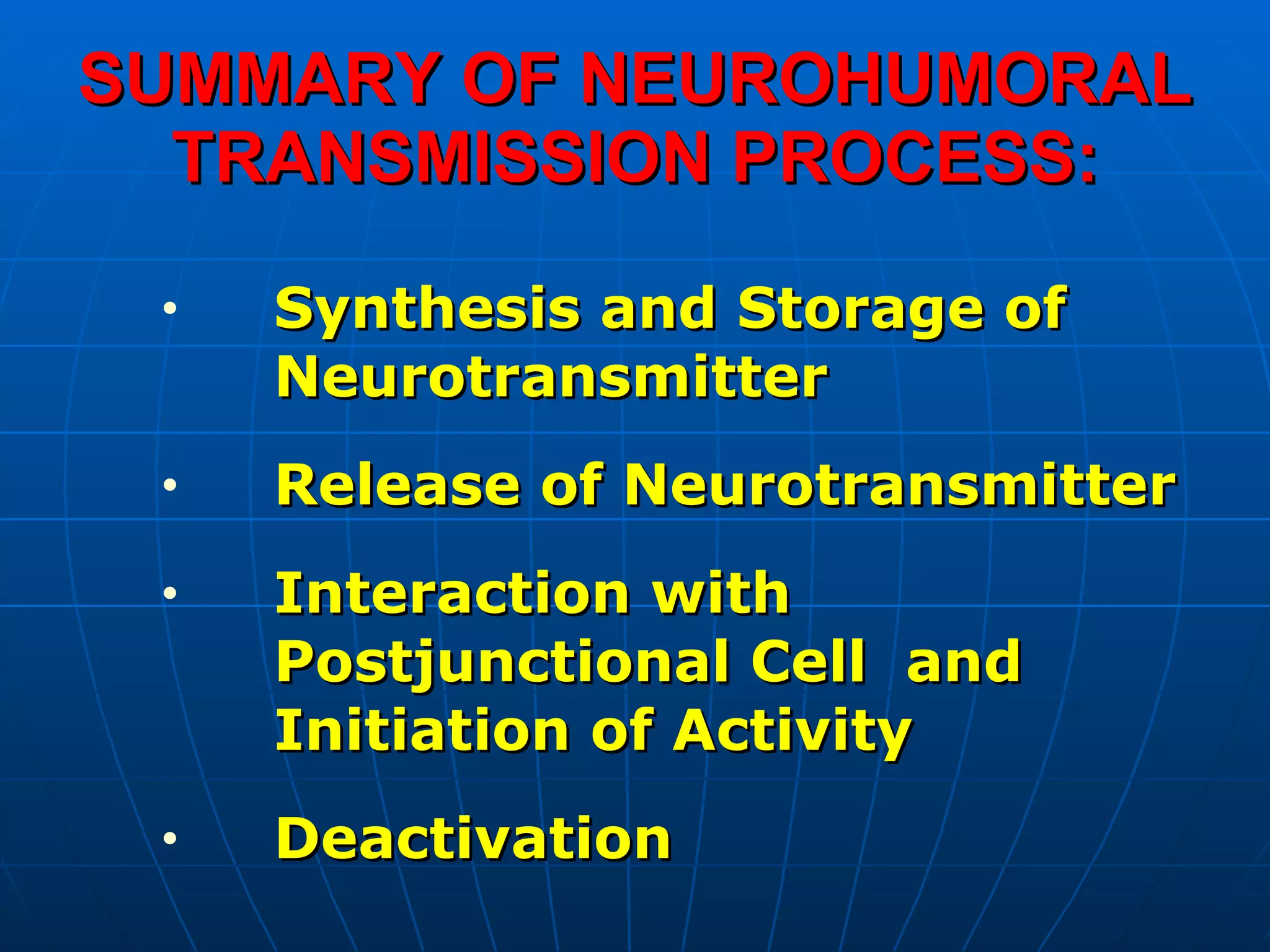
SUMMARY OF NEUROHUMORAL TRANSMISSION PROCESS: Synthesis and Storage of Neurotransmitter Release of Neurotransmitter Interaction with Postjunctional Cell  and Initiation of Activity Deactivation
METYROSINE COCAINE, TCA, IMIPRAMINE RESERPINE
HEMICHOLINIUM VESAMICOL BOTULINUM TOXIN
 
EFFECTOR  ORGANS Autonomic  Nervous System
Autonomic  Nervous System Some Sweat glds & some BV RVSM Acetylcholine Acetylcholine Acetylcholine Dopamine Nicotinic Receptor Nicotinic Receptor Muscarinic Receptor D 1  Receptor
Somatic  Nervous  System
Enteric Nervous System  Third division of the ANS Innervates GIT, pancreas, gallbladder Includes: Myenteric plexus   (Plexus of Auerbach) Submucous plexus    (Plexus of Meissner)
Autonomic  Nervous System
Sympathetic N. S. relaxation  2 Lung bronchial m. ↑  Heart rate ↑  conduction velocity ↑  contraction  1  1  1 Heart SA node AV node Contractility   Contraction (mydriasis) Relaxation α 1  2 Eye radial m. (iris)  ciliary m. Action Receptor Effector Organs
Sympathetic N. S. Constriction Relaxation Ejaculation α 1  2 α 1 GUT sphincter bladder wall Penis, seminal v. Constriction Decrease α 1 α ,   2 GIT sphincter motility & tone   Constriction Relaxation α 1  2 Blood Vessels most BV  skeletal  m. Action Receptor Effector Organs
Sympathetic N. S. Secretion of cathecolamines ↑  renin release Glycogenolysis ↓  insulin release Lipolysis N N  1  2 α 2  3 Metabolism adrenal medulla kidney skeletal m. Pancreas (B-cell) fat cells Localized secretion Inhibition - Moderate secretion α 1 α 2   - α Secretory glands sweat intestinal bronchial lacrimal Action Receptor Effector Organs
Parasympathetic N. S. contraction M 3 Lung bronchial m. ↓  Heart rate ↓  conduction velocity ↓  contraction M 2 M 2 M 2 Heart SA node AV node Contractility   Contraction (miosis) Contraction (accomodation) M 3 M 3 Eye circular m.  ciliary m. Action Receptor Effector Organs
Parasympathetic N. S. Relaxation Increase Erection M 3 M 3 M GUT trigone & sphincter m. bladder wall & detrusor m. Penis, seminal v. Relaxation Increase M 3 M 3 GIT sphincter motility & tone   - - - - Blood Vessels most BV  skeletal  m. Action Receptor Effector Organs
Parasympathetic N. S. Generalized secretion ↑  secretion ↑  secretion Profuse secretion M M 3 M M Secretory glands sweat intestinal bronchial lacrimal Action Receptor Effector Organs
Site and Mode of Action: 1. Direct Acting -  Epinephrine -  Dobutamine - Phenylephrine -  Norepinephrine  - Isoproterenol -  Clonidine 2. Indirect Acting Tyramine, Amphetamine, Cocaine 3. Mixed Acting Agonists - Dopamine - Ephedrine - Amphetamine - Metaraminol  - Phenylpropanolamine SYMPATHETIC  DRUGS
Sympathetic  Agonists SYMPATHOMIMETICS
Sympathetic Agonists (Sympathomimetics)  EPINEPHRINE NOREPINEPHRINE DOPAMINE IBOPAMINE AMPHETAMINE METHAMPHETAMINE EPHEDRINE PSEUDOEPHEDRINE DOBUTAMINE ISOPROTERENOL β 1  and  β 2 α 1   and  α 2 β 2 β 1 α  and  β α 2 α 1
Sympathetic Agonists (Sympathomimetics)  PHENYLEPHRINE METHOXAMINE MEPHENTERMINE METARAMINOL MITODRINE β 1  and  β 2 α 1   and  α 2 β 2 β 1 α  and  β α 2 α 1
Sympathetic Agonists (Sympathomimetics)  METHYLDOPA CLONIDINE GUANABENZ GUANFACINE β 1  and  β 2 α 1   and  α 2 β 2 β 1 α  and  β α 2 α 1
Sympathetic Agonists (Sympathomimetics)  NAPHAZOLINE TETRAHYDROZOLINE β 1  and  β 2 α 1   and  α 2 β 2 β 1 α  and  β α 2 α 1
Sympathetic Agonists (Sympathomimetics)  NAPHAZOLINE TETRAHYDROZOLINE OXYMETAZOLINE XYLOMETAZOLINE β 1  and  β 2 α 1   and  α 2 β 2 β 1 α  and  β α 2 α 1
Sympathetic Agonists (Sympathomimetics)  METAPROTERENOL TERBUTALINE, ALBUTEROL RITODRINE ISOETHARINE, PILBUTEROL BITOLTEROL, FENOTEROL FORMOTEROL, SALMETEROL PROCATEROL β 1  and  β 2 α 1   and  α 2 β 2 β 1 α  and  β α 2 α 1
Special sympathomimetics: COCAINE Local anesthetic Inhibits uptake 1    Peripheral sympathomimetic action CNS    inhibits reuptake of dopamine into neurons in the “pleasure centers” of the brain Sympathetic Agonists (Sympathomimetics)
Special sympathomimetics: TYRAMINE Normal by-product of tyrosine metabolism Fermented foods    cheese, red wine Metabolized by MAO Release of stored catecholamines    indirect sympathomimetic action  Sympathetic Agonists (Sympathomimetics)
Sympathetic  Antagonists SYMPATHOLYTICS
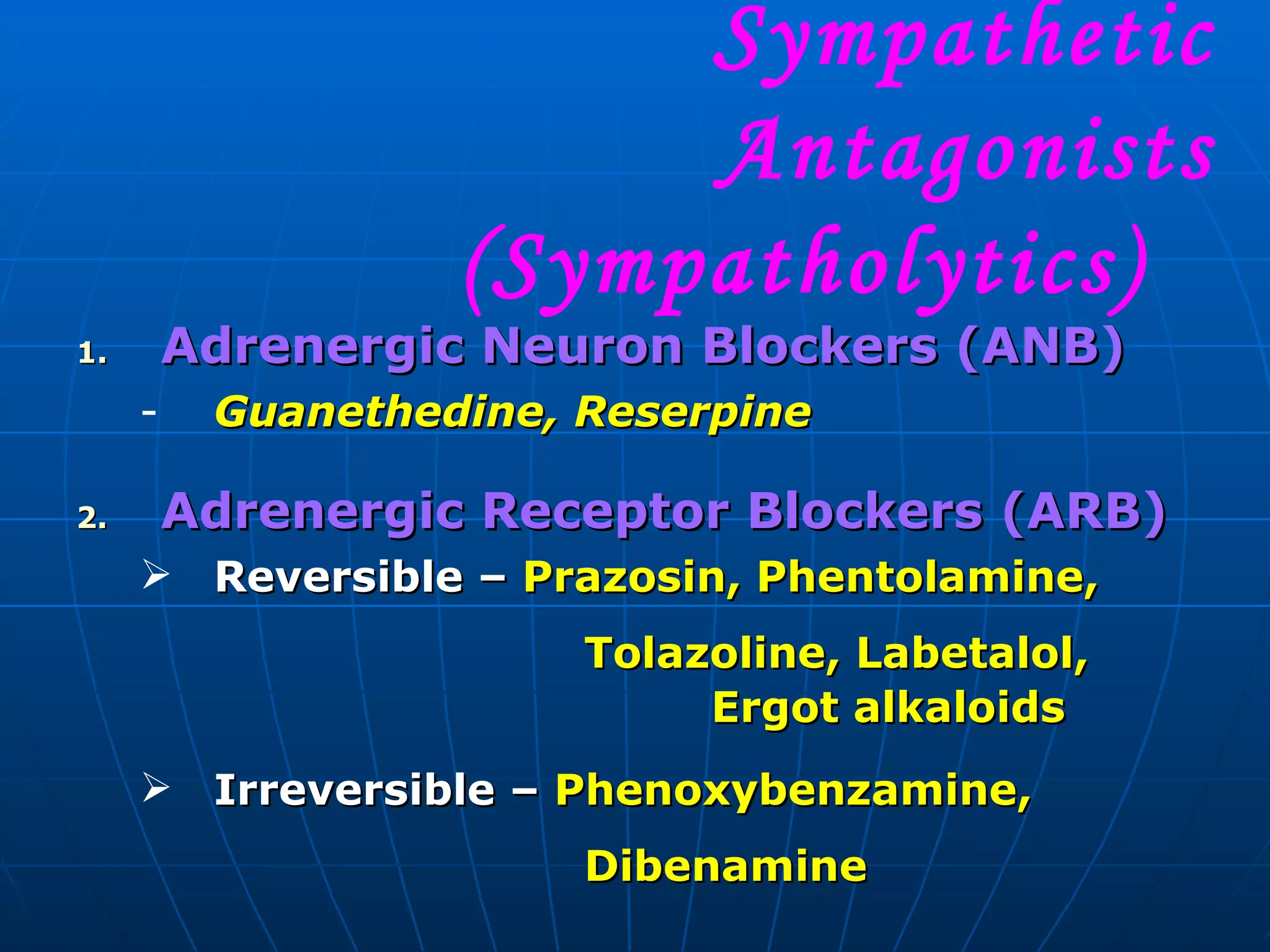
Adrenergic Neuron Blockers (ANB) Guanethedine, Reserpine Adrenergic Receptor Blockers (ARB) Reversible –  Prazosin, Phentolamine,  Tolazoline, Labetalol,  Ergot alkaloids Irreversible –  Phenoxybenzamine,  Dibenamine Sympathetic Antagonists (Sympatholytics)
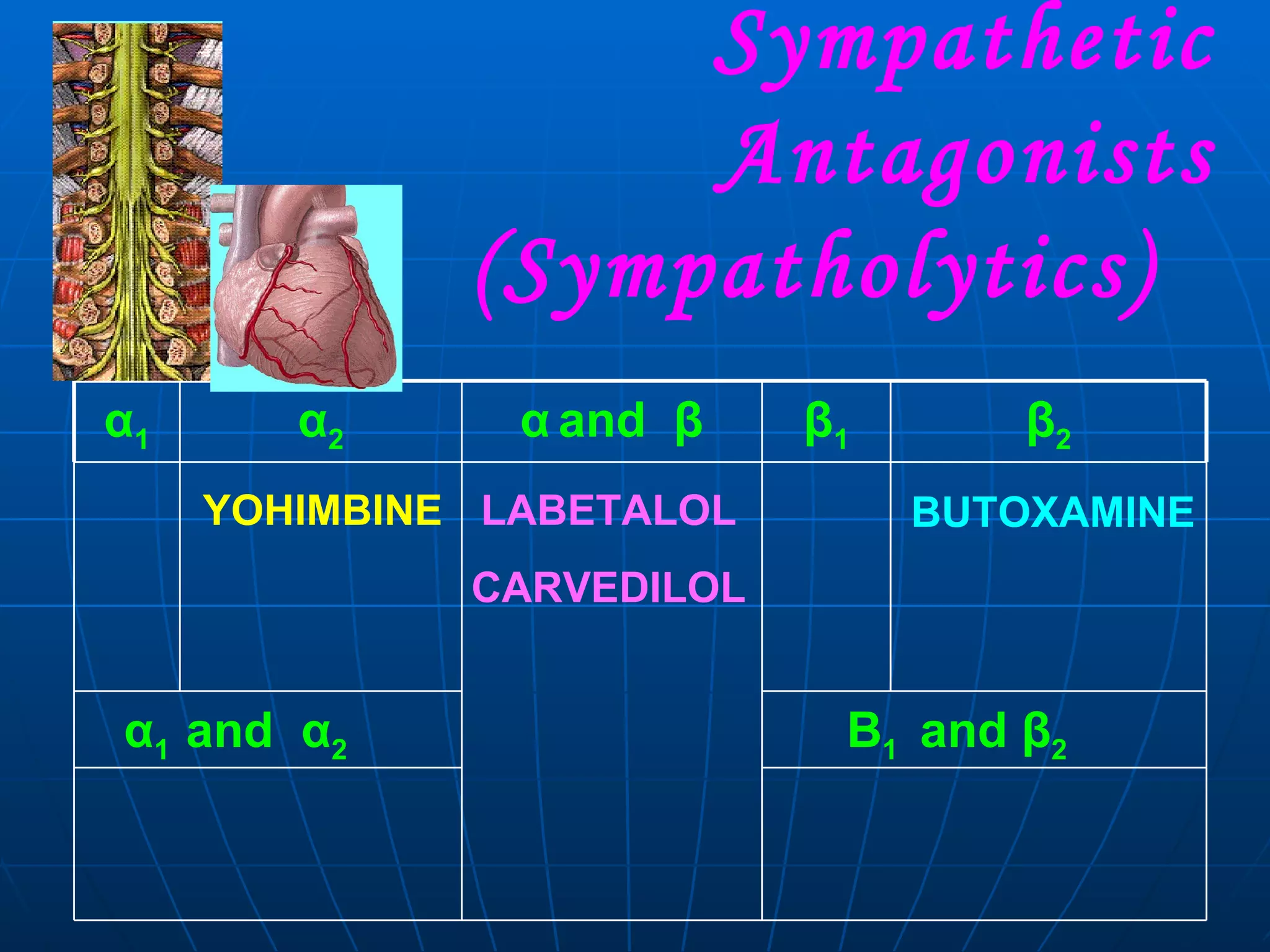
Sympathetic Antagonists (Sympatholytics)  YOHIMBINE BUTOXAMINE LABETALOL CARVEDILOL Β 1  and  β 2 α 1  and  α 2 β 2 β 1 α   and  β α 2 α 1
Sympathetic Antagonists (Sympatholytics)  PRAZOSIN, TERAZOSIN DOXAZOSIN, TRIMAZOSIN INDORAMIN, URADIPIL KETANSERIN, ALFUZOSIN BUNAZOSIN, TAMSULOSIN α 1  and  α 2 β 1  and  β 2 β 2 β 1 α   and  β α 2 α 1
Sympathetic Antagonists (Sympatholytics)  PHENOXYBENZAMINE PHENTOLAMINE ERGOT  ALKALOIDS NEUROLEPTIC DRUGS Β 1  and  β 2 α 1  and  α 2 β 2 β 1 α   and  β α 2 α 1
PHENOXYBENZAMINE irreversible noncompetetive blockade  (14-48 hrs) inhibits NE reuptake Blocks H 1 , Ach and serotonin receptors Blocks catecholamine-induced vasoconstriction Epinephrine- reversal Cl. Indication: pheochromocytoma male erectile dysfunction peripheral vascular diseases Adv. Eff: postural hypotension, tachycardia
PHENTOLAMINE Competetive antagonist (4 hrs) Epinephrine- reversal  reduce PVR Cardiac stimulation    baroreflex &  ↑ NE release Inhibits serotonin responses Indic: Pheochromocytoma, male erectile dysfunction Adv. Eff: severe tachycardia, arrhythmia, myocardial ischemia, GI stimulation
Beta-Adrenergic Blocking Agents BETA - BLOCKERS
Sympathetic Antagonists (Sympatholytics)  METOPROLOL ATENOLOL ACEBUTOLOL BETAXOLOL CELIPROLOL ESMOLOL Β 1  and  β 2 α 1  and  α 2 β 2 β 1 α   and  β α 2 α 1
Sympathetic Antagonists (Sympatholytics)  PROPRANOLOL NADOLOL, TIMOLOL PINDOLOL, LEVOBUNOLOL CARTEOLOL, BISOPROLOL Β 1  and  β 2 α 1  and  α 2 β 2 β 1 α   and  β α 2 α 1
Beta- blockers Pharmacokinetics: oral: peak in 1-3 hrs extensive first-pass metabolism half- lives: 3 to 10 hrs * Esmolol – 8 – 10 min * Nadolol – 24 hrs
PHARMACODYNAMICS: CVS: (-) chronotropic, (-) inotropic effects Respiratory: bronchoconstriction Eye: reduce IOP Metabolic & Endocrine: inhibits lipolysis partial inhibition of glycogenolysis ↑  VLDL and ↓ HDL ↓  HDL: LDL ratio ISA; MSA Beta- blockers
Properties of Beta-receptor blocking agents:   50 3-4 hrs Mod + - Metoprolol 70 4-5 hrs No data - + Celiprolol 0 8-10 min Low - - Esmolol 90 14-22 hrs Low Slight - Betaxolol 40 6-9 hrs Low - - Atenolol 50 3-4 hrs Low + + Acebutolol Selective  β 1 blockers Approxi-mate Bioavai-lability Elimination  Half-life Lipid Solu-bility Local Anesthetic Activity (MSA) Partial Agonist Activity  ( ISA)
Properties of Beta-receptor blocking agents:  90 3-4 hrs Mod + + Pindolol 50 4-50 hrs Mod - - Timolol 33 14-24 hrs Low - - Nadolol 30 5 hrs Mod + + Labetalol 25-35 6-8 hrs No Data - - Carvedilol 85 6 hrs Low - + Carteolol 30 3.5-6 hrs High + - Propranolol NonSelective  β 1  Blockers Approxi-mate Bioavai-lability Elimina-tion  Half-life Lipid Solu-bility MSA (Local Anesthetic Activity) ISA (Partial Agonist Activity )
CLINICAL INDICATIONS: Hypertension Cardiac arrhythmias Angina CHF: Metoprolol, Bisoprolol, Carvedilol Glaucoma: Timolol, Betaxolol, Carteolol, Levobunolol, Metipranolol Neurologic: Migraine, somatic mgt. of anxiety, alcohol withdrawal Misc: reduce portal vein pressure in cirrhosis Beta- blockers
Clinical toxicities: Drug allergy – rare CNS effects – sedation, sleep disturbances, depression, psychotic rxns Worsening of preexisting asthma & airway obstruction Depress myocardial contractility & excitability Hypoglycemic episodes Beta- blockers
DRUG INTERACTION: Calcium- channel  VERAPAMIL Severe hypotension Bradycardia CHF arrhythmia Beta- blockers
“ A heartfelt apology can’t change the past,  but it can brighten the future.”
QUIZ Major neurotransmitter of the Sympathetic Nervous System Write A if Agonist or B if Antagonist: 2. Epinephrine 7. Phentolamine 3. Labetalol 8. Cocaine 4. Clonidine 9. Phenylephrine 5. Prazosin 10. Ephedrine 6. Terbutaline

Autonomics & Sympathetics

  • 1.
    AUTONOMICS Ma. JanetthB. Serrano, MD, DPBA
  • 2.
    NERVOUS SYSTEMCENTRAL NERVOUS SYSTEM PERIPHERAL NERVOUS SYSTEM BRAIN SPINAL CORD EFFERENT Division AFFERENT Division AUTONOMIC N.S. SOMATIC N.S. Sympathetic N.S. Parasympathetic N.S. Enteric N.S.
  • 3.
    NERVOUS SYSTEMSOMATIC N.S. Skeletal, motor, voluntary No ganglias or plexuses Motor n. to skeletal muscles myelinated Interruption of impulses  paralysis & atrophy AUTONOMIC N.S. Visceral, vegetative, involuntary Efferent n. supply all except skeletal m. Peripheral ganglias & plexuses Postganglionic fibers unmyelinated Interruption of transmission  spontaneous activity
  • 4.
    NEUROTRANSMITTERS: Sympathetic: ADRENERGICCentral: EPINEPHRINE Peripheral: NOREPINEPHRINE Parasympathetic: CHOLINERGIC Acetylcholine
  • 5.
    RECEPTORS: Sympathetic: ADRENOCEPTORS Alpha  α 1 , α 2 Beta   1 ,  2 ,  3 Parasympathetic: CHOLINOCEPTORS Muscarinic Nicotinic Dopaminergic: D 1 , D 2
  • 6.
    Stimulation of adenylcyclase ↑ cAMP Postsynaptic effector cells esp. lipocytes Beta 3 Stimulation of adenyl cyclase ↑ cAMP Posynaptic effector cells esp. sm. m. & cardiac m. Beta 2 Stimulation of adenyl cyclase ↑ cAMP Postsynaptic effector cells esp.heart, lipocytes, brain Presyn cholinergic & adrenergic terminals Beta 1 Inhibition of adenyl cyclase ↓ cAMP Presynaptic adrenergic n. terminals, platelets, lipocytes, sm.m. Alpha 2 Formation of IP 3 and DAG ↑ IC calcium Postsynaptic effector cells esp. smooth m. Alpha 1 RESULT OF LIGAND BINDING TYPICAL LOCATIONS RECEPTOR NAME
  • 7.
    Inhibition of adenylcyclase Brain, Cardiovascular System D 4 Inhibition of adenyl cyclase Brain D 3 Inhibition of adenyl cyclase ↑ K + conductance Brain, effector tissues, esp. smooth m., presynaptic nerve terminals D 2 (DA 2 ) Stimulation of adenyl cyclase ↑ cAMP Brain, effector tissues esp. sm.m. of the renal vascular bed D 1 (DA 1 ), D 5 RESULT OF LIGAND BINDING TYPICAL LOCATIONS RECEPTOR NAME
  • 8.
    MUSCARINIC RECEPTORS Na+ , K + depolarizing ion channel Postganglionic cell body, dendrites N N Na + , K + depolarizing ion channel Skeletal muscle NMJ N M IP 3 , DAG cascade ? CNS M 5 Inhibition of cAMP production ? CNS M 4 IP 3 , DAG cascade Glands, smooth muscle, endothelium M 3 Inhibition of cAMP prod’n, activation of K + channels Heart, nerves, smooth muscles M 2 IP 3 , DAG cascade Nerves M 1 Postreceptor Mechanism Location Receptor Type
  • 9.
    SUMMARY OF NEUROHUMORALTRANSMISSION PROCESS: Synthesis and Storage of Neurotransmitter Release of Neurotransmitter Interaction with Postjunctional Cell and Initiation of Activity Deactivation
  • 10.
    METYROSINE COCAINE, TCA,IMIPRAMINE RESERPINE
  • 11.
  • 12.
  • 13.
    EFFECTOR ORGANSAutonomic Nervous System
  • 14.
    Autonomic NervousSystem Some Sweat glds & some BV RVSM Acetylcholine Acetylcholine Acetylcholine Dopamine Nicotinic Receptor Nicotinic Receptor Muscarinic Receptor D 1 Receptor
  • 15.
  • 16.
    Enteric Nervous System Third division of the ANS Innervates GIT, pancreas, gallbladder Includes: Myenteric plexus (Plexus of Auerbach) Submucous plexus (Plexus of Meissner)
  • 17.
  • 18.
    Sympathetic N. S.relaxation  2 Lung bronchial m. ↑ Heart rate ↑ conduction velocity ↑ contraction  1  1  1 Heart SA node AV node Contractility Contraction (mydriasis) Relaxation α 1  2 Eye radial m. (iris) ciliary m. Action Receptor Effector Organs
  • 19.
    Sympathetic N. S.Constriction Relaxation Ejaculation α 1  2 α 1 GUT sphincter bladder wall Penis, seminal v. Constriction Decrease α 1 α ,  2 GIT sphincter motility & tone Constriction Relaxation α 1  2 Blood Vessels most BV skeletal m. Action Receptor Effector Organs
  • 20.
    Sympathetic N. S.Secretion of cathecolamines ↑ renin release Glycogenolysis ↓ insulin release Lipolysis N N  1  2 α 2  3 Metabolism adrenal medulla kidney skeletal m. Pancreas (B-cell) fat cells Localized secretion Inhibition - Moderate secretion α 1 α 2 - α Secretory glands sweat intestinal bronchial lacrimal Action Receptor Effector Organs
  • 21.
    Parasympathetic N. S.contraction M 3 Lung bronchial m. ↓ Heart rate ↓ conduction velocity ↓ contraction M 2 M 2 M 2 Heart SA node AV node Contractility Contraction (miosis) Contraction (accomodation) M 3 M 3 Eye circular m. ciliary m. Action Receptor Effector Organs
  • 22.
    Parasympathetic N. S.Relaxation Increase Erection M 3 M 3 M GUT trigone & sphincter m. bladder wall & detrusor m. Penis, seminal v. Relaxation Increase M 3 M 3 GIT sphincter motility & tone - - - - Blood Vessels most BV skeletal m. Action Receptor Effector Organs
  • 23.
    Parasympathetic N. S.Generalized secretion ↑ secretion ↑ secretion Profuse secretion M M 3 M M Secretory glands sweat intestinal bronchial lacrimal Action Receptor Effector Organs
  • 24.
    Site and Modeof Action: 1. Direct Acting - Epinephrine - Dobutamine - Phenylephrine - Norepinephrine - Isoproterenol - Clonidine 2. Indirect Acting Tyramine, Amphetamine, Cocaine 3. Mixed Acting Agonists - Dopamine - Ephedrine - Amphetamine - Metaraminol - Phenylpropanolamine SYMPATHETIC DRUGS
  • 25.
    Sympathetic AgonistsSYMPATHOMIMETICS
  • 26.
    Sympathetic Agonists (Sympathomimetics) EPINEPHRINE NOREPINEPHRINE DOPAMINE IBOPAMINE AMPHETAMINE METHAMPHETAMINE EPHEDRINE PSEUDOEPHEDRINE DOBUTAMINE ISOPROTERENOL β 1 and β 2 α 1 and α 2 β 2 β 1 α and β α 2 α 1
  • 27.
    Sympathetic Agonists (Sympathomimetics) PHENYLEPHRINE METHOXAMINE MEPHENTERMINE METARAMINOL MITODRINE β 1 and β 2 α 1 and α 2 β 2 β 1 α and β α 2 α 1
  • 28.
    Sympathetic Agonists (Sympathomimetics) METHYLDOPA CLONIDINE GUANABENZ GUANFACINE β 1 and β 2 α 1 and α 2 β 2 β 1 α and β α 2 α 1
  • 29.
    Sympathetic Agonists (Sympathomimetics) NAPHAZOLINE TETRAHYDROZOLINE β 1 and β 2 α 1 and α 2 β 2 β 1 α and β α 2 α 1
  • 30.
    Sympathetic Agonists (Sympathomimetics) NAPHAZOLINE TETRAHYDROZOLINE OXYMETAZOLINE XYLOMETAZOLINE β 1 and β 2 α 1 and α 2 β 2 β 1 α and β α 2 α 1
  • 31.
    Sympathetic Agonists (Sympathomimetics) METAPROTERENOL TERBUTALINE, ALBUTEROL RITODRINE ISOETHARINE, PILBUTEROL BITOLTEROL, FENOTEROL FORMOTEROL, SALMETEROL PROCATEROL β 1 and β 2 α 1 and α 2 β 2 β 1 α and β α 2 α 1
  • 32.
    Special sympathomimetics: COCAINELocal anesthetic Inhibits uptake 1  Peripheral sympathomimetic action CNS  inhibits reuptake of dopamine into neurons in the “pleasure centers” of the brain Sympathetic Agonists (Sympathomimetics)
  • 33.
    Special sympathomimetics: TYRAMINENormal by-product of tyrosine metabolism Fermented foods  cheese, red wine Metabolized by MAO Release of stored catecholamines  indirect sympathomimetic action Sympathetic Agonists (Sympathomimetics)
  • 34.
  • 35.
    Adrenergic Neuron Blockers(ANB) Guanethedine, Reserpine Adrenergic Receptor Blockers (ARB) Reversible – Prazosin, Phentolamine, Tolazoline, Labetalol, Ergot alkaloids Irreversible – Phenoxybenzamine, Dibenamine Sympathetic Antagonists (Sympatholytics)
  • 36.
    Sympathetic Antagonists (Sympatholytics) YOHIMBINE BUTOXAMINE LABETALOL CARVEDILOL Β 1 and β 2 α 1 and α 2 β 2 β 1 α and β α 2 α 1
  • 37.
    Sympathetic Antagonists (Sympatholytics) PRAZOSIN, TERAZOSIN DOXAZOSIN, TRIMAZOSIN INDORAMIN, URADIPIL KETANSERIN, ALFUZOSIN BUNAZOSIN, TAMSULOSIN α 1 and α 2 β 1 and β 2 β 2 β 1 α and β α 2 α 1
  • 38.
    Sympathetic Antagonists (Sympatholytics) PHENOXYBENZAMINE PHENTOLAMINE ERGOT ALKALOIDS NEUROLEPTIC DRUGS Β 1 and β 2 α 1 and α 2 β 2 β 1 α and β α 2 α 1
  • 39.
    PHENOXYBENZAMINE irreversible noncompetetiveblockade (14-48 hrs) inhibits NE reuptake Blocks H 1 , Ach and serotonin receptors Blocks catecholamine-induced vasoconstriction Epinephrine- reversal Cl. Indication: pheochromocytoma male erectile dysfunction peripheral vascular diseases Adv. Eff: postural hypotension, tachycardia
  • 40.
    PHENTOLAMINE Competetive antagonist(4 hrs) Epinephrine- reversal reduce PVR Cardiac stimulation  baroreflex & ↑ NE release Inhibits serotonin responses Indic: Pheochromocytoma, male erectile dysfunction Adv. Eff: severe tachycardia, arrhythmia, myocardial ischemia, GI stimulation
  • 41.
  • 42.
    Sympathetic Antagonists (Sympatholytics) METOPROLOL ATENOLOL ACEBUTOLOL BETAXOLOL CELIPROLOL ESMOLOL Β 1 and β 2 α 1 and α 2 β 2 β 1 α and β α 2 α 1
  • 43.
    Sympathetic Antagonists (Sympatholytics) PROPRANOLOL NADOLOL, TIMOLOL PINDOLOL, LEVOBUNOLOL CARTEOLOL, BISOPROLOL Β 1 and β 2 α 1 and α 2 β 2 β 1 α and β α 2 α 1
  • 44.
    Beta- blockers Pharmacokinetics:oral: peak in 1-3 hrs extensive first-pass metabolism half- lives: 3 to 10 hrs * Esmolol – 8 – 10 min * Nadolol – 24 hrs
  • 45.
    PHARMACODYNAMICS: CVS: (-)chronotropic, (-) inotropic effects Respiratory: bronchoconstriction Eye: reduce IOP Metabolic & Endocrine: inhibits lipolysis partial inhibition of glycogenolysis ↑ VLDL and ↓ HDL ↓ HDL: LDL ratio ISA; MSA Beta- blockers
  • 46.
    Properties of Beta-receptorblocking agents: 50 3-4 hrs Mod + - Metoprolol 70 4-5 hrs No data - + Celiprolol 0 8-10 min Low - - Esmolol 90 14-22 hrs Low Slight - Betaxolol 40 6-9 hrs Low - - Atenolol 50 3-4 hrs Low + + Acebutolol Selective β 1 blockers Approxi-mate Bioavai-lability Elimination Half-life Lipid Solu-bility Local Anesthetic Activity (MSA) Partial Agonist Activity ( ISA)
  • 47.
    Properties of Beta-receptorblocking agents: 90 3-4 hrs Mod + + Pindolol 50 4-50 hrs Mod - - Timolol 33 14-24 hrs Low - - Nadolol 30 5 hrs Mod + + Labetalol 25-35 6-8 hrs No Data - - Carvedilol 85 6 hrs Low - + Carteolol 30 3.5-6 hrs High + - Propranolol NonSelective β 1 Blockers Approxi-mate Bioavai-lability Elimina-tion Half-life Lipid Solu-bility MSA (Local Anesthetic Activity) ISA (Partial Agonist Activity )
  • 48.
    CLINICAL INDICATIONS: HypertensionCardiac arrhythmias Angina CHF: Metoprolol, Bisoprolol, Carvedilol Glaucoma: Timolol, Betaxolol, Carteolol, Levobunolol, Metipranolol Neurologic: Migraine, somatic mgt. of anxiety, alcohol withdrawal Misc: reduce portal vein pressure in cirrhosis Beta- blockers
  • 49.
    Clinical toxicities: Drugallergy – rare CNS effects – sedation, sleep disturbances, depression, psychotic rxns Worsening of preexisting asthma & airway obstruction Depress myocardial contractility & excitability Hypoglycemic episodes Beta- blockers
  • 50.
    DRUG INTERACTION: Calcium-channel VERAPAMIL Severe hypotension Bradycardia CHF arrhythmia Beta- blockers
  • 51.
    “ A heartfeltapology can’t change the past, but it can brighten the future.”
  • 52.
    QUIZ Major neurotransmitterof the Sympathetic Nervous System Write A if Agonist or B if Antagonist: 2. Epinephrine 7. Phentolamine 3. Labetalol 8. Cocaine 4. Clonidine 9. Phenylephrine 5. Prazosin 10. Ephedrine 6. Terbutaline