International INTERNATIONAL Journal of Mechanical JOURNAL Engineering OF and MECHANICAL Technology (IJMET), ISSN ENGINEERING 
0976 – 6340(Print), 
ISSN 0976 – 6359(Online), Volume 5, Issue 7, July (2014), pp. 42-50 © IAEME 
AND TECHNOLOGY (IJMET) 
ISSN 0976 – 6340 (Print) 
ISSN 0976 – 6359 (Online) 
Volume 5, Issue 7, July (2014), pp. 42-50 
© IAEME: www.iaeme.com/IJMET.asp 
Journal Impact Factor (2014): 7.5377 (Calculated by GISI) 
www.jifactor.com 
42 
 
IJMET 
© I A E M E 
DEVELOPMENT OF AIR CONDITIONING SYSTEM BASED ON VAPOUR 
ABSORPTION REFRIGERATION CYCLE FOR AUTOMOBILES USING 
EXHAUST GASSES WITH R134a-DMF 
1G. Karthik, 2K. Usha Rani, 3Sayi Likhitha S S 
1Application Engineer, Heating Ventilation Air Conditioning Refrigeration, Ahmadabad, 
Gujarath-382435, India 
2Academic Consultant, Dept. of Mechanical Engineering, School of Engg  Tech, Sri Padmavathi 
Mahila University, TIrupathi, Chittor Dist, Andhra Pradesh – 517502, India 
3Asst.Professor, Dept. of Mechanical Engineering, N.B.K.R.I.S.T., Vidyanagar, Nellore (Dist), 
Andhra Pradesh – 524 413, India 
1. ABSTRACT 
The air conditioning system of automobiles in today’s world uses “Vapour Compression 
Refrigerant System” (VCRS) which absorbs and removes heat from the interior of the vehicle. The 
system utilizes power from engine shaft as the input power to drive the compressor of the refrigerant 
system. The loss of power of the engine to run the VCR system can be neglected by utilizing another 
refrigeration system i.e. a “Vapour Absorption Refrigerant System”. In a Vapour Absorption 
Refrigerant System, a physicochemical process replaces the mechanical process of the Vapour 
Compression Refrigerant System by using energy in the form of heat rather than mechanical work. 
The experimental work to utilize the waste heat from exhaust gases from an engine for the vapour 
absorption refrigerant system with R-134a as refrigerant and DMF as absorbent. The experimental 
results indicated that vehicle performance enhances, noise reduces, maintenance becomes easier, and 
highly reliable. The data obtained from experimentation is presented analyzed in this paper. 
2. INTRODUCTION 
The vapour absorption refrigeration system is one of the oldest methods of producing 
refrigerating effect. The principle of vapour absorption was first discovered by Michael Faraday in 
1824 while performing a set of experiments to liquefy certain gases. The first machine was based on 
Vapour Absorption Refrigeration machine was developed by a French scientist, Ferdinand Carry, in 
1860. This system may be used in both the domestic and large industrial refrigerating plants. The
International Journal of Mechanical Engineering and Technology (IJMET), ISSN 0976 – 6340(Print), 
ISSN 0976 – 6359(Online), Volume 5, Issue 7, July (2014), pp. 42-50 © IAEME 
refrigerant commonly used in vapour absorption system is Ammonia. This system uses Heat energy 
instead of mechanical energy as in vapour compression system, in order to change the condition of 
refrigerant required for the operation of the refrigeration cycle. In automobile air conditioning load 
factors are constantly and rapidly changing as the automobile moves over highways at different 
speeds and through different kind of surroundings. As the car moves faster there is greater amount of 
infiltration into the car and the heat transfer between the outdoor air and the car surface is increased. 
The sun baking down on a black top road will raise its temperature to 350oC – 450oC approximately 
and thus increases the amount of heat transmitted into car. Therefore, the car is subjected to varying 
amounts of heat load when its orientation changes during the journey. An automobile engine utilizes 
only about 35% of available energy and rests are lost in the form of heat and mechanical losses to 
cooling and exhaust system. If one is adding conventional air conditioning system to automobile, it 
further utilizes about 4-5% of the total energy. Therefore automobile becomes costlier, uneconomical 
and less efficient. The conventional air conditioning system in car decreases the life of engine and 
increases the fuel consumption, further for small cars compressor needs 3 to 4 bhp i.e. a significant 
ratio of the power output. Keeping these problems in mind, a car air conditioning system is proposed 
which is using exhaust heat. The advantages of this system over conventional air-conditioning 
system are that it does not affect designed efficiency life and fuel consumption of engine. G 
VICATOS, J GRYZAGORIDIS and S WANG (1) proposed a new system, Vapour Absorption 
Refrigeration of System based on Exhaust gas from an Internal Combustion Engine. Here energy 
from the Exhaust gas of an Internal Combustion Engine is used to power absorption Refrigeration 
system to Air condition an Ordinary passenger. In this theoretical Design is verified by the unit that 
is tested under both laboratory and road-test conditions, by using Refrigerant 134a and absorbent 
Dimethylformamide(DMF) the cooling effect for a passenger in a vehicle is been very comfort. 
Dimethylformamide is a clear liquid, miscible with water and majority organic solvents and it is used 
as a solvent in the production of fibers, films, and surface coatings. 
2.1. Comparison of Vapour Absorption Air Conditioning over Vapour Compression Air 
Conditioning: 
43 
 
2.1.1. Method of compression of the refrigerant: 
One of the most important parts of any air conditioning cycle is the compression of the 
refrigerant since all the further operations depend on it. In the vapour compression air conditioning 
system the compression of the refrigerant is done by compressor which can be of reciprocating, 
rotating or centrifugal type. In the vapour absorption air conditioning system, the compression of the 
refrigerant is done by absorption of the refrigerant by the absorbent. As the refrigerant is absorbed, it 
gets converted from the vapour state to liquid state so its volume reduces. 
2.1.2. Power consumption devices: 
In the vapour compression cycle the compressor is the major power consuming device while 
in the vapour absorption cycle the pump used for pumping refrigerant-absorbent solution is the major 
power consuming device. 
2.1.3. The amount of power required: 
The compressor of the vapour compression cycle requires large quantities of power for its 
operation and it increases as the size of the system increases. In case of the vapour absorption 
system, the pump requires very small amount of power and it remains almost the same (or may 
increase slightly) even for higher capacities of air conditioning. Thus the power consumed by the 
vapour absorption system is less than that required by the vapour compression system.
International Journal of Mechanical Engineering and Technology (IJMET), ISSN 0976 – 6340(Print), 
ISSN 0976 – 6359(Online), Volume 5, Issue 7, July (2014), pp. 42-50 © IAEME 
44 
 
2.1.4. Type of energy required: 
The vapour absorption system runs mainly on the waste or the extra heat in the plant. Thus 
one can utilize the extra steam from the boiler, or generate extra steam for the purpose and also use 
the hot available water. Similarly the waste heat from the diesel engine, hot water from the solar 
water heater, etc. can also be utilized. In case of the vapour compression system, the compressor can 
be run by electric power supply only; no other types of energy can be utilized in these systems. 
2.1.5. Running cost: 
The vapour compression air conditioning system can run only on electric power, and they 
require large amount of power. These days the electric power has become very expensive, hence the 
running cost of the vapour compression air conditioning system is very high. In case of the 
absorption air conditioning system only small pump requires electric power and it is quite low. In 
most of the process industries, where the absorption refrigeration is used, there is some extra steam 
available from the boiler, which can be used for running the system. Thus in absorption air 
conditioning system no extra power in the pure electric form is required and the energy that would 
have otherwise gone wasted is utilized in the plant. Thus the running cost of the absorption air 
conditioning system is much lesser than the vapour compression system. 
Table 1: List of Components of Vapour Absorption Air Conditioning over Vapour 
Compression Air Conditioning 
Vapour Absorption Air Conditioning 
Vapour Compression Air Conditioning 
• Generator 
• Drier 
• Condenser 
• Capillary tube 
• Evaporator 
• Absorber 
• Pump 
• Connection Tubes 
• Glass Cloth Tape 
• Insulation Foam Tube 
• Compressor 
• Condenser 
• Expansion valve 
• Evaporator 
3. EXPERIMENTAL SETUP
International Journal of Mechanical Engineering and Technology (IJMET), ISSN 0976 – 6340(Print), 
ISSN 0976 – 6359(Online), Volume 5, Issue 7, July (2014), pp. 42-50 © IAEME 
45 
 
The basic components of Vapour absorption Refrigeration system for Automobile Air 
conditioning are Generator, Drier, Condenser, Capillary tube, Evaporator, Absorber, Pump, 
Connection Tubes, Glass Cloth Tape, Insulation Foam Tube. In this experiment Refrigerant 134a and 
absorbent Dimethylformamide (DMF) are used. The properties of the refrigerant and absorbent are 
listed in the table1 and table 2 respectively. 
Table 2: Properties of R-134a refrigerant 
No Properties R-134a 
c Boiling Point -14.9°F or -26.6°C 
2 Auto-Ignition Temperature 1418°F or 770°C 
3 Ozone Depletion Level 0 
4 Solubility In Water 
0.11% by weight at 77°F or 
25°C 
5 Critical Temperature 252°F or 101°C 
6 Cylinder Colour Code Light Blue 
7 Global Warming Potential (GWP) 1200 
Table 3: Properties of Di Methyl Formamide 
(C3H7NO) 
Properties Value 
Molecular formula C3H7NO 
Molecular weight 73.09g/mol 
Boiling point 153°C 
Freezing point -60.4°C 
Density 
20°C 
949 kg/m³ 
40°C 
931 kg/m³ 
Vapour pressure 
20°C 
40°C 
60°C 
0.38 kPa 
1.3 kPa 
3.9 kPa 
Vapour density 2.5 
Critical values 
Temperature 
Pressure 
Volume 
374 °C 
4.42 Mpa 
3.65 m³/kg 
To generate base line data, the engine is allowed to run at different throttle position (one-fourth 
and half) considering engine speed as running parameter. The mass flow rate of air, mass flow 
rate of fuel and temperature of exhaust gas is measured. For measuring the required data circular 
orifice, u tube manometer, burette for petrol measurement and thermocouple for exhaust temperature 
measurement in installed on engine. The cooling load of a typical automobile is also considered at 
steady state conditions.
International Journal of Mechanical Engineering and Technology (IJMET), ISSN 0976 – 6340(Print), 
ISSN 0976 – 6359(Online), Volume 5, Issue 7, July (2014), pp. 42-50 © IAEME 
46 
4. CALCULATIONS 
 
For design considerations we have to take assumptions which are based on the basis of 
normal summer ambient weather/temperature conditions as well as the temperature to be maintained 
at Evaporator Coil is also assumed to be maintained for human comfort. 
Table 4: Design consideration of automobile air conditioning unit based on vapour absorption 
refrigeration system (CAPACITY=1TR) 
Temp 
(°C) 
Temp 
(K) 
Press 
ure 
(bar) 
Specific 
Enthalpy 
(kJ/kg) 
Specific Entropy 
(kJ/kg K) 
Enthalpy 
(kJ/kg) 
Liquid 
(hf) 
Latent 
(hfg) 
Liquid 
(sf) 
Vapour 
(sg) 
Liq+Vap 
(hg) 
Absorber 
(T_A) 
33 
306 
5.4 
228 409 
1.0885 1.7190 
181 
Generator 
(T_G)# 
90 
363 
9.2 
254 418 
1.1809 1.7122 
164 
Condenser 
(T_C) 
38 
311 
9.2 
254 418 
1.1809 1.7122 
164 
Evaporator 
(T_E) 
19 
292 
5.4 
228 409 
1.0885 1.7190 
181 
Calculations based up on Human comfort. 
(For ease of calculation and compactness of the model we have made all of our calculations, taking 
Capacity = 1TR) 
Coefficient of Performance (COP) = [ ]= 2.41 
Workdone (Winput) = [ ]= 87.02 kj/min = 1.45 kw 
Mass of Refrigerant Flowing (mf) = = 0.78 kg/min 
Volume of Refrigerant Flowing (vf) = ) = 0.000059 m3/sec 
Power Required to Drive Suction Pump = = 26 W
International Journal of Mechanical Engineering and Technology (IJMET), ISSN 0976 – 6340(Print), 
ISSN 0976 – 6359(Online), Volume 5, Issue 7, July (2014), pp. 42-50 © IAEME 
Amount of heat required in Generator = (Win x 1000 -Ppump) watts = 1.424 kj/sec 
Amount of heat rejected by refrigerant = Mass of refrigerant flowing in cycle x 
47 
 
Sp.heat of refrigerant x (Tc – Ta) kj/min 
= 0.78 x 1.350 x (311-306)=0.088 kj/sec 
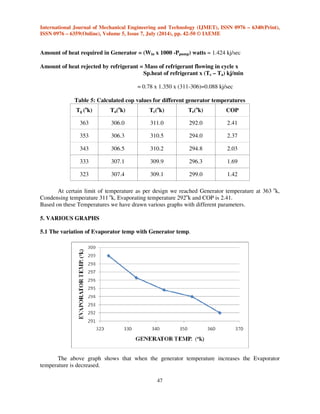
Table 5: Calculated cop values for different generator temperatures 
Tg (ok) Ta(ok) Tc(ok) Te(ok) COP 
363 306.0 311.0 292.0 2.41 
353 306.3 310.5 294.0 2.37 
343 306.5 310.2 294.8 2.03 
333 307.1 309.9 296.3 1.69 
323 307.4 309.1 299.0 1.42 
At certain limit of temperature as per design we reached Generator temperature at 363 ok, 
Condensing temperature 311 ok, Evaporating temperature 292ok and COP is 2.41. 
Based on these Temperatures we have drawn various graphs with different parameters. 
5. VARIOUS GRAPHS 
5.1 The variation of Evaporator temp with Generator temp. 
The above graph shows that when the generator temperature increases the Evaporator 
temperature is decreased.
International Journal of Mechanical Engineering and Technology (IJMET), ISSN 0976 – 6340(Print), 
ISSN 0976 – 6359(Online), Volume 5, Issue 7, July (2014), pp. 42-50 © IAEME 
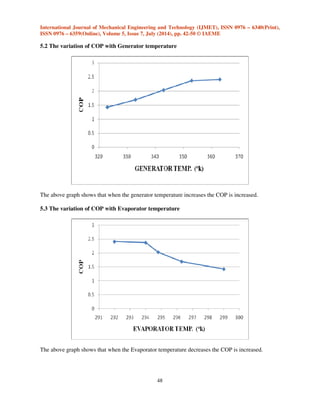
5.2 The variation of COP with Generator temperature 
The above graph shows that when the generator temperature increases the COP is increased. 
5.3 The variation of COP with Evaporator temperature 
The above graph shows that when the Evaporator temperature decreases the COP is increased. 
48
International Journal of Mechanical Engineering and Technology (IJMET), ISSN 0976 – 6340(Print), 
ISSN 0976 – 6359(Online), Volume 5, Issue 7, July (2014), pp. 42-50 © IAEME 
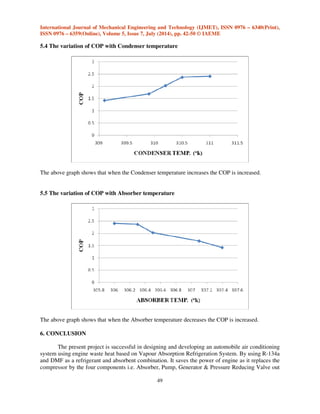
5.4 The variation of COP with Condenser temperature 
The above graph shows that when the Condenser temperature increases the COP is increased. 
5.5 The variation of COP with Absorber temperature 
The above graph shows that when the Absorber temperature decreases the COP is increased. 
49 
6. CONCLUSION 
 
The present project is successful in designing and developing an automobile air conditioning 
system using engine waste heat based on Vapour Absorption Refrigeration System. By using R-134a 
and DMF as a refrigerant and absorbent combination. It saves the power of engine as it replaces the 
compressor by the four components i.e. Absorber, Pump, Generator  Pressure Reducing Valve out
International Journal of Mechanical Engineering and Technology (IJMET), ISSN 0976 – 6340(Print), 
ISSN 0976 – 6359(Online), Volume 5, Issue 7, July (2014), pp. 42-50 © IAEME 
of which only the pump consumes some power that too is very feeble as compared to that of the 
Compressor, and thus helps in saving of fuel. 
50 
 
This system can be employed to commercial heavy vehicles including those which are 
involved in the transportation of refrigerated products, as this system can easily provide the 
refrigeration/air-conditioning of cabin as per the requirements by using the exhaust heat of the 
vehicle’s engine (which is in abundance in such vehicles) thus will not add any additional engine to 
run the air-conditioning/refrigerating unit in vehicle and hence reduces the operational cost. All in 
all, it can be a very well and economical asset for the automobile and can completely change the 
scenario of Automobile Air-Conditioning System. 
In case of vapour compression refrigeration system an amount of 15% engine work is 
required to drive the refrigeration motor. The present investigation has successfully saved this work 
by replacing vapour compression refrigeration system with Vapour Absorption Refrigeration 
System. The COP of Vapour Absorption Refrigeration System developed by the present project is 
2.41 and the lower temperature achieved is 19oC. 
REFERENCES 
[1] Alam Shah (2006), A Proposed Model for Utilizing Exhaust Heat to run Automobile Air-conditioner, 
The 2nd Joint International Conference on “Sustainable Energy and 
Environment (SEE 2006)” 21-23 Nov; 2006, Bangkok, Thailand. 
[2] G Vicatos, J Gryzagoridis, S Wang, Department of Mechanical Engineering, University of 
Cape Town, A car air-conditioning system based on an absorption refrigeration cycle using 
energy from exhaust gas of an internal combustion engine. “Journal of Energy in Southern 
Africa (Vol 19 No 4), November 2008” 
[3] M. Hosoz , M. Direk, Department of Mechanical Education, Kocaeli University, Umuttepe, 
41100 Kocaeli, Turkey, Performance evaluation of an integrated automotive air conditioning 
and heat pump system “Received 5 November 2004; accepted 18 May 2005 Available online 
14 July 2005.” Energy Conversion and Management 47 (2006) 545–559 
[4] Khurmi R S, Gupta J K, Refrigeration and Air Conditioning- 2010, Vapour Absorption 
Refrigeration (Pg 238-249). 
[5] Ganeshan V, Internal Combustion Engine- 2010, Heat Rejection  Cooling (Pg 445-467) 
[6] Domkundwar  Domkundwar, Refrigeration  Air-Conditioning Data book. 
[7] K.Ganesh Babu, K.Ravi Kumar and Dr. Md. Azizuddin, “Performance Improvement by 
Reducing Compressor Work of R-134a and R22 used Refrigeration Systems by using Two- 
Phase Ejector”, International Journal of Advanced Research in Engineering  Technology 
(IJARET), Volume 4, Issue 3, 2013, pp. 187 - 193, ISSN Print: 0976-6480, ISSN Online: 
0976-6499. 
[8] Dr. Ashok G. Matani and Mukesh K. Agrawal, “Performance Analysis of Vapour 
Compression Refrigeration System using R134a, Hc Mixture and R401a as Working 
Medium”, International Journal of Mechanical Engineering  Technology (IJMET), 
Volume 4, Issue 2, 2013, pp. 112 - 126, ISSN Print: 0976 – 6340, ISSN Online: 0976 – 6359. 
[9] Anirban Sur and Dr.Randip.K.Das, “Review on Solar Adsorption Refrigeration Cycle”, 
International Journal of Mechanical Engineering  Technology (IJMET), Volume 1, Issue 1, 
2010, pp. 190 - 226, ISSN Print: 0976 – 6340, ISSN Online: 0976 – 6359.

30120140507005

  • 1.
    International INTERNATIONAL Journalof Mechanical JOURNAL Engineering OF and MECHANICAL Technology (IJMET), ISSN ENGINEERING 0976 – 6340(Print), ISSN 0976 – 6359(Online), Volume 5, Issue 7, July (2014), pp. 42-50 © IAEME AND TECHNOLOGY (IJMET) ISSN 0976 – 6340 (Print) ISSN 0976 – 6359 (Online) Volume 5, Issue 7, July (2014), pp. 42-50 © IAEME: www.iaeme.com/IJMET.asp Journal Impact Factor (2014): 7.5377 (Calculated by GISI) www.jifactor.com 42 IJMET © I A E M E DEVELOPMENT OF AIR CONDITIONING SYSTEM BASED ON VAPOUR ABSORPTION REFRIGERATION CYCLE FOR AUTOMOBILES USING EXHAUST GASSES WITH R134a-DMF 1G. Karthik, 2K. Usha Rani, 3Sayi Likhitha S S 1Application Engineer, Heating Ventilation Air Conditioning Refrigeration, Ahmadabad, Gujarath-382435, India 2Academic Consultant, Dept. of Mechanical Engineering, School of Engg Tech, Sri Padmavathi Mahila University, TIrupathi, Chittor Dist, Andhra Pradesh – 517502, India 3Asst.Professor, Dept. of Mechanical Engineering, N.B.K.R.I.S.T., Vidyanagar, Nellore (Dist), Andhra Pradesh – 524 413, India 1. ABSTRACT The air conditioning system of automobiles in today’s world uses “Vapour Compression Refrigerant System” (VCRS) which absorbs and removes heat from the interior of the vehicle. The system utilizes power from engine shaft as the input power to drive the compressor of the refrigerant system. The loss of power of the engine to run the VCR system can be neglected by utilizing another refrigeration system i.e. a “Vapour Absorption Refrigerant System”. In a Vapour Absorption Refrigerant System, a physicochemical process replaces the mechanical process of the Vapour Compression Refrigerant System by using energy in the form of heat rather than mechanical work. The experimental work to utilize the waste heat from exhaust gases from an engine for the vapour absorption refrigerant system with R-134a as refrigerant and DMF as absorbent. The experimental results indicated that vehicle performance enhances, noise reduces, maintenance becomes easier, and highly reliable. The data obtained from experimentation is presented analyzed in this paper. 2. INTRODUCTION The vapour absorption refrigeration system is one of the oldest methods of producing refrigerating effect. The principle of vapour absorption was first discovered by Michael Faraday in 1824 while performing a set of experiments to liquefy certain gases. The first machine was based on Vapour Absorption Refrigeration machine was developed by a French scientist, Ferdinand Carry, in 1860. This system may be used in both the domestic and large industrial refrigerating plants. The
  • 2.
    International Journal ofMechanical Engineering and Technology (IJMET), ISSN 0976 – 6340(Print), ISSN 0976 – 6359(Online), Volume 5, Issue 7, July (2014), pp. 42-50 © IAEME refrigerant commonly used in vapour absorption system is Ammonia. This system uses Heat energy instead of mechanical energy as in vapour compression system, in order to change the condition of refrigerant required for the operation of the refrigeration cycle. In automobile air conditioning load factors are constantly and rapidly changing as the automobile moves over highways at different speeds and through different kind of surroundings. As the car moves faster there is greater amount of infiltration into the car and the heat transfer between the outdoor air and the car surface is increased. The sun baking down on a black top road will raise its temperature to 350oC – 450oC approximately and thus increases the amount of heat transmitted into car. Therefore, the car is subjected to varying amounts of heat load when its orientation changes during the journey. An automobile engine utilizes only about 35% of available energy and rests are lost in the form of heat and mechanical losses to cooling and exhaust system. If one is adding conventional air conditioning system to automobile, it further utilizes about 4-5% of the total energy. Therefore automobile becomes costlier, uneconomical and less efficient. The conventional air conditioning system in car decreases the life of engine and increases the fuel consumption, further for small cars compressor needs 3 to 4 bhp i.e. a significant ratio of the power output. Keeping these problems in mind, a car air conditioning system is proposed which is using exhaust heat. The advantages of this system over conventional air-conditioning system are that it does not affect designed efficiency life and fuel consumption of engine. G VICATOS, J GRYZAGORIDIS and S WANG (1) proposed a new system, Vapour Absorption Refrigeration of System based on Exhaust gas from an Internal Combustion Engine. Here energy from the Exhaust gas of an Internal Combustion Engine is used to power absorption Refrigeration system to Air condition an Ordinary passenger. In this theoretical Design is verified by the unit that is tested under both laboratory and road-test conditions, by using Refrigerant 134a and absorbent Dimethylformamide(DMF) the cooling effect for a passenger in a vehicle is been very comfort. Dimethylformamide is a clear liquid, miscible with water and majority organic solvents and it is used as a solvent in the production of fibers, films, and surface coatings. 2.1. Comparison of Vapour Absorption Air Conditioning over Vapour Compression Air Conditioning: 43 2.1.1. Method of compression of the refrigerant: One of the most important parts of any air conditioning cycle is the compression of the refrigerant since all the further operations depend on it. In the vapour compression air conditioning system the compression of the refrigerant is done by compressor which can be of reciprocating, rotating or centrifugal type. In the vapour absorption air conditioning system, the compression of the refrigerant is done by absorption of the refrigerant by the absorbent. As the refrigerant is absorbed, it gets converted from the vapour state to liquid state so its volume reduces. 2.1.2. Power consumption devices: In the vapour compression cycle the compressor is the major power consuming device while in the vapour absorption cycle the pump used for pumping refrigerant-absorbent solution is the major power consuming device. 2.1.3. The amount of power required: The compressor of the vapour compression cycle requires large quantities of power for its operation and it increases as the size of the system increases. In case of the vapour absorption system, the pump requires very small amount of power and it remains almost the same (or may increase slightly) even for higher capacities of air conditioning. Thus the power consumed by the vapour absorption system is less than that required by the vapour compression system.
  • 3.
    International Journal ofMechanical Engineering and Technology (IJMET), ISSN 0976 – 6340(Print), ISSN 0976 – 6359(Online), Volume 5, Issue 7, July (2014), pp. 42-50 © IAEME 44 2.1.4. Type of energy required: The vapour absorption system runs mainly on the waste or the extra heat in the plant. Thus one can utilize the extra steam from the boiler, or generate extra steam for the purpose and also use the hot available water. Similarly the waste heat from the diesel engine, hot water from the solar water heater, etc. can also be utilized. In case of the vapour compression system, the compressor can be run by electric power supply only; no other types of energy can be utilized in these systems. 2.1.5. Running cost: The vapour compression air conditioning system can run only on electric power, and they require large amount of power. These days the electric power has become very expensive, hence the running cost of the vapour compression air conditioning system is very high. In case of the absorption air conditioning system only small pump requires electric power and it is quite low. In most of the process industries, where the absorption refrigeration is used, there is some extra steam available from the boiler, which can be used for running the system. Thus in absorption air conditioning system no extra power in the pure electric form is required and the energy that would have otherwise gone wasted is utilized in the plant. Thus the running cost of the absorption air conditioning system is much lesser than the vapour compression system. Table 1: List of Components of Vapour Absorption Air Conditioning over Vapour Compression Air Conditioning Vapour Absorption Air Conditioning Vapour Compression Air Conditioning • Generator • Drier • Condenser • Capillary tube • Evaporator • Absorber • Pump • Connection Tubes • Glass Cloth Tape • Insulation Foam Tube • Compressor • Condenser • Expansion valve • Evaporator 3. EXPERIMENTAL SETUP
  • 4.
    International Journal ofMechanical Engineering and Technology (IJMET), ISSN 0976 – 6340(Print), ISSN 0976 – 6359(Online), Volume 5, Issue 7, July (2014), pp. 42-50 © IAEME 45 The basic components of Vapour absorption Refrigeration system for Automobile Air conditioning are Generator, Drier, Condenser, Capillary tube, Evaporator, Absorber, Pump, Connection Tubes, Glass Cloth Tape, Insulation Foam Tube. In this experiment Refrigerant 134a and absorbent Dimethylformamide (DMF) are used. The properties of the refrigerant and absorbent are listed in the table1 and table 2 respectively. Table 2: Properties of R-134a refrigerant No Properties R-134a c Boiling Point -14.9°F or -26.6°C 2 Auto-Ignition Temperature 1418°F or 770°C 3 Ozone Depletion Level 0 4 Solubility In Water 0.11% by weight at 77°F or 25°C 5 Critical Temperature 252°F or 101°C 6 Cylinder Colour Code Light Blue 7 Global Warming Potential (GWP) 1200 Table 3: Properties of Di Methyl Formamide (C3H7NO) Properties Value Molecular formula C3H7NO Molecular weight 73.09g/mol Boiling point 153°C Freezing point -60.4°C Density 20°C 949 kg/m³ 40°C 931 kg/m³ Vapour pressure 20°C 40°C 60°C 0.38 kPa 1.3 kPa 3.9 kPa Vapour density 2.5 Critical values Temperature Pressure Volume 374 °C 4.42 Mpa 3.65 m³/kg To generate base line data, the engine is allowed to run at different throttle position (one-fourth and half) considering engine speed as running parameter. The mass flow rate of air, mass flow rate of fuel and temperature of exhaust gas is measured. For measuring the required data circular orifice, u tube manometer, burette for petrol measurement and thermocouple for exhaust temperature measurement in installed on engine. The cooling load of a typical automobile is also considered at steady state conditions.
  • 5.
    International Journal ofMechanical Engineering and Technology (IJMET), ISSN 0976 – 6340(Print), ISSN 0976 – 6359(Online), Volume 5, Issue 7, July (2014), pp. 42-50 © IAEME 46 4. CALCULATIONS For design considerations we have to take assumptions which are based on the basis of normal summer ambient weather/temperature conditions as well as the temperature to be maintained at Evaporator Coil is also assumed to be maintained for human comfort. Table 4: Design consideration of automobile air conditioning unit based on vapour absorption refrigeration system (CAPACITY=1TR) Temp (°C) Temp (K) Press ure (bar) Specific Enthalpy (kJ/kg) Specific Entropy (kJ/kg K) Enthalpy (kJ/kg) Liquid (hf) Latent (hfg) Liquid (sf) Vapour (sg) Liq+Vap (hg) Absorber (T_A) 33 306 5.4 228 409 1.0885 1.7190 181 Generator (T_G)# 90 363 9.2 254 418 1.1809 1.7122 164 Condenser (T_C) 38 311 9.2 254 418 1.1809 1.7122 164 Evaporator (T_E) 19 292 5.4 228 409 1.0885 1.7190 181 Calculations based up on Human comfort. (For ease of calculation and compactness of the model we have made all of our calculations, taking Capacity = 1TR) Coefficient of Performance (COP) = [ ]= 2.41 Workdone (Winput) = [ ]= 87.02 kj/min = 1.45 kw Mass of Refrigerant Flowing (mf) = = 0.78 kg/min Volume of Refrigerant Flowing (vf) = ) = 0.000059 m3/sec Power Required to Drive Suction Pump = = 26 W
  • 6.
    International Journal ofMechanical Engineering and Technology (IJMET), ISSN 0976 – 6340(Print), ISSN 0976 – 6359(Online), Volume 5, Issue 7, July (2014), pp. 42-50 © IAEME Amount of heat required in Generator = (Win x 1000 -Ppump) watts = 1.424 kj/sec Amount of heat rejected by refrigerant = Mass of refrigerant flowing in cycle x 47 Sp.heat of refrigerant x (Tc – Ta) kj/min = 0.78 x 1.350 x (311-306)=0.088 kj/sec Table 5: Calculated cop values for different generator temperatures Tg (ok) Ta(ok) Tc(ok) Te(ok) COP 363 306.0 311.0 292.0 2.41 353 306.3 310.5 294.0 2.37 343 306.5 310.2 294.8 2.03 333 307.1 309.9 296.3 1.69 323 307.4 309.1 299.0 1.42 At certain limit of temperature as per design we reached Generator temperature at 363 ok, Condensing temperature 311 ok, Evaporating temperature 292ok and COP is 2.41. Based on these Temperatures we have drawn various graphs with different parameters. 5. VARIOUS GRAPHS 5.1 The variation of Evaporator temp with Generator temp. The above graph shows that when the generator temperature increases the Evaporator temperature is decreased.
  • 7.
    International Journal ofMechanical Engineering and Technology (IJMET), ISSN 0976 – 6340(Print), ISSN 0976 – 6359(Online), Volume 5, Issue 7, July (2014), pp. 42-50 © IAEME 5.2 The variation of COP with Generator temperature The above graph shows that when the generator temperature increases the COP is increased. 5.3 The variation of COP with Evaporator temperature The above graph shows that when the Evaporator temperature decreases the COP is increased. 48
  • 8.
    International Journal ofMechanical Engineering and Technology (IJMET), ISSN 0976 – 6340(Print), ISSN 0976 – 6359(Online), Volume 5, Issue 7, July (2014), pp. 42-50 © IAEME 5.4 The variation of COP with Condenser temperature The above graph shows that when the Condenser temperature increases the COP is increased. 5.5 The variation of COP with Absorber temperature The above graph shows that when the Absorber temperature decreases the COP is increased. 49 6. CONCLUSION The present project is successful in designing and developing an automobile air conditioning system using engine waste heat based on Vapour Absorption Refrigeration System. By using R-134a and DMF as a refrigerant and absorbent combination. It saves the power of engine as it replaces the compressor by the four components i.e. Absorber, Pump, Generator Pressure Reducing Valve out
  • 9.
    International Journal ofMechanical Engineering and Technology (IJMET), ISSN 0976 – 6340(Print), ISSN 0976 – 6359(Online), Volume 5, Issue 7, July (2014), pp. 42-50 © IAEME of which only the pump consumes some power that too is very feeble as compared to that of the Compressor, and thus helps in saving of fuel. 50 This system can be employed to commercial heavy vehicles including those which are involved in the transportation of refrigerated products, as this system can easily provide the refrigeration/air-conditioning of cabin as per the requirements by using the exhaust heat of the vehicle’s engine (which is in abundance in such vehicles) thus will not add any additional engine to run the air-conditioning/refrigerating unit in vehicle and hence reduces the operational cost. All in all, it can be a very well and economical asset for the automobile and can completely change the scenario of Automobile Air-Conditioning System. In case of vapour compression refrigeration system an amount of 15% engine work is required to drive the refrigeration motor. The present investigation has successfully saved this work by replacing vapour compression refrigeration system with Vapour Absorption Refrigeration System. The COP of Vapour Absorption Refrigeration System developed by the present project is 2.41 and the lower temperature achieved is 19oC. REFERENCES [1] Alam Shah (2006), A Proposed Model for Utilizing Exhaust Heat to run Automobile Air-conditioner, The 2nd Joint International Conference on “Sustainable Energy and Environment (SEE 2006)” 21-23 Nov; 2006, Bangkok, Thailand. [2] G Vicatos, J Gryzagoridis, S Wang, Department of Mechanical Engineering, University of Cape Town, A car air-conditioning system based on an absorption refrigeration cycle using energy from exhaust gas of an internal combustion engine. “Journal of Energy in Southern Africa (Vol 19 No 4), November 2008” [3] M. Hosoz , M. Direk, Department of Mechanical Education, Kocaeli University, Umuttepe, 41100 Kocaeli, Turkey, Performance evaluation of an integrated automotive air conditioning and heat pump system “Received 5 November 2004; accepted 18 May 2005 Available online 14 July 2005.” Energy Conversion and Management 47 (2006) 545–559 [4] Khurmi R S, Gupta J K, Refrigeration and Air Conditioning- 2010, Vapour Absorption Refrigeration (Pg 238-249). [5] Ganeshan V, Internal Combustion Engine- 2010, Heat Rejection Cooling (Pg 445-467) [6] Domkundwar Domkundwar, Refrigeration Air-Conditioning Data book. [7] K.Ganesh Babu, K.Ravi Kumar and Dr. Md. Azizuddin, “Performance Improvement by Reducing Compressor Work of R-134a and R22 used Refrigeration Systems by using Two- Phase Ejector”, International Journal of Advanced Research in Engineering Technology (IJARET), Volume 4, Issue 3, 2013, pp. 187 - 193, ISSN Print: 0976-6480, ISSN Online: 0976-6499. [8] Dr. Ashok G. Matani and Mukesh K. Agrawal, “Performance Analysis of Vapour Compression Refrigeration System using R134a, Hc Mixture and R401a as Working Medium”, International Journal of Mechanical Engineering Technology (IJMET), Volume 4, Issue 2, 2013, pp. 112 - 126, ISSN Print: 0976 – 6340, ISSN Online: 0976 – 6359. [9] Anirban Sur and Dr.Randip.K.Das, “Review on Solar Adsorption Refrigeration Cycle”, International Journal of Mechanical Engineering Technology (IJMET), Volume 1, Issue 1, 2010, pp. 190 - 226, ISSN Print: 0976 – 6340, ISSN Online: 0976 – 6359.