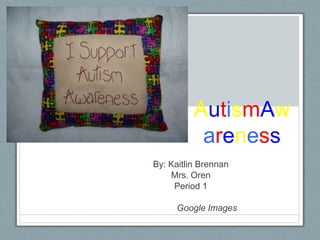
AutismAwarenessBy: Kaitlin BrennanMrs. Oren Period 1 	Google Images
ThesisAutism spectrum disorder starts out at a young age and continues into adulthood with delays in social interaction, communication, and different skills that are developed.  Even though there have been new studies and advances there is still no cure and that is why we never stop trying to solve the puzzle.
HistoryThe word “autism” has been used for over 100 yearsAutism comes from “Autos”; GreekEugenBleuler, first to discover in 1911Emotionally disturbed children http://www.autism-pdd.net
History Continued …Leo Kanner, first to introduce autism to the world1960’s; medical researchers had an understanding of autism1980’s and 90’s; when learning facilities opened for autismPresent; Many studies of autism and what it really ishttp://www.autism-pdd.net
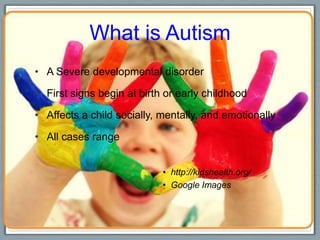
What is Autism A Severe developmental disorderFirst signs begin at birth or early childhoodAffects a child socially, mentally, and emotionallyAll cases range http://kidshealth.org/Google Images
Signs of Autism 3 main problem areas Social, language, and behavior Children diagnosed with autism usually have different symptoms 	Signs first start at early infancy of the childUnique Behaviorhttp://www.webmd.com
Social Skills Fails to respond to his or her name Poor eye contactTends not to listen at timesRestrains themselves from cuddling and holdingIs Unaware of others feelingsPrefers playing alone http://www.mayoclinic.com
Language Skills Begins talking later than other childrenLoses the ability to say words or sentencesDoes not make eye contact when asking questionsSpeaks with an abnormal tone; might use different voices to talk withSometimes cannot start a conversation or keep one goingMay repeat words or phrases, but doesn't understand how to use them	http://www.mayoclinic.com
Behavior Skills Has repetitive movement; rocking, spinning or hand-flappingSpecific routines Becomes upset at the any change in routines Moves constantlyFascinated by parts of an objectEx. : The spinning wheels of a toy carhttp://www.mayoclinic.com
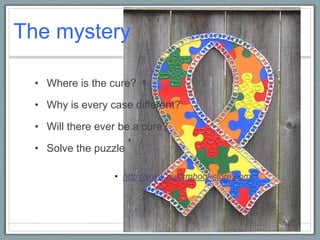
The mystery Where is the cure?Why is every case different?Will there ever be a cure? Solve the puzzle http://www.autismbookstore.com
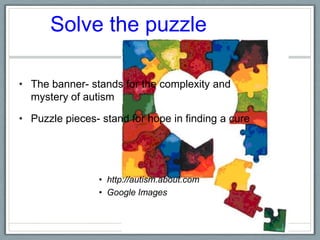
Solve the puzzle  The banner- stands for the complexity and mystery of autismPuzzle pieces- stand for hope in finding a curehttp://autism.about.comGoogle Images
		"We are not born to suffer. We are born to thrive. If you live in a dry area and your garden receives little water, you plant plants which like dry soil. But when you are given a plant that likes wet soil, you don't kill it, you water it, you spend one of your 1,440 minutes each day watering that plant. Because you know, that given the right care, that little bit of effort can produce spectacular blooms. And so it should be with children like us." - Joshua Muggleton
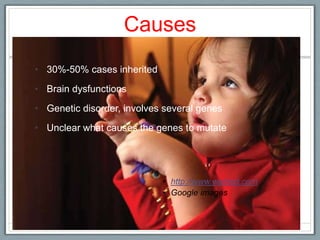
Causes 30%-50% cases inheritedBrain dysfunctionsGenetic disorder, involves several genes Unclear what causes the genes to mutate http://www.webmd.comGoogle images
Common?Past- 5 children in 10,000Present- 60 children in 10,000, since the 1990’s More common for boys than girls 4 to 1http://www.netwellness.org
Types of Autism Autism Spectrum Disorder Pervasive development disorder (PDD)Asperger's syndromeRett syndrome- Only known to be diagnosed in girls Childhood disintegrative disorderhttp://www.iser.com
Treatment Varies on the different needs3 Categoriesbehavior and communication therapymedical and dietary therapycomplementary therapyhttp://www.healthscout.com
Help the CauseWebsitesGetting Involved Walk Events Being Informedhttp://www.autismspeaks.org/walk_eventsGoogle Images
Future Treatments Researchers, parents, professors Finding a cureTechniques and TreatmentsImproving the quality of life http://ezinearticles.com/?Treatment-in-Autism
Tests and ExamsScreen tests at early ageIdentifying the signsBehaviorPhysical testshttp://www.webmd.com
Genetic? Usually more than one autistic child in a familyChromosome 13Passed onNot strong family historyhttp://autism.about.com/od/causesofautism
Pervasive development disorder (PDD)Delays in development of basic skills Confused in many areasAge 3 symptoms show“Pervasive” – to be present throughoutCommunicating, Routines, Temper, and Behavior problems http://www.medicinenet.com/pervasive_development_disorders
DiagnosesNormal development until age 3 Shows signs, begins medical and physical examinationsMRI examinationUnusual amount of reflexes; weakness on one side of the body http://www.medicinenet.com/autism
How is Autism Treated? One affective treatment Educational program for all agesIndividual classes Taught how to interact and communicateParents kept up to date  http://pediatrics.about.com/od/autism
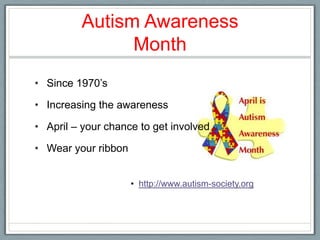
Autism Awareness Month Since 1970’sIncreasing the awareness April – your chance to get involvedWear your ribbonhttp://www.autism-society.org
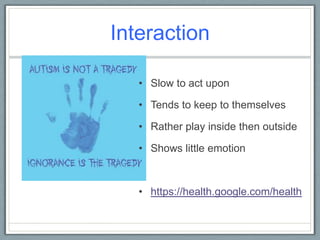
Interaction Slow to act uponTends to keep to themselves Rather play inside then outsideShows little emotionhttps://health.google.com/health
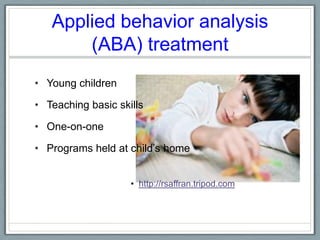
Applied behavior analysis (ABA) treatmentYoung childrenTeaching basic skillsOne-on-one Programs held at child’s homehttp://rsaffran.tripod.com
Medicine Treatment Behavior and emotional problemsAggression, Anxiety, mood swings, tantrums, irritability Risperidone- medication for children 5 to 16No medicine to cure the disorder https://health.google.com/health
Why is Autism called “Autism Spectrum Disorder?”Group of disorders with common features Mild and Severe symptoms3 types of autism spectrum disorder Autism Disorder, Asperger Syndrome, Pervasive Developmental Disorder 	http://www.nichd.nih.gov/health
Who does this affect? Boys are more likely, greater impact on girls1.5 million Americans will be affected today onlyThe percentage is raising every year 24,000 infants will eventually be diagnosed Will a cure be found from this? http://www.mychildwithoutlimits.org
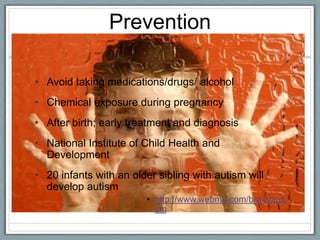
Prevention Avoid taking medications/drugs/ alcohol Chemical exposure during pregnancyAfter birth; early treatment and diagnosis National Institute of Child Health and Development20 infants with an older sibling with autism will develop autism http://www.webmd.com/brain/autism
Sensory Issues Sensitive to many things around themSounds, textures, tastes, smells Sensory problems cause the child to want to be left alone or indoorsAn autistic child’s brain has trouble balancing the senses http://www.mentalhelp.net
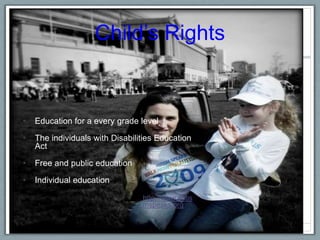
Child’s Rights Education for a every grade level The individuals with Disabilities Education Act Free and public educationIndividual educationhttp://www.autismspeaks.org
Asperger’s Syndrome Difficult to interact with othersTraits of autism Symptoms improve as the person grows olderRare disorder http://www.webmd.com/brain/autism
Autism in an Adult’s eye In school until age 22 Finding a job to meet their needsPrograms to help them throughout the other yearsCommunity help http://autism.emedtv.com

SGP Autism Awareness

  • 1.
    AutismAwarenessBy: Kaitlin BrennanMrs.Oren Period 1 Google Images
  • 2.
    ThesisAutism spectrum disorderstarts out at a young age and continues into adulthood with delays in social interaction, communication, and different skills that are developed. Even though there have been new studies and advances there is still no cure and that is why we never stop trying to solve the puzzle.
  • 3.
    HistoryThe word “autism”has been used for over 100 yearsAutism comes from “Autos”; GreekEugenBleuler, first to discover in 1911Emotionally disturbed children http://www.autism-pdd.net
  • 4.
    History Continued …LeoKanner, first to introduce autism to the world1960’s; medical researchers had an understanding of autism1980’s and 90’s; when learning facilities opened for autismPresent; Many studies of autism and what it really ishttp://www.autism-pdd.net
  • 5.
    What is AutismA Severe developmental disorderFirst signs begin at birth or early childhoodAffects a child socially, mentally, and emotionallyAll cases range http://kidshealth.org/Google Images
  • 6.
    Signs of Autism3 main problem areas Social, language, and behavior Children diagnosed with autism usually have different symptoms Signs first start at early infancy of the childUnique Behaviorhttp://www.webmd.com
  • 7.
    Social Skills Failsto respond to his or her name Poor eye contactTends not to listen at timesRestrains themselves from cuddling and holdingIs Unaware of others feelingsPrefers playing alone http://www.mayoclinic.com
  • 8.
    Language Skills Beginstalking later than other childrenLoses the ability to say words or sentencesDoes not make eye contact when asking questionsSpeaks with an abnormal tone; might use different voices to talk withSometimes cannot start a conversation or keep one goingMay repeat words or phrases, but doesn't understand how to use them http://www.mayoclinic.com
  • 9.
    Behavior Skills Hasrepetitive movement; rocking, spinning or hand-flappingSpecific routines Becomes upset at the any change in routines Moves constantlyFascinated by parts of an objectEx. : The spinning wheels of a toy carhttp://www.mayoclinic.com
  • 10.
    The mystery Whereis the cure?Why is every case different?Will there ever be a cure? Solve the puzzle http://www.autismbookstore.com
  • 11.
    Solve the puzzle The banner- stands for the complexity and mystery of autismPuzzle pieces- stand for hope in finding a curehttp://autism.about.comGoogle Images
  • 12.
    "We are notborn to suffer. We are born to thrive. If you live in a dry area and your garden receives little water, you plant plants which like dry soil. But when you are given a plant that likes wet soil, you don't kill it, you water it, you spend one of your 1,440 minutes each day watering that plant. Because you know, that given the right care, that little bit of effort can produce spectacular blooms. And so it should be with children like us." - Joshua Muggleton
  • 13.
    Causes 30%-50% casesinheritedBrain dysfunctionsGenetic disorder, involves several genes Unclear what causes the genes to mutate http://www.webmd.comGoogle images
  • 14.
    Common?Past- 5 childrenin 10,000Present- 60 children in 10,000, since the 1990’s More common for boys than girls 4 to 1http://www.netwellness.org
  • 15.
    Types of AutismAutism Spectrum Disorder Pervasive development disorder (PDD)Asperger's syndromeRett syndrome- Only known to be diagnosed in girls Childhood disintegrative disorderhttp://www.iser.com
  • 16.
    Treatment Varies onthe different needs3 Categoriesbehavior and communication therapymedical and dietary therapycomplementary therapyhttp://www.healthscout.com
  • 17.
    Help the CauseWebsitesGettingInvolved Walk Events Being Informedhttp://www.autismspeaks.org/walk_eventsGoogle Images
  • 18.
    Future Treatments Researchers,parents, professors Finding a cureTechniques and TreatmentsImproving the quality of life http://ezinearticles.com/?Treatment-in-Autism
  • 19.
    Tests and ExamsScreentests at early ageIdentifying the signsBehaviorPhysical testshttp://www.webmd.com
  • 20.
    Genetic? Usually morethan one autistic child in a familyChromosome 13Passed onNot strong family historyhttp://autism.about.com/od/causesofautism
  • 21.
    Pervasive development disorder(PDD)Delays in development of basic skills Confused in many areasAge 3 symptoms show“Pervasive” – to be present throughoutCommunicating, Routines, Temper, and Behavior problems http://www.medicinenet.com/pervasive_development_disorders
  • 22.
    DiagnosesNormal development untilage 3 Shows signs, begins medical and physical examinationsMRI examinationUnusual amount of reflexes; weakness on one side of the body http://www.medicinenet.com/autism
  • 23.
    How is AutismTreated? One affective treatment Educational program for all agesIndividual classes Taught how to interact and communicateParents kept up to date http://pediatrics.about.com/od/autism
  • 24.
    Autism Awareness MonthSince 1970’sIncreasing the awareness April – your chance to get involvedWear your ribbonhttp://www.autism-society.org
  • 25.
    Interaction Slow toact uponTends to keep to themselves Rather play inside then outsideShows little emotionhttps://health.google.com/health
  • 26.
    Applied behavior analysis(ABA) treatmentYoung childrenTeaching basic skillsOne-on-one Programs held at child’s homehttp://rsaffran.tripod.com
  • 27.
    Medicine Treatment Behaviorand emotional problemsAggression, Anxiety, mood swings, tantrums, irritability Risperidone- medication for children 5 to 16No medicine to cure the disorder https://health.google.com/health
  • 28.
    Why is Autismcalled “Autism Spectrum Disorder?”Group of disorders with common features Mild and Severe symptoms3 types of autism spectrum disorder Autism Disorder, Asperger Syndrome, Pervasive Developmental Disorder http://www.nichd.nih.gov/health
  • 29.
    Who does thisaffect? Boys are more likely, greater impact on girls1.5 million Americans will be affected today onlyThe percentage is raising every year 24,000 infants will eventually be diagnosed Will a cure be found from this? http://www.mychildwithoutlimits.org
  • 30.
    Prevention Avoid takingmedications/drugs/ alcohol Chemical exposure during pregnancyAfter birth; early treatment and diagnosis National Institute of Child Health and Development20 infants with an older sibling with autism will develop autism http://www.webmd.com/brain/autism
  • 31.
    Sensory Issues Sensitiveto many things around themSounds, textures, tastes, smells Sensory problems cause the child to want to be left alone or indoorsAn autistic child’s brain has trouble balancing the senses http://www.mentalhelp.net
  • 32.
    Child’s Rights Educationfor a every grade level The individuals with Disabilities Education Act Free and public educationIndividual educationhttp://www.autismspeaks.org
  • 33.
    Asperger’s Syndrome Difficultto interact with othersTraits of autism Symptoms improve as the person grows olderRare disorder http://www.webmd.com/brain/autism
  • 34.
    Autism in anAdult’s eye In school until age 22 Finding a job to meet their needsPrograms to help them throughout the other yearsCommunity help http://autism.emedtv.com

Editor's Notes

  • #3 My thesis is explaining what autism is all about and how it works. It talks about how autism is diagnosed as a child and continues into adulthood. Also it is explaining the main disabilities the disorder has and what skills are developed. There have not been a cure yet but there has been advances.
  • #4 The word autism comes from the Greek word “autos” meaning “self”. For the past 100 years we call this disorder Autism Spectrum Disorder.In the year 1911 EugenBleuler is a Swiss psychiatrist who was the first to diagnose the disease. When autism was first found it was used to describe emotionally disturbed children, still not knowing the entire meaning of Autism Spectrum Disorder. This was because it was still in the early 1900’s and researchers have not looked into the autism disorder as much as they should of to tell the world just yet.
  • #5 In 1943, Dr. Leo Kanner who graduated from John Hopkins University explained what autism was and how it worked. He was able to explain this because he had been observing eleven children since they were born for six years who showed the early signs of autism. The years were 1938 to 1943. By his research and understanding of what he already knew of autism, this study made it more clear. The children he was observing did indeed have Autism Spectrum Disorder. Kanner needed to do many tests and compare the different actions each child was doing in order to make sure his study was correct. During the 1930’s there was no real explanation for autism. The parents of the children with the sings were beginning to think that they were at fault for what was happening to their children, but that was not the case at all. Later, in the 1980’s and 1990’s was when Kanner’s shared his research with the world and it was all starting to make sense.
  • #6 Autism is a severe developmental disorder. Children/People who have this disorder appear and look to be normal, but do not act like it. Autism is different in every single person who has it. This affects different people in different ways. Cases of autism can range. Someone could have autism but only very lightly and interacts with others as if they do not even have the disorder. In other cases the person with the disorder can not even talk or bring themselves to hold a conversation with another person. That is why Autism is so interesting, you will never know what to expect.
  • #7 Researchers will look for delay in social interaction, they way they speak, and the way the act. Those are the three main areas health professors and researchers look at when trying to find autism. For some children autism symptoms begins right at infancy and for other children signs may not begin to develop until three years of age. With those who have autism they have a certain routine they are used to every day. If that routine were to change the person would be very confused at first, but will eventually get what is going on. Sameness is very key.
  • #8 Everyone can be social, but everyone is different about being social. Autism makes a person feel uninvited to a conversation therefore the person with autism does not want to associate themselves with others. When you are having a conversation with someone who has autism they tend not to look you in the eye or even look at you at all. When you are talking to them or calling their name, sometimes they purposely distract themselves by doing something else and do not care to listen to you. Also is someone is upset or angry the person with the disorder will not understand why someone feels this way unless you explain exactly what happened and why and repeat it over a few times so that they will completely understand. A child with autism and has problems with social skills is usually unaware of the world around them.
  • #9 When it comes to talking those with autism do not feel the need to, which is why they start talking at a later age. From my own experience I have noticed that it takes some time for someone to put words together and make a sentence. All you need is patience and it will come to them. The reason why they would repeat a word several or more times was because they did not know the meaning or because they simply just do not understand it.
  • #10 Behavior skills are different in every child with autism. Some children prefer not to talk to others and all and some cannot not stop talking once they get going. It depends mainly on their comfort zone and who they are talking to. Again there will always be a specific routine each child has everyday and will follow the same routine the same way they did the day previously. Some children like to stand, walk around, or move around the room.
  • #11 The families living with someone with autism do not think of it as a disorder but as being different and unique. Currently there is no known cure for autism but there are ways to help those with autism by treatments and therapy. There will always be a search to find the cure for autism, and there has been a search since the 1940’s when autism was first discovered. No case of autism is the same. The signs in two different people might be similar but autism can range in all different areas. http://www.flickr.com/photos/cherylsartbox/1373849921/
  • #12 The symbol for autism is the puzzle piece banner being all different colors. The reason there are puzzle pieces on the banner because every day they are trying to solve the cure to autism, just like trying to solve a puzzle. It is said that each child with autism is their own piece of the puzzle. Also with the different colors and the puzzle represents the diversity with autism, how everyone with autism is unique and special in their own way.
  • #13 This quote by JoshuaMuggleton is explaining how no person should be treated differently because of how they may act or what they might have. He says no one is born to suffer, but born to thrive and live your life as the way you want to. I agree with him, we are all born to thrive and live our life the way we plan and want to.
  • #14 It is still unclear to researchers what exactly causes autism. For the past few years there has been a gene mutation study that researchers are looking for. There are many genes that are related to brain functions that sometimes “mutate” and may cause autism. There are many possibilities of where autism can come from or how its caused. It is said that 30%-50% cases are inherited.
  • #15 When autism was first discovered it was found in five children out of every ten-thousand. Now a days since the 1990’s autism is found in every sixty children out of ten-thousand. Recent studies have shown that autism is found more in boys than girls. In the year 2007 the Center of Disease Control found autism is 1 out of 150 children. (Autism Research Institute )
  • #16 These five disorders all fall under the category of Autism. Autistic Disorder, Persuasive development disorder other wise known as PDD, Asperger’s syndrome, Rett syndrome, and Childhood disintegrative disorder. Someone who is diagnosed with Autism might have one of these syndromes as well. Each of these disorders have common symptoms that come along with them.
  • #17 There are many different treatments for treating autism. Depending on what case there is will be the treatment that the child will receive. Therapy is the main treatment for autism. The three different types of therapy are Behavior and communication therapy, medical and dietary therapy, and complementary therapy. The behavior and communication therapy focus on the areas of behavior, communication, sensory integration, and social skill development. There are antibiotics used for the medical and dietary therapy. The drugs are used to treat anxiety, attention problems, depressions, hyperactivity, and impulsivity. The complementary therapy is used to help increase learning and communication skills.
  • #18 Today if someone really wanted to help with the Autism Cause there are numerous ways for them to be involved. There are plenty of websites informing the new advances of autism and explaining exactly what the disorder is. There are walk events for autism every month until the end of the year. Then the walk events will be scheduled for the next year.
  • #19 Right now there is no cure for Autism Spectrum Disorder and it is unlikely that there will ever be a cure, but no one will ever stop looking. Researchers, health professors, family members, and the ones with autism will keep furthering their search for the cure. There are so many treatments and opportunities out there or those who have autism but that will never be enough to actually cure the disorder that is why we will never stop looking.
  • #20 Screen tests start at early child when the child begins to show signs of autism. The earlier these symptoms are found the easier it is for the doctors to determine which of the types of autism the child may have. The first way anyone would recognize signs of autism spectrum disorder would be in the child’s behavior. If the child is distant and not very social there is a good chance the child has some form of autism or the beginning stages. The next step to test the child is the physical tests. Such as. Physical examinations, their weight and height, and hearing tests.
  • #21 Is Autism Genetic? This question is hard to answer because researchers are still not positive of the answer. Even though there are families with one autistic child there are many families with more than one autistic child. Studies have shown that a gene with familial autism is found on chromosome 13. Autism is different in every family. Some families it is passed on from generation to generation. Most families with autism do not have a strong family history of the disorder.
  • #22 Children with Pervasive Developmental disorder have delays is very basic skills that children at the age of three should already have and should have no problems developing these basic motor skills. This disorder is awfully close to Autism Spectrum Disorder and falls under the category. The definition of pervasive is to be present throughout which is not what pervasive developmental disorder is. Children who have the disorder do not have issues in all areas but just one specific area. All other areas of the child function normally. The child with this disorder has problems in communicating with others and social interactions. Also if there is any change in their routine they will become very confused and aggravated with everyone around them.
  • #23 Again a child who has autism do not show the signs of autism usually until they reach the age of 3. They may show normal signs of development all the way up to 3. When that child does begins to show signs they must go through a series of tests to be sure that this case is autism. The major tests are taking by practitioner who has a good back-round on autism and other disorders that relate to autism as well. The practitioner must perform a medical examination and a physical examination. If the doctor finds weakness on one side of the body of the child and more reflexes then usual then the doctor concludes that the child has abnormal brain activity and needs an MRI examination.
  • #24 There is one known affective cure for treating autism. That is an educational program that fits each students performance level. This gives the child one on one time with the teacher to learn their basic skills they were unable to develop on their on. There are new and increasing educational programs for not only children but also adults. There are individual classes starting to develop which will help the child with autism better understand the world around them and again help them develop skills. In these classes the children are taught how to communicate and interact with others as well as learning the basic subjects. This task is difficult for families because the parents of the child with autism must always be aware of the new and upcoming treatments for autism to see if there is any more progress in finding a cure.
  • #25 April is the one month out of the year that the United States has decided to dedicate to Autism Awareness. The United States has been celebrating Autism Awareness month since the 1970’s. Dedicating an entire month to Autism gives the people who do not associate with someone who has Autism how important it is to stay involved and to help out as much as possible. The concern has been increasing throughout the year. I myself do not have a family member with Autism but yet I remain fully involved as much as possible and I love it.
  • #26 When interacting with someone with autism they are usually not very social at first, but again that all depends on how serious their case of autism might be. You should not approach someone with autism that does not know you, let them get to know you first. Autistic kids tend to keep to themselves for most of the time and also when put with a group of people they keep their distance from the group of people and like to do their own thing showing little or no emotion at all.
  • #27 The applied behavior analysis is a technique used for treating autism. This treatment is known to be very expensive therefore not widely used but parents like this idea and are trying to find ways to have their children have this opportunity. The reason why parents are so keen on having this treatment for their children is because the teacher comes into the child’s home and having a one-on-one teaching lesson with that child.
  • #28 Currently there is no medication to take for autism. There might not ever be one but there will always be medication to take to treat all the affects that come along with autism. Risperidone is the best known medication to treat children with autism from the ages of 5 to 16. The medicine is normally used to treat emotional and behavioral problems. There are eleven factors of autism that these medications can treat a few of them are listed above.
  • #29 Autism is not just called Autism, it is called Autism Spectrum Disorder. Spectrum Disorder is an entire range of disorders that have common features with one another. Another reason why this disorder is known as a spectrum disorder because of how mild someone can have the disorder to how severe someone might have the disorder. It ranges in all different areas. There are three types of the Autism Spectrum Disorder. They are Autism Disorder, Asperger Syndrome, and Pervasive Developmental Disorder.
  • #30 This relates back to how common Autism is. Boys are more likely to have Autism with a 4 to 1 chance then girls, but when girls do have the disorder it is usually much more severe and have a greater impairment from the world. There is no explanation to why this is but this is what the studies have shown. Every day there is 1.5 million Americans who are affected with Autism. They are affected in all different ways. Someone may have the disorder, someone may have a disorder similar or related, or someone could be living or interacting with anyone who may have the disorder. Autism has been known to increase by 10 to 17 percent each year. Every year there are four million babies born in the United states and out of those 4 million 24,000 will be diagnosed with Autism Spectrum Disorder. Researchers are beginning to think with Autism becoming more common it will be easier to find a cure or how Autism comes to be but there is no way to know as of now.
  • #31 It is common sense not to do drugs or drink any sort of alcohol during a mother’s pregnancy with a child, but any of those could result in a child having Autism. You must also not take any prescription pills unless they were prescribed by your doctor, this is where chemical exposure falls under. After an infant is born another way to avoiding autism is to have your child put in early treatment. If there are early signs of your child having autism then this is a good idea for your child. The National Institute of Child Health and Development is looking for new ways for autism to be prevented. With all the infants affected with autism in one year, studies show that 20 of those infants younger siblings will also be affected with autism. This institute’s goal is to be able to diagnosis someone with autism before any of the normal sings begin to develop.
  • #32 Someone with autism usually has sensory problems and are sensitive to things they interact with everyday. A normal reaction to hearing something loud or unusual to their hearing is to cover their ears and scream because they feel uncomfortable. Seeing a new texture can make them confused and again uncomfortable same goes for the tastes and smells. If a child becomes upset because of their sensory issues they want to be left alone or be somewhere where they do feel comfortable which is usually their own house. The reason why someone with autism has problems with sensory is because their brain has trouble balancing all of the senses. Other children with autism react to pain differently then someone without autism may act.
  • #33 In the year 1975 The Individuals with Disabilities Education Act was founded. This act says that each state must provide every and any child with special need have the right to a free and public education. This education must meet their needs at any cost. With the individual lessons for each child this will help the child develop their skills and to learn faster and more efficient.http://www.flickr.com/photos/26586732@N04/3537231743/
  • #34 Asperger’s Syndrome is related to Autism Spectrum Disorder. The traits appear to be the same for asperger’s are they are for autism. Delay is speech, poor social skills, and does not like the idea about change in routines. With Asperger’s Syndrome the symptoms improve over the year as with autism the symptoms remain the same. Adults with asperger’s usually understand what their illness is and even some teens. Adults understand their weakness and try to improve them. Now Asperger’s is a very rare disorder. Three out of 10,000 people have Asperger’s syndrome.
  • #35 Until an autistic child reaches the age of 22 it is the public schools responsibility to educate them. Then once they do turn 22 then it turns to the family to restart the education of their child. If the child is high functioning then it will not be hard at all to find them living arrangements or even a job. On the other hand if their child is not high functioning the child will have to live with them so they are able to receive all the help they need and the parent will also need to find them a job if they are able to maintain a job.