Authentic Assessment
Definition
› A form of Assessment in which students are asked to
perform real-world tasks that demonstrate meaningful
application of essential knowledge and skills.
What does it look like?
›An Authentic Assessment usually
includes a task for students to
perform and a rubric by which
their performance on the task will
be evaluated.
Similarities and Differences
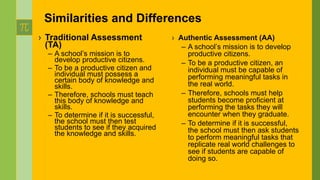
› Traditional Assessment
(TA)
– A school’s mission is to
develop productive citizens.
– To be a productive citizen and
individual must possess a
certain body of knowledge and
skills.
– Therefore, schools must teach
this body of knowledge and
skills.
– To determine if it is successful,
the school must then test
students to see if they acquired
the knowledge and skills.
› Authentic Assessment (AA)
– A school’s mission is to develop
productive citizens.
– To be a productive citizen, an
individual must be capable of
performing meaningful tasks in
the real world.
– Therefore, schools must help
students become proficient at
performing the tasks they will
encounter when they graduate.
– To determine if it is successful,
the school must then ask students
to perform meaningful tasks that
replicate real world challenges to
see if students are capable of
doing so.
Traditional Assessment
› In the TA model, the
curriculum drives the
assessment. “The” body of
knowledge is determined
first. That knowledge
becomes the curriculum that
is delivered. Subsequently,
the assessments are
developed and administered
to determine if acquisition of
the curriculum occurred.
Authentic Assessment
› In AA, assessment drives
the curriculum. That is,
teachers first determine the
tasks that students will
perform to demonstrate
their mastery and then a
curriculum is developed that
will enable students to
perform those tasks well,
which would include the
acquisition of essential
knowledge and skills.
Thought…
› We can teach students how to do math, do
history, do science, not just know them.
› Then, to assess what our students had
learned, we can ask students to perform tasks
that “replicate the challenges” faced by those
using mathematics, doing history, or
conducting scientific investigation.
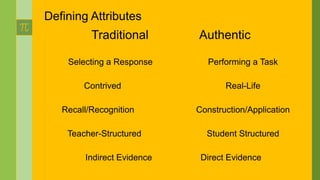
Defining Attributes
Traditional Authentic
Selecting a Response Performing a Task
Contrived Real-Life
Recall/Recognition Construction/Application
Teacher-Structured Student Structured
Indirect Evidence Direct Evidence
Alternative Names
› Performance Assessment: Students
are often asked to perform real-world or
authentic tasks or contexts.
› Alternative Assessments: Alternative to
traditional assessment using a rubric.
› Direct Assessment: Provides more
direct evidence of meaningful application
of knowledge and skills.
Why include Authentic
Assessments
› We want students to use the acquired knowledge and
skills in the real world, or authentic situations.
› Research on learning has found that we cannot simply
be fed knowledge. We need to construct our own
meaning of the world, using information we have
gathered and were taught and our own experiences
with the world.
› It encourages the integration of teaching, learning, and
assessing.
› We have different strengths and weaknesses in how
we learn. Similarly, we are different in how we can best
demonstrate what we have learned.
Creating Authentic Assessments
1. Identify your standards
2. Select and Authentic Task
3. Identify the criteria for the Task
4. Create the Rubric
Types of Authentic Tasks
›Constructed Response
–Product Like:
› short-answer essay questions, “show your
work”, journal response, concept maps, figural
representations.
–Performance Like:
› Typing test, complete a step of science lab,
construct a short musical, dance, or dramatic
response, exhibit an athletic skill.
Types of Authentic Tasks
›Product
–Essays
–Stories or Poems
–Research Reports
–Art Exhibit or Portfolio
–Lab Reports
–Newspaper
–Poster
Types of Authentic Tasks
›Performance
–Conducting an Experiment
–Musical, dance, or dramatic performances
–Debates
–Athletic competition
–Oral presentation
Rubrics
›Definition: A scoring scale used to
assess student performance along a
task-specific set of criteria
›Comprised of two components:
–Criteria
–Levels of Performance
Rubrics
›Criteria
–Each rubric has at least two criteria
–The criteria, characteristics of good
performance on a task, are usually
listed on the left hand column
–Can assign a weight to each criterion
› Levels of Performance
–What degree the student has met the criterion
–Each rubric has at least two levels of performance
–Levels of Performance help students better
understand what good (or bad) performance on a
task looks like, permit the teacher to more
consistently and objectively distinguish between
good and bad performance, and allows the teacher
to provide more detailed feedback to students.
Rubrics
Types of Rubrics
› Analytic
–Articulates levels
of performance
for each criterion
so the teacher
can assess
student
performance on
each criterion.
› Holistic
–Assigns a level of
performance by
assessing
performance
across multiple
criteria as a whole.
Portfolios
› Definition: A collection of a student’s work
specifically selected to tell a particular story
about the student.
› Could include the following, but is not limited
to :
–Samples of work
–Reflections
–Belief statements
–Goals
–Evaluations
Types of Portfolios
› Growth Portfolios
–To show growth or
change over time, help
develop process skills
such as self-evaluation
and goal-setting, identify
strengths and
weaknesses, and track
development of one or
more
products/performances.
Types of Portfolios
› Showcase Portfolios
– To showcase end-of-year/semester accomplishments, prepare a
sample of best work for employment or college admission,
showcase student perceptions of favorite, best or most important
work, and to communicate a student’s current aptitudes to future
teachers.
› Evaluation Portfolios
–To document achievement for grading purposes,
document progress towards standards, and to
place students appropriately.
Types of Portfolios
Quote
›“…Engaging and worthy problems or
questions of importance, in which
students must use knowledge to fashion
performances effectively and creatively.
The tasks are either replicas of or
analogous to the kinds of problems
faced by adult citizens and consumers
or professionals in the field.”
› Grant Wiggins on Authentic Assessments
References
› Authentic Assessment Toolbox
– http://jonathan.mueller.faculty.noctrl.edu/toolbox/whatisit.htm

Authentic assessments methods in math.ppt

  • 1.
  • 2.
    Definition › A formof Assessment in which students are asked to perform real-world tasks that demonstrate meaningful application of essential knowledge and skills.
  • 3.
    What does itlook like? ›An Authentic Assessment usually includes a task for students to perform and a rubric by which their performance on the task will be evaluated.
  • 4.
    Similarities and Differences ›Traditional Assessment (TA) – A school’s mission is to develop productive citizens. – To be a productive citizen and individual must possess a certain body of knowledge and skills. – Therefore, schools must teach this body of knowledge and skills. – To determine if it is successful, the school must then test students to see if they acquired the knowledge and skills. › Authentic Assessment (AA) – A school’s mission is to develop productive citizens. – To be a productive citizen, an individual must be capable of performing meaningful tasks in the real world. – Therefore, schools must help students become proficient at performing the tasks they will encounter when they graduate. – To determine if it is successful, the school must then ask students to perform meaningful tasks that replicate real world challenges to see if students are capable of doing so.
  • 5.
    Traditional Assessment › Inthe TA model, the curriculum drives the assessment. “The” body of knowledge is determined first. That knowledge becomes the curriculum that is delivered. Subsequently, the assessments are developed and administered to determine if acquisition of the curriculum occurred.
  • 6.
    Authentic Assessment › InAA, assessment drives the curriculum. That is, teachers first determine the tasks that students will perform to demonstrate their mastery and then a curriculum is developed that will enable students to perform those tasks well, which would include the acquisition of essential knowledge and skills.
  • 7.
    Thought… › We canteach students how to do math, do history, do science, not just know them. › Then, to assess what our students had learned, we can ask students to perform tasks that “replicate the challenges” faced by those using mathematics, doing history, or conducting scientific investigation.
  • 8.
    Defining Attributes Traditional Authentic Selectinga Response Performing a Task Contrived Real-Life Recall/Recognition Construction/Application Teacher-Structured Student Structured Indirect Evidence Direct Evidence
  • 9.
    Alternative Names › PerformanceAssessment: Students are often asked to perform real-world or authentic tasks or contexts. › Alternative Assessments: Alternative to traditional assessment using a rubric. › Direct Assessment: Provides more direct evidence of meaningful application of knowledge and skills.
  • 10.
    Why include Authentic Assessments ›We want students to use the acquired knowledge and skills in the real world, or authentic situations. › Research on learning has found that we cannot simply be fed knowledge. We need to construct our own meaning of the world, using information we have gathered and were taught and our own experiences with the world. › It encourages the integration of teaching, learning, and assessing. › We have different strengths and weaknesses in how we learn. Similarly, we are different in how we can best demonstrate what we have learned.
  • 11.
    Creating Authentic Assessments 1.Identify your standards 2. Select and Authentic Task 3. Identify the criteria for the Task 4. Create the Rubric
  • 12.
    Types of AuthenticTasks ›Constructed Response –Product Like: › short-answer essay questions, “show your work”, journal response, concept maps, figural representations. –Performance Like: › Typing test, complete a step of science lab, construct a short musical, dance, or dramatic response, exhibit an athletic skill.
  • 13.
    Types of AuthenticTasks ›Product –Essays –Stories or Poems –Research Reports –Art Exhibit or Portfolio –Lab Reports –Newspaper –Poster
  • 14.
    Types of AuthenticTasks ›Performance –Conducting an Experiment –Musical, dance, or dramatic performances –Debates –Athletic competition –Oral presentation
  • 15.
    Rubrics ›Definition: A scoringscale used to assess student performance along a task-specific set of criteria ›Comprised of two components: –Criteria –Levels of Performance
  • 16.
    Rubrics ›Criteria –Each rubric hasat least two criteria –The criteria, characteristics of good performance on a task, are usually listed on the left hand column –Can assign a weight to each criterion
  • 17.
    › Levels ofPerformance –What degree the student has met the criterion –Each rubric has at least two levels of performance –Levels of Performance help students better understand what good (or bad) performance on a task looks like, permit the teacher to more consistently and objectively distinguish between good and bad performance, and allows the teacher to provide more detailed feedback to students. Rubrics
  • 18.
    Types of Rubrics ›Analytic –Articulates levels of performance for each criterion so the teacher can assess student performance on each criterion. › Holistic –Assigns a level of performance by assessing performance across multiple criteria as a whole.
  • 19.
    Portfolios › Definition: Acollection of a student’s work specifically selected to tell a particular story about the student. › Could include the following, but is not limited to : –Samples of work –Reflections –Belief statements –Goals –Evaluations
  • 20.
    Types of Portfolios ›Growth Portfolios –To show growth or change over time, help develop process skills such as self-evaluation and goal-setting, identify strengths and weaknesses, and track development of one or more products/performances.
  • 21.
    Types of Portfolios ›Showcase Portfolios – To showcase end-of-year/semester accomplishments, prepare a sample of best work for employment or college admission, showcase student perceptions of favorite, best or most important work, and to communicate a student’s current aptitudes to future teachers.
  • 22.
    › Evaluation Portfolios –Todocument achievement for grading purposes, document progress towards standards, and to place students appropriately. Types of Portfolios
  • 23.
    Quote ›“…Engaging and worthyproblems or questions of importance, in which students must use knowledge to fashion performances effectively and creatively. The tasks are either replicas of or analogous to the kinds of problems faced by adult citizens and consumers or professionals in the field.” › Grant Wiggins on Authentic Assessments
  • 24.
    References › Authentic AssessmentToolbox – http://jonathan.mueller.faculty.noctrl.edu/toolbox/whatisit.htm