Counting and Number
Sense in Early
Childhood and
Primary Grades
CHAPTER 7
Tina Rye Sloan
To accompany Helping Children Learn Math9e, Reys et al.
©2009 John Wiley & Sons
Focus Questions
• Why is subitizing an important early step in
number sense?
• What characteristics are associated with the
different counting stages?
• How can calculators help children develop
number sense?
Reys/ Lindquist/ Lamdin/ Smith, Helping Children Learn Math,
9th
Edition, © 2009
Understand numbers, ways of
representing numbers, relationships
among numbers, and number systems
• Count with understanding and recognize “how many” in
sets of objects
• Develop understanding of the relative position and
magnitude of whole numbers and of ordinal and cardinal
numbers and their connections.
• Connect number words and numerals to the quantities they
represent, using various physical models and
representations
Excerpts of Expectations from the Number and Operations
Standard Grades Pre-K-2
NCTM(2000). Principles and Standards for School Mathematics.
Reys/ Lindquist/ Lamdin/ Smith, Helping Children Learn Math,
9th
Edition, © 2009
Number Sense
Number Sense includes:
• An understanding of number concepts and operations
on these numbers.
• The development of useful strategies for handling
numbers and operations.
• The facility to compute accurately and efficiently, to
detect errors, and to recognize results as reasonable.
Reys/ Lindquist/ Lamdin/ Smith, Helping Children Learn Math,
9th
Edition, © 2009
Number Sense
• The ability and inclination to use this understanding
in flexible ways to make mathematical judgments.
• An expectation that numbers are useful and that work
with numbers is meaningful and makes sense.
Reys/ Lindquist/ Lamdin/ Smith, Helping Children Learn Math,
9th
Edition, © 2009
Number Sense Stages
• Number sense is not a finite entity that a student either
has or does not have. Its development is a lifelong
process, and in early childhood and elementary school
number sense development involves several stages:
• Prenumber Concepts
• Early Number Development
• Number Development
Reys/ Lindquist/ Lamdin/ Smith, Helping Children Learn Math,
9th
Edition, © 2009
Prenumber Concepts are those that do
not rely on numbers but provide a
foundation for later number concepts and
skills.
•Classification
•Patterns
Reys/ Lindquist/ Lamdin/ Smith, Helping Children Learn Math,
9th
Edition, © 2009
Number Sense Stages
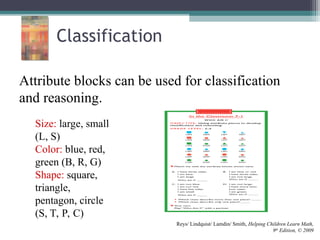
Classification
Size: large, small
(L, S)
Color: blue, red,
green (B, R, G)
Shape: square,
triangle,
pentagon, circle
(S, T, P, C)
Reys/ Lindquist/ Lamdin/ Smith, Helping Children Learn Math,
9th
Edition, © 2009
Attribute blocks can be used for classification
and reasoning.
Patterns
Reys/ Lindquist/ Lamdin/ Smith, Helping Children Learn Math,
9th
Edition, © 2009
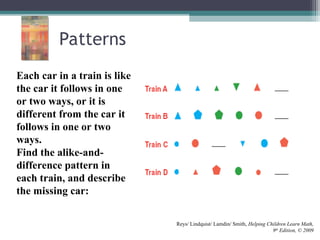
Each car in a train is like
the car it follows in one
or two ways, or it is
different from the car it
follows in one or two
ways.
Find the alike-and-
difference pattern in
each train, and describe
the missing car:
Extending a Pattern
Reys/ Lindquist/ Lamdin/ Smith, Helping Children Learn Math,
9th
Edition, © 2009
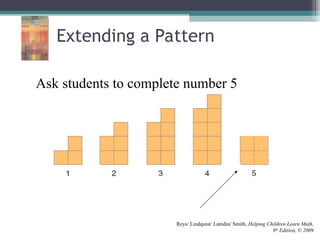
Ask students to complete number 5
Early Number Development
• Conservation
• Group Recognition
• Comparisons and One-to-one
Correspondence
Reys/ Lindquist/ Lamdin/ Smith, Helping Children Learn Math,
9th
Edition, © 2009
Conservation of Number
Reys/ Lindquist/ Lamdin/ Smith, Helping Children Learn Math,
9th
Edition, © 2009
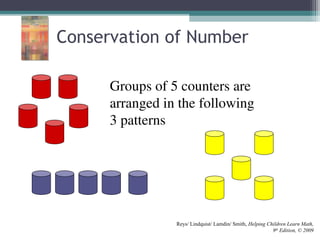
Groups of 5 counters are
arranged in the following
3 patterns
Student A
• T: Are there more red, blue, or yellow counters?
• S: More blue.
• T: How do you know?
• S: I can tell by looking.
• T: How many of each?
• S: One, two, three, four, five... five red. One, two, three, four,
five...five blue. One, two, three, four, five...five yellow.
• T: Five of each?
• S: Yes.
• T: Do you still think there are more blue?
• S: Yes, I can just see there's more blue.
Reys/ Lindquist/ Lamdin/ Smith, Helping Children Learn Math,
9th
Edition, © 2009
Conservation of Number
Student B
• T: Are there more red, blue, or yellow counters?
• S: They're the same.
• T: How do you know?
• S: I counted them.
• T: How many of each?
• S: One, two, three, four, five...Five red. Five blue.
Five yellow.
• T: Five of each?
• S: Yes.
Reys/ Lindquist/ Lamdin/ Smith, Helping Children Learn Math,
9th
Edition, © 2009
Conservation of Number
Group Recognition
Reys/ Lindquist/ Lamdin/ Smith, Helping Children Learn Math,
9th
Edition, © 2009
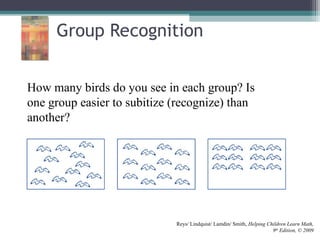
How many birds do you see in each group? Is
one group easier to subitize (recognize) than
another?
Comparisons and One-to-One
Correspondence
Reys/ Lindquist/ Lamdin/ Smith, Helping Children Learn Math,
9th
Edition, © 2009
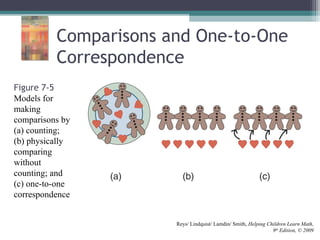
Figure 7-5
Models for
making
comparisons by
(a) counting;
(b) physically
comparing
without
counting; and
(c) one-to-one
correspondence
Number Development
• - Connecting groups with number names,
including oral and written cardinal and ordinal
numbers
• - Group recognition
• - Counting forward and backward
• - Skip counting
• - Establishing benchmarks of quantities, such as
5 or 10
• - Place value
Reys/ Lindquist/ Lamdin/ Smith, Helping Children Learn Math,
9th
Edition, © 2009
Counting: Principles
• One-to-One Rule
• Stable Order Rule
• Order Irrelevance Rule
• Cardinality Rule
Reys/ Lindquist/ Lamdin/ Smith, Helping Children Learn Math,
9th
Edition, © 2009
Counting: Counting Stages
• Rote Counters may know the proper counting sequence, but
they may not always be able to maintain a correct
correspondence between the objects being counted and the
number names.
• Rational Counters not only uses one-to-one
correspondence but also are able to answer the question
about the number of objects being counted.
Reys/ Lindquist/ Lamdin/ Smith, Helping Children Learn Math,
9th
Edition, © 2009
Counting: Counting Strategies
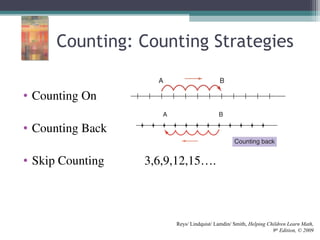
• Counting On
• Counting Back
• Skip Counting 3,6,9,12,15….
Reys/ Lindquist/ Lamdin/ Smith, Helping Children Learn Math,
9th
Edition, © 2009
Counting: Counting Practice
Counting practice should include counting on and counting
back.
A calculator is a valuable instructional tool that helps
improve children’s ability to count, but it is also a
powerful counting tool that they love to explore.
Reys/ Lindquist/ Lamdin/ Smith, Helping Children Learn Math,
9th
Edition, © 2009
Counting: Developing Number
Benchmarks
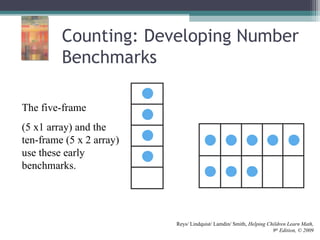
The five-frame
(5 x1 array) and the
ten-frame (5 x 2 array)
use these early
benchmarks.
Reys/ Lindquist/ Lamdin/ Smith, Helping Children Learn Math,
9th
Edition, © 2009
Counting: Making Connections
Reys/ Lindquist/ Lamdin/ Smith, Helping Children Learn Math,
9th
Edition, © 2009
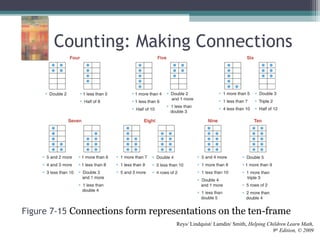
Figure 7-15 Connections form representations on the ten-frame
Cardinal, Ordinal, and Nominal
Numbers
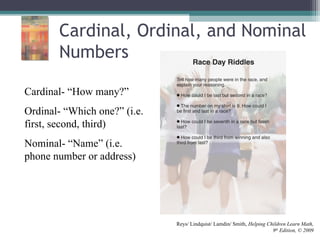
Cardinal- “How many?”
Ordinal- “Which one?” (i.e.
first, second, third)
Nominal- “Name” (i.e.
phone number or address)
Reys/ Lindquist/ Lamdin/ Smith, Helping Children Learn Math,
9th
Edition, © 2009
Writing Numerals
Reys/ Lindquist/ Lamdin/ Smith, Helping Children Learn Math,
9th
Edition, © 2009
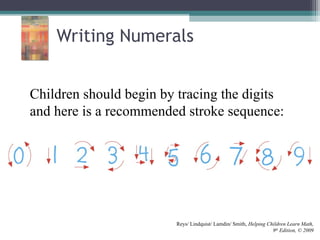
Children should begin by tracing the digits
and here is a recommended stroke sequence:
Counting Principles
Student A
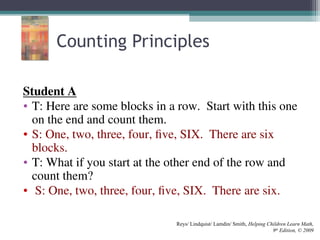
• T: Here are some blocks in a row. Start with this one
on the end and count them.
• S: One, two, three, four, five, SIX. There are six
blocks.
• T: What if you start at the other end of the row and
count them?
• S: One, two, three, four, five, SIX. There are six.
Reys/ Lindquist/ Lamdin/ Smith, Helping Children Learn Math,
9th
Edition, © 2009
Counting Principles (cont’d)
Student B
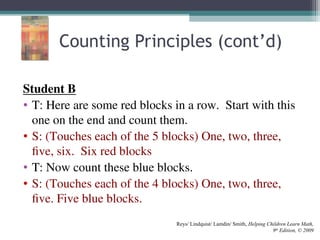
• T: Here are some red blocks in a row. Start with this
one on the end and count them.
• S: (Touches each of the 5 blocks) One, two, three,
five, six. Six red blocks
• T: Now count these blue blocks.
• S: (Touches each of the 4 blocks) One, two, three,
five. Five blue blocks.
Reys/ Lindquist/ Lamdin/ Smith, Helping Children Learn Math,
9th
Edition, © 2009
Counting Principles (cont’d)
Student C
• T: Here are some blocks in a row. Start with the one
on this end and count them.
• S: One, two, three, four, five, six. There are six.
• T: What if you start at the other end of the row and
count them?
• S: I already counted them! There are six!
Reys/ Lindquist/ Lamdin/ Smith, Helping Children Learn Math,
9th
Edition, © 2009
Counting Principles (cont’d)
Student D
• T: Here are some red blocks (4) in a row. Start with
this one on the end and count them.
• S: (Points to each but says two numbers with each
point) One, two, three, four, five, six, seven, eight.
Eight red blocks.
Reys/ Lindquist/ Lamdin/ Smith, Helping Children Learn Math,
9th
Edition, © 2009
Construct a Pattern
• The color spinner will be used to select the colors to
be used in constructing the pattern.
• Using the colors chosen, make a pattern that repeats
at least twice in the time allotted.
• When the time is up, compare patterns with others.
Did you come up with a unique pattern idea?
Reys/ Lindquist/ Lamdin/ Smith, Helping Children Learn Math,
9th
Edition, © 2009
Construct a Pattern
• Try another pattern with new colors or different types
of manipulatives.
• Why should students have an opportunity to
participate in patterning activities?
• Do you have other suggestions for patterning
activities?
Reys/ Lindquist/ Lamdin/ Smith, Helping Children Learn Math,
9th
Edition, © 2009
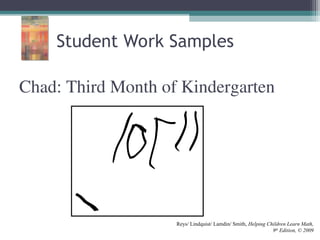
Chad: Third Month of Kindergarten
Reys/ Lindquist/ Lamdin/ Smith, Helping Children Learn Math,
9th
Edition, © 2009
Student Work Samples
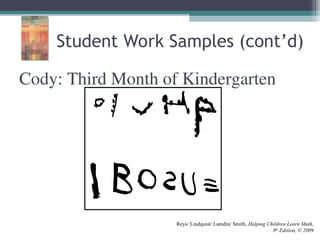
Cody: Third Month of Kindergarten
Reys/ Lindquist/ Lamdin/ Smith, Helping Children Learn Math,
9th
Edition, © 2009
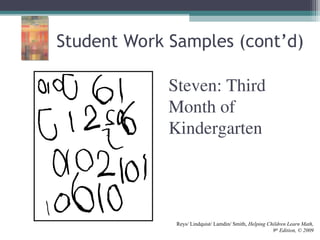
Student Work Samples (cont’d)
Steven: Third
Month of
Kindergarten
Reys/ Lindquist/ Lamdin/ Smith, Helping Children Learn Math,
9th
Edition, © 2009
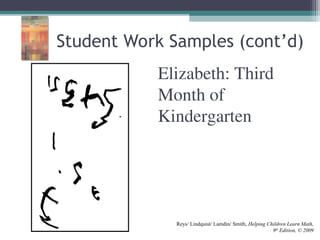
Student Work Samples (cont’d)
Elizabeth: Third
Month of
Kindergarten
Reys/ Lindquist/ Lamdin/ Smith, Helping Children Learn Math,
9th
Edition, © 2009
Student Work Samples (cont’d)
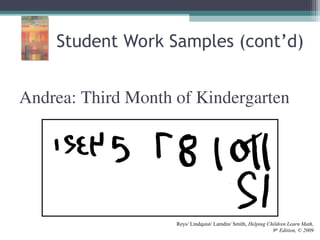
Andrea: Third Month of Kindergarten
Reys/ Lindquist/ Lamdin/ Smith, Helping Children Learn Math,
9th
Edition, © 2009
Student Work Samples (cont’d)
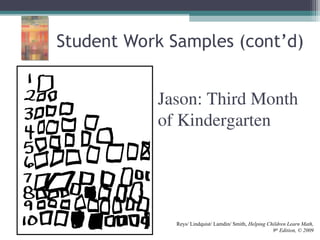
Jason: Third Month
of Kindergarten
Reys/ Lindquist/ Lamdin/ Smith, Helping Children Learn Math,
9th
Edition, © 2009
Student Work Samples (cont’d)
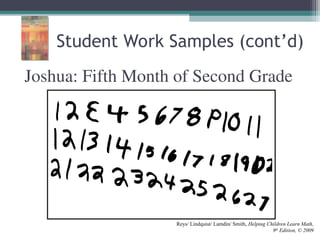
Joshua: Fifth Month of Second Grade
Reys/ Lindquist/ Lamdin/ Smith, Helping Children Learn Math,
9th
Edition, © 2009
Student Work Samples (cont’d)

teaching number and number sense.ppt

  • 1.
    Counting and Number Sensein Early Childhood and Primary Grades CHAPTER 7 Tina Rye Sloan To accompany Helping Children Learn Math9e, Reys et al. ©2009 John Wiley & Sons
  • 2.
    Focus Questions • Whyis subitizing an important early step in number sense? • What characteristics are associated with the different counting stages? • How can calculators help children develop number sense? Reys/ Lindquist/ Lamdin/ Smith, Helping Children Learn Math, 9th Edition, © 2009
  • 3.
    Understand numbers, waysof representing numbers, relationships among numbers, and number systems • Count with understanding and recognize “how many” in sets of objects • Develop understanding of the relative position and magnitude of whole numbers and of ordinal and cardinal numbers and their connections. • Connect number words and numerals to the quantities they represent, using various physical models and representations Excerpts of Expectations from the Number and Operations Standard Grades Pre-K-2 NCTM(2000). Principles and Standards for School Mathematics. Reys/ Lindquist/ Lamdin/ Smith, Helping Children Learn Math, 9th Edition, © 2009
  • 4.
    Number Sense Number Senseincludes: • An understanding of number concepts and operations on these numbers. • The development of useful strategies for handling numbers and operations. • The facility to compute accurately and efficiently, to detect errors, and to recognize results as reasonable. Reys/ Lindquist/ Lamdin/ Smith, Helping Children Learn Math, 9th Edition, © 2009
  • 5.
    Number Sense • Theability and inclination to use this understanding in flexible ways to make mathematical judgments. • An expectation that numbers are useful and that work with numbers is meaningful and makes sense. Reys/ Lindquist/ Lamdin/ Smith, Helping Children Learn Math, 9th Edition, © 2009
  • 6.
    Number Sense Stages •Number sense is not a finite entity that a student either has or does not have. Its development is a lifelong process, and in early childhood and elementary school number sense development involves several stages: • Prenumber Concepts • Early Number Development • Number Development Reys/ Lindquist/ Lamdin/ Smith, Helping Children Learn Math, 9th Edition, © 2009
  • 7.
    Prenumber Concepts arethose that do not rely on numbers but provide a foundation for later number concepts and skills. •Classification •Patterns Reys/ Lindquist/ Lamdin/ Smith, Helping Children Learn Math, 9th Edition, © 2009 Number Sense Stages
  • 8.
    Classification Size: large, small (L,S) Color: blue, red, green (B, R, G) Shape: square, triangle, pentagon, circle (S, T, P, C) Reys/ Lindquist/ Lamdin/ Smith, Helping Children Learn Math, 9th Edition, © 2009 Attribute blocks can be used for classification and reasoning.
  • 9.
    Patterns Reys/ Lindquist/ Lamdin/Smith, Helping Children Learn Math, 9th Edition, © 2009 Each car in a train is like the car it follows in one or two ways, or it is different from the car it follows in one or two ways. Find the alike-and- difference pattern in each train, and describe the missing car:
  • 10.
    Extending a Pattern Reys/Lindquist/ Lamdin/ Smith, Helping Children Learn Math, 9th Edition, © 2009 Ask students to complete number 5
  • 11.
    Early Number Development •Conservation • Group Recognition • Comparisons and One-to-one Correspondence Reys/ Lindquist/ Lamdin/ Smith, Helping Children Learn Math, 9th Edition, © 2009
  • 12.
    Conservation of Number Reys/Lindquist/ Lamdin/ Smith, Helping Children Learn Math, 9th Edition, © 2009 Groups of 5 counters are arranged in the following 3 patterns
  • 13.
    Student A • T:Are there more red, blue, or yellow counters? • S: More blue. • T: How do you know? • S: I can tell by looking. • T: How many of each? • S: One, two, three, four, five... five red. One, two, three, four, five...five blue. One, two, three, four, five...five yellow. • T: Five of each? • S: Yes. • T: Do you still think there are more blue? • S: Yes, I can just see there's more blue. Reys/ Lindquist/ Lamdin/ Smith, Helping Children Learn Math, 9th Edition, © 2009 Conservation of Number
  • 14.
    Student B • T:Are there more red, blue, or yellow counters? • S: They're the same. • T: How do you know? • S: I counted them. • T: How many of each? • S: One, two, three, four, five...Five red. Five blue. Five yellow. • T: Five of each? • S: Yes. Reys/ Lindquist/ Lamdin/ Smith, Helping Children Learn Math, 9th Edition, © 2009 Conservation of Number
  • 15.
    Group Recognition Reys/ Lindquist/Lamdin/ Smith, Helping Children Learn Math, 9th Edition, © 2009 How many birds do you see in each group? Is one group easier to subitize (recognize) than another?
  • 16.
    Comparisons and One-to-One Correspondence Reys/Lindquist/ Lamdin/ Smith, Helping Children Learn Math, 9th Edition, © 2009 Figure 7-5 Models for making comparisons by (a) counting; (b) physically comparing without counting; and (c) one-to-one correspondence
  • 17.
    Number Development • -Connecting groups with number names, including oral and written cardinal and ordinal numbers • - Group recognition • - Counting forward and backward • - Skip counting • - Establishing benchmarks of quantities, such as 5 or 10 • - Place value Reys/ Lindquist/ Lamdin/ Smith, Helping Children Learn Math, 9th Edition, © 2009
  • 18.
    Counting: Principles • One-to-OneRule • Stable Order Rule • Order Irrelevance Rule • Cardinality Rule Reys/ Lindquist/ Lamdin/ Smith, Helping Children Learn Math, 9th Edition, © 2009
  • 19.
    Counting: Counting Stages •Rote Counters may know the proper counting sequence, but they may not always be able to maintain a correct correspondence between the objects being counted and the number names. • Rational Counters not only uses one-to-one correspondence but also are able to answer the question about the number of objects being counted. Reys/ Lindquist/ Lamdin/ Smith, Helping Children Learn Math, 9th Edition, © 2009
  • 20.
    Counting: Counting Strategies •Counting On • Counting Back • Skip Counting 3,6,9,12,15…. Reys/ Lindquist/ Lamdin/ Smith, Helping Children Learn Math, 9th Edition, © 2009
  • 21.
    Counting: Counting Practice Countingpractice should include counting on and counting back. A calculator is a valuable instructional tool that helps improve children’s ability to count, but it is also a powerful counting tool that they love to explore. Reys/ Lindquist/ Lamdin/ Smith, Helping Children Learn Math, 9th Edition, © 2009
  • 22.
    Counting: Developing Number Benchmarks Thefive-frame (5 x1 array) and the ten-frame (5 x 2 array) use these early benchmarks. Reys/ Lindquist/ Lamdin/ Smith, Helping Children Learn Math, 9th Edition, © 2009
  • 23.
    Counting: Making Connections Reys/Lindquist/ Lamdin/ Smith, Helping Children Learn Math, 9th Edition, © 2009 Figure 7-15 Connections form representations on the ten-frame
  • 24.
    Cardinal, Ordinal, andNominal Numbers Cardinal- “How many?” Ordinal- “Which one?” (i.e. first, second, third) Nominal- “Name” (i.e. phone number or address) Reys/ Lindquist/ Lamdin/ Smith, Helping Children Learn Math, 9th Edition, © 2009
  • 25.
    Writing Numerals Reys/ Lindquist/Lamdin/ Smith, Helping Children Learn Math, 9th Edition, © 2009 Children should begin by tracing the digits and here is a recommended stroke sequence:
  • 26.
    Counting Principles Student A •T: Here are some blocks in a row. Start with this one on the end and count them. • S: One, two, three, four, five, SIX. There are six blocks. • T: What if you start at the other end of the row and count them? • S: One, two, three, four, five, SIX. There are six. Reys/ Lindquist/ Lamdin/ Smith, Helping Children Learn Math, 9th Edition, © 2009
  • 27.
    Counting Principles (cont’d) StudentB • T: Here are some red blocks in a row. Start with this one on the end and count them. • S: (Touches each of the 5 blocks) One, two, three, five, six. Six red blocks • T: Now count these blue blocks. • S: (Touches each of the 4 blocks) One, two, three, five. Five blue blocks. Reys/ Lindquist/ Lamdin/ Smith, Helping Children Learn Math, 9th Edition, © 2009
  • 28.
    Counting Principles (cont’d) StudentC • T: Here are some blocks in a row. Start with the one on this end and count them. • S: One, two, three, four, five, six. There are six. • T: What if you start at the other end of the row and count them? • S: I already counted them! There are six! Reys/ Lindquist/ Lamdin/ Smith, Helping Children Learn Math, 9th Edition, © 2009
  • 29.
    Counting Principles (cont’d) StudentD • T: Here are some red blocks (4) in a row. Start with this one on the end and count them. • S: (Points to each but says two numbers with each point) One, two, three, four, five, six, seven, eight. Eight red blocks. Reys/ Lindquist/ Lamdin/ Smith, Helping Children Learn Math, 9th Edition, © 2009
  • 30.
    Construct a Pattern •The color spinner will be used to select the colors to be used in constructing the pattern. • Using the colors chosen, make a pattern that repeats at least twice in the time allotted. • When the time is up, compare patterns with others. Did you come up with a unique pattern idea? Reys/ Lindquist/ Lamdin/ Smith, Helping Children Learn Math, 9th Edition, © 2009
  • 31.
    Construct a Pattern •Try another pattern with new colors or different types of manipulatives. • Why should students have an opportunity to participate in patterning activities? • Do you have other suggestions for patterning activities? Reys/ Lindquist/ Lamdin/ Smith, Helping Children Learn Math, 9th Edition, © 2009
  • 32.
    Chad: Third Monthof Kindergarten Reys/ Lindquist/ Lamdin/ Smith, Helping Children Learn Math, 9th Edition, © 2009 Student Work Samples
  • 33.
    Cody: Third Monthof Kindergarten Reys/ Lindquist/ Lamdin/ Smith, Helping Children Learn Math, 9th Edition, © 2009 Student Work Samples (cont’d)
  • 34.
    Steven: Third Month of Kindergarten Reys/Lindquist/ Lamdin/ Smith, Helping Children Learn Math, 9th Edition, © 2009 Student Work Samples (cont’d)
  • 35.
    Elizabeth: Third Month of Kindergarten Reys/Lindquist/ Lamdin/ Smith, Helping Children Learn Math, 9th Edition, © 2009 Student Work Samples (cont’d)
  • 36.
    Andrea: Third Monthof Kindergarten Reys/ Lindquist/ Lamdin/ Smith, Helping Children Learn Math, 9th Edition, © 2009 Student Work Samples (cont’d)
  • 37.
    Jason: Third Month ofKindergarten Reys/ Lindquist/ Lamdin/ Smith, Helping Children Learn Math, 9th Edition, © 2009 Student Work Samples (cont’d)
  • 38.
    Joshua: Fifth Monthof Second Grade Reys/ Lindquist/ Lamdin/ Smith, Helping Children Learn Math, 9th Edition, © 2009 Student Work Samples (cont’d)

Editor's Notes

  • #3  Master 7-2: Number and Operations Excerpts (number concepts)
  • #4 Master 7-1: Number Sense
  • #5 Master 7-1: Number Sense
  • #7 Master 7-3: Prenumber and Early Number Concepts
  • #12 Master 7-4: Conservation of Number
  • #13 Master 7-4: Conservation of Number
  • #14 Master 7-4: Conservation of Number
  • #18 Master 7-5: Counting
  • #19 Master 7-5: Counting
  • #20 Master 7-5: Counting
  • #26 Master 7-6: Counting Principle Examples
  • #27 Master 7-6: Counting Principle Examples
  • #28 Master 7-6: Counting Principle Examples
  • #29 Master 7-6: Counting Principle Examples
  • #30 Master 7-7: Construct a Pattern
  • #31 Master 7-7: Construct a Pattern
  • #32 Master 7-8: Writing Sample
  • #33 Master 7-9: Writing Sample
  • #34 Master 7-10: Writing Sample
  • #35 Master 7-11: Writing Sample
  • #36 Master 7-12: Writing Sample
  • #37 Master 7-13: Writing Sample
  • #38 Master 7-14: Writing Sample