LEARNING TARGETS
At theend of the lesson, students are expected to:
1.Understand the meaning of authentic assessment.
2.Describe the characteristics of authentic assessment.
3.Identify the practices of authentic assessment.
3.
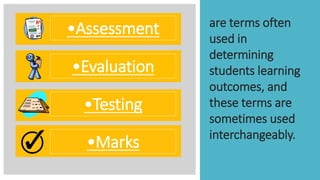
are terms often
usedin
determining
students learning
outcomes, and
these terms are
sometimes used
interchangeably.
•Assessment
•Evaluation
•Testing
•Marks
4.
-refer to theprocess of gathering data
and information about what students
know and can do. It can be observed
during learning activities, examining the
results of their learning activities or
testing their knowledge and skills.
Through assessment, the teacher can
find out what students are learning.
Assessment
5.
--involves review ofevidence of learning
such as journal entries, written work,
portfolios, skill demonstrations,
performance in learning activities, test
results and rubrics ratings which cover a
period time and should reveal the
progress of the students in competencies
Assessment
6.
--involves the taskof interpreting, forming
conclusions and making judgements about
the information which was gathered in the
process of assessment that will reflect the
learning process.
-occurs when a mark or grade is assigned
after a quiz, presentation or a completed
task.
Evaluation
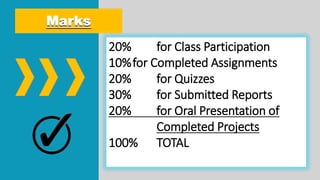
-are report ofthe results of evaluating
information obtained in the assessment
process. Marks have certain components
related to the learning activities
undertaken by the students.
Marks
9.
20% for ClassParticipation
10%for Completed Assignments
20% for Quizzes
30% for Submitted Reports
20% for Oral Presentation of
Completed Projects
100% TOTAL
Marks
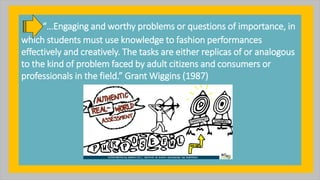
“…Engaging and worthyproblems or questions of importance, in
which students must use knowledge to fashion performances
effectively and creatively. The tasks are either replicas of or analogous
to the kind of problem faced by adult citizens and consumers or
professionals in the field.” Grant Wiggins (1987)
12.
“Performance (Authentic) assessmentscall upon the examinee to
demonstrate specific skills and competencies; that is, to apply of their
weakness. This results are diminished fear of tests and improvements
of self-esteem.”
13.
AA encourages alearner-centered class where the teacher’s
major role is to help students accepts responsibility for their learning
and become self-evaluators.
The teachers’ designs activities and evaluates results which provide
information needed for monitoring students’ progress and evaluating
the teacher’s instructional strategies.
15.
AA starts withclear and definite criteria of
performance made known to the students.
AA requires students to make their own answers to
questions rather than select from given options as
in multiple choice items, and requires them to use
a range of higher order thinking skills(HOTS).
AA is criterion-referenced rather than
norm-referenced and so it identifies strengths
and weaknesses, but does not compare students
nor rank their level of performance.
16.
AA often emphasizesperformance and therefore students
are required to demonstrate their knowledge, skills
and competencies in appropriate situations.
AA does not rely on ability to recall facts or
memorize details, instead students are asked
to demonstrate skills and concepts they have learned.
AA encourages both teacher and students to
determine their rate of progress in cooperatively
attaining the desired student learning outcomes.
17.
AA does notencourage rote learning and passive
taking of tests; instead, students are required to
demonstrate analytical skills, ability to integrate
what they learn, creativity and ability to work in
a group, skills in oral and written communications.
AA values not only the finished products which are the
learning outcomes, but also the process of learning.
AA changes role of students as passive test takers
into becoming active and involved participants in
assessment activities that emphasize what they
are capable of doing.
AA does not encourage rote learning and passive
taking of tests; instead, students are required to
demonstrate analytical skills, ability to integrate
what they learn, creativity and ability to work in
a group, skills in oral and written communications.
AA values not only the finished products which are the
learning outcomes, but also the process of learning.
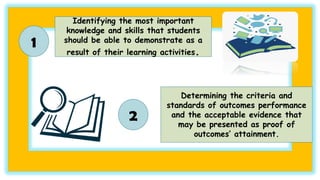
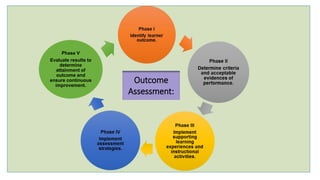
19.
1
Identifying the mostimportant
knowledge and skills that students
should be able to demonstrate as a
result of their learning activities.
2
Determining the criteria and
standards of outcomes performance
and the acceptable evidence that
may be presented as proof of
outcomes’ attainment.
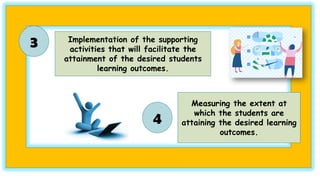
20.
3 Implementation ofthe supporting
activities that will facilitate the
attainment of the desired students
learning outcomes.
4
Measuring the extent at
which the students are
attaining the desired learning
outcomes.
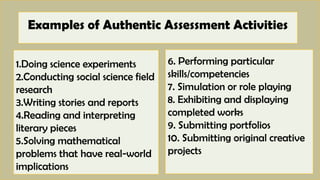
Examples of AuthenticAssessment Activities
1.Doing science experiments
2.Conducting social science field
research
3.Writing stories and reports
4.Reading and interpreting
literary pieces
5.Solving mathematical
problems that have real-world
implications
6. Performing particular
skills/competencies
7. Simulation or role playing
8. Exhibiting and displaying
completed works
9. Submitting portfolios
10. Submitting original creative
projects
24.
Traditional Assessment
(TA)
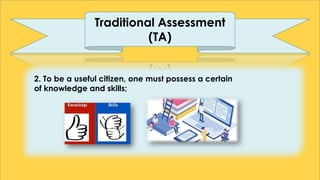
-commonly associatedwith pre-determined choice
measures of assessment such as multiple choice tasks, fill-in-the-
blanks, true-false, matching type and others. Students typically
recall or select the answers.
-TA springs from the educational philosophy which involves
the following principles and practices:
Traditional Assessment
(TA)
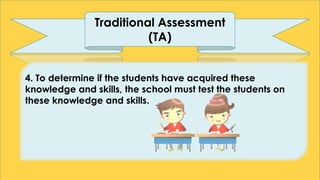
4. Todetermine if the students have acquired these
knowledge and skills, the school must test the students on
these knowledge and skills.
30.
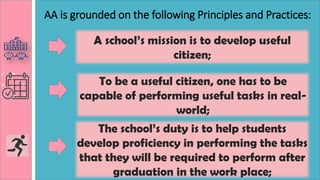
AA is groundedon the following Principles and Practices:
A school’s mission is to develop useful
citizen;
To be a useful citizen, one has to be
capable of performing useful tasks in real-
world;
The school’s duty is to help students
develop proficiency in performing the tasks
that they will be required to perform after
graduation in the work place;
31.
AA is groundedon the following Principles and Practices:
The school must then require students to
perform tasks that duplicate or imitate
real-world situations
32.
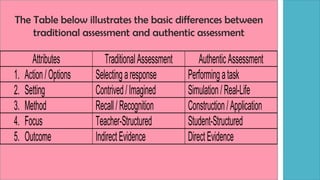
The Table belowillustrates the basic differences between
traditional assessment and authentic assessment
.
Attributes TraditionalAssessment AuthenticAssessment
1. Action/Options Selectingaresponse Performingatask
2. Setting Contrived/Imagined Simulation/Real-Life
3. Method Recall/Recognition Construction/Application
4. Focus Teacher-Structured Student-Structured
5. Outcome IndirectEvidence DirectEvidence
34.
Teachers do nothave to select between authentic
assessment and traditional assessment. Mastery of
knowledge and skills which is the focus of traditional
assessment must be encouraged among the students to
form the foundation on which will be built the activities
that will require students to demonstrate and perform
the tasks that they are expected to perform in the real
world.
35.
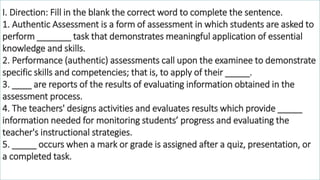
I. Direction: Fillin the blank the correct word to complete the sentence.
1. Authentic Assessment is a form of assessment in which students are asked to
perform _______ task that demonstrates meaningful application of essential
knowledge and skills.
2. Performance (authentic) assessments call upon the examinee to demonstrate
specific skills and competencies; that is, to apply of their _____.
3. ____ are reports of the results of evaluating information obtained in the
assessment process.
4. The teachers' designs activities and evaluates results which provide _____
information needed for monitoring students’ progress and evaluating the
teacher's instructional strategies.
5. _____ occurs when a mark or grade is assigned after a quiz, presentation, or
a completed task.
36.
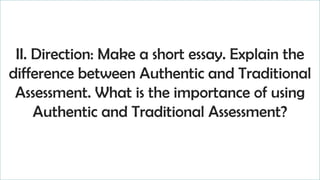
II. Direction: Makea short essay. Explain the
difference between Authentic and Traditional
Assessment. What is the importance of using
Authentic and Traditional Assessment?
38.
Prepared by: Beed3A
Alcomendas, Joshua J.
Ayala, Jelly Mae B.
Balisoro, Wacky L.
Bernas, Patricia Mae B.
Bernas, Jhon Philip F.