… and now for…
Sequences
1
Sequences
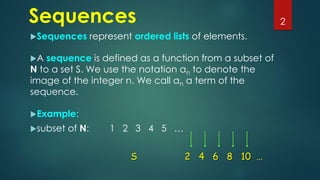
Sequences represent ordered lists of elements.
A sequence is defined as a function from a subset of
N to a set S. We use the notation an to denote the
image of the integer n. We call an a term of the
sequence.
Example:
subset of N: 1 2 3 4 5 …
2
S 2 4 6 8 10 …
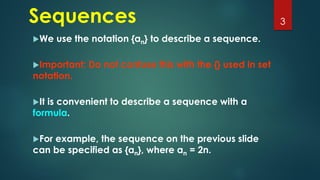
We use the notation {an} to describe a sequence.
Important: Do not confuse this with the {} used in set
notation.
It is convenient to describe a sequence with a
formula.
For example, the sequence on the previous slide
can be specified as {an}, where an = 2n.
3
Sequences
The Formula Game
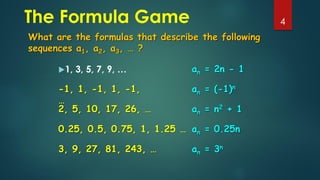
1, 3, 5, 7, 9, …
4
an = 2n - 1
-1, 1, -1, 1, -1,
…
an = (-1)n
2, 5, 10, 17, 26, … an = n2 + 1
0.25, 0.5, 0.75, 1, 1.25 … an = 0.25n
3, 9, 27, 81, 243, … an = 3n
What are the formulas that describe the following
sequences a1, a2, a3, … ?
Strings
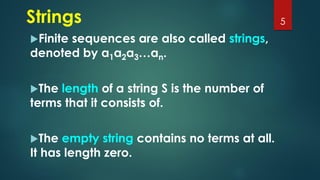
Finite sequences are also called strings,
denoted by a1a2a3…an.
The length of a string S is the number of
terms that it consists of.
The empty string contains no terms at all.
It has length zero.
5
Summations
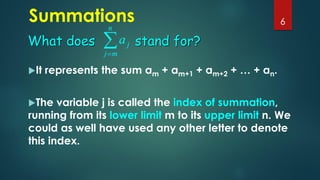
It represents the sum am + am+1 + am+2 + … + an.
The variable j is called the index of summation,
running from its lower limit m to its upper limit n. We
could as well have used any other letter to denote
this index.
6

=
n
m
j
j
a
What does stand for?
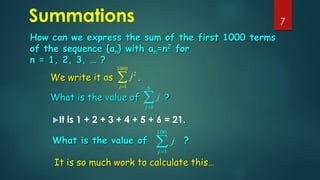
It is 1 + 2 + 3 + 4 + 5 + 6 = 21.
7
We write it as .

=
1000
1
2
j
j
What is the value of ?

=
6
1
j
j
It is so much work to calculate this…
What is the value of ?

=
100
1
j
j
How can we express the sum of the first 1000 terms
of the sequence {an} with an=n2 for
n = 1, 2, 3, … ?
Summations
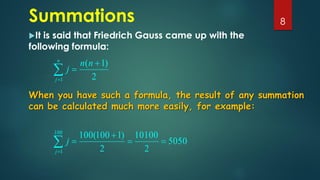
It is said that Friedrich Gauss came up with the
following formula:
8

=
+
=
n
j
n
n
j
1 2
)
1
(
When you have such a formula, the result of any summation
can be calculated much more easily, for example:
5050
2
10100
2
)
1
100
(
100
100
1
=
=
+
=

=
j
j
Summations
Arithemetic Series
How does:
9

=
+
=
n
j
n
n
j
1 2
)
1
(
Observe that:
1 + 2 + 3 +…+ n/2 + (n/2 + 1) +…+ (n - 2) + (n - 1) + n
???
= [1 + n] + [2 + (n - 1)] + [3 + (n - 2)] +…+ [n/2 + (n/2 + 1)]
= (n + 1) + (n + 1) + (n + 1) + … + (n + 1) (with n/2 terms)
= n(n + 1)/2.
Geometric Series
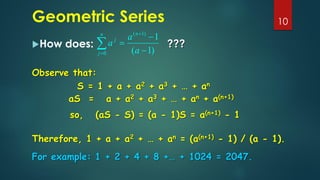
How does:
10

=
+
−
−
=
n
j
n
j
a
a
a
0
)
1
(
)
1
(
1
Observe that:
S = 1 + a + a2 + a3 + … + an
???
aS = a + a2 + a3 + … + an + a(n+1)
so, (aS - S) = (a - 1)S = a(n+1) - 1
Therefore, 1 + a + a2 + … + an = (a(n+1) - 1) / (a - 1).
For example: 1 + 2 + 4 + 8 +… + 1024 = 2047.
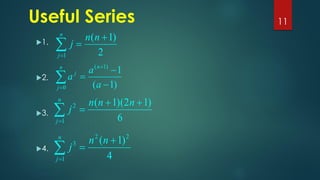
Useful Series
1.
2.
3.
4.
11

=
+
−
−
=
n
j
n
j
a
a
a
0
)
1
(
)
1
(
1

=
+
=
n
j
n
n
j
1 2
)
1
(

=
+
+
=
n
j
n
n
n
j
1
2
6
)
1
2
)(
1
(

=
+
=
n
j
n
n
j
1
2
2
3
4
)
1
(

Discrete Mathematics - Sequences .pdf

  • 1.
    … and nowfor… Sequences 1
  • 2.
    Sequences Sequences represent orderedlists of elements. A sequence is defined as a function from a subset of N to a set S. We use the notation an to denote the image of the integer n. We call an a term of the sequence. Example: subset of N: 1 2 3 4 5 … 2 S 2 4 6 8 10 …
  • 3.
    We use thenotation {an} to describe a sequence. Important: Do not confuse this with the {} used in set notation. It is convenient to describe a sequence with a formula. For example, the sequence on the previous slide can be specified as {an}, where an = 2n. 3 Sequences
  • 4.
    The Formula Game 1,3, 5, 7, 9, … 4 an = 2n - 1 -1, 1, -1, 1, -1, … an = (-1)n 2, 5, 10, 17, 26, … an = n2 + 1 0.25, 0.5, 0.75, 1, 1.25 … an = 0.25n 3, 9, 27, 81, 243, … an = 3n What are the formulas that describe the following sequences a1, a2, a3, … ?
  • 5.
    Strings Finite sequences arealso called strings, denoted by a1a2a3…an. The length of a string S is the number of terms that it consists of. The empty string contains no terms at all. It has length zero. 5
  • 6.
    Summations It represents thesum am + am+1 + am+2 + … + an. The variable j is called the index of summation, running from its lower limit m to its upper limit n. We could as well have used any other letter to denote this index. 6  = n m j j a What does stand for?
  • 7.
    It is 1+ 2 + 3 + 4 + 5 + 6 = 21. 7 We write it as .  = 1000 1 2 j j What is the value of ?  = 6 1 j j It is so much work to calculate this… What is the value of ?  = 100 1 j j How can we express the sum of the first 1000 terms of the sequence {an} with an=n2 for n = 1, 2, 3, … ? Summations
  • 8.
    It is saidthat Friedrich Gauss came up with the following formula: 8  = + = n j n n j 1 2 ) 1 ( When you have such a formula, the result of any summation can be calculated much more easily, for example: 5050 2 10100 2 ) 1 100 ( 100 100 1 = = + =  = j j Summations
  • 9.
    Arithemetic Series How does: 9  = + = n j n n j 12 ) 1 ( Observe that: 1 + 2 + 3 +…+ n/2 + (n/2 + 1) +…+ (n - 2) + (n - 1) + n ??? = [1 + n] + [2 + (n - 1)] + [3 + (n - 2)] +…+ [n/2 + (n/2 + 1)] = (n + 1) + (n + 1) + (n + 1) + … + (n + 1) (with n/2 terms) = n(n + 1)/2.
  • 10.
    Geometric Series How does: 10  = + − − = n j n j a a a 0 ) 1 ( ) 1 ( 1 Observethat: S = 1 + a + a2 + a3 + … + an ??? aS = a + a2 + a3 + … + an + a(n+1) so, (aS - S) = (a - 1)S = a(n+1) - 1 Therefore, 1 + a + a2 + … + an = (a(n+1) - 1) / (a - 1). For example: 1 + 2 + 4 + 8 +… + 1024 = 2047.
  • 11.