AUDIO INFORMATION
AND
MEDIA INFORMATION
MEDIA AND INFORMATION LITERACY
Quarter II
OBJECTIVES
LEARNING COMPETENCY
* Describe the different dimensions of audio information and media
(MIL11/12AIM-IVd-11).
* Comprehend how audio information and media are formally and
informally produced, organized, and disseminated (MIL11/12AIM-IVd-12)
SPECIFIC OBJECTIVES:
1. Evaluate the reliability and validity of audio information and media and their
sources using selection criteria.
2. Produce and evaluate a creative audio-based presentation using design principle
and elements.
REVIEW
DEFINITION OF TERMS:
1.Visual Design
2. Balance
3. Visual Media
4. Directional
5. Center of Interest
MOTIVATION
Watch the trailer of “A
Woman of Paris” presented in
the video and answer the
following questions once you
are done watching.
MOTIVATION
ANGELIQUE T. DEL
ROSARIO
MOTIVATION
GUIDE QUESTIONS:
1. How did you find your experience in watching
the video clip of a silent movie?
2. Do you think most media consumers would
enjoy this type of media? Why or why not?
3. What suggestions can you make to improve
this video?
DISCUSSION
Audio
Audio is defined as anything connected to
sound, specifically when received, recorded,
transferred, or duplicated (HarperCollins, n.d.). It
is anything related to the documentation and
transmission of sound (Cambridge University,
n.d.). Audio is one of the resources of media and
information, along with text, visual, and motion.
DISCUSSION
Audio Media and Audio Information
Audio Media refers to the media communication
that uses audio equipment to report, document, and
deliver information through the means of sound. It may
also refer to audio formats such as analog tape
cassettes, digital compact discs, and computer files
containing audio. On the other hand, audio
information is the file or sound created and
transferred by using high fidelity waves that are heard
through certain audio tools.
DISCUSSION
Types and Categories of Audio Information
There are several types of audio file:
❖ Radio Broadcast – the act of sending a live or
recorded audio through radio waves meant for a
large group of listeners
DISCUSSION
Types and Categories of Audio Information
There are several types of audio file:
❖ Music – an artistic form of auditory
communication incorporating instrumental or
vocal tones in a structured and continuous
manner
DISCUSSION
Types and Categories of Audio Information
There are several types of audio file:
❖ Sound Recording – the encoding of any sound
sound from the surroundings; the act or
procedure of making a record of a certain sound
(Merriam-Webster, n.d.)
ANGELIQUE T. DEL
ROSARIO
DISCUSSION
Types and Categories of Audio Information
There are several types of audio file:
❖ Sound Clip/Sound Effect – the sound, aside
from dialogue and music, artificially made to
create an effect in a movie, play, or other
broadcast production (Oxford University, n.d.)
DISCUSSION
Types and Categories of Audio Information
There are several types of audio file:
❖ Audio Podcast – an episodic series of digital
audio or video file or recording that can be
downloaded by a user from a website to a media
player or computer to listen
DISCUSSION
WAYS OF STORING AUDIO FILES
❖ Tape – a magnetic tape sound recording format on which sound can
can be documented
❖ Compact Disc – a plastic-fabricated, circular tool on which audio,
video, and other digital information is recorded, stored, and played
back
❖ USB Flash Drive - an external hard disk drive, small enough to fit on
on a keychain, that can be plugged into the computer’s USB port
DISCUSSION
WAYS OF STORING AUDIO FILES
❖ Memory Card – a small, flat flash drive used to save data such as
audio files, pictures, texts, and videos for use on small, portable, or
remote computing devices
❖ Computer Hard Drive – a secondary data storage device for saving
digital data
❖ Internet/Cloud – a wide network of remote servers in the internet
meant to operate as storage and retrieval of audio files and other
computer data
DISCUSSION
AUDIO FILE FORMATS
❖ MP3 (MPEG Audio Layer 3) - a coding format for consumer
consumer audio, as well as a mean of sound sequence
compression for the transmission and playback of music on
most digital audio players
❖ M4A/AAC (MPEG-4 Audio/Advanced Audio Coding) - a file
file extension for lossy digital audio compression
DISCUSSION
AUDIO FILE FORMATS
❖ WAV (Waveform Audio File Format) - the Microsoft
Microsoft audio file format standard used for the
storage of digital audio data on personal computers
❖ WMA (Windows Media Audio) - a file extension
developed by Microsoft and used with Windows Media
Player
DISCUSSION
CHARACTERISTICS OF SOUND
The following are the characteristics of sound:
❖ Volume - the force of a sound
❖ Tone - the musical or vocal sound of a definite quality (Merriam-Webster,
n.d.)
❖ Pitch - the degree of highness or lowness of a sound (Oxford University,
n.d.)
❖ Loudness - the feature of a sound that determines the degree of the
auditory sensation produced (Merriam-Webster, n.d.)
DISCUSSION
PURPOSES OF USING SOUND OR AUDIO MEDIA
❖ These enable the learners to listen to the ideas and views of the
experts and other reliable people;
❖ These allow learners to listen to learning materials, like speeches;
❖ These serve as alternative guides for the learners when they are
doing their tasks, such as experiments; and
❖ These grant the learners audio files of important past events or
sounds from the settings that the learners cannot personally visit.
DISCUSSION
ELEMENT OF SOUND DESIGN
❖ Dialogue – a composition in the form of conversation between two
people
❖ Sound Effect - the sound, aside from dialogue and music, artificially
artificially made to create an effect in a movie, play, or broadcast
production (Oxford University, n.d.)
❖ Music - an instrumental or a vocal sound that conveys emotions
and ideas in significant forms through the elements of color, harmony,
melody, and rhythm
❖ Silence – the complete absence of noise or sound
DISCUSSION
PRINCIPLES OF SOUND DESIGN
❖ Mixing – the balance, combination, and control of numerous sound
elements
❖ Pace – the editing and the time control of sound design; it has numerous
categories:
1. Linear – the sounds that are permanent, used once, and will be in
the same place
2. Non-Linear – the sounds that are much more open in comparison
to linear sounds
3. Multi-Linear
DISCUSSION
PRINCIPLES OF SOUND DESIGN
❖ Transition – the process of getting from one element or fragment of
sound design to another; it has various types:
1. Segue – an uninterrupted movement from one piece of music to
another
2. Cross-Fade – the smooth transition of a sound between two side by
side audio files on the same track
3. V-Fade – a switch from one volume level to another softer or louder
level
4. Fade to Black – a type of V-Fade which has some silence between
the elements of sound design
DISCUSSION
PRINCIPLES OF SOUND DESIGN
❖ Stereo Imaging - the feature of sound documentation and
duplication concerning the supposed spatial locations of the
sound sources, both sideways and in depth.
GENERALIZATION
Answer the questions briefly based on your objective
insight and critical thinking.
1. What are the aspects that you must look at to regard an
audio information as valid and reliable?
2. How would a student like you benefit from the various
audio information and media available online?
3. What is the importance of audio or sound in media
production?
APPLICATION
Listen to the audio clip by accessing the link
provided below. After listening, complete the
table by supplying the appropriate description for
the indicated elements of sound design.
Audio link:
https://www.youtube.com/watch?v=VGRtovmOP
2I&list=PLODQoPsF-
a2fEyJKjp10CDARz6rKqDPVm&index=5
APPLICATION
ANGELIQUE T. DEL
ROSARIO
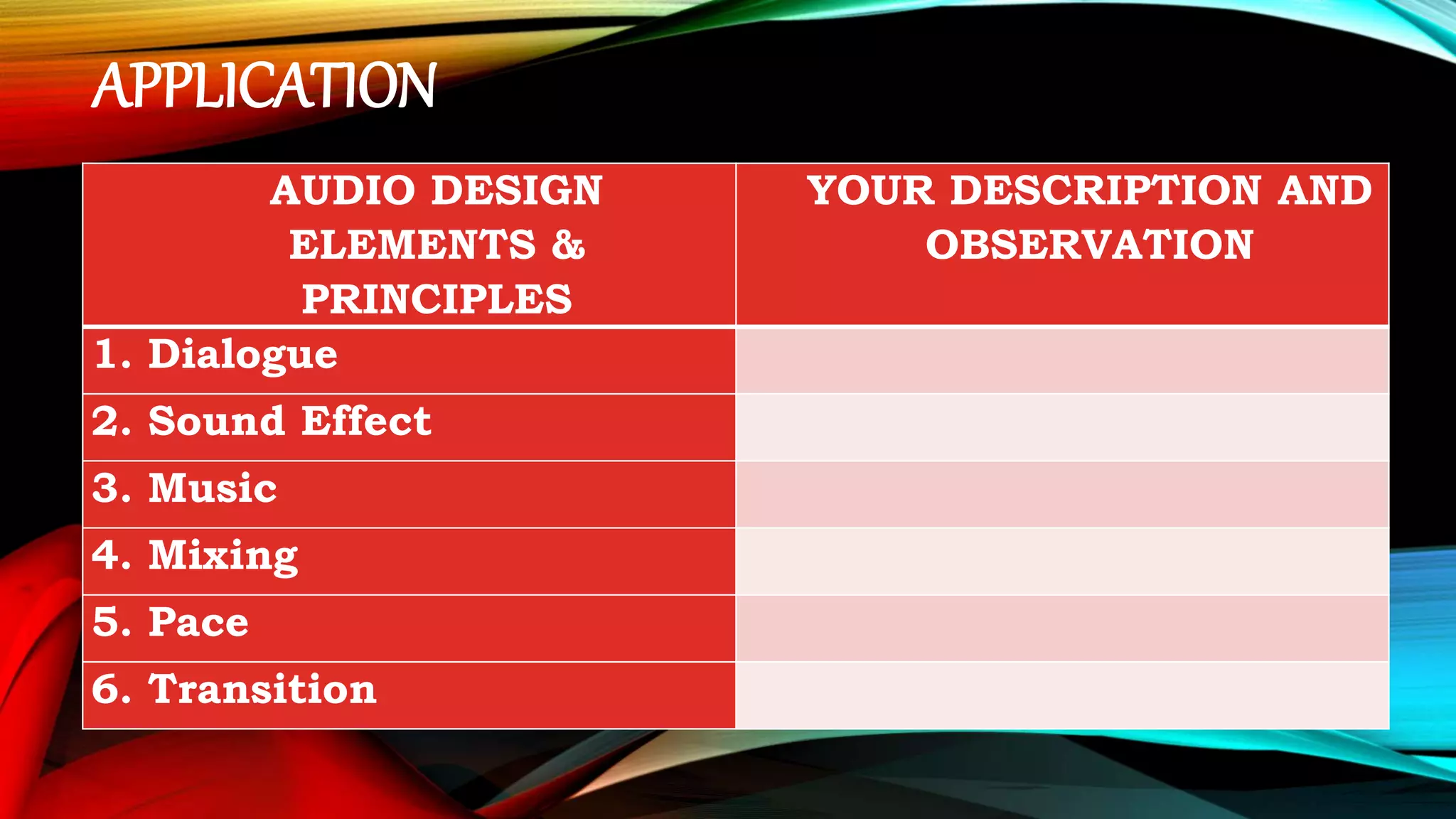
APPLICATION
AUDIO DESIGN
ELEMENTS &
PRINCIPLES
YOUR DESCRIPTION AND
OBSERVATION
1. Dialogue
2. Sound Effect
3. Music
4. Mixing
5. Pace
6. Transition
EVALUATION
Modified True or False: Read each statement carefully. Write True if the
statement is correct, but if it is false, change the underlined word or group of
words to make the whole statement true.
__________1. Mixing refers to the balance, combination, and control of
numerous sound elements.
__________2. Radio Broadcast is an episodic series of digital audio or video
file or recording that can be downloaded by a user from a website to a media
player or computer to listen.
__________3. USB Drive is a small, flat flash drive used to save data such as
audios, pictures, texts, and videos for use on small, portable, or remote
computing devices.
__________4. Silence refers to the complete absence of noise or sound.
__________5. WMA is the Microsoft audio file format standard used for the
storage of digital audio data on personal computers.
EVALUATION
__________6. Sound Clip is an instrumental or a vocal sound that conveys
emotions and ideas in significant forms through the elements of color,
harmony, melody, and rhythm.
__________7. Audio Podcast is the sound, aside from dialogue and music,
artificially made to create an effect in a movie, play, or other broadcast
production.
__________8. M4A is a coding format for consumer audio, as well as a means
of sound sequence compression for the transmission and playback of music
on most digital audio players.
__________9. Compact Disc refers to a plastic-fabricated, circular tool on
which audio, video, and other digital information is recorded, stored, and
played back.
__________10. Visual is defined as anything connected to sound, specifically
when received, recorded, transferred, or duplicated.
ASSIGNMENT
Write a short script for a radio
advertisement selling a moisturizing soap
for the face and body. You may create
your own product name. Be sure to
incorporate the principles and elements of
sound design in your radio commercial.
THANK YOU

AUDIO AND MEDIA INFORMATION.pptx

  • 1.
    AUDIO INFORMATION AND MEDIA INFORMATION MEDIAAND INFORMATION LITERACY Quarter II
  • 2.
    OBJECTIVES LEARNING COMPETENCY * Describethe different dimensions of audio information and media (MIL11/12AIM-IVd-11). * Comprehend how audio information and media are formally and informally produced, organized, and disseminated (MIL11/12AIM-IVd-12) SPECIFIC OBJECTIVES: 1. Evaluate the reliability and validity of audio information and media and their sources using selection criteria. 2. Produce and evaluate a creative audio-based presentation using design principle and elements.
  • 3.
    REVIEW DEFINITION OF TERMS: 1.VisualDesign 2. Balance 3. Visual Media 4. Directional 5. Center of Interest
  • 4.
    MOTIVATION Watch the trailerof “A Woman of Paris” presented in the video and answer the following questions once you are done watching.
  • 5.
  • 6.
    MOTIVATION GUIDE QUESTIONS: 1. Howdid you find your experience in watching the video clip of a silent movie? 2. Do you think most media consumers would enjoy this type of media? Why or why not? 3. What suggestions can you make to improve this video?
  • 7.
    DISCUSSION Audio Audio is definedas anything connected to sound, specifically when received, recorded, transferred, or duplicated (HarperCollins, n.d.). It is anything related to the documentation and transmission of sound (Cambridge University, n.d.). Audio is one of the resources of media and information, along with text, visual, and motion.
  • 8.
    DISCUSSION Audio Media andAudio Information Audio Media refers to the media communication that uses audio equipment to report, document, and deliver information through the means of sound. It may also refer to audio formats such as analog tape cassettes, digital compact discs, and computer files containing audio. On the other hand, audio information is the file or sound created and transferred by using high fidelity waves that are heard through certain audio tools.
  • 9.
    DISCUSSION Types and Categoriesof Audio Information There are several types of audio file: ❖ Radio Broadcast – the act of sending a live or recorded audio through radio waves meant for a large group of listeners
  • 10.
    DISCUSSION Types and Categoriesof Audio Information There are several types of audio file: ❖ Music – an artistic form of auditory communication incorporating instrumental or vocal tones in a structured and continuous manner
  • 11.
    DISCUSSION Types and Categoriesof Audio Information There are several types of audio file: ❖ Sound Recording – the encoding of any sound sound from the surroundings; the act or procedure of making a record of a certain sound (Merriam-Webster, n.d.) ANGELIQUE T. DEL ROSARIO
  • 12.
    DISCUSSION Types and Categoriesof Audio Information There are several types of audio file: ❖ Sound Clip/Sound Effect – the sound, aside from dialogue and music, artificially made to create an effect in a movie, play, or other broadcast production (Oxford University, n.d.)
  • 13.
    DISCUSSION Types and Categoriesof Audio Information There are several types of audio file: ❖ Audio Podcast – an episodic series of digital audio or video file or recording that can be downloaded by a user from a website to a media player or computer to listen
  • 14.
    DISCUSSION WAYS OF STORINGAUDIO FILES ❖ Tape – a magnetic tape sound recording format on which sound can can be documented ❖ Compact Disc – a plastic-fabricated, circular tool on which audio, video, and other digital information is recorded, stored, and played back ❖ USB Flash Drive - an external hard disk drive, small enough to fit on on a keychain, that can be plugged into the computer’s USB port
  • 15.
    DISCUSSION WAYS OF STORINGAUDIO FILES ❖ Memory Card – a small, flat flash drive used to save data such as audio files, pictures, texts, and videos for use on small, portable, or remote computing devices ❖ Computer Hard Drive – a secondary data storage device for saving digital data ❖ Internet/Cloud – a wide network of remote servers in the internet meant to operate as storage and retrieval of audio files and other computer data
  • 16.
    DISCUSSION AUDIO FILE FORMATS ❖MP3 (MPEG Audio Layer 3) - a coding format for consumer consumer audio, as well as a mean of sound sequence compression for the transmission and playback of music on most digital audio players ❖ M4A/AAC (MPEG-4 Audio/Advanced Audio Coding) - a file file extension for lossy digital audio compression
  • 17.
    DISCUSSION AUDIO FILE FORMATS ❖WAV (Waveform Audio File Format) - the Microsoft Microsoft audio file format standard used for the storage of digital audio data on personal computers ❖ WMA (Windows Media Audio) - a file extension developed by Microsoft and used with Windows Media Player
  • 18.
    DISCUSSION CHARACTERISTICS OF SOUND Thefollowing are the characteristics of sound: ❖ Volume - the force of a sound ❖ Tone - the musical or vocal sound of a definite quality (Merriam-Webster, n.d.) ❖ Pitch - the degree of highness or lowness of a sound (Oxford University, n.d.) ❖ Loudness - the feature of a sound that determines the degree of the auditory sensation produced (Merriam-Webster, n.d.)
  • 19.
    DISCUSSION PURPOSES OF USINGSOUND OR AUDIO MEDIA ❖ These enable the learners to listen to the ideas and views of the experts and other reliable people; ❖ These allow learners to listen to learning materials, like speeches; ❖ These serve as alternative guides for the learners when they are doing their tasks, such as experiments; and ❖ These grant the learners audio files of important past events or sounds from the settings that the learners cannot personally visit.
  • 20.
    DISCUSSION ELEMENT OF SOUNDDESIGN ❖ Dialogue – a composition in the form of conversation between two people ❖ Sound Effect - the sound, aside from dialogue and music, artificially artificially made to create an effect in a movie, play, or broadcast production (Oxford University, n.d.) ❖ Music - an instrumental or a vocal sound that conveys emotions and ideas in significant forms through the elements of color, harmony, melody, and rhythm ❖ Silence – the complete absence of noise or sound
  • 21.
    DISCUSSION PRINCIPLES OF SOUNDDESIGN ❖ Mixing – the balance, combination, and control of numerous sound elements ❖ Pace – the editing and the time control of sound design; it has numerous categories: 1. Linear – the sounds that are permanent, used once, and will be in the same place 2. Non-Linear – the sounds that are much more open in comparison to linear sounds 3. Multi-Linear
  • 22.
    DISCUSSION PRINCIPLES OF SOUNDDESIGN ❖ Transition – the process of getting from one element or fragment of sound design to another; it has various types: 1. Segue – an uninterrupted movement from one piece of music to another 2. Cross-Fade – the smooth transition of a sound between two side by side audio files on the same track 3. V-Fade – a switch from one volume level to another softer or louder level 4. Fade to Black – a type of V-Fade which has some silence between the elements of sound design
  • 23.
    DISCUSSION PRINCIPLES OF SOUNDDESIGN ❖ Stereo Imaging - the feature of sound documentation and duplication concerning the supposed spatial locations of the sound sources, both sideways and in depth.
  • 24.
    GENERALIZATION Answer the questionsbriefly based on your objective insight and critical thinking. 1. What are the aspects that you must look at to regard an audio information as valid and reliable? 2. How would a student like you benefit from the various audio information and media available online? 3. What is the importance of audio or sound in media production?
  • 25.
    APPLICATION Listen to theaudio clip by accessing the link provided below. After listening, complete the table by supplying the appropriate description for the indicated elements of sound design. Audio link: https://www.youtube.com/watch?v=VGRtovmOP 2I&list=PLODQoPsF- a2fEyJKjp10CDARz6rKqDPVm&index=5
  • 26.
  • 27.
    APPLICATION AUDIO DESIGN ELEMENTS & PRINCIPLES YOURDESCRIPTION AND OBSERVATION 1. Dialogue 2. Sound Effect 3. Music 4. Mixing 5. Pace 6. Transition
  • 28.
    EVALUATION Modified True orFalse: Read each statement carefully. Write True if the statement is correct, but if it is false, change the underlined word or group of words to make the whole statement true. __________1. Mixing refers to the balance, combination, and control of numerous sound elements. __________2. Radio Broadcast is an episodic series of digital audio or video file or recording that can be downloaded by a user from a website to a media player or computer to listen. __________3. USB Drive is a small, flat flash drive used to save data such as audios, pictures, texts, and videos for use on small, portable, or remote computing devices. __________4. Silence refers to the complete absence of noise or sound. __________5. WMA is the Microsoft audio file format standard used for the storage of digital audio data on personal computers.
  • 29.
    EVALUATION __________6. Sound Clipis an instrumental or a vocal sound that conveys emotions and ideas in significant forms through the elements of color, harmony, melody, and rhythm. __________7. Audio Podcast is the sound, aside from dialogue and music, artificially made to create an effect in a movie, play, or other broadcast production. __________8. M4A is a coding format for consumer audio, as well as a means of sound sequence compression for the transmission and playback of music on most digital audio players. __________9. Compact Disc refers to a plastic-fabricated, circular tool on which audio, video, and other digital information is recorded, stored, and played back. __________10. Visual is defined as anything connected to sound, specifically when received, recorded, transferred, or duplicated.
  • 30.
    ASSIGNMENT Write a shortscript for a radio advertisement selling a moisturizing soap for the face and body. You may create your own product name. Be sure to incorporate the principles and elements of sound design in your radio commercial.
  • 31.