AUDIO
INFORMATION
AND MEDIA
Introduction
RESOURCES OF MEDIA AND INFROMATION
a. People Media
b. Text
c. Visual
d. Audio
e. Motion
f. Manipulatives / Interactive
g. Multimedia
OUR TOPIC IS
AUDIO
INFORMATION
AND MEDIA
AUDIO
INFORMATION
AND MEDIA
WHAT IS AUDIO MEDIA?
* Audio formats. May refer to analog tape
cassettes and digital CDs as well as to
computer files containing audio in any
number of digital format.
*Audio media was founded in 1994 as a
digitil studio by T. Selvakumar, a well
known musician and in the Indian Film
University.
Types and Categories of Audio Information
a.Radio broadcast - live or recorded audio sent through radio waves to reach a wide
audience.
b.Music - vocal and/or instrumental sounds combined in such a way as to produce
beauty of form, harmony, and expression of emotion. It is composed and performed for
many purposes, ranging from aesthetic pleasure, religious or ceremonial purposes, or as
an entertainment product.
c.Sound recording - recording of an interview, meeting, or any sound from the
environment.
d.Sound clips/effects - any sound, other than music or speech, artificially reproduced to
create an effect in a dramatic presentation, as the sound of a storm or a creaking door.
e.Audio Podcast - a digital audio or video file or recording, usually part of a themed
series, that can be downloaded from a website to a media player or computer.
Different ways of storing audio media
•
•
•
•
•
•
a.Tape - magnetic tape on which sound can be
recorded.
b.CD - a plastic-fabricated, circular medium for
recording, storing, and playing back audio, video,
and computer data.
c.USB drive - an external flash drive, small
enough to carry on a key ring, that can be used
with any computer that has a USB port.
d.Memory Card - (aka flash memory card or
storage card) is a small storage medium used to
store data such as text, pictures, audio, and video,
for use on small, portable, or remote computing
devices.
e.Computer hard drive - secondary storage
devices for storing audio files.
f.Internet/Cloud - websites or file repositories for
retrieving audio files, and more precisely the files
are stored in some datacenter full of servers that
is connected to the Internet.
Different Audio file formats:
•
•
•
•
a.MP3 (MPEG Audio Layer 3) - a common format
for consumer audio, as well as a standard of
digital audio compression for the transfer and
playback of music on most digital audio players.
b.M4A/AAC (MPEG-4 Audio/Advanced Audio
Coding) - an audio coding standard for lossy
digital audio compression. Designed to be the
successor of the MP3 format, AAC generally
achieves better sound quality than MP3 at similar
bit rates.
c.WAV - is a Microsoft audio file format standard
for storing an audio bitstream on PCs. It has
become a standard file format for game sounds,
among others.
d.WMA (Windows Media Audio) - is an audio data
compression technology developed by Microsoft
and used with Windows Media Player.
TWO TYPES OF AUDIO MEDIA
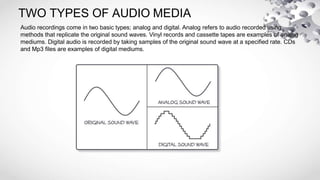
Audio recordings come in two basic types; analog and digital. Analog refers to audio recorded using
methods that replicate the original sound waves. Vinyl records and cassette tapes are examples of analog
mediums. Digital audio is recorded by taking samples of the original sound wave at a specified rate. CDs
and Mp3 files are examples of digital mediums.
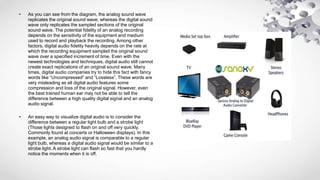
• As you can see from the diagram, the analog sound wave
replicates the original sound wave, whereas the digital sound
wave only replicates the sampled sections of the original
sound wave. The potential fidelity of an analog recording
depends on the sensitivity of the equipment and medium
used to record and playback the recording. Among other
factors, digital audio fidelity heavily depends on the rate at
which the recording equipment sampled the original sound
wave over a specified increment of time. Even with the
newest technologies and techniques, digital audio still cannot
create exact replications of an original sound wave. Many
times, digital audio companies try to hide this fact with fancy
words like “Uncompressed” and “Lossless”. These words are
very misleading as all digital audio features some
compression and loss of the original signal. However, even
the best trained human ear may not be able to tell the
difference between a high quality digital signal and an analog
audio signal.
• An easy way to visualize digital audio is to consider the
difference between a regular light bulb and a strobe light
(Those lights designed to flash on and off very quickly.
Commonly found at concerts or Halloween displays). In this
example, an analog audio signal is comparable to a regular
light bulb, whereas a digital audio signal would be similar to a
strobe light. A strobe light can flash so fast that you hardly
notice the moments when it is off.
REFRENCES
• http://teachtogether.chedk12.com/teaching_guides/view/2
52
• https://www.youtube.com/watch?v=cjO-wil4NMo
• https://www.slideshare.net/markjhonoxillo/audio-
information-and-media
Presented by:
Wandasan, Lycah Roelyn Y.
Buluran, Rhea Mae
Pioquinto, Wisdom Mae T.
Casas, Eugene

audio info and media.pptx

  • 1.
  • 2.
    Introduction RESOURCES OF MEDIAAND INFROMATION a. People Media b. Text c. Visual d. Audio e. Motion f. Manipulatives / Interactive g. Multimedia OUR TOPIC IS AUDIO INFORMATION AND MEDIA
  • 3.
  • 4.
    WHAT IS AUDIOMEDIA? * Audio formats. May refer to analog tape cassettes and digital CDs as well as to computer files containing audio in any number of digital format. *Audio media was founded in 1994 as a digitil studio by T. Selvakumar, a well known musician and in the Indian Film University.
  • 5.
    Types and Categoriesof Audio Information a.Radio broadcast - live or recorded audio sent through radio waves to reach a wide audience. b.Music - vocal and/or instrumental sounds combined in such a way as to produce beauty of form, harmony, and expression of emotion. It is composed and performed for many purposes, ranging from aesthetic pleasure, religious or ceremonial purposes, or as an entertainment product. c.Sound recording - recording of an interview, meeting, or any sound from the environment. d.Sound clips/effects - any sound, other than music or speech, artificially reproduced to create an effect in a dramatic presentation, as the sound of a storm or a creaking door. e.Audio Podcast - a digital audio or video file or recording, usually part of a themed series, that can be downloaded from a website to a media player or computer.
  • 6.
    Different ways ofstoring audio media • • • • • • a.Tape - magnetic tape on which sound can be recorded. b.CD - a plastic-fabricated, circular medium for recording, storing, and playing back audio, video, and computer data. c.USB drive - an external flash drive, small enough to carry on a key ring, that can be used with any computer that has a USB port. d.Memory Card - (aka flash memory card or storage card) is a small storage medium used to store data such as text, pictures, audio, and video, for use on small, portable, or remote computing devices. e.Computer hard drive - secondary storage devices for storing audio files. f.Internet/Cloud - websites or file repositories for retrieving audio files, and more precisely the files are stored in some datacenter full of servers that is connected to the Internet.
  • 7.
    Different Audio fileformats: • • • • a.MP3 (MPEG Audio Layer 3) - a common format for consumer audio, as well as a standard of digital audio compression for the transfer and playback of music on most digital audio players. b.M4A/AAC (MPEG-4 Audio/Advanced Audio Coding) - an audio coding standard for lossy digital audio compression. Designed to be the successor of the MP3 format, AAC generally achieves better sound quality than MP3 at similar bit rates. c.WAV - is a Microsoft audio file format standard for storing an audio bitstream on PCs. It has become a standard file format for game sounds, among others. d.WMA (Windows Media Audio) - is an audio data compression technology developed by Microsoft and used with Windows Media Player.
  • 8.
    TWO TYPES OFAUDIO MEDIA Audio recordings come in two basic types; analog and digital. Analog refers to audio recorded using methods that replicate the original sound waves. Vinyl records and cassette tapes are examples of analog mediums. Digital audio is recorded by taking samples of the original sound wave at a specified rate. CDs and Mp3 files are examples of digital mediums.
  • 9.
    • As youcan see from the diagram, the analog sound wave replicates the original sound wave, whereas the digital sound wave only replicates the sampled sections of the original sound wave. The potential fidelity of an analog recording depends on the sensitivity of the equipment and medium used to record and playback the recording. Among other factors, digital audio fidelity heavily depends on the rate at which the recording equipment sampled the original sound wave over a specified increment of time. Even with the newest technologies and techniques, digital audio still cannot create exact replications of an original sound wave. Many times, digital audio companies try to hide this fact with fancy words like “Uncompressed” and “Lossless”. These words are very misleading as all digital audio features some compression and loss of the original signal. However, even the best trained human ear may not be able to tell the difference between a high quality digital signal and an analog audio signal. • An easy way to visualize digital audio is to consider the difference between a regular light bulb and a strobe light (Those lights designed to flash on and off very quickly. Commonly found at concerts or Halloween displays). In this example, an analog audio signal is comparable to a regular light bulb, whereas a digital audio signal would be similar to a strobe light. A strobe light can flash so fast that you hardly notice the moments when it is off.
  • 10.
  • 12.
    Presented by: Wandasan, LycahRoelyn Y. Buluran, Rhea Mae Pioquinto, Wisdom Mae T. Casas, Eugene