AUDIO
INFORMATION AND
MEDIA
Intended Learning Outcomes
• Describe the different dimensions of audio information and media
• Comprehend how audio information and media is/are formally and
informally produced, organized, and disseminated
• Evaluate the reliability and validity of audio information and media
and it’s/their sources using selection criteria
Audio Media
- Media communication that
uses audio or recordings to
deliver and transfer
information through means of
sound
Types of Audio
Information Media
There are many different types of audio media, each with its own unique
characteristics and uses. Some common types include:
• Music: This can include any type of musical composition, from classical
to hip-hop.
• Podcasts: Audio recordings that can be downloaded or streamed online,
typically consisting of discussions or interviews on a particular topic.
• Radio shows: Live or pre-recorded broadcasts that typically feature
music, news, and other types of programming.
• Sound Recording: Recording of an interview, meeting, or any sound
from the environment
• Audiobooks: Narrated versions of books that can be listened to rather
than read.
• Sound effects: Pre-recorded or synthesized sounds used in the film,
television, and other forms of media to enhance the auditory
experience.
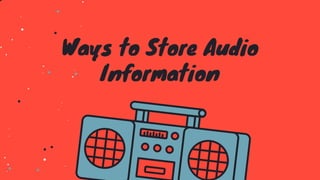
Ways to Store Audio
Information
Ways to Store Audio Information
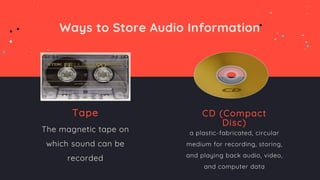
Tape
The magnetic tape on
which sound can be
recorded
CD (Compact
Disc)
a plastic-fabricated, circular
medium for recording, storing,
and playing back audio, video,
and computer data
Ways to Store Audio Information
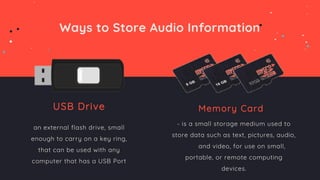
USB Drive
an external flash drive, small
enough to carry on a key ring,
that can be used with any
computer that has a USB Port
Memory Card
- is a small storage medium used to
store data such as text, pictures, audio,
and video, for use on small,
portable, or remote computing
devices.
Ways to Store Audio Information
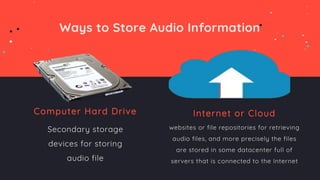
Computer Hard Drive
Secondary storage
devices for storing
audio file
Internet or Cloud
websites or file repositories for retrieving
audio files, and more precisely the files
are stored in some datacenter full of
servers that is connected to the Internet
Audio File Formats
MP3 (MPEG Audio Layer 3)
- a common format for consumer audio, as
well as a standard of digital audio
compression for the transfer and playback of
music on most digital audio players.
- An audio coding standard for lossy digital audio
compression. Designed to be the successor of the
MP3 format, AAC generally achieves better sound
quality than MP3 at a similar bit rate
M4A / AAC (MPEG4 Audio / Advanced Audio Coding)
- is a Microsoft audio file format
standard for storing an audio bitstream
on PCs. It has become a standard file
format for game sounds, among others
WAV
WMA (Windows Media Audio)
- is an audio data compression
technology developed by Microsoft and
used with Windows Media Player
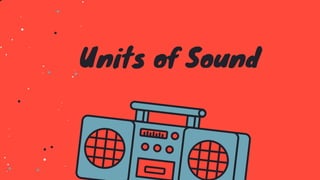
Units of Sound
• or simply dB
• noise of the sound measurement
• or simply Hz
• unit of sound frequency
•unit of subjective loudness
Characteristics of
Sound
1. Volume – the intensity of a sound
2. Tone – the audible characteristic of a
sound.
3. Pitch - is how high or low a sound is.
Principles of Sound
Design
1. Mixing – the combination, balance, and control of multiple sound
elements.
2. Pace – time control, editing, order of events
3. Stereo Imaging – Using left and right channels for depth. This
refers to the aspect of sound recording and reproduction.
4. Transition – how you get from one segment or element to
another
1. Segue – one element stops, and the next begins (“cut” in the film).
2. Cross-fade – one element fades out, the next fades in, and they overlap on the
way
3. V-Fade – the first element fades to inaudible before the second element begins
4. Waterfall –As the first element fades out, the second element begins at full
volume. Better for voice transitions, than for effects
Accessibility:
For individuals with visual
impairments, audio media provides a
means of accessing information and
entertainment that might otherwise be
difficult or impossible to obtain..
Convenience
Audio media can be enjoyed on
the go, making it a popular
choice for people who are
commuting or traveling.
Emotional Impact
Music and other types of audio
media can have a powerful
emotional impact on listeners,
evoking a wide range of feelings
and memories.
Educational Value
Audiobooks, podcasts, and
other types of audio media can
be a valuable source of
information and education on a
variety of topics.
The
Importance
of Audio
Media
ESTIMATED
ANNOUNCE DATES
Challenges in
Audio Media
Quality control:
• Ensuring that audio recordings are of high quality
and free from errors or technical issues can be
difficult.
Copyright issues:
• Audio media is subject to copyright laws, which
can make it difficult to use or distribute certain
types of content.
Language barriers:
• Audio media that is recorded in a particular
language may be inaccessible to those who
do not speak that language.
AAI | Pro X
Hearing
• the act of perceiving sound by the
ear
Listening
• requires concentration so that your
brain processes meaning from words
and sentences.
Question:
So, are you
listening or just
hearing?
FINAL WORDS
Music is the movement of
sound to reach the soul for
the education of its virtue.
PLATO
AAI | Pro X

audioinformationandmedia ITS FUNCTION AND USES

  • 1.
  • 2.
    Intended Learning Outcomes •Describe the different dimensions of audio information and media • Comprehend how audio information and media is/are formally and informally produced, organized, and disseminated • Evaluate the reliability and validity of audio information and media and it’s/their sources using selection criteria
  • 3.
    Audio Media - Mediacommunication that uses audio or recordings to deliver and transfer information through means of sound
  • 4.
  • 5.
    There are manydifferent types of audio media, each with its own unique characteristics and uses. Some common types include: • Music: This can include any type of musical composition, from classical to hip-hop. • Podcasts: Audio recordings that can be downloaded or streamed online, typically consisting of discussions or interviews on a particular topic. • Radio shows: Live or pre-recorded broadcasts that typically feature music, news, and other types of programming.
  • 6.
    • Sound Recording:Recording of an interview, meeting, or any sound from the environment • Audiobooks: Narrated versions of books that can be listened to rather than read. • Sound effects: Pre-recorded or synthesized sounds used in the film, television, and other forms of media to enhance the auditory experience.
  • 7.
    Ways to StoreAudio Information
  • 8.
    Ways to StoreAudio Information Tape The magnetic tape on which sound can be recorded CD (Compact Disc) a plastic-fabricated, circular medium for recording, storing, and playing back audio, video, and computer data
  • 9.
    Ways to StoreAudio Information USB Drive an external flash drive, small enough to carry on a key ring, that can be used with any computer that has a USB Port Memory Card - is a small storage medium used to store data such as text, pictures, audio, and video, for use on small, portable, or remote computing devices.
  • 10.
    Ways to StoreAudio Information Computer Hard Drive Secondary storage devices for storing audio file Internet or Cloud websites or file repositories for retrieving audio files, and more precisely the files are stored in some datacenter full of servers that is connected to the Internet
  • 11.
  • 12.
    MP3 (MPEG AudioLayer 3) - a common format for consumer audio, as well as a standard of digital audio compression for the transfer and playback of music on most digital audio players.
  • 13.
    - An audiocoding standard for lossy digital audio compression. Designed to be the successor of the MP3 format, AAC generally achieves better sound quality than MP3 at a similar bit rate M4A / AAC (MPEG4 Audio / Advanced Audio Coding)
  • 14.
    - is aMicrosoft audio file format standard for storing an audio bitstream on PCs. It has become a standard file format for game sounds, among others WAV
  • 15.
    WMA (Windows MediaAudio) - is an audio data compression technology developed by Microsoft and used with Windows Media Player
  • 16.
  • 17.
    • or simplydB • noise of the sound measurement
  • 18.
    • or simplyHz • unit of sound frequency
  • 19.
  • 20.
  • 21.
    1. Volume –the intensity of a sound 2. Tone – the audible characteristic of a sound. 3. Pitch - is how high or low a sound is.
  • 22.
  • 23.
    1. Mixing –the combination, balance, and control of multiple sound elements. 2. Pace – time control, editing, order of events 3. Stereo Imaging – Using left and right channels for depth. This refers to the aspect of sound recording and reproduction. 4. Transition – how you get from one segment or element to another
  • 24.
    1. Segue –one element stops, and the next begins (“cut” in the film). 2. Cross-fade – one element fades out, the next fades in, and they overlap on the way 3. V-Fade – the first element fades to inaudible before the second element begins 4. Waterfall –As the first element fades out, the second element begins at full volume. Better for voice transitions, than for effects
  • 25.
    Accessibility: For individuals withvisual impairments, audio media provides a means of accessing information and entertainment that might otherwise be difficult or impossible to obtain.. Convenience Audio media can be enjoyed on the go, making it a popular choice for people who are commuting or traveling. Emotional Impact Music and other types of audio media can have a powerful emotional impact on listeners, evoking a wide range of feelings and memories. Educational Value Audiobooks, podcasts, and other types of audio media can be a valuable source of information and education on a variety of topics. The Importance of Audio Media
  • 26.
    ESTIMATED ANNOUNCE DATES Challenges in AudioMedia Quality control: • Ensuring that audio recordings are of high quality and free from errors or technical issues can be difficult. Copyright issues: • Audio media is subject to copyright laws, which can make it difficult to use or distribute certain types of content. Language barriers: • Audio media that is recorded in a particular language may be inaccessible to those who do not speak that language. AAI | Pro X
  • 27.
    Hearing • the actof perceiving sound by the ear Listening • requires concentration so that your brain processes meaning from words and sentences.
  • 28.
  • 29.
    FINAL WORDS Music isthe movement of sound to reach the soul for the education of its virtue. PLATO AAI | Pro X