Audience Management
LIS 2016 Preparation
Outline
• Importance of audience analysis
• How to analyze the audience briefly
• How to spot difficult audience members
• How to deal with them
• Practice makes perfect!
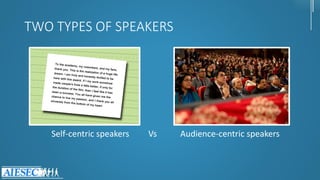
TWO TYPES OF SPEAKERS
Self-centric speakers Vs Audience-centric speakers
AUDIENCE
• A nalysis - Who are they? How many will be there?
• U nderstanding - What is their knowledge of the subject?
• D emographics - What is their age, sex, educational background?
• I nterest - Why are they there? Who asked them to be there?
• E nvironment - Where will I stand? Can they all see & hear me?
• N eeds - What are their needs? What are your needs as the speaker?
• C ustomized - What specific needs do you need to address?
• E xpectations - What do they expect to learn or hear from you?
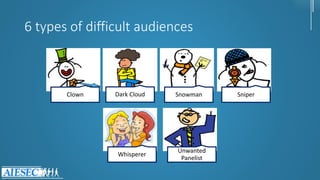
6 types of difficult audiences
Clown Dark Cloud Snowman Sniper
Whisperer
Unwanted
Panelist
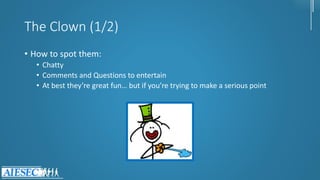
The Clown (1/2)
• How to spot them:
• Chatty
• Comments and Questions to entertain
• At best they’re great fun… but if you’re trying to make a serious point
The Clown (2/2)
• How to deal with them:
• Use them
• Give them spotlight for a couple of seconds, then refocus
The Sniper (1/2)
• How to spot them:
• Gets satisfaction from needling
• Cynical
• Arms may be folded, or eyes rolled as you start to speak.
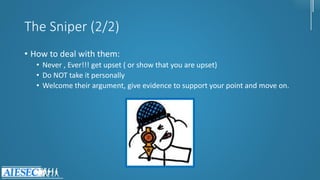
The Sniper (2/2)
• How to deal with them:
• Never , Ever!!! get upset ( or show that you are upset)
• Do NOT take it personally
• Welcome their argument, give evidence to support your point and move on.
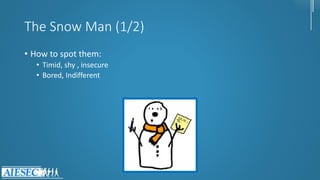
The Snow Man (1/2)
• How to spot them:
• Timid, shy , insecure
• Bored, Indifferent
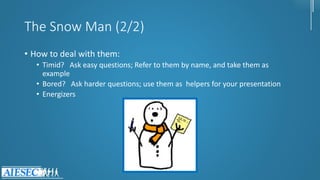
The Snow Man (2/2)
• How to deal with them:
• Timid? Ask easy questions; Refer to them by name, and take them as
example
• Bored? Ask harder questions; use them as helpers for your presentation
• Energizers
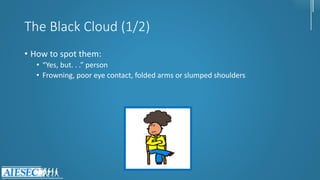
The Black Cloud (1/2)
• How to spot them:
• “Yes, but. . .” person
• Frowning, poor eye contact, folded arms or slumped shoulders
The Black Cloud (2/2)
• How to deal with them:
• Show them you are different- Positive
• Be enthusiastic
• Use peer pressure
The Unwanted Panelist (1/2)
• How to spot them:
• The ‘expert’ in the room
• Show off
• Well informed and anxious to show it
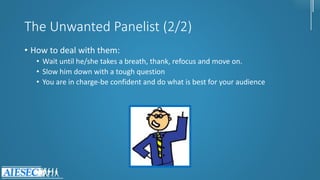
The Unwanted Panelist (2/2)
• How to deal with them:
• Wait until he/she takes a breath, thank, refocus and move on.
• Slow him down with a tough question
• You are in charge-be confident and do what is best for your audience
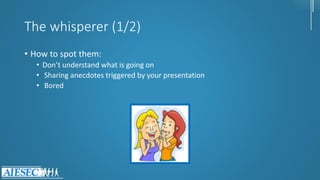
The whisperer (1/2)
• How to spot them:
• Don’t understand what is going on
• Sharing anecdotes triggered by your presentation
• Bored
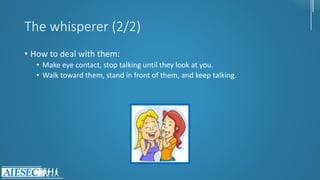
The whisperer (2/2)
• How to deal with them:
• Make eye contact, stop talking until they look at you.
• Walk toward them, stand in front of them, and keep talking.
Comment in the post if you
enjoyed!

Audience management

  • 1.
  • 2.
    Outline • Importance ofaudience analysis • How to analyze the audience briefly • How to spot difficult audience members • How to deal with them • Practice makes perfect!
  • 3.
    TWO TYPES OFSPEAKERS Self-centric speakers Vs Audience-centric speakers
  • 4.
    AUDIENCE • A nalysis- Who are they? How many will be there? • U nderstanding - What is their knowledge of the subject? • D emographics - What is their age, sex, educational background? • I nterest - Why are they there? Who asked them to be there? • E nvironment - Where will I stand? Can they all see & hear me? • N eeds - What are their needs? What are your needs as the speaker? • C ustomized - What specific needs do you need to address? • E xpectations - What do they expect to learn or hear from you?
  • 5.
    6 types ofdifficult audiences Clown Dark Cloud Snowman Sniper Whisperer Unwanted Panelist
  • 6.
    The Clown (1/2) •How to spot them: • Chatty • Comments and Questions to entertain • At best they’re great fun… but if you’re trying to make a serious point
  • 7.
    The Clown (2/2) •How to deal with them: • Use them • Give them spotlight for a couple of seconds, then refocus
  • 8.
    The Sniper (1/2) •How to spot them: • Gets satisfaction from needling • Cynical • Arms may be folded, or eyes rolled as you start to speak.
  • 9.
    The Sniper (2/2) •How to deal with them: • Never , Ever!!! get upset ( or show that you are upset) • Do NOT take it personally • Welcome their argument, give evidence to support your point and move on.
  • 10.
    The Snow Man(1/2) • How to spot them: • Timid, shy , insecure • Bored, Indifferent
  • 11.
    The Snow Man(2/2) • How to deal with them: • Timid? Ask easy questions; Refer to them by name, and take them as example • Bored? Ask harder questions; use them as helpers for your presentation • Energizers
  • 12.
    The Black Cloud(1/2) • How to spot them: • “Yes, but. . .” person • Frowning, poor eye contact, folded arms or slumped shoulders
  • 13.
    The Black Cloud(2/2) • How to deal with them: • Show them you are different- Positive • Be enthusiastic • Use peer pressure
  • 14.
    The Unwanted Panelist(1/2) • How to spot them: • The ‘expert’ in the room • Show off • Well informed and anxious to show it
  • 15.
    The Unwanted Panelist(2/2) • How to deal with them: • Wait until he/she takes a breath, thank, refocus and move on. • Slow him down with a tough question • You are in charge-be confident and do what is best for your audience
  • 16.
    The whisperer (1/2) •How to spot them: • Don’t understand what is going on • Sharing anecdotes triggered by your presentation • Bored
  • 17.
    The whisperer (2/2) •How to deal with them: • Make eye contact, stop talking until they look at you. • Walk toward them, stand in front of them, and keep talking.
  • 18.
    Comment in thepost if you enjoyed!