Downloaded 11 times
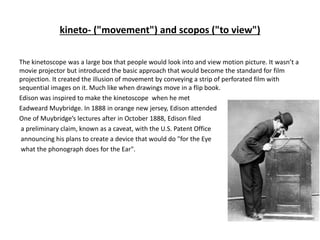
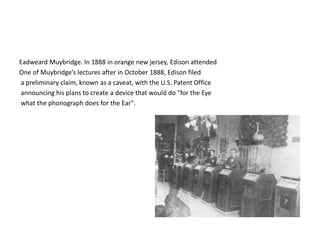
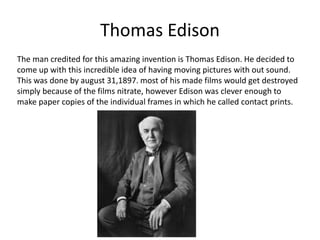

The kinetoscope was a device developed by Thomas Edison that allowed individual viewers to watch short motion pictures through a peephole viewer. It worked by conveying a strip of film with sequential images past the viewer, creating the illusion of movement similar to a flip book. Inspired by Eadweard Muybridge's work with sequential photography, Edison announced his plans in 1888 to create a device that would do "for the Eye what the phonograph does for the Ear". He went on to develop the kinetoscope, which introduced the basic approach of film projection that became the standard, although it was not itself a movie projector.


