DR (Mrs) Manju Gita Mishra
DGO., MS., FICS., FICOG., FIAMS., FICMCH
♦ Ex-Professor of Obstetrics and Gynaecology, Patna Medical College
and Hospital, Patna.
♦President ISOPARB 2014-2016.
♦At Present Consultant M.G.M. Hospital and Research Centre Pvt. Ltd., Patna.
♦ Chairperson Medical Education Committee, FOGSI -2007-09.
♦ Delivered Orations, Guest Lectures in State , National & International Conferences.
♦ Contributed chapters in FOGSI Publication and edited book – “CRITICAL CARE IN
OBSTETRICS 1st
& 2nd
edition “, “Treatment and Prognosis in Obstetrics & Gynaecology”
♦ More than seventy publications in various National and International Journals.
♦ Appointed Inspector by M.C.I. and National Board for recognition of D.G.O.,
M.D. and D.N.B. course in various Colleges and Institute.
♦Examiner – Under graduate, Post graduate, DNB
♦Special Interest in High Risk Pregnancy & Adolescent Gynaecology, Emergency Obstetrics.
♦ Past Senior Vice President ISOPARB
♦ Past President B.O.G.S.
♦ Past President I.M.A. Bihar State.
♦ Past President I.M.A. All India Women’s Doctors Wing.
♦ Past Secretary General ISOPARB.
♦ Past President Association Obstetrics Gynaecology Society Bihar Jharkhand
♦ Organized various Seminars, Workshops Conferences and rural camps.
♦Promoted O.C.P. and A.I.D.S. awareness in different parts of Bihar.
♦Organizing Secretary A.I.C.O.G. 2014.
♦ Adhoc committee member, Red Cross Society.
 Kanak Goyal Award
 C.L. Jhaveri Family Planning Award
 B.C. ROY Award
 R. K. Menda Community Service AwardRecipient of :
Abnormal uterine Bleeding (AUB)
Common concern for adolescent females
Significant impact on an adolescent’s quality of life
Affected
adolescents
ability to
participate
in physical,
educational
or sports
At least 1 day
of missed
school during
each menses
Disrupted
their hobbies
and leisure
activities
Physical
Social
Emotional and
Material
Excessive menstrual blood loss which interferes with woman’s
(NICE Guidelines for HMB, Jan. 2007).
Abnormal uterine Bleeding (AUB)
quality of life
AUB changes in frequency, volume, duration of flow, amount of blood loss
without any demonstrable organic cause -- genital or extra genital.
FIGO classification system
Discontinuation of the term dysfunctional uterine bleeding
Heavy menstrual
bleeding –
MENORRHAGIA
> 7 days / > 80cc
uterine bleeding
occurring at regular
intervals
Intermenstrual bleeding –
METRORRHAGIA
Uterine bleeding completely
irregular at frequent
intervals, the amount being
variable.
POLYMENORRHEA
Uterine bleeding at regular
intervals of less than 21 days.
OLIGOMENORRHEA
Uterine bleeding at regular
intervals from 35 days to 6 months.
FIGO classification system
American College of Obstetricians and gynaecologists. Obstet Gynecol 2013;121:891-6
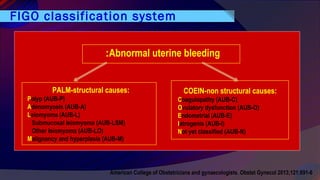
Abnormal uterine bleeding:
PALM-structural causes:
Polyp (AUB-P)
Adenomyosis (AUB-A)
Leiomyoma (AUB-L)
Submucosal Ieiomyoma (AUB-LSM)
Other Ieiomyoma (AUB-LO)
Malignancy and hyperplasia (AUB-M)
COEIN-non structural causes:
Coagulopathy (AUB-C)
Ovulatory dysfunction (AUB-O)
Endometrial (AUB-E)
Iatrogenis (AUB-I)
Not yet classified (AUB-N)
Etiology
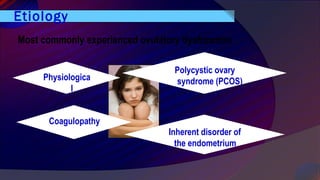
Most commonly experienced ovulatory dysfunction
Physiologica
l
Polycystic ovary
syndrome (PCOS)
Coagulopathy
Inherent disorder of
the endometrium
Etiology
Other causes of menorrhagia
• Pregnancy and infection-- should be considered in sexually
active adolescents.
• STI esp Chlamydia, endometritis can result in heavy
menses.
• Infection causes inflammation of the endometrium making
endometrial lining fragile. More likely to occur in adolescents
than in adults.
• Adolescent pregnancy should always be ruled out.
Pathophysiology
Anovulatory cycles
• Irregular menses due to an immature
hypothalamic– pituitary–ovarian axis
Ovaries produce continuous levels of estrogen
• No corpus luteum to secrete progesterone
• Ovarian estrogen is unopposed
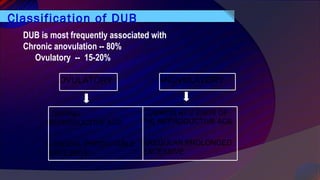
DUB is most frequently associated with
Chronic anovulation -- 80%
Ovulatory -- 15-20%
OVULATORYOVULATORY ANOVULATORYANOVULATORY
DURING
REPRODUCTIVE AGE
CYCLICAL PREDICTABLE
EXCESSIVE
COMMON AT 2 ENDS OF
THE REPRODUCTIVE AGE
IRREGULAR PROLONGED
EXCESSIVE
Classification of DUB
History
 Menstrual history
Smartphone application to keep track
 Associated symptoms
-- Premenstrual synptoms
-- Dysmenorrhea
-- Galactorrhea
-- Hirsutism
 Underlying systemic illness – thyroid, liver, kidney and
haemopoetic
 Medication – hormonal and anti coagulant
 Regarding sexual activity-- Consensual or coerced
History
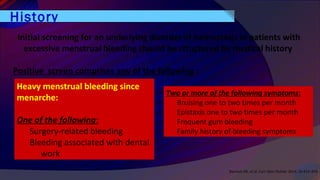
Bennett AR, et al. Curr Opin Pediatr 2014, 26:413–419
Initial screening for an underlying disorder of hemostasis in patients with
excessive menstrual bleeding should be structured by medical history
Positive screen comprises any of the following :
Heavy menstrual bleeding since
menarche:
One of the following:
Surgery-related bleeding
Bleeding associated with dental
work
Two or more of the following symptoms:
Bruising one to two times per month
Epistaxis one to two times per month
Frequent gum bleeding
Family history of bleeding symptoms
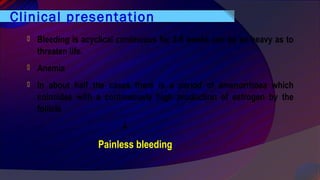
Clinical presentation
 Bleeding is acyclical continuous for 2-8 weeks can be so heavy as to
threaten life.
 Anemia
 In about half the cases there is a period of amenorrhoea which
coincides with a continuously high production of estrogen by the
follicle
↓
Painless bleeding
Physical Examination
 Vital signs
Tachycardia and orthostatic hypotension
 Skin
Signs of androgen excess/anaemia/bleeding disorder
 Thyroid gland
 Cardiac examination
 Abdominal examination
 Pelvic and bimanual examination
 External genital examination +/- transabdominal pelvic sonography
 Rectovaginal
Bennett AR, et al. Curr Opin Pediatr 2014, 26:413–419
Investigations
• Urine pregnancy test, complete blood count (CBC),
TSH, LFT, KFT
• Coagulation studies
• FSH, LH, total and free testosterone levels,
dehydroepiandrosterone
Investigations
• Pelvic ultrasound
 Serum progesterone determination –
may be done during the luteal phase of the cycle Can
help to document ovulation or anovulation A value
grater than 3 ng/ml is an evidence that ovulation has occurred.
One should consider an endometrial biopsy for adolescents with 2-3 years
history of untreated anovulatory bleeding, in obese females <20 years of age
(ACOG practice bulletin #14, March, 2000).
Investigations
 USG
Is the method of choice for evaluation of
female pelvis
 Pelvic USG
 Vaginoscope or even a
hysteroscope inserted
in vagina
Is of great importance in confirming
the diagnosis
Can be of great
help in arriving at
a diagnosis
Timing of curettage
In women with abnormal bleeding and no recent
exposure to exogenous progestational agents,
a secretory endometrium provides reliable
evidence of recent ovulation and signals the need
to search for an anatomical cause.
Testing for von Willebrand’s disease or inherited bleeding disorder as part of
the routine investigation of menorrhagia (especially in adolescents)
The Royal College of Obstetricians and Gynaecologists (RCOG)
guidelines for the management of menorrhagia published in 1999
recommended
testing only when there are features present in the history or examination
that suggest bleeding disorders (grade C recommendation).
American College of Obstetricians and Gynecologists guidelines of 2001
recommended.
screening for von Willebrand’s disease in all adolescents with
menorrhagia, as well as all adults with no pelvic pathology and in all
women prior to hysterectomy
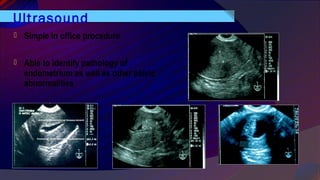
Ultrasound
 Simple in office procedure
 Able to identify pathology of
endometrium as well as other pelvic
abnormalities
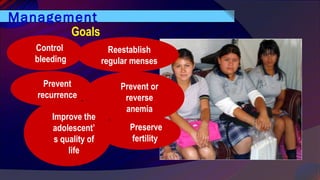
Management
Goals
Prevent or
reverse
anemia
Reestablish
regular menses
Improve the
adolescent’
s quality of
life
Control
bleeding
Prevent
recurrence
Preserve
fertility
Medical management
Effective methods include:
Estrogens, progestins, or both
NSAID’s
Antifibrinolytic agents
GnRH agonists
Desmopressin
Mirena
General Management
If bleeding is not very heavy and hemoglobin is normal –
observation and maintenance of menstrual chart for a few
months.
Spontaneous cure is possible and can be awaited.
Oral iron therapy
Severely anaemic – blood transfusion
 Medical Treatment
Non-hormonal
Hormonal  Surgical (rare in adolescents)
Conservative
Hysterectomy
Non-hormonal
NSAIDs
Inhibits cyclooxygenase, blocks PGE2
Alter the balance between thromboxane A2 (proaggregator
vasoconstrictor) and prostacyclin antiaggregator vasodilator
20-30% ↓ in blood loss
1st line therapy for ovulatory women with heavy menstrual bleeding and
no demonstrable cause
Mefenamic acid 250-500 qid/tid - 1 for 5 days or until cessation of
menses.
Naproxen 275 mg tds after 550 mg load.
Ibuprofen 200-400 mg qid
Antifibrinolytics - EACA, Tranexamic Acid
Tranexamic Acid
1gm tds x 5 days.
Reversible blockade on plasminogen
Inhibitor of Plasminogen activator
To be used with caution in
○ Kidney Disease
○ History of Thrombosis
REDUCES BLOOD LOSS BY 50 %
Nevertheless, Tranexamic Acid may be considered as a first line treatment for
the initial management of idiopathic menorrhagia, especially for patients in
whom hormonal treatment is either not recommended or not wanted.
RCOG guidelines for the initial medical treatment
of idiopathic menorrhagia recommend Tranexamic
Acid or mefenamic acid for 3 months, and then
indefinitely if successful, in those patients not
requiring contraception who prefer non-hormonal
treatment.
Hormonal
PROGESTATIONAL AGENTS
 Mainstay of therapy
 Most patients with DUB have an underlying etiology of chronic
anovulation with unopposed estrogen stimulation of the
endometrium.
Mechanisms of Action: Inhibit endometrial growth
 Progestins are powerful antiestrogens
Effect on Endometrium
Withdrawal of the progestin after adequate exposure results in
orderly and uniform shedding of the endometrium with a finite self
limited bleed
Medical Curettage
 Adolescent anovulatory patients are ideally suited for progestins
-- as the development of the immature hypothalamic-pituitary
axis is not impeded.
 Progestins are the preferred treatment for those women with
anovulatory AUB
-- who does not want contraception.
 Cyclic progesterone is not recommended
-- for ovulatory AUB.
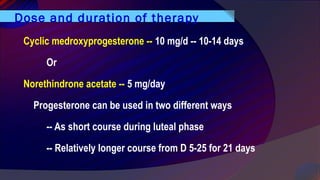
Dose and duration of therapy
Cyclic medroxyprogesterone -- 10 mg/d -- 10-14 days
Or
Norethindrone acetate -- 5 mg/day
Progesterone can be used in two different ways
-- As short course during luteal phase
-- Relatively longer course from D 5-25 for 21 days
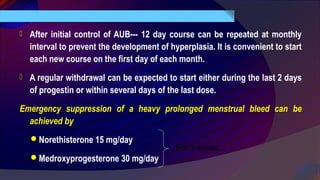
 After initial control of AUB--- 12 day course can be repeated at monthly
interval to prevent the development of hyperplasia. It is convenient to start
each new course on the first day of each month.
 A regular withdrawal can be expected to start either during the last 2 days
of progestin or within several days of the last dose.
Emergency suppression of a heavy prolonged menstrual bleed can be
achieved by
Norethisterone 15 mg/day
Medroxyprogesterone 30 mg/day
For 3 weeks
Cyclic pure progestin therapy generally works very well
in women who are completely anovulatiory.
In women who likely still ovulate (albeit infrequently) or
want to avoid pregnancy, an estrogen- progestin
contraceptive is a better choice.
Oral Contraceptive Therapy
 Prolonged episodes of heavy anovulatory bleeding usually are
treated best with
-- combined estrogen progestin therapy
 Chronic unopposed estrogen can produce a very lush
endometrium that can
-- bleed heavily during progestin withdrawal.
 Speroff & colleagues recommended treatment using OCPs in a
step down regimen.
Oral Contraceptive Therapy
For acute control of bleeding:
 2-4 pills are given daily : 1 q 6-12 hours x 5-7 days
 Withdrawal of medication will result in a heavy bleed followed
by one pill daily from D5 of withdrawal bleed for three cycles.
Alternatively:
The dosage of combination pill can be tapered
1 pill QID x 4 days
Followed by
1 pill tds x 3 days
Followed by
1 pill BD x 2 days
↓
Then continued at 1 pill daily for 3 weeks then 1 week off followed by
cyclic OCP for 3 months
Mechanism of action:
 Suppress pituitary gonadotropins & inhibits endogenous steroidogenesis
 Atrophy of the endometrium
 OCPs are useful for long-term management of DUB in pts without
contraindications
 Added benefit of pregnancy prevention
 Can be used to reduce menstrual blood loss in ovulatory women with heavy
menstrual bleeding regardless of whether their menorrhagia is associated
with pathology (Myomas, adenomyosis) or unexplained
 ↓ bleeding by 60% in unexplained menorrhagia
 Marginal / frankly low levels of estrogen
stimulation leads to Breakthrough
bleeding
 Intermittent vaginal spotting under such
circumstances, the endometrium is
typically extremely thin and the beneficial
effect of progestin treatment cannot be
achieved.
Estrogen breakthrough bleeding
Estrogen Therapy is indicated in
Estrogen breakthrough bleeding
After prolonged episodes of heavy bleeding that may result in
very thin and denuded endometrium.
Episodic progesterone breakthrough bleeding (commonly
observed in women receiving low dose OCPs / depot provera)
 When the endometrium is attenuated / grossly denuded and bleeding is acute
and heavy 
high dose estrogen therapy
 In those whose bleeding demands hospitalization for treatment and careful
observation 
i.v. estrogen therapy (25 mg conjugated equine estrogen
every 4 hourly until bleeding subsides or for 24 hours)
(TVS – look for ET any obvious anatomic abnormality)
 When bleeding is less emergent but still quite heavy –
high dose oral estrogen treatment i.e. 1.25 mg conjugated estrogens or 2 mg
micronized estradiol every 4-6 hours for every 24 hours  tapering to once
daily dose x 7-10 days after bleeding is controlled.
Less acute or lighter intermittent nuisance bleeding 
single daily dose of 1.25 mg conjugated estrogens or 2 mg
micronized estradiol for 7-10 days.
Megestrol 20 mg twice daily is also an excellent method for →
obtaining acute control of AUB without the side effect of
estrogen therapy.
All such initial estrogen therapy should be followed by treatment with
progestin or estrogen progestins contraceptives to stabilize the estrogen
stimulated endometrial growth.
In the dose used for contraception →
150 mg intramuscularly every 3 months, can be a useful option for
maintenance therapy in women who have difficulty with or cannot take
estrogen-progestin contraceptives, but the medication has no place in
the acute management of abnormal bleeding.
Depot-medroxyprogesterone acetate (depo-provera)
Once given, it cannot be withdrawn, and if unsuccessful, its effects can be
difficult to overcome
Episode breakthrough bleeding is relatively common and can be treated with
estrogen.
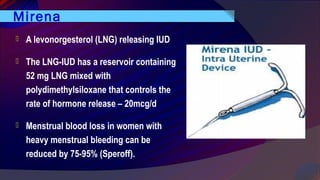
Mirena
 A levonorgesterol (LNG) releasing IUD
 The LNG-IUD has a reservoir containing
52 mg LNG mixed with
polydimethylsiloxane that controls the
rate of hormone release – 20mcg/d
 Menstrual blood loss in women with
heavy menstrual bleeding can be
reduced by 75-95% (Speroff).
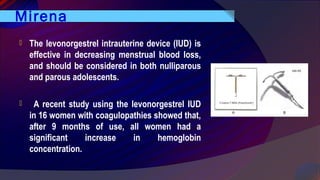
Mirena
 The levonorgestrel intrauterine device (IUD) is
effective in decreasing menstrual blood loss,
and should be considered in both nulliparous
and parous adolescents.
  A recent study using the levonorgestrel IUD
in 16 women with coagulopathies showed that,
after 9 months of use, all women had a
significant increase in hemoglobin
concentration.
Mechanism of action:
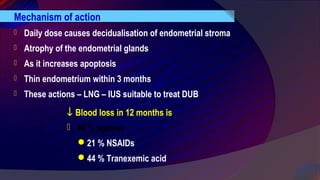
 Daily dose causes decidualisation of endometrial stroma
 Atrophy of the endometrial glands
 As it increases apoptosis
 Thin endometrium within 3 months
 These actions – LNG – IUS suitable to treat DUB
↓ Blood loss in 12 months is
 96 % against
21 % NSAIDs
44 % Tranexemic acid
Levonorgesterol IUD vs cyclic progestin
therapy
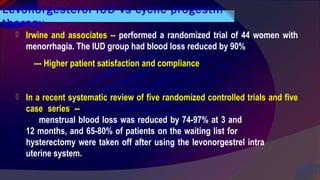
 Irwine and associates -- performed a randomized trial of 44 women with
menorrhagia. The IUD group had blood loss reduced by 90%
--- Higher patient satisfaction and compliance
 In a recent systematic review of five randomized controlled trials and five
case series --
menstrual blood loss was reduced by 74-97% at 3 and
12 months, and 65-80% of patients on the waiting list for
hysterectomy were taken off after using the levonorgestrel intra
uterine system.
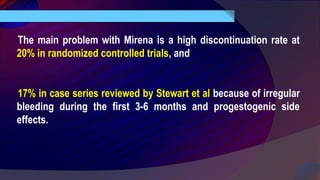
The main problem with Mirena is a high discontinuation rate at
20% in randomized controlled trials, and
17% in case series reviewed by Stewart et al because of irregular
bleeding during the first 3-6 months and progestogenic side
effects.
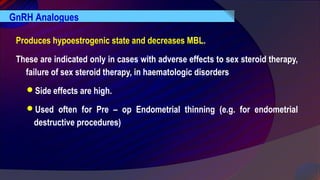
Produces hypoestrogenic state and decreases MBL.
These are indicated only in cases with adverse effects to sex steroid therapy,
failure of sex steroid therapy, in haematologic disorders
Side effects are high.
Used often for Pre – op Endometrial thinning (e.g. for endometrial
destructive procedures)
GnRH Analogues
DDAVP (Desmopressin)
 1-deamino-8- D -arginine vasopressin (DDAVP) has an established role
treating patients with abnormal bleeding in VWD, mild-to-moderate
hemophilia A, and some cases of platelet dysfunction.
 DDAVP increases levels of VWF and Factor VIII from endothelial cells,
and is given intranasally or intravenously.
 Side effects include water retention and hyponatremia, so use is limited
to 48 h.
Increases factor VIII levels –used in DUB patients with coagulopathy
New and Alternative Treatment Options
Antifibrinolytic agents
Tranexamic acid and aminocaproic acid
Non hormonal, non contraceptive options
For adult women with heavy menstrual bleeding
Heavy bleeding despite maximal hormonal treatment
New and Alternative Treatment Options
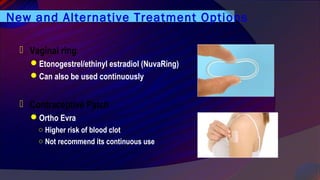
 Vaginal ring
Etonogestrel/ethinyl estradiol (NuvaRing)
Can also be used continuously
 Contraceptive Patch
Ortho Evra
○ Higher risk of blood clot
○ Not recommend its continuous use
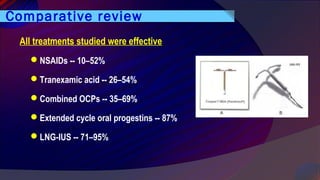
Comparative review
All treatments studied were effective
NSAIDs -- 10–52%
Tranexamic acid -- 26–54%
Combined OCPs -- 35–69%
Extended cycle oral progestins -- 87%
LNG-IUS -- 71–95%
Surgical Management
 Clinical stability of the patient
 Severity of bleeding
 Contraindications to medical management
 Patients lack of response to medical management
 Underlying medical condition of the patient
Surgical Management
 Surgical options
Dilatation and curettage (D&C)
Endometrial ablation
Uterine artery embolization
Hysterectomy
 Surgical intervention is rarely necessary in
adolescents
Place of Surgery
 The surgical option is very limited in puberty
menorrhagia
 The advent of endoscopic surgery is a boon to
young girls having • Fibroids
• Ovarian cysts and
• endometriosis
With minimal impact on future reproductive function
 D & C in an adolescent girl is generally a last resort
option and is performed only if other measures
fail for 6 mths.
Conclusion
• Adolescents often report heavy or abnormal periods
• Careful history and physical examination
– Narrow the differential diagnosis
• CBC and pregnancy test
• Treatment regimen
– Combined OCPs
– Progestin-only and non hormonal treatment options
Take Home Message
 Puberty menorrhagia is the commonest menstrual
disorder for which adolescent girls seek
medical advice
 Most common cause is anovulation
 Reassurance, diet and iron is the only therapy
required in most of the girls
 Rest of the cases are easily treated with either
prostaglandin synthetase inhibitors or OCP
 If does not respond in the expected fashion in
3-6 mths or has initial low Hb% a further
evaluation and work up is essential
Thank you

Aub in adolescents edit2

  • 2.
    DR (Mrs) ManjuGita Mishra DGO., MS., FICS., FICOG., FIAMS., FICMCH ♦ Ex-Professor of Obstetrics and Gynaecology, Patna Medical College and Hospital, Patna. ♦President ISOPARB 2014-2016. ♦At Present Consultant M.G.M. Hospital and Research Centre Pvt. Ltd., Patna. ♦ Chairperson Medical Education Committee, FOGSI -2007-09. ♦ Delivered Orations, Guest Lectures in State , National & International Conferences. ♦ Contributed chapters in FOGSI Publication and edited book – “CRITICAL CARE IN OBSTETRICS 1st & 2nd edition “, “Treatment and Prognosis in Obstetrics & Gynaecology” ♦ More than seventy publications in various National and International Journals. ♦ Appointed Inspector by M.C.I. and National Board for recognition of D.G.O., M.D. and D.N.B. course in various Colleges and Institute. ♦Examiner – Under graduate, Post graduate, DNB ♦Special Interest in High Risk Pregnancy & Adolescent Gynaecology, Emergency Obstetrics.
  • 3.
    ♦ Past SeniorVice President ISOPARB ♦ Past President B.O.G.S. ♦ Past President I.M.A. Bihar State. ♦ Past President I.M.A. All India Women’s Doctors Wing. ♦ Past Secretary General ISOPARB. ♦ Past President Association Obstetrics Gynaecology Society Bihar Jharkhand ♦ Organized various Seminars, Workshops Conferences and rural camps. ♦Promoted O.C.P. and A.I.D.S. awareness in different parts of Bihar. ♦Organizing Secretary A.I.C.O.G. 2014. ♦ Adhoc committee member, Red Cross Society.  Kanak Goyal Award  C.L. Jhaveri Family Planning Award  B.C. ROY Award  R. K. Menda Community Service AwardRecipient of :
  • 4.
    Abnormal uterine Bleeding(AUB) Common concern for adolescent females Significant impact on an adolescent’s quality of life Affected adolescents ability to participate in physical, educational or sports At least 1 day of missed school during each menses Disrupted their hobbies and leisure activities
  • 5.
    Physical Social Emotional and Material Excessive menstrualblood loss which interferes with woman’s (NICE Guidelines for HMB, Jan. 2007). Abnormal uterine Bleeding (AUB) quality of life AUB changes in frequency, volume, duration of flow, amount of blood loss without any demonstrable organic cause -- genital or extra genital.
  • 6.
    FIGO classification system Discontinuationof the term dysfunctional uterine bleeding Heavy menstrual bleeding – MENORRHAGIA > 7 days / > 80cc uterine bleeding occurring at regular intervals Intermenstrual bleeding – METRORRHAGIA Uterine bleeding completely irregular at frequent intervals, the amount being variable. POLYMENORRHEA Uterine bleeding at regular intervals of less than 21 days. OLIGOMENORRHEA Uterine bleeding at regular intervals from 35 days to 6 months.
  • 7.
    FIGO classification system AmericanCollege of Obstetricians and gynaecologists. Obstet Gynecol 2013;121:891-6 Abnormal uterine bleeding: PALM-structural causes: Polyp (AUB-P) Adenomyosis (AUB-A) Leiomyoma (AUB-L) Submucosal Ieiomyoma (AUB-LSM) Other Ieiomyoma (AUB-LO) Malignancy and hyperplasia (AUB-M) COEIN-non structural causes: Coagulopathy (AUB-C) Ovulatory dysfunction (AUB-O) Endometrial (AUB-E) Iatrogenis (AUB-I) Not yet classified (AUB-N)
  • 8.
    Etiology Most commonly experiencedovulatory dysfunction Physiologica l Polycystic ovary syndrome (PCOS) Coagulopathy Inherent disorder of the endometrium
  • 9.
    Etiology Other causes ofmenorrhagia • Pregnancy and infection-- should be considered in sexually active adolescents. • STI esp Chlamydia, endometritis can result in heavy menses. • Infection causes inflammation of the endometrium making endometrial lining fragile. More likely to occur in adolescents than in adults. • Adolescent pregnancy should always be ruled out.
  • 10.
    Pathophysiology Anovulatory cycles • Irregularmenses due to an immature hypothalamic– pituitary–ovarian axis Ovaries produce continuous levels of estrogen • No corpus luteum to secrete progesterone • Ovarian estrogen is unopposed
  • 11.
    DUB is mostfrequently associated with Chronic anovulation -- 80% Ovulatory -- 15-20% OVULATORYOVULATORY ANOVULATORYANOVULATORY DURING REPRODUCTIVE AGE CYCLICAL PREDICTABLE EXCESSIVE COMMON AT 2 ENDS OF THE REPRODUCTIVE AGE IRREGULAR PROLONGED EXCESSIVE Classification of DUB
  • 12.
    History  Menstrual history Smartphoneapplication to keep track  Associated symptoms -- Premenstrual synptoms -- Dysmenorrhea -- Galactorrhea -- Hirsutism  Underlying systemic illness – thyroid, liver, kidney and haemopoetic  Medication – hormonal and anti coagulant  Regarding sexual activity-- Consensual or coerced
  • 13.
    History Bennett AR, etal. Curr Opin Pediatr 2014, 26:413–419 Initial screening for an underlying disorder of hemostasis in patients with excessive menstrual bleeding should be structured by medical history Positive screen comprises any of the following : Heavy menstrual bleeding since menarche: One of the following: Surgery-related bleeding Bleeding associated with dental work Two or more of the following symptoms: Bruising one to two times per month Epistaxis one to two times per month Frequent gum bleeding Family history of bleeding symptoms
  • 14.
    Clinical presentation  Bleedingis acyclical continuous for 2-8 weeks can be so heavy as to threaten life.  Anemia  In about half the cases there is a period of amenorrhoea which coincides with a continuously high production of estrogen by the follicle ↓ Painless bleeding
  • 15.
    Physical Examination  Vitalsigns Tachycardia and orthostatic hypotension  Skin Signs of androgen excess/anaemia/bleeding disorder  Thyroid gland  Cardiac examination  Abdominal examination  Pelvic and bimanual examination  External genital examination +/- transabdominal pelvic sonography  Rectovaginal Bennett AR, et al. Curr Opin Pediatr 2014, 26:413–419
  • 16.
    Investigations • Urine pregnancytest, complete blood count (CBC), TSH, LFT, KFT • Coagulation studies • FSH, LH, total and free testosterone levels, dehydroepiandrosterone
  • 17.
    Investigations • Pelvic ultrasound Serum progesterone determination – may be done during the luteal phase of the cycle Can help to document ovulation or anovulation A value grater than 3 ng/ml is an evidence that ovulation has occurred. One should consider an endometrial biopsy for adolescents with 2-3 years history of untreated anovulatory bleeding, in obese females <20 years of age (ACOG practice bulletin #14, March, 2000).
  • 18.
    Investigations  USG Is themethod of choice for evaluation of female pelvis  Pelvic USG  Vaginoscope or even a hysteroscope inserted in vagina Is of great importance in confirming the diagnosis Can be of great help in arriving at a diagnosis
  • 19.
    Timing of curettage Inwomen with abnormal bleeding and no recent exposure to exogenous progestational agents, a secretory endometrium provides reliable evidence of recent ovulation and signals the need to search for an anatomical cause.
  • 20.
    Testing for vonWillebrand’s disease or inherited bleeding disorder as part of the routine investigation of menorrhagia (especially in adolescents) The Royal College of Obstetricians and Gynaecologists (RCOG) guidelines for the management of menorrhagia published in 1999 recommended testing only when there are features present in the history or examination that suggest bleeding disorders (grade C recommendation). American College of Obstetricians and Gynecologists guidelines of 2001 recommended. screening for von Willebrand’s disease in all adolescents with menorrhagia, as well as all adults with no pelvic pathology and in all women prior to hysterectomy
  • 21.
    Ultrasound  Simple inoffice procedure  Able to identify pathology of endometrium as well as other pelvic abnormalities
  • 22.
    Management Goals Prevent or reverse anemia Reestablish regular menses Improvethe adolescent’ s quality of life Control bleeding Prevent recurrence Preserve fertility
  • 23.
    Medical management Effective methodsinclude: Estrogens, progestins, or both NSAID’s Antifibrinolytic agents GnRH agonists Desmopressin Mirena
  • 24.
    General Management If bleedingis not very heavy and hemoglobin is normal – observation and maintenance of menstrual chart for a few months. Spontaneous cure is possible and can be awaited. Oral iron therapy Severely anaemic – blood transfusion
  • 25.
     Medical Treatment Non-hormonal Hormonal Surgical (rare in adolescents) Conservative Hysterectomy
  • 26.
    Non-hormonal NSAIDs Inhibits cyclooxygenase, blocksPGE2 Alter the balance between thromboxane A2 (proaggregator vasoconstrictor) and prostacyclin antiaggregator vasodilator 20-30% ↓ in blood loss 1st line therapy for ovulatory women with heavy menstrual bleeding and no demonstrable cause Mefenamic acid 250-500 qid/tid - 1 for 5 days or until cessation of menses. Naproxen 275 mg tds after 550 mg load. Ibuprofen 200-400 mg qid
  • 27.
    Antifibrinolytics - EACA,Tranexamic Acid Tranexamic Acid 1gm tds x 5 days. Reversible blockade on plasminogen Inhibitor of Plasminogen activator To be used with caution in ○ Kidney Disease ○ History of Thrombosis REDUCES BLOOD LOSS BY 50 %
  • 28.
    Nevertheless, Tranexamic Acidmay be considered as a first line treatment for the initial management of idiopathic menorrhagia, especially for patients in whom hormonal treatment is either not recommended or not wanted. RCOG guidelines for the initial medical treatment of idiopathic menorrhagia recommend Tranexamic Acid or mefenamic acid for 3 months, and then indefinitely if successful, in those patients not requiring contraception who prefer non-hormonal treatment.
  • 29.
    Hormonal PROGESTATIONAL AGENTS  Mainstayof therapy  Most patients with DUB have an underlying etiology of chronic anovulation with unopposed estrogen stimulation of the endometrium. Mechanisms of Action: Inhibit endometrial growth  Progestins are powerful antiestrogens
  • 30.
    Effect on Endometrium Withdrawalof the progestin after adequate exposure results in orderly and uniform shedding of the endometrium with a finite self limited bleed Medical Curettage
  • 31.
     Adolescent anovulatorypatients are ideally suited for progestins -- as the development of the immature hypothalamic-pituitary axis is not impeded.  Progestins are the preferred treatment for those women with anovulatory AUB -- who does not want contraception.  Cyclic progesterone is not recommended -- for ovulatory AUB.
  • 32.
    Dose and durationof therapy Cyclic medroxyprogesterone -- 10 mg/d -- 10-14 days Or Norethindrone acetate -- 5 mg/day Progesterone can be used in two different ways -- As short course during luteal phase -- Relatively longer course from D 5-25 for 21 days
  • 33.
     After initialcontrol of AUB--- 12 day course can be repeated at monthly interval to prevent the development of hyperplasia. It is convenient to start each new course on the first day of each month.  A regular withdrawal can be expected to start either during the last 2 days of progestin or within several days of the last dose. Emergency suppression of a heavy prolonged menstrual bleed can be achieved by Norethisterone 15 mg/day Medroxyprogesterone 30 mg/day For 3 weeks
  • 34.
    Cyclic pure progestintherapy generally works very well in women who are completely anovulatiory. In women who likely still ovulate (albeit infrequently) or want to avoid pregnancy, an estrogen- progestin contraceptive is a better choice.
  • 35.
    Oral Contraceptive Therapy Prolonged episodes of heavy anovulatory bleeding usually are treated best with -- combined estrogen progestin therapy  Chronic unopposed estrogen can produce a very lush endometrium that can -- bleed heavily during progestin withdrawal.  Speroff & colleagues recommended treatment using OCPs in a step down regimen.
  • 36.
    Oral Contraceptive Therapy Foracute control of bleeding:  2-4 pills are given daily : 1 q 6-12 hours x 5-7 days  Withdrawal of medication will result in a heavy bleed followed by one pill daily from D5 of withdrawal bleed for three cycles.
  • 37.
    Alternatively: The dosage ofcombination pill can be tapered 1 pill QID x 4 days Followed by 1 pill tds x 3 days Followed by 1 pill BD x 2 days ↓ Then continued at 1 pill daily for 3 weeks then 1 week off followed by cyclic OCP for 3 months
  • 38.
    Mechanism of action: Suppress pituitary gonadotropins & inhibits endogenous steroidogenesis  Atrophy of the endometrium  OCPs are useful for long-term management of DUB in pts without contraindications  Added benefit of pregnancy prevention  Can be used to reduce menstrual blood loss in ovulatory women with heavy menstrual bleeding regardless of whether their menorrhagia is associated with pathology (Myomas, adenomyosis) or unexplained  ↓ bleeding by 60% in unexplained menorrhagia
  • 39.
     Marginal /frankly low levels of estrogen stimulation leads to Breakthrough bleeding  Intermittent vaginal spotting under such circumstances, the endometrium is typically extremely thin and the beneficial effect of progestin treatment cannot be achieved. Estrogen breakthrough bleeding
  • 40.
    Estrogen Therapy isindicated in Estrogen breakthrough bleeding After prolonged episodes of heavy bleeding that may result in very thin and denuded endometrium. Episodic progesterone breakthrough bleeding (commonly observed in women receiving low dose OCPs / depot provera)
  • 41.
     When theendometrium is attenuated / grossly denuded and bleeding is acute and heavy  high dose estrogen therapy  In those whose bleeding demands hospitalization for treatment and careful observation  i.v. estrogen therapy (25 mg conjugated equine estrogen every 4 hourly until bleeding subsides or for 24 hours) (TVS – look for ET any obvious anatomic abnormality)  When bleeding is less emergent but still quite heavy – high dose oral estrogen treatment i.e. 1.25 mg conjugated estrogens or 2 mg micronized estradiol every 4-6 hours for every 24 hours  tapering to once daily dose x 7-10 days after bleeding is controlled.
  • 42.
    Less acute orlighter intermittent nuisance bleeding  single daily dose of 1.25 mg conjugated estrogens or 2 mg micronized estradiol for 7-10 days. Megestrol 20 mg twice daily is also an excellent method for → obtaining acute control of AUB without the side effect of estrogen therapy. All such initial estrogen therapy should be followed by treatment with progestin or estrogen progestins contraceptives to stabilize the estrogen stimulated endometrial growth.
  • 43.
    In the doseused for contraception → 150 mg intramuscularly every 3 months, can be a useful option for maintenance therapy in women who have difficulty with or cannot take estrogen-progestin contraceptives, but the medication has no place in the acute management of abnormal bleeding. Depot-medroxyprogesterone acetate (depo-provera) Once given, it cannot be withdrawn, and if unsuccessful, its effects can be difficult to overcome Episode breakthrough bleeding is relatively common and can be treated with estrogen.
  • 44.
    Mirena  A levonorgesterol(LNG) releasing IUD  The LNG-IUD has a reservoir containing 52 mg LNG mixed with polydimethylsiloxane that controls the rate of hormone release – 20mcg/d  Menstrual blood loss in women with heavy menstrual bleeding can be reduced by 75-95% (Speroff).
  • 45.
    Mirena  The levonorgestrelintrauterine device (IUD) is effective in decreasing menstrual blood loss, and should be considered in both nulliparous and parous adolescents.   A recent study using the levonorgestrel IUD in 16 women with coagulopathies showed that, after 9 months of use, all women had a significant increase in hemoglobin concentration.
  • 46.
    Mechanism of action: Daily dose causes decidualisation of endometrial stroma  Atrophy of the endometrial glands  As it increases apoptosis  Thin endometrium within 3 months  These actions – LNG – IUS suitable to treat DUB ↓ Blood loss in 12 months is  96 % against 21 % NSAIDs 44 % Tranexemic acid
  • 47.
    Levonorgesterol IUD vscyclic progestin therapy  Irwine and associates -- performed a randomized trial of 44 women with menorrhagia. The IUD group had blood loss reduced by 90% --- Higher patient satisfaction and compliance  In a recent systematic review of five randomized controlled trials and five case series -- menstrual blood loss was reduced by 74-97% at 3 and 12 months, and 65-80% of patients on the waiting list for hysterectomy were taken off after using the levonorgestrel intra uterine system.
  • 48.
    The main problemwith Mirena is a high discontinuation rate at 20% in randomized controlled trials, and 17% in case series reviewed by Stewart et al because of irregular bleeding during the first 3-6 months and progestogenic side effects.
  • 49.
    Produces hypoestrogenic stateand decreases MBL. These are indicated only in cases with adverse effects to sex steroid therapy, failure of sex steroid therapy, in haematologic disorders Side effects are high. Used often for Pre – op Endometrial thinning (e.g. for endometrial destructive procedures) GnRH Analogues
  • 50.
    DDAVP (Desmopressin)  1-deamino-8- D -argininevasopressin (DDAVP) has an established role treating patients with abnormal bleeding in VWD, mild-to-moderate hemophilia A, and some cases of platelet dysfunction.  DDAVP increases levels of VWF and Factor VIII from endothelial cells, and is given intranasally or intravenously.  Side effects include water retention and hyponatremia, so use is limited to 48 h. Increases factor VIII levels –used in DUB patients with coagulopathy
  • 51.
    New and AlternativeTreatment Options Antifibrinolytic agents Tranexamic acid and aminocaproic acid Non hormonal, non contraceptive options For adult women with heavy menstrual bleeding Heavy bleeding despite maximal hormonal treatment
  • 52.
    New and AlternativeTreatment Options  Vaginal ring Etonogestrel/ethinyl estradiol (NuvaRing) Can also be used continuously  Contraceptive Patch Ortho Evra ○ Higher risk of blood clot ○ Not recommend its continuous use
  • 53.
    Comparative review All treatmentsstudied were effective NSAIDs -- 10–52% Tranexamic acid -- 26–54% Combined OCPs -- 35–69% Extended cycle oral progestins -- 87% LNG-IUS -- 71–95%
  • 54.
    Surgical Management  Clinicalstability of the patient  Severity of bleeding  Contraindications to medical management  Patients lack of response to medical management  Underlying medical condition of the patient
  • 55.
    Surgical Management  Surgicaloptions Dilatation and curettage (D&C) Endometrial ablation Uterine artery embolization Hysterectomy  Surgical intervention is rarely necessary in adolescents
  • 56.
    Place of Surgery The surgical option is very limited in puberty menorrhagia  The advent of endoscopic surgery is a boon to young girls having • Fibroids • Ovarian cysts and • endometriosis With minimal impact on future reproductive function  D & C in an adolescent girl is generally a last resort option and is performed only if other measures fail for 6 mths.
  • 57.
    Conclusion • Adolescents oftenreport heavy or abnormal periods • Careful history and physical examination – Narrow the differential diagnosis • CBC and pregnancy test • Treatment regimen – Combined OCPs – Progestin-only and non hormonal treatment options
  • 58.
    Take Home Message Puberty menorrhagia is the commonest menstrual disorder for which adolescent girls seek medical advice  Most common cause is anovulation  Reassurance, diet and iron is the only therapy required in most of the girls  Rest of the cases are easily treated with either prostaglandin synthetase inhibitors or OCP  If does not respond in the expected fashion in 3-6 mths or has initial low Hb% a further evaluation and work up is essential
  • 59.