INDIAN BANKING SYSTEM
AND ITS EMERGING
TRENDS
SUBMITTED BY-
Saurav Prashar
ROLL NO- 140423301
SUBMITTED TO-
Dr. Dheeraj Joshi
ESTABLISHMENT OF BANKS IN
INDIA
• .
June 2, 1806: The Bank of Calcutta
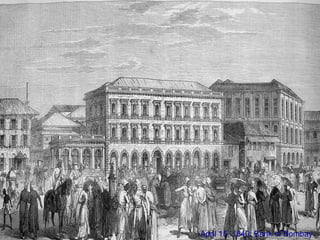
April 15, 1840: Bank of Bombay
July 1, 1843: Bank of Madras
1861: Paper Currency Act passed.
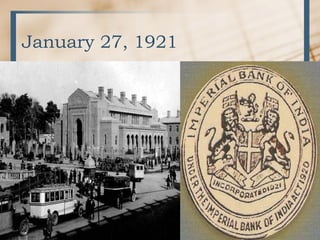
January 27, 1921
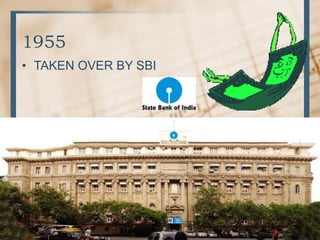
1955
• TAKEN OVER BY SBI
FUNCTIONS OF BANKING
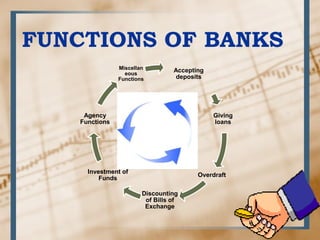
FUNCTIONS OF BANKS
Accepting
deposits
Giving
loans
Overdraft
Discounting
of Bills of
Exchange
Investment of
Funds
Agency
Functions
Miscellan
eous
Functions
INVENTIONS AND FACILITIES FOR EASING OF BANKING IN
THIS MODERN ERA
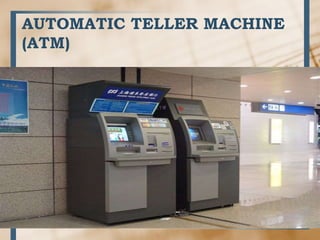
AUTOMATIC TELLER MACHINE
(ATM)
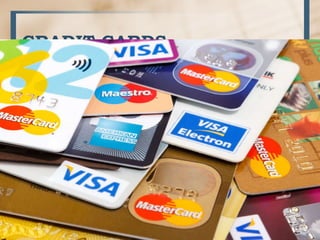
CRADIT CARDS
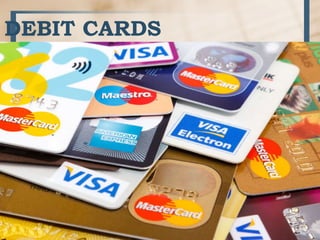
DEBIT CARDS
CHEQUE CARDS
CHARGE CARDS
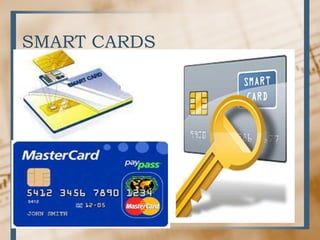
SMART CARDS
LATEST TRENDS IN BANKING
UNIVERSAL BANKING
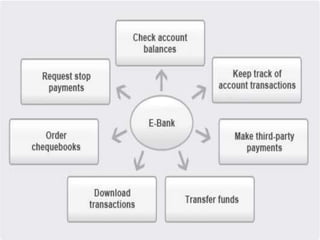
ELECTRONIC BANKING
GLOBALISATION OF BANKING
• Globalization has emerged as a prime mover in the
Indian banking system.
• This has come about as a result of the policy of
liberalization and opening up of banking and other
sectors pursued after 1991 in India.
• Foreign banks that wish to set up their
offices/branches in India have been granted
licenses by RBI on liberal and on reciprocal basis.
• Similarly, Indian banks are also opening their
offices/branches abroad, particularly in countries
whose banks have opened offices in India
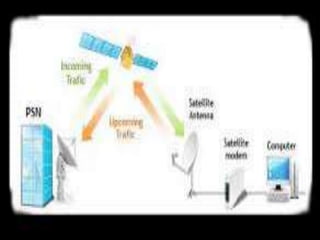
SATELLITE BANKING
• Satellite banking is an upcoming technological
innovation in the Indian banking industry.
• It is expected to help in solving the problem of
weak terrestrial communication links in many
parts of the country.
• The use of satellites for establishing
connectivity between branches will help banks
to reach rural and hilly areas in a better way,
and offer better facilities, particularly in relation
to electronic funds transfers.
TECHNOLOGICAL DEVELOPMENT
• With the advancement of technology and the
birth of competition, banks are in the race of
becoming the best in the country.
• The advancement in the technology has helped
the banks to reduce the workload.
• There are so many activities, which are taken
over by machines. Employees are no more
loaded with paper work.
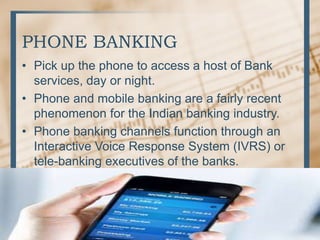
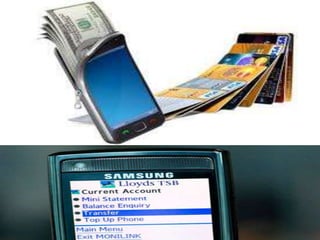
PHONE BANKING
• Pick up the phone to access a host of Bank
services, day or night.
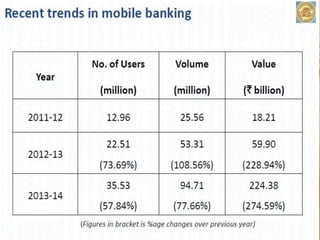
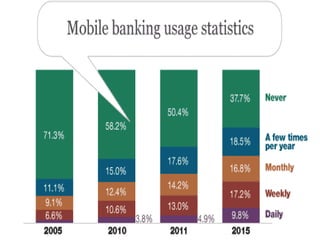
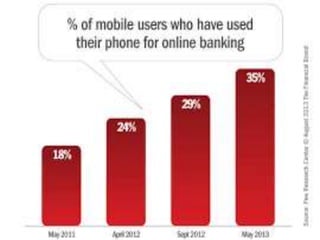
• Phone and mobile banking are a fairly recent
phenomenon for the Indian banking industry.
• Phone banking channels function through an
Interactive Voice Response System (IVRS) or
tele-banking executives of the banks.
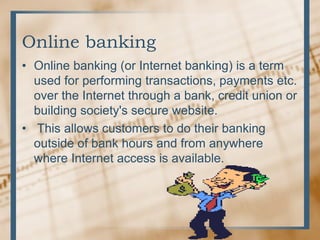
Online banking
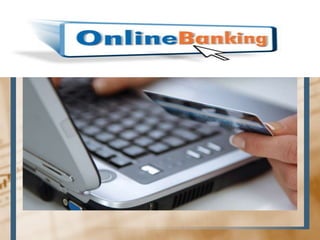
• Online banking (or Internet banking) is a term
used for performing transactions, payments etc.
over the Internet through a bank, credit union or
building society's secure website.
• This allows customers to do their banking
outside of bank hours and from anywhere
where Internet access is available.
Features of online banking
• Online banking usually offers such features as:
• Bank statements.
• Electronic bill payment
• Funds transfer.
• Loan applications and transactions, such as
repayments
• Account aggregation
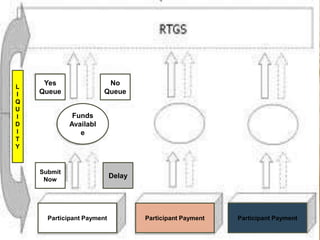
REAL TIME GROSS SETTLEMENT
• RTGS is a large value funds transfer system .
• Transfer of money takes place from one bank to
another on a “real time” and on “gross basis”.
• Money can be transferred only to those
branches in which RTGS is enable
Benefits of RTGS
• full value of individual
• Real time immediate value transfer
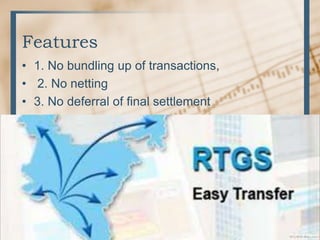
Features
• 1. No bundling up of transactions,
• 2. No netting
• 3. No deferral of final settlement
Funds
Availabl
e
No
Queue
Yes
Queue
Delay
Submit
Now
L
I
Q
U
I
D
I
T
Y
Participant Payment Participant Payment Participant Payment
BANCASSURANCE
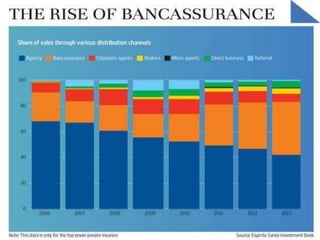
Bancassurance
• Bancassurance is the term used to describe the
sale of insurance products in a bank.
• The word is a combination of "banque or bank"
and "assurance" signifying that both banking and
insurance is provided by the same corporate entity.
• Banks gives you peace of mind with
Bancassurance.
• One receive coverage and save money at the
same time. You can choose the right option which
benefits you the most.
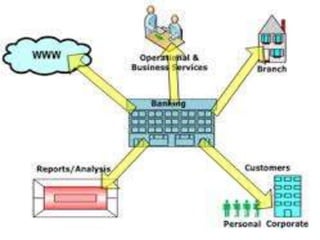
Core banking solutions(CBS)
• Core banking (stand for "centralized online
real-time exchange") is a banking services
provided by a group of networked bank
branches
• Here customers may access their bank
account and perform basic transactions from
any of the member branch offices.
• Larger businesses are managed via
the Corporate banking division of the institution.
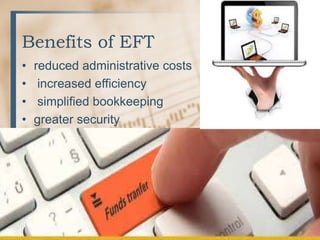
Electronic fund transfer (EFT)
• Electronic Funds Transfer (EFT) is a system of
transferring money from one bank account directly
to another without any paper money changing
hands.
• It is used for both credit transfers, such as payroll
payments, and for debit transfers, such as
mortgage payments.
• The growing popularity of EFT for online bill
payment is paving the way for a paperless universe
where checks, stamps, envelopes, and paper bills
are obsolete.
Benefits of EFT
• reduced administrative costs
• increased efficiency
• simplified bookkeeping
• greater security
Electronic clearing system
• ECS is an electronic mode of funds transfer from
one bank account to another.
• It can be used by institutions for making payments
such as distribution of dividend interest, salary,
pension, among others.
• It can also be used to pay bills and other charges
such as telephone, electricity, water.
• For making equated monthly installments
payments on loans as well as SIP investments.
ECS can be used for both credit and debit
purposes.
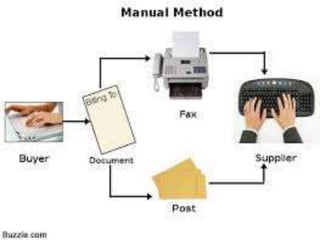
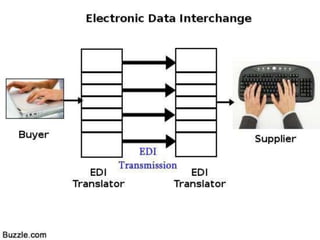
Electronic data interchange (EDI)
It facilitates computer to-computer exchange
of electronic documents (such as purchase
orders, advance shipment notices and without
human intervention or human readable (paper
or electronic documents)..
International banking
• Indian banks have extended their activities beyond
the national boundaries.
• The extension may take place in the form of
borrowings as well as lending and it may take place
through official or private or commercial channel.
• In the process of internationalization, the domestic
financial institutions participate in foreign financial
markets and the foreign institutions participate in
domestic market to a significant extent.
International lending
• Syndicated loans
• Large loans that enable borrowers to obtain
large amounts of funds and lenders can
diversify their credit risk. Lead bank can earn
fee income for management services.
• Letters of credit
• Import letters of credit are issued by a bank in
favor of a firm in most cases. An export letter of
credit is issued by a foreign bank to a firm in the
U.S.
Letters of credit
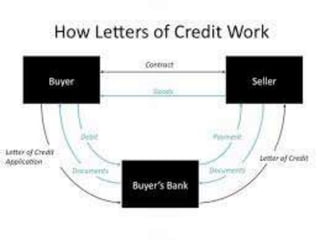
• The letter of credit is a document from a bank
that says it will pay the exporter when the
conditions in the letter are met.
• In effect, the bank’s credit is substituted for the
importer.
• The issuing bank pays the seller through the
advising (paying) bank.
• The importer pays the issuing bank a fee for its
services.
Foreign exchange markets
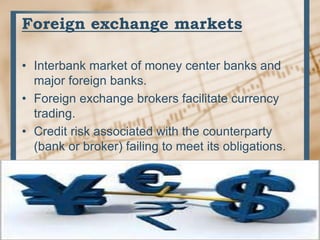
• Interbank market of money center banks and
major foreign banks.
• Foreign exchange brokers facilitate currency
trading.
• Credit risk associated with the counterparty
(bank or broker) failing to meet its obligations.
CRMs and any branch banking
• Customer relationship management (CRM) is a
system for managing a company’s interactions with
current and future customers.
• It often involves using technology to organize,
automate and synchronize sales, marketing,
customer service and technical.
• Any branch banking
• All the branches are inter-connected and are
capable of providing online, real-time transactions
to its customers.
• Customers can Deposit/Withdraw freely without
any tariff charge i.e. free ABBS facility.
Risk management
• The financial sector in various economies like
that of India are undergoing a monumental
change factoring into account world events
such as the ongoing Banking Crisis across the
globe.
• Risk management in Indian banks is a
relatively newer practice, but has already
shown to increase efficiency in governing of
these banks as such procedures tend to
increase the corporate governance of a
financial institution
POINT OF SALE TERMINAL
• A type of electronic-transaction terminal.
• Point-of-sale terminals typically include a
computer, a cash register and other equipment
or software used to sell goods or services.
• They also transmit sales data to be posted to
customer accounts.
• It is an electronic payment system involving
electronic fund transfers based on the use of
payment cards, such as debit or credit, at
payment terminals located at point of sale.
Thank you
• A presentation by-
Saurav prashar

Indian banking system and its emerging trends

  • 1.
    INDIAN BANKING SYSTEM ANDITS EMERGING TRENDS SUBMITTED BY- Saurav Prashar ROLL NO- 140423301 SUBMITTED TO- Dr. Dheeraj Joshi
  • 3.
    ESTABLISHMENT OF BANKSIN INDIA • .
  • 4.
    June 2, 1806:The Bank of Calcutta
  • 5.
    April 15, 1840:Bank of Bombay
  • 6.
    July 1, 1843:Bank of Madras 1861: Paper Currency Act passed.
  • 7.
  • 8.
  • 9.
  • 10.
    FUNCTIONS OF BANKS Accepting deposits Giving loans Overdraft Discounting ofBills of Exchange Investment of Funds Agency Functions Miscellan eous Functions
  • 11.
    INVENTIONS AND FACILITIESFOR EASING OF BANKING IN THIS MODERN ERA
  • 12.
  • 13.
  • 14.
  • 15.
  • 16.
  • 17.
  • 18.
  • 19.
  • 20.
  • 22.
    GLOBALISATION OF BANKING •Globalization has emerged as a prime mover in the Indian banking system. • This has come about as a result of the policy of liberalization and opening up of banking and other sectors pursued after 1991 in India. • Foreign banks that wish to set up their offices/branches in India have been granted licenses by RBI on liberal and on reciprocal basis. • Similarly, Indian banks are also opening their offices/branches abroad, particularly in countries whose banks have opened offices in India
  • 23.
    SATELLITE BANKING • Satellitebanking is an upcoming technological innovation in the Indian banking industry. • It is expected to help in solving the problem of weak terrestrial communication links in many parts of the country. • The use of satellites for establishing connectivity between branches will help banks to reach rural and hilly areas in a better way, and offer better facilities, particularly in relation to electronic funds transfers.
  • 25.
    TECHNOLOGICAL DEVELOPMENT • Withthe advancement of technology and the birth of competition, banks are in the race of becoming the best in the country. • The advancement in the technology has helped the banks to reduce the workload. • There are so many activities, which are taken over by machines. Employees are no more loaded with paper work.
  • 27.
    PHONE BANKING • Pickup the phone to access a host of Bank services, day or night. • Phone and mobile banking are a fairly recent phenomenon for the Indian banking industry. • Phone banking channels function through an Interactive Voice Response System (IVRS) or tele-banking executives of the banks.
  • 33.
    Online banking • Onlinebanking (or Internet banking) is a term used for performing transactions, payments etc. over the Internet through a bank, credit union or building society's secure website. • This allows customers to do their banking outside of bank hours and from anywhere where Internet access is available.
  • 34.
    Features of onlinebanking • Online banking usually offers such features as: • Bank statements. • Electronic bill payment • Funds transfer. • Loan applications and transactions, such as repayments • Account aggregation
  • 36.
    REAL TIME GROSSSETTLEMENT • RTGS is a large value funds transfer system . • Transfer of money takes place from one bank to another on a “real time” and on “gross basis”. • Money can be transferred only to those branches in which RTGS is enable Benefits of RTGS • full value of individual • Real time immediate value transfer
  • 37.
    Features • 1. Nobundling up of transactions, • 2. No netting • 3. No deferral of final settlement
  • 38.
  • 39.
  • 40.
    Bancassurance • Bancassurance isthe term used to describe the sale of insurance products in a bank. • The word is a combination of "banque or bank" and "assurance" signifying that both banking and insurance is provided by the same corporate entity. • Banks gives you peace of mind with Bancassurance. • One receive coverage and save money at the same time. You can choose the right option which benefits you the most.
  • 43.
    Core banking solutions(CBS) •Core banking (stand for "centralized online real-time exchange") is a banking services provided by a group of networked bank branches • Here customers may access their bank account and perform basic transactions from any of the member branch offices. • Larger businesses are managed via the Corporate banking division of the institution.
  • 45.
    Electronic fund transfer(EFT) • Electronic Funds Transfer (EFT) is a system of transferring money from one bank account directly to another without any paper money changing hands. • It is used for both credit transfers, such as payroll payments, and for debit transfers, such as mortgage payments. • The growing popularity of EFT for online bill payment is paving the way for a paperless universe where checks, stamps, envelopes, and paper bills are obsolete.
  • 46.
    Benefits of EFT •reduced administrative costs • increased efficiency • simplified bookkeeping • greater security
  • 48.
    Electronic clearing system •ECS is an electronic mode of funds transfer from one bank account to another. • It can be used by institutions for making payments such as distribution of dividend interest, salary, pension, among others. • It can also be used to pay bills and other charges such as telephone, electricity, water. • For making equated monthly installments payments on loans as well as SIP investments. ECS can be used for both credit and debit purposes.
  • 50.
    Electronic data interchange(EDI) It facilitates computer to-computer exchange of electronic documents (such as purchase orders, advance shipment notices and without human intervention or human readable (paper or electronic documents)..
  • 53.
    International banking • Indianbanks have extended their activities beyond the national boundaries. • The extension may take place in the form of borrowings as well as lending and it may take place through official or private or commercial channel. • In the process of internationalization, the domestic financial institutions participate in foreign financial markets and the foreign institutions participate in domestic market to a significant extent.
  • 54.
    International lending • Syndicatedloans • Large loans that enable borrowers to obtain large amounts of funds and lenders can diversify their credit risk. Lead bank can earn fee income for management services. • Letters of credit • Import letters of credit are issued by a bank in favor of a firm in most cases. An export letter of credit is issued by a foreign bank to a firm in the U.S.
  • 55.
    Letters of credit •The letter of credit is a document from a bank that says it will pay the exporter when the conditions in the letter are met. • In effect, the bank’s credit is substituted for the importer. • The issuing bank pays the seller through the advising (paying) bank. • The importer pays the issuing bank a fee for its services.
  • 57.
    Foreign exchange markets •Interbank market of money center banks and major foreign banks. • Foreign exchange brokers facilitate currency trading. • Credit risk associated with the counterparty (bank or broker) failing to meet its obligations.
  • 58.
    CRMs and anybranch banking • Customer relationship management (CRM) is a system for managing a company’s interactions with current and future customers. • It often involves using technology to organize, automate and synchronize sales, marketing, customer service and technical. • Any branch banking • All the branches are inter-connected and are capable of providing online, real-time transactions to its customers. • Customers can Deposit/Withdraw freely without any tariff charge i.e. free ABBS facility.
  • 59.
    Risk management • Thefinancial sector in various economies like that of India are undergoing a monumental change factoring into account world events such as the ongoing Banking Crisis across the globe. • Risk management in Indian banks is a relatively newer practice, but has already shown to increase efficiency in governing of these banks as such procedures tend to increase the corporate governance of a financial institution
  • 60.
    POINT OF SALETERMINAL • A type of electronic-transaction terminal. • Point-of-sale terminals typically include a computer, a cash register and other equipment or software used to sell goods or services. • They also transmit sales data to be posted to customer accounts. • It is an electronic payment system involving electronic fund transfers based on the use of payment cards, such as debit or credit, at payment terminals located at point of sale.
  • 63.
    Thank you • Apresentation by- Saurav prashar