Sumiran khatri
MA I year
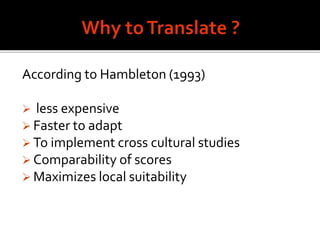
According to Hambleton (1993)
 less expensive
 Faster to adapt
 To implement cross cultural studies
 Comparability of scores
 Maximizes local suitability
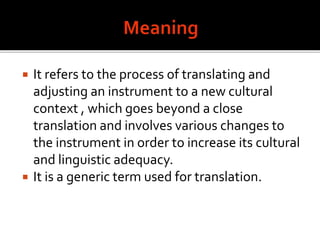
 It refers to the process of translating and
adjusting an instrument to a new cultural
context , which goes beyond a close
translation and involves various changes to
the instrument in order to increase its cultural
and linguistic adequacy.
 It is a generic term used for translation.
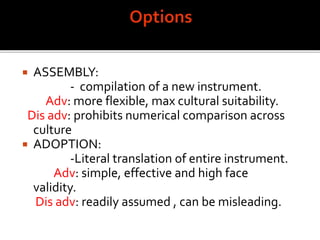
 ASSEMBLY:
- compilation of a new instrument.
Adv: more flexible, max cultural suitability.
Dis adv: prohibits numerical comparison across
culture
 ADOPTION:
-Literal translation of entire instrument.
Adv: simple, effective and high face
validity.
Dis adv: readily assumed , can be misleading.
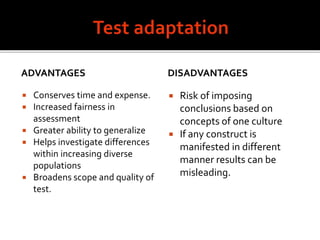
ADVANTAGES
 Conserves time and expense.
 Increased fairness in
assessment
 Greater ability to generalize
 Helps investigate differences
within increasing diverse
populations
 Broadens scope and quality of
test.
DISADVANTAGES
 Risk of imposing
conclusions based on
concepts of one culture
 If any construct is
manifested in different
manner results can be
misleading.
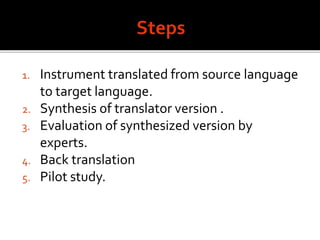
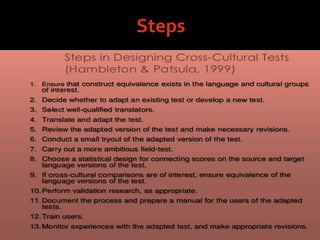
1. Instrument translated from source language
to target language.
2. Synthesis of translator version .
3. Evaluation of synthesized version by
experts.
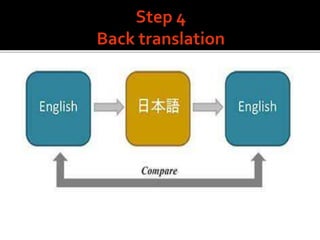
4. Back translation
5. Pilot study.
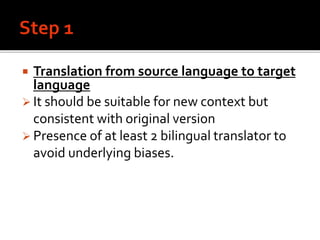
 Translation from source language to target
language
 It should be suitable for new context but
consistent with original version
 Presence of at least 2 bilingual translator to
avoid underlying biases.
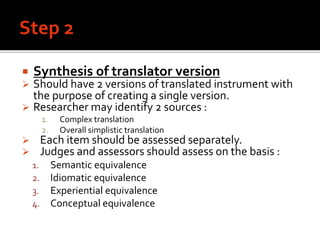
 Synthesis of translator version
 Should have 2 versions of translated instrument with
the purpose of creating a single version.
 Researcher may identify 2 sources :
1. Complex translation
2. Overall simplistic translation
 Each item should be assessed separately.
 Judges and assessors should assess on the basis :
1. Semantic equivalence
2. Idiomatic equivalence
3. Experiential equivalence
4. Conceptual equivalence
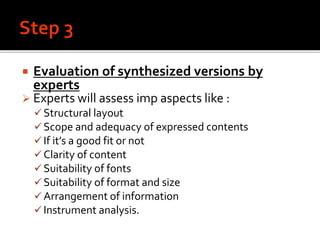
 Evaluation of synthesized versions by
experts
 Experts will assess imp aspects like :
Structural layout
Scope and adequacy of expressed contents
If it’s a good fit or not
Clarity of content
Suitability of fonts
Suitability of format and size
Arrangement of information
Instrument analysis.
 Pilot study
It refers to application of instrument in a small
sample of target population .
It helps to assess:
Appropriateness of items
Meaning and difficulty
Instructions for conducting test
Multiple pilot study can be conducted
To avoid biases
Should be done with the help of expert
Thank you

Test adaptation by sumiran khatri

  • 1.
  • 2.
    According to Hambleton(1993)  less expensive  Faster to adapt  To implement cross cultural studies  Comparability of scores  Maximizes local suitability
  • 3.
     It refersto the process of translating and adjusting an instrument to a new cultural context , which goes beyond a close translation and involves various changes to the instrument in order to increase its cultural and linguistic adequacy.  It is a generic term used for translation.
  • 4.
     ASSEMBLY: - compilationof a new instrument. Adv: more flexible, max cultural suitability. Dis adv: prohibits numerical comparison across culture  ADOPTION: -Literal translation of entire instrument. Adv: simple, effective and high face validity. Dis adv: readily assumed , can be misleading.
  • 6.
    ADVANTAGES  Conserves timeand expense.  Increased fairness in assessment  Greater ability to generalize  Helps investigate differences within increasing diverse populations  Broadens scope and quality of test. DISADVANTAGES  Risk of imposing conclusions based on concepts of one culture  If any construct is manifested in different manner results can be misleading.
  • 7.
    1. Instrument translatedfrom source language to target language. 2. Synthesis of translator version . 3. Evaluation of synthesized version by experts. 4. Back translation 5. Pilot study.
  • 8.
     Translation fromsource language to target language  It should be suitable for new context but consistent with original version  Presence of at least 2 bilingual translator to avoid underlying biases.
  • 9.
     Synthesis oftranslator version  Should have 2 versions of translated instrument with the purpose of creating a single version.  Researcher may identify 2 sources : 1. Complex translation 2. Overall simplistic translation  Each item should be assessed separately.  Judges and assessors should assess on the basis : 1. Semantic equivalence 2. Idiomatic equivalence 3. Experiential equivalence 4. Conceptual equivalence
  • 10.
     Evaluation ofsynthesized versions by experts  Experts will assess imp aspects like : Structural layout Scope and adequacy of expressed contents If it’s a good fit or not Clarity of content Suitability of fonts Suitability of format and size Arrangement of information Instrument analysis.
  • 12.
     Pilot study Itrefers to application of instrument in a small sample of target population . It helps to assess: Appropriateness of items Meaning and difficulty Instructions for conducting test Multiple pilot study can be conducted To avoid biases Should be done with the help of expert
  • 14.