Attention and
Concentration
Miss Nasar shah
SLP
◦ Attention is the process by which the mind
chooses from among the various stimuli that
strike the senses at any given moment
 allows only some info to enter into
consciousness
What is attention?
 A number of people cris-cross each other wearing
different colour dresses, cars and buses pass through on
the nearby road, shops and buildings also attract your
attention.
 However, only a small and selected part of the available
stimulation is registered by an individual for processing
and the rest is filtered out.
 This process of selectively responding to a stimulus
or range of stimuli is called attention.
 Attention is a cognitive process whereby you direct
and maintain awareness of stimuli detected by the
senses and use that information to make decisions
and choose responses.
◦ You continually receive information about your
internal and external environment through your
senses.
◦ You can not be aware of all the sensory
information coming into your senses.
 Attentional processes serve various functions in the
organization of our perceptions and other cognitive
functions.
 The various functions of attention are :
 1. Alerting function
 2. Selective function
 3. Limited capacity channel
 4. Vigilance
Attention and its component
processes
 Carefully observe a cat poised at the mouse hole. If you
look at the cat carefully in such a situation, you will
observe that the ears of the cat are directed towards the
mouse hole (to receive the slightest sound of movement
inside the hole), eyes are converged and focused on the
hole (to get visual image of the mouse as it tries to
come out), the four leg muscles are in a state of high
alert (to pounce at the mouse as it comes out). There is
a complete physiological and mental preparedness to
catch the prey. This is an example of alertness, what we
call an alerting function of attention.
Alerting Function
 The most important function of attention is
selectivity.
 Selectivity refers to a process by which attention is
focused on stimulus or stimuli of ongoing interest
and other stimuli are ignored.
 Selective attention acts as a filter, that allows some
information in and the other (unwanted) out.
 The best example of selective attention is that of "tea-
party effect" in selective listening.
Selective function
 It has been established through research that we have
limited capacity to process information that is available
in the outside world.
 That is, tasks that require attentional resources cannot
be carried out simultaneously because we have limited
capacity to process the incoming information.
 We process the task one at a time, called serial
processing.
 For example, if you are asked to listen to music as well
as read this page in your text book.
Limited Capacity Channel
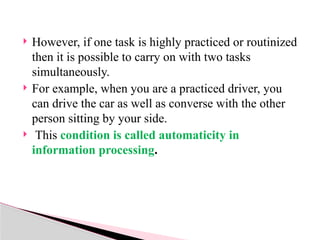
 However, if one task is highly practiced or routinized
then it is possible to carry on with two tasks
simultaneously.
 For example, when you are a practiced driver, you
can drive the car as well as converse with the other
person sitting by your side.
 This condition is called automaticity in
information processing.
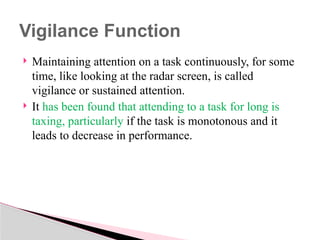
 Maintaining attention on a task continuously, for some
time, like looking at the radar screen, is called
vigilance or sustained attention.
 It has been found that attending to a task for long is
taxing, particularly if the task is monotonous and it
leads to decrease in performance.
Vigilance Function
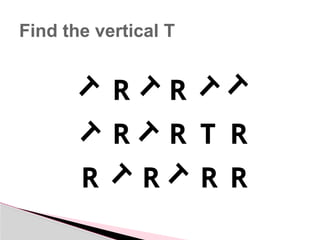
Find the vertical T
R R
R
R
T
R
R
R
R
R
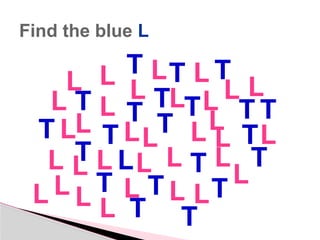
Find the blue L
T
L
L
L
L
L
L
L
L
L
L
L
L
L
L
L
L
L
L
L L
L L
L
L
L
L
L
L
L
L
L
L L
T
T
T
T
T T
T
T
T
T T
T
T
T
T
T
T
T
T T
L
Concentration
 Concentration is defined as the ability to give something
our undivided attention to the exclusion of other
distractions.
 Concentration – is the ability to sustain
attention on selected stimuli for a period of
time.
 Concentration can easily be broken by . . .
◦ external distractions,
◦ our own thoughts and feelings,
◦ planned “psych out” strategies, and
◦ the intense energy demands of intense concentration.
Concentration
 Factors that interfere with quieting
or “parking” the mind include . . .
◦ excessive thinking
◦ stress,
◦ pain, and
◦ fatigue.
What are some common
concentration roadblocks?
 Gallwey emphasizes, “Quieting the
mind means less thinking, calculating,
judging, worrying, fearing, hoping,
trying, regretting, controlling, jittering
or distracting. The mind is still when it
is in the here and now in perfect
oneness with the action and the actor.”
 Poor diet and nutrition
 Hunger
 Dehydration
 Hormonal changes
 Lack of sleep
 Stress
 Medical, emotional or psychological problems
 Lack of physical activity
 Environment and quality of information
Other factors that effect focus
Improving
concentration
  Pick the Best Environment for You to Study In. Choose a place to
study where you feel secure and comfortable (but not too comfortable
—you may fall asleep). Does it have adequate lighting? Is it too warm
or cool?
  Always Reduce Visual Distractions. Are there too many line-of-
sight distractions? Is there a television nearby that might tempt you?
Do friends find and distract you easily? (Hide, disable the “instant
messenger” on your computer, or learn to say “Sorry, I’m studying!”)
  Try to Eliminate Noise Around You. Some people are distracted
by music while others are helped by music. Generally music with
lyrics is distracting. If noise distracts you, use earplugs or a machine
that generates white noise, like a fan. And turn off that cell phone!
Try the PATS Model to Help You Stay
on Task
  Self-talk to Control Internal Distractions. When
you notice your mind has drifted off task, stop what you
are doing and put a checkmark on some scrap paper.
Keep track of your checkmarks as a way to keep track of
your tendencies to lose focus. Also, talk to yourself and
direct your attention back to studying with an affirmative
statement: “I know I have a lot to do today, but I have to
read this chapter first.” Keep a notepad next to you and
if you start to worry about something, write it down,
promise yourself to attend to it later, and then get back to
work
 Chunking. This involves learning small pieces of a
concept first and later putting them together to form the
whole.
  Elaborative Rehearsal. We are more likely to
remember things when we consider the meaning of
something as opposed to its structural components. A
good way to remember a theory or concept is to find
everyday examples so the information is more relevant.
Putting material into your own words also makes it
more meaningful.
 Generation Effect. You are more likely to remember
information that you come up with individually (i.e. you
generate on your own) than information that is simply
presented. Consider studying in pairs so you have
sufficient opportunity to generate information. Using
flash cards is also beneficial.
 Dual Coding. If we have a verbal and visual memory for
a piece of information, we are more likely to remember it.
For example, if you want to remember someone’s name
you can say their name out loud while visualizing a
particular image. Having both a verbal and visual memory
makes it much more likely you will recall their name.
 Spacing Effect. Not surprisingly, spacing out your
review is much more effective than “cramming” in the
long term. For example, if your test is two days away,
study once a day. If your test is in two hours, study
once an hour.
Thank you

atention and concentration.pptxpschology second semste

  • 1.
  • 2.
    ◦ Attention isthe process by which the mind chooses from among the various stimuli that strike the senses at any given moment  allows only some info to enter into consciousness What is attention?
  • 3.
     A numberof people cris-cross each other wearing different colour dresses, cars and buses pass through on the nearby road, shops and buildings also attract your attention.  However, only a small and selected part of the available stimulation is registered by an individual for processing and the rest is filtered out.  This process of selectively responding to a stimulus or range of stimuli is called attention.
  • 4.
     Attention isa cognitive process whereby you direct and maintain awareness of stimuli detected by the senses and use that information to make decisions and choose responses. ◦ You continually receive information about your internal and external environment through your senses. ◦ You can not be aware of all the sensory information coming into your senses.
  • 5.
     Attentional processesserve various functions in the organization of our perceptions and other cognitive functions.  The various functions of attention are :  1. Alerting function  2. Selective function  3. Limited capacity channel  4. Vigilance Attention and its component processes
  • 6.
     Carefully observea cat poised at the mouse hole. If you look at the cat carefully in such a situation, you will observe that the ears of the cat are directed towards the mouse hole (to receive the slightest sound of movement inside the hole), eyes are converged and focused on the hole (to get visual image of the mouse as it tries to come out), the four leg muscles are in a state of high alert (to pounce at the mouse as it comes out). There is a complete physiological and mental preparedness to catch the prey. This is an example of alertness, what we call an alerting function of attention. Alerting Function
  • 7.
     The mostimportant function of attention is selectivity.  Selectivity refers to a process by which attention is focused on stimulus or stimuli of ongoing interest and other stimuli are ignored.  Selective attention acts as a filter, that allows some information in and the other (unwanted) out.  The best example of selective attention is that of "tea- party effect" in selective listening. Selective function
  • 8.
     It hasbeen established through research that we have limited capacity to process information that is available in the outside world.  That is, tasks that require attentional resources cannot be carried out simultaneously because we have limited capacity to process the incoming information.  We process the task one at a time, called serial processing.  For example, if you are asked to listen to music as well as read this page in your text book. Limited Capacity Channel
  • 9.
     However, ifone task is highly practiced or routinized then it is possible to carry on with two tasks simultaneously.  For example, when you are a practiced driver, you can drive the car as well as converse with the other person sitting by your side.  This condition is called automaticity in information processing.
  • 10.
     Maintaining attentionon a task continuously, for some time, like looking at the radar screen, is called vigilance or sustained attention.  It has been found that attending to a task for long is taxing, particularly if the task is monotonous and it leads to decrease in performance. Vigilance Function
  • 11.
    Find the verticalT R R R R T R R R R R
  • 12.
    Find the blueL T L L L L L L L L L L L L L L L L L L L L L L L L L L L L L L L L L T T T T T T T T T T T T T T T T T T T T L
  • 13.
  • 14.
     Concentration isdefined as the ability to give something our undivided attention to the exclusion of other distractions.  Concentration – is the ability to sustain attention on selected stimuli for a period of time.  Concentration can easily be broken by . . . ◦ external distractions, ◦ our own thoughts and feelings, ◦ planned “psych out” strategies, and ◦ the intense energy demands of intense concentration. Concentration
  • 15.
     Factors thatinterfere with quieting or “parking” the mind include . . . ◦ excessive thinking ◦ stress, ◦ pain, and ◦ fatigue. What are some common concentration roadblocks?
  • 16.
     Gallwey emphasizes,“Quieting the mind means less thinking, calculating, judging, worrying, fearing, hoping, trying, regretting, controlling, jittering or distracting. The mind is still when it is in the here and now in perfect oneness with the action and the actor.”
  • 17.
     Poor dietand nutrition  Hunger  Dehydration  Hormonal changes  Lack of sleep  Stress  Medical, emotional or psychological problems  Lack of physical activity  Environment and quality of information Other factors that effect focus
  • 18.
  • 19.
      Pickthe Best Environment for You to Study In. Choose a place to study where you feel secure and comfortable (but not too comfortable —you may fall asleep). Does it have adequate lighting? Is it too warm or cool?   Always Reduce Visual Distractions. Are there too many line-of- sight distractions? Is there a television nearby that might tempt you? Do friends find and distract you easily? (Hide, disable the “instant messenger” on your computer, or learn to say “Sorry, I’m studying!”)   Try to Eliminate Noise Around You. Some people are distracted by music while others are helped by music. Generally music with lyrics is distracting. If noise distracts you, use earplugs or a machine that generates white noise, like a fan. And turn off that cell phone! Try the PATS Model to Help You Stay on Task
  • 20.
      Self-talkto Control Internal Distractions. When you notice your mind has drifted off task, stop what you are doing and put a checkmark on some scrap paper. Keep track of your checkmarks as a way to keep track of your tendencies to lose focus. Also, talk to yourself and direct your attention back to studying with an affirmative statement: “I know I have a lot to do today, but I have to read this chapter first.” Keep a notepad next to you and if you start to worry about something, write it down, promise yourself to attend to it later, and then get back to work
  • 21.
     Chunking. Thisinvolves learning small pieces of a concept first and later putting them together to form the whole.   Elaborative Rehearsal. We are more likely to remember things when we consider the meaning of something as opposed to its structural components. A good way to remember a theory or concept is to find everyday examples so the information is more relevant. Putting material into your own words also makes it more meaningful.
  • 22.
     Generation Effect.You are more likely to remember information that you come up with individually (i.e. you generate on your own) than information that is simply presented. Consider studying in pairs so you have sufficient opportunity to generate information. Using flash cards is also beneficial.  Dual Coding. If we have a verbal and visual memory for a piece of information, we are more likely to remember it. For example, if you want to remember someone’s name you can say their name out loud while visualizing a particular image. Having both a verbal and visual memory makes it much more likely you will recall their name.
  • 23.
     Spacing Effect.Not surprisingly, spacing out your review is much more effective than “cramming” in the long term. For example, if your test is two days away, study once a day. If your test is in two hours, study once an hour.
  • 24.