
AT&T’s Wireless Network Improving, Expanding, Evolving and Innovating
Cautionary Language Concerning Forward-Looking Statements Information set forth in this presentation contains financial estimates and other forward-looking statements that are subject to risks and uncertainties, and actual results might differ materially. A discussion of factors that may affect future results is contained in AT&T’s filings with the Securities and Exchange Commission. AT&T disclaims any obligation to update and revise statements contained in this presentation based on new information or otherwise. Safe Harbor Statement
Improving Innovating Evolving Current Level of Maturity  for Most Businesses Expanding Why Technology is Important GSM enables a smooth evolution as your mobile needs mature Future Deployment Voice Email/Messaging Corporate-Provided Device Video-on-demand Peer-to-peer file sharing Complex Web services ERP/SCM/CRM SFA/Field Service Fleet Workflow Enhancers Smart Devices Laptops Corporate Intranets 4G Real-time Workforce Collaboration Business Process Applications Remote Access  to Business Information Business Communications 2G 3G
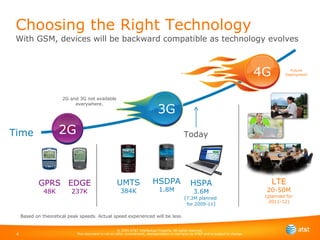
Today GPRS 48K Time 2G EDGE 237K LTE 20-50M (planned for 2011-12) Choosing the Right Technology  With GSM, devices will be backward compatible as technology evolves 3G 4G Based on theoretical peak speeds. Actual speed experienced will be less. 2G and 3G not available everywhere. Future Deployment UMTS 384K HSDPA 1.8M HSPA 3.6M ( 7.2M planned  for 2009-11 )
Speed, Coverage and Capacity AT&T’s Network Investments
Expanding Broadband Coverage Significant network investment, including new 3G cell sites underway Significant network investment Investing Over the past two years, AT&T has invested  some $38 billion to enhance our wireless and wired networks and supporting infrastructure.  AT&T plans to invest between $17 billion and $18 billion this year (2009), two-thirds of which is being used for expansion and enhancement of the networks Building 3G Plan to deploy about 2,000 new cell sites in 2009  Acquired Assets Dobson Communications, Edge Wireless, Easterbrooke Cellular Corp. and others Wireless spectrum from Aloha Partners
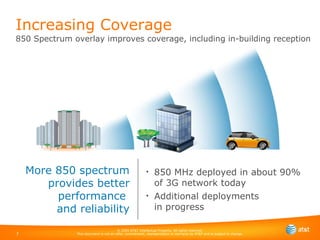
850 MHz deployed in about 90% of 3G network today  Additional deployments  in progress Increasing Coverage 850 Spectrum overlay improves coverage, including in-building reception More 850 spectrum provides better performance  and reliability
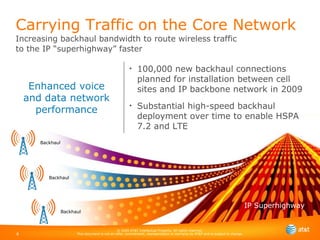
Enhanced voice and data network performance Carrying Traffic on the Core Network  Increasing backhaul bandwidth to route wireless traffic  to the IP “superhighway” faster 100,000 new backhaul connections planned for installation between cell sites and IP backbone network in 2009 Substantial high-speed backhaul deployment over time to enable HSPA 7.2 and LTE IP Superhighway © 2009 AT&T Intellectual Property. All rights reserved. This document is not an offer, commitment, representation or warranty by AT&T and is subject to change. Backhaul Backhaul Backhaul
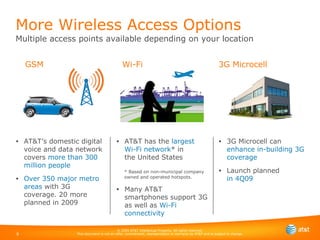
AT&T’s domestic digital voice and data network covers  more than 300 million people Over 350 major metro areas  with 3G coverage. 20 more planned in 2009 More Wireless Access Options Multiple access points available depending on your location 3G Microcell can  enhance in-building 3G coverage Launch planned  in 4Q09 GSM Wi-Fi 3G Microcell AT&T has the  largest Wi-Fi network * in  the United States * Based on non-municipal company owned and operated hotspots. Many AT&T smartphones support 3G as well as  Wi-Fi connectivity
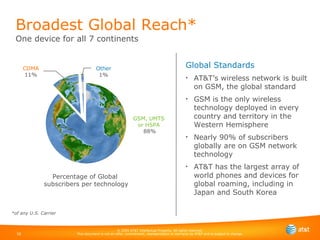
Global Standards  AT&T’s wireless network is built on GSM, the global standard GSM is the only wireless technology deployed in every country and territory in the Western Hemisphere Nearly 90% of subscribers globally are on GSM network technology AT&T has the largest array of world phones and devices for global roaming, including in Japan and South Korea *of any U.S. Carrier Broadest Global Reach* One device for all 7 continents Percentage of Global  subscribers per technology GSM, UMTS or HSPA  88% Other 1% CDMA 11%
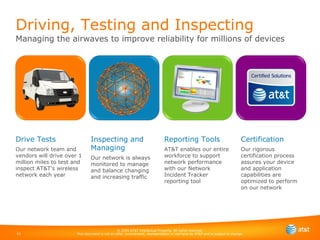
Driving, Testing and Inspecting Managing the airwaves to improve reliability for millions of devices Drive Tests Our network team and vendors will drive over 1 million miles to test and inspect AT&T's wireless network each year Inspecting and Managing Our network is always monitored to manage  and balance changing and increasing traffic Reporting Tools AT&T enables our entire workforce to support network performance  with our Network Incident Tracker reporting tool Certification Our rigorous certification process assures your device and application capabilities are optimized to perform on our network
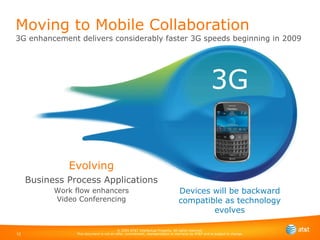
3G Devices will be backward compatible as technology evolves Moving to Mobile Collaboration 3G enhancement delivers considerably faster 3G speeds beginning in 2009 Evolving Work flow enhancers Video Conferencing Business Process Applications
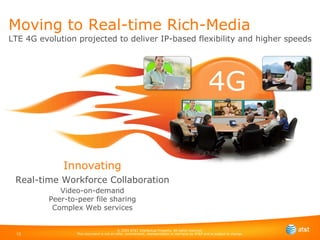
Moving to Real-time Rich-Media LTE 4G evolution projected to deliver IP-based flexibility and higher speeds 4G Innovating Video-on-demand Peer-to-peer file sharing Complex Web services Real-time Workforce Collaboration
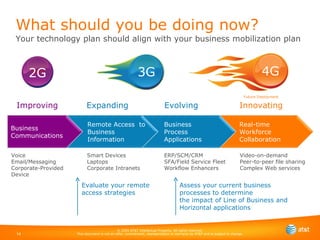
Voice Email/Messaging Corporate-Provided Device Video-on-demand Peer-to-peer file sharing Complex Web services ERP/SCM/CRM SFA/Field Service Fleet Workflow Enhancers Smart Devices Laptops Corporate Intranets What should you be doing now? Your technology plan should align with your business mobilization plan Assess your current business processes to determine  the impact of Line of Business and Horizontal applications Evaluate your remote access strategies  Improving Innovating Evolving Expanding Future Deployment Real-time Workforce Collaboration Business Process Applications Remote Access  to Business Information Business Communications 4G 2G 3G
Thank You!
Backup
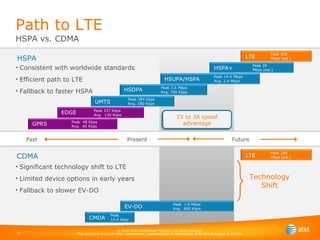
Technology Shift Significant technology shift to LTE Limited device options in early years Fallback to slower EV-DO Consistent with worldwide standards Efficient path to LTE Fallback to faster HSPA HSPA CDMA Path to LTE  HSPA vs. CDMA © 2009 AT&T Intellectual Property. All rights reserved. This document is not an offer, commitment, representation or warranty by AT&T and is subject to change. 2X to 3X speed advantage Past Present Future LTE Peak 100  Mbps (est.)   EDGE Peak  237  Kbps Avg.  130 Kbps  UMTS Peak  384  Kbps Avg. 180 Kbps  HSDPA Peak 3.6 Mbps Avg. 700 Kbps  HSPA+  Peak 20  Mbps (est.) Peak 14.4 Mbps Avg. 1.4 Mbps  HSUPA/HSPA GPRS Peak  48 Kbps Avg.  40 Kbps  EV-DO Peak  1.6 Mbps Avg.  600 Kbps  CMDA Peak  14.4 kbps LTE Peak 100  Mbps (est.)
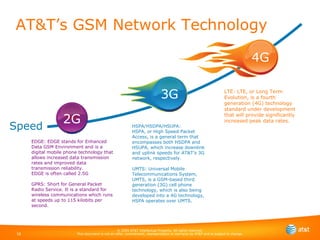
Speed 3G 4G 2G AT&T’s GSM Network Technology LTE: LTE, or Long Term Evolution, is a fourth generation (4G) technology standard under development that will provide significantly increased peak data rates. EDGE: EDGE stands for Enhanced Data GSM Environment and is a digital mobile phone technology that allows increased data transmission rates and improved data transmission reliability. EDGE is often called 2.5G GPRS: Short for General Packet Radio Service. It is a standard for wireless communications which runs at speeds up to 115 kilobits per second. HSPA/HSDPA/HSUPA:  HSPA, or High Speed Packet Access, is a general term that encompasses both HSDPA and HSUPA, which increase downlink and uplink speeds for AT&T’s 3G network, respectively. UMTS: Universal Mobile Telecommunications System, UMTS, is a GSM-based third generation (3G) cell phone technology, which is also being developed into a 4G technology, HSPA operates over UMTS.

At&t wireless network customer&training

  • 1.
    AT&T’s Wireless NetworkImproving, Expanding, Evolving and Innovating
  • 2.
    Cautionary Language ConcerningForward-Looking Statements Information set forth in this presentation contains financial estimates and other forward-looking statements that are subject to risks and uncertainties, and actual results might differ materially. A discussion of factors that may affect future results is contained in AT&T’s filings with the Securities and Exchange Commission. AT&T disclaims any obligation to update and revise statements contained in this presentation based on new information or otherwise. Safe Harbor Statement
  • 3.
    Improving Innovating EvolvingCurrent Level of Maturity for Most Businesses Expanding Why Technology is Important GSM enables a smooth evolution as your mobile needs mature Future Deployment Voice Email/Messaging Corporate-Provided Device Video-on-demand Peer-to-peer file sharing Complex Web services ERP/SCM/CRM SFA/Field Service Fleet Workflow Enhancers Smart Devices Laptops Corporate Intranets 4G Real-time Workforce Collaboration Business Process Applications Remote Access to Business Information Business Communications 2G 3G
  • 4.
    Today GPRS 48KTime 2G EDGE 237K LTE 20-50M (planned for 2011-12) Choosing the Right Technology With GSM, devices will be backward compatible as technology evolves 3G 4G Based on theoretical peak speeds. Actual speed experienced will be less. 2G and 3G not available everywhere. Future Deployment UMTS 384K HSDPA 1.8M HSPA 3.6M ( 7.2M planned for 2009-11 )
  • 5.
    Speed, Coverage andCapacity AT&T’s Network Investments
  • 6.
    Expanding Broadband CoverageSignificant network investment, including new 3G cell sites underway Significant network investment Investing Over the past two years, AT&T has invested some $38 billion to enhance our wireless and wired networks and supporting infrastructure. AT&T plans to invest between $17 billion and $18 billion this year (2009), two-thirds of which is being used for expansion and enhancement of the networks Building 3G Plan to deploy about 2,000 new cell sites in 2009 Acquired Assets Dobson Communications, Edge Wireless, Easterbrooke Cellular Corp. and others Wireless spectrum from Aloha Partners
  • 7.
    850 MHz deployedin about 90% of 3G network today Additional deployments in progress Increasing Coverage 850 Spectrum overlay improves coverage, including in-building reception More 850 spectrum provides better performance and reliability
  • 8.
    Enhanced voice anddata network performance Carrying Traffic on the Core Network Increasing backhaul bandwidth to route wireless traffic to the IP “superhighway” faster 100,000 new backhaul connections planned for installation between cell sites and IP backbone network in 2009 Substantial high-speed backhaul deployment over time to enable HSPA 7.2 and LTE IP Superhighway © 2009 AT&T Intellectual Property. All rights reserved. This document is not an offer, commitment, representation or warranty by AT&T and is subject to change. Backhaul Backhaul Backhaul
  • 9.
    AT&T’s domestic digitalvoice and data network covers more than 300 million people Over 350 major metro areas with 3G coverage. 20 more planned in 2009 More Wireless Access Options Multiple access points available depending on your location 3G Microcell can enhance in-building 3G coverage Launch planned in 4Q09 GSM Wi-Fi 3G Microcell AT&T has the largest Wi-Fi network * in the United States * Based on non-municipal company owned and operated hotspots. Many AT&T smartphones support 3G as well as Wi-Fi connectivity
  • 10.
    Global Standards AT&T’s wireless network is built on GSM, the global standard GSM is the only wireless technology deployed in every country and territory in the Western Hemisphere Nearly 90% of subscribers globally are on GSM network technology AT&T has the largest array of world phones and devices for global roaming, including in Japan and South Korea *of any U.S. Carrier Broadest Global Reach* One device for all 7 continents Percentage of Global subscribers per technology GSM, UMTS or HSPA 88% Other 1% CDMA 11%
  • 11.
    Driving, Testing andInspecting Managing the airwaves to improve reliability for millions of devices Drive Tests Our network team and vendors will drive over 1 million miles to test and inspect AT&T's wireless network each year Inspecting and Managing Our network is always monitored to manage and balance changing and increasing traffic Reporting Tools AT&T enables our entire workforce to support network performance with our Network Incident Tracker reporting tool Certification Our rigorous certification process assures your device and application capabilities are optimized to perform on our network
  • 12.
    3G Devices willbe backward compatible as technology evolves Moving to Mobile Collaboration 3G enhancement delivers considerably faster 3G speeds beginning in 2009 Evolving Work flow enhancers Video Conferencing Business Process Applications
  • 13.
    Moving to Real-timeRich-Media LTE 4G evolution projected to deliver IP-based flexibility and higher speeds 4G Innovating Video-on-demand Peer-to-peer file sharing Complex Web services Real-time Workforce Collaboration
  • 14.
    Voice Email/Messaging Corporate-ProvidedDevice Video-on-demand Peer-to-peer file sharing Complex Web services ERP/SCM/CRM SFA/Field Service Fleet Workflow Enhancers Smart Devices Laptops Corporate Intranets What should you be doing now? Your technology plan should align with your business mobilization plan Assess your current business processes to determine the impact of Line of Business and Horizontal applications Evaluate your remote access strategies Improving Innovating Evolving Expanding Future Deployment Real-time Workforce Collaboration Business Process Applications Remote Access to Business Information Business Communications 4G 2G 3G
  • 15.
  • 16.
  • 17.
    Technology Shift Significanttechnology shift to LTE Limited device options in early years Fallback to slower EV-DO Consistent with worldwide standards Efficient path to LTE Fallback to faster HSPA HSPA CDMA Path to LTE HSPA vs. CDMA © 2009 AT&T Intellectual Property. All rights reserved. This document is not an offer, commitment, representation or warranty by AT&T and is subject to change. 2X to 3X speed advantage Past Present Future LTE Peak 100 Mbps (est.) EDGE Peak 237 Kbps Avg. 130 Kbps UMTS Peak 384 Kbps Avg. 180 Kbps HSDPA Peak 3.6 Mbps Avg. 700 Kbps HSPA+ Peak 20 Mbps (est.) Peak 14.4 Mbps Avg. 1.4 Mbps HSUPA/HSPA GPRS Peak 48 Kbps Avg. 40 Kbps EV-DO Peak 1.6 Mbps Avg. 600 Kbps CMDA Peak 14.4 kbps LTE Peak 100 Mbps (est.)
  • 18.
    Speed 3G 4G2G AT&T’s GSM Network Technology LTE: LTE, or Long Term Evolution, is a fourth generation (4G) technology standard under development that will provide significantly increased peak data rates. EDGE: EDGE stands for Enhanced Data GSM Environment and is a digital mobile phone technology that allows increased data transmission rates and improved data transmission reliability. EDGE is often called 2.5G GPRS: Short for General Packet Radio Service. It is a standard for wireless communications which runs at speeds up to 115 kilobits per second. HSPA/HSDPA/HSUPA: HSPA, or High Speed Packet Access, is a general term that encompasses both HSDPA and HSUPA, which increase downlink and uplink speeds for AT&T’s 3G network, respectively. UMTS: Universal Mobile Telecommunications System, UMTS, is a GSM-based third generation (3G) cell phone technology, which is also being developed into a 4G technology, HSPA operates over UMTS.