Generic Access Network
Overview
 Generic Access Network or GAN is a telecommunication system that extends mobile voice, data
and multimedia (IMS/SIP) applications over IP networks
 Unlicensed Mobile Access or UMA, is the commercial name used by mobile carriers for external
IP access into their core networks.
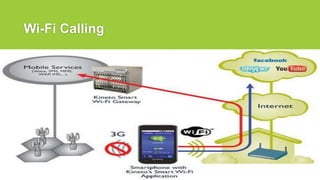
 Usually called Wi-Fi Calling
Overview
 GAN allows cell phone packets to be forwarded to a network access point over the internet, rather
than over-the-air using GSM/GPRS, UMTS or similar.
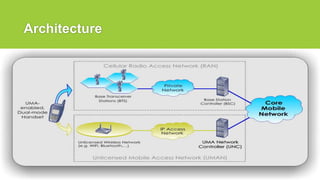
 A separate device known as a "GAN Controller" (GANC) receives this data from the internet and
feeds it into the phone network as if it were coming from an antenna on a tower.
 In its most common form, GAN is used to allow UMA-compatible mobile phones to use Wi-Fi
networks to connect calls, in place of conventional cell towers.
History
 UMA was developed by a group of operator and vendor companies.
 The initial specifications were published on 2 September 2004.
 On 8 April 2005, 3GPP approved specifications for Generic Access to A/Gb interfaces for 3GPP
Release 6.
Mode of Operation
A typical UMA/GAN handset will have four modes of operation:
 GERAN-only: uses only cellular networks
 GERAN-preferred: uses cellular networks if available, otherwise the 802.11 radio
 GAN-preferred: uses an 802.11 connection if an access point is in range, otherwise the cellular
network
 GAN-only: uses only the 802.11 connection
Architecture
Wi-Fi Calling
Advantages For carrier
 GAN allows carriers to add coverage using low cost 802.11 access points.
 GAN relieves congestion
 Can leverage 3rd party hotspots to create more capacity and provide better coverage in populous
areas.
Advantages for subscribers
 Subscribers do not rely on their operator's ability to roll out towers and coverage.
 The cheaper rates for 802.11 use, coupled with better coverage at home, make more affordable.
 Using IP over 802.11 eliminates expensive charges when roaming.
 GAN can migrate between IP and cellular coverage and is thus seamless.
Disadvantages
 Subscribers must upgrade to Wi-Fi/UMA enabled handsets.
 Calls may be more prone to disconnect when the handset transitions from Wi-Fi to the standard
wireless service and vice versa
 The phones that support multiple signals may be more expensive.
 GNA drains the battery faster, and reduces both the talk time and standby time
Service Deployments
 BT Fusion was a telecommunications product available from BT in the United Kingdom
 On August 28, 2006, Telia Sonera was the first to launch an 802.11 based UMA service called
"Home Free“ in Denmark.
 On September 25, 2006 Orange announced its "Unik service", also known as Signal Boost in the
UK.
 In Canada, both Fido and Rogers Wireless launched UMA plans under the names UNO and
Rogers Home Calling Zone
 UMA is not implemented in Asia, Australia, Africa and some European countries
GAN Beyond Dual-mode
While UMA is nearly always associated with dual-mode GSM/Wi-Fi services, it is actually a ‘generic’
access network technology that provides a generic method for extending the services and applications
in an operator's mobile core (voice, data, IMS) over IP and the public Internet.
 Femtocells
 Analog Terminal Adaptor
 Mobile VoIP Client
Devices
•Apple - iPhone 5C, iPhone 5S, and newer devices with iOS 8 or later.
•BlackBerry - Curve 8320, 8520, 8820, Curve 8900, Pearl 8120 and 8220, Bold 9700, Bold 9780, Torch 9800,
Blackberry 9105, 9300, Blackberry Bold 9900 with OS 7.1
•HTC - Touch 3G, T-Mobile Shadow 2009, T-Mobile myTouch 4G (sometimes called the myTouch HD), T-Mobile G2
•(as of build 1.22.531.8 OTA update), Desire S, Wildfire S, Sensation 4G, Amaze 4G, HTC One, HTC One S
•Huawei - U8651T
•LG - KE 520, KF 757 (3G), GT505, Optimus One, LG Optimus Me
Thanks

Generic Access Network

  • 1.
  • 2.
    Overview  Generic AccessNetwork or GAN is a telecommunication system that extends mobile voice, data and multimedia (IMS/SIP) applications over IP networks  Unlicensed Mobile Access or UMA, is the commercial name used by mobile carriers for external IP access into their core networks.  Usually called Wi-Fi Calling
  • 3.
    Overview  GAN allowscell phone packets to be forwarded to a network access point over the internet, rather than over-the-air using GSM/GPRS, UMTS or similar.  A separate device known as a "GAN Controller" (GANC) receives this data from the internet and feeds it into the phone network as if it were coming from an antenna on a tower.  In its most common form, GAN is used to allow UMA-compatible mobile phones to use Wi-Fi networks to connect calls, in place of conventional cell towers.
  • 4.
    History  UMA wasdeveloped by a group of operator and vendor companies.  The initial specifications were published on 2 September 2004.  On 8 April 2005, 3GPP approved specifications for Generic Access to A/Gb interfaces for 3GPP Release 6.
  • 5.
    Mode of Operation Atypical UMA/GAN handset will have four modes of operation:  GERAN-only: uses only cellular networks  GERAN-preferred: uses cellular networks if available, otherwise the 802.11 radio  GAN-preferred: uses an 802.11 connection if an access point is in range, otherwise the cellular network  GAN-only: uses only the 802.11 connection
  • 6.
  • 7.
  • 8.
    Advantages For carrier GAN allows carriers to add coverage using low cost 802.11 access points.  GAN relieves congestion  Can leverage 3rd party hotspots to create more capacity and provide better coverage in populous areas.
  • 9.
    Advantages for subscribers Subscribers do not rely on their operator's ability to roll out towers and coverage.  The cheaper rates for 802.11 use, coupled with better coverage at home, make more affordable.  Using IP over 802.11 eliminates expensive charges when roaming.  GAN can migrate between IP and cellular coverage and is thus seamless.
  • 10.
    Disadvantages  Subscribers mustupgrade to Wi-Fi/UMA enabled handsets.  Calls may be more prone to disconnect when the handset transitions from Wi-Fi to the standard wireless service and vice versa  The phones that support multiple signals may be more expensive.  GNA drains the battery faster, and reduces both the talk time and standby time
  • 11.
    Service Deployments  BTFusion was a telecommunications product available from BT in the United Kingdom  On August 28, 2006, Telia Sonera was the first to launch an 802.11 based UMA service called "Home Free“ in Denmark.  On September 25, 2006 Orange announced its "Unik service", also known as Signal Boost in the UK.  In Canada, both Fido and Rogers Wireless launched UMA plans under the names UNO and Rogers Home Calling Zone  UMA is not implemented in Asia, Australia, Africa and some European countries
  • 12.
    GAN Beyond Dual-mode WhileUMA is nearly always associated with dual-mode GSM/Wi-Fi services, it is actually a ‘generic’ access network technology that provides a generic method for extending the services and applications in an operator's mobile core (voice, data, IMS) over IP and the public Internet.  Femtocells  Analog Terminal Adaptor  Mobile VoIP Client
  • 13.
    Devices •Apple - iPhone5C, iPhone 5S, and newer devices with iOS 8 or later. •BlackBerry - Curve 8320, 8520, 8820, Curve 8900, Pearl 8120 and 8220, Bold 9700, Bold 9780, Torch 9800, Blackberry 9105, 9300, Blackberry Bold 9900 with OS 7.1 •HTC - Touch 3G, T-Mobile Shadow 2009, T-Mobile myTouch 4G (sometimes called the myTouch HD), T-Mobile G2 •(as of build 1.22.531.8 OTA update), Desire S, Wildfire S, Sensation 4G, Amaze 4G, HTC One, HTC One S •Huawei - U8651T •LG - KE 520, KF 757 (3G), GT505, Optimus One, LG Optimus Me
  • 14.