Name: Title:Sagi Subocki Products Manager,
Head of IMS Segment
October 2010
LTE – The Future of IMS
RCS – Advanced Interoperable Services
Agenda
Introduction to LTE
The VoLTE initiative
LTE and IMS
RADVISION IMS Development solution
Rich Communication Suite
RADVISION RCS Developer Solutions
LTE - Introduction
LTE (Long Term Evolution) – foundation of 4G
All IP and Higher Bandwidth, low latency.
Enhances existing 3G UMTS
Efficiently supports multi-antenna technologies (MIMO).
High bandwidth—up to 20 MHz.
Scalable, LTE can operate in the existing 5-MHz UMTS
frequency bands, or in even smaller bands.
LTE – the end of Circuit Switch
LTE is an all-IP mobile network
No support for ‘traditional’ CS domain voice
New Voice and SMS solutions required
The future of operators
Top 25 LTE Operators Will Reach Over 200
million LTE Subscribers by 2015
CAPEX spending to reach $14 billion in 2015
- Maravedis research
Operators today face real challenges
Future of voice service usage:
Migration of customers towards mobile
VoIP solutions over their data networks
The App Store:
Services that run on the network are
not controlled by the network operator.
LTE:
All about IP connectivity. Need a solution for
traditional voice and SMS services.
Significantly improves network's quality – operators are
becoming "dumb" data pipes
Operators need to be able to provide new services
and stay relevant!
The Solution - IMS
The enabler for operators to continue to be the
service provider of all services over LTE.
Reliable, QoS, Secure,
Service Continuity, Roaming.
IMS will materialize –
the operators simply have
no other choice.
VoLTE - Voice over LTE
IMS profile
Started as “One Voice”
Initiative of 18 operators and handset vendors
GSMA adopted it
Work continues on the initial “One Voice” draft
Renamed to “VoLTE”
IMTC IMS Activity Group was selected by
“OneVoice” initiative to develop VoLTE test
specification.
VoLTE - Introduction
VoLTE profile defines a minimum mandatory
set of features in order to guarantee an
interoperable, high quality IMS-based telephony
service over LTE access networks
Voice and SMS in first stage - fast to fight new
options for mobile VoIP
“smart pipe” vs “dumb pipe”
VoLTE
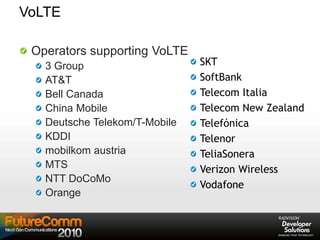
Operators supporting VoLTE
3 Group
AT&T
Bell Canada
China Mobile
Deutsche Telekom/T-Mobile
KDDI
mobilkom austria
MTS
NTT DoCoMo
Orange
SKT
SoftBank
Telecom Italia
Telecom New Zealand
Telefónica
Telenor
TeliaSonera
Verizon Wireless
Vodafone
VoLTE
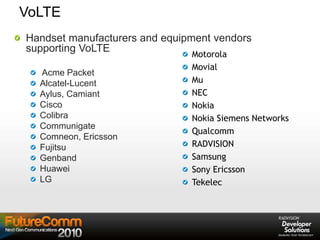
Handset manufacturers and equipment vendors
supporting VoLTE
Acme Packet
Alcatel-Lucent
Aylus, Camiant
Cisco
Colibra
Communigate
Comneon, Ericsson
Fujitsu
Genband
Huawei
LG
Motorola
Movial
Mu
NEC
Nokia
Nokia Siemens Networks
Qualcomm
RADVISION
Samsung
Sony Ericsson
Tekelec
How Will Networks Migrate to LTE?
Networks will not switch overnight from GSM and 3G to
LTE.
Operators will need to provide service continuity
VCC = Voice Call Continuity
SMS
Need to integrate new technologies to stay relevant
Operators making the move with different approaches.
IMS - Introduction
IP Multimedia Subsystem
Designed to provide flexible multimedia services anytime
and everywhere
Part of the core network, with interfaces to other
subsystems in the network
Technical specifications by GPP/3GPP2/TISPAN/Packet
Cable and others
Enables to ensure secure, reliable,
interoperable, roamed, services with QoS
How?
An architecture for IP based next generation service and
call control
Layered, functional architecture
Open application development framework
Common authentication, authorization and accounting
framework
Common media control and network management
functions
An architecture that will be used in all networks
Cellular
Fixed carrier networks
WiMax networks
Packet Cable networks
LTE
IMS is happening now!
By 2011 80% of surveyed service providers will run voice over IMS
(Infonetics).
Common IMS – Adopted by Cellular (3GPP/3GPP2), LTE, Fixed
Line (TISPAN), Cable (PacketCable 2.0), and WiMAX
A wide basic set of IMS standards which are identical to all networks.
Each access network has its own unique "flavor" added on top of it.
Key to IMS Application Success
Compliancy to the standards
Ensures interoperability
Easy deployment
“Worry-free” roaming
Smooth evolution to IMS SIP
Ability to add new IMS Services
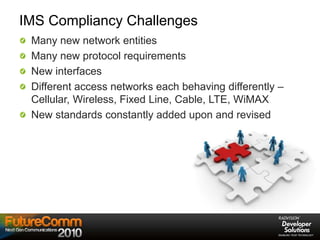
IMS Compliancy Challenges
Many new network entities
Many new protocol requirements
New interfaces
Different access networks each behaving differently –
Cellular, Wireless, Fixed Line, Cable, LTE, WiMAX
New standards constantly added upon and revised
New Services in IMS Release 9
Public Warning System,
Earthquake and Tsunami
Warning System (ETWS)
Service Specific Access Control
Machine to Machine Network Improvements
New Deployment & Migration Scenarios in
IMS Release 9
Circuit Switched to VOIP, Service continuity
improvements
3GPP/Non-3GPP accesses -> LTE
LTE HNB (Femtocells)
IMS Express™ - RADVISION’s IMS
Developer Suite
RADVISION is a proven market leader in the Voice and
Video over IP and 3G protocol markets
Involved in SDO and IOT
RADVISION provides “future-proof solutions” and a clear
standard based roadmap
RADVISION’s IMS Express™
Comprehensive IMS product line
Full IMS compliancy - 3GPP, TISPAN, PacketCable 2.0, LTE,
WiMAX
RADVISION provides all the tools to meet the IMS challenge
RADVISION IMS Protocol Toolkits
Powerful and highly versatile set of tools to
facilitate development of IMS applications
Reduces development time and costs
Toolkits highlights:
Source Code
Multilayered APIs
Extensive choice of quick start sample applications
that enable full user control and flexibility
GUI test applications
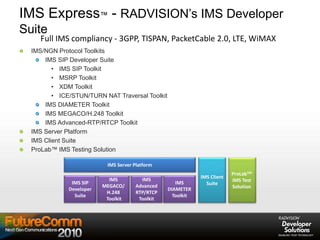
IMS Express™ - RADVISION’s IMS Developer
Suite
IMS/NGN Protocol Toolkits
IMS SIP Developer Suite
• IMS SIP Toolkit
• MSRP Toolkit
• XDM Toolkit
• ICE/STUN/TURN NAT Traversal Toolkit
IMS DIAMETER Toolkit
IMS MEGACO/H.248 Toolkit
IMS Advanced-RTP/RTCP Toolkit
IMS Server Platform
IMS Client Suite
ProLab™ IMS Testing Solution
IMS
MEGACO/
H.248
Toolkit
IMS SIP
Developer
Suite
IMS
DIAMETER
Toolkit
IMS Server Platform
ProLabTM
IMS Test
Solution
IMS
Advanced
RTP/RTCP
Toolkit
IMS Client
Suite
Full IMS compliancy - 3GPP, TISPAN, PacketCable 2.0, LTE, WiMAX
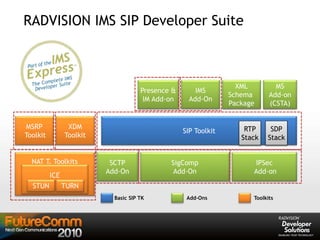
RADVISION IMS SIP Developer Suite
Basic SIP TK Add-Ons Toolkits
SIP Toolkit RTP
Stack
SDP
Stack
SCTP
Add-On
SigComp
Add-On
IMS
Add-On
XML
Schema
Package
MS
Add-on
(CSTA)
STUN ICE
NAT T. Toolkits
ICE
XDM
Toolkit
MSRP
Toolkit
IPSec
Add-on
STUN
Presence &
IM Add-on
TURN
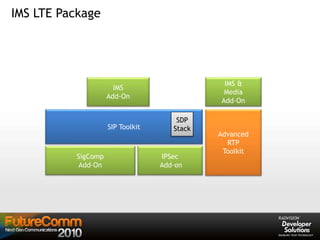
SIP Toolkit
SDP
Stack
SigComp
Add-On
IMS
Add-On
IPSec
Add-on
Advanced
RTP
Toolkit
IMS &
Media
Add-On
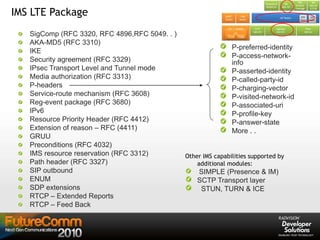
IMS LTE Package
NGN/IMS features – partial list
SigComp (RFC 3320, RFC 4896,RFC 5049. . )
AKA-MD5 (RFC 3310)
IKE
Security agreement (RFC 3329)
IPsec Transport Level and Tunnel mode
Media authorization (RFC 3313)
P-headers
Service-route mechanism (RFC 3608)
Reg-event package (RFC 3680)
IPv6
Resource Priority Header (RFC 4412)
Extension of reason – RFC (4411)
GRUU
Preconditions (RFC 4032)
IMS resource reservation (RFC 3312)
Path header (RFC 3327)
SIP outbound
ENUM
SDP extensions
RTCP – Extended Reports
RTCP – Feed Back
P-preferred-identity
P-access-network-
info
P-asserted-identity
P-called-party-id
P-charging-vector
P-visited-network-id
P-associated-uri
P-profile-key
P-answer-state
More . .
Other IMS capabilities supported by
additional modules:
SIMPLE (Presence & IM)
SCTP Transport layer
STUN, TURN & ICE
IMS LTE Package
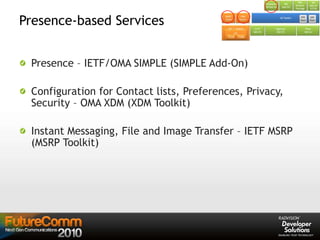
Presence-based Services
Presence – IETF/OMA SIMPLE (SIMPLE Add-On)
Configuration for Contact lists, Preferences, Privacy,
Security – OMA XDM (XDM Toolkit)
Instant Messaging, File and Image Transfer – IETF MSRP
(MSRP Toolkit)
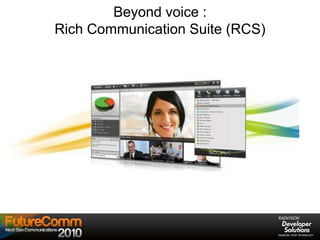
Beyond voice :
Rich Communication Suite (RCS)
Enriched, interoperable, communication services
Today, only (switched) voice, SMS or e-mail, are
really interoperable
Existing enriched communication services are not
standard or interoperable
There is a need for interoperable enriched
communication services with multimedia
capabilities, beyond voice and SMS
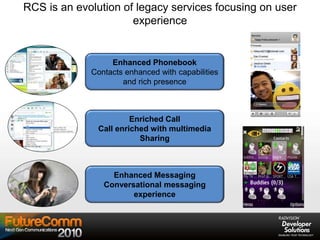
Enriched Call
Call enriched with multimedia
Sharing
Enhanced Phonebook
Contacts enhanced with capabilities
and rich presence
Enhanced Messaging
Conversational messaging
experience
RCS is an evolution of legacy services focusing on user
experience
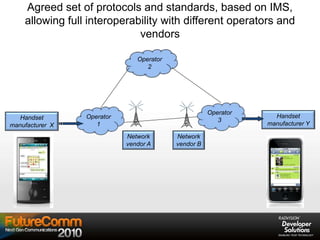
Agreed set of protocols and standards, based on IMS,
allowing full interoperability with different operators and
vendors
Network
vendor B
Operator
2
Operator
1
Operator
3Handset
manufacturer X
Handset
manufacturer Y
Network
vendor A
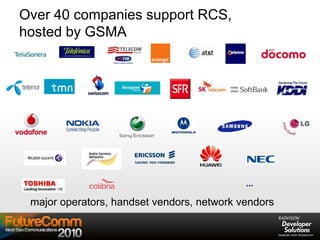
Over 40 companies support RCS,
hosted by GSMA
major operators, handset vendors, network vendors
…
Elements of RCS Presence-based Services
Based on Open Standards
Includes the following:
Presence – IETF/OMA SIMPLE
Configuration for Contact lists, Preferences, Privacy,
Security – OMA XDM/IETF XCAP
Instant Messaging, File and Image Transfer – IETF
MSRP
Applications of Presence-based Services
SIP Networks
IMS/NGN Networks
Mobile phones/PDA
PC and embedded voice/video/chat clients
Set-top boxes and IPTV clients
Video-share applications
Interactive TV
Gaming applications and appliances
Collaboration solutions
IP PBX
IMS Rich Communication Suite (RCS)
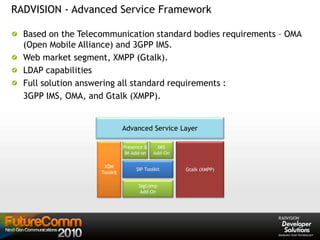
Based on the Telecommunication standard bodies requirements – OMA
(Open Mobile Alliance) and 3GPP IMS.
Web market segment, XMPP (Gtalk).
LDAP capabilities
Full solution answering all standard requirements :
3GPP IMS, OMA, and Gtalk (XMPP).
RADVISION - Advanced Service Framework
SIP Toolkit
SigComp
Add-On
IMS
Add-On
XDM
Toolkit
Presence &
IM Add-on
Gtalk (XMPP)
Advanced Service Layer
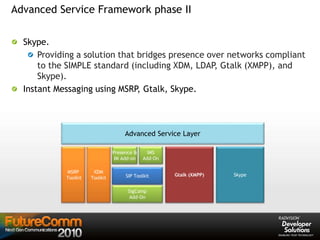
Skype.
Providing a solution that bridges presence over networks compliant
to the SIMPLE standard (including XDM, LDAP, Gtalk (XMPP), and
Skype).
Instant Messaging using MSRP, Gtalk, Skype.
Advanced Service Framework phase II
SIP Toolkit
SigComp
Add-On
IMS
Add-On
XDM
Toolkit
MSRP
Toolkit
Presence &
IM Add-on
Gtalk (XMPP)
Advanced Service Layer
Skype
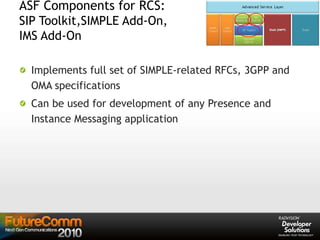
ASF Components for RCS:
SIP Toolkit,SIMPLE Add-On,
IMS Add-On
Implements full set of SIMPLE-related RFCs, 3GPP and
OMA specifications
Can be used for development of any Presence and
Instance Messaging application
ASF Components for RCS:
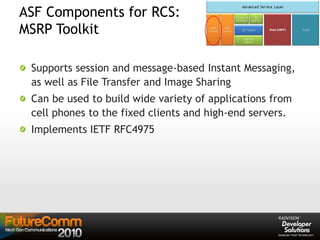
MSRP Toolkit
Supports session and message-based Instant Messaging,
as well as File Transfer and Image Sharing
Can be used to build wide variety of applications from
cell phones to the fixed clients and high-end servers.
Implements IETF RFC4975
ASF Components for RCS:
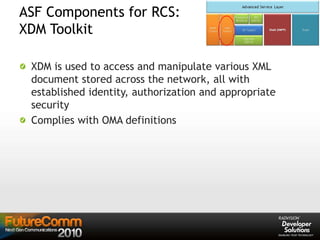
XDM Toolkit
XDM is used to access and manipulate various XML
document stored across the network, all with
established identity, authorization and appropriate
security
Complies with OMA definitions
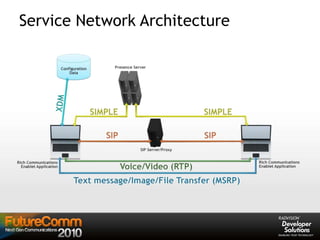
Service Network Architecture
ASF Optional Component:
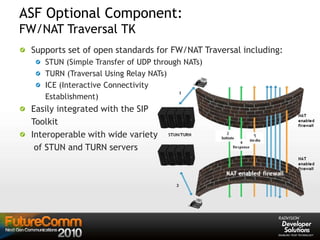
FW/NAT Traversal TK
Supports set of open standards for FW/NAT Traversal including:
STUN (Simple Transfer of UDP through NATs)
TURN (Traversal Using Relay NATs)
ICE (Interactive Connectivity
Establishment)
Easily integrated with the SIP
Toolkit
Interoperable with wide variety
of STUN and TURN servers
LTE, IMS & RCS – the Future of Telecom!
With LTE – IMS is here to stay
RCS – The future way of advanced interoperable
services
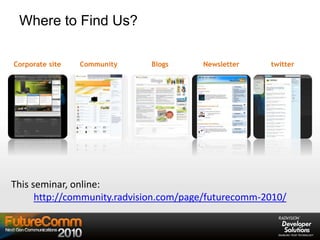
Where to Find Us?
Corporate site Community Blogs Newsletter twitter
This seminar, online:
http://community.radvision.com/page/futurecomm-2010/
Name: Title:Sagi Subocki
sagis@radvision.com
Products Manager
Thank you!

FutureComm 2010: LTE and RCS

  • 1.
    Name: Title:Sagi SubockiProducts Manager, Head of IMS Segment October 2010 LTE – The Future of IMS RCS – Advanced Interoperable Services
  • 2.
    Agenda Introduction to LTE TheVoLTE initiative LTE and IMS RADVISION IMS Development solution Rich Communication Suite RADVISION RCS Developer Solutions
  • 3.
    LTE - Introduction LTE(Long Term Evolution) – foundation of 4G All IP and Higher Bandwidth, low latency. Enhances existing 3G UMTS Efficiently supports multi-antenna technologies (MIMO). High bandwidth—up to 20 MHz. Scalable, LTE can operate in the existing 5-MHz UMTS frequency bands, or in even smaller bands.
  • 4.
    LTE – theend of Circuit Switch LTE is an all-IP mobile network No support for ‘traditional’ CS domain voice New Voice and SMS solutions required
  • 5.
    The future ofoperators Top 25 LTE Operators Will Reach Over 200 million LTE Subscribers by 2015 CAPEX spending to reach $14 billion in 2015 - Maravedis research
  • 6.
    Operators today facereal challenges Future of voice service usage: Migration of customers towards mobile VoIP solutions over their data networks The App Store: Services that run on the network are not controlled by the network operator. LTE: All about IP connectivity. Need a solution for traditional voice and SMS services. Significantly improves network's quality – operators are becoming "dumb" data pipes Operators need to be able to provide new services and stay relevant!
  • 7.
    The Solution -IMS The enabler for operators to continue to be the service provider of all services over LTE. Reliable, QoS, Secure, Service Continuity, Roaming. IMS will materialize – the operators simply have no other choice.
  • 8.
    VoLTE - Voiceover LTE IMS profile Started as “One Voice” Initiative of 18 operators and handset vendors GSMA adopted it Work continues on the initial “One Voice” draft Renamed to “VoLTE” IMTC IMS Activity Group was selected by “OneVoice” initiative to develop VoLTE test specification.
  • 9.
    VoLTE - Introduction VoLTEprofile defines a minimum mandatory set of features in order to guarantee an interoperable, high quality IMS-based telephony service over LTE access networks Voice and SMS in first stage - fast to fight new options for mobile VoIP “smart pipe” vs “dumb pipe”
  • 10.
    VoLTE Operators supporting VoLTE 3Group AT&T Bell Canada China Mobile Deutsche Telekom/T-Mobile KDDI mobilkom austria MTS NTT DoCoMo Orange SKT SoftBank Telecom Italia Telecom New Zealand Telefónica Telenor TeliaSonera Verizon Wireless Vodafone
  • 11.
    VoLTE Handset manufacturers andequipment vendors supporting VoLTE Acme Packet Alcatel-Lucent Aylus, Camiant Cisco Colibra Communigate Comneon, Ericsson Fujitsu Genband Huawei LG Motorola Movial Mu NEC Nokia Nokia Siemens Networks Qualcomm RADVISION Samsung Sony Ericsson Tekelec
  • 12.
    How Will NetworksMigrate to LTE? Networks will not switch overnight from GSM and 3G to LTE. Operators will need to provide service continuity VCC = Voice Call Continuity SMS Need to integrate new technologies to stay relevant Operators making the move with different approaches.
  • 13.
    IMS - Introduction IPMultimedia Subsystem Designed to provide flexible multimedia services anytime and everywhere Part of the core network, with interfaces to other subsystems in the network Technical specifications by GPP/3GPP2/TISPAN/Packet Cable and others Enables to ensure secure, reliable, interoperable, roamed, services with QoS
  • 14.
    How? An architecture forIP based next generation service and call control Layered, functional architecture Open application development framework Common authentication, authorization and accounting framework Common media control and network management functions An architecture that will be used in all networks Cellular Fixed carrier networks WiMax networks Packet Cable networks LTE
  • 15.
    IMS is happeningnow! By 2011 80% of surveyed service providers will run voice over IMS (Infonetics). Common IMS – Adopted by Cellular (3GPP/3GPP2), LTE, Fixed Line (TISPAN), Cable (PacketCable 2.0), and WiMAX A wide basic set of IMS standards which are identical to all networks. Each access network has its own unique "flavor" added on top of it.
  • 16.
    Key to IMSApplication Success Compliancy to the standards Ensures interoperability Easy deployment “Worry-free” roaming Smooth evolution to IMS SIP Ability to add new IMS Services
  • 17.
    IMS Compliancy Challenges Manynew network entities Many new protocol requirements New interfaces Different access networks each behaving differently – Cellular, Wireless, Fixed Line, Cable, LTE, WiMAX New standards constantly added upon and revised
  • 18.
    New Services inIMS Release 9 Public Warning System, Earthquake and Tsunami Warning System (ETWS) Service Specific Access Control Machine to Machine Network Improvements
  • 19.
    New Deployment &Migration Scenarios in IMS Release 9 Circuit Switched to VOIP, Service continuity improvements 3GPP/Non-3GPP accesses -> LTE LTE HNB (Femtocells)
  • 20.
    IMS Express™ -RADVISION’s IMS Developer Suite RADVISION is a proven market leader in the Voice and Video over IP and 3G protocol markets Involved in SDO and IOT RADVISION provides “future-proof solutions” and a clear standard based roadmap RADVISION’s IMS Express™ Comprehensive IMS product line Full IMS compliancy - 3GPP, TISPAN, PacketCable 2.0, LTE, WiMAX RADVISION provides all the tools to meet the IMS challenge
  • 21.
    RADVISION IMS ProtocolToolkits Powerful and highly versatile set of tools to facilitate development of IMS applications Reduces development time and costs Toolkits highlights: Source Code Multilayered APIs Extensive choice of quick start sample applications that enable full user control and flexibility GUI test applications
  • 22.
    IMS Express™ -RADVISION’s IMS Developer Suite IMS/NGN Protocol Toolkits IMS SIP Developer Suite • IMS SIP Toolkit • MSRP Toolkit • XDM Toolkit • ICE/STUN/TURN NAT Traversal Toolkit IMS DIAMETER Toolkit IMS MEGACO/H.248 Toolkit IMS Advanced-RTP/RTCP Toolkit IMS Server Platform IMS Client Suite ProLab™ IMS Testing Solution IMS MEGACO/ H.248 Toolkit IMS SIP Developer Suite IMS DIAMETER Toolkit IMS Server Platform ProLabTM IMS Test Solution IMS Advanced RTP/RTCP Toolkit IMS Client Suite Full IMS compliancy - 3GPP, TISPAN, PacketCable 2.0, LTE, WiMAX
  • 23.
    RADVISION IMS SIPDeveloper Suite Basic SIP TK Add-Ons Toolkits SIP Toolkit RTP Stack SDP Stack SCTP Add-On SigComp Add-On IMS Add-On XML Schema Package MS Add-on (CSTA) STUN ICE NAT T. Toolkits ICE XDM Toolkit MSRP Toolkit IPSec Add-on STUN Presence & IM Add-on TURN
  • 24.
  • 25.
    NGN/IMS features –partial list SigComp (RFC 3320, RFC 4896,RFC 5049. . ) AKA-MD5 (RFC 3310) IKE Security agreement (RFC 3329) IPsec Transport Level and Tunnel mode Media authorization (RFC 3313) P-headers Service-route mechanism (RFC 3608) Reg-event package (RFC 3680) IPv6 Resource Priority Header (RFC 4412) Extension of reason – RFC (4411) GRUU Preconditions (RFC 4032) IMS resource reservation (RFC 3312) Path header (RFC 3327) SIP outbound ENUM SDP extensions RTCP – Extended Reports RTCP – Feed Back P-preferred-identity P-access-network- info P-asserted-identity P-called-party-id P-charging-vector P-visited-network-id P-associated-uri P-profile-key P-answer-state More . . Other IMS capabilities supported by additional modules: SIMPLE (Presence & IM) SCTP Transport layer STUN, TURN & ICE IMS LTE Package
  • 26.
    Presence-based Services Presence –IETF/OMA SIMPLE (SIMPLE Add-On) Configuration for Contact lists, Preferences, Privacy, Security – OMA XDM (XDM Toolkit) Instant Messaging, File and Image Transfer – IETF MSRP (MSRP Toolkit)
  • 27.
    Beyond voice : RichCommunication Suite (RCS)
  • 28.
    Enriched, interoperable, communicationservices Today, only (switched) voice, SMS or e-mail, are really interoperable Existing enriched communication services are not standard or interoperable There is a need for interoperable enriched communication services with multimedia capabilities, beyond voice and SMS
  • 29.
    Enriched Call Call enrichedwith multimedia Sharing Enhanced Phonebook Contacts enhanced with capabilities and rich presence Enhanced Messaging Conversational messaging experience RCS is an evolution of legacy services focusing on user experience
  • 30.
    Agreed set ofprotocols and standards, based on IMS, allowing full interoperability with different operators and vendors Network vendor B Operator 2 Operator 1 Operator 3Handset manufacturer X Handset manufacturer Y Network vendor A
  • 31.
    Over 40 companiessupport RCS, hosted by GSMA major operators, handset vendors, network vendors …
  • 32.
    Elements of RCSPresence-based Services Based on Open Standards Includes the following: Presence – IETF/OMA SIMPLE Configuration for Contact lists, Preferences, Privacy, Security – OMA XDM/IETF XCAP Instant Messaging, File and Image Transfer – IETF MSRP
  • 33.
    Applications of Presence-basedServices SIP Networks IMS/NGN Networks Mobile phones/PDA PC and embedded voice/video/chat clients Set-top boxes and IPTV clients Video-share applications Interactive TV Gaming applications and appliances Collaboration solutions IP PBX IMS Rich Communication Suite (RCS)
  • 34.
    Based on theTelecommunication standard bodies requirements – OMA (Open Mobile Alliance) and 3GPP IMS. Web market segment, XMPP (Gtalk). LDAP capabilities Full solution answering all standard requirements : 3GPP IMS, OMA, and Gtalk (XMPP). RADVISION - Advanced Service Framework SIP Toolkit SigComp Add-On IMS Add-On XDM Toolkit Presence & IM Add-on Gtalk (XMPP) Advanced Service Layer
  • 35.
    Skype. Providing a solutionthat bridges presence over networks compliant to the SIMPLE standard (including XDM, LDAP, Gtalk (XMPP), and Skype). Instant Messaging using MSRP, Gtalk, Skype. Advanced Service Framework phase II SIP Toolkit SigComp Add-On IMS Add-On XDM Toolkit MSRP Toolkit Presence & IM Add-on Gtalk (XMPP) Advanced Service Layer Skype
  • 36.
    ASF Components forRCS: SIP Toolkit,SIMPLE Add-On, IMS Add-On Implements full set of SIMPLE-related RFCs, 3GPP and OMA specifications Can be used for development of any Presence and Instance Messaging application
  • 37.
    ASF Components forRCS: MSRP Toolkit Supports session and message-based Instant Messaging, as well as File Transfer and Image Sharing Can be used to build wide variety of applications from cell phones to the fixed clients and high-end servers. Implements IETF RFC4975
  • 38.
    ASF Components forRCS: XDM Toolkit XDM is used to access and manipulate various XML document stored across the network, all with established identity, authorization and appropriate security Complies with OMA definitions
  • 39.
  • 40.
    ASF Optional Component: FW/NATTraversal TK Supports set of open standards for FW/NAT Traversal including: STUN (Simple Transfer of UDP through NATs) TURN (Traversal Using Relay NATs) ICE (Interactive Connectivity Establishment) Easily integrated with the SIP Toolkit Interoperable with wide variety of STUN and TURN servers
  • 41.
    LTE, IMS &RCS – the Future of Telecom! With LTE – IMS is here to stay RCS – The future way of advanced interoperable services
  • 42.
    Where to FindUs? Corporate site Community Blogs Newsletter twitter This seminar, online: http://community.radvision.com/page/futurecomm-2010/
  • 43.