Lesson5: 2xProton, CNO & Alpha
The proton–proton chain reaction is one of two
known sets of nuclear fusion reactions by
which stars convert hydrogen to helium.
The first step in all the branches is the fusion of
two protons into deuterium. As the protons fuse one
of them undergoes beta decay, converting into
a neutron by emitting a positron and an electron
neutrino.[6]
The alpha process, also known as the alpha
ladder, is one of two classes of nuclear
fusion reactions by which stars convert helium into
heavier elements, the other being the triple-alpha
process.[1] The triple-alpha process consumes only
helium, and produces carbon. After enough carbon
has accumulated, the reactions below take place, all
consuming only helium and the product of the
previous reaction.
The CNO cycle (for carbon–nitrogen–oxygen) is
one of the two known sets of fusion reactions by
which stars convert hydrogento helium, the other
being the proton–proton chain reaction (pp-chain
reaction). Unlike the latter, the CNO cycle is
a catalytic cycle.
In the CNO cycle, four protons fuse, using carbon,
nitrogen, and oxygen isotopes as catalysts, to
produce one alpha particle, two positrons and
two electron neutrinos.
The triple-alpha process is a set of nuclear
fusion reactions by which three helium-4 nuclei
(alpha particles) are transformed into carbon.
Beta plus decay- releases neutrino and positron
𝑝 → 𝑣 + 𝑒 = 𝑛
Beta minus decay- releases anti-neutrino and
electron
Lesson 2: The structure of the atom
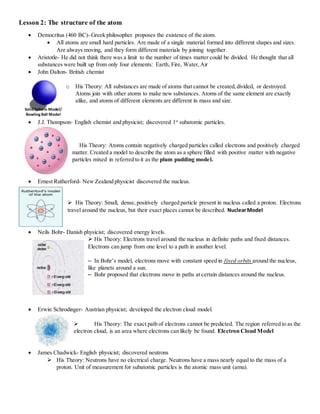
 Democritus (460 BC)- Greek philosopher proposes the existence of the atom.
 All atoms are small hard particles. Are made of a single material formed into different shapes and sizes.
Are always moving, and they form different materials by joining together.
 Aristotle- He did not think there was a limit to the number of times matter could be divided. He thought that all
substances were built up from only four elements: Earth, Fire, Water, Air
 John Dalton- British chemist
o His Theory: All substances are made of atoms that cannot be created,divided, or destroyed.
Atoms join with other atoms to make new substances. Atoms of the same element are exactly
alike, and atoms of different elements are different in mass and size.
 J.J. Thompson- English chemist and physicist; discovered 1st
subatomic particles.
His Theory: Atoms contain negatively charged particles called electrons and positively charged
matter. Created a model to describe the atom as a sphere filled with positive matter with negative
particles mixed in referred to it as the plum pudding model.
 Ernest Rutherford- New Zealand physicist discovered the nucleus.
 His Theory: Small, dense,positively charged particle present in nucleus called a proton. Electrons
travel around the nucleus, but their exact places cannot be described. NuclearModel
 Neils Bohr- Danish physicist; discovered energy levels.
 His Theory: Electrons travel around the nucleus in definite paths and fixed distances.
Electrons can jump from one level to a path in another level.
– In Bohr’s model, electrons move with constant speed in fixed orbits around the nucleus,
like planets around a sun.
– Bohr proposed that electrons move in paths at certain distances around the nucleus.
 Erwin Schrodinger- Austrian physicist; developed the electron cloud model.
 His Theory: The exact path of electrons cannot be predicted. The region referred to as the
electron cloud, is an area where electrons can likely be found. Electron Cloud Model
 James Chadwick- English physicist; discovered neutrons
 His Theory: Neutrons have no electrical charge. Neutrons have a mass nearly equal to the mass of a
proton. Unit of measurement for subatomic particles is the atomic mass unit (amu).
Solid Sphere Model/
Bowling Ball Model
 Modern Theory of the Atom
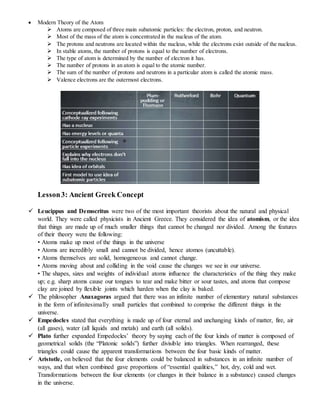
 Atoms are composed of three main subatomic particles: the electron, proton, and neutron.
 Most of the mass of the atom is concentrated in the nucleus of the atom.
 The protons and neutrons are located within the nucleus, while the electrons exist outside of the nucleus.
 In stable atoms, the number of protons is equal to the number of electrons.
 The type of atom is determined by the number of electron it has.
 The number of protons in an atom is equal to the atomic number.
 The sum of the number of protons and neutrons in a particular atom is called the atomic mass.
 Valence electrons are the outermost electrons.
Lesson3: Ancient Greek Concept
 Leucippus and Democritus were two of the most important theorists about the natural and physical
world. They were called physicists in Ancient Greece. They considered the idea of atomism, or the idea
that things are made up of much smaller things that cannot be changed nor divided. Among the features
of their theory were the following:
• Atoms make up most of the things in the universe
• Atoms are incredibly small and cannot be divided, hence atomos (uncuttable).
• Atoms themselves are solid, homogeneous and cannot change.
• Atoms moving about and colliding in the void cause the changes we see in our universe.
• The shapes, sizes and weights of individual atoms influence the characteristics of the thing they make
up; e.g. sharp atoms cause our tongues to tear and make bitter or sour tastes, and atoms that compose
clay are joined by flexible joints which harden when the clay is baked.
 The philosopher Anaxagoras argued that there was an infinite number of elementary natural substances
in the form of infinitesimally small particles that combined to comprise the different things in the
universe.
 Empedocles stated that everything is made up of four eternal and unchanging kinds of matter, fire, air
(all gases), water (all liquids and metals) and earth (all solids).
 Plato further expanded Empedocles’ theory by saying each of the four kinds of matter is composed of
geometrical solids (the “Platonic solids”) further divisible into triangles. When rearranged, these
triangles could cause the apparent transformations between the four basic kinds of matter.
 Aristotle, on believed that the four elements could be balanced in substances in an infinite number of
ways, and that when combined gave proportions of “essential qualities,” hot, dry, cold and wet.
Transformations between the four elements (or changes in their balance in a substance) caused changes
in the universe.
Lesson4: Growth of Alchemy in different civilizations
 Mesopotamians. The Mesopotamians had techniques to utilize metals like gold and copper. They even
assigned certain symbols to match metals with the heavenly bodies such as the Sun and Moon.
 The Egyptians adapted techniques from the Mesopotamians and perfected the use of bronze, dye and
glass that the Greeks later copied.
 The Chinese also had their own processes for metalwork and ceramic materials, but they especially
focused on finding minerals, plants and substances that could prolong life. Some of the substances
discovered in Chinese medicine have been found to have actual positive effects while others were found
useless or even harmful, like mercury.
Li Ching-Yuen- claimed to be born 1677 or 1736 - died 6 May 1933). Both claimed lifespans of 197 and 256
years old
 The Indians, like the Chinese, had a kind of alchemy (rasayana) that looked at different substances and
practices for Vedic medicine. This is tied closely to Hindu and Buddhist beliefs. They also perfected the
use of iron and steel and were well-known manufacturers of dyes, glass, cement, solutions for textiles,
and soap.
 The Arabs and Muslims enriched not only the practice but also the literature of chemistry. In particular,
the scholar Jabir Ibn-Hayyan, also known as Geber, translated the practices and Aristotelian thinking of
the Greeks and wrote extensively on how metals can be purified. They came up with the preparation of
acids such as nitric, hydrochloric and sulfuric acids, as well as aqua regia (nitro-hydrochloric acid).
Scientific Contributions Unscientific Contributions
refined how to crystallize, condense, distill,evaporate and
dissolve metals and materials
used incantations, magic spells and symbols
took lots of notes and information about what they did used esoteric symbols connected to astrology
and religion
developed step-by-step procedures and specialized set-
ups or equipment
concerned with riches, purity, immortality, and
spirits
discovered and investigated the properties of many now-
useful substances such as phosphorus, sulfur and potash
promoted the Aristotelian concept of the
elements
Lesson1: Big Bang Theory
Cosmology- the science of the origin and development of the universe, the study of how the universe began,and
how it continues to exist .
 Biblical cosmology- The universe of the ancient Israelites was made up of a flat disc-shaped earth
floating on water, heaven above, underworld below.
 Ex nihilo- Around the time of Jesus or a little earlier, the Greek idea that God had actually created matter
replaced the older idea that matter had always existed, but in a chaotic state.
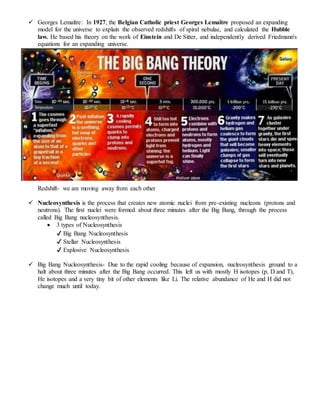
 Georges Lemaître: In 1927, the Belgian Catholic priest Georges Lemaître proposed an expanding
model for the universe to explain the observed redshifts of spiral nebulae, and calculated the Hubble
law. He based his theory on the work of Einstein and De Sitter, and independently derived Friedmann's
equations for an expanding universe.
Redshift- we are moving away from each other
 Nucleosynthesis is the process that creates new atomic nuclei from pre-existing nucleons (protons and
neutrons). The first nuclei were formed about three minutes after the Big Bang, through the process
called Big Bang nucleosynthesis.
 3 types of Nucleosynthesis
✔ Big Bang Nucleosynthesis
✔ Stellar Nucleosynthesis
✔ Explosive Nucleosynthesis
 Big Bang Nucleosynthesis- Due to the rapid cooling because of expansion, nucleosynthesis ground to a
halt about three minutes after the Big Bang occurred. This left us with mostly H isotopes (p, D and T),
He isotopes and a very tiny bit of other elements like Li. The relative abundance of He and H did not
change much until today.

Physical science (module)

  • 1.
    Lesson5: 2xProton, CNO& Alpha The proton–proton chain reaction is one of two known sets of nuclear fusion reactions by which stars convert hydrogen to helium. The first step in all the branches is the fusion of two protons into deuterium. As the protons fuse one of them undergoes beta decay, converting into a neutron by emitting a positron and an electron neutrino.[6] The alpha process, also known as the alpha ladder, is one of two classes of nuclear fusion reactions by which stars convert helium into heavier elements, the other being the triple-alpha process.[1] The triple-alpha process consumes only helium, and produces carbon. After enough carbon has accumulated, the reactions below take place, all consuming only helium and the product of the previous reaction. The CNO cycle (for carbon–nitrogen–oxygen) is one of the two known sets of fusion reactions by which stars convert hydrogento helium, the other being the proton–proton chain reaction (pp-chain reaction). Unlike the latter, the CNO cycle is a catalytic cycle. In the CNO cycle, four protons fuse, using carbon, nitrogen, and oxygen isotopes as catalysts, to produce one alpha particle, two positrons and two electron neutrinos. The triple-alpha process is a set of nuclear fusion reactions by which three helium-4 nuclei (alpha particles) are transformed into carbon. Beta plus decay- releases neutrino and positron 𝑝 → 𝑣 + 𝑒 = 𝑛 Beta minus decay- releases anti-neutrino and electron
  • 2.
    Lesson 2: Thestructure of the atom  Democritus (460 BC)- Greek philosopher proposes the existence of the atom.  All atoms are small hard particles. Are made of a single material formed into different shapes and sizes. Are always moving, and they form different materials by joining together.  Aristotle- He did not think there was a limit to the number of times matter could be divided. He thought that all substances were built up from only four elements: Earth, Fire, Water, Air  John Dalton- British chemist o His Theory: All substances are made of atoms that cannot be created,divided, or destroyed. Atoms join with other atoms to make new substances. Atoms of the same element are exactly alike, and atoms of different elements are different in mass and size.  J.J. Thompson- English chemist and physicist; discovered 1st subatomic particles. His Theory: Atoms contain negatively charged particles called electrons and positively charged matter. Created a model to describe the atom as a sphere filled with positive matter with negative particles mixed in referred to it as the plum pudding model.  Ernest Rutherford- New Zealand physicist discovered the nucleus.  His Theory: Small, dense,positively charged particle present in nucleus called a proton. Electrons travel around the nucleus, but their exact places cannot be described. NuclearModel  Neils Bohr- Danish physicist; discovered energy levels.  His Theory: Electrons travel around the nucleus in definite paths and fixed distances. Electrons can jump from one level to a path in another level. – In Bohr’s model, electrons move with constant speed in fixed orbits around the nucleus, like planets around a sun. – Bohr proposed that electrons move in paths at certain distances around the nucleus.  Erwin Schrodinger- Austrian physicist; developed the electron cloud model.  His Theory: The exact path of electrons cannot be predicted. The region referred to as the electron cloud, is an area where electrons can likely be found. Electron Cloud Model  James Chadwick- English physicist; discovered neutrons  His Theory: Neutrons have no electrical charge. Neutrons have a mass nearly equal to the mass of a proton. Unit of measurement for subatomic particles is the atomic mass unit (amu). Solid Sphere Model/ Bowling Ball Model
  • 3.
     Modern Theoryof the Atom  Atoms are composed of three main subatomic particles: the electron, proton, and neutron.  Most of the mass of the atom is concentrated in the nucleus of the atom.  The protons and neutrons are located within the nucleus, while the electrons exist outside of the nucleus.  In stable atoms, the number of protons is equal to the number of electrons.  The type of atom is determined by the number of electron it has.  The number of protons in an atom is equal to the atomic number.  The sum of the number of protons and neutrons in a particular atom is called the atomic mass.  Valence electrons are the outermost electrons. Lesson3: Ancient Greek Concept  Leucippus and Democritus were two of the most important theorists about the natural and physical world. They were called physicists in Ancient Greece. They considered the idea of atomism, or the idea that things are made up of much smaller things that cannot be changed nor divided. Among the features of their theory were the following: • Atoms make up most of the things in the universe • Atoms are incredibly small and cannot be divided, hence atomos (uncuttable). • Atoms themselves are solid, homogeneous and cannot change. • Atoms moving about and colliding in the void cause the changes we see in our universe. • The shapes, sizes and weights of individual atoms influence the characteristics of the thing they make up; e.g. sharp atoms cause our tongues to tear and make bitter or sour tastes, and atoms that compose clay are joined by flexible joints which harden when the clay is baked.  The philosopher Anaxagoras argued that there was an infinite number of elementary natural substances in the form of infinitesimally small particles that combined to comprise the different things in the universe.  Empedocles stated that everything is made up of four eternal and unchanging kinds of matter, fire, air (all gases), water (all liquids and metals) and earth (all solids).  Plato further expanded Empedocles’ theory by saying each of the four kinds of matter is composed of geometrical solids (the “Platonic solids”) further divisible into triangles. When rearranged, these triangles could cause the apparent transformations between the four basic kinds of matter.  Aristotle, on believed that the four elements could be balanced in substances in an infinite number of ways, and that when combined gave proportions of “essential qualities,” hot, dry, cold and wet. Transformations between the four elements (or changes in their balance in a substance) caused changes in the universe.
  • 4.
    Lesson4: Growth ofAlchemy in different civilizations  Mesopotamians. The Mesopotamians had techniques to utilize metals like gold and copper. They even assigned certain symbols to match metals with the heavenly bodies such as the Sun and Moon.  The Egyptians adapted techniques from the Mesopotamians and perfected the use of bronze, dye and glass that the Greeks later copied.  The Chinese also had their own processes for metalwork and ceramic materials, but they especially focused on finding minerals, plants and substances that could prolong life. Some of the substances discovered in Chinese medicine have been found to have actual positive effects while others were found useless or even harmful, like mercury. Li Ching-Yuen- claimed to be born 1677 or 1736 - died 6 May 1933). Both claimed lifespans of 197 and 256 years old  The Indians, like the Chinese, had a kind of alchemy (rasayana) that looked at different substances and practices for Vedic medicine. This is tied closely to Hindu and Buddhist beliefs. They also perfected the use of iron and steel and were well-known manufacturers of dyes, glass, cement, solutions for textiles, and soap.  The Arabs and Muslims enriched not only the practice but also the literature of chemistry. In particular, the scholar Jabir Ibn-Hayyan, also known as Geber, translated the practices and Aristotelian thinking of the Greeks and wrote extensively on how metals can be purified. They came up with the preparation of acids such as nitric, hydrochloric and sulfuric acids, as well as aqua regia (nitro-hydrochloric acid). Scientific Contributions Unscientific Contributions refined how to crystallize, condense, distill,evaporate and dissolve metals and materials used incantations, magic spells and symbols took lots of notes and information about what they did used esoteric symbols connected to astrology and religion developed step-by-step procedures and specialized set- ups or equipment concerned with riches, purity, immortality, and spirits discovered and investigated the properties of many now- useful substances such as phosphorus, sulfur and potash promoted the Aristotelian concept of the elements Lesson1: Big Bang Theory Cosmology- the science of the origin and development of the universe, the study of how the universe began,and how it continues to exist .  Biblical cosmology- The universe of the ancient Israelites was made up of a flat disc-shaped earth floating on water, heaven above, underworld below.  Ex nihilo- Around the time of Jesus or a little earlier, the Greek idea that God had actually created matter replaced the older idea that matter had always existed, but in a chaotic state.
  • 5.
     Georges Lemaître:In 1927, the Belgian Catholic priest Georges Lemaître proposed an expanding model for the universe to explain the observed redshifts of spiral nebulae, and calculated the Hubble law. He based his theory on the work of Einstein and De Sitter, and independently derived Friedmann's equations for an expanding universe. Redshift- we are moving away from each other  Nucleosynthesis is the process that creates new atomic nuclei from pre-existing nucleons (protons and neutrons). The first nuclei were formed about three minutes after the Big Bang, through the process called Big Bang nucleosynthesis.  3 types of Nucleosynthesis ✔ Big Bang Nucleosynthesis ✔ Stellar Nucleosynthesis ✔ Explosive Nucleosynthesis  Big Bang Nucleosynthesis- Due to the rapid cooling because of expansion, nucleosynthesis ground to a halt about three minutes after the Big Bang occurred. This left us with mostly H isotopes (p, D and T), He isotopes and a very tiny bit of other elements like Li. The relative abundance of He and H did not change much until today.