What is Physical Science?
Physical Sciences are those
disciplines that study natural
sciences, dealing with nonliving
materials. Areas of coverage
includes physics, chemistry, earth
science, geology, space science,
astronomy, materials science, etc.
Why do we need to study Physical
Science?
It helps us understand the natural world
around us, from the behavior of matter
and energy to the forces and interactions
that shape our universe. Physical science
also forms the foundation for many other
scientific disciplines, such as chemistry,
physics, and engineering.
GUESS THE
ELEMENT
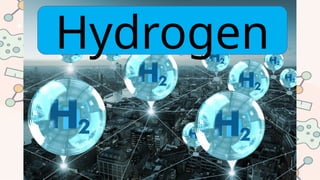
Hydrogen
Oxygen
Gold
Silver
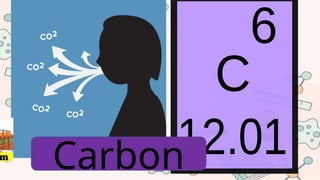
Carbon
Helium
Neon
Magnesium
Chlorine
Potassium
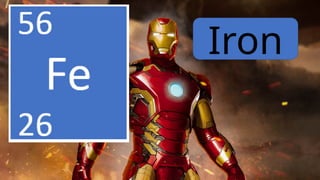
Iron
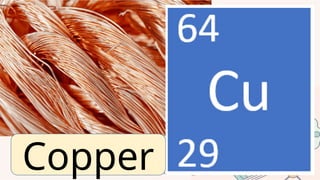
Copper
Aluminum
Nitrogen
Evolution of Stars
and the Formation
of Heavier Elements
•Star formation theory states that stars are
formed when a dense region of molecular
cloud collapses. During this process,
fragments of clouds contract and form a
stellar core known as protostar. The
contraction and gravitational force of the
protostar result in an increase in
temperature which triggers nuclear reaction
within the star upon reaching 10 million
Kelvin.
•Throughout the reaction,
neutrinos and positrons are
released, slowing down the
reaction. Once the contraction
stops and the protostar attains its
gravitational equilibrium, a main
sequence star will be formed.
•In the core of a main sequence
star, hydrogen fuses with helium
through proton-proton chain. In
addition, the gravitational force of
a main sequence star forces
hydrogen and helium to fuse
resulting to burning of two
primordial elements.
•Furthermore, at this stage,
helium is converted to carbon
at the core while hydrogen is
converted into helium
surrounding the core which
denotes the formation of red
giant.
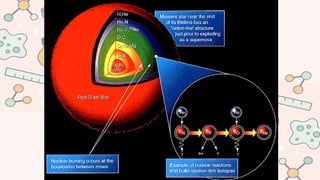
•On the other hand, since
massive stars possess enough
energy, mass, temperature, and
pressure, the star will undergo a
series of stages where heavier
elements are fused around the
shell of the core
•whereas carbon will be formed
through helium fusion, neon will
be formed through oxygen fusion,
magnesium from neon fusion,
silicon from magnesium fusion,
and iron from silicon fusion which
denotes the formation of red
giant.
•The first 3 minutes of Big Bang
focused primarily on the
expansion and cooling of universe
so as to the synthesis of the first
three elements. On the other
hand, the second cosmological
event is Stellar
nucleosynthesis.
•It is a process in which
heavier elements such as
Beryllium, and Iron were
formed by combining protons
and neutrons from the nuclei
of a lighter elements.
•Moreover, under the process
of stellar nucleosynthesis,
heavier elements are created
in different types of stars as
they die or explode and the
abundance of these elements
change as the stars evolve.
•The process to form
heavier elements from
lighter ones, but not
heavier than Iron with
atomic mass of 26.
•Lastly, supernova happens
when the core can no longer
produce the needed energy
to resist gravitational force,
leading to its explosion and
release of large amounts of
energy.
KEY CONCEPTS
RELATED TO
PHYSICAL
SCIENCE
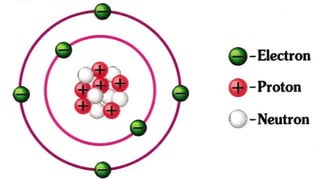
•The identity of an
element depends
on how many
proton it has.
•The light elements
hydrogen, helium,
lithium and beryllium
were the very first to
form.
•Nucleosynthesis
combines nucleons
to form new
elements.
•Big Bang is NOT
an explosion but
rather an
expansion.
•As the universe
expands, it
cools.
•Mass can be
converted
into energy.
•The higher the energy
of the particles in an
object are, the higher
the temperature of
that object.
PERFORMANCE TASK: ½
crosswise
1. Why do we need to
study Physical Science?
2. How did heavier
elements form?

Introduction to Physical Science Lesson 1.pptx

  • 2.
    What is PhysicalScience? Physical Sciences are those disciplines that study natural sciences, dealing with nonliving materials. Areas of coverage includes physics, chemistry, earth science, geology, space science, astronomy, materials science, etc.
  • 3.
    Why do weneed to study Physical Science? It helps us understand the natural world around us, from the behavior of matter and energy to the forces and interactions that shape our universe. Physical science also forms the foundation for many other scientific disciplines, such as chemistry, physics, and engineering.
  • 4.
  • 5.
  • 6.
  • 7.
  • 8.
  • 9.
  • 10.
  • 11.
  • 12.
  • 13.
  • 14.
  • 16.
  • 17.
  • 18.
  • 19.
  • 20.
    Evolution of Stars andthe Formation of Heavier Elements
  • 21.
    •Star formation theorystates that stars are formed when a dense region of molecular cloud collapses. During this process, fragments of clouds contract and form a stellar core known as protostar. The contraction and gravitational force of the protostar result in an increase in temperature which triggers nuclear reaction within the star upon reaching 10 million Kelvin.
  • 22.
    •Throughout the reaction, neutrinosand positrons are released, slowing down the reaction. Once the contraction stops and the protostar attains its gravitational equilibrium, a main sequence star will be formed.
  • 23.
    •In the coreof a main sequence star, hydrogen fuses with helium through proton-proton chain. In addition, the gravitational force of a main sequence star forces hydrogen and helium to fuse resulting to burning of two primordial elements.
  • 24.
    •Furthermore, at thisstage, helium is converted to carbon at the core while hydrogen is converted into helium surrounding the core which denotes the formation of red giant.
  • 25.
    •On the otherhand, since massive stars possess enough energy, mass, temperature, and pressure, the star will undergo a series of stages where heavier elements are fused around the shell of the core
  • 26.
    •whereas carbon willbe formed through helium fusion, neon will be formed through oxygen fusion, magnesium from neon fusion, silicon from magnesium fusion, and iron from silicon fusion which denotes the formation of red giant.
  • 28.
    •The first 3minutes of Big Bang focused primarily on the expansion and cooling of universe so as to the synthesis of the first three elements. On the other hand, the second cosmological event is Stellar nucleosynthesis.
  • 29.
    •It is aprocess in which heavier elements such as Beryllium, and Iron were formed by combining protons and neutrons from the nuclei of a lighter elements.
  • 30.
    •Moreover, under theprocess of stellar nucleosynthesis, heavier elements are created in different types of stars as they die or explode and the abundance of these elements change as the stars evolve.
  • 31.
    •The process toform heavier elements from lighter ones, but not heavier than Iron with atomic mass of 26.
  • 32.
    •Lastly, supernova happens whenthe core can no longer produce the needed energy to resist gravitational force, leading to its explosion and release of large amounts of energy.
  • 33.
  • 35.
    •The identity ofan element depends on how many proton it has.
  • 36.
    •The light elements hydrogen,helium, lithium and beryllium were the very first to form.
  • 37.
  • 38.
    •Big Bang isNOT an explosion but rather an expansion.
  • 39.
  • 40.
  • 41.
    •The higher theenergy of the particles in an object are, the higher the temperature of that object.
  • 42.
    PERFORMANCE TASK: ½ crosswise 1.Why do we need to study Physical Science? 2. How did heavier elements form?