Atmospheric Chemistry
• Atmospheric chemistry is a branch of Atmospheric 
Science in which Chemistry of the Earth’s atmosphere   
and that of other planets is studied.
• It is a multidisciplinary approach of research and draws 
on:
o Environmental Chemistry
o Physics
o Meteorology
o Computer Molding
o Oceanography
o Geology and
o Volcanology and other discipline
Topic-ATMOSPHERE CHEMISTRY
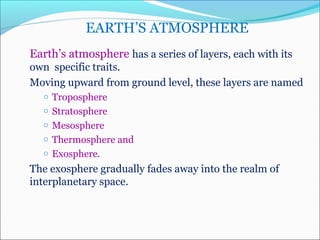
EARTH’S ATMOSPHERE
Earth’s atmosphere has a series of layers, each with its   
own  specific traits. 
Moving upward from ground level, these layers are named 
o Troposphere 
o Stratosphere
o Mesosphere
o Thermosphere and 
o Exosphere.
The exosphere gradually fades away into the realm of 
interplanetary space.
Atmospheric Chemistry
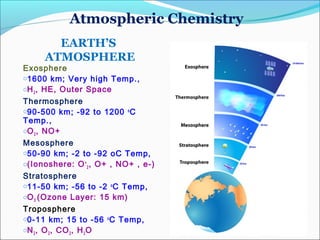
EARTH’S
ATMOSPHERE
Exosphere
o1600 km; Very high Temp.,
oH2, HE, Outer Space
Thermosphere
o90-500 km; -92 to 1200 o
C
Temp.,
oO2, NO+
Mesosphere
o50-90 km; -2 to -92 oC Temp,
o(Ionoshere: O+
2, O+ , NO+ , e-)
Stratosphere
o11-50 km; -56 to -2 o
C Temp,
oO3 (Ozone Layer: 15 km)
Troposphere
o0-11 km; 15 to -56 o
C Temp,
oN2, O2, CO2, H2O
Troposphere
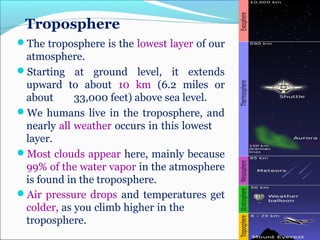
The troposphere is the lowest layer of our 
atmosphere. 
Starting  at  ground  level,  it  extends 
upward  to  about  10  km  (6.2  miles  or 
about        33,000 feet) above sea level. 
We  humans  live  in the troposphere, and 
nearly all weather occurs in this lowest     
layer. 
Most clouds appear here, mainly because 
99% of the water vapor in the atmosphere 
is found in the troposphere. 
Air pressure drops  and temperatures get 
colder, as you climb higher in the               
troposphere.  
Stratosphere
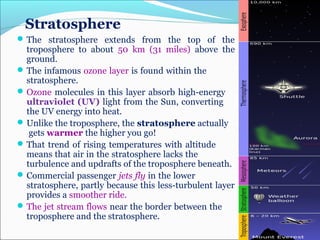
The stratosphere extends from the top of the
troposphere to about 50 km (31 miles) above the
ground.
The infamous ozone layer is found within the
stratosphere.
Ozone molecules in this layer absorb high-energy
ultraviolet (UV) light from the Sun, converting
the UV energy into heat.
Unlike the troposphere, the stratosphere actually
gets warmer the higher you go!
That trend of rising temperatures with altitude
means that air in the stratosphere lacks the
turbulence and updrafts of the troposphere beneath.
Commercial passenger jets fly in the lower
stratosphere, partly because this less-turbulent layer
provides a smoother ride.
The jet stream flows near the border between the
troposphere and the stratosphere.
Mesosphere
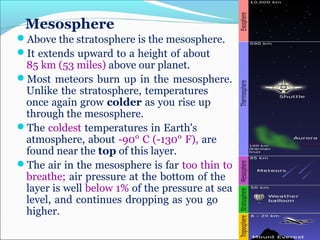
Above the stratosphere is the mesosphere.
It extends upward to a height of about
85 km (53 miles) above our planet.
Most meteors burn up in the mesosphere.
Unlike the stratosphere, temperatures
once again grow colder as you rise up
through the mesosphere.
The coldest temperatures in Earth's
atmosphere, about -90° C (-130° F), are
found near the top of this layer.
The air in the mesosphere is far too thin to
breathe; air pressure at the bottom of the
layer is well below 1% of the pressure at sea
level, and continues dropping as you go
higher.
Thermosphere
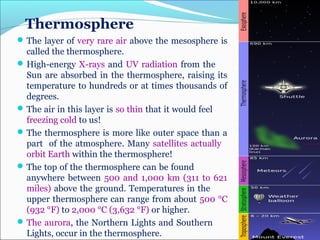
The layer of very rare air above the mesosphere is
called the thermosphere.
High-energy X-rays and UV radiation from the
Sun are absorbed in the thermosphere, raising its
temperature to hundreds or at times thousands of
degrees.
The air in this layer is so thin that it would feel
freezing cold to us!
The thermosphere is more like outer space than a
part of the atmosphere. Many satellites actually
orbit Earth within the thermosphere!
The top of the thermosphere can be found
anywhere between 500 and 1,000 km (311 to 621
miles) above the ground. Temperatures in the
upper thermosphere can range from about 500 °C
(932 °F) to 2,000 °C (3,632 °F) or higher.
The aurora, the Northern Lights and Southern
Lights, occur in the thermosphere.
Exosphere
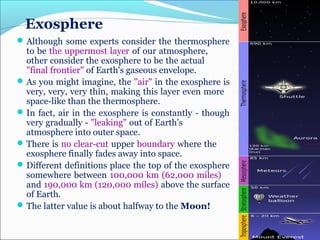
Although some experts consider the thermosphere
to be the uppermost layer of our atmosphere,
other consider the exosphere to be the actual
"final frontier" of Earth's gaseous envelope.
As you might imagine, the "air" in the exosphere is
very, very, very thin, making this layer even more
space-like than the thermosphere.
In fact, air in the exosphere is constantly - though
very gradually - "leaking" out of Earth's
atmosphere into outer space.
There is no clear-cut upper boundary where the
exosphere finally fades away into space.
Different definitions place the top of the exosphere
somewhere between 100,000 km (62,000 miles)
and 190,000 km (120,000 miles) above the surface
of Earth.
The latter value is about halfway to the Moon!
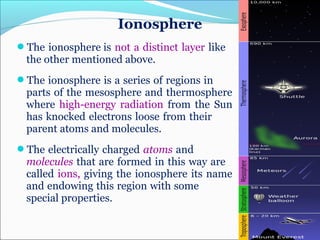
The ionosphere is not a distinct layer like
the other mentioned above.
The ionosphere is a series of regions in
parts of the mesosphere and thermosphere
where high-energy radiation from the Sun
has knocked electrons loose from their
parent atoms and molecules.
The electrically charged atoms and
molecules that are formed in this way are
called ions, giving the ionosphere its name
and endowing this region with some
special properties.
Ionosphere
Atmospheric Chemistry
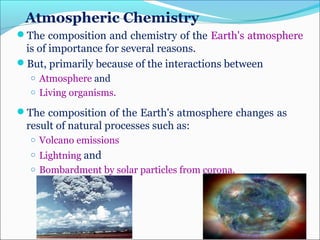
The composition and chemistry of the Earth's atmosphere
is of importance for several reasons.
But, primarily because of the interactions between
o Atmosphere and
o Living organisms.
The composition of the Earth's atmosphere changes as
result of natural processes such as:
o Volcano emissions
o Lightning and
o Bombardment by solar particles from corona.
Atmospheric Chemistry
It has also been changed by human activity and some of
these changes are harmful to:
o Human health
o Crops and
o Ecosystems.
Examples of problems which have been addressed by
atmospheric chemistry include:
o Acid rain
o Ozone depletion
o Photochemical smog
o Greenhouse gases and
o Global warming.
Acid rain
This phenomenon came to attention in the 1970s
Burning coal, oil and natural gas in power stations makes electricity,
giving off Sulphur dioxide gas.
Burning petrol and oil in vehicle engines gives off Nitrogen oxides as
gases.
Presence of H2SO4 (related to SO2 from coal combustion) and HNO3
(from NO2)
In the presence of lightning and thunderstorm, the nitrogen of the
atmosphere combines with oxygen to form nitric oxide (NO), which
in turn combines with oxygen to give nitrogen dioxide.
N2 + O2 ———— 2 NO→
2 NO + O2 ———— 2 NO→ 2
In the atmosphere, nitrogen dioxide reacts with water vapour
producing nitric acid, which is washed down as acid rain.
3 NO2 + H2O ———— 2 HNO→ 3+ NO
The formation of Nitric acid and Sulphuric acid as secondary
pollutants in the atmosphere leads to acid rain.
Acid rain
All rain is acidic with or without air pollution.
This is due to the natural presence of carbon dioxide in the
atmosphere with dissolves in rain drops of rain water (even
moisture present in the atmosphere does the same function) to
form Carbonic acid.
CO2 + H2O H2CO3→
Due to the above reaction carbon dioxide can dissolve in water
until the solution becomes saturated.
This results in the rain water attaining an acidic pH of 5.6
Due to this, the purest form of rain reaches the earth as an
acidic solution of pH 5.6
Acidity causes Environmental problems like
o Destruction of vegetation
o Marine life
o Corrosion and
o Etching of buildings that are exposed to atmosphere.
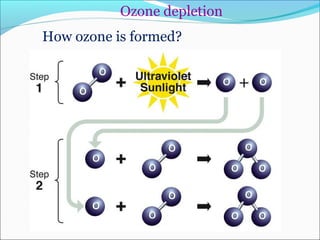
How ozone is formed?
Ozone depletion
Man-made causes of depletion of ozone layer:
• The main cause for the depletion of ozone is determined as
excessive release of chlorine and bromine from man-made
compounds such as chloro fluoro carbons (CFCs).
• CFCs (chlorofluorocarbons)
• Halogens
• CH3CCl3 (Methyl chloroform)
• CCl4(Carbon tetrachloride)
• HCFCs (hydro-chlorofluorocarbons)
• Hydrobromofluorocarbons and
• Methyl bromide are found to have direct impact on the
depletion of the ozone layer.
• These are categorized as Ozone-Depleting Substances (ODS).
• Chlorofluorocarbons are released into the atmosphere due to:
o Cleaning Agents
o Coolants in refrigerators
o Packing material
o Air conditioning
o Aerosol spray cans etc.
Ozone depletion
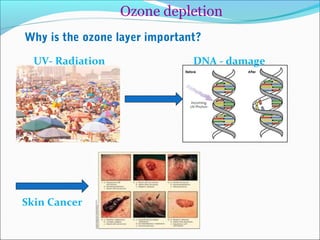
Why is the ozone layer important?
UV- Radiation DNA - damage
Skin Cancer
Ozone depletion
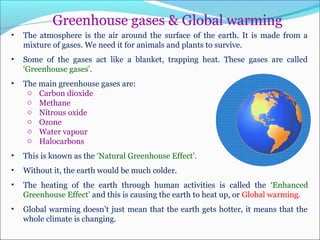
Greenhouse gases & Global warming
• The atmosphere is the air around the surface of the earth. It is made from a
mixture of gases. We need it for animals and plants to survive.
• Some of the gases act like a blanket, trapping heat. These gases are called
‘Greenhouse gases’.
• The main greenhouse gases are:
o Carbon dioxide
o Methane
o Nitrous oxide
o Ozone
o Water vapour
o Halocarbons
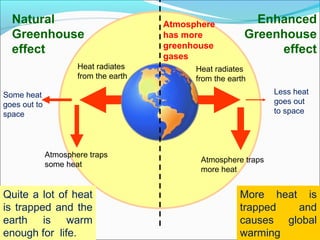
• This is known as the ‘Natural Greenhouse Effect’.
• Without it, the earth would be much colder.
• The heating of the earth through human activities is called the ‘Enhanced
Greenhouse Effect’ and this is causing the earth to heat up, or Global warming.
• Global warming doesn’t just mean that the earth gets hotter, it means that the
whole climate is changing.
Natural
Greenhouse
effect
More heat is
trapped and
causes global
warming
Atmosphere traps
some heat
Some heat
goes out to
space
Quite a lot of heat
is trapped and the
earth is warm
enough for life.
Enhanced
Greenhouse
effect
Heat radiates
from the earth
Heat radiates
from the earth
Atmosphere
has more
greenhouse
gases
Atmosphere traps
more heat
Less heat
goes out
to space
Atmosphere chemistry 1.2

Atmosphere chemistry 1.2

  • 1.
    Atmospheric Chemistry • Atmosphericchemistry is a branch of Atmospheric  Science in which Chemistry of the Earth’s atmosphere    and that of other planets is studied. • It is a multidisciplinary approach of research and draws  on: o Environmental Chemistry o Physics o Meteorology o Computer Molding o Oceanography o Geology and o Volcanology and other discipline
  • 2.
  • 3.
  • 4.
    Atmospheric Chemistry EARTH’S ATMOSPHERE Exosphere o1600 km;Very high Temp., oH2, HE, Outer Space Thermosphere o90-500 km; -92 to 1200 o C Temp., oO2, NO+ Mesosphere o50-90 km; -2 to -92 oC Temp, o(Ionoshere: O+ 2, O+ , NO+ , e-) Stratosphere o11-50 km; -56 to -2 o C Temp, oO3 (Ozone Layer: 15 km) Troposphere o0-11 km; 15 to -56 o C Temp, oN2, O2, CO2, H2O
  • 5.
    Troposphere The troposphere is the lowest layer of our  atmosphere.  Starting  at  ground level,  it  extends  upward  to  about  10  km  (6.2  miles  or  about        33,000 feet) above sea level.  We  humans  live  in the troposphere, and  nearly all weather occurs in this lowest      layer.  Most clouds appear here, mainly because  99% of the water vapor in the atmosphere  is found in the troposphere.  Air pressure drops  and temperatures get  colder, as you climb higher in the                troposphere.  
  • 6.
    Stratosphere The stratosphere extendsfrom the top of the troposphere to about 50 km (31 miles) above the ground. The infamous ozone layer is found within the stratosphere. Ozone molecules in this layer absorb high-energy ultraviolet (UV) light from the Sun, converting the UV energy into heat. Unlike the troposphere, the stratosphere actually gets warmer the higher you go! That trend of rising temperatures with altitude means that air in the stratosphere lacks the turbulence and updrafts of the troposphere beneath. Commercial passenger jets fly in the lower stratosphere, partly because this less-turbulent layer provides a smoother ride. The jet stream flows near the border between the troposphere and the stratosphere.
  • 7.
    Mesosphere Above the stratosphereis the mesosphere. It extends upward to a height of about 85 km (53 miles) above our planet. Most meteors burn up in the mesosphere. Unlike the stratosphere, temperatures once again grow colder as you rise up through the mesosphere. The coldest temperatures in Earth's atmosphere, about -90° C (-130° F), are found near the top of this layer. The air in the mesosphere is far too thin to breathe; air pressure at the bottom of the layer is well below 1% of the pressure at sea level, and continues dropping as you go higher.
  • 8.
    Thermosphere The layer ofvery rare air above the mesosphere is called the thermosphere. High-energy X-rays and UV radiation from the Sun are absorbed in the thermosphere, raising its temperature to hundreds or at times thousands of degrees. The air in this layer is so thin that it would feel freezing cold to us! The thermosphere is more like outer space than a part of the atmosphere. Many satellites actually orbit Earth within the thermosphere! The top of the thermosphere can be found anywhere between 500 and 1,000 km (311 to 621 miles) above the ground. Temperatures in the upper thermosphere can range from about 500 °C (932 °F) to 2,000 °C (3,632 °F) or higher. The aurora, the Northern Lights and Southern Lights, occur in the thermosphere.
  • 9.
    Exosphere Although some expertsconsider the thermosphere to be the uppermost layer of our atmosphere, other consider the exosphere to be the actual "final frontier" of Earth's gaseous envelope. As you might imagine, the "air" in the exosphere is very, very, very thin, making this layer even more space-like than the thermosphere. In fact, air in the exosphere is constantly - though very gradually - "leaking" out of Earth's atmosphere into outer space. There is no clear-cut upper boundary where the exosphere finally fades away into space. Different definitions place the top of the exosphere somewhere between 100,000 km (62,000 miles) and 190,000 km (120,000 miles) above the surface of Earth. The latter value is about halfway to the Moon!
  • 10.
    The ionosphere isnot a distinct layer like the other mentioned above. The ionosphere is a series of regions in parts of the mesosphere and thermosphere where high-energy radiation from the Sun has knocked electrons loose from their parent atoms and molecules. The electrically charged atoms and molecules that are formed in this way are called ions, giving the ionosphere its name and endowing this region with some special properties. Ionosphere
  • 11.
    Atmospheric Chemistry The compositionand chemistry of the Earth's atmosphere is of importance for several reasons. But, primarily because of the interactions between o Atmosphere and o Living organisms. The composition of the Earth's atmosphere changes as result of natural processes such as: o Volcano emissions o Lightning and o Bombardment by solar particles from corona.
  • 12.
    Atmospheric Chemistry It hasalso been changed by human activity and some of these changes are harmful to: o Human health o Crops and o Ecosystems. Examples of problems which have been addressed by atmospheric chemistry include: o Acid rain o Ozone depletion o Photochemical smog o Greenhouse gases and o Global warming.
  • 13.
    Acid rain This phenomenoncame to attention in the 1970s Burning coal, oil and natural gas in power stations makes electricity, giving off Sulphur dioxide gas. Burning petrol and oil in vehicle engines gives off Nitrogen oxides as gases. Presence of H2SO4 (related to SO2 from coal combustion) and HNO3 (from NO2) In the presence of lightning and thunderstorm, the nitrogen of the atmosphere combines with oxygen to form nitric oxide (NO), which in turn combines with oxygen to give nitrogen dioxide. N2 + O2 ———— 2 NO→ 2 NO + O2 ———— 2 NO→ 2 In the atmosphere, nitrogen dioxide reacts with water vapour producing nitric acid, which is washed down as acid rain. 3 NO2 + H2O ———— 2 HNO→ 3+ NO The formation of Nitric acid and Sulphuric acid as secondary pollutants in the atmosphere leads to acid rain.
  • 14.
    Acid rain All rainis acidic with or without air pollution. This is due to the natural presence of carbon dioxide in the atmosphere with dissolves in rain drops of rain water (even moisture present in the atmosphere does the same function) to form Carbonic acid. CO2 + H2O H2CO3→ Due to the above reaction carbon dioxide can dissolve in water until the solution becomes saturated. This results in the rain water attaining an acidic pH of 5.6 Due to this, the purest form of rain reaches the earth as an acidic solution of pH 5.6 Acidity causes Environmental problems like o Destruction of vegetation o Marine life o Corrosion and o Etching of buildings that are exposed to atmosphere.
  • 15.
    How ozone isformed? Ozone depletion
  • 16.
    Man-made causes ofdepletion of ozone layer: • The main cause for the depletion of ozone is determined as excessive release of chlorine and bromine from man-made compounds such as chloro fluoro carbons (CFCs). • CFCs (chlorofluorocarbons) • Halogens • CH3CCl3 (Methyl chloroform) • CCl4(Carbon tetrachloride) • HCFCs (hydro-chlorofluorocarbons) • Hydrobromofluorocarbons and • Methyl bromide are found to have direct impact on the depletion of the ozone layer. • These are categorized as Ozone-Depleting Substances (ODS). • Chlorofluorocarbons are released into the atmosphere due to: o Cleaning Agents o Coolants in refrigerators o Packing material o Air conditioning o Aerosol spray cans etc. Ozone depletion
  • 17.
    Why is theozone layer important? UV- Radiation DNA - damage Skin Cancer Ozone depletion
  • 18.
    Greenhouse gases &Global warming • The atmosphere is the air around the surface of the earth. It is made from a mixture of gases. We need it for animals and plants to survive. • Some of the gases act like a blanket, trapping heat. These gases are called ‘Greenhouse gases’. • The main greenhouse gases are: o Carbon dioxide o Methane o Nitrous oxide o Ozone o Water vapour o Halocarbons • This is known as the ‘Natural Greenhouse Effect’. • Without it, the earth would be much colder. • The heating of the earth through human activities is called the ‘Enhanced Greenhouse Effect’ and this is causing the earth to heat up, or Global warming. • Global warming doesn’t just mean that the earth gets hotter, it means that the whole climate is changing.
  • 19.
    Natural Greenhouse effect More heat is trappedand causes global warming Atmosphere traps some heat Some heat goes out to space Quite a lot of heat is trapped and the earth is warm enough for life. Enhanced Greenhouse effect Heat radiates from the earth Heat radiates from the earth Atmosphere has more greenhouse gases Atmosphere traps more heat Less heat goes out to space