ATLS, Management of Trauma
patient at ER
Presented by: Dr. Meron Zewde (Intern)
Moderator: Dr. Misale (General Surgeon)
07/09/2022 1
Outline
• Definition
• Epidemiology
• Primary survey
• Secondary survey
• Tertiary survey
07/09/2022 2
Introduction
• Trauma, or injury, is defined as cellular disruption caused by
environmental energy that is beyond the body’s resilience, which is
compounded by cell death due to ischemia/reperfusion.
• Trauma is the most common cause of death for all individuals
between the ages of 1 and 44 years, and is the third most common
cause of death regardless of age.
• It is also the leading cause of years of productive life lost.
07/09/2022 3
Epidemiology
07/09/2022 4
Emergency Approach to Trauma
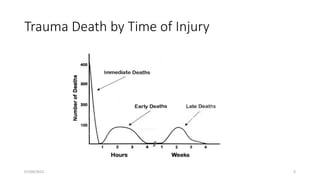
Trimodal distribution of trauma deaths:
1. Immediate deaths (on scene): Hemorrhage due to great vessel
injury, severe TBI, High spinal cord injury etc.
2. Early deaths (1st 1-4 hours): chest trauma, abdomino thoracic
injuries, pelvic injuries most common
• Gives rise to the concept of the “golden hour”
3. Late deaths (hours-days-weeks): from secondary insult –
pneumonia, PE, sepsis, coagulopathy
07/09/2022 5
Trauma Death by Time of Injury
07/09/2022 6
Primary Survey
• Encompasses the ABCDEs of trauma care and identifies life-
threatening conditions by adhering to this sequence.
• Airway maintenance with restriction of cervical spine motion
• Breathing and ventilation
• Circulation with hemorrhage control
• Disability(assessment of neurologic status)
• Exposure/Environmental control
07/09/2022 7
Airway Maintenance with restriction of
cervical spine motion
• This rapid assessment for signs of airway obstruction includes
inspecting for
• Foreign bodies;
• Identifying facial, mandibular, and/or tracheal/laryngeal fractures;
• Suctioning to clear accumulated blood or secretions
• In patients with severe head injuries with GCS score of 8 or lower the
tongue may fall backward and obstruct the hypopharynx; this can be
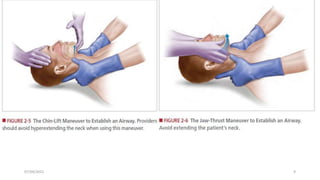
relieved by either a chin lift , jaw thrust or by inserting a
nasopharyngeal or oropharyngeal airway but endotracheal intubation
might be needed at last.
07/09/2022 8
07/09/2022 9
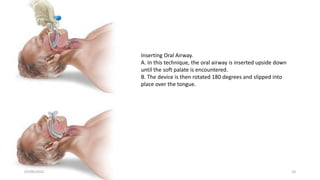
Inserting Oral Airway.
A. In this technique, the oral airway is inserted upside down
until the soft palate is encountered.
B. The device is then rotated 180 degrees and slipped into
place over the tongue.
07/09/2022 10
Contd.
• Establishing a definitive airway (i.e., endotracheal intubation) is
indicated in patients with: -
• Apnea;
• Inability to protect the airway due to altered mental status;
• Impending airway compromise due to inhalation injury,
hematoma, facial bleeding, soft tissue swelling, or aspiration;
• Inability to maintain oxygenation.
07/09/2022 11
Contd.
• Patients in whom attempts at intubation have failed or who are
precluded from intubation due to extensive facial injuries require
operative establishment of an airway like: -
• Cricothyroidotomy or
• Emergent tracheostomy
07/09/2022 12
Contd.
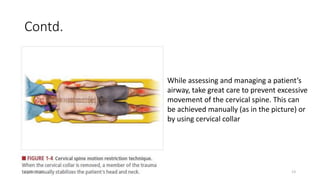
While assessing and managing a patient’s
airway, take great care to prevent excessive
movement of the cervical spine. This can
be achieved manually (as in the picture) or
by using cervical collar
07/09/2022 13
Breathing and ventilation
• The following conditions constitute an immediate threat to life due to
inadequate ventilation and should be checked:
• Tension pneumothorax
• Open pneumothorax,
• Flail chest with underlying pulmonary contusion,
• Massive hemothorax, and
• Major air leak due to a tracheobronchial injury.
07/09/2022 14
Contd.
• Give supplemental oxygen to every injured patient.
• If the patient is not intubated, oxygen should be delivered by a mask-
reservoir device to achieve optimal oxygenation.
• Use a pulse oximeter to monitor adequacy of hemoglobin oxygen
saturation.
07/09/2022 15
Tension Pneumothorax
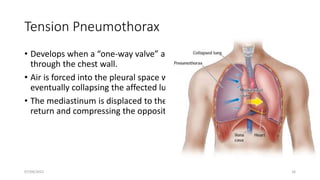
• Develops when a “one-way valve” air leak occurs from the lung or
through the chest wall.
• Air is forced into the pleural space with no means of escape,
eventually collapsing the affected lung.
• The mediastinum is displaced to the opposite side, decreasing venous
return and compressing the opposite lung causing hypotension
07/09/2022 16
Contd.
• is characterized by some or all of the following signs and symptoms:
• Chest pain,
• Respiratory distress
• Tachycardia and Hypotension
• Tracheal deviation away from the side of the injury
• Unilateral absence of breath sounds
• Neck vein distention
• Cyanosis
07/09/2022 17
Contd.
• Treatment is Immediate decompression either by
• Large-bore needle insertion into the 2nd ICS in the MCL of the
affected hemithorax or
• A chest tube through the 5th ICS in the anterior axillary line.
07/09/2022 18
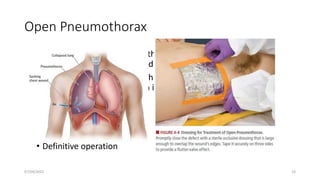
Open Pneumothorax
• Large injuries to the chest wall that remain open can result in a
sucking chest wound causing a disequilibrium in airway pressure
• Air passes preferentially through the chest wall defect with each
inspiration. Effective ventilation is thereby impaired, leading to
hypoxia and hypercarbia.
• Treatment is by
• 3-sided cover over defect
• Chest tube insertion
• Definitive operation
07/09/2022 19
Flail Chest
• Three or more contiguous ribs are fractured in at least two locations
• Treatment
• Mechanical ventilation until fibrous union of broken ribs occur
• Oxygen administration
• Adequate analgesia & physiotherapy
07/09/2022 20
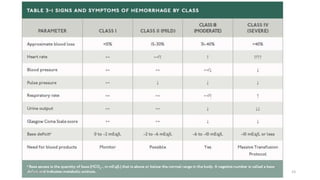
Circulation with hemorrhage control
• Blood pressure and pulse should be measured at least every 5
minutes in patients with significant blood loss until normal vital sign
values are restored.
• Look for external bleeding, extremity hematoma, abdominal or pelvic
bruises or lacerations.
07/09/2022 21
Contd.
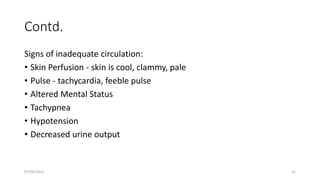
Signs of inadequate circulation:
• Skin Perfusion - skin is cool, clammy, pale
• Pulse - tachycardia, feeble pulse
• Altered Mental Status
• Tachypnea
• Hypotension
• Decreased urine output
07/09/2022 22
07/09/2022 23
Contd.
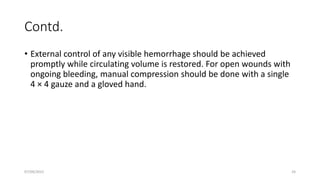
• External control of any visible hemorrhage should be achieved
promptly while circulating volume is restored. For open wounds with
ongoing bleeding, manual compression should be done with a single
4 × 4 gauze and a gloved hand.
07/09/2022 24
Contd.
• Intravenous (IV) access for fluid resuscitation and medication
administration is obtained with two peripheral catheters, 16-gauge or
larger in adults.
• For patients in whom IV access is difficult, intraosseous (IO) needles
can be placed in the proximal humerus or tibia.
• Fluid resuscitation begin with a 1 L (adult) or 20 mL/kg (child) IV bolus
of isotonic crystalloid, typically RL.
• If hypotension persists, initiate RBC and FFP also for patients with
class III and IV hemorrhage it should be considered earlier on.
07/09/2022 25
Contd.
• This life-threatening injuries must be identified promptly:
• Massive hemothorax,
• Cardiac tamponade,
• Massive hemoperitoneum,
• Mechanically unstable pelvic fractures with bleeding.
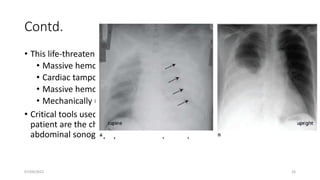
• Critical tools used to differentiate these in the multisystem trauma
patient are the chest and pelvis radiographs, and extended focused
abdominal sonography for trauma (eFAST)
07/09/2022 26
Contd.
• Management
• Massive hemothorax – Chest Tube insertion
• Cardiac tamponade - Pericardiocentesis
• Massive hemoperitoneum – Exploratory Laparotomy
• Mechanically unstable pelvic fractures with bleeding – Stabilize the
pelvis and definite surgery
07/09/2022 27
Disability
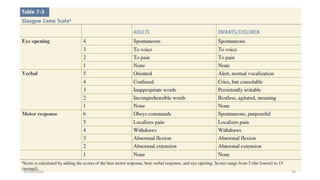
• Determine the patients Glasgow Coma Scale (GCS)
• The GCS is a quantifiable determination of neurologic function that is
useful for triage, treatment, and prognosis.
• Severity of head Injury
• 13 to 15 indicate mild head injury,
• 9 to 12 moderate injury, and
• ≤8 severe injury
07/09/2022 28
07/09/2022 29
Contd.
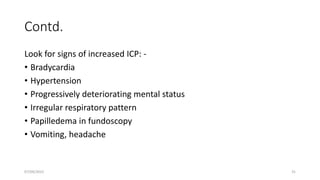
Look for signs of increased ICP: -
• Bradycardia
• Hypertension
• Progressively deteriorating mental status
• Irregular respiratory pattern
• Papilledema in fundoscopy
• Vomiting, headache
07/09/2022 31
Contd.
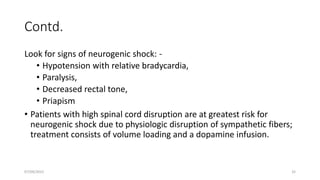
Look for signs of neurogenic shock: -
• Hypotension with relative bradycardia,
• Paralysis,
• Decreased rectal tone,
• Priapism
• Patients with high spinal cord disruption are at greatest risk for
neurogenic shock due to physiologic disruption of sympathetic fibers;
treatment consists of volume loading and a dopamine infusion.
07/09/2022 32
Exposure
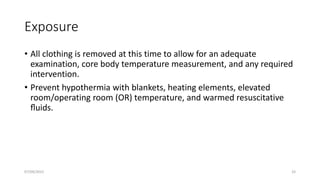
• All clothing is removed at this time to allow for an adequate
examination, core body temperature measurement, and any required
intervention.
• Prevent hypothermia with blankets, heating elements, elevated
room/operating room (OR) temperature, and warmed resuscitative
fluids.
07/09/2022 33
Adjuncts to the Primary Survey
• Continuous electrocardiography, pulse oximetry, carbon dioxide (CO2)
monitoring,
• Assessment of ventilatory rate, and arterial blood gas (ABG)
measurement.
• Insertion of urinary catheters to monitor urine output and assess for
hematuria.
• Gastric catheters to decompress distention.
• Chest and pelvis x-ray
• FAST
07/09/2022 34
Secondary Survey
• does not begin until the primary survey is completed, resuscitative
efforts are under way, and improvement of the patient’s vital
functions has been demonstrated.
• Comprises history and a thorough head-to-toe physical examination.
• AMPLE history
• Allergies
• Medications
• Past illnesses or Pregnancy
• Last meal
• Events related to the injury
07/09/2022 35
Contd.
• Ask about the mechanism of injury (e.g. blunt, penetrating trauma,
thermal injury)
Physical Examination
• It should be literally head to toe, with special attention to the
patient’s back, axillae, and perineum, because injuries here are easily
overlooked
07/09/2022 36
Contd.
HEENT
• Inspect the face and scalp. Look for any lacerations or bruising,
including mastoid or periorbital bruising.
• Gently palpate for any depressions or irregularities in the skull.
• Assess the ears for any signs of cerebrospinal fluid leak, bleeding or
blood behind the tympanic membrane.
• Look in the eyes for any foreign body, subconjunctival hemorrhage.
• Gently palpate the cervical vertebrae. Note any cervical spine pain,
tenderness or deformity.
07/09/2022 37
Contd.
Chest
• Palpate for rib tenderness and subcutaneous emphysema.
• Auscultate the lung fields; note any percussion abnormality, lack of
breath sounds, wheezing or crepitations.
• Check the heart sounds: apex beat and presence and quality of heart
sounds.
07/09/2022 38
Contd.
Abdomen and Pelvis
• Inspect the abdomen. Palpate for areas of tenderness especially over
the liver, spleen, kidneys and bladder. Look for any bruising,
lacerations or penetrating injuries.
• Auscultate bowel sounds.
• Inspect the perineum and external genitalia for bruising or
hemorrhage.
07/09/2022 39
Contd.
Perineum, Rectum, and Vagina
• The perineum should be examined for contusions, hematomas,
lacerations, and urethral bleeding.
• A rectal examination may be performed to assess for the presence of
blood within the bowel lumen, integrity of the rectal wall, and quality
of sphincter tone.
• Vaginal examination to assess for the presence of blood in the vaginal
vault and vaginal lacerations.
07/09/2022 40
Contd.
Musculoskeletal system
• Inspect all the limbs and joints, palpate for bony and soft-tissue
tenderness and check joint movements, stability and muscular power.
• Log roll the patient. Palpate the spine for any tenderness or steps
between the vertebrae.
Neurological examination
• includes motor and sensory evaluation of the extremities, as well as
reevaluation of the patient’s level of consciousness and pupillary size
and response.
07/09/2022 41
Adjuncts to the Secondary Survey
• Specialized diagnostic tests may be performed to identify specific
injuries.
• X-ray examinations of the spine and extremities;
• CT scans of the head, chest, abdomen, and spine;
• Contrast urography and angiography;
• Transesophageal ultrasound;
• Bronchoscopy;
• Esophagoscopy;
07/09/2022 42
Tertiary Survey
• Structured and comprehensive reexamination that takes place within
24 hours of initial assessment.
• 7-13% of patients have injuries that are missed during the initial
evaluation.
07/09/2022 43
References
• Schwartz principles of surgery 11th edition
• ATLS 2018 Student Course Manual
• UpToDate 2022
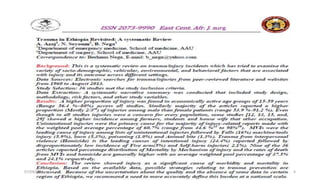
• Nebyou Seyoum, A Azaj, Berhanu Nega, Trauma in Ethiopia
Revisited: A systematic Review; East Cent. Afr. J. surg, 2013,
Volume 18 (2)
07/09/2022 44
07/09/2022 45

ATLS.pptx

  • 1.
    ATLS, Management ofTrauma patient at ER Presented by: Dr. Meron Zewde (Intern) Moderator: Dr. Misale (General Surgeon) 07/09/2022 1
  • 2.
    Outline • Definition • Epidemiology •Primary survey • Secondary survey • Tertiary survey 07/09/2022 2
  • 3.
    Introduction • Trauma, orinjury, is defined as cellular disruption caused by environmental energy that is beyond the body’s resilience, which is compounded by cell death due to ischemia/reperfusion. • Trauma is the most common cause of death for all individuals between the ages of 1 and 44 years, and is the third most common cause of death regardless of age. • It is also the leading cause of years of productive life lost. 07/09/2022 3
  • 4.
  • 5.
    Emergency Approach toTrauma Trimodal distribution of trauma deaths: 1. Immediate deaths (on scene): Hemorrhage due to great vessel injury, severe TBI, High spinal cord injury etc. 2. Early deaths (1st 1-4 hours): chest trauma, abdomino thoracic injuries, pelvic injuries most common • Gives rise to the concept of the “golden hour” 3. Late deaths (hours-days-weeks): from secondary insult – pneumonia, PE, sepsis, coagulopathy 07/09/2022 5
  • 6.
    Trauma Death byTime of Injury 07/09/2022 6
  • 7.
    Primary Survey • Encompassesthe ABCDEs of trauma care and identifies life- threatening conditions by adhering to this sequence. • Airway maintenance with restriction of cervical spine motion • Breathing and ventilation • Circulation with hemorrhage control • Disability(assessment of neurologic status) • Exposure/Environmental control 07/09/2022 7
  • 8.
    Airway Maintenance withrestriction of cervical spine motion • This rapid assessment for signs of airway obstruction includes inspecting for • Foreign bodies; • Identifying facial, mandibular, and/or tracheal/laryngeal fractures; • Suctioning to clear accumulated blood or secretions • In patients with severe head injuries with GCS score of 8 or lower the tongue may fall backward and obstruct the hypopharynx; this can be relieved by either a chin lift , jaw thrust or by inserting a nasopharyngeal or oropharyngeal airway but endotracheal intubation might be needed at last. 07/09/2022 8
  • 9.
  • 10.
    Inserting Oral Airway. A.In this technique, the oral airway is inserted upside down until the soft palate is encountered. B. The device is then rotated 180 degrees and slipped into place over the tongue. 07/09/2022 10
  • 11.
    Contd. • Establishing adefinitive airway (i.e., endotracheal intubation) is indicated in patients with: - • Apnea; • Inability to protect the airway due to altered mental status; • Impending airway compromise due to inhalation injury, hematoma, facial bleeding, soft tissue swelling, or aspiration; • Inability to maintain oxygenation. 07/09/2022 11
  • 12.
    Contd. • Patients inwhom attempts at intubation have failed or who are precluded from intubation due to extensive facial injuries require operative establishment of an airway like: - • Cricothyroidotomy or • Emergent tracheostomy 07/09/2022 12
  • 13.
    Contd. While assessing andmanaging a patient’s airway, take great care to prevent excessive movement of the cervical spine. This can be achieved manually (as in the picture) or by using cervical collar 07/09/2022 13
  • 14.
    Breathing and ventilation •The following conditions constitute an immediate threat to life due to inadequate ventilation and should be checked: • Tension pneumothorax • Open pneumothorax, • Flail chest with underlying pulmonary contusion, • Massive hemothorax, and • Major air leak due to a tracheobronchial injury. 07/09/2022 14
  • 15.
    Contd. • Give supplementaloxygen to every injured patient. • If the patient is not intubated, oxygen should be delivered by a mask- reservoir device to achieve optimal oxygenation. • Use a pulse oximeter to monitor adequacy of hemoglobin oxygen saturation. 07/09/2022 15
  • 16.
    Tension Pneumothorax • Developswhen a “one-way valve” air leak occurs from the lung or through the chest wall. • Air is forced into the pleural space with no means of escape, eventually collapsing the affected lung. • The mediastinum is displaced to the opposite side, decreasing venous return and compressing the opposite lung causing hypotension 07/09/2022 16
  • 17.
    Contd. • is characterizedby some or all of the following signs and symptoms: • Chest pain, • Respiratory distress • Tachycardia and Hypotension • Tracheal deviation away from the side of the injury • Unilateral absence of breath sounds • Neck vein distention • Cyanosis 07/09/2022 17
  • 18.
    Contd. • Treatment isImmediate decompression either by • Large-bore needle insertion into the 2nd ICS in the MCL of the affected hemithorax or • A chest tube through the 5th ICS in the anterior axillary line. 07/09/2022 18
  • 19.
    Open Pneumothorax • Largeinjuries to the chest wall that remain open can result in a sucking chest wound causing a disequilibrium in airway pressure • Air passes preferentially through the chest wall defect with each inspiration. Effective ventilation is thereby impaired, leading to hypoxia and hypercarbia. • Treatment is by • 3-sided cover over defect • Chest tube insertion • Definitive operation 07/09/2022 19
  • 20.
    Flail Chest • Threeor more contiguous ribs are fractured in at least two locations • Treatment • Mechanical ventilation until fibrous union of broken ribs occur • Oxygen administration • Adequate analgesia & physiotherapy 07/09/2022 20
  • 21.
    Circulation with hemorrhagecontrol • Blood pressure and pulse should be measured at least every 5 minutes in patients with significant blood loss until normal vital sign values are restored. • Look for external bleeding, extremity hematoma, abdominal or pelvic bruises or lacerations. 07/09/2022 21
  • 22.
    Contd. Signs of inadequatecirculation: • Skin Perfusion - skin is cool, clammy, pale • Pulse - tachycardia, feeble pulse • Altered Mental Status • Tachypnea • Hypotension • Decreased urine output 07/09/2022 22
  • 23.
  • 24.
    Contd. • External controlof any visible hemorrhage should be achieved promptly while circulating volume is restored. For open wounds with ongoing bleeding, manual compression should be done with a single 4 × 4 gauze and a gloved hand. 07/09/2022 24
  • 25.
    Contd. • Intravenous (IV)access for fluid resuscitation and medication administration is obtained with two peripheral catheters, 16-gauge or larger in adults. • For patients in whom IV access is difficult, intraosseous (IO) needles can be placed in the proximal humerus or tibia. • Fluid resuscitation begin with a 1 L (adult) or 20 mL/kg (child) IV bolus of isotonic crystalloid, typically RL. • If hypotension persists, initiate RBC and FFP also for patients with class III and IV hemorrhage it should be considered earlier on. 07/09/2022 25
  • 26.
    Contd. • This life-threateninginjuries must be identified promptly: • Massive hemothorax, • Cardiac tamponade, • Massive hemoperitoneum, • Mechanically unstable pelvic fractures with bleeding. • Critical tools used to differentiate these in the multisystem trauma patient are the chest and pelvis radiographs, and extended focused abdominal sonography for trauma (eFAST) 07/09/2022 26
  • 27.
    Contd. • Management • Massivehemothorax – Chest Tube insertion • Cardiac tamponade - Pericardiocentesis • Massive hemoperitoneum – Exploratory Laparotomy • Mechanically unstable pelvic fractures with bleeding – Stabilize the pelvis and definite surgery 07/09/2022 27
  • 28.
    Disability • Determine thepatients Glasgow Coma Scale (GCS) • The GCS is a quantifiable determination of neurologic function that is useful for triage, treatment, and prognosis. • Severity of head Injury • 13 to 15 indicate mild head injury, • 9 to 12 moderate injury, and • ≤8 severe injury 07/09/2022 28
  • 29.
  • 30.
    Contd. Look for signsof increased ICP: - • Bradycardia • Hypertension • Progressively deteriorating mental status • Irregular respiratory pattern • Papilledema in fundoscopy • Vomiting, headache 07/09/2022 31
  • 31.
    Contd. Look for signsof neurogenic shock: - • Hypotension with relative bradycardia, • Paralysis, • Decreased rectal tone, • Priapism • Patients with high spinal cord disruption are at greatest risk for neurogenic shock due to physiologic disruption of sympathetic fibers; treatment consists of volume loading and a dopamine infusion. 07/09/2022 32
  • 32.
    Exposure • All clothingis removed at this time to allow for an adequate examination, core body temperature measurement, and any required intervention. • Prevent hypothermia with blankets, heating elements, elevated room/operating room (OR) temperature, and warmed resuscitative fluids. 07/09/2022 33
  • 33.
    Adjuncts to thePrimary Survey • Continuous electrocardiography, pulse oximetry, carbon dioxide (CO2) monitoring, • Assessment of ventilatory rate, and arterial blood gas (ABG) measurement. • Insertion of urinary catheters to monitor urine output and assess for hematuria. • Gastric catheters to decompress distention. • Chest and pelvis x-ray • FAST 07/09/2022 34
  • 34.
    Secondary Survey • doesnot begin until the primary survey is completed, resuscitative efforts are under way, and improvement of the patient’s vital functions has been demonstrated. • Comprises history and a thorough head-to-toe physical examination. • AMPLE history • Allergies • Medications • Past illnesses or Pregnancy • Last meal • Events related to the injury 07/09/2022 35
  • 35.
    Contd. • Ask aboutthe mechanism of injury (e.g. blunt, penetrating trauma, thermal injury) Physical Examination • It should be literally head to toe, with special attention to the patient’s back, axillae, and perineum, because injuries here are easily overlooked 07/09/2022 36
  • 36.
    Contd. HEENT • Inspect theface and scalp. Look for any lacerations or bruising, including mastoid or periorbital bruising. • Gently palpate for any depressions or irregularities in the skull. • Assess the ears for any signs of cerebrospinal fluid leak, bleeding or blood behind the tympanic membrane. • Look in the eyes for any foreign body, subconjunctival hemorrhage. • Gently palpate the cervical vertebrae. Note any cervical spine pain, tenderness or deformity. 07/09/2022 37
  • 37.
    Contd. Chest • Palpate forrib tenderness and subcutaneous emphysema. • Auscultate the lung fields; note any percussion abnormality, lack of breath sounds, wheezing or crepitations. • Check the heart sounds: apex beat and presence and quality of heart sounds. 07/09/2022 38
  • 38.
    Contd. Abdomen and Pelvis •Inspect the abdomen. Palpate for areas of tenderness especially over the liver, spleen, kidneys and bladder. Look for any bruising, lacerations or penetrating injuries. • Auscultate bowel sounds. • Inspect the perineum and external genitalia for bruising or hemorrhage. 07/09/2022 39
  • 39.
    Contd. Perineum, Rectum, andVagina • The perineum should be examined for contusions, hematomas, lacerations, and urethral bleeding. • A rectal examination may be performed to assess for the presence of blood within the bowel lumen, integrity of the rectal wall, and quality of sphincter tone. • Vaginal examination to assess for the presence of blood in the vaginal vault and vaginal lacerations. 07/09/2022 40
  • 40.
    Contd. Musculoskeletal system • Inspectall the limbs and joints, palpate for bony and soft-tissue tenderness and check joint movements, stability and muscular power. • Log roll the patient. Palpate the spine for any tenderness or steps between the vertebrae. Neurological examination • includes motor and sensory evaluation of the extremities, as well as reevaluation of the patient’s level of consciousness and pupillary size and response. 07/09/2022 41
  • 41.
    Adjuncts to theSecondary Survey • Specialized diagnostic tests may be performed to identify specific injuries. • X-ray examinations of the spine and extremities; • CT scans of the head, chest, abdomen, and spine; • Contrast urography and angiography; • Transesophageal ultrasound; • Bronchoscopy; • Esophagoscopy; 07/09/2022 42
  • 42.
    Tertiary Survey • Structuredand comprehensive reexamination that takes place within 24 hours of initial assessment. • 7-13% of patients have injuries that are missed during the initial evaluation. 07/09/2022 43
  • 43.
    References • Schwartz principlesof surgery 11th edition • ATLS 2018 Student Course Manual • UpToDate 2022 • Nebyou Seyoum, A Azaj, Berhanu Nega, Trauma in Ethiopia Revisited: A systematic Review; East Cent. Afr. J. surg, 2013, Volume 18 (2) 07/09/2022 44
  • 44.

Editor's Notes

  • #5 This is a systematic review of different studies based on trauma in Ethiopia till 2013
  • #6 golden hour is the time where we can immediately act upon to the save the life of the trauma victim
  • #8 During the primary survey, life-threatening conditions are identified and treated in a prioritized sequence based on the effects of injuries on the patient’s Physiology. Regardless of the injury causing airway compromise, the first priority is airway management: Because the prioritized sequence is based on the degree of life threat, the abnormality posing the greatest threat to life is addressed first.
  • #10 The chin-lift maneuver is performed by placing the fingers of one hand under the mandible and then gently lifting it upward to bring the chin anterior. To perform a jaw thrust maneuver, grasp the angles of the mandibles with a hand on each side and then displace the mandible forward While doing these maneuvers always stabilize the c-spine (neck)
  • #11 If available we can insert an oral airway to prevent the tongue from falling backward
  • #20 This is a picture illustrating open pneumothorax with air entering from the environment to the lung and collapsing the lung This a 3 way cover dressing as a temporary tx for open pneumothrax
  • #25 For bleeding of the extremities, it is tempting to apply tourniquets for hemorrhage control but complete vascular occlusion with a tourniquet risks permanent neuromuscular impairment.
  • #27 Figure 7-8. More than 1500 mL of blood in the pleural space is considered a massive hemothorax. Chest film findings reflect the positioning of the patient. A. In the supine position, blood tracks along the entire posterior section of the chest and is most notable pushing the lung away from the chest wall. B. In the upright position, blood is visible dependently in the right pleural space.
  • #31 We should check findings on neurological examination for these complications of head trauma
  • #35 extended focused assessment with sonography for trauma (eFAST)