© Russell Martin & Associates www.russellmartin.comPage 1
a Moser Consulting
company
Methodology MADNESS:
ADDIE, SAM, Agile, and More
presented by
Russell Martin & Associates
(317) 596-8022
info@russellmartin.com
www.russellmartin.com
© Russell Martin & Associates www.russellmartin.comPage 2
a Moser Consulting
company
How Has Work Changed
Ten Years Ago…
• Work on 1 project at a time,
sometimes alone.
• No email.
• Less or no multi-tasking.
• Functions / roles were clear
• Governance was clear – the
boss was the boss
• 8 – 5 work and rare overtime
•
•
Present…
•
•
•
•
•
•
•
© Russell Martin & Associates www.russellmartin.comPage 3
a Moser Consulting
company
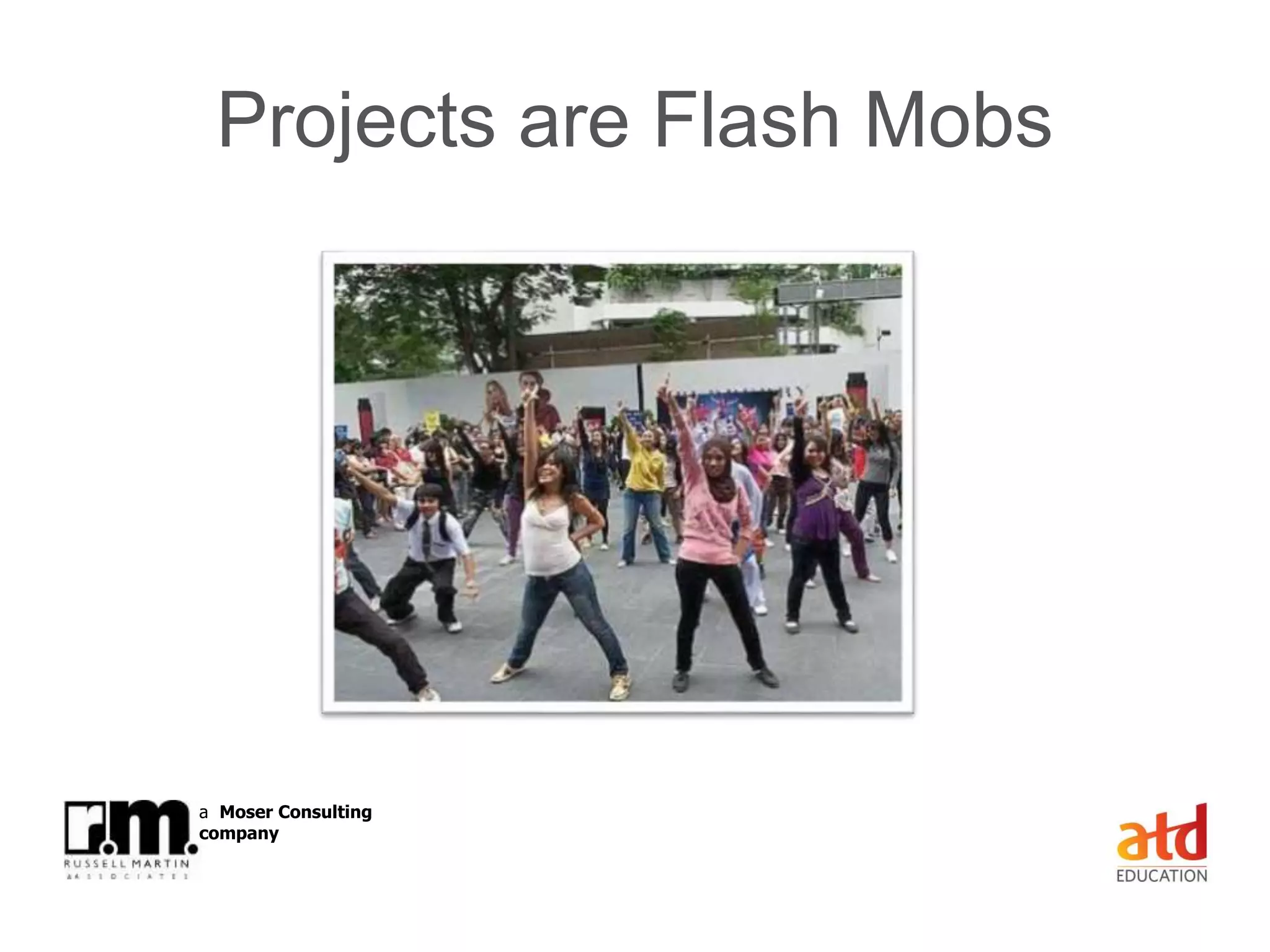
Projects are Flash Mobs
© Russell Martin & Associates www.russellmartin.comPage 4
a Moser Consulting
company
How frustrated ARE YOU???
© Russell Martin & Associates www.russellmartin.comPage 5
a Moser Consulting
company
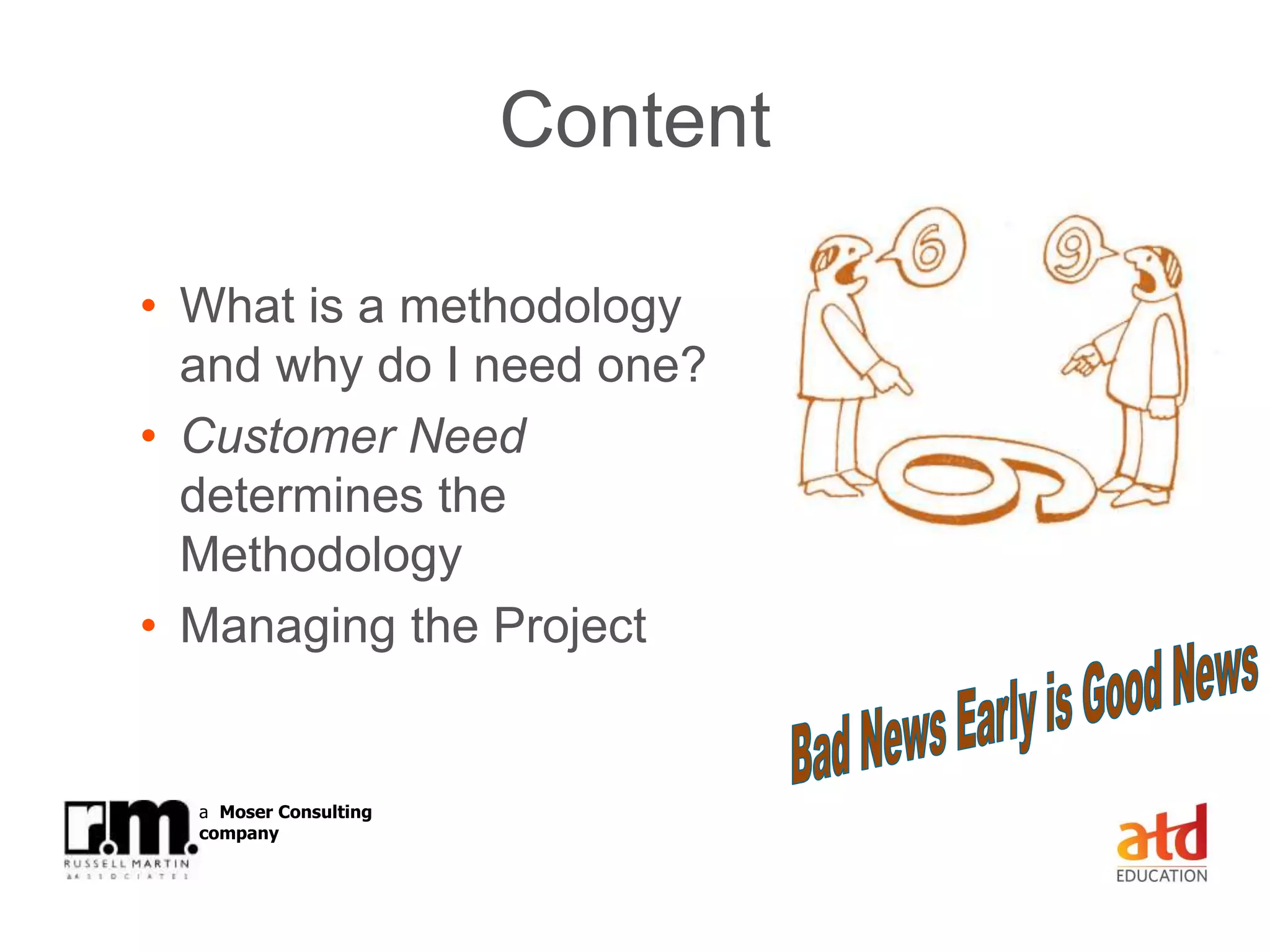
Content
• What is a methodology
and why do I need one?
• Customer Need
determines the
Methodology
• Managing the Project
© Russell Martin & Associates www.russellmartin.comPage 6
a Moser Consulting
company
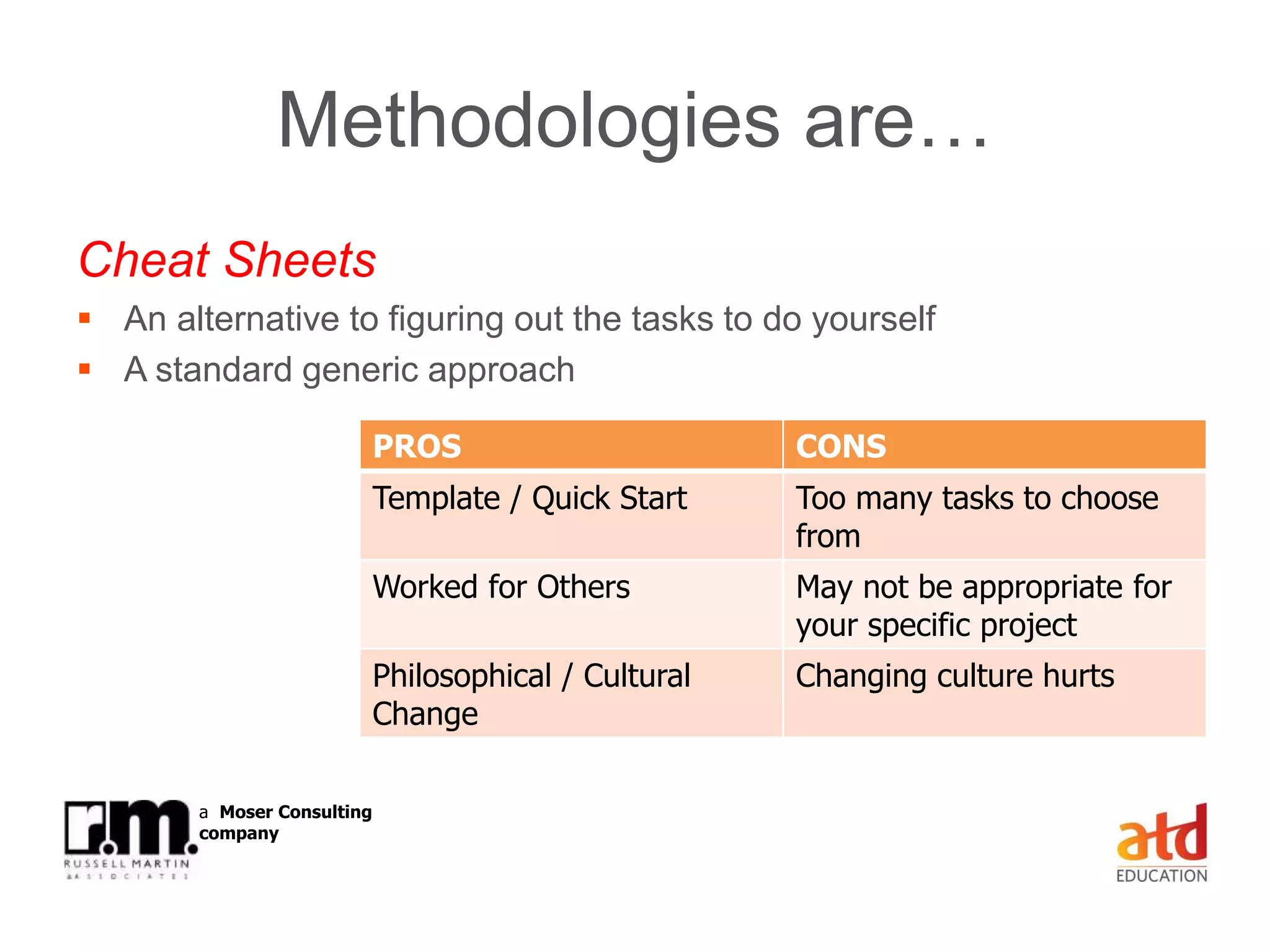
Methodologies are…
Cheat Sheets
 An alternative to figuring out the tasks to do yourself
 A standard generic approach
PROS CONS
Template / Quick Start Too many tasks to choose
from
Worked for Others May not be appropriate for
your specific project
Philosophical / Cultural
Change
Changing culture hurts
© Russell Martin & Associates www.russellmartin.comPage 7
a Moser Consulting
company
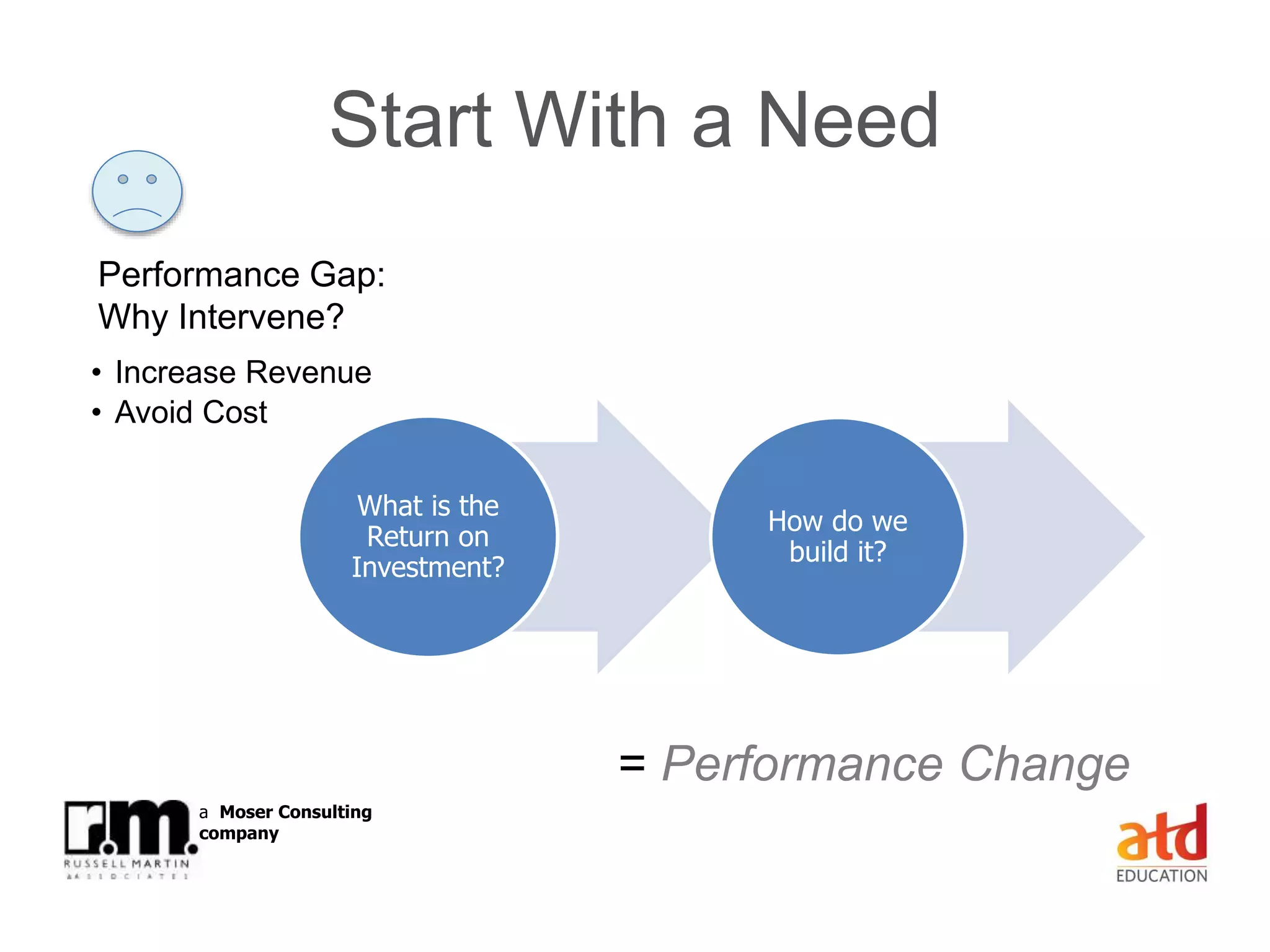
What is the
Return on
Investment?
Performance Gap:
Why Intervene?
• Increase Revenue
• Avoid Cost
How do we
build it?
= Performance Change
Start With a Need
© Russell Martin & Associates www.russellmartin.comPage 8
a Moser Consulting
company
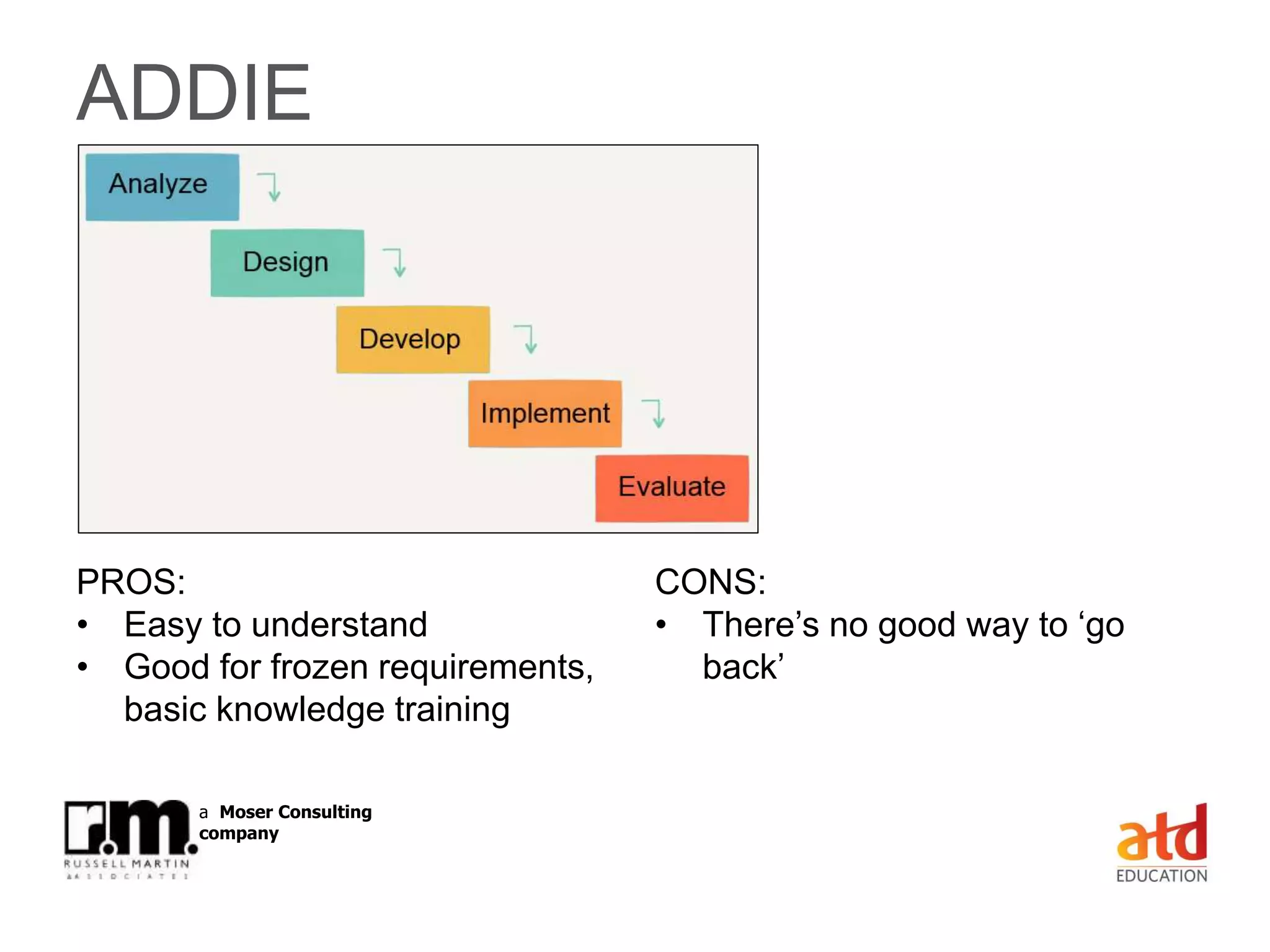
ADDIE
PROS:
• Easy to understand
• Good for frozen requirements,
basic knowledge training
CONS:
• There’s no good way to ‘go
back’
© Russell Martin & Associates www.russellmartin.comPage 9
a Moser Consulting
company
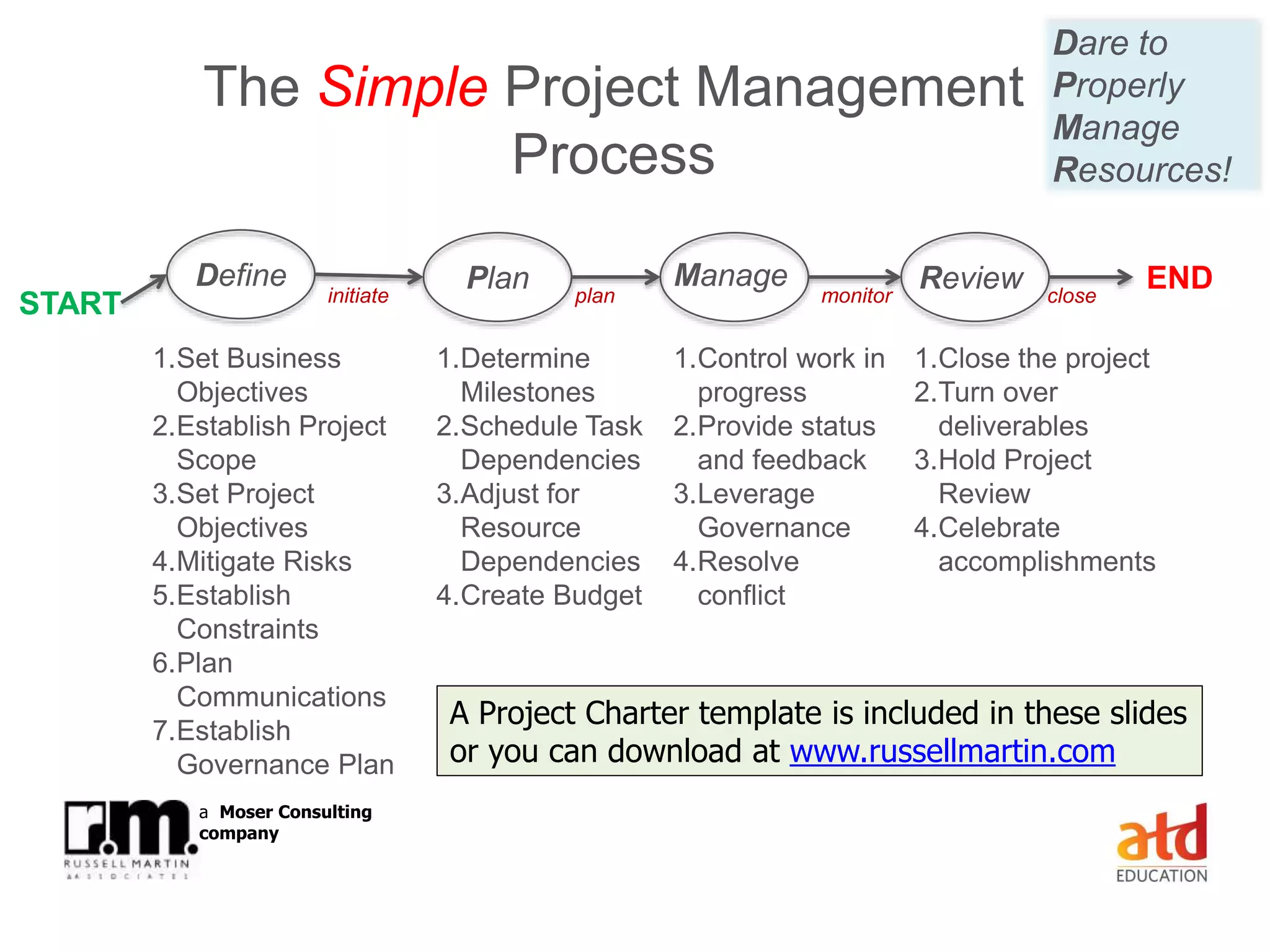
The Simple Project Management
Process
Dare to
Properly
Manage
Resources!
Define Plan Manage Review
1.Set Business
Objectives
2.Establish Project
Scope
3.Set Project
Objectives
4.Mitigate Risks
5.Establish
Constraints
6.Plan
Communications
7.Establish
Governance Plan
1.Determine
Milestones
2.Schedule Task
Dependencies
3.Adjust for
Resource
Dependencies
4.Create Budget
START
1.Control work in
progress
2.Provide status
and feedback
3.Leverage
Governance
4.Resolve
conflict
1.Close the project
2.Turn over
deliverables
3.Hold Project
Review
4.Celebrate
accomplishments
initiate plan monitor close
END
A Project Charter template is included in these slides
or you can download at www.russellmartin.com
© Russell Martin & Associates www.russellmartin.comPage 10
a Moser Consulting
company
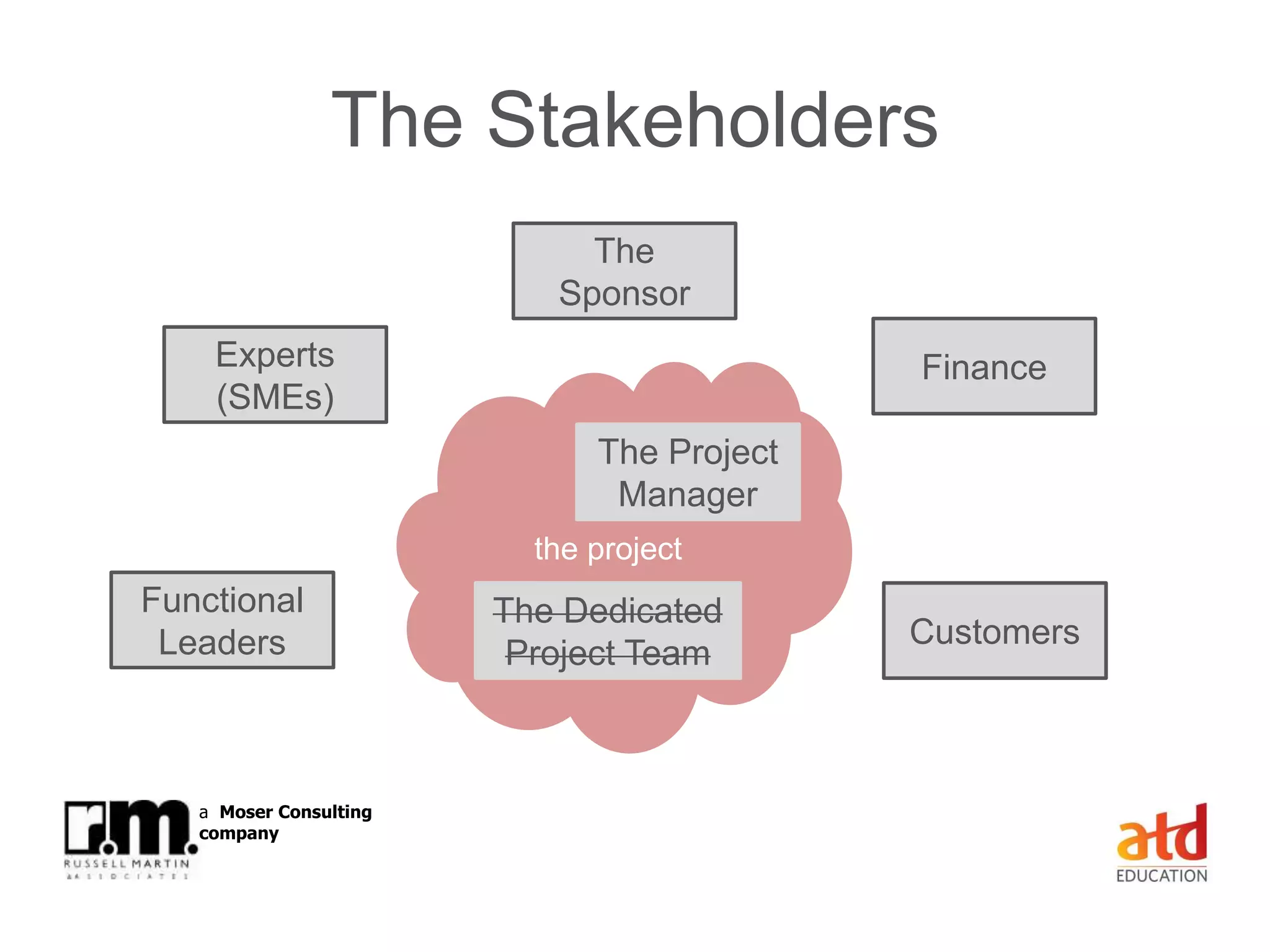
The Stakeholders
the project
The
Sponsor
Experts
(SMEs)
Finance
Customers
Functional
Leaders
The Project
Manager
The Dedicated
Project Team
© Russell Martin & Associates www.russellmartin.comPage 11
a Moser Consulting
company
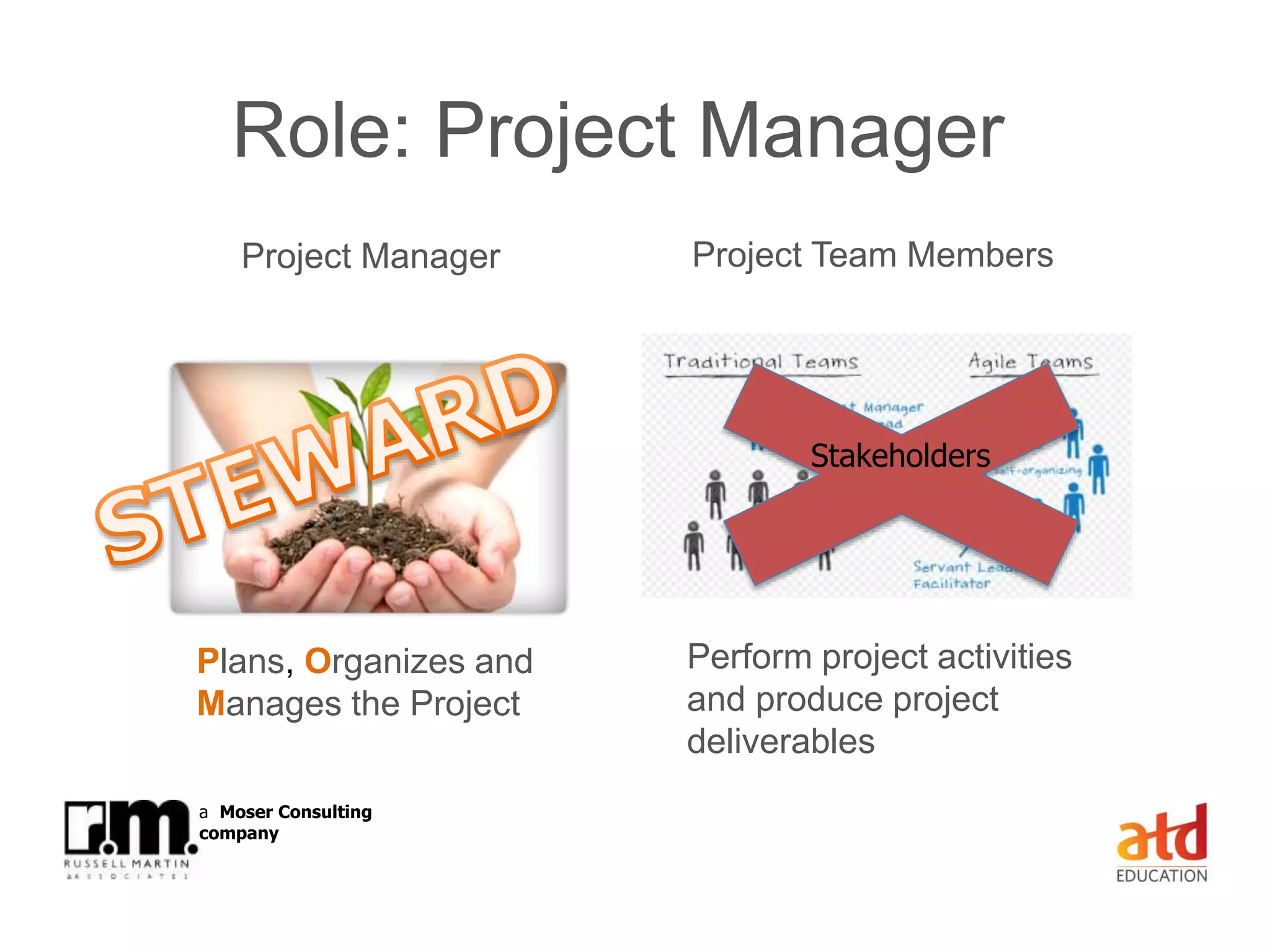
Role: Project Manager
Project Team Members
Perform project activities
and produce project
deliverables
Project Manager
Plans, Organizes and
Manages the Project
Stakeholders
© Russell Martin & Associates www.russellmartin.comPage 12
a Moser Consulting
company
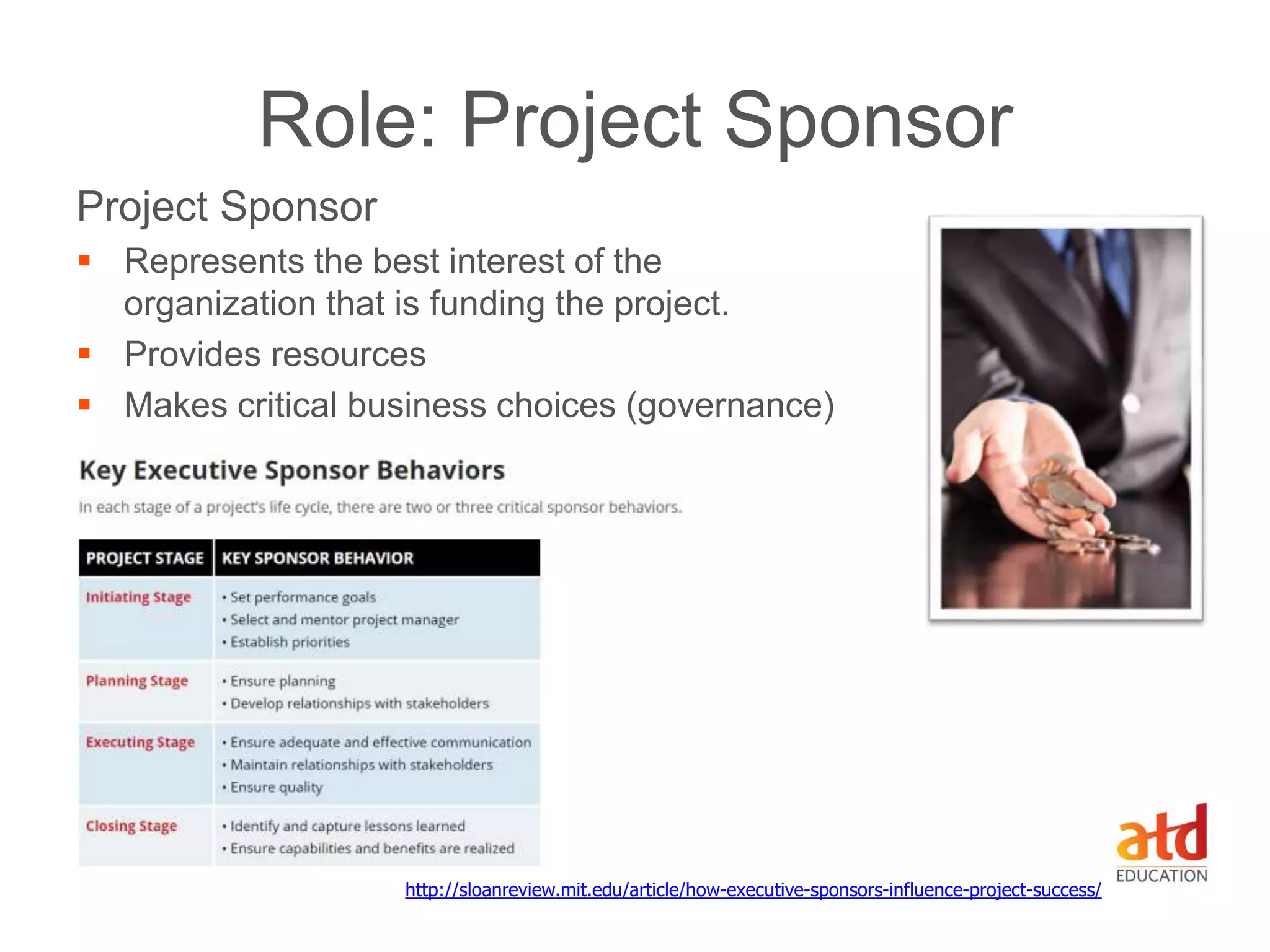
Role: Project Sponsor
Project Sponsor
 Represents the best interest of the
organization that is funding the project.
 Provides resources
 Makes critical business choices (governance)
http://sloanreview.mit.edu/article/how-executive-sponsors-influence-project-success/
© Russell Martin & Associates www.russellmartin.comPage 13
a Moser Consulting
company
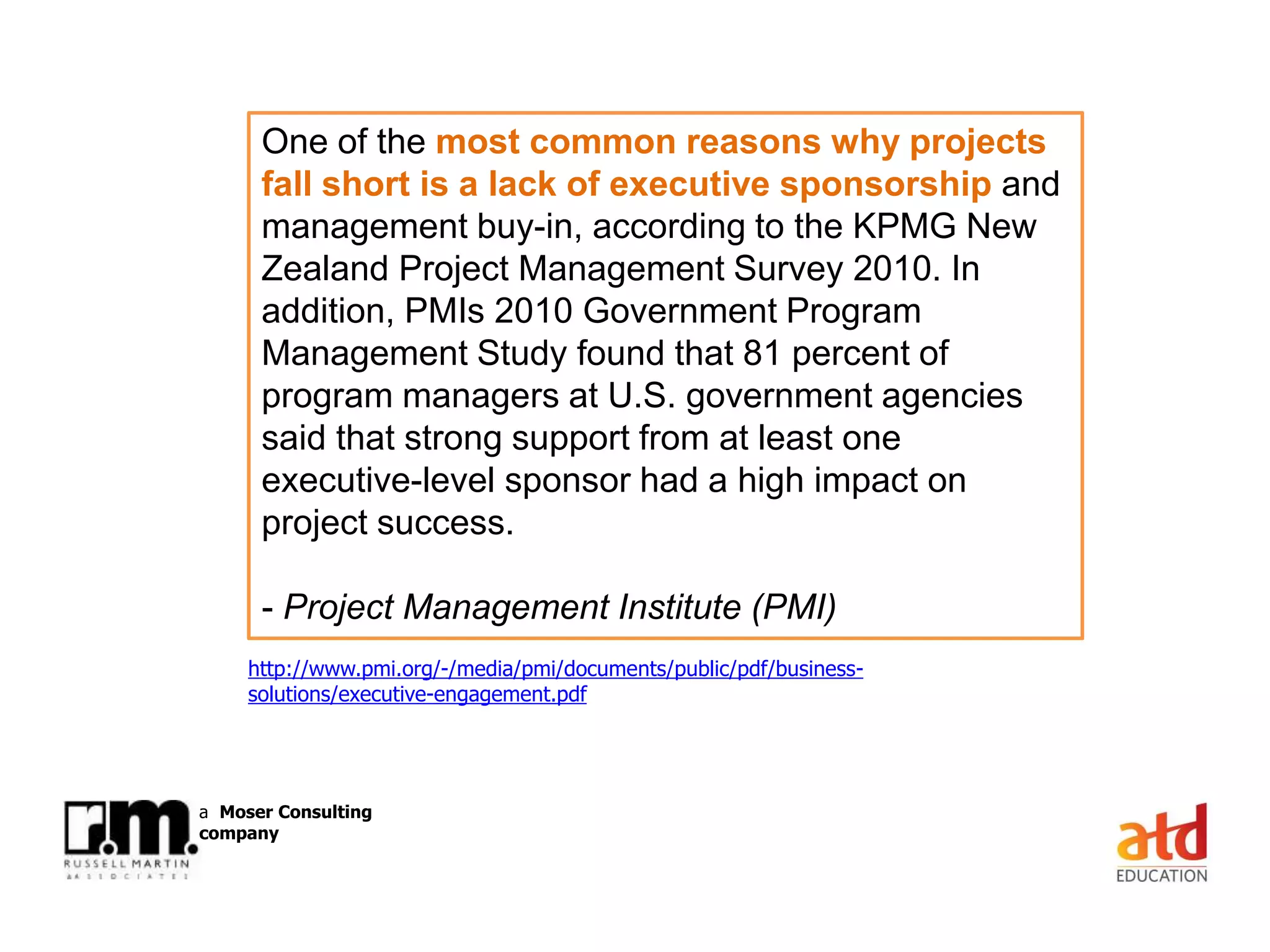
One of the most common reasons why projects
fall short is a lack of executive sponsorship and
management buy-in, according to the KPMG New
Zealand Project Management Survey 2010. In
addition, PMIs 2010 Government Program
Management Study found that 81 percent of
program managers at U.S. government agencies
said that strong support from at least one
executive-level sponsor had a high impact on
project success.
- Project Management Institute (PMI)
http://www.pmi.org/-/media/pmi/documents/public/pdf/business-
solutions/executive-engagement.pdf
© Russell Martin & Associates www.russellmartin.comPage 14
a Moser Consulting
company
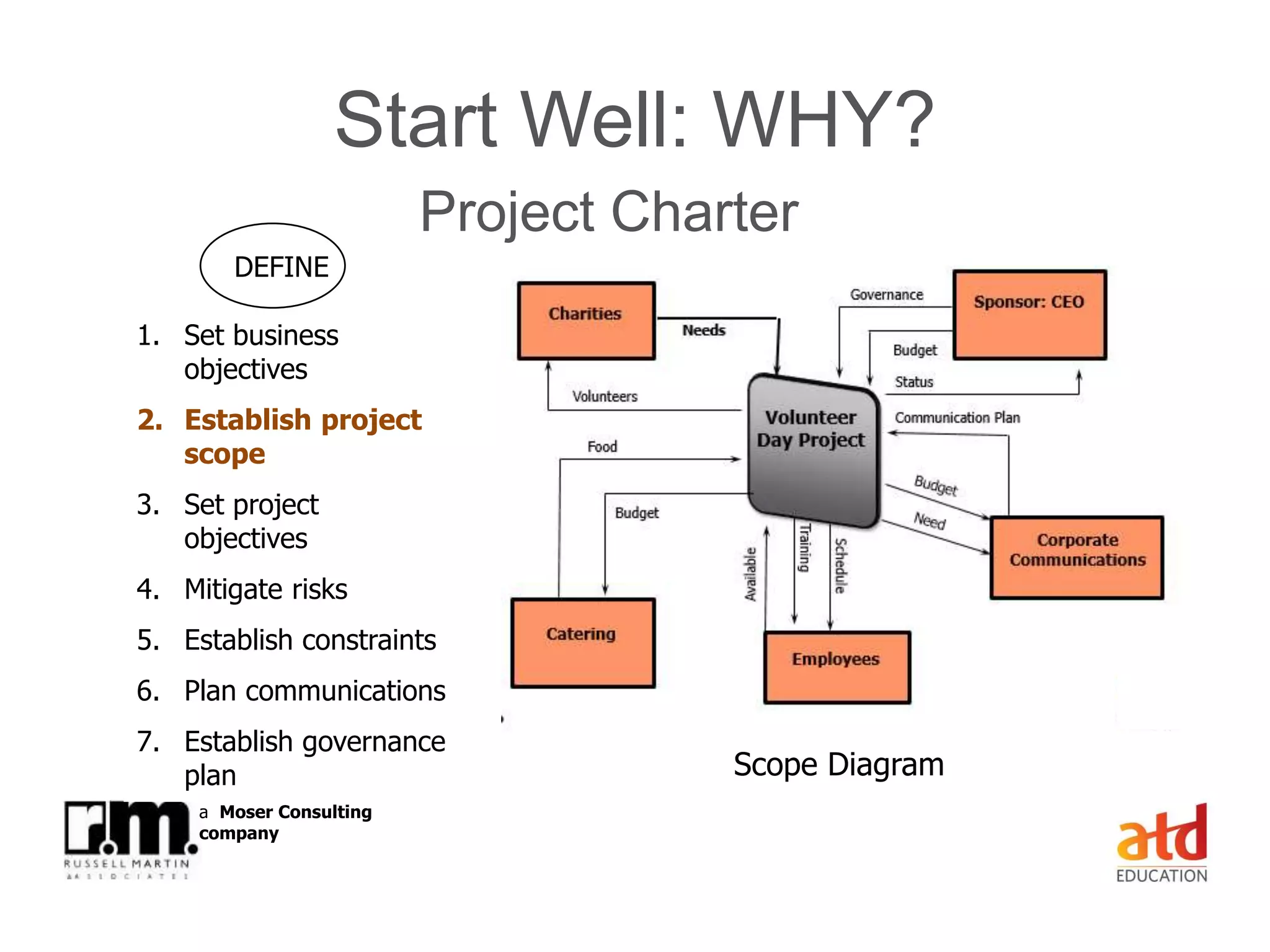
Start Well: WHY?
Project Charter
DEFINE
1. Set business
objectives
2. Establish project
scope
3. Set project
objectives
4. Mitigate risks
5. Establish constraints
6. Plan communications
7. Establish governance
plan Scope Diagram
© Russell Martin & Associates www.russellmartin.comPage 15
a Moser Consulting
company
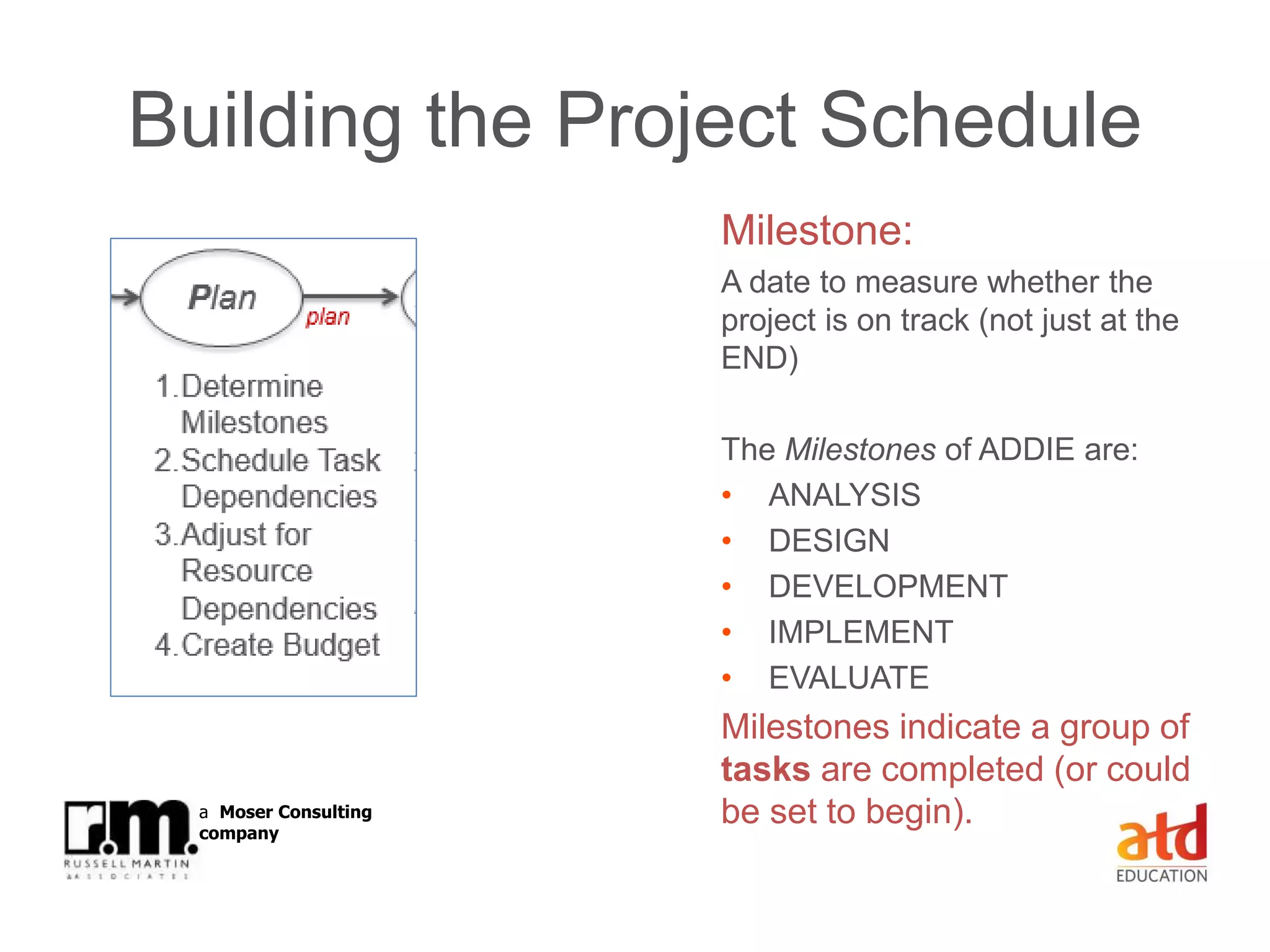
Building the Project Schedule
Milestone:
A date to measure whether the
project is on track (not just at the
END)
The Milestones of ADDIE are:
• ANALYSIS
• DESIGN
• DEVELOPMENT
• IMPLEMENT
• EVALUATE
Milestones indicate a group of
tasks are completed (or could
be set to begin).
© Russell Martin & Associates www.russellmartin.comPage 16
a Moser Consulting
company
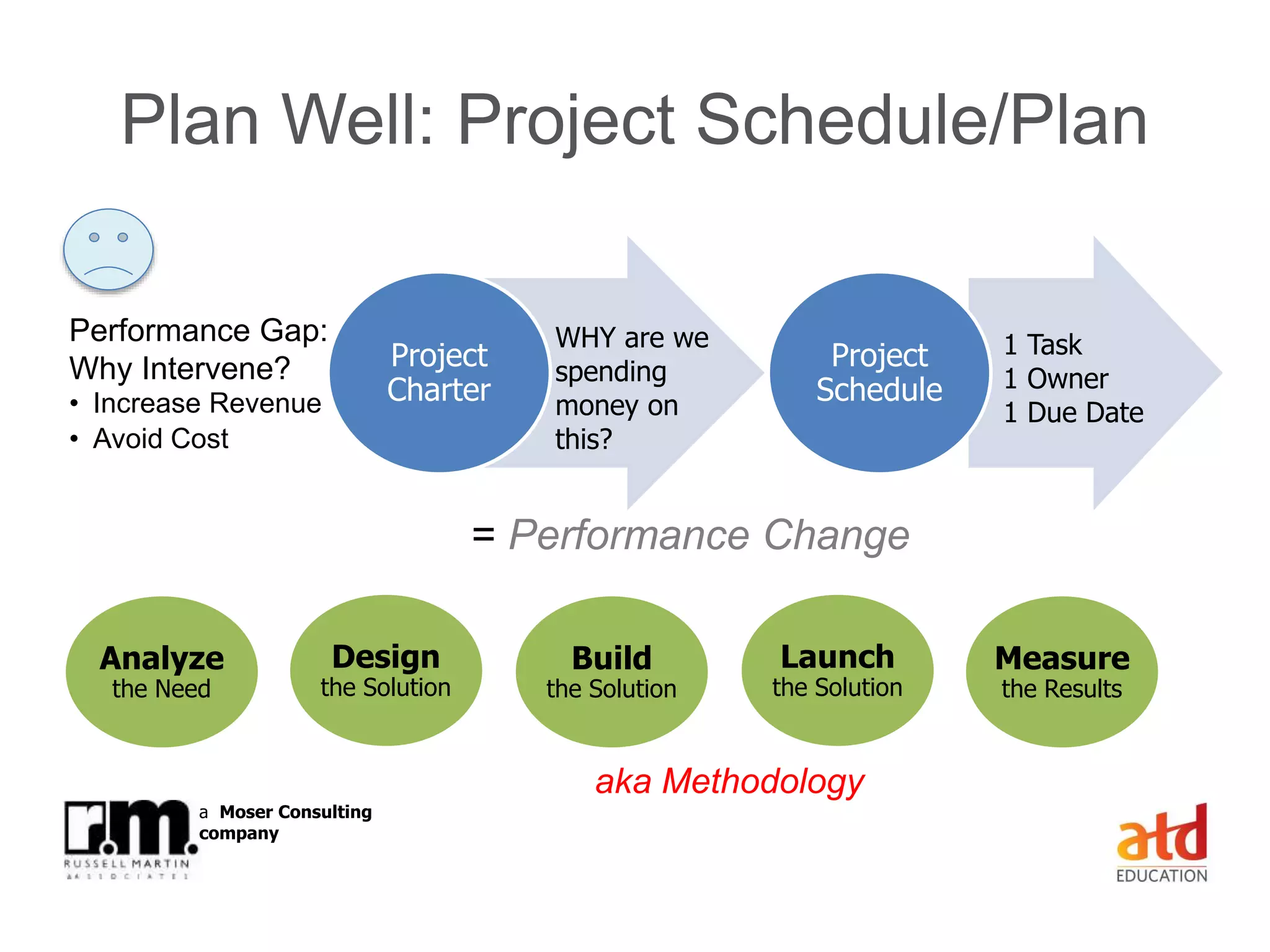
Project
Charter
Performance Gap:
Why Intervene?
• Increase Revenue
• Avoid Cost
WHY are we
spending
money on
this?
Project
Schedule
1 Task
1 Owner
1 Due Date
Analyze
the Need
Design
the Solution
Build
the Solution
Launch
the Solution
Measure
the Results
= Performance Change
Plan Well: Project Schedule/Plan
aka Methodology
© Russell Martin & Associates www.russellmartin.comPage 17
a Moser Consulting
company
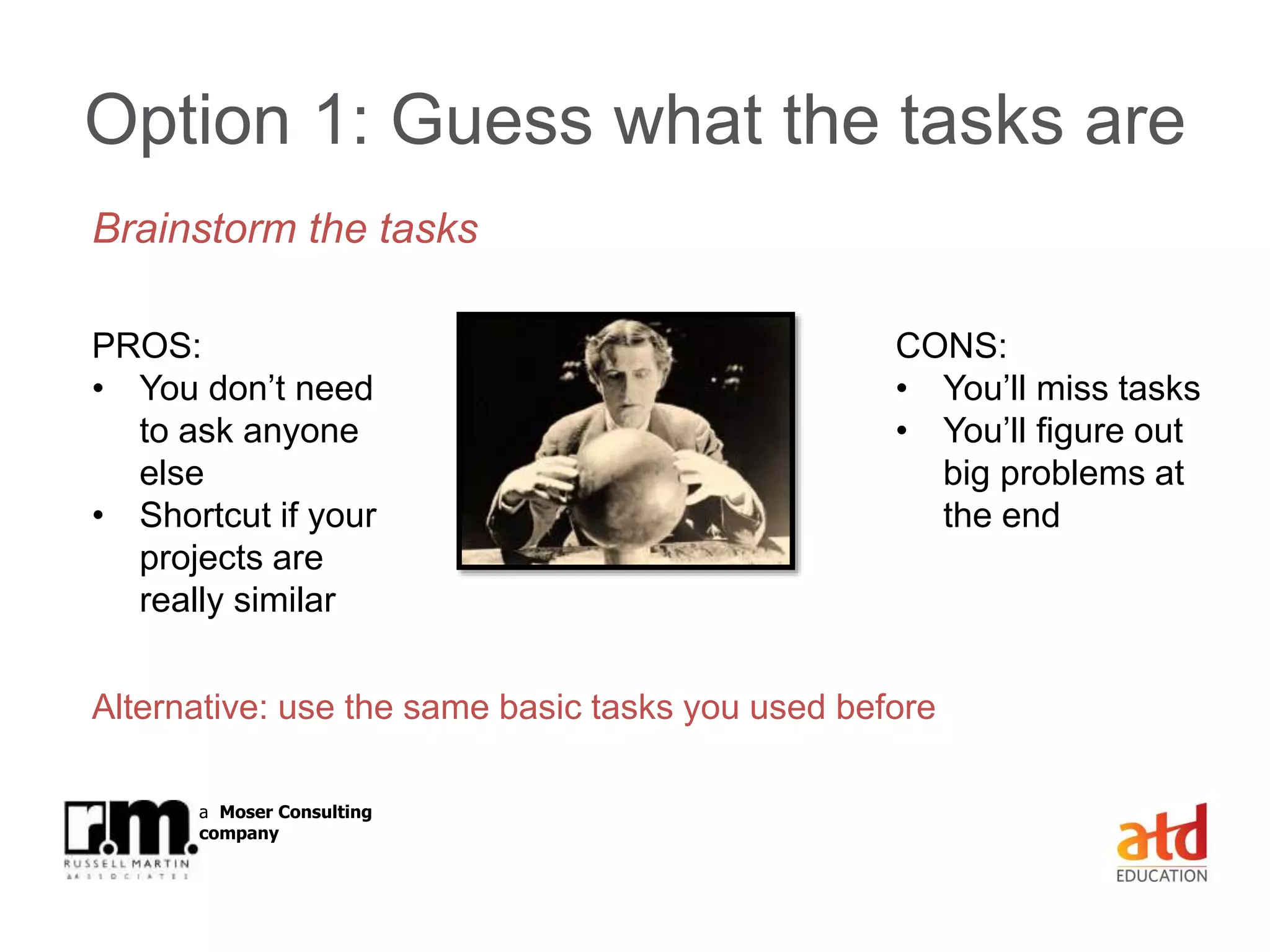
Option 1: Guess what the tasks are
Brainstorm the tasks
PROS:
• You don’t need
to ask anyone
else
• Shortcut if your
projects are
really similar
CONS:
• You’ll miss tasks
• You’ll figure out
big problems at
the end
Alternative: use the same basic tasks you used before
© Russell Martin & Associates www.russellmartin.comPage 18
a Moser Consulting
company
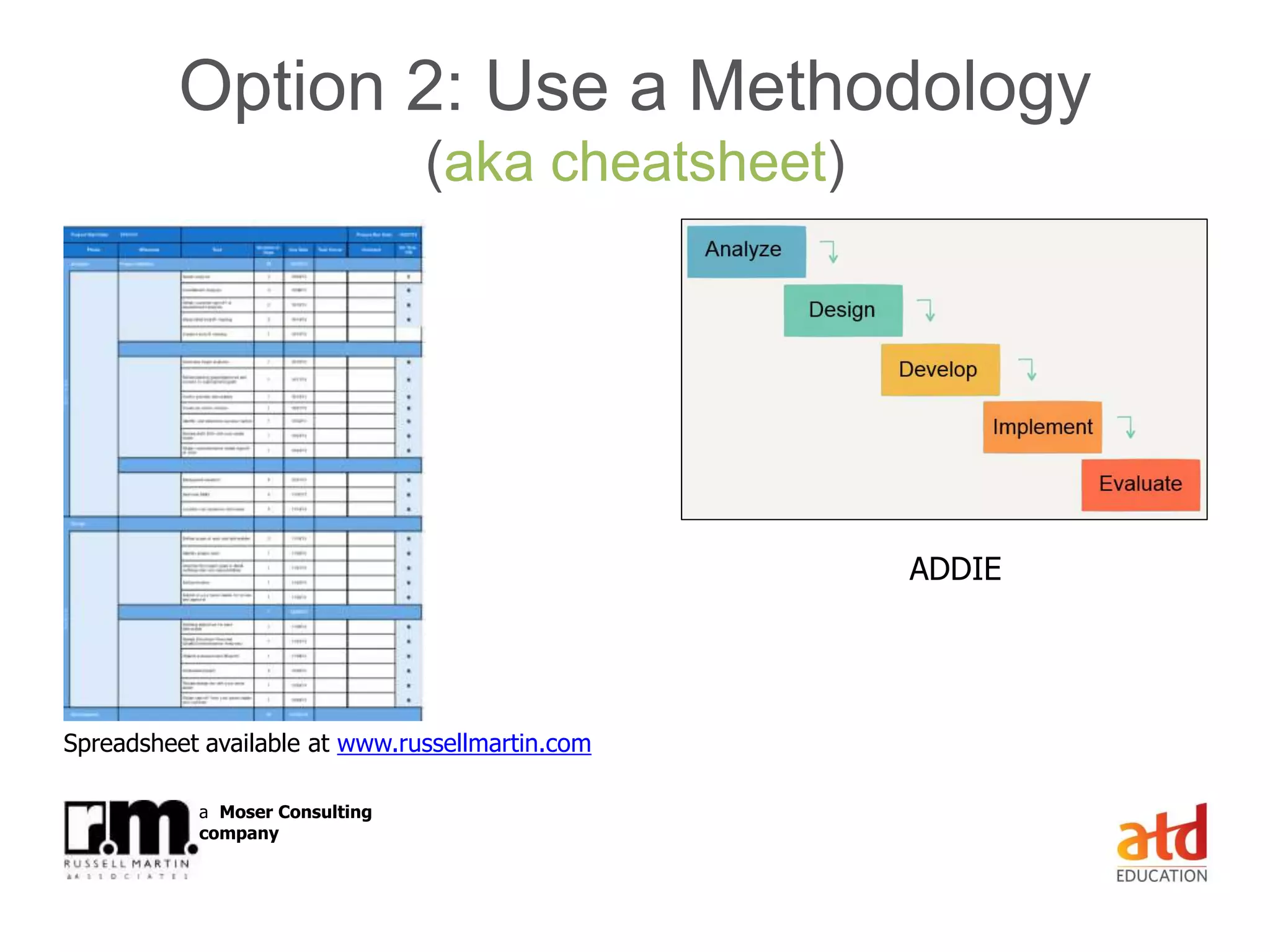
Option 2: Use a Methodology
(aka cheatsheet)
ADDIE
Spreadsheet available at www.russellmartin.com
© Russell Martin & Associates www.russellmartin.comPage 19
a Moser Consulting
company
Choices
Chicken or Egg?
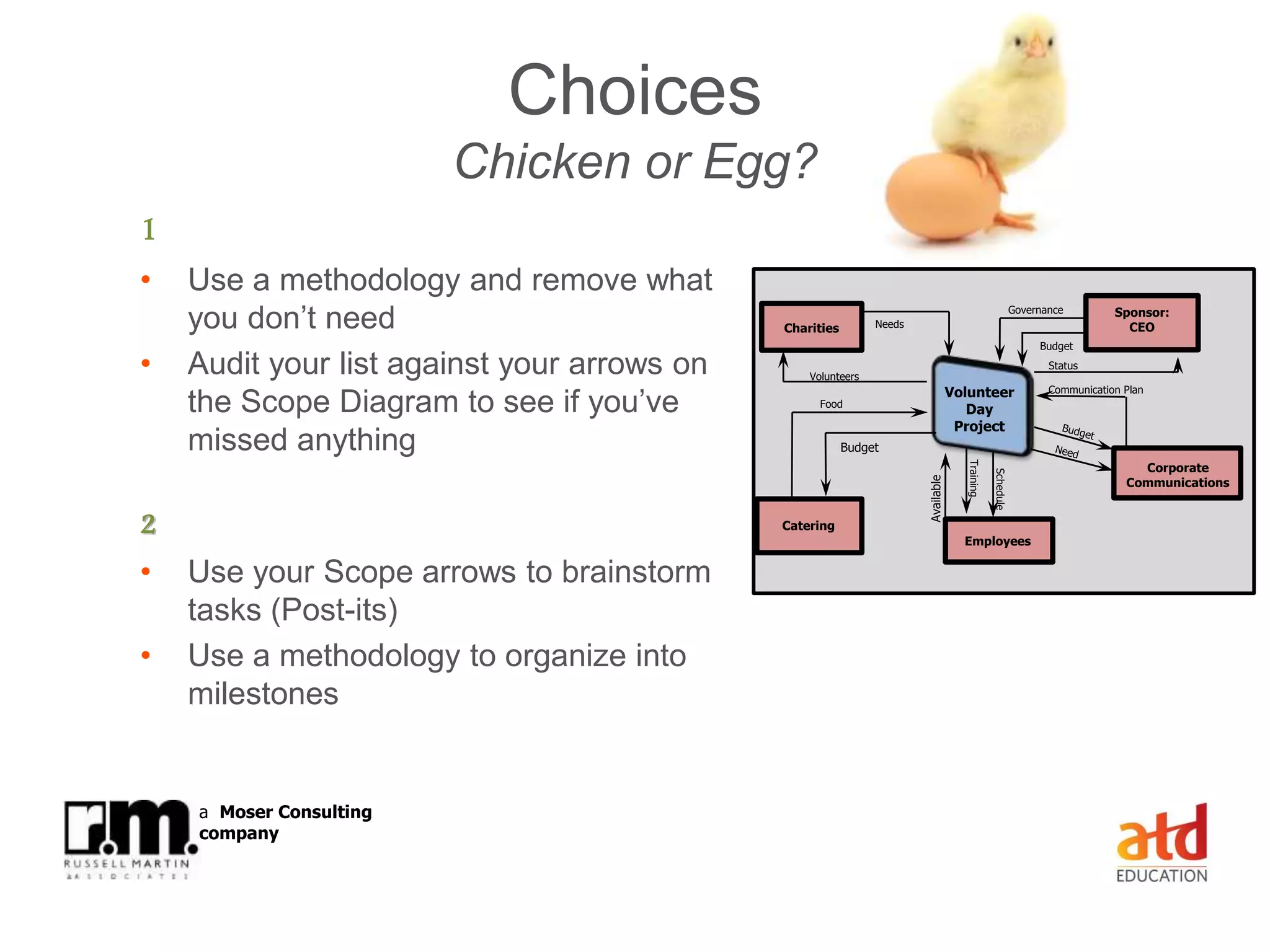
1
• Use a methodology and remove what
you don’t need
• Audit your list against your arrows on
the Scope Diagram to see if you’ve
missed anything
2
• Use your Scope arrows to brainstorm
tasks (Post-its)
• Use a methodology to organize into
milestones
Charities
Sponsor:
CEO
Volunteer
Day
Project
Catering
Volunteers
Food
Budget
Schedule
Budget
Available
Corporate
Communications
Employees
Communication Plan
Status
Training
Governance
Needs
© Russell Martin & Associates www.russellmartin.comPage 20
a Moser Consulting
company
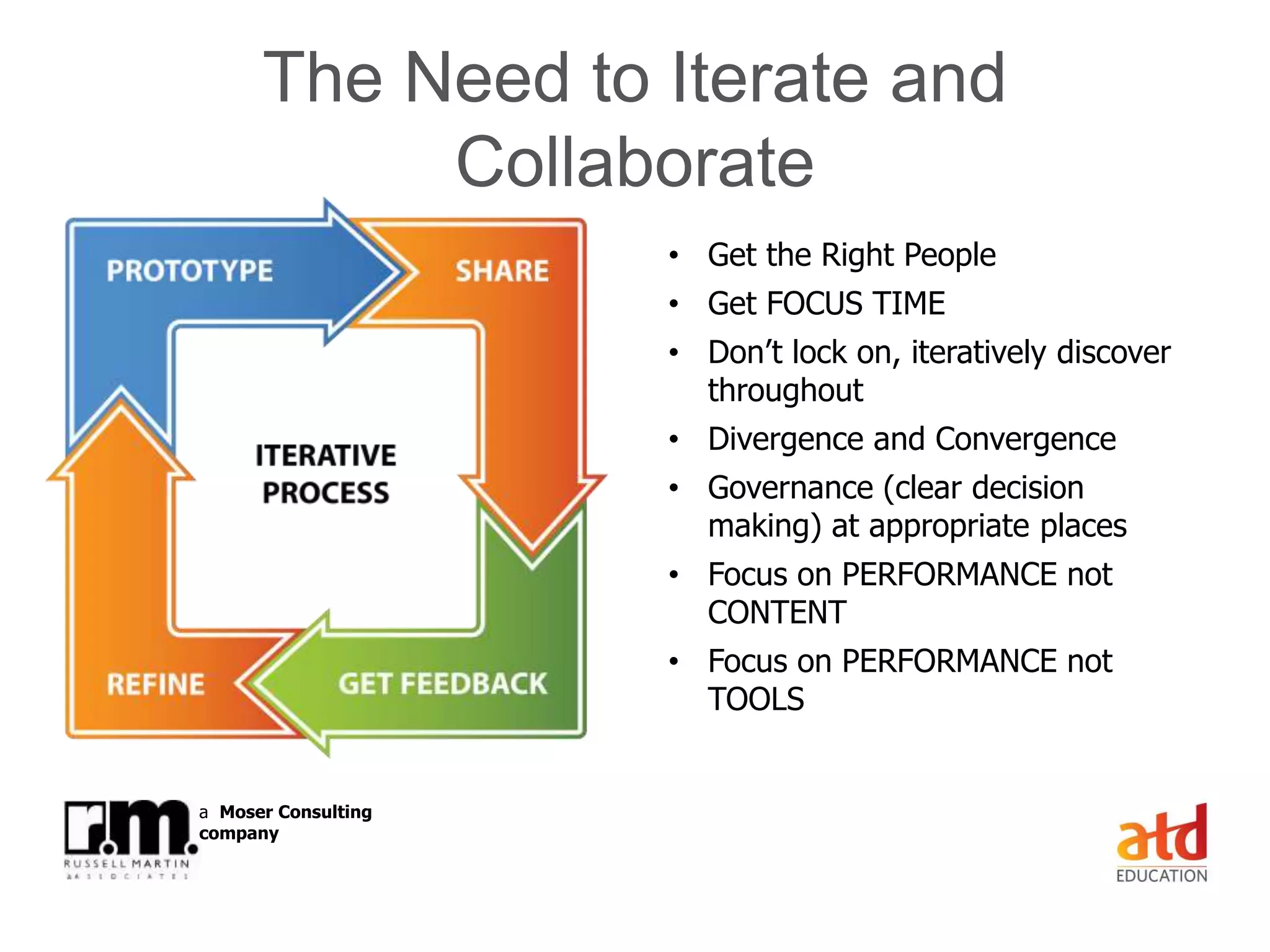
The Need to Iterate and
Collaborate
• Get the Right People
• Get FOCUS TIME
• Don’t lock on, iteratively discover
throughout
• Divergence and Convergence
• Governance (clear decision
making) at appropriate places
• Focus on PERFORMANCE not
CONTENT
• Focus on PERFORMANCE not
TOOLS
© Russell Martin & Associates www.russellmartin.comPage 21
a Moser Consulting
company
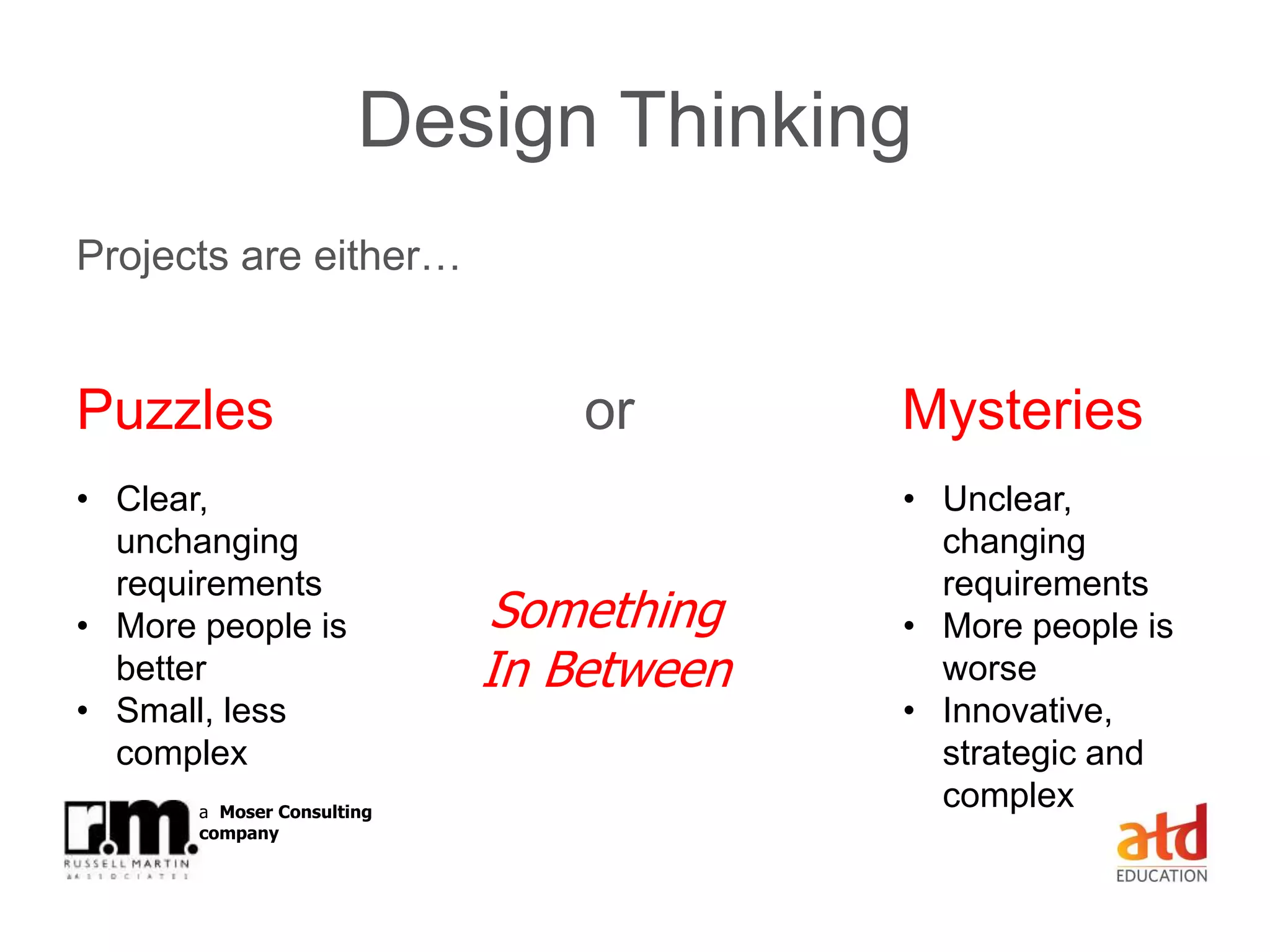
Design Thinking
Projects are either…
Puzzles or Mysteries
• Clear,
unchanging
requirements
• More people is
better
• Small, less
complex
• Unclear,
changing
requirements
• More people is
worse
• Innovative,
strategic and
complex
Something
In Between
© Russell Martin & Associates www.russellmartin.comPage 22
a Moser Consulting
company
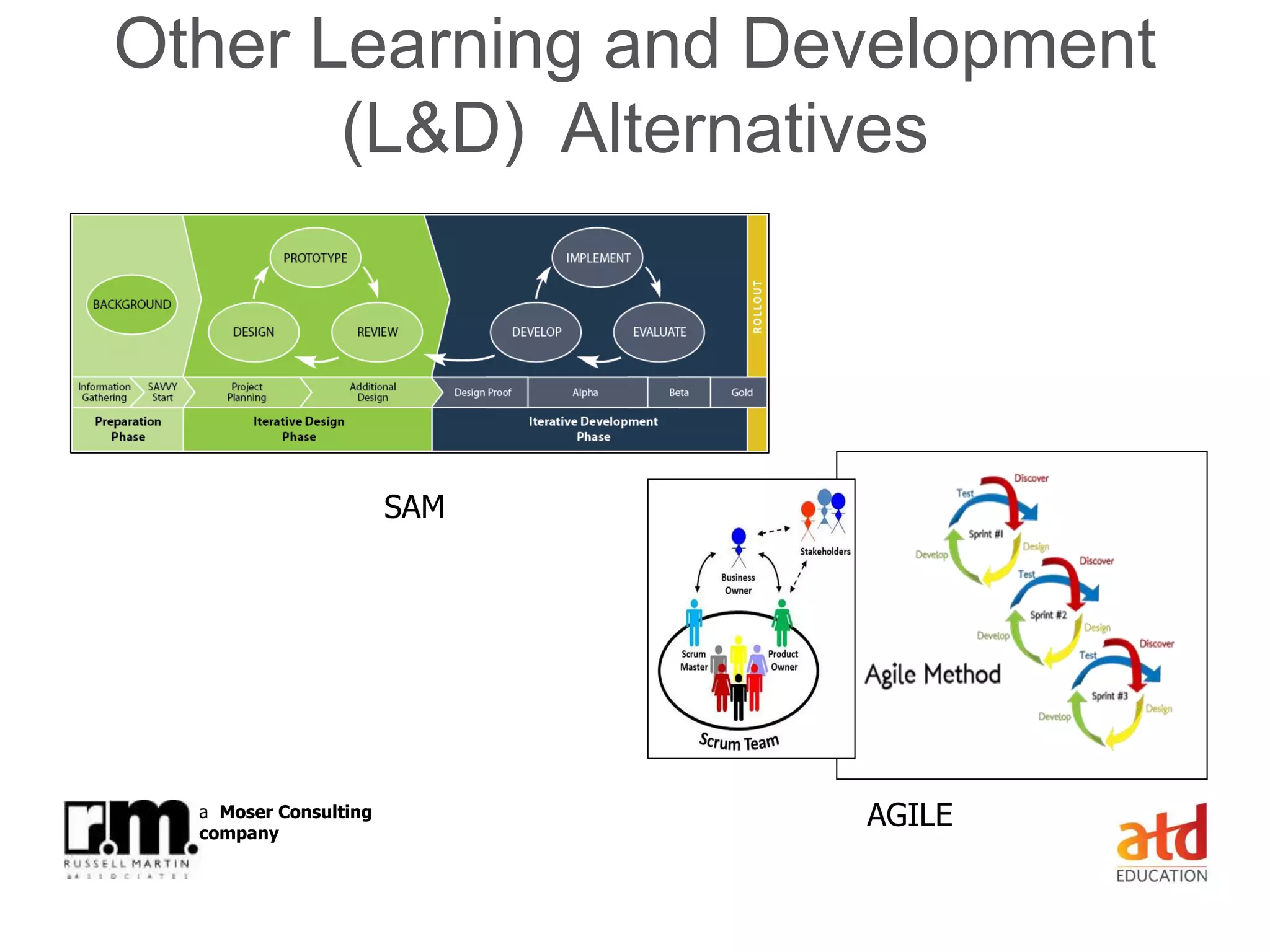
Other Learning and Development
(L&D) Alternatives
SAM
AGILE
© Russell Martin & Associates www.russellmartin.comPage 23
a Moser Consulting
company
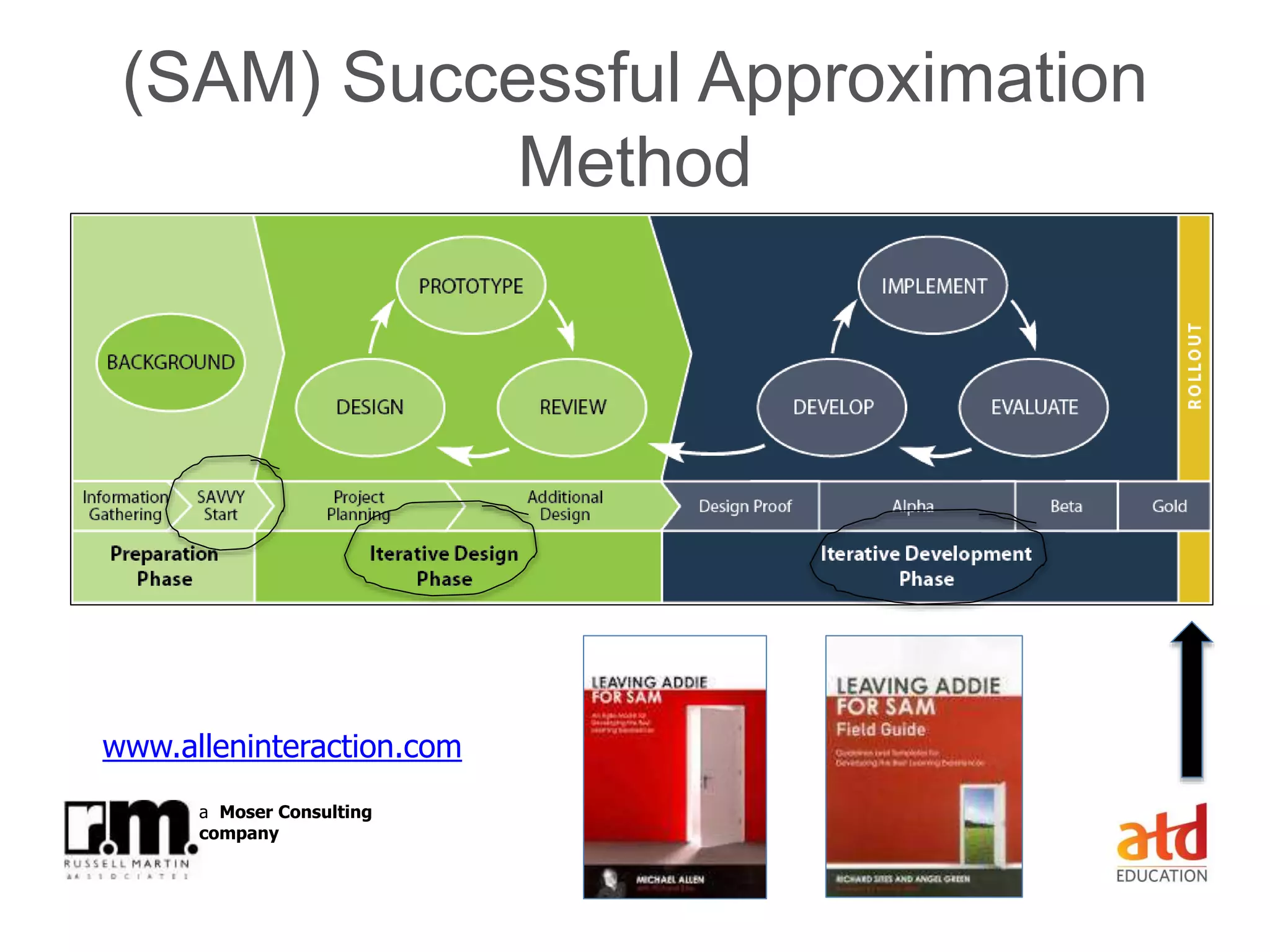
(SAM) Successful Approximation
Method
www.alleninteraction.com
© Russell Martin & Associates www.russellmartin.comPage 24
a Moser Consulting
company
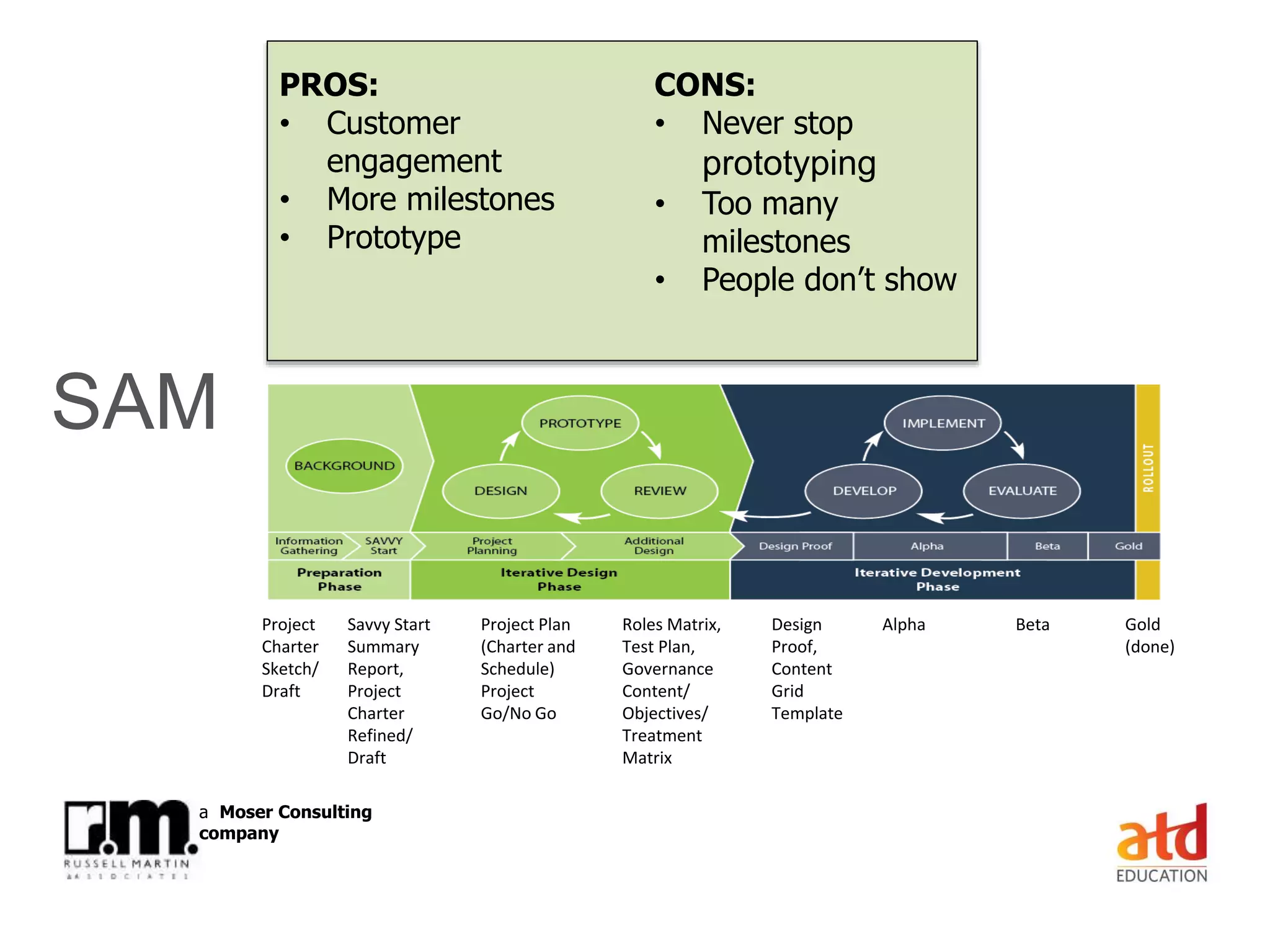
SAM
Project
Charter
Sketch/
Draft
Savvy Start
Summary
Report,
Project
Charter
Refined/
Draft
Project Plan
(Charter and
Schedule)
Project
Go/No Go
Roles Matrix,
Test Plan,
Governance
Content/
Objectives/
Treatment
Matrix
Design
Proof,
Content
Grid
Template
Alpha Beta Gold
(done)
PROS:
• Customer
engagement
• More milestones
• Prototype
CONS:
• Never stop
prototyping
• Too many
milestones
• People don’t show
© Russell Martin & Associates www.russellmartin.comPage 25
a Moser Consulting
company
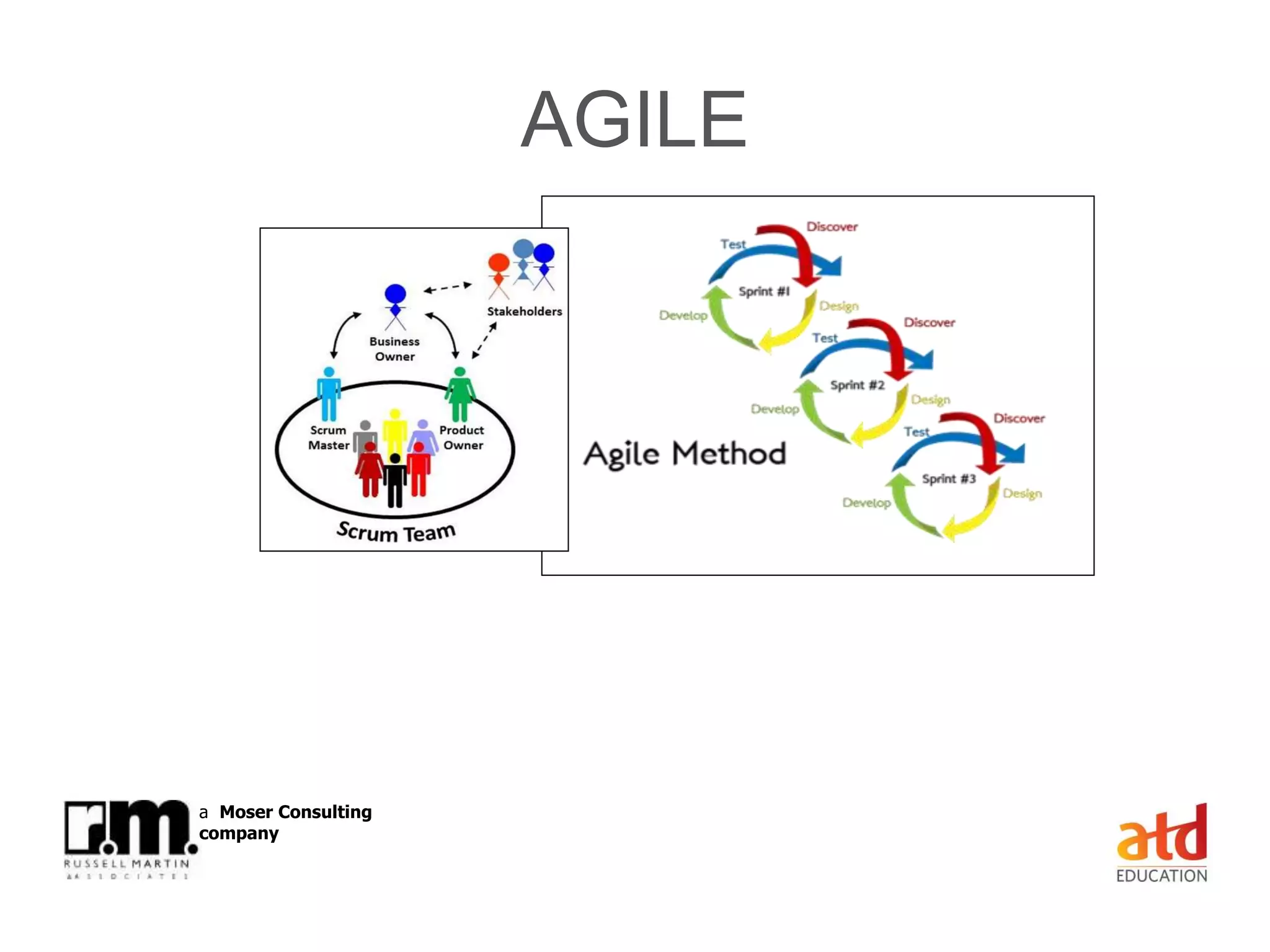
AGILE
© Russell Martin & Associates www.russellmartin.comPage 26
a Moser Consulting
company
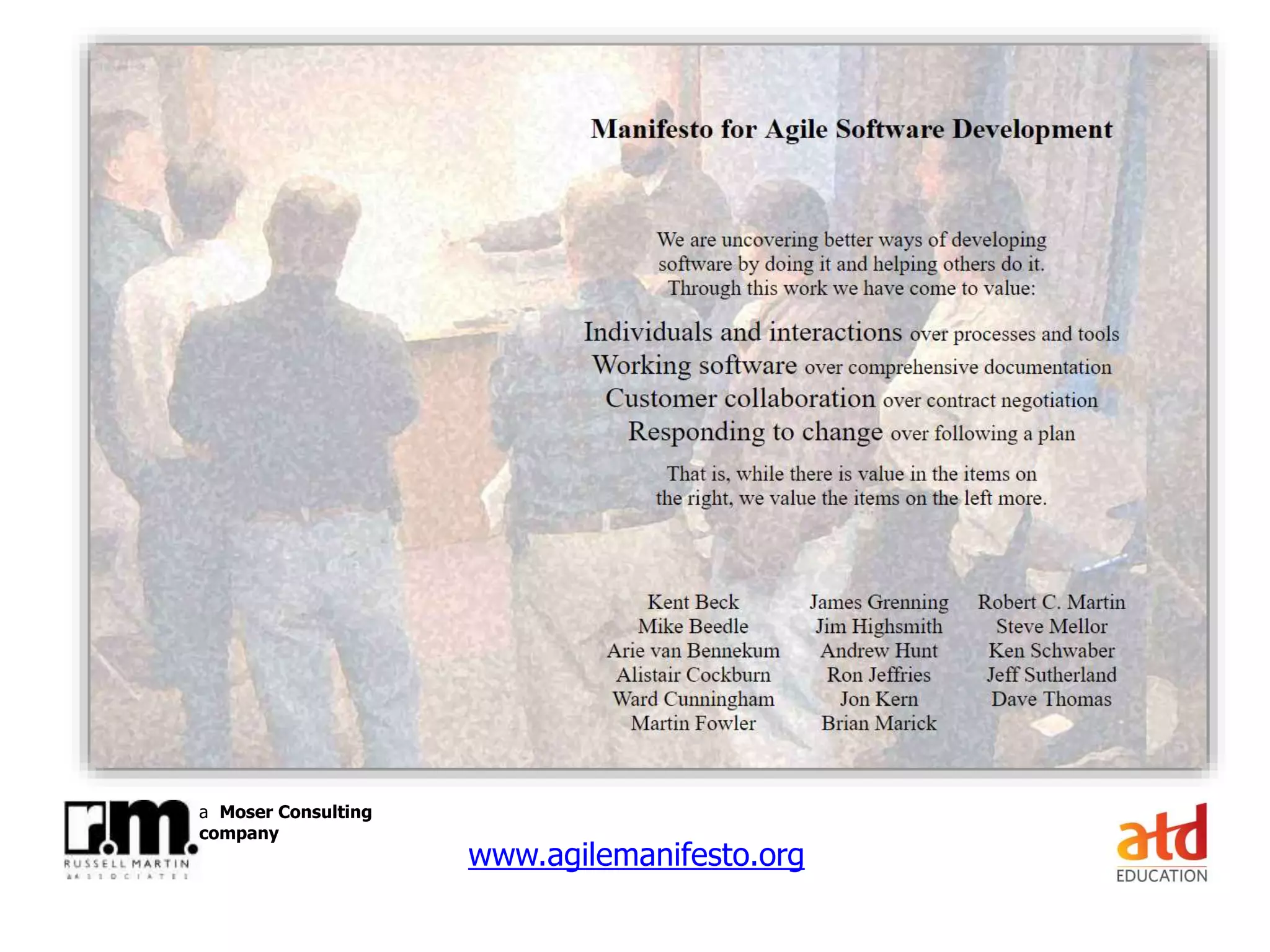
www.agilemanifesto.org
© Russell Martin & Associates www.russellmartin.comPage 27
a Moser Consulting
company
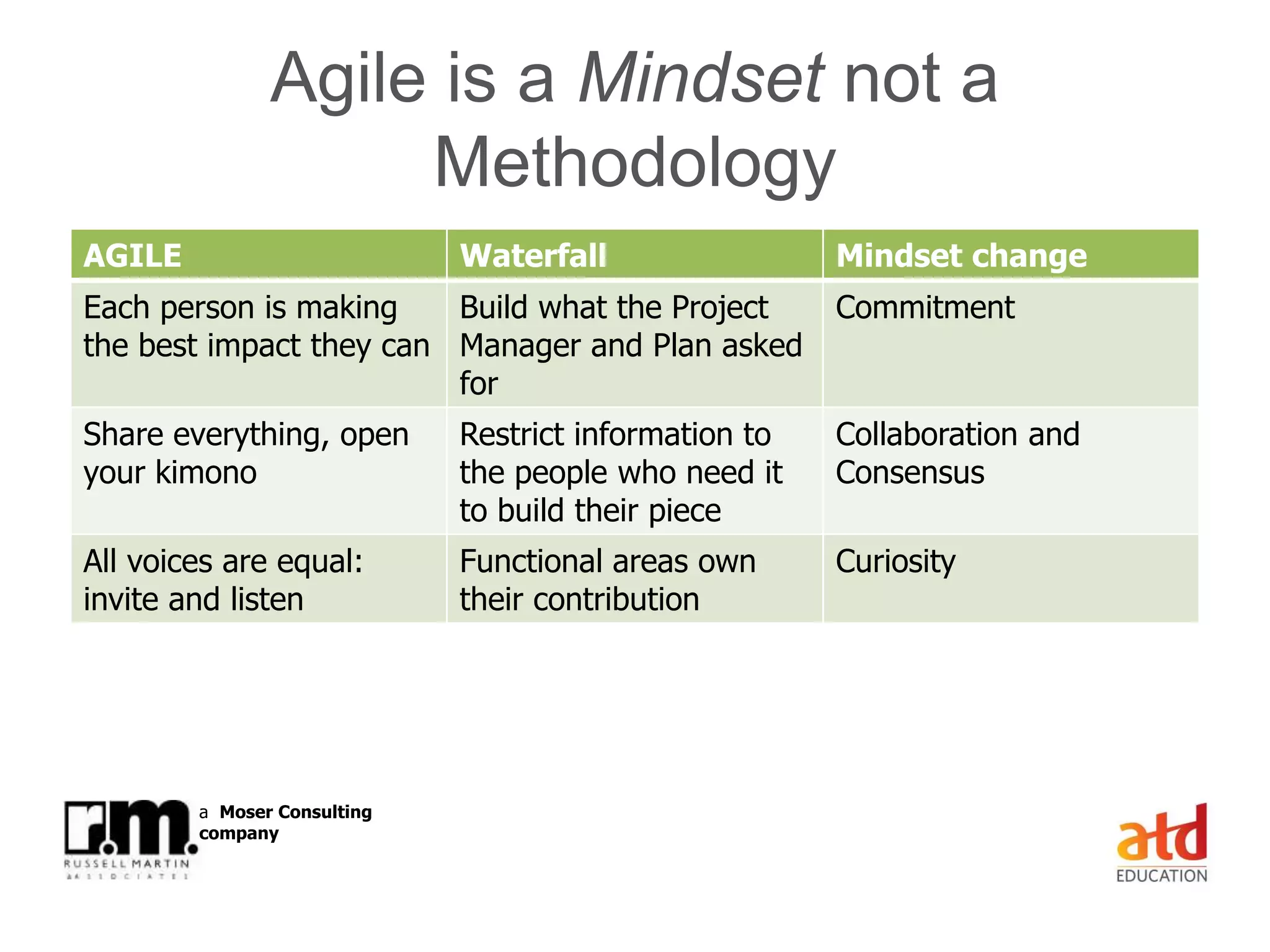
Agile is a Mindset not a
Methodology
AGILE Waterfall Mindset change
Each person is making
the best impact they can
Build what the Project
Manager and Plan asked
for
Commitment
Share everything, open
your kimono
Restrict information to
the people who need it
to build their piece
Collaboration and
Consensus
All voices are equal:
invite and listen
Functional areas own
their contribution
Curiosity
© Russell Martin & Associates www.russellmartin.comPage 28
a Moser Consulting
company
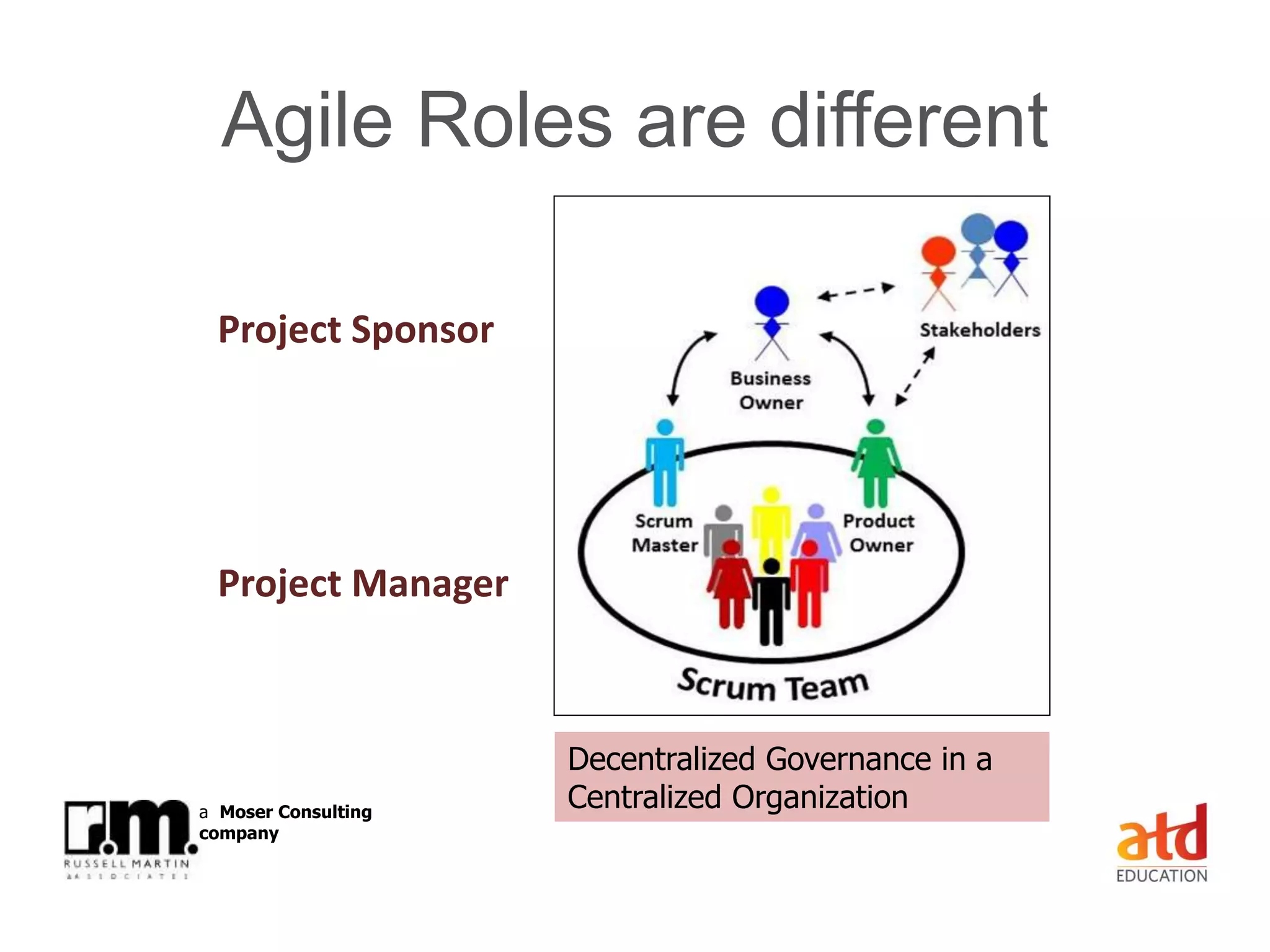
Agile Roles are different
Project Sponsor
Project Manager
Decentralized Governance in a
Centralized Organization
© Russell Martin & Associates www.russellmartin.comPage 29
a Moser Consulting
company
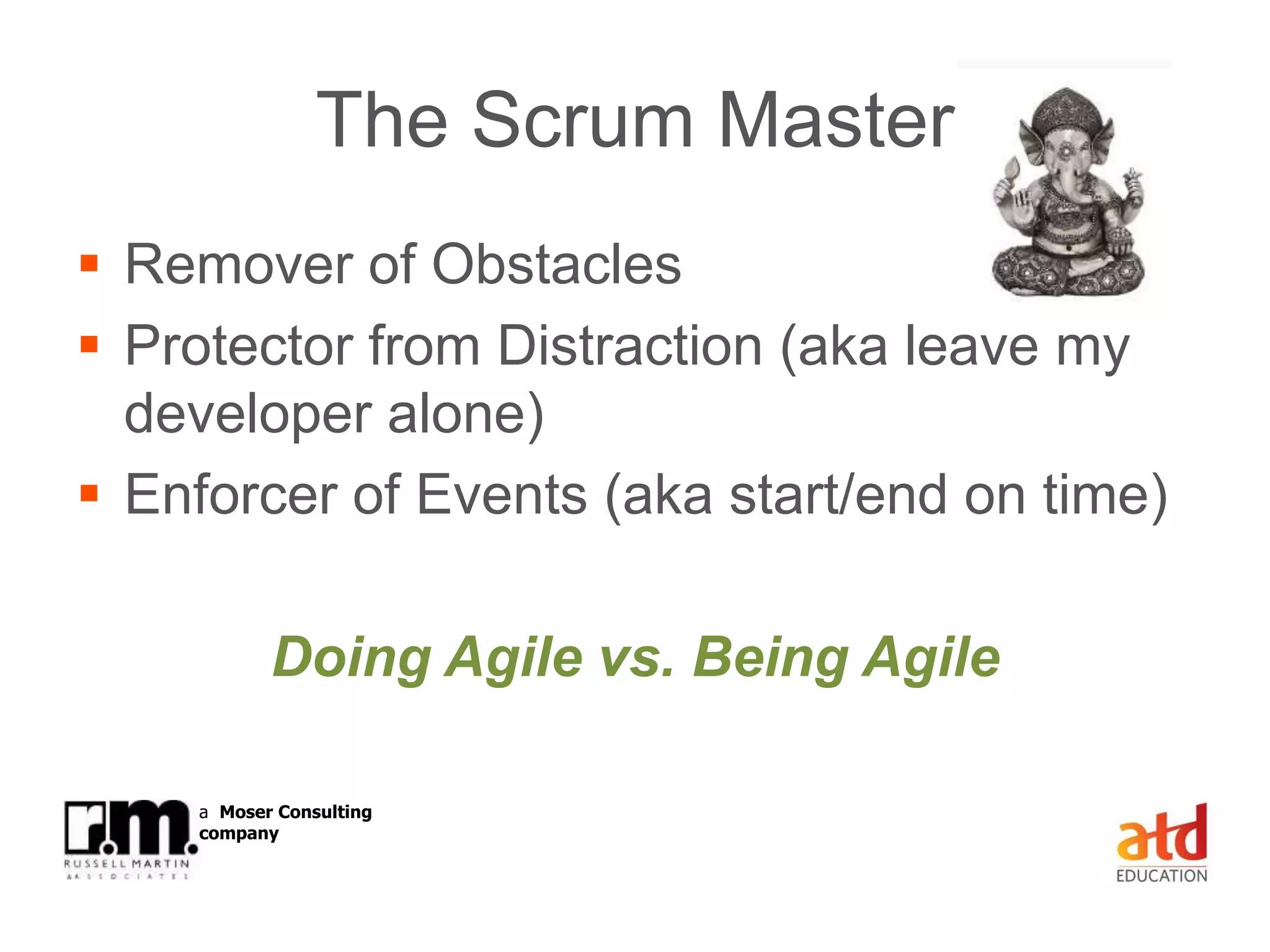
The Scrum Master
 Remover of Obstacles
 Protector from Distraction (aka leave my
developer alone)
 Enforcer of Events (aka start/end on time)
Doing Agile vs. Being Agile
© Russell Martin & Associates www.russellmartin.comPage 30
a Moser Consulting
company
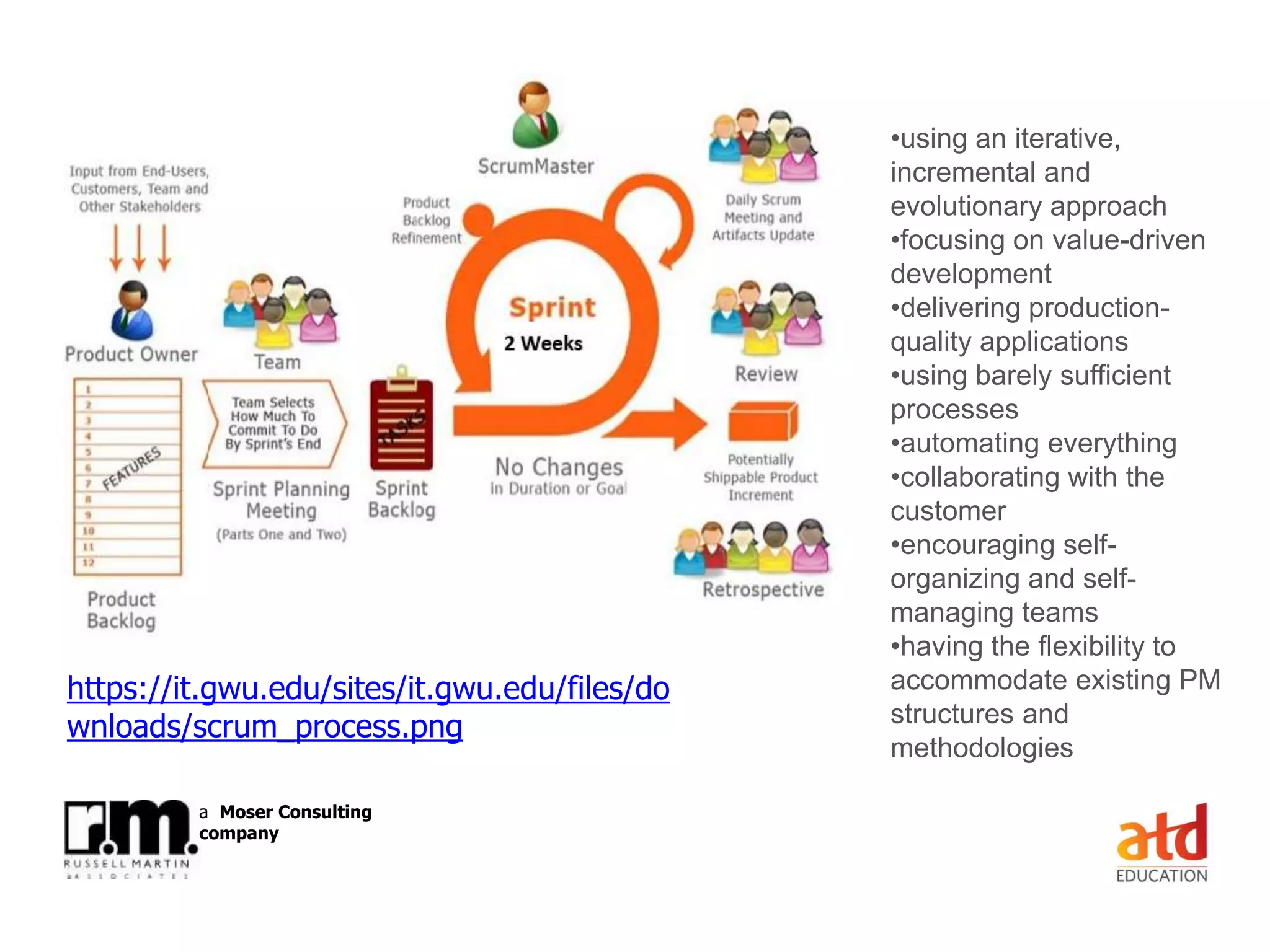
https://it.gwu.edu/sites/it.gwu.edu/files/do
wnloads/scrum_process.png
•using an iterative,
incremental and
evolutionary approach
•focusing on value-driven
development
•delivering production-
quality applications
•using barely sufficient
processes
•automating everything
•collaborating with the
customer
•encouraging self-
organizing and self-
managing teams
•having the flexibility to
accommodate existing PM
structures and
methodologies
© Russell Martin & Associates www.russellmartin.comPage 31
a Moser Consulting
company
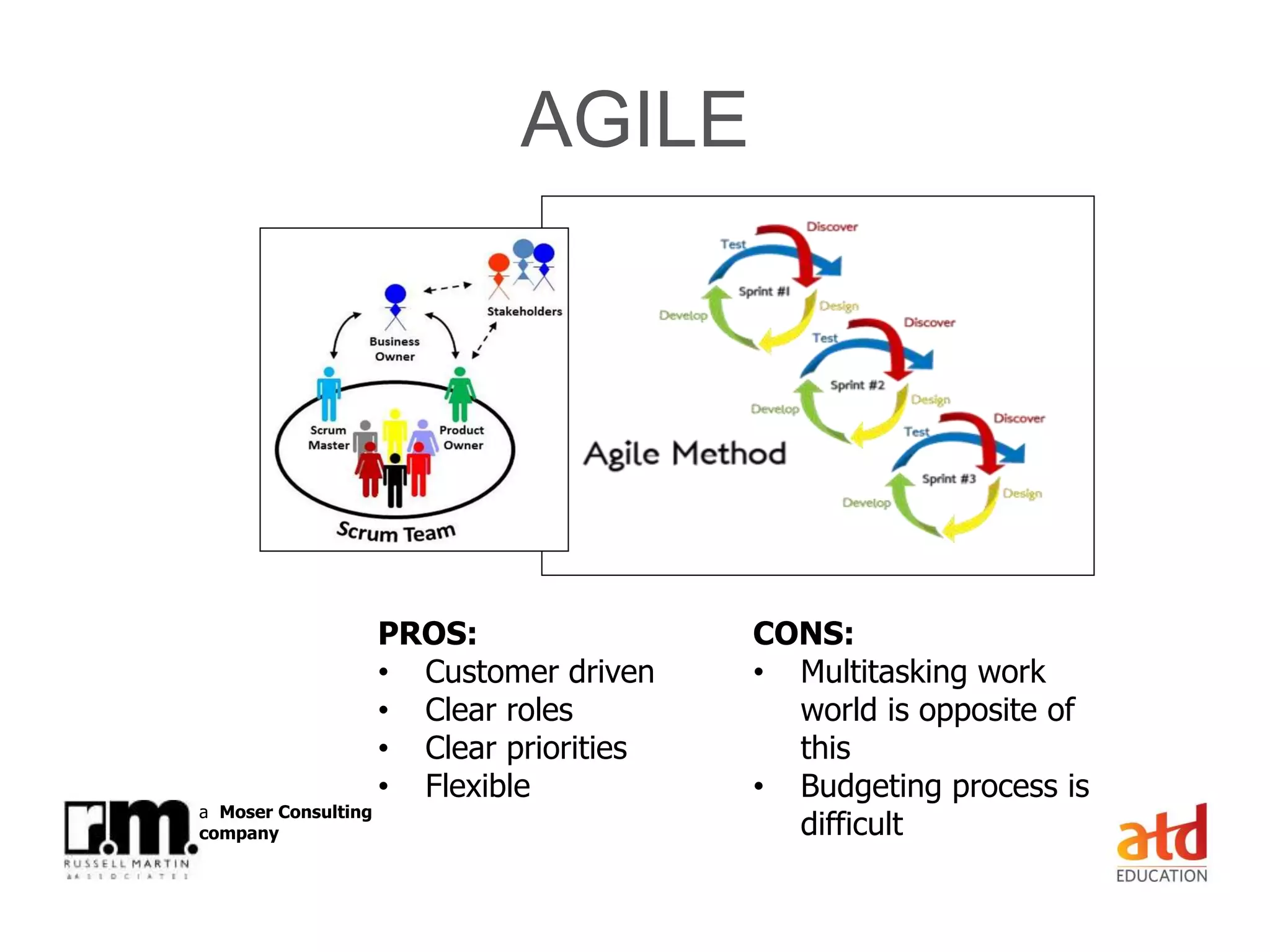
AGILE
PROS:
• Customer driven
• Clear roles
• Clear priorities
• Flexible
CONS:
• Multitasking work
world is opposite of
this
• Budgeting process is
difficult
© Russell Martin & Associates www.russellmartin.comPage 32
a Moser Consulting
company
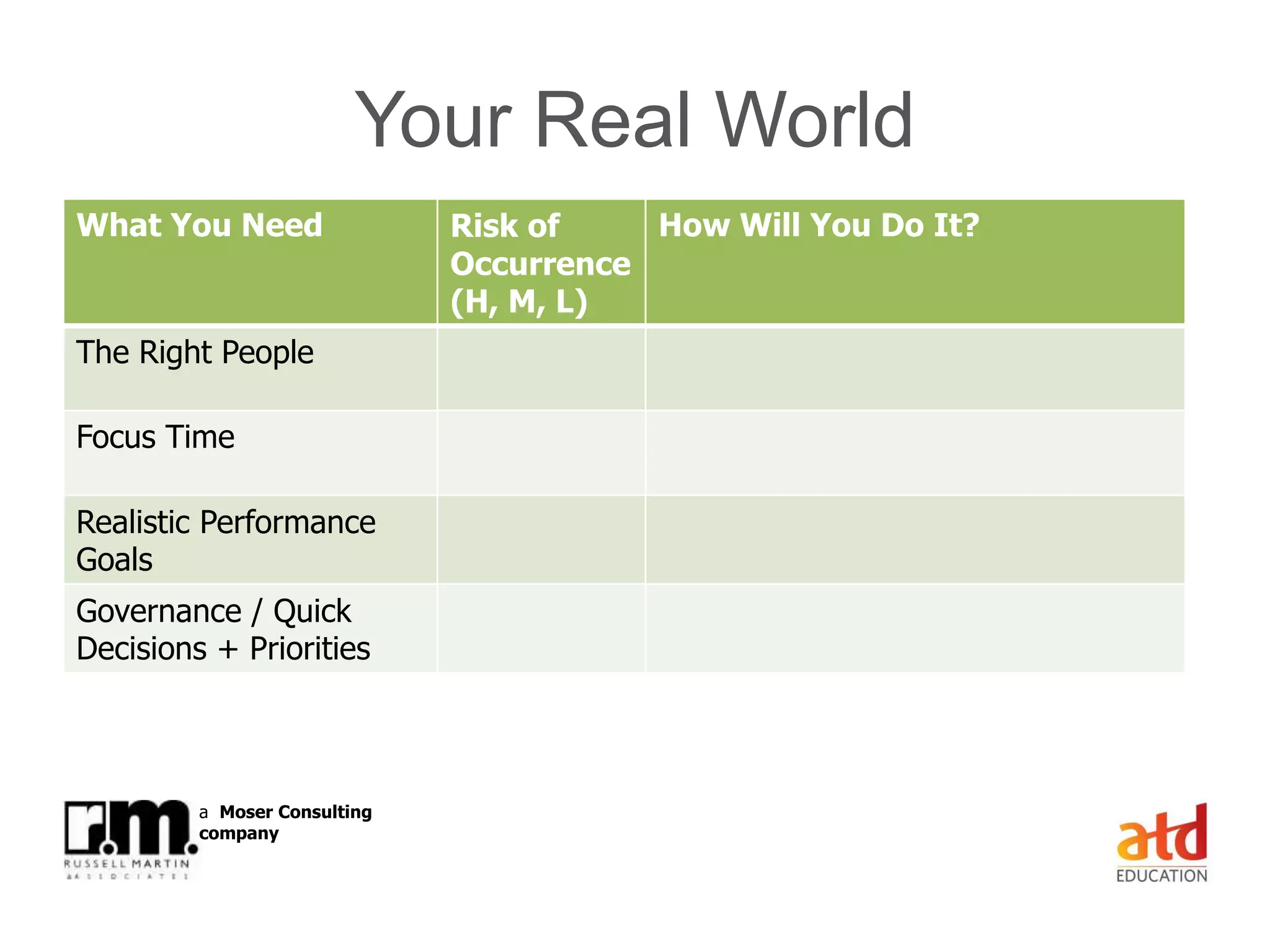
Your Real World
What You Need Risk of
Occurrence
(H, M, L)
How Will You Do It?
The Right People
Focus Time
Realistic Performance
Goals
Governance / Quick
Decisions + Priorities
© Russell Martin & Associates www.russellmartin.comPage 33
a Moser Consulting
company
Where to Get More Help
At www.russellmartin.com:
•Purchase books
•Get our LEARNING FLASH e-zine for
more tips and tools
•Find out about workshops, webinars, e-learning
and virtual alumni communities
•info@russellmartin.com
@nolecture Lou Russell

ATD Core 4 fall 2017 Methodology Madness

  • 1.
    © Russell Martin& Associates www.russellmartin.comPage 1 a Moser Consulting company Methodology MADNESS: ADDIE, SAM, Agile, and More presented by Russell Martin & Associates (317) 596-8022 info@russellmartin.com www.russellmartin.com
  • 2.
    © Russell Martin& Associates www.russellmartin.comPage 2 a Moser Consulting company How Has Work Changed Ten Years Ago… • Work on 1 project at a time, sometimes alone. • No email. • Less or no multi-tasking. • Functions / roles were clear • Governance was clear – the boss was the boss • 8 – 5 work and rare overtime • • Present… • • • • • • •
  • 3.
    © Russell Martin& Associates www.russellmartin.comPage 3 a Moser Consulting company Projects are Flash Mobs
  • 4.
    © Russell Martin& Associates www.russellmartin.comPage 4 a Moser Consulting company How frustrated ARE YOU???
  • 5.
    © Russell Martin& Associates www.russellmartin.comPage 5 a Moser Consulting company Content • What is a methodology and why do I need one? • Customer Need determines the Methodology • Managing the Project
  • 6.
    © Russell Martin& Associates www.russellmartin.comPage 6 a Moser Consulting company Methodologies are… Cheat Sheets  An alternative to figuring out the tasks to do yourself  A standard generic approach PROS CONS Template / Quick Start Too many tasks to choose from Worked for Others May not be appropriate for your specific project Philosophical / Cultural Change Changing culture hurts
  • 7.
    © Russell Martin& Associates www.russellmartin.comPage 7 a Moser Consulting company What is the Return on Investment? Performance Gap: Why Intervene? • Increase Revenue • Avoid Cost How do we build it? = Performance Change Start With a Need
  • 8.
    © Russell Martin& Associates www.russellmartin.comPage 8 a Moser Consulting company ADDIE PROS: • Easy to understand • Good for frozen requirements, basic knowledge training CONS: • There’s no good way to ‘go back’
  • 9.
    © Russell Martin& Associates www.russellmartin.comPage 9 a Moser Consulting company The Simple Project Management Process Dare to Properly Manage Resources! Define Plan Manage Review 1.Set Business Objectives 2.Establish Project Scope 3.Set Project Objectives 4.Mitigate Risks 5.Establish Constraints 6.Plan Communications 7.Establish Governance Plan 1.Determine Milestones 2.Schedule Task Dependencies 3.Adjust for Resource Dependencies 4.Create Budget START 1.Control work in progress 2.Provide status and feedback 3.Leverage Governance 4.Resolve conflict 1.Close the project 2.Turn over deliverables 3.Hold Project Review 4.Celebrate accomplishments initiate plan monitor close END A Project Charter template is included in these slides or you can download at www.russellmartin.com
  • 10.
    © Russell Martin& Associates www.russellmartin.comPage 10 a Moser Consulting company The Stakeholders the project The Sponsor Experts (SMEs) Finance Customers Functional Leaders The Project Manager The Dedicated Project Team
  • 11.
    © Russell Martin& Associates www.russellmartin.comPage 11 a Moser Consulting company Role: Project Manager Project Team Members Perform project activities and produce project deliverables Project Manager Plans, Organizes and Manages the Project Stakeholders
  • 12.
    © Russell Martin& Associates www.russellmartin.comPage 12 a Moser Consulting company Role: Project Sponsor Project Sponsor  Represents the best interest of the organization that is funding the project.  Provides resources  Makes critical business choices (governance) http://sloanreview.mit.edu/article/how-executive-sponsors-influence-project-success/
  • 13.
    © Russell Martin& Associates www.russellmartin.comPage 13 a Moser Consulting company One of the most common reasons why projects fall short is a lack of executive sponsorship and management buy-in, according to the KPMG New Zealand Project Management Survey 2010. In addition, PMIs 2010 Government Program Management Study found that 81 percent of program managers at U.S. government agencies said that strong support from at least one executive-level sponsor had a high impact on project success. - Project Management Institute (PMI) http://www.pmi.org/-/media/pmi/documents/public/pdf/business- solutions/executive-engagement.pdf
  • 14.
    © Russell Martin& Associates www.russellmartin.comPage 14 a Moser Consulting company Start Well: WHY? Project Charter DEFINE 1. Set business objectives 2. Establish project scope 3. Set project objectives 4. Mitigate risks 5. Establish constraints 6. Plan communications 7. Establish governance plan Scope Diagram
  • 15.
    © Russell Martin& Associates www.russellmartin.comPage 15 a Moser Consulting company Building the Project Schedule Milestone: A date to measure whether the project is on track (not just at the END) The Milestones of ADDIE are: • ANALYSIS • DESIGN • DEVELOPMENT • IMPLEMENT • EVALUATE Milestones indicate a group of tasks are completed (or could be set to begin).
  • 16.
    © Russell Martin& Associates www.russellmartin.comPage 16 a Moser Consulting company Project Charter Performance Gap: Why Intervene? • Increase Revenue • Avoid Cost WHY are we spending money on this? Project Schedule 1 Task 1 Owner 1 Due Date Analyze the Need Design the Solution Build the Solution Launch the Solution Measure the Results = Performance Change Plan Well: Project Schedule/Plan aka Methodology
  • 17.
    © Russell Martin& Associates www.russellmartin.comPage 17 a Moser Consulting company Option 1: Guess what the tasks are Brainstorm the tasks PROS: • You don’t need to ask anyone else • Shortcut if your projects are really similar CONS: • You’ll miss tasks • You’ll figure out big problems at the end Alternative: use the same basic tasks you used before
  • 18.
    © Russell Martin& Associates www.russellmartin.comPage 18 a Moser Consulting company Option 2: Use a Methodology (aka cheatsheet) ADDIE Spreadsheet available at www.russellmartin.com
  • 19.
    © Russell Martin& Associates www.russellmartin.comPage 19 a Moser Consulting company Choices Chicken or Egg? 1 • Use a methodology and remove what you don’t need • Audit your list against your arrows on the Scope Diagram to see if you’ve missed anything 2 • Use your Scope arrows to brainstorm tasks (Post-its) • Use a methodology to organize into milestones Charities Sponsor: CEO Volunteer Day Project Catering Volunteers Food Budget Schedule Budget Available Corporate Communications Employees Communication Plan Status Training Governance Needs
  • 20.
    © Russell Martin& Associates www.russellmartin.comPage 20 a Moser Consulting company The Need to Iterate and Collaborate • Get the Right People • Get FOCUS TIME • Don’t lock on, iteratively discover throughout • Divergence and Convergence • Governance (clear decision making) at appropriate places • Focus on PERFORMANCE not CONTENT • Focus on PERFORMANCE not TOOLS
  • 21.
    © Russell Martin& Associates www.russellmartin.comPage 21 a Moser Consulting company Design Thinking Projects are either… Puzzles or Mysteries • Clear, unchanging requirements • More people is better • Small, less complex • Unclear, changing requirements • More people is worse • Innovative, strategic and complex Something In Between
  • 22.
    © Russell Martin& Associates www.russellmartin.comPage 22 a Moser Consulting company Other Learning and Development (L&D) Alternatives SAM AGILE
  • 23.
    © Russell Martin& Associates www.russellmartin.comPage 23 a Moser Consulting company (SAM) Successful Approximation Method www.alleninteraction.com
  • 24.
    © Russell Martin& Associates www.russellmartin.comPage 24 a Moser Consulting company SAM Project Charter Sketch/ Draft Savvy Start Summary Report, Project Charter Refined/ Draft Project Plan (Charter and Schedule) Project Go/No Go Roles Matrix, Test Plan, Governance Content/ Objectives/ Treatment Matrix Design Proof, Content Grid Template Alpha Beta Gold (done) PROS: • Customer engagement • More milestones • Prototype CONS: • Never stop prototyping • Too many milestones • People don’t show
  • 25.
    © Russell Martin& Associates www.russellmartin.comPage 25 a Moser Consulting company AGILE
  • 26.
    © Russell Martin& Associates www.russellmartin.comPage 26 a Moser Consulting company www.agilemanifesto.org
  • 27.
    © Russell Martin& Associates www.russellmartin.comPage 27 a Moser Consulting company Agile is a Mindset not a Methodology AGILE Waterfall Mindset change Each person is making the best impact they can Build what the Project Manager and Plan asked for Commitment Share everything, open your kimono Restrict information to the people who need it to build their piece Collaboration and Consensus All voices are equal: invite and listen Functional areas own their contribution Curiosity
  • 28.
    © Russell Martin& Associates www.russellmartin.comPage 28 a Moser Consulting company Agile Roles are different Project Sponsor Project Manager Decentralized Governance in a Centralized Organization
  • 29.
    © Russell Martin& Associates www.russellmartin.comPage 29 a Moser Consulting company The Scrum Master  Remover of Obstacles  Protector from Distraction (aka leave my developer alone)  Enforcer of Events (aka start/end on time) Doing Agile vs. Being Agile
  • 30.
    © Russell Martin& Associates www.russellmartin.comPage 30 a Moser Consulting company https://it.gwu.edu/sites/it.gwu.edu/files/do wnloads/scrum_process.png •using an iterative, incremental and evolutionary approach •focusing on value-driven development •delivering production- quality applications •using barely sufficient processes •automating everything •collaborating with the customer •encouraging self- organizing and self- managing teams •having the flexibility to accommodate existing PM structures and methodologies
  • 31.
    © Russell Martin& Associates www.russellmartin.comPage 31 a Moser Consulting company AGILE PROS: • Customer driven • Clear roles • Clear priorities • Flexible CONS: • Multitasking work world is opposite of this • Budgeting process is difficult
  • 32.
    © Russell Martin& Associates www.russellmartin.comPage 32 a Moser Consulting company Your Real World What You Need Risk of Occurrence (H, M, L) How Will You Do It? The Right People Focus Time Realistic Performance Goals Governance / Quick Decisions + Priorities
  • 33.
    © Russell Martin& Associates www.russellmartin.comPage 33 a Moser Consulting company Where to Get More Help At www.russellmartin.com: •Purchase books •Get our LEARNING FLASH e-zine for more tips and tools •Find out about workshops, webinars, e-learning and virtual alumni communities •info@russellmartin.com @nolecture Lou Russell

Editor's Notes

  • #2 Overall flow: Work has changed – need different approaches to building solutions Tee up the relationship between projects and methodologies (= what tasks to do) Methodologies all begin with basic problem solving: Analysis, Design, Develop/Build, Implement, Review Project Roles, Project Charter -> Why, Scope Diagram helps us figure out how to build the schedule with the help of methodologies Options for figuring out the Project Schedule / tasks: Wing It, Methodology, Scope Diagram, Reuse Compare methodologies: when / why What does it look like for your current project / your org: Risks? Constraints? 11:00 – produce may take 5 – 10 minutes to go through introductory slides As people are coming in ask them (and demonstrate yourself) to put an Emotion 1-10 (10 – a lot) they are feeling right now. Example: EXCITED 7 or ANXIOUS 3
  • #3 1. Read the left hand side, ask for people to contribute other ideas for ‘old work’ 2. Ask someone to type in the right side, or do it yourself. Get contributions from learners – suggested things to point out: Working on multiple projects, can’t do alone – requires a group of stakeholders, multi-tasking a lot, email suffocates, everyone is playing multiple roles, may have multiple leaders = multiple priorities, remote work / working at home / long hours,
  • #4 When we review the comparison we just made, it seems like work today looks more like a flashmob – a group of people come together for small amounts of times (maybe an hour), discuss the problems with the project, disperse to a different group meeting on a different. project. In flashmobs, most of the ‘requirements’ come from social media / email; people really don’t know they others they are working with. What are some things that you think would improve the output of your projects thinking about them as flashmobs? Suggested answers: If we are communicating NOT face to face, our needs have to be simple, shared and measurable. If we’re working on multiple projects, we need to be able to review quickly (like practicing for a flashmob) whenever we get back to a project. We’ll do a better job if we work on things for more than an hour – we really need to focus ONLY on that project and make some progress.
  • #5 Randomly pick two people to speak and send them a private message (if webinar) or tell them privately what they will speak about: The topic is “Why projects struggle and often fail where you work”. Tell them they will be speaking at the same time. They can respond to each other if they want, but they can’t pause from speaking (don’t tell the classmates this). BEGIN: 1 minute – both speakers are speaking, others are taking notes. STOP: Ask students to share what they’ve learned (flipchart or whiteboard for webinar). DEBRIEF: Speakers – how did you feel? How productive was the conversation? How is this like the project meetings you attend? Participants – how did you feel? How productive was the conversation? How is this like the project meetings you attend? All – what could be done to improve this type of meeting? EMPHASIZE: Most of the difficulties in PROJECTS are around people and communication. Methodologies are a way to be more organized so people communicate effectively. But like everything else, someimtes methodologies are used to hide from others, ignore others, grab power, etc. Methodologies should be about getting the project done, and the performance change in place.
  • #6  Go over the Contents – The point of PM is to COMMUNICATE. Everything we do on a project should improve COMMUNICATION and COLLABORATION. People can work out change and chaos if they trust each other. If anyone turns into a control freak, it pushes other people to hide and resist. Similar to this picture, different stakeholders on a project can be completely positive that their view of the project outcomes is right. Like this picture, they may each be looking that the project differently. Only collaboration can build the trust that allows them to explain their perspective and come to agreement.
  • #8 Traditionally, the Project Charter determines WHY the business is doing this project by laying out who is involved, what their role is, risks and constraints, communication and governance (decision making). All projects should start with this to understand the Big Picture. To build the Project Schedule (determine how to layout the tasks to do the project), requires defining the tasks that need to be done, putting them in the best order and putting the best person on that task to complete.
  • #9 Most Classic Methodology (basic problem solving model) used over the years in all industries (building, IT, Training, etc.) ADDIE is specific to building instruction, as are the next two examples Also called the Waterfall Methodology. As ‘designed’, it is very difficult to go-back or iterated in any way. In Analyze, you figure out the requirements. Maybe you get sign-off from your stakeholders, and you begin Design. You get sign-off on Design and then you start to build. Suddenly people show up at your meetings that didn’t show up early and want to change everything! Do you start all over again with ANALYSIS (you should, really…) or do you just jam the new requirement in somewhere and go on. The more requirements are discovered late, the more ‘cracks’ are in your course materials. Ask students to share other Pros / Cons Ask what kind of training would this be good for - small Compliance training using delivery methods you are very familiar with.
  • #10 Walk through the project phases typing on the screen the following: Above DEFINE type WHY? Below the governance plan type (the artifact of Define is) Project Charter – always a draft Above PLAN type HOW? Below the create budget type (the artifact of Plan is) Project Schedule – also a draft Ask everyone to point their finger at the word CONTROL under MANAGE and make an imaginary X over it. There is NO CONTROLLING a project – it is the opposite of collaboration. The facilitator can actually make an X with the drawing tool over the word control and then Above MANAGE type ADAPT Below the resolve conflict type (the artifact of Manage is) Done Project – but not transitioned Above REVIEW type LEARN Below the celebrate accomplishments type (the artifact of Review is) Improved Competence in PM Ask learners to draw a red dot on the phase(s) they almost always skip – discuss the impact of this Ask learners to draw a green dot on the phase(s) they always do – discuss the impact of this
  • #11 The next thing to figure you out (second), is what roles are going to be involved in this project. Comments on this slide: Middle is like a giant hairball – the project, there are not dedicated teams anymore, everyone is a STAKEHOLDER except you the PM (which everyone views as ‘the project’). A Stakeholder provides info to your project and/or receives something from your project. Notice the Sponsor is (the most important) a Stakeholder and the PM is not. You do want to think through what are other roles you play on the project besides the PM. Draw squares as learners discuss what are other roles they play in addition to the PM (for example, Developer, Graphic Design, LMS coordinator…) This visual picture helps you and others understand the complexity and even risk of your project. We’re going to add some lines to indicate the handoffs between the stakeholders and the project in a minute . The Lines will also provide a clue to what your tasks are and who you should be assigning the work to.
  • #12 The methodology choice comes from collaboration and clarity of purpose between the Project Sponsor and the Project Manager. (1 of each only) The PM does not OWN the project – the business owns the project, represented by the Project Sponsor (more on this in a few pages). They are accountable for project deliverables, but sometimes people get freaked out as PMs and forget that they are not their project. The ROLE (versus the person) of PM is to Plan, Organize and Control the project. The PM is in three time states at the same time- looking back to learn from past experiences, in the now to deal with whatever is happening today, and looking forward to other possible challenges. The Project Team members ‘do’ the project – write the course, code the e-learning etc. Often, a person plays the role of both PM and a Team Member. Here I recommend that people hold time on their calendars to do project management to make sure that under stress they don’t neglect ‘watching’ the project. You may be able to look at the results of the first bridge building exercise to show how the lack of an assigned project manager influenced the success of the project.
  • #13 The Project Sponsor is responsible for laying out the return on investmenet (ROI) for this project, seeing everything from a business perspective. The Project Sponsor depends on the Project Manager to get the project done – the Sponsor does not belong in the weeds and may have little to say about what tasks need to be done. The methodology strategy is likely recommended to the Project Sponsor by the Project Manager based on the needs expressed in the Project Charter.
  • #15 Here’s a small Scope Diagram for a United Way Day of Caring. Facilitator should read out loud, and/or have volunteers read a couple of them. Point out the arrow to the Sponsor that says “Status”: ask people to put in the chat window what tasks might be done to make this handoff happen and who would be assigned to that task?
  • #16 Assume we’ve completed the Project Charter and we’re now going to build the Project Schedule. To deal with the complexity, many methodologies create phases which are called milestones. It’s a way of knowing you’re project is getting late earlier vs later. You’ll see how the milestones differ in other methodologies.
  • #17 We use ‘methodologies’ (green circles example of ADDIE like approach) to figure out what tasks need to be done to build the project.
  • #18 Ask students to suggest other Pros and Cons
  • #19 These are the most discussed methodologies in L&D right now. I am also going to show you some interesting other methodologies from other industries in cluding Design Thinking and Duarte’s development process.
  • #21 Given the troubles just shared, why is iteration important? Complexity of work (easy stuff has been done) Moving targets Time is the enemy of requirements and collaboration
  • #22 Framing the discussion on why there are so many different ways to finish a project. In DESIGN THINKING, projects are defined as either being a PUZZLE or a MYSTERY. Before animating, ask the learners to define what a puzzle is (for example, more people helping gets it done quicker, if you have the cover of the box and all the pieces you’ll eventually figure it out, there’s one right answer) versus a MYSTERY (no requirements, doing something that never has been done before, more people can take you down the rabbit hole, etc.). Ask students: How would you treat a Mystery project different? What would you have to do to figure out what to build? (answer should be iterate, prototype, or pilot something small). Ask them, “Should you do these things in a puzzle?” (no) “Why not?” (there’s no one to iterate with and you already know the requirements so just build it.) Ask students what types of projects they are working on now.
  • #23 These are the most discussed methodologies in L&D right now. I am also going to show you some interesting other methodologies from other industries in cluding Design Thinking and Duarte’s development process.
  • #24 Walk through the phases, emphasizing the restrictions: SAVVY START (1 at the beginning – establishes all the features the product owners need, prioritized /weighted) Iterative DESIGN (only 3 iterations – based on research from The Mythical Man Month, Frederick Brooks: 1st design is missing stuff, 2nd has too much, 3rd is as good as it gets for the ROI of change) ITERATIVE DEVELOPMENT (alpha, beta, gold = 3, Alpha hardest to get approval – feature creep most prevalent here). NO Transition Plan or Evaluate – this is a CONSULTING model. What would the difficulties be if this were done inhouse without consultants being paid by the hour?
  • #25  SAVVY start – get everyone in the room that is a stakeholder on the project (the Scope Diagram is helpful for that). Identify the features required for this training. ITERATIVE DESIGN – three passes with the stakeholders needed in the room for each feature: ‘co-’ design, prototype, review ITERATIVE DEVELOPMENT – three builds: Alpha (most difficult, get everything done), Beta (tweak missing stuff), Gold (final approval) Issues: Keeping the customers engaged in the entire process Written for Allen Interactions on use – a consuting model (notice there is no roll-out, transition or review at the end – the customer is supposed to do that. Rapid Prototyping used – kind of a combo analysis/design at the same time Still seeing the phases of ADDIE in a way – the three cycle prototyping and builds help deal with realistic changes as things go which ADDIE was not designed for. Add to the PROs/ CONs list about with the class: Best USED when the stakeholders will be involved actively and the solution needs to be created (innovation). Good for elearning modules.
  • #26 AGILE (by original design) requires that the customer be fully present and chooses/ owns the features they want; the developers choose / own the time estimate (what it will take for them to deliver each feature). Originally created by IT Methodology experts in the 80s (Agile Manifesto) Like a SAVVY start, the customers and developers hold a meeting (SCRUM is a word used, others as well) – the customers list and prioritize the features they want and the developers create time estimates for each feature. The outcome of the SCRUM meeting is: An agreement with developers and customers about how long each Sprint will be (a timeboxed ‘build’, for example it might be 5 days) A list from the customers of the features they’d like built in the first Sprint respecting the time estimates of the developers). Multiple sprints can occur in parallel with different customer/developer groups working on different features. After the first Sprint, the group discovers that they were able to build more or less features than were chosen. This is called Velocity, and this number is used for the next Sprint (real data about real productivity between these specific people). Key success factors: the customers are ALL IN and always available, roles are clear, collaboration is critical Discuss options for Pros / Cons. Summary: Look at as a spread from ADDIE (most rigid) to AGILE (least rigid) with SAM in the middle (a bit of both, leaning more toward AGILE)
  • #29 Decentralized Governance in a Centralized Organization Activity – Figure out what these two PM terms map to… NO ONE IS an AUTHORITY – all people have the same vote but make these votes in different domains: Product Vote (product owner/team), Build Vote (developers) Project Sponsor – similar to the Business Owner, but is not in authority (just one of the voices) Project Manager – no such thing, not an authority figure INSTEAD: Product Manager – represents the needs of the user / customer; coordinates the user view with others Scrum Master – facilitates meetings, gets
  • #32 AGILE (by original design) requires that the customer be fully present and chooses/ owns the features they want; the developers choose / own the time estimate (what it will take for them to deliver each feature). Originally created by IT Methodology experts in the 80s (Agile Manifesto) Like a SAVVY start, the customers and developers hold a meeting (SCRUM is a word used, others as well) – the customers list and prioritize the features they want and the developers create time estimates for each feature. The outcome of the SCRUM meeting is: An agreement with developers and customers about how long each Sprint will be (a timeboxed ‘build’, for example it might be 5 days) A list from the customers of the features they’d like built in the first Sprint respecting the time estimates of the developers). Multiple sprints can occur in parallel with different customer/developer groups working on different features. After the first Sprint, the group discovers that they were able to build more or less features than were chosen. This is called Velocity, and this number is used for the next Sprint (real data about real productivity between these specific people). Key success factors: the customers are ALL IN and always available, roles are clear, collaboration is critical Discuss options for Pros / Cons. Summary: Look at as a spread from ADDIE (most rigid) to AGILE (least rigid) with SAM in the middle (a bit of both, leaning more toward AGILE)
  • #33 Ask students to think about which are the biggest risk factors for them to use different methodologies. What are some ideas for mitigation? Put in chat window.