Presented by ZweigWhite Project Management Part II
ZweigWhite is a Registered Provider with The American Institute of Architects Continuing Education Systems. Credit earned on completion of this program will be reported to CES Records for AIA members. Certificates of Completion for non-AIA members are available on request. This program is registered with the AIA/CES for continuing professional education. As such, it does not include content that may be deemed or construed to be an approval or endorsement by the AIA of any material of construction or any method or manner of handling, using distributing, or dealing in any material or product. Questions related to specific materials, methods, and services will be addressed at the conclusion of this presentation.
Copyright Materials This presentation is protected by US and International copyright laws. Reproduction, distribution, display and use of the presentation without written permission of the speaker is prohibited. © ZweigWhite, 2010
Seminar Overview Introduction and Logistics Headaches and Learning Objectives Facts, Figures, and Things to Consider Skills and Abilities of Today’s Project Manager What we need to do, when, why and how Project Phases Key Concepts Excellence in Project Leadership Objectives in Motion
What We Need to Do, When, Why, and How
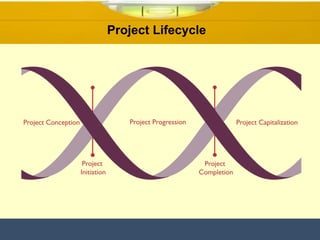
Project Lifecycle
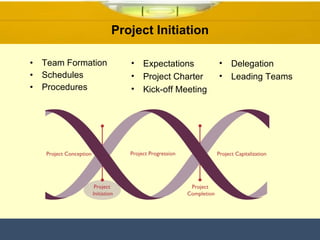
Project Initiation
Project Initiation Team Formation  Schedules Procedures  Expectations Project Charter Kick-off Meeting Delegation Leading Teams
Project Teams: Project Manager Clients, consultants, and subconsultants Project Leader Project Designer Other detailers, technical professionals Team Formation
Elements to Consider: Project goals and objectives Roles and responsibilities Education, training, and certification Years of experience and qualifications Personalities Team Formation
Sub-Consultants  They play a role in the project too: When and what Great drawings They understand our process and expectations of them Why Their role and actions impact construction – time and costs How Choosing consultants committed to superior outcomes Submittals:  “Note as corrected” vs “Rejected”; turnaround times, impact of substitutions  RFIs:  Communication channels, timeliness, great drawings
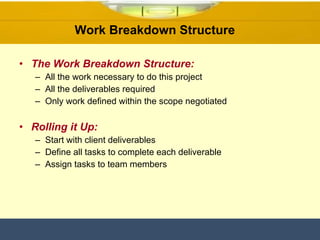
The Work Breakdown Structure: All the work necessary to do this project All the deliverables required Only work defined within the scope negotiated Rolling it Up: Start with client deliverables Define all tasks to complete each deliverable Assign tasks to team members Work Breakdown Structure
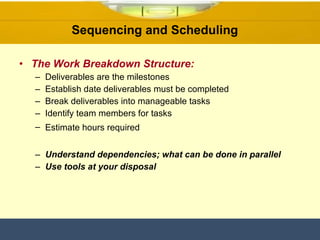
The Work Breakdown Structure: Deliverables are the milestones Establish date deliverables must be completed Break deliverables into manageable tasks Identify team members for tasks Estimate hours required   Understand dependencies; what can be done in parallel  Use tools at your disposal  Sequencing and Scheduling
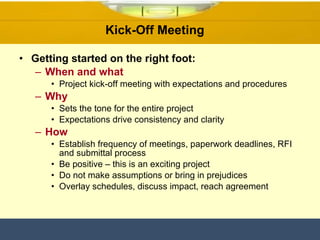
Kick-Off Meeting  Getting started on the right foot: When and what Project kick-off meeting with expectations and procedures  Why Sets the tone for the entire project Expectations drive consistency and clarity  How Establish frequency of meetings, paperwork deadlines, RFI and submittal process Be positive – this is an exciting project Do not make assumptions or bring in prejudices  Overlay schedules, discuss impact, reach agreement
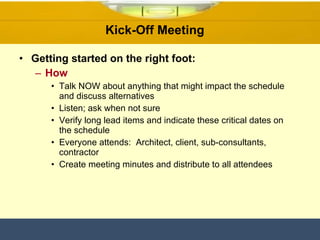
Kick-Off Meeting  Getting started on the right foot: How Talk NOW about anything that might impact the schedule and discuss alternatives Listen; ask when not sure Verify long lead items and indicate these critical dates on the schedule Everyone attends:  Architect, client, sub-consultants, contractor Create meeting minutes and distribute to all attendees
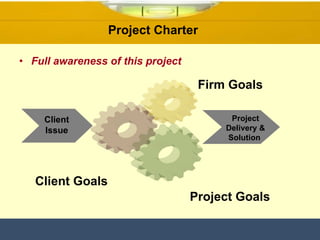
Full awareness of this project Project Charter  Firm Goals  Client Issue Project Delivery & Solution   Client Goals  Project Goals
Always Includes: Client goals Project description, scope, design criteria, approach and deliverables Project budget Project schedule QA/QC plan Project administration and filing procedures Contact list Communications plan  Contract document  Project Charter
Key Concept:  Delegation  Best Practices: When and what Appointing someone to act on our behalf  Delegation is a two way process:  You delegate responsibility – authority flows from you to team member Accountability flows from team member to you Why Delegation is good for us– it’s good for the team We don’t have time to do it all  How There is a pathway to successful delegation
Key Concept:  Delegation  Best Practices: How Communicate desired results Set clear goals and deadlines Give all information/ideas Define authority/responsibility Resist making decisions for others Give appropriate credit
Key Concept: Delegation Considerations During Task Assignments:   What input will this task receive? What output do you expect from this task? What process do you expect will be followed in completing this task? What schedule do you expect for completion of this task? Within what budget should this task be completed? Determine, Identify, Assign, Monitor, Evaluate
“ I don’t motivate my players. You cannot motivate someone.  All you can do is provide a motivating environment  and the players will motivate themselves.”   Phil Jackson Coach, 2000 LA Lakers Motivating Teams
Factors that enhance abilities: Creative and challenging work Participation in decision making Job flexibility, autonomy, responsibility Training and development activities Praise and recognition from peers and supervisors Promotion to higher job status Social interaction with co-workers Interaction with clients Enhancing Team Abilities
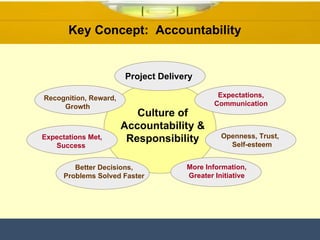
Key Concept:  Accountability  Culture of Accountability & Responsibility Better Decisions, Problems Solved Faster Openness, Trust,  Self-esteem More Information, Greater Initiative Recognition, Reward, Growth   Project Delivery   Expectations, Communication Expectations Met, Success
Within Project Teams: Everyone in the firm understands the critical role of projects Project Manager is the shepherd of this process Role and authority of Project Manager is clear Everyone grows – requirement of the firm Set expectations and desired results Reviews and feedback at project conclusion Be prepared to take necessary action Be prepared to congratulate and reward Key Concept:  Accountability
Project Progression
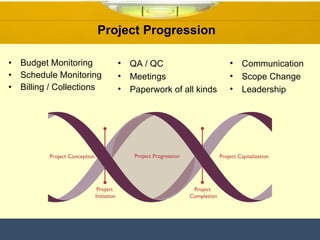
Project Progression  Budget Monitoring  Schedule Monitoring  Billing / Collections QA / QC Meetings Paperwork of all kinds Communication  Scope Change Leadership
Budget Monitoring  Keeping our eyes on the money: When and what Frequency will depend on project size Why Because this tracks our profit or loss How Use internal systems for timesheets, invoices, expenses, accounts payable, receivables, and work in progress Monitor costs against budget on a frequent basis, watch red flags and take corrective action when needed Use resource projections, cost to complete estimates Provide periodic summary to team and PIC
Budget Monitoring  How Team understands and commits to budget (see Project Charter) Team records accurate time  Deal with out of scope requests immediately Close out projects promptly and properly Communicate as much as possible
When a Project is Over Budget: Perhaps:   The original budget was too low, wrong staff assigned, scope increased without compensation, internal delays - What risks did we identify at the beginning? Take action:   Compress or extend the schedule, change staff if necessary, use additional staff, as a last resort ask client to renegotiate the contract Budget Monitoring
Schedule Monitoring  Keeping our eyes on the time: When and what Periodically review the project work plan against dates Why We don’t want to get jammed into trouble How Start with a realistic schedule Team is committed to tasks and milestones Provide early/late start and stop dates Use tools at our disposal:  scheduling software, records, data Compare time sheets against progress reports Periodically review team members’ performance
Schedule Monitoring  How Frequently publish or talk about the schedule with the team Look for ways to save time, beat schedule Do not use contingencies as a crutch Hire schedule driven sub-consultants Document all issues that can affect schedule Communicate with entire team – especially client Delegate schedule updates to team member
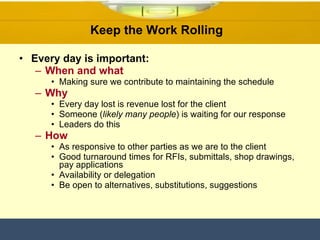
Keep the Work Rolling  Every day is important: When and what Making sure we contribute to maintaining the schedule Why Every day lost is revenue lost for the client  Someone ( likely many people ) is waiting for our response Leaders do this  How As responsive to other parties as we are to the client Good turnaround times for RFIs, submittals, shop drawings, pay applications Availability or delegation  Be open to alternatives, substitutions, suggestions
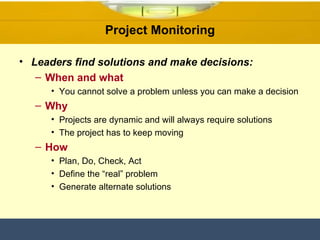
Project Monitoring Leaders find solutions and make decisions: When and what You cannot solve a problem unless you can make a decision Why Projects are dynamic and will always require solutions The project has to keep moving How Plan, Do, Check, Act Define the “real” problem Generate alternate solutions
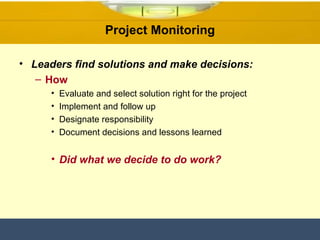
Project Monitoring Leaders find solutions and make decisions: How Evaluate and select solution right for the project Implement and follow up Designate responsibility Document decisions and lessons learned Did what we decide to do work?
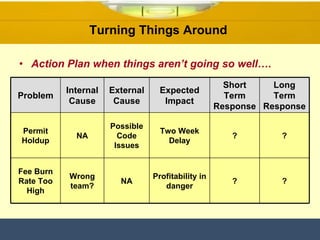
Action Plan when things aren’t going so well…. Turning Things Around  Problem Internal Cause External Cause Expected Impact Short Term Response Long Term Response Permit Holdup NA Possible Code Issues Two Week Delay ? ? Fee Burn Rate Too High Wrong team? NA Profitability in danger ? ?
Invoicing: Getting paid for our work is critical today Cash flow  Shorter duration projects Establish billing dates / frequency / terms at the beginning of the project PM and team understand importance of timely billing cycles and accurate recording  Use a well-designed A/R report Design an effective invoice or use owner supplied forms correctly Billing and Collections
QA / QC  Providing a high quality product: When and what QA: Everything that drives consistent quality levels vs. QC: Processes that verify quality at the end of project stages Why A good set of drawings is different than a bad set of drawings This is the claim we make on our website How Excellent work expected at every level, on every deliverable  Verification on work packages, tasks, deliverables Part of performance evaluations and team review Build QC processes into budget and schedule Outsource
Key Concept:  Communication  Best Practices: When and what Exchanging information in all directions 90% of our time will be spent communicating Why Lack of communication will ruin any project  We owe it to everyone we work with Leaders do this Remember “ The single biggest problem in communication is the illusion that it has taken place.” – George Bernard Shaw
Key Concept:  Communication  Best practices: How Establish a communication plan for the project Determine RACI roles ( responsible, accountable, consult, inform ) Decide what is critical and what is not Good communication does not include email – after three exchanges, pick up the phone or meet in person Document discussions, decisions, actions taken, outcomes
Best Practices for Meetings: Budget the time and understand the commitment Set ground rules at initiation Distribute and work from an agenda Prioritize meeting items Allocate time for each List attendees Limit length of meetings Consistency Key Concept:  Communication
Periodic Project Updates: Weekly, brief email: Progress to date Upcoming tasks Issues to be aware of Client reviews and input Out of scope work  Schedule and/or budget issues Report trouble or issues early Send consistently to every team member involved in the project – client, technical staff, subconsultants Weekly Updates
Key Concept:  Remote Management  More and more projects out of state: When and what Keeping our eyes on the project from a distance Why More risk involved at a distance  How Roles and responsibilities super clear from the start Use web-based meetings  Hold them more frequently Thorough and efficient site visits Extra client care when needed Take lots of photographs
Key Concept:  Managing Scope Change  Best practices: When and what Hardly a project out there that does not have at least one  Why That’s the nature of the design and construction industry How Get it going:  discuss changes immediately and thoroughly Decide whether to charge client for your services or not  Get approvals first and invoice it immediately Disputes put off until the end will likely appear at the end Consider contract terms that define breadth of scope: Number of meetings or permit reviews
Know thy client: Why is the project being done Who are the stakeholders Who does the client report to Who makes the final decisions What are the client’s issues / concerns What are the client’s expectations Get the Principal involved when necessary Key Concept:  Managing the Client
Key Concept:  Project Leadership  Best practices: When and what This ( project, owner, contractor ) is driving me nuts.  Why should I be the bigger person here or do this extra work??  Why We are committed to the client’s goals  Or at least we said we were  Project leadership is increasingly important today  How Argue in the positive Assess wins and losses – pick your battles Know where your alliances are and use them Get assistance from the principal or colleagues
 
Thank You! Christine Brack, PMP Principal 239-280-2300 x2902 [email_address] Click here to purchase the entire series: http://www.zweigwhite.com/p-792-ae-project-management-optimization-series.aspx

A/E Project Management Optimization-Part Two

  • 1.
    Presented by ZweigWhiteProject Management Part II
  • 2.
    ZweigWhite is aRegistered Provider with The American Institute of Architects Continuing Education Systems. Credit earned on completion of this program will be reported to CES Records for AIA members. Certificates of Completion for non-AIA members are available on request. This program is registered with the AIA/CES for continuing professional education. As such, it does not include content that may be deemed or construed to be an approval or endorsement by the AIA of any material of construction or any method or manner of handling, using distributing, or dealing in any material or product. Questions related to specific materials, methods, and services will be addressed at the conclusion of this presentation.
  • 3.
    Copyright Materials Thispresentation is protected by US and International copyright laws. Reproduction, distribution, display and use of the presentation without written permission of the speaker is prohibited. © ZweigWhite, 2010
  • 4.
    Seminar Overview Introductionand Logistics Headaches and Learning Objectives Facts, Figures, and Things to Consider Skills and Abilities of Today’s Project Manager What we need to do, when, why and how Project Phases Key Concepts Excellence in Project Leadership Objectives in Motion
  • 5.
    What We Needto Do, When, Why, and How
  • 6.
  • 7.
  • 8.
    Project Initiation TeamFormation Schedules Procedures Expectations Project Charter Kick-off Meeting Delegation Leading Teams
  • 9.
    Project Teams: ProjectManager Clients, consultants, and subconsultants Project Leader Project Designer Other detailers, technical professionals Team Formation
  • 10.
    Elements to Consider:Project goals and objectives Roles and responsibilities Education, training, and certification Years of experience and qualifications Personalities Team Formation
  • 11.
    Sub-Consultants Theyplay a role in the project too: When and what Great drawings They understand our process and expectations of them Why Their role and actions impact construction – time and costs How Choosing consultants committed to superior outcomes Submittals: “Note as corrected” vs “Rejected”; turnaround times, impact of substitutions RFIs: Communication channels, timeliness, great drawings
  • 12.
    The Work BreakdownStructure: All the work necessary to do this project All the deliverables required Only work defined within the scope negotiated Rolling it Up: Start with client deliverables Define all tasks to complete each deliverable Assign tasks to team members Work Breakdown Structure
  • 13.
    The Work BreakdownStructure: Deliverables are the milestones Establish date deliverables must be completed Break deliverables into manageable tasks Identify team members for tasks Estimate hours required Understand dependencies; what can be done in parallel Use tools at your disposal Sequencing and Scheduling
  • 14.
    Kick-Off Meeting Getting started on the right foot: When and what Project kick-off meeting with expectations and procedures Why Sets the tone for the entire project Expectations drive consistency and clarity How Establish frequency of meetings, paperwork deadlines, RFI and submittal process Be positive – this is an exciting project Do not make assumptions or bring in prejudices Overlay schedules, discuss impact, reach agreement
  • 15.
    Kick-Off Meeting Getting started on the right foot: How Talk NOW about anything that might impact the schedule and discuss alternatives Listen; ask when not sure Verify long lead items and indicate these critical dates on the schedule Everyone attends: Architect, client, sub-consultants, contractor Create meeting minutes and distribute to all attendees
  • 16.
    Full awareness ofthis project Project Charter Firm Goals Client Issue Project Delivery & Solution Client Goals Project Goals
  • 17.
    Always Includes: Clientgoals Project description, scope, design criteria, approach and deliverables Project budget Project schedule QA/QC plan Project administration and filing procedures Contact list Communications plan Contract document Project Charter
  • 18.
    Key Concept: Delegation Best Practices: When and what Appointing someone to act on our behalf Delegation is a two way process: You delegate responsibility – authority flows from you to team member Accountability flows from team member to you Why Delegation is good for us– it’s good for the team We don’t have time to do it all How There is a pathway to successful delegation
  • 19.
    Key Concept: Delegation Best Practices: How Communicate desired results Set clear goals and deadlines Give all information/ideas Define authority/responsibility Resist making decisions for others Give appropriate credit
  • 20.
    Key Concept: DelegationConsiderations During Task Assignments: What input will this task receive? What output do you expect from this task? What process do you expect will be followed in completing this task? What schedule do you expect for completion of this task? Within what budget should this task be completed? Determine, Identify, Assign, Monitor, Evaluate
  • 21.
    “ I don’tmotivate my players. You cannot motivate someone. All you can do is provide a motivating environment and the players will motivate themselves.” Phil Jackson Coach, 2000 LA Lakers Motivating Teams
  • 22.
    Factors that enhanceabilities: Creative and challenging work Participation in decision making Job flexibility, autonomy, responsibility Training and development activities Praise and recognition from peers and supervisors Promotion to higher job status Social interaction with co-workers Interaction with clients Enhancing Team Abilities
  • 23.
    Key Concept: Accountability Culture of Accountability & Responsibility Better Decisions, Problems Solved Faster Openness, Trust, Self-esteem More Information, Greater Initiative Recognition, Reward, Growth Project Delivery Expectations, Communication Expectations Met, Success
  • 24.
    Within Project Teams:Everyone in the firm understands the critical role of projects Project Manager is the shepherd of this process Role and authority of Project Manager is clear Everyone grows – requirement of the firm Set expectations and desired results Reviews and feedback at project conclusion Be prepared to take necessary action Be prepared to congratulate and reward Key Concept: Accountability
  • 25.
  • 26.
    Project Progression Budget Monitoring Schedule Monitoring Billing / Collections QA / QC Meetings Paperwork of all kinds Communication Scope Change Leadership
  • 27.
    Budget Monitoring Keeping our eyes on the money: When and what Frequency will depend on project size Why Because this tracks our profit or loss How Use internal systems for timesheets, invoices, expenses, accounts payable, receivables, and work in progress Monitor costs against budget on a frequent basis, watch red flags and take corrective action when needed Use resource projections, cost to complete estimates Provide periodic summary to team and PIC
  • 28.
    Budget Monitoring How Team understands and commits to budget (see Project Charter) Team records accurate time Deal with out of scope requests immediately Close out projects promptly and properly Communicate as much as possible
  • 29.
    When a Projectis Over Budget: Perhaps: The original budget was too low, wrong staff assigned, scope increased without compensation, internal delays - What risks did we identify at the beginning? Take action: Compress or extend the schedule, change staff if necessary, use additional staff, as a last resort ask client to renegotiate the contract Budget Monitoring
  • 30.
    Schedule Monitoring Keeping our eyes on the time: When and what Periodically review the project work plan against dates Why We don’t want to get jammed into trouble How Start with a realistic schedule Team is committed to tasks and milestones Provide early/late start and stop dates Use tools at our disposal: scheduling software, records, data Compare time sheets against progress reports Periodically review team members’ performance
  • 31.
    Schedule Monitoring How Frequently publish or talk about the schedule with the team Look for ways to save time, beat schedule Do not use contingencies as a crutch Hire schedule driven sub-consultants Document all issues that can affect schedule Communicate with entire team – especially client Delegate schedule updates to team member
  • 32.
    Keep the WorkRolling Every day is important: When and what Making sure we contribute to maintaining the schedule Why Every day lost is revenue lost for the client Someone ( likely many people ) is waiting for our response Leaders do this How As responsive to other parties as we are to the client Good turnaround times for RFIs, submittals, shop drawings, pay applications Availability or delegation Be open to alternatives, substitutions, suggestions
  • 33.
    Project Monitoring Leadersfind solutions and make decisions: When and what You cannot solve a problem unless you can make a decision Why Projects are dynamic and will always require solutions The project has to keep moving How Plan, Do, Check, Act Define the “real” problem Generate alternate solutions
  • 34.
    Project Monitoring Leadersfind solutions and make decisions: How Evaluate and select solution right for the project Implement and follow up Designate responsibility Document decisions and lessons learned Did what we decide to do work?
  • 35.
    Action Plan whenthings aren’t going so well…. Turning Things Around Problem Internal Cause External Cause Expected Impact Short Term Response Long Term Response Permit Holdup NA Possible Code Issues Two Week Delay ? ? Fee Burn Rate Too High Wrong team? NA Profitability in danger ? ?
  • 36.
    Invoicing: Getting paidfor our work is critical today Cash flow Shorter duration projects Establish billing dates / frequency / terms at the beginning of the project PM and team understand importance of timely billing cycles and accurate recording Use a well-designed A/R report Design an effective invoice or use owner supplied forms correctly Billing and Collections
  • 37.
    QA / QC Providing a high quality product: When and what QA: Everything that drives consistent quality levels vs. QC: Processes that verify quality at the end of project stages Why A good set of drawings is different than a bad set of drawings This is the claim we make on our website How Excellent work expected at every level, on every deliverable Verification on work packages, tasks, deliverables Part of performance evaluations and team review Build QC processes into budget and schedule Outsource
  • 38.
    Key Concept: Communication Best Practices: When and what Exchanging information in all directions 90% of our time will be spent communicating Why Lack of communication will ruin any project We owe it to everyone we work with Leaders do this Remember “ The single biggest problem in communication is the illusion that it has taken place.” – George Bernard Shaw
  • 39.
    Key Concept: Communication Best practices: How Establish a communication plan for the project Determine RACI roles ( responsible, accountable, consult, inform ) Decide what is critical and what is not Good communication does not include email – after three exchanges, pick up the phone or meet in person Document discussions, decisions, actions taken, outcomes
  • 40.
    Best Practices forMeetings: Budget the time and understand the commitment Set ground rules at initiation Distribute and work from an agenda Prioritize meeting items Allocate time for each List attendees Limit length of meetings Consistency Key Concept: Communication
  • 41.
    Periodic Project Updates:Weekly, brief email: Progress to date Upcoming tasks Issues to be aware of Client reviews and input Out of scope work Schedule and/or budget issues Report trouble or issues early Send consistently to every team member involved in the project – client, technical staff, subconsultants Weekly Updates
  • 42.
    Key Concept: Remote Management More and more projects out of state: When and what Keeping our eyes on the project from a distance Why More risk involved at a distance How Roles and responsibilities super clear from the start Use web-based meetings Hold them more frequently Thorough and efficient site visits Extra client care when needed Take lots of photographs
  • 43.
    Key Concept: Managing Scope Change Best practices: When and what Hardly a project out there that does not have at least one Why That’s the nature of the design and construction industry How Get it going: discuss changes immediately and thoroughly Decide whether to charge client for your services or not Get approvals first and invoice it immediately Disputes put off until the end will likely appear at the end Consider contract terms that define breadth of scope: Number of meetings or permit reviews
  • 44.
    Know thy client:Why is the project being done Who are the stakeholders Who does the client report to Who makes the final decisions What are the client’s issues / concerns What are the client’s expectations Get the Principal involved when necessary Key Concept: Managing the Client
  • 45.
    Key Concept: Project Leadership Best practices: When and what This ( project, owner, contractor ) is driving me nuts. Why should I be the bigger person here or do this extra work?? Why We are committed to the client’s goals Or at least we said we were Project leadership is increasingly important today How Argue in the positive Assess wins and losses – pick your battles Know where your alliances are and use them Get assistance from the principal or colleagues
  • 46.
  • 47.
    Thank You! ChristineBrack, PMP Principal 239-280-2300 x2902 [email_address] Click here to purchase the entire series: http://www.zweigwhite.com/p-792-ae-project-management-optimization-series.aspx