With the End in Mind:
Choosing the Right Solutions
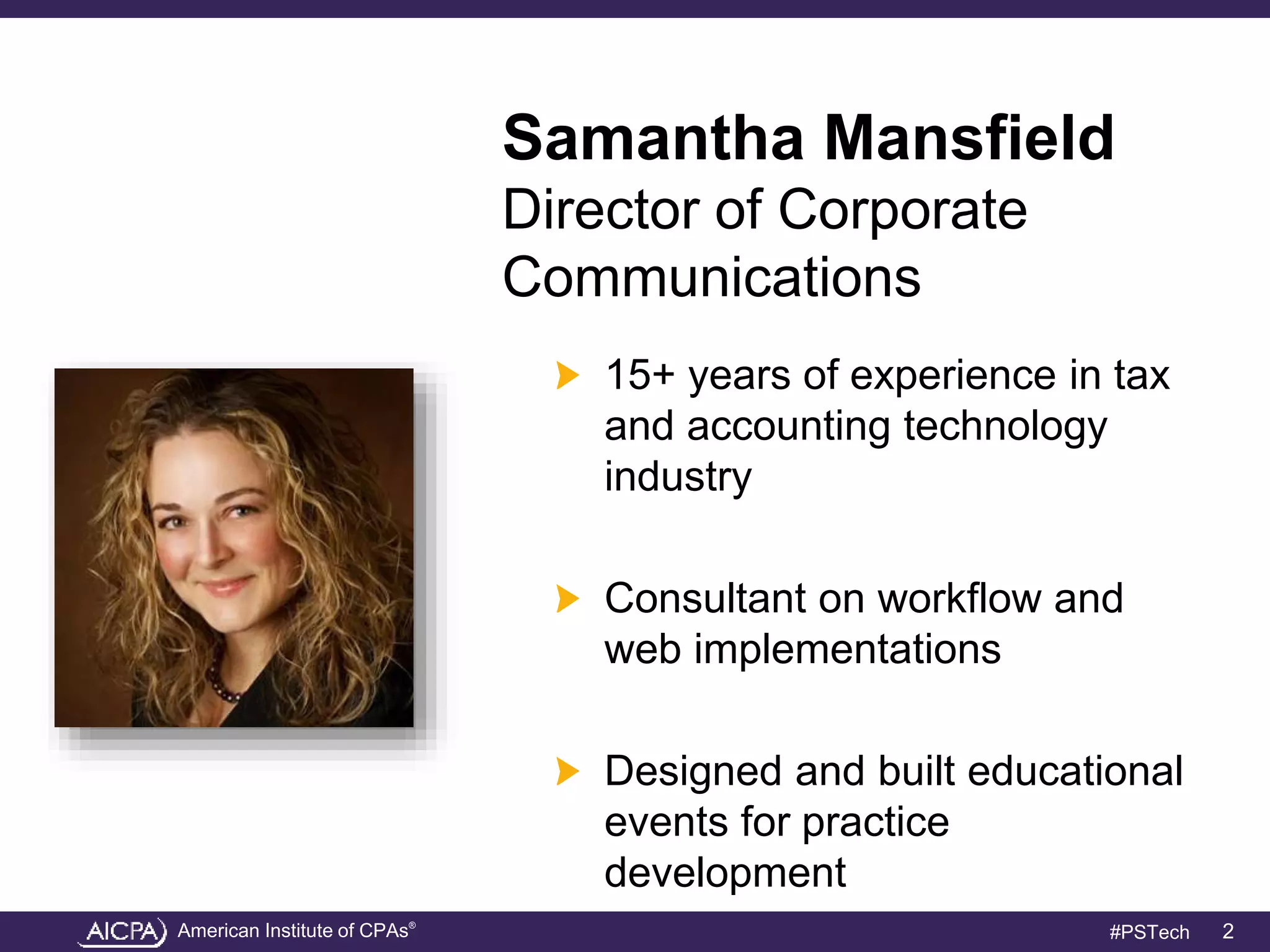
Samantha Mansfield, Director of Corporate
Communications, CPA.com
Cathy Foley, CPA, MST
Director of Technical Sales
1
American Institute of CPAs®
#PSTech
15+ years of experience in tax
and accounting technology
industry
Consultant on workflow and
web implementations
Designed and built educational
events for practice
development
2
Samantha Mansfield
Director of Corporate
Communications
American Institute of CPAs®
#PSTech
25+ years public accounting
experience with national and
regional firms
Project Team Leader for
Flowtivity workflow process
improvement
Consulting with firms
implementing web based
workflow technology
Cathy Foley, MST, CPA
Director of Technical Sales
American Institute of CPAs®
#PSTech
Agenda
• Beginning the Process
• “I don’t know what I don’t know”
• Systematize the Evaluation
• Group Exercise
• Final Thoughts
4
American Institute of CPAs®
#PSTech
Beginning the
Process
5
American Institute of CPAs®
#PSTech 6
American Institute of CPAs®
#PSTech
Items to Identify
Identify that you’ve outgrown with current
processes
Identify what is causing pain
Identify budget, timeline and key decision makers
Identify your team
American Institute of CPAs®
#PSTech 8
“Innovation doesn’t happen in the
comfort zone… The key thing is for
your company to understand that
innovation is uncomfortable because
it’s new, not because it’s bad.”
- Daniel Burrus
What’s Your Innovation Readiness?
American Institute of CPAs®
#PSTech
Uncomfortable Topics
Committed to SALY
Discussing a change in processes when new
technology is employed
Staff roles may change
“We have always done it this way”
American Institute of CPAs®
#PSTech
“I don’t know what I
don’t know”
10
American Institute of CPAs®
#PSTech
Focus on Discovery
 Understand the underlying problem
 Process improvement is only successful if the underlying
process is understood
 Think outside the box
11
American Institute of CPAs®
#PSTech
Systematize the
Evaluation
12
American Institute of CPAs®
#PSTech
Identify and assess process to improve
 What specific process
needs to be improved
 Why does it need to be
improve
 Understand current
process and pain points
13
American Institute of CPAs®
#PSTech
What Does Your Ideal Process Look Like?
 Staff playing different
roles
 Eliminated steps
 Actions clients taking
(on time and correct)
14
American Institute of CPAs®
#PSTech
Determine Measurement for Implementation
Success
KPIs - look beyond traditional measurements
• Real-time budget vs. actual
• Cycle time
• Just in time
• Bottlenecks
American Institute of CPAs®
#PSTech
Gather Feedback
16
American Institute of CPAs®
#PSTech
Group Exercise
17
American Institute of CPAs®
#PSTech 18
American Institute of CPAs®
#PSTech
Research/Evaluate Tools available
19
Develop evaluation process
• Suite/ best of breed/ customized
application?
Apply consistently
American Institute of CPAs®
#PSTech
Do you need to adjust
your process?
Did you think too big for
now?
Did you not think big
enough?
Revisit Your Ideal
20
American Institute of CPAs®
#PSTech
Map Out the New Process
21
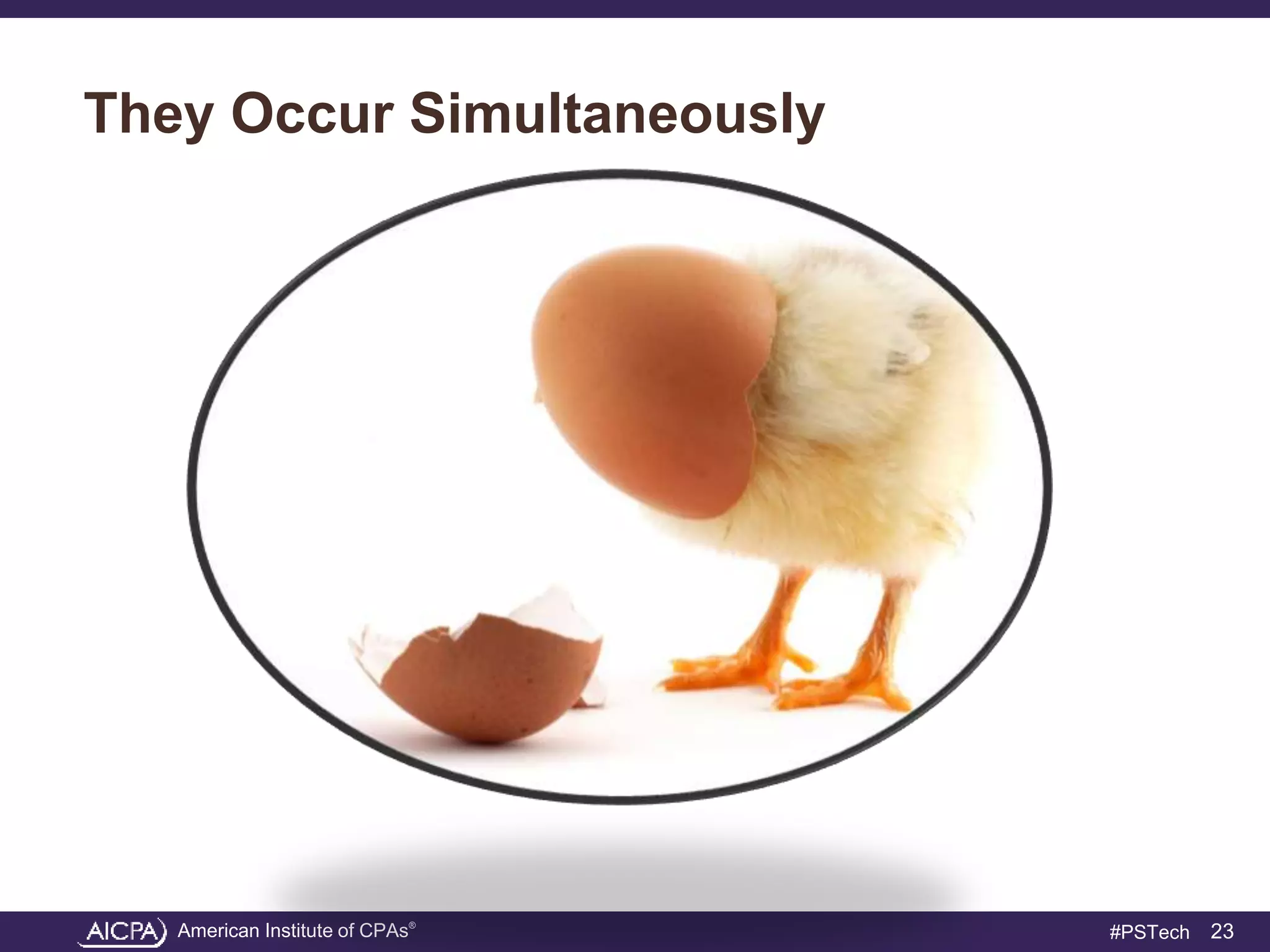
So……
Do you pick a solution or
design your process 1st?
22
American Institute of CPAs®
#PSTech
They Occur Simultaneously
23
American Institute of CPAs®
#PSTech
The Steps
Imagine the ideal
Gather feedback
Explore the options
Revisit the ideal
Map out the new process
24
American Institute of CPAs®
#PSTech
“Culture should be divided into values and behaviors.
Values will remain constant…
Behaviors, however, can vary from year to year, person to
person. It is important to evaluate these quarterly. I
think of behaviors as attributes that you want to focus on
for the organization. These can even be skills for the
organization. The interesting thing about behaviors is
that they are not static; they should change, especially
as the company grows. I have found that they have an
effect on the short and medium term results. Having both
has become an important tool for me as I manage the
growth of our company”
- Rene Lacerte, CEO, Bill.com
“4 Lessons I wished I learned in my 20’s”
American Institute of CPAs®
#PSTech
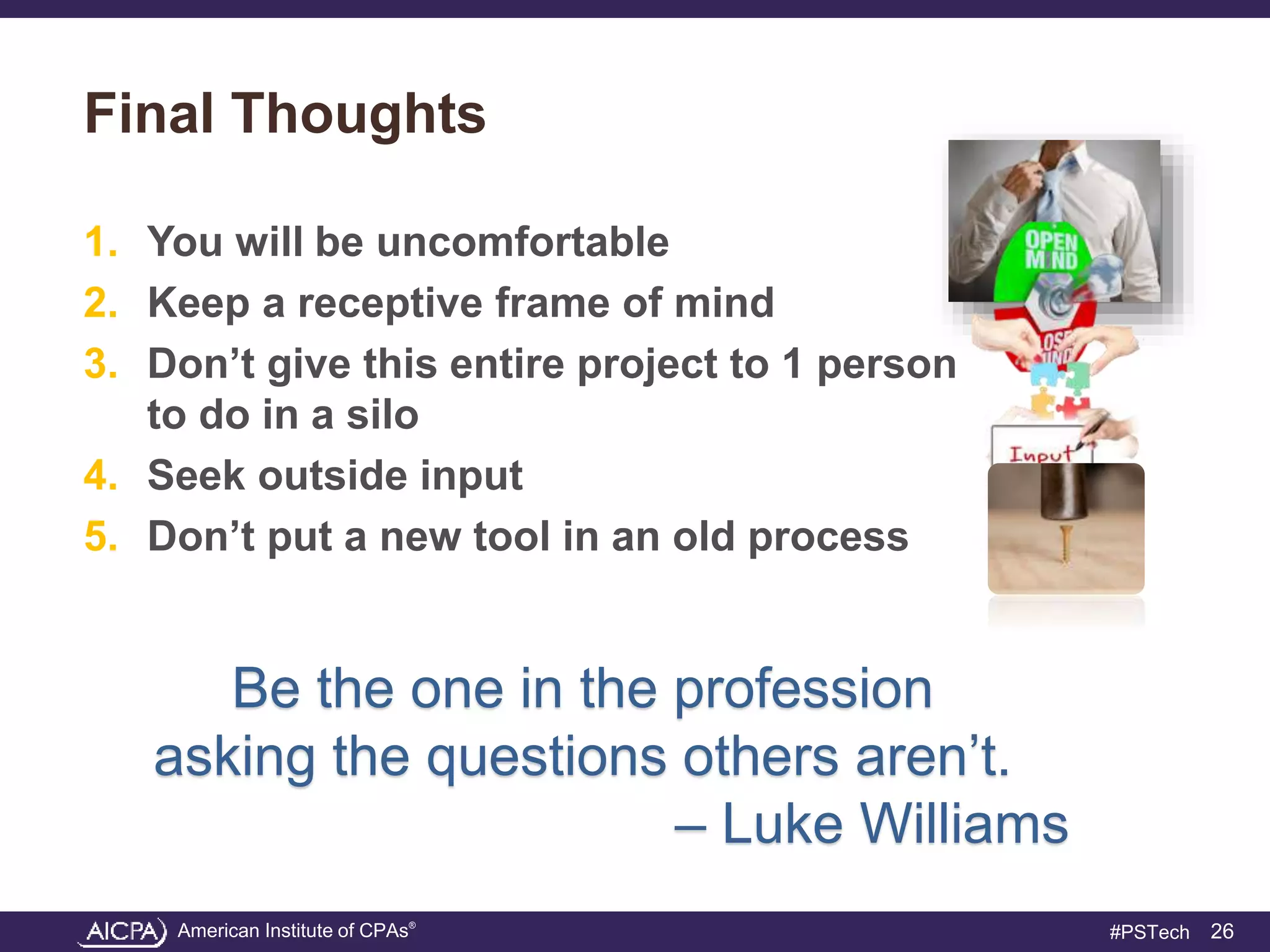
Final Thoughts
1. You will be uncomfortable
2. Keep a receptive frame of mind
3. Don’t give this entire project to 1 person
to do in a silo
4. Seek outside input
5. Don’t put a new tool in an old process
26
Be the one in the profession
asking the questions others aren’t.
– Luke Williams
American Institute of CPAs®
#PSTech
Questions?
27
American Institute of CPAs®
#PSTech
Copyright © 2013 American Institute of CPAs. All rights reserved.
THANK YOU
28
@SnMansfield
@CathyFoley20

With the end in mind choosing the right solutions

  • 1.
    With the Endin Mind: Choosing the Right Solutions Samantha Mansfield, Director of Corporate Communications, CPA.com Cathy Foley, CPA, MST Director of Technical Sales 1
  • 2.
    American Institute ofCPAs® #PSTech 15+ years of experience in tax and accounting technology industry Consultant on workflow and web implementations Designed and built educational events for practice development 2 Samantha Mansfield Director of Corporate Communications
  • 3.
    American Institute ofCPAs® #PSTech 25+ years public accounting experience with national and regional firms Project Team Leader for Flowtivity workflow process improvement Consulting with firms implementing web based workflow technology Cathy Foley, MST, CPA Director of Technical Sales
  • 4.
    American Institute ofCPAs® #PSTech Agenda • Beginning the Process • “I don’t know what I don’t know” • Systematize the Evaluation • Group Exercise • Final Thoughts 4
  • 5.
    American Institute ofCPAs® #PSTech Beginning the Process 5
  • 6.
    American Institute ofCPAs® #PSTech 6
  • 7.
    American Institute ofCPAs® #PSTech Items to Identify Identify that you’ve outgrown with current processes Identify what is causing pain Identify budget, timeline and key decision makers Identify your team
  • 8.
    American Institute ofCPAs® #PSTech 8 “Innovation doesn’t happen in the comfort zone… The key thing is for your company to understand that innovation is uncomfortable because it’s new, not because it’s bad.” - Daniel Burrus What’s Your Innovation Readiness?
  • 9.
    American Institute ofCPAs® #PSTech Uncomfortable Topics Committed to SALY Discussing a change in processes when new technology is employed Staff roles may change “We have always done it this way”
  • 10.
    American Institute ofCPAs® #PSTech “I don’t know what I don’t know” 10
  • 11.
    American Institute ofCPAs® #PSTech Focus on Discovery  Understand the underlying problem  Process improvement is only successful if the underlying process is understood  Think outside the box 11
  • 12.
    American Institute ofCPAs® #PSTech Systematize the Evaluation 12
  • 13.
    American Institute ofCPAs® #PSTech Identify and assess process to improve  What specific process needs to be improved  Why does it need to be improve  Understand current process and pain points 13
  • 14.
    American Institute ofCPAs® #PSTech What Does Your Ideal Process Look Like?  Staff playing different roles  Eliminated steps  Actions clients taking (on time and correct) 14
  • 15.
    American Institute ofCPAs® #PSTech Determine Measurement for Implementation Success KPIs - look beyond traditional measurements • Real-time budget vs. actual • Cycle time • Just in time • Bottlenecks
  • 16.
    American Institute ofCPAs® #PSTech Gather Feedback 16
  • 17.
    American Institute ofCPAs® #PSTech Group Exercise 17
  • 18.
    American Institute ofCPAs® #PSTech 18
  • 19.
    American Institute ofCPAs® #PSTech Research/Evaluate Tools available 19 Develop evaluation process • Suite/ best of breed/ customized application? Apply consistently
  • 20.
    American Institute ofCPAs® #PSTech Do you need to adjust your process? Did you think too big for now? Did you not think big enough? Revisit Your Ideal 20
  • 21.
    American Institute ofCPAs® #PSTech Map Out the New Process 21
  • 22.
    So…… Do you picka solution or design your process 1st? 22
  • 23.
    American Institute ofCPAs® #PSTech They Occur Simultaneously 23
  • 24.
    American Institute ofCPAs® #PSTech The Steps Imagine the ideal Gather feedback Explore the options Revisit the ideal Map out the new process 24
  • 25.
    American Institute ofCPAs® #PSTech “Culture should be divided into values and behaviors. Values will remain constant… Behaviors, however, can vary from year to year, person to person. It is important to evaluate these quarterly. I think of behaviors as attributes that you want to focus on for the organization. These can even be skills for the organization. The interesting thing about behaviors is that they are not static; they should change, especially as the company grows. I have found that they have an effect on the short and medium term results. Having both has become an important tool for me as I manage the growth of our company” - Rene Lacerte, CEO, Bill.com “4 Lessons I wished I learned in my 20’s”
  • 26.
    American Institute ofCPAs® #PSTech Final Thoughts 1. You will be uncomfortable 2. Keep a receptive frame of mind 3. Don’t give this entire project to 1 person to do in a silo 4. Seek outside input 5. Don’t put a new tool in an old process 26 Be the one in the profession asking the questions others aren’t. – Luke Williams
  • 27.
    American Institute ofCPAs® #PSTech Questions? 27
  • 28.
    American Institute ofCPAs® #PSTech Copyright © 2013 American Institute of CPAs. All rights reserved. THANK YOU 28 @SnMansfield @CathyFoley20

Editor's Notes

  • #2 SM Welcome… (remind to use the workbook) Ask audience: How many of you have asked yourself this question? Or wondered really where to start? How have you begun in the past? Encourage them to think disruptively as we start. How can things be different?
  • #3 SM Ask audience: what is your role in your firm Explain my role at CPA.com now.
  • #4 CF
  • #5 CF
  • #6 SM (15 min for this section) Where do you begin? It is like the chicken and the egg question. Do you need to know what is possible w/ technology to redesign your process or do you start knowing what you want the process to be then finding the technology that will facilitate that? Arguments can genuinely be made for either side being the 1st step just like the age old chicken and the egg. But we are not going to leave you w/ this today. The important elements are that you’ve identified that you’ve outgrown current processes. Make sure you identify what is causing the pain, as well as what your budget is, what is your time line, who are the key decision makers and who will be part of the team.
  • #7 SM Let’s put the discussion in the context of the business cycle. You start your business w/ specific needs and you get the tools that meet those needs and budget. You grow, expand services and clients. Your services mature and become more refined on what you are offering and then there are transitions that will take place. These transitions may be leadership, clients, staff, and most assuredly processes. As a consultant what I witnessed many firms not change their processes and tech as they grow. They continue the same way it was always done just adding more people and more licenses to the software. It is key to break out of the comfort zone and analyze if things can be improved. Honestly sometimes there is not much to change, but more often than not there is opportunity for improvement. So the question is when you think of your firm, or the department you work in where are you in this process?
  • #8 SM Identify that you’ve outgrown current processes Consider the use of outside consultants Identify what is causing pain On the surface this is perhaps the easiest b/c people are vocal, but what you have to do is dig into the real root cause! Many times the noise will just create a band aid not long term solution and we will continue to talk about ways to dig deeper. Identify budget, time line and key decision makers Often you want to start exploring and really not have a viable budget and timeline in mind Keep in mind both of these can change when you get into later stages and you need to revisit this one. Key decision makers – get their input on these key decisions, but give autonomy to the person leading the charge otherwise you create a bottle neck in the progress. Identify Team - Have the team established early
  • #9 SM When the maturing stage hits it can be hard to infuse innovation, which limits transitions and further startup services, growth, expansion, etc.
  • #10 SM Often firms get: very committed to SALY Won’t change processes though have new technology Firms very committed to staff, and don’t want to change their role. Click: don’t let these words slow you down. You have to make the case why it is worth a change, but don’t let a success history keep you from looking into alternatives. Great book called “What Got you Here Won’t get you There.” As you are growing or wanting to take your firm to the next stage in its life cycle you have to look at new options!
  • #11 SM (10 minutes) The flip side of this coin is the sentiment “I don’t know what I don’t know.” This is completely understandable. When you are doing things the same way for many years it is hard to think of doing it differently. When I entered firms one of the most common questions I received was “You are in a lot of firms how do others handle this problem?” I loved that question because it is a great way to learn. Doesn’t mean you will mimic their method, but sometimes we just need that spark of a different way to get you rethinking. The challenge is when you start hearing different methods to not immediately dismiss it. I saw that all too often too; I would share and the partner starts shaking their head no and grimacing “Oh that would never work.” When I see this reaction I know we have an uphill climb. It makes me wonder is this mentality felt throughout the organization so innovation is stunted or done under the table by individual staff members just making their daily life easier. So as we venture down this discussion about process or solution 1 thing we have to remember is that all parties need to be receptive, prepared for being uncomfortable and acknowledge you may not be doing it optimally. I realize some of you may think – I am in this class of course I am open to this information, but amazingly enough the openness shuts down pretty quickly when we dive into the work that will be involved so you want to keep the energy high and stay focused.
  • #12 SM It can be daunting or frustrating thinking about what all you don’t know so make sure you spend time in discovery. If the underlying process is right, then the outcome will be reliable. Think outside the box. Start asking yourself what could it be? Don’t limit yourself to what you think it possible, but really what you would imagine it to be. More often then not I talk to firms that don’t know how far the processes and technology has come and what they can expect from it. If you struggle w/ thinking like that just start talking to other practitioners, association members or even CFO’s in private industry you know and how they do the processes you are feeling pain w/. Start getting your juices flowing. So who are you going to talk to? Did you get ideas here at Prac Tech? Make sure you build on those further since you are in one session to the next, make sure you go back and think more and think bigger!
  • #13 CF Once you have identified that you need to re-examine your processes to look for improvements, how do you go about doing it? You want to go at it with a well thought out and systematic process. Why do you want to systemize the evaluation process? (participant response)
  • #14 CF First of all, what process needs to be improved and why? It is also important to understand what your current process is, and what the pain points are so they are not replicated.
  • #15 CF From what you know right how if you could wave a magic wand what would your process look like? Don’t put limits on yourself just think if anything could happen what would that be? Think about different roles people will play, steps that could be automated, ideally what clients are doing (ontime and correctly). Ask the tough questions “what value is being brought to our client” or “is there a technical requirement being met”?
  • #16 CF How are you going to measure whether your new process/technology meets original stated goals? Traditional means have been total billable hours and realization rate. Perhaps it’s also time to update to more meaningful Key Predictive Indexes (KPIs) such as: Budget vs Actual in real time In Jim Metzler’s white paper, “Beyond Commoditization”, he discusses the measurement of engagement efficiency at the billing stage. “That’s a lagging indicator, however, and of little use because the information arrives after the fact”. If you see that prep has taken twice as long as you have budgeted, you can do something about it. Further investigation may show that you have a training need for a new staff member and can address it before it impacts any other jobs. Or, perhaps a job fell victim to scope creep – you have the information early enough to go back to your client and discuss expanding the scope of the project. Cycle Time - Total time from start to finish – how long does this specific type of job, with your standardized process, typically take. This is useful in quickly identifying outliers that can impact actual, but also help you set the budget for projects like this. Cycle time can help you know which services are your most profitable on average, or loss leaders that need to be adjusted accordingly or “packaged” as Metzler calls for in his white paper. Just in Time Resource allocation management – Can you more nimbly allocate your resources to avoid burnout and churn on the staff side, and to ensure that work coming in is managed effectively and according to your client’s expectations. Bottlenecks Dustin Hostetler, Flowtivity, LLC big proponent of identifying bottlenecks so as to eliminate backlogs and improve cycle time. Having visibility into steps in your process that tend to become bottlenecks that drag your cycle time is essential to eliminating them and more profitably serving your clients. Look for redundant loops, training issues, value-less steps in your process….
  • #17 CF You work w/ others – staff, clients, other professionals. Gather input from them on specific processes. If we go too general in the questioning you won’t get to the details. If you are trying to improve your accounting process ask EVERYONE that is involved in that process from receptionist that may collect data from clients to admin staff copying & scanning work in. You may be surprised at the duplication in processes between team members. Also look at metrics: which services are most profitable, which are highest revenue (2 different questions). Find out from clients what bothers them about your process? We don’t want to know, but we need to know so they aren’t telling others. Ask other professionals you work with: bankers, boards, etc. and what do they like and not like
  • #18 (25 min) CF to lead off, but both CF and SM to facilitate Lets go through and exercise process evaluation.
  • #19 CF It is important to know what else is available. You may think you have identified all the time savings an efficiencies, but technology changes so fast you may not be aware of the options out there. Conferences are good to hear and see what is happening. Watch webinars on tools associated to your process, look at reviews like TrustRadius, CPA Practice Advisor, social media etc. Do firm visits as part of your associations you are in to see how others are doing it. (share how PASBA does this and others).
  • #20 CF Do you also need new tools with the new process? Develop an evaluation system to apply to each tool, once the evaluation system is identified, then follow the process through each tool. What tool meets the criteria/solves the pain identified at the beginning of the process? Do you want to go Suite of Products/Best of Breed/Customized application Consider software integration needs What is the budget? Who has authority to make approvals? What is the timetable?
  • #21 CF Is it still your ideal now that you have gathered the feedback and have seen other options? Do you need to adjust the process? Did you think too big and the solution doesn’t exist yet, or did you not think big enough?
  • #22 CF Now that you know options available, you can prioritize the areas of focus from the feedback you gathered and you have adjusted your ideal scenario it is time to map out what the process is going to be. Make sure you document. Make sure you specify who is involved. Make sure you are thinking about the how and the why. Don’t put a new tool in an old process, or vice versa. (pulled from description)
  • #23 SM Give audience a chance to answer.
  • #24 http://www.shutterstock.com/cat.mhtml?searchterm=chicken+and+the+egg&language=en&lang=en&search_source=&safesearch=1&version=llv1&media_type=#id=60168772&src=KtNwvW63GEPylGgXGAS5lA-1-86 It isn’t a pure black and white. It is both.
  • #25 CF Recap
  • #26 SM Many firms are focused on a creating a culture of change. I thought this was a fitting quote, though long, about what makes up culture and good food for thought as we finish this discussion. Need to evaluate on a regular basis the comment about behaviors should not be static. We love things to stay the same – it is dependable, we know what to expect and that makes things easier. But that doesn’t always help us achieve our goals. And 1 person’s behaviors and attributes may be better suited in a different role in your firm.
  • #27 SM 1) Mention William Bridges book to help w/ this discomfort 2) Staying open minded is a conscious effort we have to make which is why I depict it as a switch. We can catch ourselves turning it off. 3) 1 person hard to see all the angles. Also don’t leave just to IT w/o involvement from those doing the work everyday. 4) doesn’t mean you are going to do it the same way, but get the fresh ideas and why others will do it another way. Creates innovation.
  • #28 SM/CF