Project Management:
Still More Art Than Science
Presented By
Donald W. Larson
AC Bronze, CL
June 6, 2007
Click mouse to continue
Original Whitepaper Source
Click mouse to continue
 Author: Kate Belzer
- Copyright © 2001
 http://www.pmforum.org/library/pa
pers/2001/0102papers.htm#01
 Used here by Don Larson for
Technical Presentations Manual
Project #4, “Presenting a Technical
Paper”
Change is Here to Stay
Click mouse to continue
 Organizations change at breakneck
speed to satisfy customers and
maintain competitive
 To thrive in this environment, project
managers must meet the needs of the
organization and assist businesses in
delivering value to customers
Understanding Business Value1
Click mouse to continue
 Who are our customers?
 What value do we provide to
them? (GAP Analysis)
 Who will be our customers in the
future?
 How will we satisfy their needs?
Delivering Business Value2
Click mouse to continue
 Strategic planning, through thoughtful
consideration of these questions, leads to
the creation of an organization that satisfies
customer needs and provides an
acceptable benefit to stakeholders
 Strategic planning also provides a
framework that stimulates projects to
introduce new products and improve
processes
Strategies Beget Projects3
Click mouse to continue
 Projects are implemented to
advance organizational goals
 Potential projects must be
aligned with your company's
mission and strategic direction
 Project must be a strategic fit
What Makes a Project
Successful?
Click mouse to continue
 Plan-Do-Check-Act [PDCA] (Walter Shewhart)
- Limited knowledge, improving as we go
- Velocity of change through iterations
 Use processes, tools, and techniques
 Soft skills
- Working within the organization
 Hard Skills (Supplemental Information)
- Project Management Institute’s (PMI):
- Five Process Groups
- Nine Knowledge Areas
Project Approaches
Click mouse to continue
 Project Management Body of
Knowledge (PMBOK)
 Unified Software Development
Process
 Critical Chain Project
Management
 Experience
PMBOK Tools, Processes, and
Techniques
Click mouse to continue
 What is required by the process:
- Inputs
 What occurs during the process
 What are the deliverables of the
process:
- Outputs
Using Only Hard Skills
Click mouse to continue
 No clear communication means
unclear deliverables, requirements,
and dissatisfied customer
 Lack of open communication can
lead to issues reaching a critical point
 Developing a plan in isolation can
cause team instability
 Lack of leadership results in failure
Missing Link: The Appropriate
Application of Soft Skills
Click mouse to continue
 A clear understanding and effective
application of soft skills enhance the
success of a project exponentially:
- A project manager must communicate
effectively, work within the organization’s culture,
motivate the team, manage stakeholder
expectations, understand business objectives,
solve problems effectively, and make clear and
knowledgeable decisions
Soft Skills: Communication
Click mouse to continue
 The most important skill:
- Convey complex ideas easily
- Clearly articulate what must be
accomplished
- Keep team moving toward a common goal
- Foster an environment that allows team
members to communicate openly and
honestly
- Admit own mistakes without losing respect
- Negotiate, listen, and facilitate
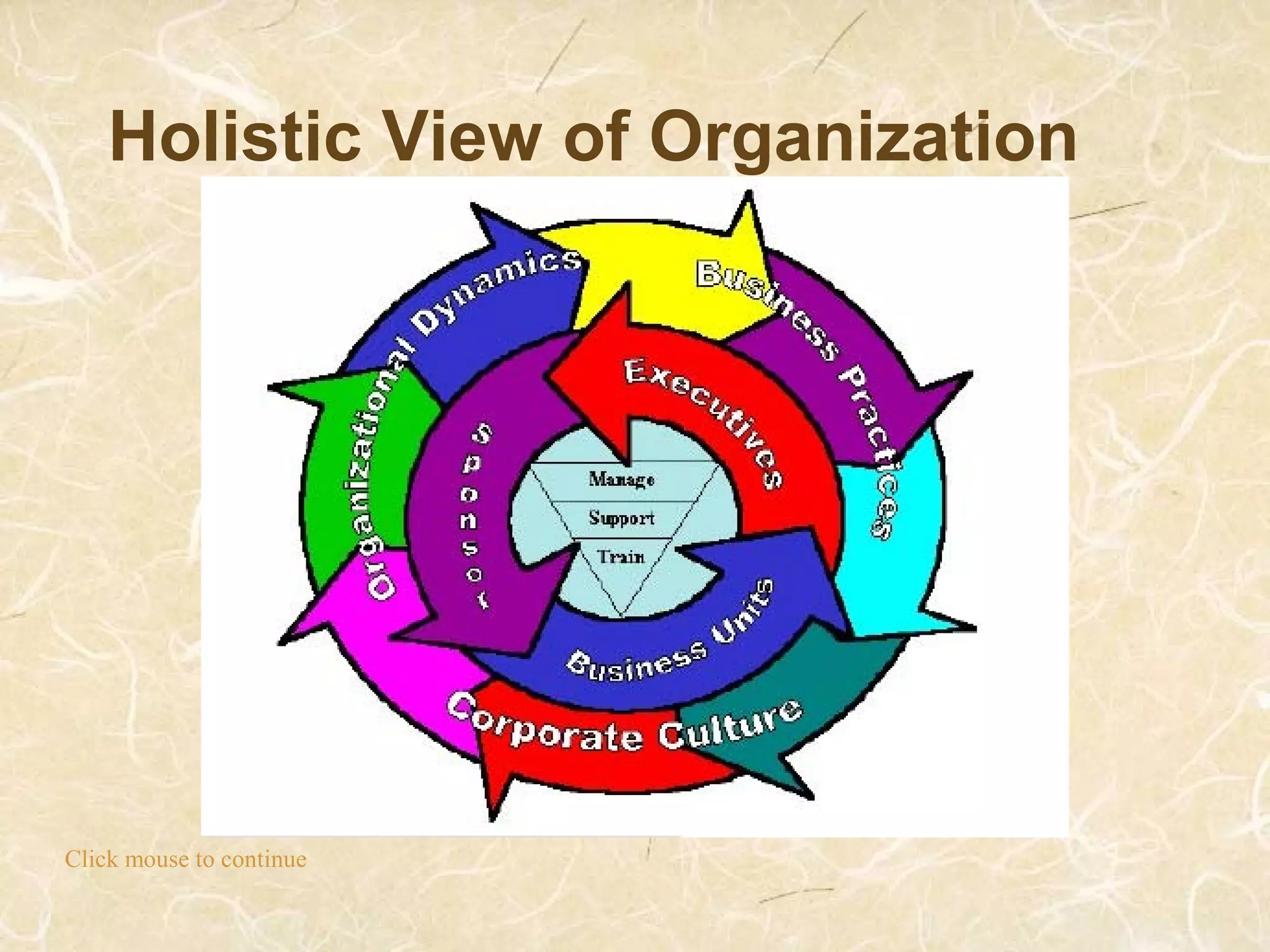
Holistic View of Organization
Click mouse to continue
Grow with Today’s Business
Click mouse to continue
 It is inherently complex
 Constantly changing
 Focused on customer
satisfaction
Master the Challenge
Click mouse to continue
 Delivering business value on
time, within budget, and to the
customers' satisfaction is both
science and art
 Master the timeless soft skills
to supplement the hard skills for
success
Supplemental Information
Click mouse to continue
 Five PM Process Groups
 Nine PM Knowledge Areas
 20 Key Project Manager Actions and
Results
 Management By Objective
 The Center for Collaborative
Organizations
 Managing Team Conflict
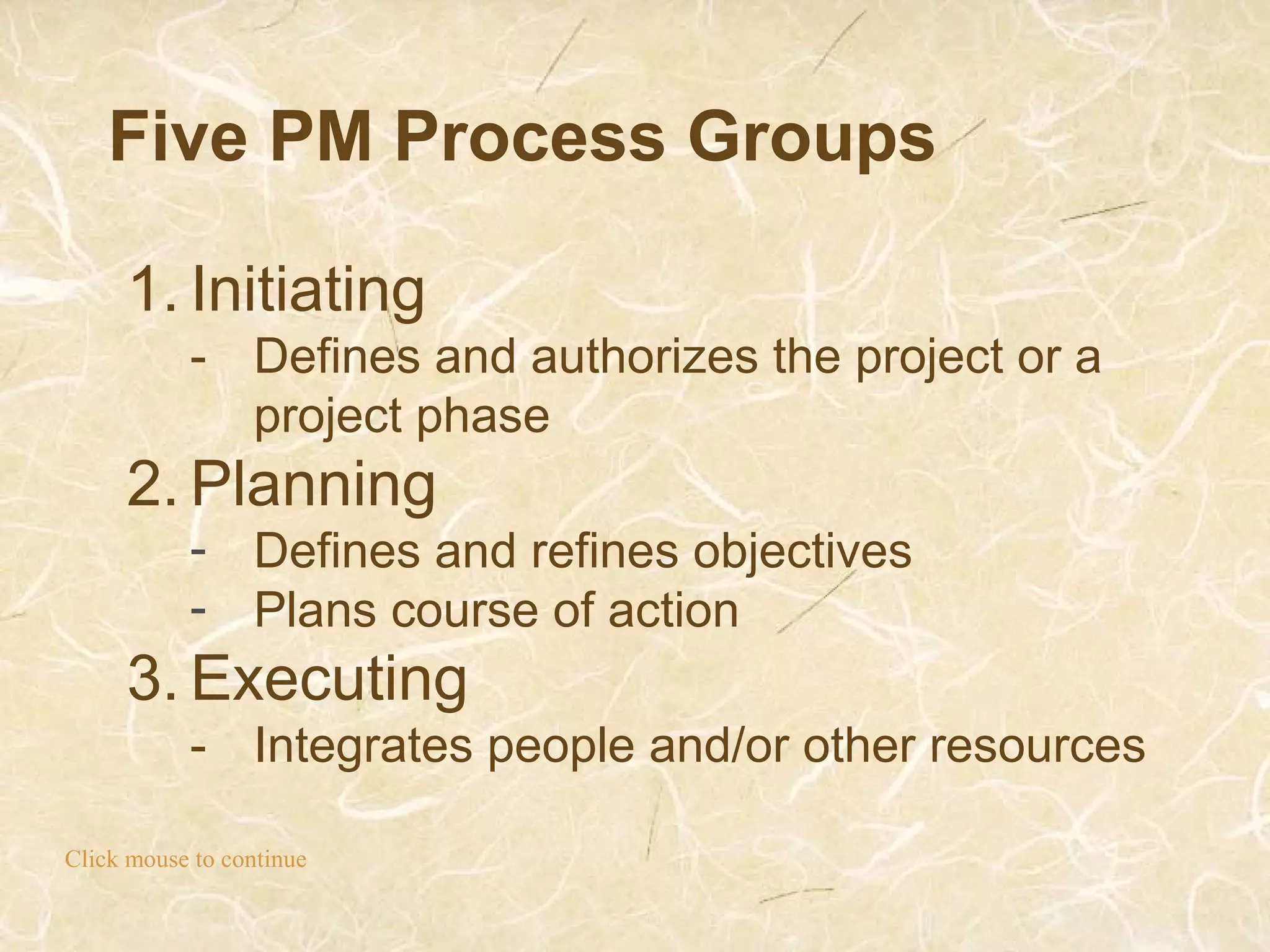
Five PM Process Groups
Click mouse to continue
1. Initiating
- Defines and authorizes the project or a
project phase
2. Planning
- Defines and refines objectives
- Plans course of action
3. Executing
- Integrates people and/or other resources
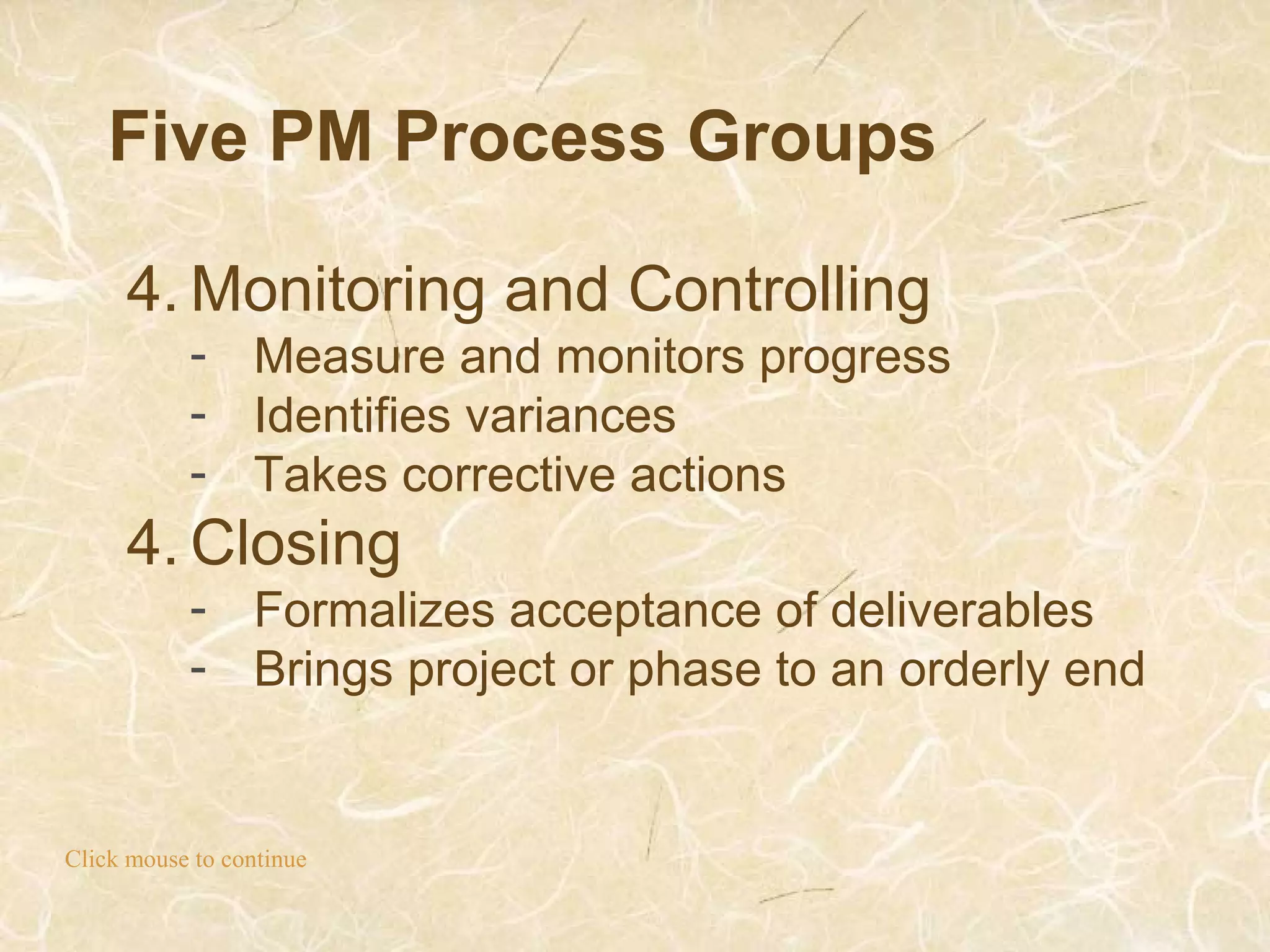
Five PM Process Groups
Click mouse to continue
4. Monitoring and Controlling
- Measure and monitors progress
- Identifies variances
- Takes corrective actions
4. Closing
- Formalizes acceptance of deliverables
- Brings project or phase to an orderly end
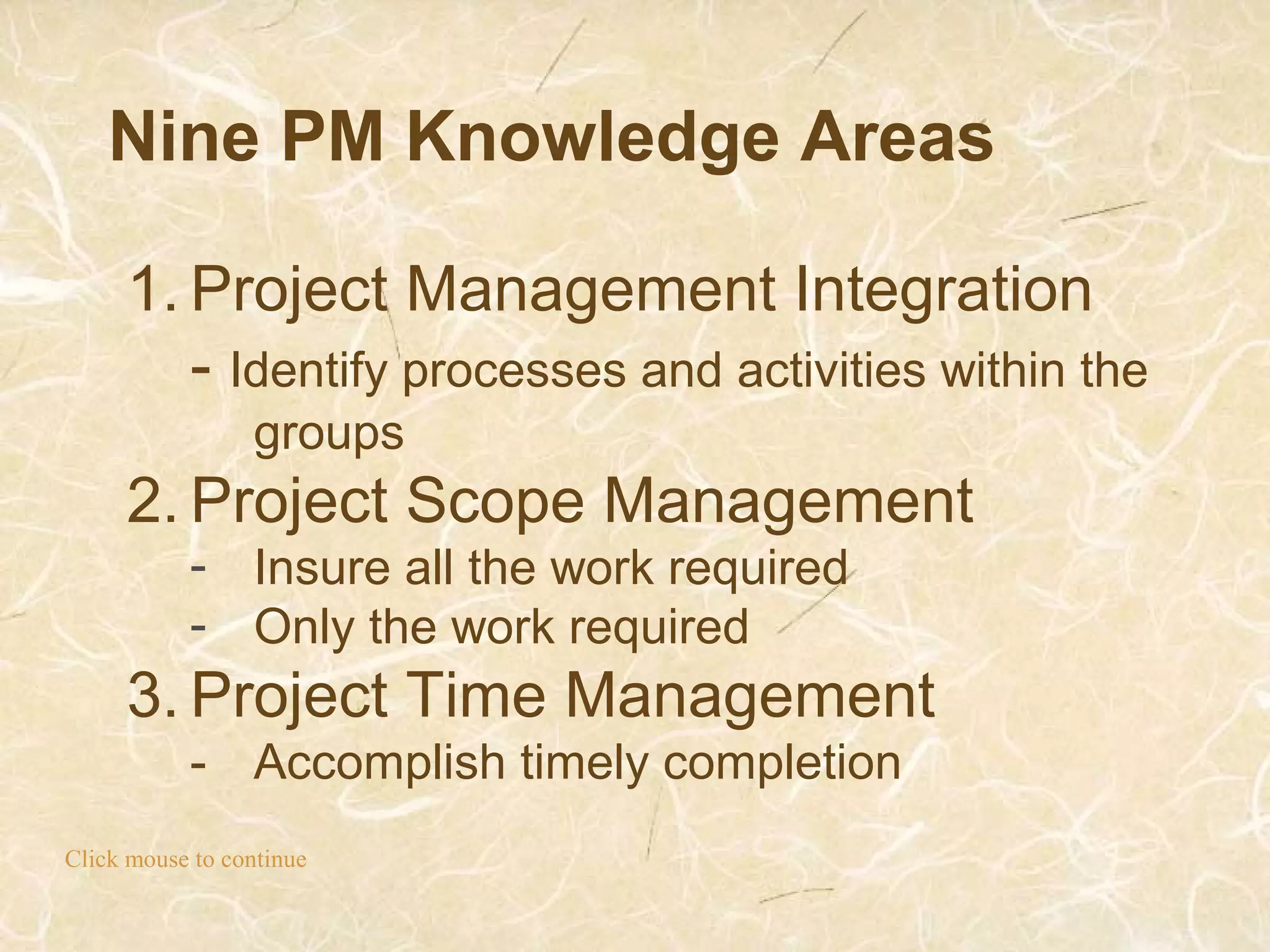
Nine PM Knowledge Areas
Click mouse to continue
1. Project Management Integration
- Identify processes and activities within the
groups
2. Project Scope Management
- Insure all the work required
- Only the work required
3. Project Time Management
- Accomplish timely completion
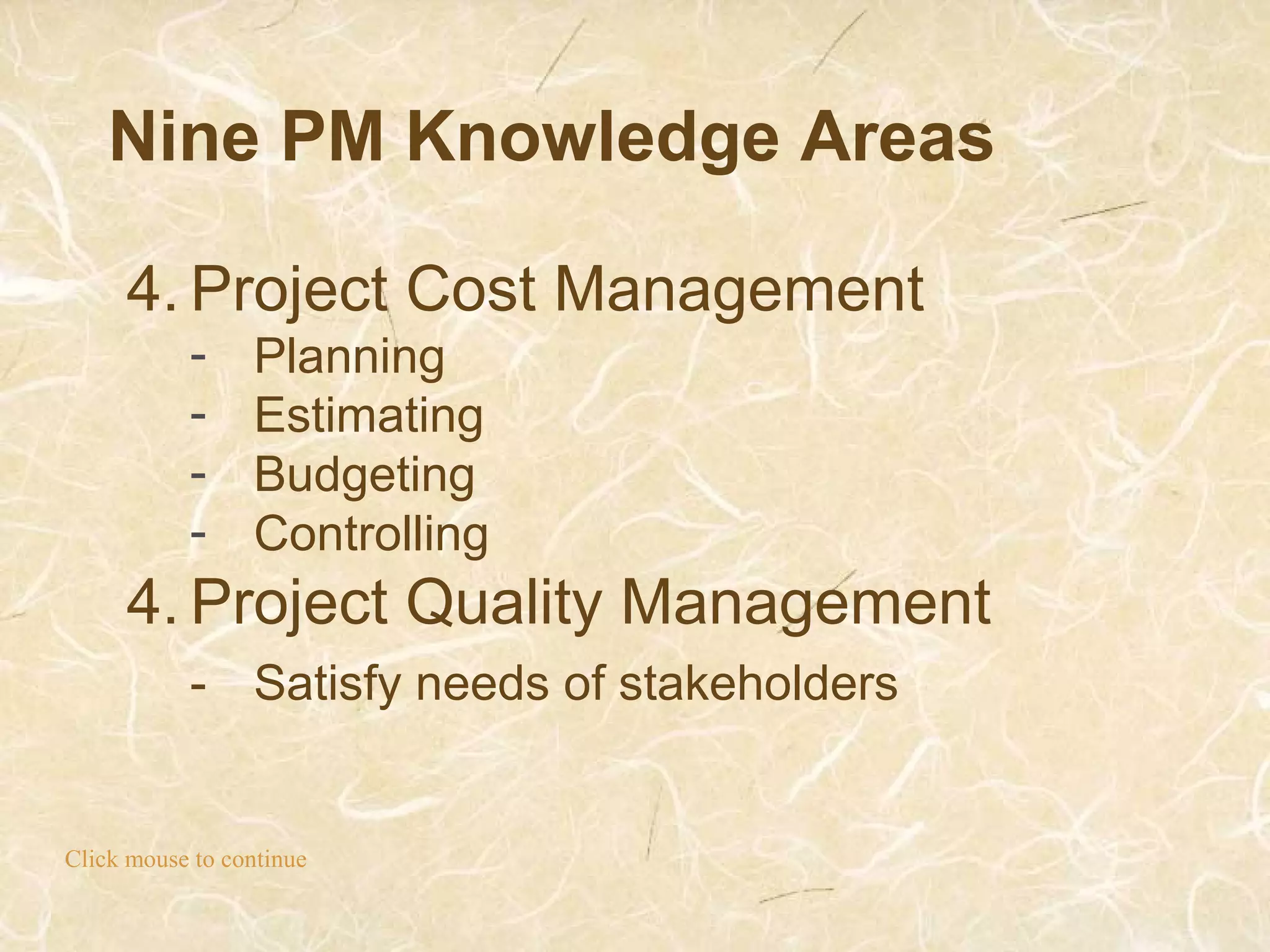
Nine PM Knowledge Areas
Click mouse to continue
4. Project Cost Management
- Planning
- Estimating
- Budgeting
- Controlling
4. Project Quality Management
- Satisfy needs of stakeholders
Nine PM Knowledge Areas
Click mouse to continue
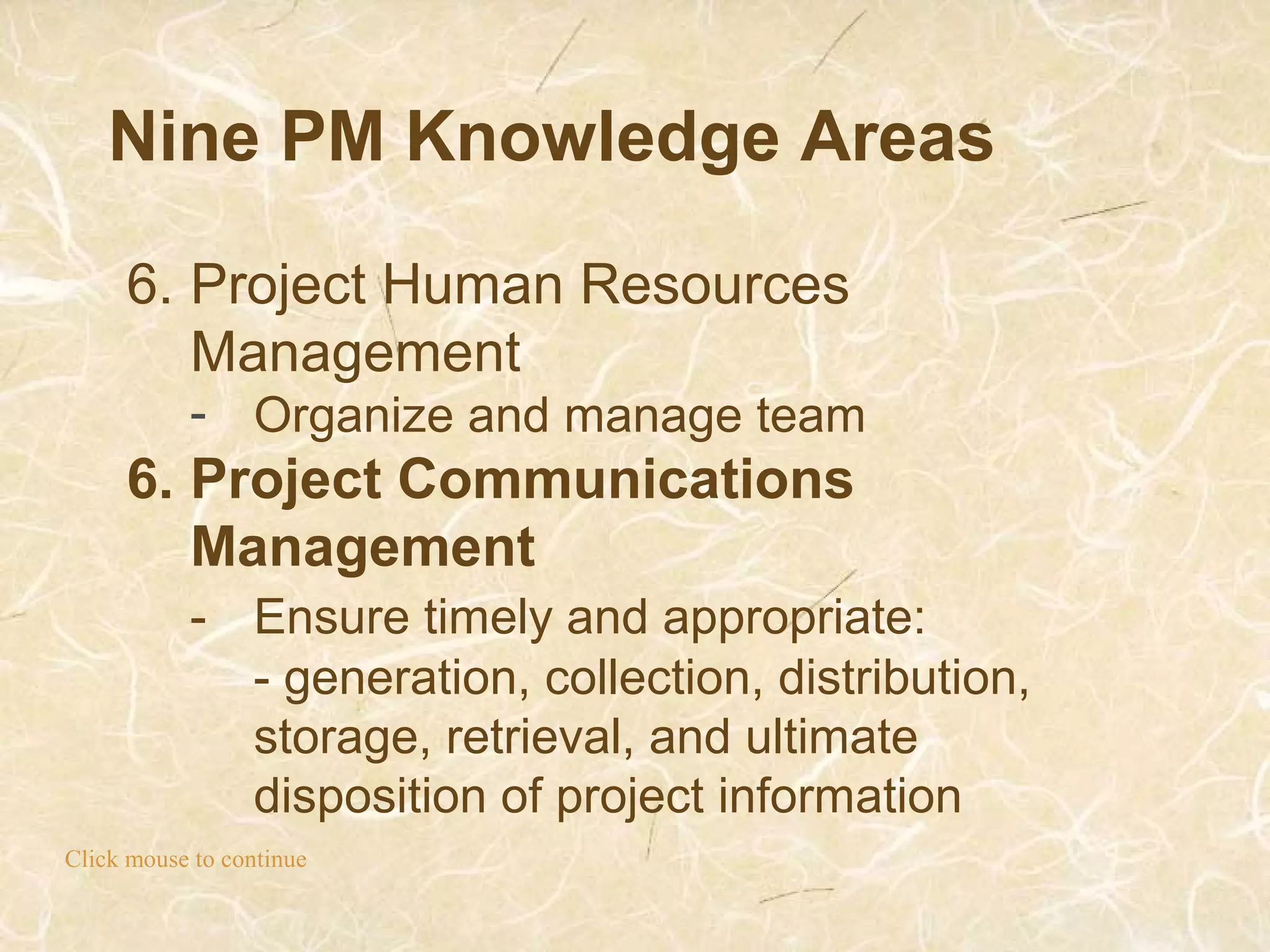
6. Project Human Resources
Management
- Organize and manage team
6. Project Communications
Management
- Ensure timely and appropriate:
- generation, collection, distribution,
storage, retrieval, and ultimate
disposition of project information
Nine PM Knowledge Areas
Click mouse to continue
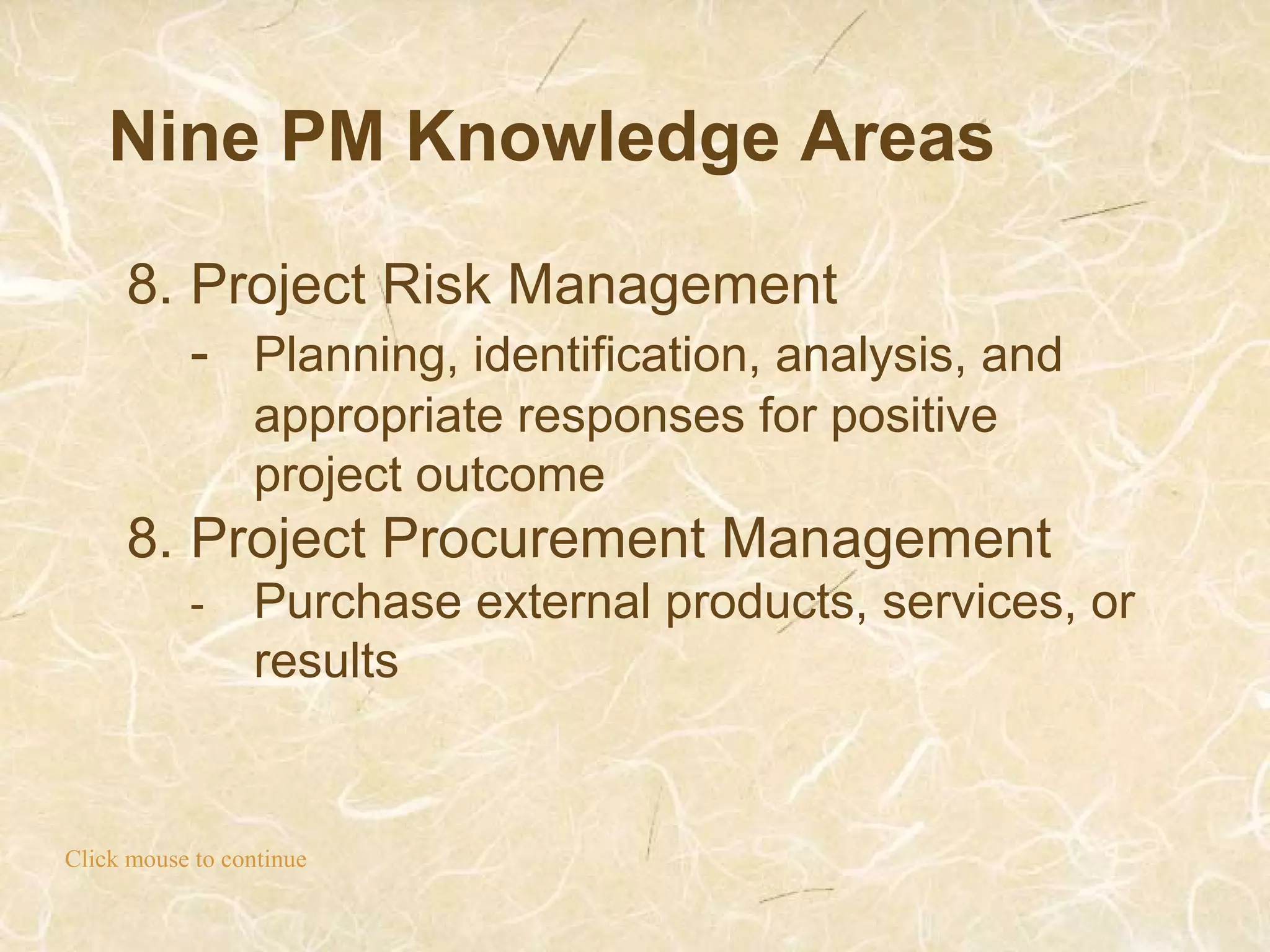
8. Project Risk Management
- Planning, identification, analysis, and
appropriate responses for positive
project outcome
8. Project Procurement Management
- Purchase external products, services, or
results
Title Footnotes
Click mouse to continue
 1; 2; and 3
 Source: Project Management
Fundamentals - Tony Swaim

project management

  • 1.
    Project Management: Still MoreArt Than Science Presented By Donald W. Larson AC Bronze, CL June 6, 2007
  • 2.
  • 3.
    Original Whitepaper Source Clickmouse to continue  Author: Kate Belzer - Copyright © 2001  http://www.pmforum.org/library/pa pers/2001/0102papers.htm#01  Used here by Don Larson for Technical Presentations Manual Project #4, “Presenting a Technical Paper”
  • 4.
    Change is Hereto Stay Click mouse to continue  Organizations change at breakneck speed to satisfy customers and maintain competitive  To thrive in this environment, project managers must meet the needs of the organization and assist businesses in delivering value to customers
  • 5.
    Understanding Business Value1 Clickmouse to continue  Who are our customers?  What value do we provide to them? (GAP Analysis)  Who will be our customers in the future?  How will we satisfy their needs?
  • 6.
    Delivering Business Value2 Clickmouse to continue  Strategic planning, through thoughtful consideration of these questions, leads to the creation of an organization that satisfies customer needs and provides an acceptable benefit to stakeholders  Strategic planning also provides a framework that stimulates projects to introduce new products and improve processes
  • 7.
    Strategies Beget Projects3 Clickmouse to continue  Projects are implemented to advance organizational goals  Potential projects must be aligned with your company's mission and strategic direction  Project must be a strategic fit
  • 8.
    What Makes aProject Successful? Click mouse to continue  Plan-Do-Check-Act [PDCA] (Walter Shewhart) - Limited knowledge, improving as we go - Velocity of change through iterations  Use processes, tools, and techniques  Soft skills - Working within the organization  Hard Skills (Supplemental Information) - Project Management Institute’s (PMI): - Five Process Groups - Nine Knowledge Areas
  • 9.
    Project Approaches Click mouseto continue  Project Management Body of Knowledge (PMBOK)  Unified Software Development Process  Critical Chain Project Management  Experience
  • 10.
    PMBOK Tools, Processes,and Techniques Click mouse to continue  What is required by the process: - Inputs  What occurs during the process  What are the deliverables of the process: - Outputs
  • 11.
    Using Only HardSkills Click mouse to continue  No clear communication means unclear deliverables, requirements, and dissatisfied customer  Lack of open communication can lead to issues reaching a critical point  Developing a plan in isolation can cause team instability  Lack of leadership results in failure
  • 12.
    Missing Link: TheAppropriate Application of Soft Skills Click mouse to continue  A clear understanding and effective application of soft skills enhance the success of a project exponentially: - A project manager must communicate effectively, work within the organization’s culture, motivate the team, manage stakeholder expectations, understand business objectives, solve problems effectively, and make clear and knowledgeable decisions
  • 13.
    Soft Skills: Communication Clickmouse to continue  The most important skill: - Convey complex ideas easily - Clearly articulate what must be accomplished - Keep team moving toward a common goal - Foster an environment that allows team members to communicate openly and honestly - Admit own mistakes without losing respect - Negotiate, listen, and facilitate
  • 14.
    Holistic View ofOrganization Click mouse to continue
  • 15.
    Grow with Today’sBusiness Click mouse to continue  It is inherently complex  Constantly changing  Focused on customer satisfaction
  • 16.
    Master the Challenge Clickmouse to continue  Delivering business value on time, within budget, and to the customers' satisfaction is both science and art  Master the timeless soft skills to supplement the hard skills for success
  • 17.
    Supplemental Information Click mouseto continue  Five PM Process Groups  Nine PM Knowledge Areas  20 Key Project Manager Actions and Results  Management By Objective  The Center for Collaborative Organizations  Managing Team Conflict
  • 18.
    Five PM ProcessGroups Click mouse to continue 1. Initiating - Defines and authorizes the project or a project phase 2. Planning - Defines and refines objectives - Plans course of action 3. Executing - Integrates people and/or other resources
  • 19.
    Five PM ProcessGroups Click mouse to continue 4. Monitoring and Controlling - Measure and monitors progress - Identifies variances - Takes corrective actions 4. Closing - Formalizes acceptance of deliverables - Brings project or phase to an orderly end
  • 20.
    Nine PM KnowledgeAreas Click mouse to continue 1. Project Management Integration - Identify processes and activities within the groups 2. Project Scope Management - Insure all the work required - Only the work required 3. Project Time Management - Accomplish timely completion
  • 21.
    Nine PM KnowledgeAreas Click mouse to continue 4. Project Cost Management - Planning - Estimating - Budgeting - Controlling 4. Project Quality Management - Satisfy needs of stakeholders
  • 22.
    Nine PM KnowledgeAreas Click mouse to continue 6. Project Human Resources Management - Organize and manage team 6. Project Communications Management - Ensure timely and appropriate: - generation, collection, distribution, storage, retrieval, and ultimate disposition of project information
  • 23.
    Nine PM KnowledgeAreas Click mouse to continue 8. Project Risk Management - Planning, identification, analysis, and appropriate responses for positive project outcome 8. Project Procurement Management - Purchase external products, services, or results
  • 24.
    Title Footnotes Click mouseto continue  1; 2; and 3  Source: Project Management Fundamentals - Tony Swaim