1
Data Structures
Performance Analysis
2
Fundamental Concepts
Some fundamental concepts that you should
know:
– Dynamic memory allocation.
– Recursion.
– Performance analysis.
3
Performance Analysis
• There are problems and algorithms to solve them.
• Problems and problem instances.
• Example: Sorting data in ascending order.
– Problem: Sorting
– Problem Instance: e.g. sorting data (2 3 9 5 6 8)
– Algorithms: Bubble sort, Merge sort, Quick sort,
Selection sort, etc.
• Which is the best algorithm for the problem? How
do we judge?
4
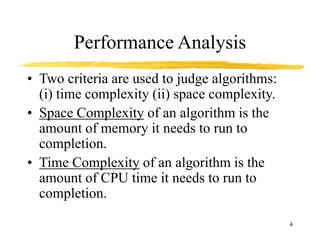
Performance Analysis
• Two criteria are used to judge algorithms:
(i) time complexity (ii) space complexity.
• Space Complexity of an algorithm is the
amount of memory it needs to run to
completion.
• Time Complexity of an algorithm is the
amount of CPU time it needs to run to
completion.
5
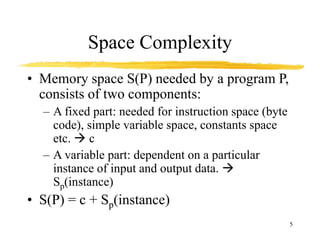
Space Complexity
• Memory space S(P) needed by a program P,
consists of two components:
– A fixed part: needed for instruction space (byte
code), simple variable space, constants space
etc.  c
– A variable part: dependent on a particular
instance of input and output data. 
Sp(instance)
• S(P) = c + Sp(instance)
6
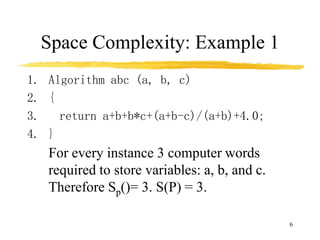
Space Complexity: Example 1
1. Algorithm abc (a, b, c)
2. {
3. return a+b+b*c+(a+b-c)/(a+b)+4.0;
4. }
For every instance 3 computer words
required to store variables: a, b, and c.
Therefore Sp()= 3. S(P) = 3.
7
Space Complexity: Example 2
1. Algorithm Sum(a[], n)
2. {
3. s:= 0.0;
4. for i = 1 to n do
5. s := s + a[i];
6. return s;
7. }
8
Space Complexity: Example 2.
• Every instance needs to store array a[] & n.
– Space needed to store n = 1 word.
– Space needed to store a[ ] = n floating point
words (or at least n
words)
– Space needed to store i and s = 2 words
• Sp(n) = (n + 3). Hence S(P) = (n + 3).
9
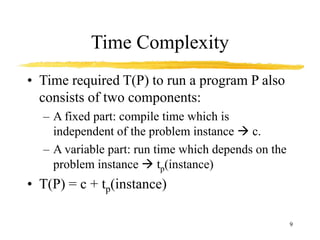
Time Complexity
• Time required T(P) to run a program P also
consists of two components:
– A fixed part: compile time which is
independent of the problem instance  c.
– A variable part: run time which depends on the
problem instance  tp(instance)
• T(P) = c + tp(instance)
10
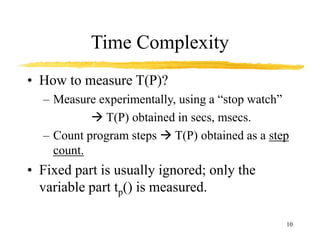
Time Complexity
• How to measure T(P)?
– Measure experimentally, using a “stop watch”
 T(P) obtained in secs, msecs.
– Count program steps  T(P) obtained as a step
count.
• Fixed part is usually ignored; only the
variable part tp() is measured.
11
Time Complexity
• What is a program step?
– a+b+b*c+(a+b)/(a-b)  one step;
– comments  zero steps;
–while (<expr>) do  step count equal to
the number of times <expr> is executed.
–for i=<expr> to <expr1> do  step count
equal to number of times <expr1> is checked.
12
Time Complexity: Example 1
Statements S/E Freq. Total
1 Algorithm Sum(a[],n) 0 - 0
2 { 0 - 0
3 S = 0.0; 1 1 1
4 for i=1 to n do 1 n+1 n+1
5 s = s+a[i]; 1 n n
6 return s; 1 1 1
7 } 0 - 0
2n+3
13
Time Complexity: Example 2
Statements S/E Freq. Total
1 Algorithm Sum(a[],n,m) 0 - 0
2 { 0 - 0
3 for i=1 to n do; 1 n+1 n+1
4 for j=1 to m do 1 n(m+1) n(m+1)
5 s = s+a[i][j]; 1 nm nm
6 return s; 1 1 1
2nm+2n+2
14
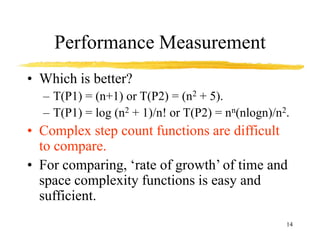
Performance Measurement
• Which is better?
– T(P1) = (n+1) or T(P2) = (n2 + 5).
– T(P1) = log (n2 + 1)/n! or T(P2) = nn(nlogn)/n2.
• Complex step count functions are difficult
to compare.
• For comparing, ‘rate of growth’ of time and
space complexity functions is easy and
sufficient.
15
Big O Notation
• Big O of a function gives us ‘rate of growth’ of the
step count function f(n), in terms of a simple
function g(n), which is easy to compare.
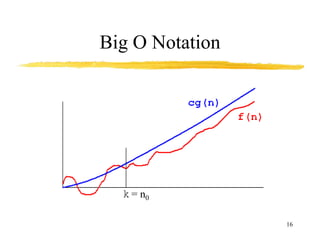
• Definition: [Big O] The function f(n) = O(g(n))
(big ‘oh’ of g of n) iff there exist positive
constants c and n0 such that f(n) <= c*g(n) for all
n, n>=n0. See graph on next slide.
• Example: f(n) = 3n+2 is O(n) because 3n+2 <= 4n
for all n >= 2. c = 4, n0 = 2. Here g(n) = n.
16
Big O Notation
= n0
17
Big O Notation
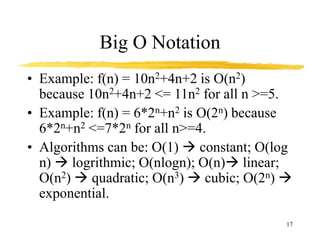
• Example: f(n) = 10n2+4n+2 is O(n2)
because 10n2+4n+2 <= 11n2 for all n >=5.
• Example: f(n) = 6*2n+n2 is O(2n) because
6*2n+n2 <=7*2n for all n>=4.
• Algorithms can be: O(1)  constant; O(log
n)  logrithmic; O(nlogn); O(n) linear;
O(n2)  quadratic; O(n3)  cubic; O(2n) 
exponential.
18
Big O Notation
• Now it is easy to compare time or space
complexities of algorithms. Which
algorithm complexity is better?
– T(P1) = O(n) or T(P2) = O(n2)
– T(P1) = O(1) or T(P2) = O(log n)
– T(P1) = O(2n) or T(P2) = O(n10)
19
Some Results
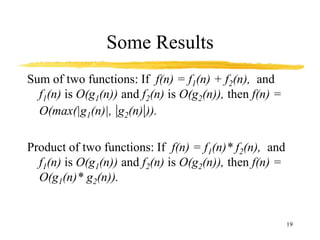
Sum of two functions: If f(n) = f1(n) + f2(n), and
f1(n) is O(g1(n)) and f2(n) is O(g2(n)), then f(n) =
O(max(|g1(n)|, |g2(n)|)).
Product of two functions: If f(n) = f1(n)* f2(n), and
f1(n) is O(g1(n)) and f2(n) is O(g2(n)), then f(n) =
O(g1(n)* g2(n)).

ALGORITHM-ANALYSIS.ppt

  • 1.
  • 2.
    2 Fundamental Concepts Some fundamentalconcepts that you should know: – Dynamic memory allocation. – Recursion. – Performance analysis.
  • 3.
    3 Performance Analysis • Thereare problems and algorithms to solve them. • Problems and problem instances. • Example: Sorting data in ascending order. – Problem: Sorting – Problem Instance: e.g. sorting data (2 3 9 5 6 8) – Algorithms: Bubble sort, Merge sort, Quick sort, Selection sort, etc. • Which is the best algorithm for the problem? How do we judge?
  • 4.
    4 Performance Analysis • Twocriteria are used to judge algorithms: (i) time complexity (ii) space complexity. • Space Complexity of an algorithm is the amount of memory it needs to run to completion. • Time Complexity of an algorithm is the amount of CPU time it needs to run to completion.
  • 5.
    5 Space Complexity • Memoryspace S(P) needed by a program P, consists of two components: – A fixed part: needed for instruction space (byte code), simple variable space, constants space etc.  c – A variable part: dependent on a particular instance of input and output data.  Sp(instance) • S(P) = c + Sp(instance)
  • 6.
    6 Space Complexity: Example1 1. Algorithm abc (a, b, c) 2. { 3. return a+b+b*c+(a+b-c)/(a+b)+4.0; 4. } For every instance 3 computer words required to store variables: a, b, and c. Therefore Sp()= 3. S(P) = 3.
  • 7.
    7 Space Complexity: Example2 1. Algorithm Sum(a[], n) 2. { 3. s:= 0.0; 4. for i = 1 to n do 5. s := s + a[i]; 6. return s; 7. }
  • 8.
    8 Space Complexity: Example2. • Every instance needs to store array a[] & n. – Space needed to store n = 1 word. – Space needed to store a[ ] = n floating point words (or at least n words) – Space needed to store i and s = 2 words • Sp(n) = (n + 3). Hence S(P) = (n + 3).
  • 9.
    9 Time Complexity • Timerequired T(P) to run a program P also consists of two components: – A fixed part: compile time which is independent of the problem instance  c. – A variable part: run time which depends on the problem instance  tp(instance) • T(P) = c + tp(instance)
  • 10.
    10 Time Complexity • Howto measure T(P)? – Measure experimentally, using a “stop watch”  T(P) obtained in secs, msecs. – Count program steps  T(P) obtained as a step count. • Fixed part is usually ignored; only the variable part tp() is measured.
  • 11.
    11 Time Complexity • Whatis a program step? – a+b+b*c+(a+b)/(a-b)  one step; – comments  zero steps; –while (<expr>) do  step count equal to the number of times <expr> is executed. –for i=<expr> to <expr1> do  step count equal to number of times <expr1> is checked.
  • 12.
    12 Time Complexity: Example1 Statements S/E Freq. Total 1 Algorithm Sum(a[],n) 0 - 0 2 { 0 - 0 3 S = 0.0; 1 1 1 4 for i=1 to n do 1 n+1 n+1 5 s = s+a[i]; 1 n n 6 return s; 1 1 1 7 } 0 - 0 2n+3
  • 13.
    13 Time Complexity: Example2 Statements S/E Freq. Total 1 Algorithm Sum(a[],n,m) 0 - 0 2 { 0 - 0 3 for i=1 to n do; 1 n+1 n+1 4 for j=1 to m do 1 n(m+1) n(m+1) 5 s = s+a[i][j]; 1 nm nm 6 return s; 1 1 1 2nm+2n+2
  • 14.
    14 Performance Measurement • Whichis better? – T(P1) = (n+1) or T(P2) = (n2 + 5). – T(P1) = log (n2 + 1)/n! or T(P2) = nn(nlogn)/n2. • Complex step count functions are difficult to compare. • For comparing, ‘rate of growth’ of time and space complexity functions is easy and sufficient.
  • 15.
    15 Big O Notation •Big O of a function gives us ‘rate of growth’ of the step count function f(n), in terms of a simple function g(n), which is easy to compare. • Definition: [Big O] The function f(n) = O(g(n)) (big ‘oh’ of g of n) iff there exist positive constants c and n0 such that f(n) <= c*g(n) for all n, n>=n0. See graph on next slide. • Example: f(n) = 3n+2 is O(n) because 3n+2 <= 4n for all n >= 2. c = 4, n0 = 2. Here g(n) = n.
  • 16.
  • 17.
    17 Big O Notation •Example: f(n) = 10n2+4n+2 is O(n2) because 10n2+4n+2 <= 11n2 for all n >=5. • Example: f(n) = 6*2n+n2 is O(2n) because 6*2n+n2 <=7*2n for all n>=4. • Algorithms can be: O(1)  constant; O(log n)  logrithmic; O(nlogn); O(n) linear; O(n2)  quadratic; O(n3)  cubic; O(2n)  exponential.
  • 18.
    18 Big O Notation •Now it is easy to compare time or space complexities of algorithms. Which algorithm complexity is better? – T(P1) = O(n) or T(P2) = O(n2) – T(P1) = O(1) or T(P2) = O(log n) – T(P1) = O(2n) or T(P2) = O(n10)
  • 19.
    19 Some Results Sum oftwo functions: If f(n) = f1(n) + f2(n), and f1(n) is O(g1(n)) and f2(n) is O(g2(n)), then f(n) = O(max(|g1(n)|, |g2(n)|)). Product of two functions: If f(n) = f1(n)* f2(n), and f1(n) is O(g1(n)) and f2(n) is O(g2(n)), then f(n) = O(g1(n)* g2(n)).