Download to read offline

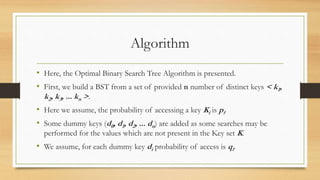
![Algorithm
int sum(int freq[], int i, int j);
int optCost(int freq[], int i, int j)
{
if (j < i) // no elements in this subarray
return 0;
if (j == i)
return freq[i];
int fsum = sum(freq, i, j);
int min = INT_MAX;
for (int r = i; r <= j; ++r)
{
int cost = optCost(freq, i, r - 1) +
optCost(freq, r + 1, j);
if (cost < min)
min = cost;
}
return min + fsum;
}
int optimalSearchTree(int keys[],
int freq[], int n) {
return optCost(freq, 0, n - 1);
}
int sum(int freq[], int i, int j) {
int s = 0;
for (int k = i; k <= j; k++)
s += freq[k];
return s;
}
int main() {
int keys[] = {10, 12, 20};
int freq[] = {34, 8, 50};
int n = sizeof(keys) / sizeof(keys[0]);
cout << "Cost of Optimal BST is "
<< optimalSearchTree(keys, freq, n);
return 0;
}](https://image.slidesharecdn.com/daaopticalbinarysearch-200228183146/85/OPTIMAL-BINARY-SEARCH-4-320.jpg)
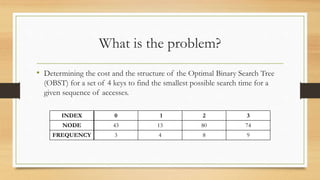
![Solving the Problem
• First for l = 1
calculating costs of following
Cost[0,0] = 3
Cost[1,1] = 4
Cost[2,2] = 8
Cost[3,3] = 9
• Now for l = 2
calculating cost
Cost[0,1] = 10
Cost[1,2] = 16](https://image.slidesharecdn.com/daaopticalbinarysearch-200228183146/85/OPTIMAL-BINARY-SEARCH-5-320.jpg)
![Solving the Problem
• For l = 2
calculating cost
Cost[2,3] = 25
• Now for l = 3
calculating cost
Cost[0,2] = 25
Cost[1,3] = 34
• For l = 4
calculating cost
Cost[0,3] = 43 (Maximum frequency)](https://image.slidesharecdn.com/daaopticalbinarysearch-200228183146/85/OPTIMAL-BINARY-SEARCH-6-320.jpg)
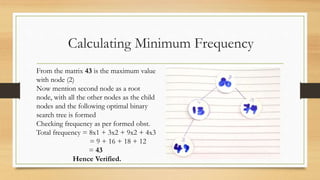


This document describes the optimal binary search tree algorithm. It finds the structure of the optimal binary search tree (OBST) that results in the smallest possible search time for a given sequence of key accesses. It builds a BST from a set of keys with access probabilities. It calculates the costs of different subtree configurations in a bottom-up dynamic programming approach to find the overall minimum cost tree. As an example, it calculates the optimal BST for 4 keys with frequencies 3, 4, 8, 9, which has a cost of 43 and root node 2.


![제 23회 보아즈(BOAZ) 빅데이터 컨퍼런스 - [MBOAX] : ABSA를 활용한 소비자 반응 분석 기반 운영 효율화 대시보드 설계](https://cdn.slidesharecdn.com/ss_thumbnails/3-1boaz23rdconferencemboax-260203102709-9d519923-thumbnail.jpg?width=640&height=640&fit=bounds)


