Packing Curved
Objects
Ignacio SALAS & Gilles CHABERT
Outline
Motivation
Method
Method: Inner Inflator
Experimental Results
Conclusions
Definitions
2
Motivation
3
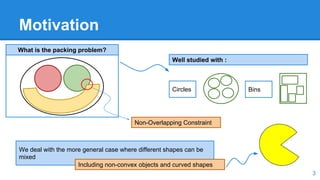
What is the packing problem?
Well studied with :
Circles Bins
We deal with the more general case where different shapes can be
mixed
Including non-convex objects and curved shapes
Non-Overlapping Constraint
Motivation: Using CMA-ES
In [Mar13] the packing problem was solved minimizing a violation function
with the CMA-ES algorithm. The function is a measure of overlapping.
The approach gives
encouraging results, but
requires ad-hoc distance
functions for each pair of
objects
Our objective is to replace these ad-hoc formulas by a numerical algorithm
4
Definitions: The objects
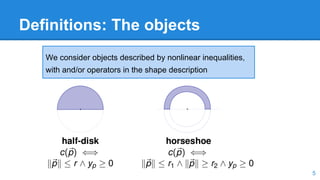
We consider objects described by nonlinear inequalities,
with and/or operators in the shape description
5
Definitions: The non-overlapping
constraint
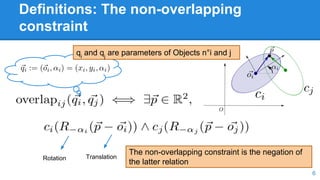
The non-overlapping constraint is the negation of
the latter relation
6
qi
and qj
are parameters of Objects n°i and j
Rotation Translation
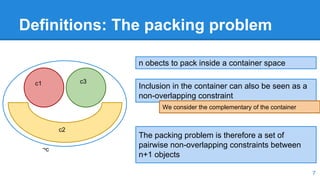
Definitions: The packing problem
The packing problem is therefore a set of
pairwise non-overlapping constraints between
n+1 objects
n obects to pack inside a container space
Inclusion in the container can also be seen as a
non-overlapping constraint
We consider the complementary of the container
c1
c2
c3
¬c
7
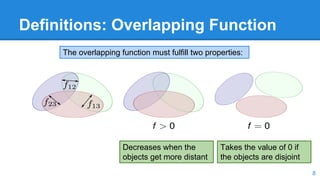
Definitions: Overlapping Function
The overlapping function must fulfill two properties:
8
Decreases when the
objects get more distant
Takes the value of 0 if
the objects are disjoint
Definitions: Overlapping Function
A ⦅distance to satisfaction⦆
A generic definition is:
9
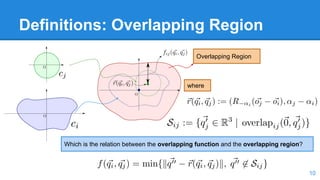
Definitions: Overlapping Region
Overlapping Region
10
where
Which is the relation between the overlapping function and the overlapping region?
Off-line
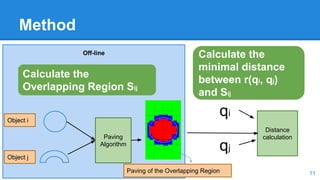
Method
Calculate the
Overlapping Region Sij
Calculate the
minimal distance
between r(qi, qj)
and Sij
Paving
Algorithm
Paving of the Overlapping Region
Distance
calculation
qi
qj
11
Object i
Object j
Method: Paving of the Overlapping Region
Outer Rejection Test
Inner Inflation [detailed further]
Bisection
Branch and Bound algorithm, that alternates 3 steps:
Starts with an arbitrary large box [qj]
The paving is stored in a tree structure
12
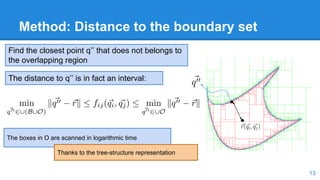
Method: Distance to the boundary set
Find the closest point q’’ that does not belongs to
the overlapping region
The distance to q’’ is in fact an interval:
The boxes in O are scanned in logarithmic time
Thanks to the tree-structure representation
13
Resulting
inflation
Method: Inner Inflation
p satisfies
14
Translation Rotation
The boundary angles of [ᾱ , ⍶] are two angles that
makes the boundary of Object j meets p
~
~
Method: Inner Inflation
15
Cartesian
Product [ᾱ , ⍶][oj
]
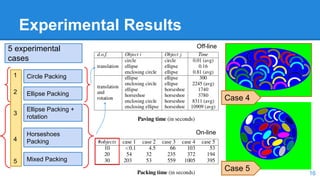
Experimental Results
16
Off-line
On-line
5 experimental
cases
Circle Packing
Ellipse Packing
Ellipse Packing +
rotation
Horseshoes
Packing
Mixed Packing
Case 4
Case 5
1
2
3
4
5
Conclusions
We have presented a numerical algorithm that replaces such formulas.
The experimental results shows that our approach:
In [Mar13] was proposed an original approach for solving the generic packing
problem, requiring ad-hoc distance formulas.
17
Is not competitive for standard packing problems.
But is able to pack arbitrary objects, including non-convex ones.
The approach is particularly well-suited for uniform packing.
Limitation: the processing time increases with the number of shapes.
Objects with the same shape
Thank You !
18
Packing Curved
Objects
Ignacio SALAS & Gilles CHABERT

Packing Curved Objects

  • 1.
  • 2.
  • 3.
    Motivation 3 What is thepacking problem? Well studied with : Circles Bins We deal with the more general case where different shapes can be mixed Including non-convex objects and curved shapes Non-Overlapping Constraint
  • 4.
    Motivation: Using CMA-ES In[Mar13] the packing problem was solved minimizing a violation function with the CMA-ES algorithm. The function is a measure of overlapping. The approach gives encouraging results, but requires ad-hoc distance functions for each pair of objects Our objective is to replace these ad-hoc formulas by a numerical algorithm 4
  • 5.
    Definitions: The objects Weconsider objects described by nonlinear inequalities, with and/or operators in the shape description 5
  • 6.
    Definitions: The non-overlapping constraint Thenon-overlapping constraint is the negation of the latter relation 6 qi and qj are parameters of Objects n°i and j Rotation Translation
  • 7.
    Definitions: The packingproblem The packing problem is therefore a set of pairwise non-overlapping constraints between n+1 objects n obects to pack inside a container space Inclusion in the container can also be seen as a non-overlapping constraint We consider the complementary of the container c1 c2 c3 ¬c 7
  • 8.
    Definitions: Overlapping Function Theoverlapping function must fulfill two properties: 8 Decreases when the objects get more distant Takes the value of 0 if the objects are disjoint
  • 9.
    Definitions: Overlapping Function A⦅distance to satisfaction⦆ A generic definition is: 9
  • 10.
    Definitions: Overlapping Region OverlappingRegion 10 where Which is the relation between the overlapping function and the overlapping region?
  • 11.
    Off-line Method Calculate the Overlapping RegionSij Calculate the minimal distance between r(qi, qj) and Sij Paving Algorithm Paving of the Overlapping Region Distance calculation qi qj 11 Object i Object j
  • 12.
    Method: Paving ofthe Overlapping Region Outer Rejection Test Inner Inflation [detailed further] Bisection Branch and Bound algorithm, that alternates 3 steps: Starts with an arbitrary large box [qj] The paving is stored in a tree structure 12
  • 13.
    Method: Distance tothe boundary set Find the closest point q’’ that does not belongs to the overlapping region The distance to q’’ is in fact an interval: The boxes in O are scanned in logarithmic time Thanks to the tree-structure representation 13
  • 14.
    Resulting inflation Method: Inner Inflation psatisfies 14 Translation Rotation The boundary angles of [ᾱ , ⍶] are two angles that makes the boundary of Object j meets p ~ ~
  • 15.
  • 16.
    Experimental Results 16 Off-line On-line 5 experimental cases CirclePacking Ellipse Packing Ellipse Packing + rotation Horseshoes Packing Mixed Packing Case 4 Case 5 1 2 3 4 5
  • 17.
    Conclusions We have presenteda numerical algorithm that replaces such formulas. The experimental results shows that our approach: In [Mar13] was proposed an original approach for solving the generic packing problem, requiring ad-hoc distance formulas. 17 Is not competitive for standard packing problems. But is able to pack arbitrary objects, including non-convex ones. The approach is particularly well-suited for uniform packing. Limitation: the processing time increases with the number of shapes. Objects with the same shape
  • 18.
  • 19.