LIMBIC SYSTEM
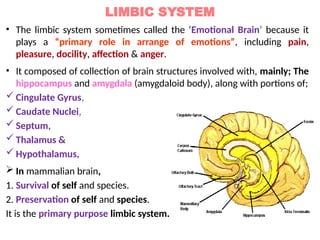
• The limbic system sometimes called the ‘Emotional Brain’ because it
plays a “primary role in arrange of emotions”, including pain,
pleasure, docility, affection & anger.
• It composed of collection of brain structures involved with, mainly; The
hippocampus and amygdala (amygdaloid body), along with portions of;
 Cingulate Gyrus,
 Caudate Nuclei,
 Septum,
 Thalamus &
 Hypothalamus,
 In mammalian brain,
1. Survival of self and species.
2. Preservation of self and species.
It is the primary purpose limbic system.
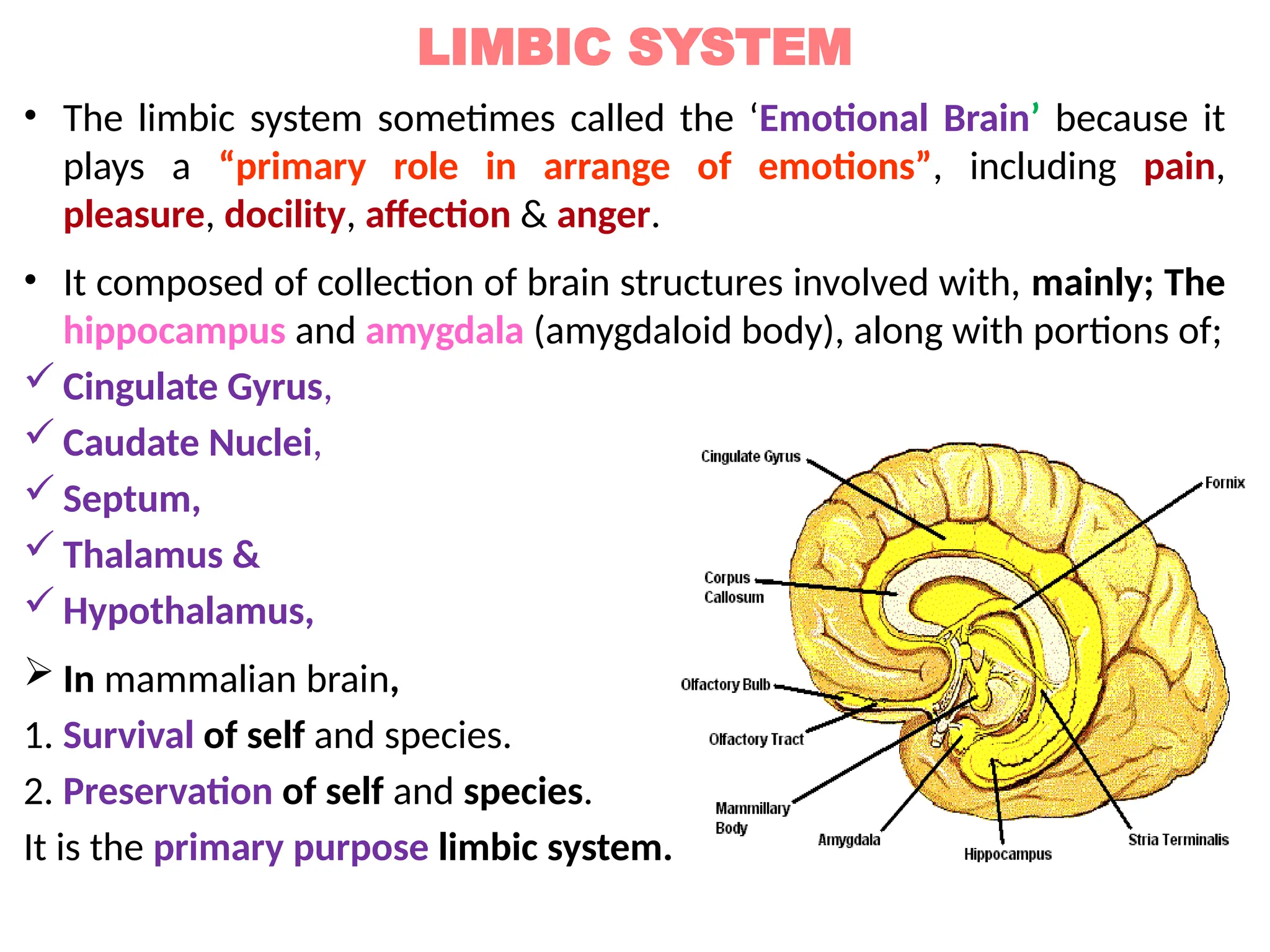
Cont…………..!
The behavior of the mammalian brain is said to “revolve’
around”
Fighting,
Fleeing,
Mating,
Feeding,
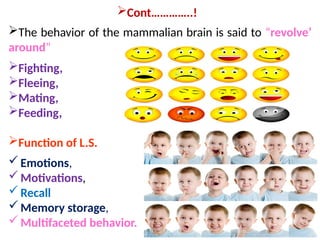
Function of L.S.
Emotions,
Motivations,
Recall
Memory storage,
Multifaceted behavior.
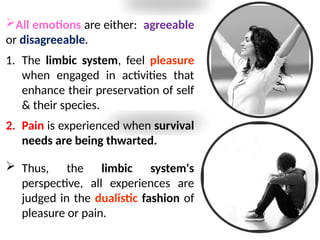
All emotions are either: agreeable
or disagreeable.
1. The limbic system, feel pleasure
when engaged in activities that
enhance their preservation of self
& their species.
2. Pain is experienced when survival
needs are being thwarted.
 Thus, the limbic system's
perspective, all experiences are
judged in the dualistic fashion of
pleasure or pain.
 It interconnect with the
cerebral cortex comprises
the "human" brain and is
associated with advanced
functions such as;
1. Planning,
2. Thinking,
3. Analyzing,
4. Communicating,
5. Memory &
6. Behavior.
 Hippocampus
The hippocampus is comprised of rows of 40 million nerve cells. Its
main function; converting short-term memory into long-term
memory.
If damage to hippocampus, causes disability to make new
memories.
The Hippocampus in the Right hemisphere of the brain is concerned
with Visual, Emotional, Tactile, and Non-verbal memories.
The Hippocampus in the Left hemisphere stores Verbal and
Mathematical memories.
Ultimately, it stores the memories which are of emotional and
motivational significance.
Schizophrenia: The physiological aspects of schizophrenia have
been linked to the hippocampus,
The cells of the hippocampus which are normally arranged in an
ordered manner, are grossly disarranged in the brains of
“Schizophrenics” patient.
Amygdala
The Amygdala (amygdaloid body) is interconnected with the
hypothalamus, septal nucleus, and hippocampus.
Function: The job of the amygdala is to Discern (discard) the
emotional significance of all aspects of experience.
It adds color to thoughts and It is responsible for the capacity to
feel complex emotions, like love and anxiety.
The Amygdala is extremely sensitive to tactile stimulation and is
involved with memory.
The Visual and auditory perceptual information is received by the
amygdala causes an emotional influence on perception and
thought.
Damage to the amygdala can cause, a person to misperceive or fail
to perceive societal cues which are emotionally based.
Traditionally, the amygdala has been linked to violent tendencies
and behavior.
Septal Nuclei
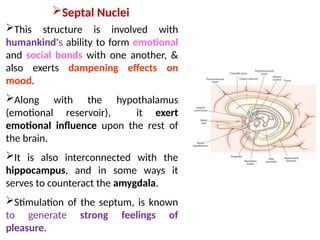
This structure is involved with
humankind's ability to form emotional
and social bonds with one another, &
also exerts dampening effects on
mood.
Along with the hypothalamus
(emotional reservoir), it exert
emotional influence upon the rest of
the brain.
It is also interconnected with the
hippocampus, and in some ways it
serves to counteract the amygdala.
Stimulation of the septum, is known
to generate strong feelings of
pleasure.
Cingulate Gyrus
The cortex covering the cingulate gyrus is an important part of the
limbic system.
The cingulate gyrus involves three distinct behavior centers;
Nursing and Maternal care, and Audio-vocal communication.
The three behavior centers are exhibited by mammals which have a
cingulate gyrus, and not by reptiles who lack a cingulate gyrus.
It interfere the ‘decision-making’ processes between the frontal
cortex, the emotional functions of the limbic system, and the brain
controlling movement mechanisms.
The cingulate gyrus also communicates with the rest of the limbic
system and other regions of the frontal cortex.
Electrical stimulation of this part of the limbic system produces
feelings that are either emotionally positive or negative.
In general, the cingulate gyrus plays an excitatory role in emotions
and motivated behavior.
INTERNAL CAPSULE
It is v shaped band of fibers bounded medially by thalamus, caudate
nucleus & laterally by lantiform nucleus. It is divided into three limbs;
Anterior, Posterior & Genu
Most of ascending & descending cortical fibers pass through this
area, all fibers are condensed in this small area,
slight damage to this area causes; extensive loss of function on
opposite side.
Applied physiology: (Blood supply) Lateral sriate branch
(lanticulostriate artery) of the middle cerebral artery, recurrent branch
of the anterior cerebral artery & anterior choroid branch of internal
carotid artery supply the internal capsule.
One of the branches of lateral striate artery or lanticulostriate artery
is frequently ruptured & it is known as charcott’s artery of cerebral
haemorrhage.
Frequent rupture this; because of the lanticulo striate artery
remains under very high pressure & it has no collateral branches.
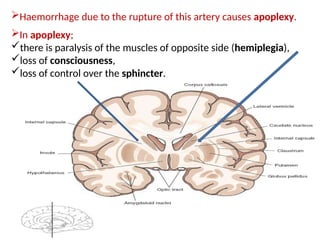
Haemorrhage due to the rupture of this artery causes apoplexy.
In apoplexy;
there is paralysis of the muscles of opposite side (hemiplegia),
loss of consciousness,
loss of control over the sphincter.
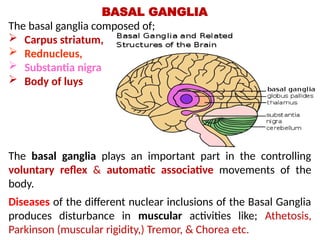
BASAL GANGLIA
The basal ganglia composed of;
 Carpus striatum,
 Rednucleus,
 Substantia nigra
 Body of luys
The basal ganglia plays an important part in the controlling
voluntary reflex & automatic associative movements of the
body.
Diseases of the different nuclear inclusions of the Basal Ganglia
produces disturbance in muscular activities like; Athetosis,
Parkinson (muscular rigidity,) Tremor, & Chorea etc.
Carpus Striatum
It is mass of gray matter, it is placed lateral & anterior to the
thalamus.
It has two part; the smaller anterior part (Caudate nuclei), the larger
posterior part (Lanticular nucleus)- 2types; putmen & globus pallidum
(pallidus).
Putmen & caudate nucleus contains small satellite cells, resembling
sensory cortex & mostly receive afferent striate fibers.
Globus pallidus contains pyramid cells or multipolar cells, all
efferent striate fibers arises from it.
Putamen & Caudate nucleus acts as receiving center, where as
globus pallidus act as discharging center of basal ganglia.
Corpus striatum communicates directly or indirectly with cerebral
cortex (areas 4, 4s, 6, 8s, & 2s), thalamus, hypothalamus, cerebellum,
midbrain.
It guides & controls the activities of almost all important parts of the
nervous system both somatic & automatic.
Red Nucleus:
It is a large, oval mass of the gray matter in the
tegmentum of midbrain, laying bellow the thalamus & close
to the third ventricle nucleus.
The colour of the this nucleus is due to the presence of
the reddish brown lipochrome,
It consists of;
Old-part with large cell as (nucleus magnocellularis) &
New-part with small cells (nucleus parvocellularis).
From old part, motor (efferent) fibers arises, while the
new part receives all the afferent fibers.
The kinaesthetic impulses from spinal cord, carried
through flechsig’s & gower’s tracts are relayed to the red
nucleus.
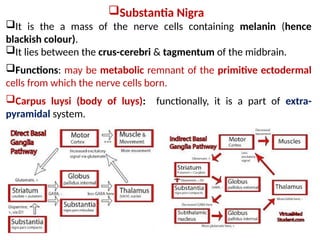
Substantia Nigra
It is the a mass of the nerve cells containing melanin (hence
blackish colour).
It lies between the crus-cerebri & tagmentum of the midbrain.
Functions: may be metabolic remnant of the primitive ectodermal
cells from which the nerve cells born.
Carpus luysi (body of luys): functionally, it is a part of extra-
pyramidal system.
Function of the Basal ganglia
It is the primitive motor cortex for voluntary muscular activity (area
4 & 6), in primates the pre-central cortex (area 4, 6) is highest motor
centers.
It control muscular activity:
It exert inhibitory effect on the spinal reflexes, & regulates the activity
of the muscles which maintain posture.
Thus diseases to Basal Ganglia produce muscular rigidity which is seen
in Parkinson’s & paralysis.
Lesion in the Globus pallidus & Substintia nigra are concerned with
the tremor in the parkinsonism.
1. Carpus striatum:
It controls automatic & associative movements:
This movements are initiated by area-6 & mediated by carpus
striatum, such as swinging of arms during walking.
It checks abnormal involuntary movements:
In lesion to the carpus striatum, abnormal involuntary movements
occurs.
It controls the group of movements for emotional expressions:
Disease to Carpus striatum causes lack of emotional expression
(mask like appearance: Parkinson disease)
2. Red nucleus:
It is relay station & co-ordinating center for many motor & sensory
impulses & act as a center for reflexes.
3.Substintia nigra:
it is highly developed in man & higher apes, it is regarded as the
center for the co-ordinating of those impulses which are essential
for the Skilled movements.
Substintia nigra is concerned with the tremor in the parkinsonism.
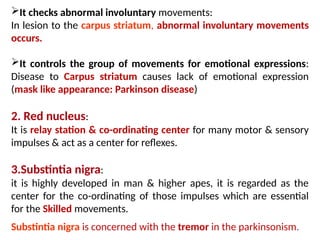
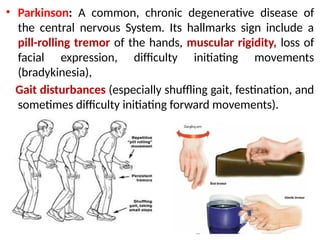
• Parkinson: A common, chronic degenerative disease of
the central nervous System. Its hallmarks sign include a
pill-rolling tremor of the hands, muscular rigidity, loss of
facial expression, difficulty initiating movements
(bradykinesia),
Gait disturbances (especially shuffling gait, festination, and
sometimes difficulty initiating forward movements).
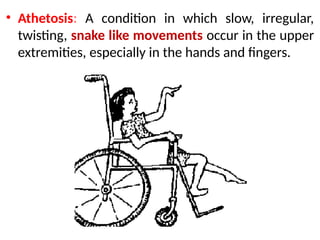
• Athetosis: A condition in which slow, irregular,
twisting, snake like movements occur in the upper
extremities, especially in the hands and fingers.
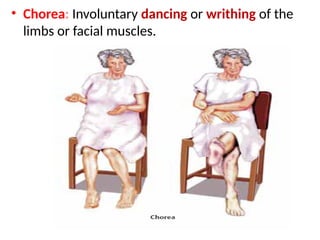
• Chorea: Involuntary dancing or writhing of the
limbs or facial muscles.
5  Limbic System  &  Basal Ganglia .pptx

5 Limbic System & Basal Ganglia .pptx

  • 1.
    LIMBIC SYSTEM • Thelimbic system sometimes called the ‘Emotional Brain’ because it plays a “primary role in arrange of emotions”, including pain, pleasure, docility, affection & anger. • It composed of collection of brain structures involved with, mainly; The hippocampus and amygdala (amygdaloid body), along with portions of;  Cingulate Gyrus,  Caudate Nuclei,  Septum,  Thalamus &  Hypothalamus,  In mammalian brain, 1. Survival of self and species. 2. Preservation of self and species. It is the primary purpose limbic system.
  • 2.
    Cont…………..! The behavior ofthe mammalian brain is said to “revolve’ around” Fighting, Fleeing, Mating, Feeding, Function of L.S. Emotions, Motivations, Recall Memory storage, Multifaceted behavior.
  • 3.
    All emotions areeither: agreeable or disagreeable. 1. The limbic system, feel pleasure when engaged in activities that enhance their preservation of self & their species. 2. Pain is experienced when survival needs are being thwarted.  Thus, the limbic system's perspective, all experiences are judged in the dualistic fashion of pleasure or pain.
  • 4.
     It interconnectwith the cerebral cortex comprises the "human" brain and is associated with advanced functions such as; 1. Planning, 2. Thinking, 3. Analyzing, 4. Communicating, 5. Memory & 6. Behavior.
  • 5.
     Hippocampus The hippocampusis comprised of rows of 40 million nerve cells. Its main function; converting short-term memory into long-term memory. If damage to hippocampus, causes disability to make new memories. The Hippocampus in the Right hemisphere of the brain is concerned with Visual, Emotional, Tactile, and Non-verbal memories. The Hippocampus in the Left hemisphere stores Verbal and Mathematical memories. Ultimately, it stores the memories which are of emotional and motivational significance. Schizophrenia: The physiological aspects of schizophrenia have been linked to the hippocampus, The cells of the hippocampus which are normally arranged in an ordered manner, are grossly disarranged in the brains of “Schizophrenics” patient.
  • 6.
    Amygdala The Amygdala (amygdaloidbody) is interconnected with the hypothalamus, septal nucleus, and hippocampus. Function: The job of the amygdala is to Discern (discard) the emotional significance of all aspects of experience. It adds color to thoughts and It is responsible for the capacity to feel complex emotions, like love and anxiety. The Amygdala is extremely sensitive to tactile stimulation and is involved with memory. The Visual and auditory perceptual information is received by the amygdala causes an emotional influence on perception and thought. Damage to the amygdala can cause, a person to misperceive or fail to perceive societal cues which are emotionally based. Traditionally, the amygdala has been linked to violent tendencies and behavior.
  • 7.
    Septal Nuclei This structureis involved with humankind's ability to form emotional and social bonds with one another, & also exerts dampening effects on mood. Along with the hypothalamus (emotional reservoir), it exert emotional influence upon the rest of the brain. It is also interconnected with the hippocampus, and in some ways it serves to counteract the amygdala. Stimulation of the septum, is known to generate strong feelings of pleasure.
  • 8.
    Cingulate Gyrus The cortexcovering the cingulate gyrus is an important part of the limbic system. The cingulate gyrus involves three distinct behavior centers; Nursing and Maternal care, and Audio-vocal communication. The three behavior centers are exhibited by mammals which have a cingulate gyrus, and not by reptiles who lack a cingulate gyrus. It interfere the ‘decision-making’ processes between the frontal cortex, the emotional functions of the limbic system, and the brain controlling movement mechanisms. The cingulate gyrus also communicates with the rest of the limbic system and other regions of the frontal cortex. Electrical stimulation of this part of the limbic system produces feelings that are either emotionally positive or negative. In general, the cingulate gyrus plays an excitatory role in emotions and motivated behavior.
  • 9.
    INTERNAL CAPSULE It isv shaped band of fibers bounded medially by thalamus, caudate nucleus & laterally by lantiform nucleus. It is divided into three limbs; Anterior, Posterior & Genu Most of ascending & descending cortical fibers pass through this area, all fibers are condensed in this small area, slight damage to this area causes; extensive loss of function on opposite side. Applied physiology: (Blood supply) Lateral sriate branch (lanticulostriate artery) of the middle cerebral artery, recurrent branch of the anterior cerebral artery & anterior choroid branch of internal carotid artery supply the internal capsule. One of the branches of lateral striate artery or lanticulostriate artery is frequently ruptured & it is known as charcott’s artery of cerebral haemorrhage. Frequent rupture this; because of the lanticulo striate artery remains under very high pressure & it has no collateral branches.
  • 10.
    Haemorrhage due tothe rupture of this artery causes apoplexy. In apoplexy; there is paralysis of the muscles of opposite side (hemiplegia), loss of consciousness, loss of control over the sphincter.
  • 11.
    BASAL GANGLIA The basalganglia composed of;  Carpus striatum,  Rednucleus,  Substantia nigra  Body of luys The basal ganglia plays an important part in the controlling voluntary reflex & automatic associative movements of the body. Diseases of the different nuclear inclusions of the Basal Ganglia produces disturbance in muscular activities like; Athetosis, Parkinson (muscular rigidity,) Tremor, & Chorea etc.
  • 12.
    Carpus Striatum It ismass of gray matter, it is placed lateral & anterior to the thalamus. It has two part; the smaller anterior part (Caudate nuclei), the larger posterior part (Lanticular nucleus)- 2types; putmen & globus pallidum (pallidus). Putmen & caudate nucleus contains small satellite cells, resembling sensory cortex & mostly receive afferent striate fibers. Globus pallidus contains pyramid cells or multipolar cells, all efferent striate fibers arises from it. Putamen & Caudate nucleus acts as receiving center, where as globus pallidus act as discharging center of basal ganglia. Corpus striatum communicates directly or indirectly with cerebral cortex (areas 4, 4s, 6, 8s, & 2s), thalamus, hypothalamus, cerebellum, midbrain. It guides & controls the activities of almost all important parts of the nervous system both somatic & automatic.
  • 13.
    Red Nucleus: It isa large, oval mass of the gray matter in the tegmentum of midbrain, laying bellow the thalamus & close to the third ventricle nucleus. The colour of the this nucleus is due to the presence of the reddish brown lipochrome, It consists of; Old-part with large cell as (nucleus magnocellularis) & New-part with small cells (nucleus parvocellularis). From old part, motor (efferent) fibers arises, while the new part receives all the afferent fibers. The kinaesthetic impulses from spinal cord, carried through flechsig’s & gower’s tracts are relayed to the red nucleus.
  • 14.
    Substantia Nigra It isthe a mass of the nerve cells containing melanin (hence blackish colour). It lies between the crus-cerebri & tagmentum of the midbrain. Functions: may be metabolic remnant of the primitive ectodermal cells from which the nerve cells born. Carpus luysi (body of luys): functionally, it is a part of extra- pyramidal system.
  • 15.
    Function of theBasal ganglia It is the primitive motor cortex for voluntary muscular activity (area 4 & 6), in primates the pre-central cortex (area 4, 6) is highest motor centers. It control muscular activity: It exert inhibitory effect on the spinal reflexes, & regulates the activity of the muscles which maintain posture. Thus diseases to Basal Ganglia produce muscular rigidity which is seen in Parkinson’s & paralysis. Lesion in the Globus pallidus & Substintia nigra are concerned with the tremor in the parkinsonism. 1. Carpus striatum: It controls automatic & associative movements: This movements are initiated by area-6 & mediated by carpus striatum, such as swinging of arms during walking.
  • 16.
    It checks abnormalinvoluntary movements: In lesion to the carpus striatum, abnormal involuntary movements occurs. It controls the group of movements for emotional expressions: Disease to Carpus striatum causes lack of emotional expression (mask like appearance: Parkinson disease) 2. Red nucleus: It is relay station & co-ordinating center for many motor & sensory impulses & act as a center for reflexes. 3.Substintia nigra: it is highly developed in man & higher apes, it is regarded as the center for the co-ordinating of those impulses which are essential for the Skilled movements. Substintia nigra is concerned with the tremor in the parkinsonism.
  • 17.
    • Parkinson: Acommon, chronic degenerative disease of the central nervous System. Its hallmarks sign include a pill-rolling tremor of the hands, muscular rigidity, loss of facial expression, difficulty initiating movements (bradykinesia), Gait disturbances (especially shuffling gait, festination, and sometimes difficulty initiating forward movements).
  • 18.
    • Athetosis: Acondition in which slow, irregular, twisting, snake like movements occur in the upper extremities, especially in the hands and fingers.
  • 19.
    • Chorea: Involuntarydancing or writhing of the limbs or facial muscles.

Editor's Notes

  • #3 The reptilian brain includes the brain stem and its primary functions of keeping the organism alive.  The mammalian brain resides in the limbic system.  Its primary purpose is survival and preservation of self and species.  Behavior of the mammalian brain is said to revolve around feeding, fighting, fleeing, and mating.  For the mammalian brain there are no neutral emotions; all emotions are either agreeable or disagreeable.  Through the mammalian brain mammals, including humans, feel pleasure when engaged in activities that enhance their preservation or the preservation of their species.  Pain is experienced when survival needs are thwarted.  From the limbic system's perspective all experiences are judged in the dualistic fashion of pain or pleasure. The limbic brain scans for differences; typically when one is found it is deemed a threat to survival.  The cerebral cortex comprises the  "human" brain and is associated with advanced functions such as planning, thinking, analyzing, and communicating.   The limbic brain can be seen as receiving its cues from the inside.  Whereas the neo-cortex processes sensory information from the external world, the limbic system has, according to MacLean, a loose grip on reality.  Temporal lobe epilepsy, resulting in limbic storms, produces the overwhelming feeling of experiencing truth.  Without the reality check of the neo-cortex, the limbic system is capable of producing sensations of deja-vu, sudden memories, waking dreams, messages from God, even religious conversions.
  • #8 Cingulate Gyrus: MacLean states that the cingulate gyrus involves three distinct behaviors: nursing and maternal care, play, and audio-vocal communication.  The three behaviors are exhibited my mammals which have a cingulate gyrus, and not by reptiles who lack a cingulate gyrus.  The cortex covering the cingulate gyrus is an important part of the limbic system.  Research indicates that it provides an interface between the decision-making processes of the frontal cortex, the emotional functions of the limbic system, and the brain mechanisms controlling movement.  The cingulate gyrus communicates with the rest of the limbic system and other regions of the frontal cortex.  Electrical stimulation of this part of the limbic system produces feelings that are either emotionally positive or negative.  In general, the cingulate gyrus plays an excitatory role in emotions and motivated behavior.  
  • #9 Internal capsule: It is v shaped band of fibers bounded medially by thalamus & caudate nucleus & laterally by lantiform nucleus. Most of ascending & descending cortical fibers pass through this area, all fibers are condensed in this small area, slight damage to this area causes extensive loss of function on opposite side. It is divided into three limbs; anterior, posterior & genu Lateral sriate branch of the middle cerebral artery, recurrent branch of the anterior cerebral artery & anterior choroid branch of internal carotid artery supply the internal capsule.
  • #10 One of the branches of lateral striate artery or lanticulostriate artery is frequently ruptured & it is known as charcott’s artery of cerebral haemorrhage. The rupture of this artery is due to the fact that the lanticulo striate artery remains under very high pressure & it has no collateral branches. Haemorrhage due to the rupture of thus artery causes apoplexy. In apoplexy there is paralysis of the muscles of opposite side (hemiplegia), loss of consciousness, loss of control over the sphincter.
  • #11 Basal ganglia: The carpus striatum, claustrum, rednucleus, body of luys & substantia nigra have been included in the basal ganglia. The basal ganglia plays an important part in the controlling voluntary reflex & automatic associative movements of the body. Diseases of the different nuclear inclusions of the BG produces disturbance in mascular activities (mascular rigidity, tremor,athetosis & chorea etc.)
  • #12 Carpus striatum: It is mass of gray matter , it is placed lateral & anterior to the thalamus. It has two part; the smaller anterior part (caudate nucleu), the larger posterior part (lanticular nucleus)- 2types; putmen & globus pallidum (pallidus). Histology: globus pallidus contains pyramid or multipolar cells (resembling betz cells or anterior horn cells respectively), all efferent striatal fibers arises from it. Putmen & caudate nucleus contains small stellate cells, resembling sensory cortex & mostly receive afferent striatal fibers. Corpus striatum communicates directly or indirectly with cerebral cortex (areas 4, 4s, 6, 8s, & 2s), thalamus, hypothalamus, cerebellum & midbrain etc. On the other wards, it guides & controls the activities of almost all important parts of the nervous system both somatic & automatic. Caudate nucleus & putamen acts as receiving center, where as globus pallidus act as discharging center of basal ganglia.  
  • #13 Red nucleus: It is a large, oval mass of the gray matter in the tegmentum of midbrain, laying bellow the thalamus & close to the third ventricle nucleus. The colour of the this nucleus is due to the presence of the raddish brown lipochrome, & it consists of the oldpart with large cells (nucleus magnocellularis) & new part with small cells (nucleus parvocellularis). From old part, motor fibers arises, while the new part receives all the afferent fibers. The kinaesthetic impulses from spinal cord, carried through flechsig’s & gower’s tracts are relayed to the red nucleus.
  • #14 Substintia nigra It is the a crescentic mass of the nerve cells containing melanin (hence blackish). It lies between the crus cerebri & tagmentum of the midbrain. Functions: may be metabolic remnant of the primitive ectodermal cells from which the nerve cells born. Carpus luysi (body of luys): functionally, it is a part of extrapyramidal system.
  • #15 Function of the Basal ganglia It is the primitive motor cortex for voluntary muscular activity (area 4 & 6), in primates the precentral cortex (area 4, 6) is highest motor centers. Control reflex muscular activity: it exert inhibitory effect on the spinal reflexes regulates the activity of the muscles which maintain posture. Thus diseases to BG produce mascular rigidity i.e. Parkinson’s paralysis agitans. Lesion in the globus pallidus & substintia nigra are concerned with the tremor in the parkinsonism. Controls automatic & associative movements: this movements are initiated by area6 & mediated by carpus striatum, such as swinging of arms during walking.
  • #16 Checks abnormal involuntary movements: in lesion to the carpus striatum, abnormal involuntary movements accurs. Controls the group of movements for emotional expressions: carpus striatum disease causes lack of emotional expression (mask like appearance) Red nucleus: it is relay station & co-ordinating center for many motor & sensory impulses & act as a center for righting reflexes. Substintia nigra: it is highly developed in man & higher apes, it is regarded as the center for the co-ordinating of those impulses which are essential for the skilled movements.