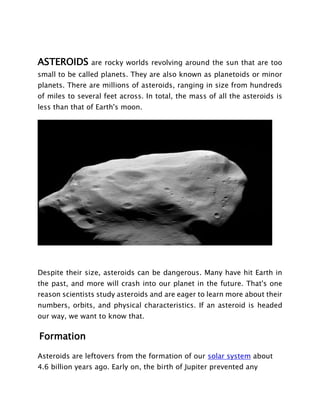
ASTEROIDS are rocky worlds revolving around the sun that are too
small to be called planets. They are also known as planetoids or minor
planets. There are millions of asteroids, ranging in size from hundreds
of miles to several feet across. In total, the mass of all the asteroids is
less than that of Earth's moon.
Despite their size, asteroids can be dangerous. Many have hit Earth in
the past, and more will crash into our planet in the future. That's one
reason scientists study asteroids and are eager to learn more about their
numbers, orbits, and physical characteristics. If an asteroid is headed
our way, we want to know that.
Formation
Asteroids are leftovers from the formation of our solar system about
4.6 billion years ago. Early on, the birth of Jupiter prevented any
planetary bodies from forming in the gap between Mars and Jupiter,
causing the small objects that were there to collide with each other
and fragment into the asteroids seen today.
Understanding of how the solar system evolved is constantly
expanding. Two fairly recent theories, the Nice model and the Grand
Tack, suggest that the gas giants moved around before settling into
their modern orbits. This movement could have sent asteroids from
the main belt raining down on the terrestrial planets, emptying and
refilling the original belt.
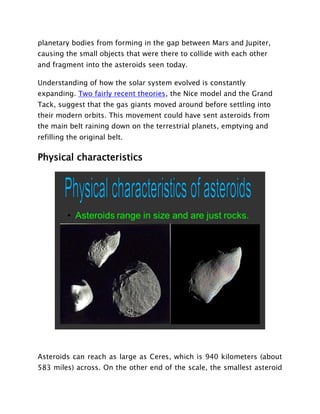
Physical characteristics
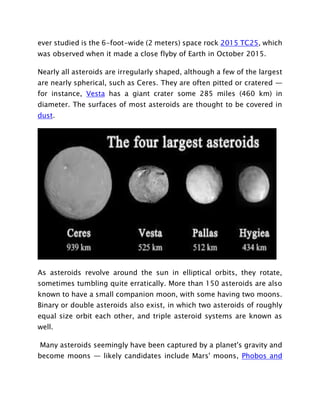
Asteroids can reach as large as Ceres, which is 940 kilometers (about
583 miles) across. On the other end of the scale, the smallest asteroid
ever studied is the 6-foot-wide (2 meters) space rock 2015 TC25, which
was observed when it made a close flyby of Earth in October 2015.
Nearly all asteroids are irregularly shaped, although a few of the largest
are nearly spherical, such as Ceres. They are often pitted or cratered —
for instance, Vesta has a giant crater some 285 miles (460 km) in
diameter. The surfaces of most asteroids are thought to be covered in
dust.
As asteroids revolve around the sun in elliptical orbits, they rotate,
sometimes tumbling quite erratically. More than 150 asteroids are also
known to have a small companion moon, with some having two moons.
Binary or double asteroids also exist, in which two asteroids of roughly
equal size orbit each other, and triple asteroid systems are known as
well.
Many asteroids seemingly have been captured by a planet's gravity and
become moons — likely candidates include Mars' moons, Phobos and
Deimos, and most of the outer moons of Jupiter, Saturn, Uranus and
Neptune.
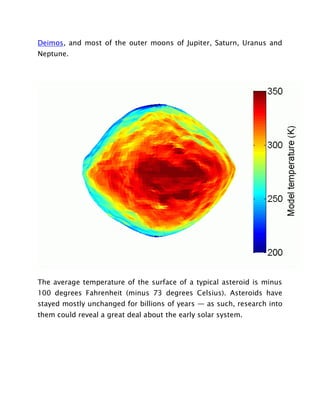
The average temperature of the surface of a typical asteroid is minus
100 degrees Fahrenheit (minus 73 degrees Celsius). Asteroids have
stayed mostly unchanged for billions of years — as such, research into
them could reveal a great deal about the early solar system.
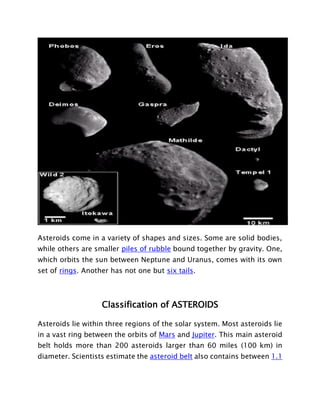
Asteroids come in a variety of shapes and sizes. Some are solid bodies,
while others are smaller piles of rubble bound together by gravity. One,
which orbits the sun between Neptune and Uranus, comes with its own
set of rings. Another has not one but six tails.
Classification of ASTEROIDS
Asteroids lie within three regions of the solar system. Most asteroids lie
in a vast ring between the orbits of Mars and Jupiter. This main asteroid
belt holds more than 200 asteroids larger than 60 miles (100 km) in
diameter. Scientists estimate the asteroid belt also contains between 1.1
million and 1.9 million asteroids larger than 1 km (3,281 feet) in
diameter and millions of smaller ones.
Not everything in the main belt is an asteroid — Ceres, once thought of
only as an asteroid, is now also considered a dwarf planet. In the past
decade, scientists have also identified a class of objects known as "main
belt asteroids," small rocky objects with tails. While some of the tails
form when objects crash into an asteroid, or by disintegrating asteroids,
others may be comets in disguise.
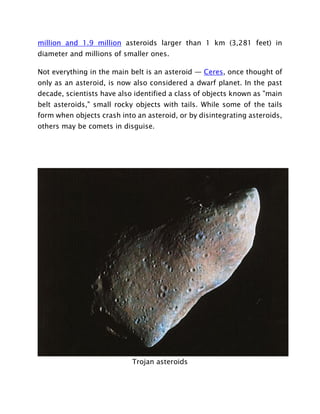
Trojan asteroids
Many asteroids lie outside the main belt. Trojan asteroids orbit a larger
planet in two special places, known as Lagrange points, where the
gravitational pull of the sun and the planet are balanced. Jupiter Trojans
are the most numerous, boasting nearly as high a population as the
main asteroid belt. Neptune, Mars and Earth also have Trojan asteroids.
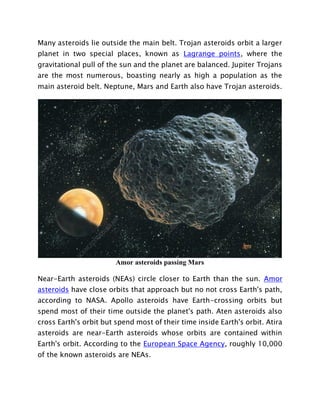
Amor asteroids passing Mars
Near-Earth asteroids (NEAs) circle closer to Earth than the sun. Amor
asteroids have close orbits that approach but no not cross Earth's path,
according to NASA. Apollo asteroids have Earth-crossing orbits but
spend most of their time outside the planet's path. Aten asteroids also
cross Earth's orbit but spend most of their time inside Earth's orbit. Atira
asteroids are near-Earth asteroids whose orbits are contained within
Earth's orbit. According to the European Space Agency, roughly 10,000
of the known asteroids are NEAs.
In addition to classifications of asteroids based on their orbits, most
asteroids fall into three classes based on composition:
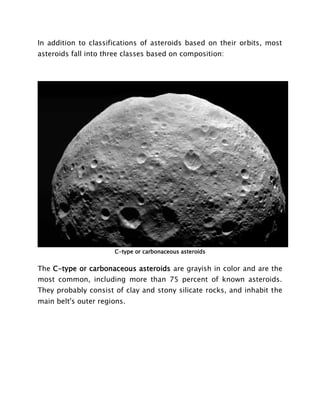
C-type or carbonaceous asteroids
The C-type or carbonaceous asteroids are grayish in color and are the
most common, including more than 75 percent of known asteroids.
They probably consist of clay and stony silicate rocks, and inhabit the
main belt's outer regions.
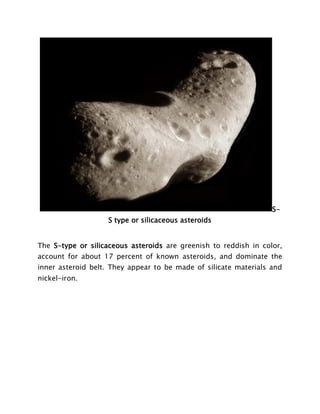
S-
S type or silicaceous asteroids
The S-type or silicaceous asteroids are greenish to reddish in color,
account for about 17 percent of known asteroids, and dominate the
inner asteroid belt. They appear to be made of silicate materials and
nickel-iron.
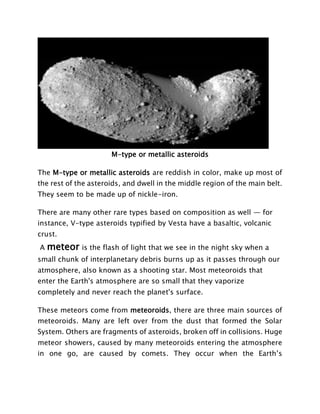
M-type or metallic asteroids
The M-type or metallic asteroids are reddish in color, make up most of
the rest of the asteroids, and dwell in the middle region of the main belt.
They seem to be made up of nickle-iron.
There are many other rare types based on composition as well — for
instance, V-type asteroids typified by Vesta have a basaltic, volcanic
crust.
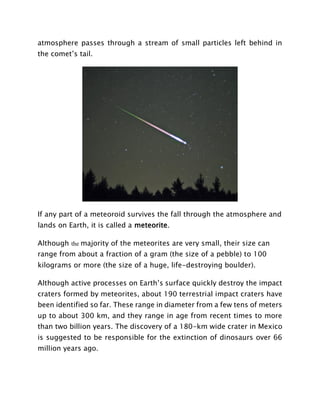
A meteor is the flash of light that we see in the night sky when a
small chunk of interplanetary debris burns up as it passes through our
atmosphere, also known as a shooting star. Most meteoroids that
enter the Earth's atmosphere are so small that they vaporize
completely and never reach the planet's surface.
These meteors come from meteoroids, there are three main sources of
meteoroids. Many are left over from the dust that formed the Solar
System. Others are fragments of asteroids, broken off in collisions. Huge
meteor showers, caused by many meteoroids entering the atmosphere
in one go, are caused by comets. They occur when the Earth’s
atmosphere passes through a stream of small particles left behind in
the comet’s tail.
If any part of a meteoroid survives the fall through the atmosphere and
lands on Earth, it is called a meteorite.
Although the majority of the meteorites are very small, their size can
range from about a fraction of a gram (the size of a pebble) to 100
kilograms or more (the size of a huge, life-destroying boulder).
Although active processes on Earth’s surface quickly destroy the impact
craters formed by meteorites, about 190 terrestrial impact craters have
been identified so far. These range in diameter from a few tens of meters
up to about 300 km, and they range in age from recent times to more
than two billion years. The discovery of a 180-km wide crater in Mexico
is suggested to be responsible for the extinction of dinosaurs over 66
million years ago.
THREE CLASSIFICATIONS OF METEORITES
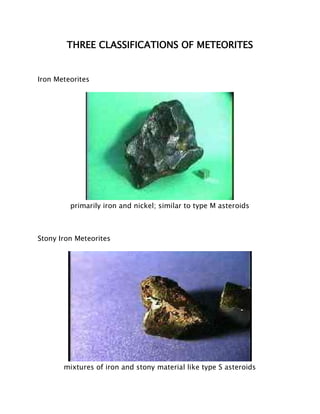
Iron Meteorites
primarily iron and nickel; similar to type M asteroids
Stony Iron Meteorites
mixtures of iron and stony material like type S asteroids
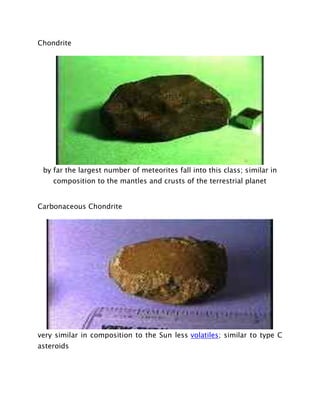
Chondrite
by far the largest number of meteorites fall into this class; similar in
composition to the mantles and crusts of the terrestrial planet
Carbonaceous Chondrite
very similar in composition to the Sun less volatiles; similar to type C
asteroids
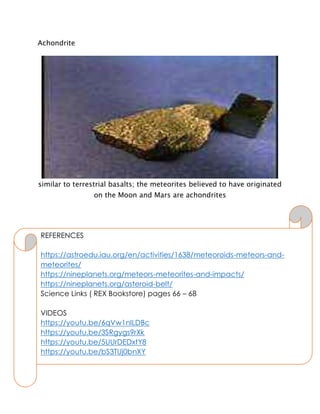
Achondrite
similar to terrestrial basalts; the meteorites believed to have originated
on the Moon and Mars are achondrites
REFERENCES
https://astroedu.iau.org/en/activities/1638/meteoroids-meteors-and-
meteorites/
https://nineplanets.org/meteors-meteorites-and-impacts/
https://nineplanets.org/asteroid-belt/
Science Links ( REX Bookstore) pages 66 – 68
VIDEOS
https://youtu.be/6qVw1nILDBc
https://youtu.be/3SRgygs9rXk
https://youtu.be/5UUrDEDxtY8
https://youtu.be/bS3TUj0bnXY
ASTEROIDSasdfghasdfgasdfh ( LECTURE).pdf

ASTEROIDSasdfghasdfgasdfh ( LECTURE).pdf

  • 1.
    ASTEROIDS are rockyworlds revolving around the sun that are too small to be called planets. They are also known as planetoids or minor planets. There are millions of asteroids, ranging in size from hundreds of miles to several feet across. In total, the mass of all the asteroids is less than that of Earth's moon. Despite their size, asteroids can be dangerous. Many have hit Earth in the past, and more will crash into our planet in the future. That's one reason scientists study asteroids and are eager to learn more about their numbers, orbits, and physical characteristics. If an asteroid is headed our way, we want to know that. Formation Asteroids are leftovers from the formation of our solar system about 4.6 billion years ago. Early on, the birth of Jupiter prevented any
  • 2.
    planetary bodies fromforming in the gap between Mars and Jupiter, causing the small objects that were there to collide with each other and fragment into the asteroids seen today. Understanding of how the solar system evolved is constantly expanding. Two fairly recent theories, the Nice model and the Grand Tack, suggest that the gas giants moved around before settling into their modern orbits. This movement could have sent asteroids from the main belt raining down on the terrestrial planets, emptying and refilling the original belt. Physical characteristics Asteroids can reach as large as Ceres, which is 940 kilometers (about 583 miles) across. On the other end of the scale, the smallest asteroid
  • 3.
    ever studied isthe 6-foot-wide (2 meters) space rock 2015 TC25, which was observed when it made a close flyby of Earth in October 2015. Nearly all asteroids are irregularly shaped, although a few of the largest are nearly spherical, such as Ceres. They are often pitted or cratered — for instance, Vesta has a giant crater some 285 miles (460 km) in diameter. The surfaces of most asteroids are thought to be covered in dust. As asteroids revolve around the sun in elliptical orbits, they rotate, sometimes tumbling quite erratically. More than 150 asteroids are also known to have a small companion moon, with some having two moons. Binary or double asteroids also exist, in which two asteroids of roughly equal size orbit each other, and triple asteroid systems are known as well. Many asteroids seemingly have been captured by a planet's gravity and become moons — likely candidates include Mars' moons, Phobos and
  • 4.
    Deimos, and mostof the outer moons of Jupiter, Saturn, Uranus and Neptune. The average temperature of the surface of a typical asteroid is minus 100 degrees Fahrenheit (minus 73 degrees Celsius). Asteroids have stayed mostly unchanged for billions of years — as such, research into them could reveal a great deal about the early solar system.
  • 5.
    Asteroids come ina variety of shapes and sizes. Some are solid bodies, while others are smaller piles of rubble bound together by gravity. One, which orbits the sun between Neptune and Uranus, comes with its own set of rings. Another has not one but six tails. Classification of ASTEROIDS Asteroids lie within three regions of the solar system. Most asteroids lie in a vast ring between the orbits of Mars and Jupiter. This main asteroid belt holds more than 200 asteroids larger than 60 miles (100 km) in diameter. Scientists estimate the asteroid belt also contains between 1.1
  • 6.
    million and 1.9million asteroids larger than 1 km (3,281 feet) in diameter and millions of smaller ones. Not everything in the main belt is an asteroid — Ceres, once thought of only as an asteroid, is now also considered a dwarf planet. In the past decade, scientists have also identified a class of objects known as "main belt asteroids," small rocky objects with tails. While some of the tails form when objects crash into an asteroid, or by disintegrating asteroids, others may be comets in disguise. Trojan asteroids
  • 7.
    Many asteroids lieoutside the main belt. Trojan asteroids orbit a larger planet in two special places, known as Lagrange points, where the gravitational pull of the sun and the planet are balanced. Jupiter Trojans are the most numerous, boasting nearly as high a population as the main asteroid belt. Neptune, Mars and Earth also have Trojan asteroids. Amor asteroids passing Mars Near-Earth asteroids (NEAs) circle closer to Earth than the sun. Amor asteroids have close orbits that approach but no not cross Earth's path, according to NASA. Apollo asteroids have Earth-crossing orbits but spend most of their time outside the planet's path. Aten asteroids also cross Earth's orbit but spend most of their time inside Earth's orbit. Atira asteroids are near-Earth asteroids whose orbits are contained within Earth's orbit. According to the European Space Agency, roughly 10,000 of the known asteroids are NEAs.
  • 8.
    In addition toclassifications of asteroids based on their orbits, most asteroids fall into three classes based on composition: C-type or carbonaceous asteroids The C-type or carbonaceous asteroids are grayish in color and are the most common, including more than 75 percent of known asteroids. They probably consist of clay and stony silicate rocks, and inhabit the main belt's outer regions.
  • 9.
    S- S type orsilicaceous asteroids The S-type or silicaceous asteroids are greenish to reddish in color, account for about 17 percent of known asteroids, and dominate the inner asteroid belt. They appear to be made of silicate materials and nickel-iron.
  • 10.
    M-type or metallicasteroids The M-type or metallic asteroids are reddish in color, make up most of the rest of the asteroids, and dwell in the middle region of the main belt. They seem to be made up of nickle-iron. There are many other rare types based on composition as well — for instance, V-type asteroids typified by Vesta have a basaltic, volcanic crust. A meteor is the flash of light that we see in the night sky when a small chunk of interplanetary debris burns up as it passes through our atmosphere, also known as a shooting star. Most meteoroids that enter the Earth's atmosphere are so small that they vaporize completely and never reach the planet's surface. These meteors come from meteoroids, there are three main sources of meteoroids. Many are left over from the dust that formed the Solar System. Others are fragments of asteroids, broken off in collisions. Huge meteor showers, caused by many meteoroids entering the atmosphere in one go, are caused by comets. They occur when the Earth’s
  • 11.
    atmosphere passes througha stream of small particles left behind in the comet’s tail. If any part of a meteoroid survives the fall through the atmosphere and lands on Earth, it is called a meteorite. Although the majority of the meteorites are very small, their size can range from about a fraction of a gram (the size of a pebble) to 100 kilograms or more (the size of a huge, life-destroying boulder). Although active processes on Earth’s surface quickly destroy the impact craters formed by meteorites, about 190 terrestrial impact craters have been identified so far. These range in diameter from a few tens of meters up to about 300 km, and they range in age from recent times to more than two billion years. The discovery of a 180-km wide crater in Mexico is suggested to be responsible for the extinction of dinosaurs over 66 million years ago.
  • 12.
    THREE CLASSIFICATIONS OFMETEORITES Iron Meteorites primarily iron and nickel; similar to type M asteroids Stony Iron Meteorites mixtures of iron and stony material like type S asteroids
  • 13.
    Chondrite by far thelargest number of meteorites fall into this class; similar in composition to the mantles and crusts of the terrestrial planet Carbonaceous Chondrite very similar in composition to the Sun less volatiles; similar to type C asteroids
  • 14.
    Achondrite similar to terrestrialbasalts; the meteorites believed to have originated on the Moon and Mars are achondrites REFERENCES https://astroedu.iau.org/en/activities/1638/meteoroids-meteors-and- meteorites/ https://nineplanets.org/meteors-meteorites-and-impacts/ https://nineplanets.org/asteroid-belt/ Science Links ( REX Bookstore) pages 66 – 68 VIDEOS https://youtu.be/6qVw1nILDBc https://youtu.be/3SRgygs9rXk https://youtu.be/5UUrDEDxtY8 https://youtu.be/bS3TUj0bnXY