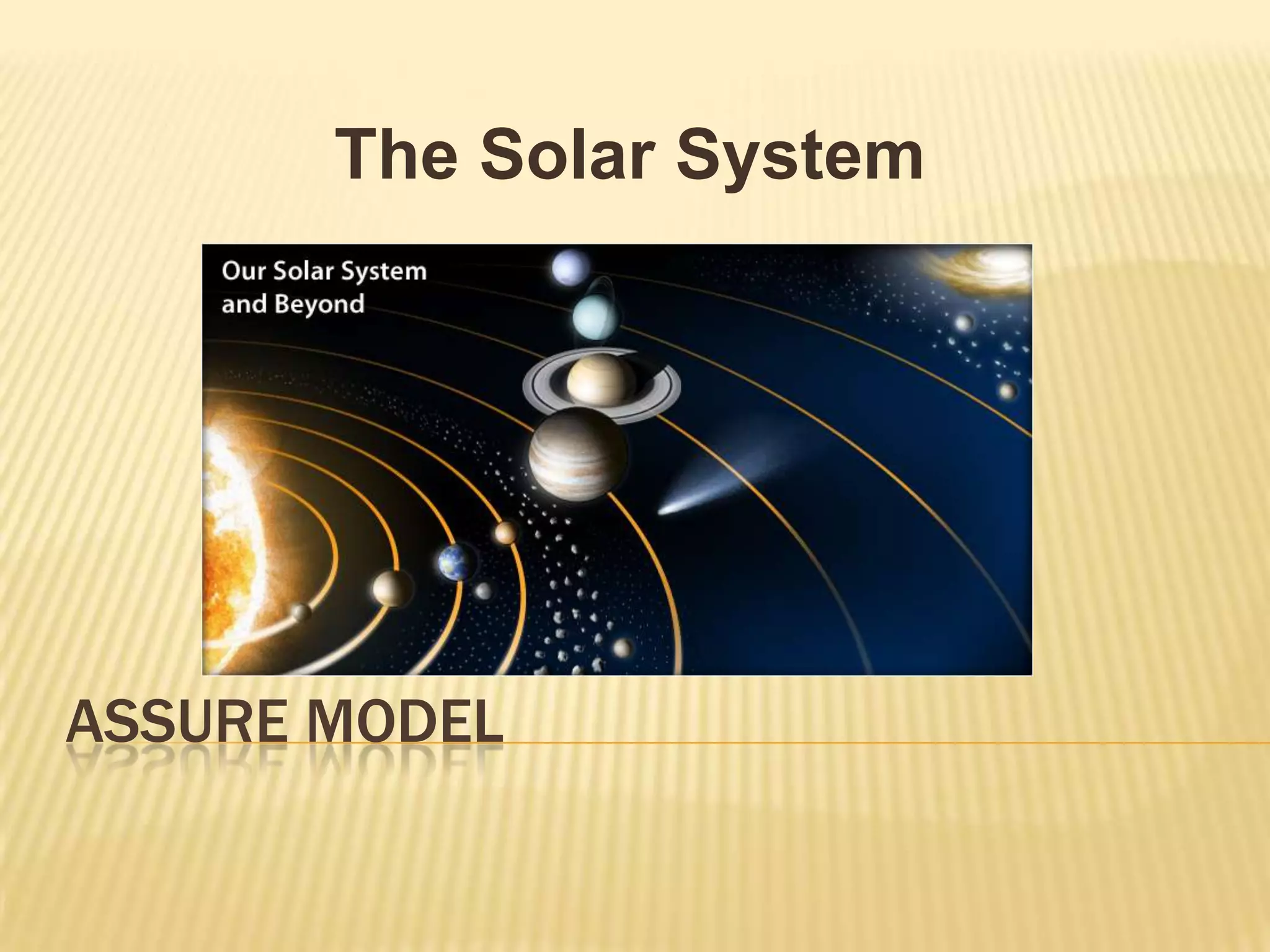
Assure ModelThe Solar System
Analyze LearnersThe primary audience for this lesson are 5th grade students in an elementary school, where the students are between the ages of ten years to eleven years. Most of these students come from  low socio-economic income families and from culturally diverse backgrounds. The second audience is the instructors that will implement this lesson to the students. The instructor’s primary goal is for the students to master the concept of the solar system. The prior knowledge that these students should have acquired is having to learn the order of the planets in our solar system. This lesson will be incorporating various learning styles to accommodate the learning styles of every student including but not limited to verbal, logical, visual, auditory and tactile.
State Objectives5.5 	The student knows that a system is a collection of cycles, structures, and processes that interact. 	5.5A 	Describe some cycles, structures, and processes that are found in a simple system. 	5.5B 	Describe some interactions that occur in a simple system. 	5.12 	The student knows that the natural world includes Earth materials and objects in the sky. 	(http://ritter.tea.state.tx.us/rules/tac/chapter112/ch112a.html)
Select methods, media, & MaterialsInstructional methods must be carefully planned and selected for the specific objective. Media can include video tutorials, PowerPoint presentations, interactive software and many other forms of media and materialsVideo Tutorialshttp://player.discoveryeducation.com/index.cfm?guidAssetId=89AE5324-ECBC-4818-8483-63C8ED2E29BB&blnFromSearch=1&productcode=USBooksThe Magic School Bus Gets Lost in Space by Joanna Cole The Solar System: Exploring the Earth and its Neighbors by Miguel Perez PowerPoint presentationAnimated Solar SystemFree software websitewww.stellarium.org (http://bisd.nerdeveloper.net/index.cfm)
Utilize media & materialsIt is recommended that materials and media be previewed before using them in class to make sure they function properly. For example, if the instructor plans to show a PowerPoint that instructor must select and preview the PowerPoint in advance.  When using technology it is also a good idea to have a backup plan.
Require learner participationStudies show that learners learn more effectively when they are actively engaged.  Students can be actively engaged by the following strategies:  questions and answers, discussions, blogs, group work, hands-on work related to real life situations and educational games.QuestioningWhat do you know about the solar system? What is the main source of energy in our solar system?How many planets to we have?Why do the planets orbit the sun instead of the other way?Hands-on ActivitiesInstruct the students to create an illustration of our solar system into their journals or to work in groups and model how the solar system works.(http://bisd.nerdeveloper.net/attachments/913451774_10_C050501.pdf)
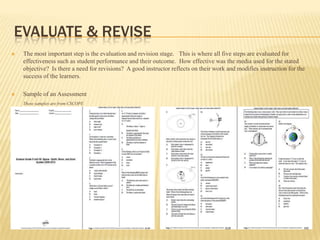
Evaluate & reviseThe most important step is the evaluation and revision stage.   This is where all five steps are evaluated for effectiveness such as student performance and their outcome.  How effective was the media used for the stated objective?  Is there a need for revisions?  A good instructor reflects on their work and modifies instruction for the success of the learners.Sample of an AssessmentThese samples are from CSCOPE
referenceshttp://bisd.nerdeveloper.net/attachments/913451774_10_C050501.pdfhttp://ritter.tea.state.tx.us/rules/tac/chapter112/ch112a.html

Assure model

  • 1.
  • 2.
    Analyze LearnersThe primaryaudience for this lesson are 5th grade students in an elementary school, where the students are between the ages of ten years to eleven years. Most of these students come from low socio-economic income families and from culturally diverse backgrounds. The second audience is the instructors that will implement this lesson to the students. The instructor’s primary goal is for the students to master the concept of the solar system. The prior knowledge that these students should have acquired is having to learn the order of the planets in our solar system. This lesson will be incorporating various learning styles to accommodate the learning styles of every student including but not limited to verbal, logical, visual, auditory and tactile.
  • 3.
    State Objectives5.5 Thestudent knows that a system is a collection of cycles, structures, and processes that interact. 5.5A Describe some cycles, structures, and processes that are found in a simple system. 5.5B Describe some interactions that occur in a simple system. 5.12 The student knows that the natural world includes Earth materials and objects in the sky. (http://ritter.tea.state.tx.us/rules/tac/chapter112/ch112a.html)
  • 4.
    Select methods, media,& MaterialsInstructional methods must be carefully planned and selected for the specific objective. Media can include video tutorials, PowerPoint presentations, interactive software and many other forms of media and materialsVideo Tutorialshttp://player.discoveryeducation.com/index.cfm?guidAssetId=89AE5324-ECBC-4818-8483-63C8ED2E29BB&blnFromSearch=1&productcode=USBooksThe Magic School Bus Gets Lost in Space by Joanna Cole The Solar System: Exploring the Earth and its Neighbors by Miguel Perez PowerPoint presentationAnimated Solar SystemFree software websitewww.stellarium.org (http://bisd.nerdeveloper.net/index.cfm)
  • 5.
    Utilize media &materialsIt is recommended that materials and media be previewed before using them in class to make sure they function properly. For example, if the instructor plans to show a PowerPoint that instructor must select and preview the PowerPoint in advance.  When using technology it is also a good idea to have a backup plan.
  • 6.
    Require learner participationStudiesshow that learners learn more effectively when they are actively engaged.  Students can be actively engaged by the following strategies:  questions and answers, discussions, blogs, group work, hands-on work related to real life situations and educational games.QuestioningWhat do you know about the solar system? What is the main source of energy in our solar system?How many planets to we have?Why do the planets orbit the sun instead of the other way?Hands-on ActivitiesInstruct the students to create an illustration of our solar system into their journals or to work in groups and model how the solar system works.(http://bisd.nerdeveloper.net/attachments/913451774_10_C050501.pdf)
  • 7.
    Evaluate & reviseThemost important step is the evaluation and revision stage.   This is where all five steps are evaluated for effectiveness such as student performance and their outcome.  How effective was the media used for the stated objective?  Is there a need for revisions?  A good instructor reflects on their work and modifies instruction for the success of the learners.Sample of an AssessmentThese samples are from CSCOPE
  • 8.