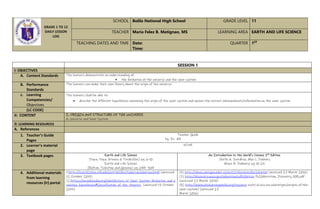
SCHOOL Bolila National High School GRADE LEVEL 11
TEACHER Maria Felez B. Matignao, MS LEARNING AREA EARTH AND LIFE SCIENCE
TEACHING DATES AND TIME Date:
Time:
QUARTER 1ST
SESSION 1
I: OBJECTIVES
A. Content Standards The learners demonstrate an understanding of:
 the formation of the universe and the solar system
B. Performance
Standards
The learners can make their own theory about the origin of the universe.
c. Learning
Competencies/
Objectives
The learners shall be able to:
 describe the different hypotheses explaining the origin of the solar system and explain the current advancements/information on the solar system
(LC CODE)
II: CONTENT I. ORIGIN AND STRUCTURE OF THE UNIVERSE
A. Universe and Solar System
II: LEARNING RESOURCES
A. References
1. Teacher’s Guide
Pages
Teacher Guide
Pg. 31- 49
2. Learner’s material
page
NONE
3. Textbook pages Earth and Life Science
(Papa, Papa, Briones & Tordesillas) pg. 6-10
Earth and Life Science
(Refran, Tolentino and Genuino) pg 299- 309
An Introduction to the World’s Oceans 7th
Edition
(Keith A. Sverdrup, Alyn C. Duxbury
Alison B. Duxbury) pg 10-25
4. Additional materials
from learning
resources (lr) portal
1)http://csep10.phys.utk.edu/astr161/lect/solarsys/solarsys.html (accessed
12 October 2015)
(2)https://en.wikipedia.org/wiki/History_of_Solar_System_formation_and_e
volution_hypotheses#Classification_of_the_theories (accessed 13 October
2015)
(5) http://abyss.uoregon.edu/~js/ast121/lectures/lec24.html (accessed 27 March 2016)
(7) http://discovery.nasa.gov/education/pdfs/Active %20Accretion_Discovery_508.pdf
(accessed 27 March 2016)
(8) http://www.pbslearningmedia.org/resource nsn11.sci.ess.eiu.solarorigins/origins-of-the-
solar-system/ (accessed 27
March 2016)
GRADE 1 TO 12
DAILY LESSON
LOG
(3) "The Origin of the Universe, Earth, and Life." National Academy of
Sciences. Science and Creationism: A View from the National Academy of
Sciences, Second Edition. Washington, DC: The NationalAcademies Press,
1999. http://www.nap.edu/read/6024/chapter/3#8 (accessed 2 October
2015)
(4) http://science.nasa.gov/astrophysics/focus-areas/what-powered-
thebig- bang/ (accessed 5 October 2015)
(9) http://dawn.jpl.nasa.gov/DawnClassrooms/pdfs/ ActiveAccretion_Dawn.pdf (accessed
27 March 2016)
B: Other Learning Resources Multimedia, PPT Presentations, Video Clips
IV: PROCEDURES
A. Reviewing previous
lesson or presenting
Reviewing lessons previous
week.
Motivation
Presenting the new lesson
B. Establishing a purpose
for the lesson
1. Self-reflection on the relevance of the subject in the learners course and life using What, So What and Now What Method.
C. Presenting examples/
instances of the new
lesson
1. Before each discussion
remind the students of
the importance of taking
notes
2. Give the definition of the
terms for the lesson.
3. Review previous lesson…
4. Let them summarize what
they learned based on their
notes
1. Introduce and discuss the different
hypothesis explaining the origin of
the solar system;
2. Provide definition and examples of
the topic being discuss
1. Discuss the different hypotheses to
become familiar with the most recent
advancements/information on the solar
system.
2. Provide definition and examples of the
topic being discuss
1. Identify the large scale and small
scale properties of the Solar System;
2. Provide definition and examples of the
topic being discuss
3. Homework, “Graphing,” Students find
out about recently discovered
planets and create a bar chart
comparing the sizes of planets.
D. Discussing new concepts
and practicing new skill
#1
1. Asked the students to
interpret their notes
2. Let them recite their
interpretation of the
notes
Power Point Presentation / Video clip presentation
Discussion
Question and Answer
E. Discussing new concepts
and practicing new skill
#2
Contacting the Aliens:
1. If you could communicate with aliens, what would you tell them about our species? In 1974, we sent a message traveling at light speed toward the stars of
the Hercules constellation. The message was sent from a large radio telescope in Arecibo, Puerto
Rico. Scientists hope that the message, which bears information about humans and Earth, will be intercepted by intelligent extraterrestrial life. That is, if
there is such a thing . . . make a comic skit
2. What if they exist, research the possibility of life elsewhere in the universe. What are the conditions necessary for life? What is the likelihood of the existence
of extraterrestrial life? What calculations have exobiologists made to determine the probability of life on distant planets? What other attempts have been
made to contact intelligent extraterrestrial life? Give an oral presentation to your class on the subject of exobiology. Be sure to include visual aids.
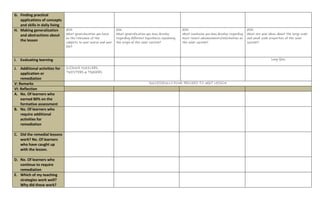
F. Developing mastery
G. Finding practical
applications of concepts
and skills in daily living
H. Making generalization
and abstractions about
the lesson
ASK:
What generalization you have
on the relevance of the
subjects to your course and your
life?
Ask:
What generalization you may develop
regarding different hypothesis explaining
the origin of the solar system?
ASK:
What conclusion you may develop regarding
most recent advancements/information on
the solar system?
ASK:
What are your ideas about the large scale
and small scale properties of the solar
system?
I. Evaluating learning Long Quiz
J. Additional activities for
application or
remediation
SCIENCE PUZZLERS,
TWISTERS & TEASERS
V: Remarks SUCCESSFULLY DONE PROCEED TO NEXT LESSON
VI: Reflection
A. No. Of learners who
earned 80% on the
formative assessment
B. No. Of learners who
require additional
activities for
remediation
C. Did the remedial lessons
work? No. Of learners
who have caught up
with the lesson.
D. No. Of learners who
continue to require
remediation
E. Which of my teaching
strategies work well?
Why did these work?
F. What difficulties did i
encounter which my
principal or supervisor
can help me solve?
G. What innovation or
localized materials did i
use/ discover which i
wish to share with other
teachers?
SCIENCE PUZZLERS, TWISTERS & TEASERS
Made the learners remember and comprehend the topics.
Prepared by:
MARIA FELEZ B. MATIGNAO, MS
Master Teacher I- SHS
Approved:
ARGIE M. ABREGANA
Head Teacher I

new detailed lesson plan competency 2.docx

  • 1.
    SCHOOL Bolila NationalHigh School GRADE LEVEL 11 TEACHER Maria Felez B. Matignao, MS LEARNING AREA EARTH AND LIFE SCIENCE TEACHING DATES AND TIME Date: Time: QUARTER 1ST SESSION 1 I: OBJECTIVES A. Content Standards The learners demonstrate an understanding of:  the formation of the universe and the solar system B. Performance Standards The learners can make their own theory about the origin of the universe. c. Learning Competencies/ Objectives The learners shall be able to:  describe the different hypotheses explaining the origin of the solar system and explain the current advancements/information on the solar system (LC CODE) II: CONTENT I. ORIGIN AND STRUCTURE OF THE UNIVERSE A. Universe and Solar System II: LEARNING RESOURCES A. References 1. Teacher’s Guide Pages Teacher Guide Pg. 31- 49 2. Learner’s material page NONE 3. Textbook pages Earth and Life Science (Papa, Papa, Briones & Tordesillas) pg. 6-10 Earth and Life Science (Refran, Tolentino and Genuino) pg 299- 309 An Introduction to the World’s Oceans 7th Edition (Keith A. Sverdrup, Alyn C. Duxbury Alison B. Duxbury) pg 10-25 4. Additional materials from learning resources (lr) portal 1)http://csep10.phys.utk.edu/astr161/lect/solarsys/solarsys.html (accessed 12 October 2015) (2)https://en.wikipedia.org/wiki/History_of_Solar_System_formation_and_e volution_hypotheses#Classification_of_the_theories (accessed 13 October 2015) (5) http://abyss.uoregon.edu/~js/ast121/lectures/lec24.html (accessed 27 March 2016) (7) http://discovery.nasa.gov/education/pdfs/Active %20Accretion_Discovery_508.pdf (accessed 27 March 2016) (8) http://www.pbslearningmedia.org/resource nsn11.sci.ess.eiu.solarorigins/origins-of-the- solar-system/ (accessed 27 March 2016) GRADE 1 TO 12 DAILY LESSON LOG
  • 2.
    (3) "The Originof the Universe, Earth, and Life." National Academy of Sciences. Science and Creationism: A View from the National Academy of Sciences, Second Edition. Washington, DC: The NationalAcademies Press, 1999. http://www.nap.edu/read/6024/chapter/3#8 (accessed 2 October 2015) (4) http://science.nasa.gov/astrophysics/focus-areas/what-powered- thebig- bang/ (accessed 5 October 2015) (9) http://dawn.jpl.nasa.gov/DawnClassrooms/pdfs/ ActiveAccretion_Dawn.pdf (accessed 27 March 2016) B: Other Learning Resources Multimedia, PPT Presentations, Video Clips IV: PROCEDURES A. Reviewing previous lesson or presenting Reviewing lessons previous week. Motivation Presenting the new lesson B. Establishing a purpose for the lesson 1. Self-reflection on the relevance of the subject in the learners course and life using What, So What and Now What Method. C. Presenting examples/ instances of the new lesson 1. Before each discussion remind the students of the importance of taking notes 2. Give the definition of the terms for the lesson. 3. Review previous lesson… 4. Let them summarize what they learned based on their notes 1. Introduce and discuss the different hypothesis explaining the origin of the solar system; 2. Provide definition and examples of the topic being discuss 1. Discuss the different hypotheses to become familiar with the most recent advancements/information on the solar system. 2. Provide definition and examples of the topic being discuss 1. Identify the large scale and small scale properties of the Solar System; 2. Provide definition and examples of the topic being discuss 3. Homework, “Graphing,” Students find out about recently discovered planets and create a bar chart comparing the sizes of planets. D. Discussing new concepts and practicing new skill #1 1. Asked the students to interpret their notes 2. Let them recite their interpretation of the notes Power Point Presentation / Video clip presentation Discussion Question and Answer E. Discussing new concepts and practicing new skill #2 Contacting the Aliens: 1. If you could communicate with aliens, what would you tell them about our species? In 1974, we sent a message traveling at light speed toward the stars of the Hercules constellation. The message was sent from a large radio telescope in Arecibo, Puerto Rico. Scientists hope that the message, which bears information about humans and Earth, will be intercepted by intelligent extraterrestrial life. That is, if there is such a thing . . . make a comic skit 2. What if they exist, research the possibility of life elsewhere in the universe. What are the conditions necessary for life? What is the likelihood of the existence of extraterrestrial life? What calculations have exobiologists made to determine the probability of life on distant planets? What other attempts have been made to contact intelligent extraterrestrial life? Give an oral presentation to your class on the subject of exobiology. Be sure to include visual aids. F. Developing mastery
  • 3.
    G. Finding practical applicationsof concepts and skills in daily living H. Making generalization and abstractions about the lesson ASK: What generalization you have on the relevance of the subjects to your course and your life? Ask: What generalization you may develop regarding different hypothesis explaining the origin of the solar system? ASK: What conclusion you may develop regarding most recent advancements/information on the solar system? ASK: What are your ideas about the large scale and small scale properties of the solar system? I. Evaluating learning Long Quiz J. Additional activities for application or remediation SCIENCE PUZZLERS, TWISTERS & TEASERS V: Remarks SUCCESSFULLY DONE PROCEED TO NEXT LESSON VI: Reflection A. No. Of learners who earned 80% on the formative assessment B. No. Of learners who require additional activities for remediation C. Did the remedial lessons work? No. Of learners who have caught up with the lesson. D. No. Of learners who continue to require remediation E. Which of my teaching strategies work well? Why did these work?
  • 4.
    F. What difficultiesdid i encounter which my principal or supervisor can help me solve? G. What innovation or localized materials did i use/ discover which i wish to share with other teachers? SCIENCE PUZZLERS, TWISTERS & TEASERS Made the learners remember and comprehend the topics. Prepared by: MARIA FELEZ B. MATIGNAO, MS Master Teacher I- SHS Approved: ARGIE M. ABREGANA Head Teacher I