1
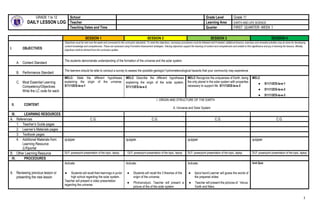
GRADE 1 to 12
DAILY LESSON LOG
School Grade Level Grade 11
Teacher Learning Area EARTH AND LIFE SCIENCE
Teaching Dates and Time Quarter FIRST QUARTER -WEEK 1
SESSION 1 SESSION 2 SESSION 3 SESSION 4
I. OBJECTIVES
Objectives must be met over the week and connected to the curriculum standards. To meet the objectives, necessary procedures must be followed and if needed, additional lessons, exercises and remedial activities may be done for developing
content knowledge and competencies. These are assessed using Formative Assessment strategies. Valuing objectives support the learning of content and competencies and enable to find significance and joy in learning the lessons. Weekly
objectives shall be derived from the curriculum guides.
A. Content Standard
The students demonstrate understanding of the formation of the universe and the solar system.
B. Performance Standard
The learners should be able to conduct a survey to assess the possible geologic/ hydrometeorological hazards that your community may experience
C. Most Essential Learning
Competency/Objectives
Write the LC code for each.
MELC: State the different hypotheses
explaining the origin of the universe.
S11/12ES-Ia-e-1
MELC Describe the different hypotheses
explaining the origin of the solar system.
S11/12ES-Ia-e-2
MELC Recognize the uniqueness of Earth, being
the only planet in the solar system with properties
necessary to support life. S11/12ES-Ia-e-3
MELC
● S11/12ES-Ia-e-1
● S11/12ES-Ia-e-2
● S11/12ES-Ia-e-3
II. CONTENT
I. ORIGIN AND STRUCTURE OF THE EARTH
A. Universe and Solar System
III. LEARNING RESOURCES
A. References C.G. C.G. C.G. C.G.
1. Teacher’s Guide pages
2. Learner’s Materials pages
3. Textbook pages
4. Additional Materials from
Learning Resource
(LR)portal
quipper quipper quipper quipper
B. Other Learning Resource DLP, powerpoint presentation of the topic, laptop DLP, powerpoint presentation of the topic, laptop DLP, powerpoint presentation of the topic, laptop DLP, powerpoint presentation of the topic, laptop
IV. PROCEDURES .
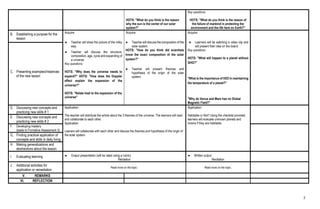
A. Reviewing previous lesson or
presenting the new lesson
Activate:
● Students will recall their learnings in junior
high school regarding the solar system.
Teacher will present a video presentation
regarding the universe.
Activate:
● Students will recall the 3 theories of the
origin of the universe.
● Photoanalysis. Teacher will present a
picture of the of the solar system
Activate:
● 4pics1word.Learner will guess the words of
the prepared slides
● Teacher will present the pictures of Venus,
Earth and Mars.
Unit Quiz
2
HOTS: "What do you think is the reason
why the sun is the center of our solar
system?"
Key questions:
HOTS: "What do you think is the reason of
the failure of mankind in protecting the
environment and the life here on Earth?"
B. Establishing a purpose for the
lesson
Acquire:
● Teacher will show the picture of the milky
way.
● Teacher will discuss the structure,
composition, age, cycle and expanding of
a universe
Key questions:
HOTS: "Why does the universe needs to
expand?" HOTS: "How does the Doppler
effect explain the expansion of the
universe?"
HOTS: "Relate heat to the expansion of the
universe"
Acquire:
● Teacher will discuss the composition of the
solar system.
HOTS: "How do you think did scientists
know the exact composition of the solar
system?"
● Teacher will present theories and
hypothesis of the origin of the solar
system.
Acquire:
● Learners will be watching a video clip and
will present their idea on the board.
Key questions:
HOTS: "What will happen to a planet without
GHG?"
"What is the importance of H2O in maintaining
the temperature of a planet?"
"Why do Venus and Mars has no Global
Magnetic Field?"
C. Presenting examples/Instances
of the new lesson
D. Discussing new concepts and
practicing new skills # 1
Application:
The teacher will distribute the article about the 3 theories of the universe. The learners will read
and collaborate to each other.
Application:
Leaners will collaborate with each other and discuss the theories and hypothesis of the origin of
the solar system.
Application:
Habitable or Not? Using the checklist provided,
learners will evaluate unknown planets and
moons if they are habitable.
.
E. Discussing new concepts and
practicing new skills # 2
F. Developing mastery
(leads to Formative Assessment 3)
G. Finding practical application of
concepts and skills in daily living
H. Making generalizations and
abstractions about the lesson
I. Evaluating learning ● Output presentation (will be rated using a rubric)
Recitation
● Written output
Recitation
J. Additional activities for
application or remediation
Read more on the topic. Read more on the topic.
V. REMARKS
VI. REFLECTION
3
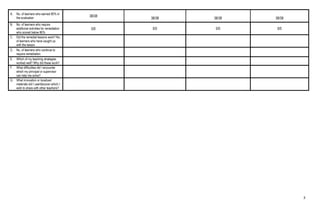
A. No. of learners who earned 80% in
the evaluation
38/38
38/38 38/38 38/38
B. No. of learners who require
additional activities for remediation
who scored below 80%
0/0 0/0 0/0 0/0
C. Did the remedial lessons work? No.
of learners who have caught up
with the lesson
D. No. of learners who continue to
require remediation
E. Which of my teaching strategies
worked well? Why did these work?
F. What difficulties did I encounter
which my principal or supervisor
can help me solve?
G. What innovation or localized
materials did I use/discover which I
wish to share with other teachers?

week 1.docx

  • 1.
    1 GRADE 1 to12 DAILY LESSON LOG School Grade Level Grade 11 Teacher Learning Area EARTH AND LIFE SCIENCE Teaching Dates and Time Quarter FIRST QUARTER -WEEK 1 SESSION 1 SESSION 2 SESSION 3 SESSION 4 I. OBJECTIVES Objectives must be met over the week and connected to the curriculum standards. To meet the objectives, necessary procedures must be followed and if needed, additional lessons, exercises and remedial activities may be done for developing content knowledge and competencies. These are assessed using Formative Assessment strategies. Valuing objectives support the learning of content and competencies and enable to find significance and joy in learning the lessons. Weekly objectives shall be derived from the curriculum guides. A. Content Standard The students demonstrate understanding of the formation of the universe and the solar system. B. Performance Standard The learners should be able to conduct a survey to assess the possible geologic/ hydrometeorological hazards that your community may experience C. Most Essential Learning Competency/Objectives Write the LC code for each. MELC: State the different hypotheses explaining the origin of the universe. S11/12ES-Ia-e-1 MELC Describe the different hypotheses explaining the origin of the solar system. S11/12ES-Ia-e-2 MELC Recognize the uniqueness of Earth, being the only planet in the solar system with properties necessary to support life. S11/12ES-Ia-e-3 MELC ● S11/12ES-Ia-e-1 ● S11/12ES-Ia-e-2 ● S11/12ES-Ia-e-3 II. CONTENT I. ORIGIN AND STRUCTURE OF THE EARTH A. Universe and Solar System III. LEARNING RESOURCES A. References C.G. C.G. C.G. C.G. 1. Teacher’s Guide pages 2. Learner’s Materials pages 3. Textbook pages 4. Additional Materials from Learning Resource (LR)portal quipper quipper quipper quipper B. Other Learning Resource DLP, powerpoint presentation of the topic, laptop DLP, powerpoint presentation of the topic, laptop DLP, powerpoint presentation of the topic, laptop DLP, powerpoint presentation of the topic, laptop IV. PROCEDURES . A. Reviewing previous lesson or presenting the new lesson Activate: ● Students will recall their learnings in junior high school regarding the solar system. Teacher will present a video presentation regarding the universe. Activate: ● Students will recall the 3 theories of the origin of the universe. ● Photoanalysis. Teacher will present a picture of the of the solar system Activate: ● 4pics1word.Learner will guess the words of the prepared slides ● Teacher will present the pictures of Venus, Earth and Mars. Unit Quiz
  • 2.
    2 HOTS: "What doyou think is the reason why the sun is the center of our solar system?" Key questions: HOTS: "What do you think is the reason of the failure of mankind in protecting the environment and the life here on Earth?" B. Establishing a purpose for the lesson Acquire: ● Teacher will show the picture of the milky way. ● Teacher will discuss the structure, composition, age, cycle and expanding of a universe Key questions: HOTS: "Why does the universe needs to expand?" HOTS: "How does the Doppler effect explain the expansion of the universe?" HOTS: "Relate heat to the expansion of the universe" Acquire: ● Teacher will discuss the composition of the solar system. HOTS: "How do you think did scientists know the exact composition of the solar system?" ● Teacher will present theories and hypothesis of the origin of the solar system. Acquire: ● Learners will be watching a video clip and will present their idea on the board. Key questions: HOTS: "What will happen to a planet without GHG?" "What is the importance of H2O in maintaining the temperature of a planet?" "Why do Venus and Mars has no Global Magnetic Field?" C. Presenting examples/Instances of the new lesson D. Discussing new concepts and practicing new skills # 1 Application: The teacher will distribute the article about the 3 theories of the universe. The learners will read and collaborate to each other. Application: Leaners will collaborate with each other and discuss the theories and hypothesis of the origin of the solar system. Application: Habitable or Not? Using the checklist provided, learners will evaluate unknown planets and moons if they are habitable. . E. Discussing new concepts and practicing new skills # 2 F. Developing mastery (leads to Formative Assessment 3) G. Finding practical application of concepts and skills in daily living H. Making generalizations and abstractions about the lesson I. Evaluating learning ● Output presentation (will be rated using a rubric) Recitation ● Written output Recitation J. Additional activities for application or remediation Read more on the topic. Read more on the topic. V. REMARKS VI. REFLECTION
  • 3.
    3 A. No. oflearners who earned 80% in the evaluation 38/38 38/38 38/38 38/38 B. No. of learners who require additional activities for remediation who scored below 80% 0/0 0/0 0/0 0/0 C. Did the remedial lessons work? No. of learners who have caught up with the lesson D. No. of learners who continue to require remediation E. Which of my teaching strategies worked well? Why did these work? F. What difficulties did I encounter which my principal or supervisor can help me solve? G. What innovation or localized materials did I use/discover which I wish to share with other teachers?